
You Call That Radio? · Mark McG
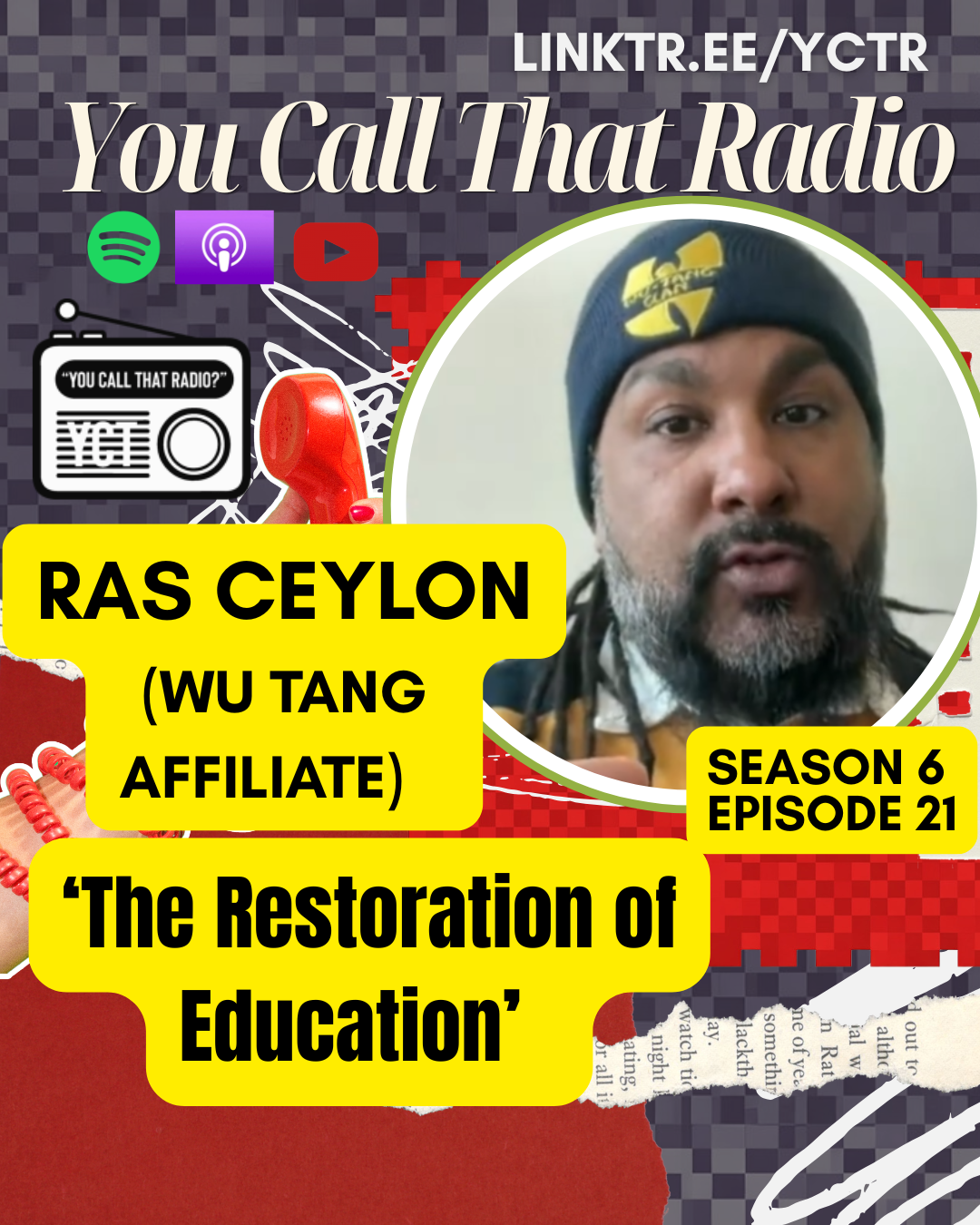
Ras Ceylon is an Oakland, California-based MC, educator, and activist recognized as the first Sri Lankan rapper to emerge within the western hip-hop canon. Over a career spanning nearly three decades, he has officially solidified his place as a Wu-Tang Clan affiliate within the Wu Killa Beez lineage. We discuss getting banned from Sri Lanka for 12 years, Becoming a Wu Tang affilate, Having Power (r.I.P) oversee his newest album 'Scrollz of Lion Rock' , The education to Prison pipeline, The propaganda of East Oakland, California Food, Teaching rapping to becoming a princaple of an antire school, the misinformation of media, The conflicts overseas and the political challenges within the USA , The elements of Hip Hop, Doing an ODB verse live on stage , His top 5 dead or alive and much, much more.You Call That Radio is powered by our patreons at http://patreon.com/YouCallThatRadio and http://ko-fi.com/YouCallThatRadio
0:00Speaker AForeign. We are live with Wu Tang affiliate MC Educator RA Salon. How you doing, mate?
0:22Speaker BPeace and blessings. What's good? What's good?
0:25Speaker AAll the way from East Oakland.
0:27Speaker BIndeed, indeed, man. So it's beautiful to be able to touch down with folks across the pond, as they say. Never been to Scotland. I would love to tap in sometime. I know there's a rich history and legacy there too, you know what I mean? So salute to all the Scottish L listeners and everybody tuning in worldwide.
0:46Speaker AAbsolutely, mate. Well, yeah, give us a shout if you're ever in the uk. We can definitely make a Scotland gig happening. It's an honor to have you here. We're going to be talking about the. The Scrolls of Line Rock with. With the Timbo and what a great album it is. Wu Tang affiliate, honored to have you. I think we should start with the album first of all. Where did that come about and yeah, what was the process in making that like?
1:18Speaker BYeah, awesome. So this new album, Scrolls of Lion Rock out right now, as you mentioned, co directed by Timbo King, which essentially means he's like the guest, guest star, co host kind of thing. He's on multiple tracks and was kind of part of the whole process. Right. And he and I actually released an album in 2024 called Jacket Full of Metals produced by Dawood justice. And it was one producer and then me and Timbo. And so this kind of builds off of that track or that album rather. But this one is more kind of. It's my focus but again with his support. But we brought in a lot of the Wu family in there. Right. So of course we have Capadonna on there, obviously made member of the clan as well as DJ a lot. Mathematics, who actually created the W and is, you know, they're Wu Tang's DJ and one of their core producers. He's. He has a track on there, of course, my big brother, prodigal son from Sons of Man, who's like a mentor for me for, for the past five years and then kind of the crowning achievement. There's others on there as well. But the, the really the most important thing I'd like to highlight with the album is the fact that it's executive produced by Oliver Power Grant. And for those who don't know, Power is one of the co founders of Wuang as a whole. He is the founder of W where and also helped, you know, the CEO of W Wuang brand essentially. So a lot of the things that you saw outside of the music involving Wu, that was my brother's Power Visionary mind, you know, and I've been kind of working with him over the past five years and, you know, receiving guidance and mentorship in terms of, like, all the work I'm doing within the Wu family, he was definitely there for each step of the way. And so when he asked me to be the executive producer of the album, it was like such a blessing, you know, to have a legend, you know, an iconic figure in hip hop and really in. In modern culture. Right. In many ways, if you look at the impact that Power has had, it's huge. And then. So that was a huge high. And then unfortunately, February 24, 2026, you know, he returned to the essence and became an ancestor. You know what I mean? So for us releasing the album in June of this year, you know, five months after Power returned to the essence, you know, it's. It's been a challenge, man. It's been a bit of a void there in terms of, you know, not feeling his. His physical presence. But it's all in his honor and we feel his spirit, man. It's very strong.
3:44Speaker AAbsolutely. So a complete. Completely a dedication and. And what a dedication is. It's a great album. It flows so well. There's so many topics that you pick on. There's a. It's. You've got some really good traditional bimbap tunes there. There's some bimbap bangers there.
4:04Speaker BAnd.
4:04Speaker ABut you're also going into sort of, I don't know if it's the right phrases, conscious rap, but, but, but lyrics to make you think. Talking about the. The state of the world, you know, the misinformation from the media, the free Palestine and, And, you know, you're touching on subjects that a lot of rappers, I don't know why they don't touch it. I don't know. Because there's not. There's been a lack of big voices in hip hop. Not, not speaking on was genocides that are happening in front of. They're getting live streamed right now, literally. Why, why do you think. Why do you think people are scared to talk about these topics? Are they maybe miseducated? Are they suffering from misinformation or are they scared of. To put their careers in jeopardy?
4:55Speaker BYeah, honestly, I think it's probably a combination of all three of those factors that you mentioned. I think the fear factor is. Is way up there when we see the repression of. Of people speaking out. Right. Whether it's artists or actors or anybody, you know, educators. So many times, if you say anything in support of the Palestinian People you're labeled as a is and you know, you're put on these lists and you know, there's a lot that goes into that, you know what I mean? So I think that that part of that intimidation factor is, is in there. But honestly, there's. There's always the corporate control as well, where I think there is that gatekeeping that's happening, especially on the mainstream level, where it's like, all right, you know, let's make sure that everyone stays happy and we have these songs about whatever, about shaking your butt and going to the club and spending money or whatever it may be, right? And let's make sure that that is at the forefront of hip hop culture and that's corporate controlled. Now, from my experience, you know, and I'm sure you as well, like we came up with hip hop that was educational, it was entertaining, it was, it was inspiring. And it was always relevant, right? And it was raw, it was authentic, it was sincere. It was not this kind of corporate controlled, safe message, you know, And I think we've gotten away from that. But for me, you know, I grew up in the 80s and came up in the 90s, so like, that is part and parcel of like my approach to hip hop culture. So every time I get down to write a song or, you know, you know, and oftentimes it's the beat that will dictate the message and, and the, the concept and the focus of the lyrics. But it's always going to come from that place of like, yo, there's a lot of crazy stuff going on right now especially, right? But we've always, when I say we, I mean me and mine, you know, my crew, myself, my collaborators, there's always been a focus on the content of like, what are we actually saying in this song? Because it's more important to get a message across to me than it is to try to get hit a certain market or, you know, anything within that business realm. You know what I mean?
6:59Speaker AWhat was the process with the. I always find it quite interesting. You said it's the beat that's dictating the message. So where, what happens, what happened with this album specifically?
7:13Speaker BYeah, I think for me, with this album, to be honest, I had a lot of songs. You know, I had over 20, 30 songs I had been building since me and Timbo King Dropped Jacket Full of Medals with produced by Dawood Justice. So I had a lot of music I was, I was creating and in my mind it was like two different projects. I was kind of taking a lot of some of my more reggae influence and some of the more west coast influence production and, and putting that on one project and some of the kind of more Woo stuff and more of the boom Bap stuff in another project. And it was going to be like a two part album but then more stars start. Started developing and I started to like hear some cohesion within these kind of 30 songs and we're able to turn those into the 14 that you get in Scrolls of Lion Rock. So there's actually, there's singles that I've released, Excuse me over the past couple years that didn't make the album because it didn't quite fit what we were going for, you know. And in many ways the, the art of making the album is kind of lost. Right. Like people listen to playlists, they, you know, I'm guilty of it myself. I'm shuffle on my phone, you know. So like a lot of times we don't sit there and listen to a whole album. But that was the intention of this. I wanted it to be from, from the very intro all the way through, you know, build up and, and have the peaks and valleys and really feel like a cohesive project like we are used to or we came up with. You know. So hopefully folks get that.
8:41Speaker AThat's exactly what it sounds like to me. So thanks for doing that because it is becoming a lost, I lost art where by people aren't really focused on the album or if they're releasing an album as a collection of singles. And I'm a sucker for a concept album. I want the intro, I want the excitement of the intro and I want the album to kind of sort of come to a crescendo at the end. And I think, I think you've nailed that. But we are guilty of this and it's the playlist thing as well where the algorithm sort of sending us songs and we are, we're sometimes guilty of listening to our favorite songs. And I suppose that the. Where are the gatekeepers? Where? Well, the good gatekeepers. Because it used to be we'd be listening to radio, but I don't know how, how has radio over. Over in Oakland and in the wider area because radio is dead in the uk it's very, very commercialized. And I don't mean I'm not a music snob. There's nothing wrong with a good pop song, right? I'm talking about terrible, terrible music. And it's getting worse now with the fact that yeah, they can now just make the, the music without having even paying or having one artist because they've stolen it from previous works.
10:05Speaker BFacts. Yeah, it's a trip. You know, to be honest, radio here isn't, you know, it's probably similar to in Europe where it's not what it once was and it's really is like this Clear Channel Corporation that pretty much has a conglomerate control over all the, the playlists, you know what the program directors, you know, they're given a certain amount of songs to play over and over and over again. And I think people have realized that. So what we've seen is a migration as far as like underground hip hop or independent hip hop to the satellite radio a lot. Right. Where now people are tuning into the satellite shows and we're getting some support there, which I definitely appreciate because those are some real DJs on those shows. They actually are in the mix with, you know, with the turntable, scratching, blending, actually feeling like a mixtape and it's, it's got that quality to it. So big up to the satellite radio, but also to the independent radio. You know, the grassroots radio stations are still out there. I just did a two part interview with Davey D on Hard Knock Radio here in the Bay Area. Myself and Sunspot Jones from Living Legends on one. And then just myself and Davey D and David, he goes way back to the Bronx and you know, he's been here in New York, I mean here in California a long time and so, you know, able to play a lot of music. He played I think five or six songs from the album in a one hour segment. So that was awesome. But that's rare, you know what I mean? And it's only certain of those stations that exist and they're usually some of the more independent ones and certainly not the mainstream ones.
11:31Speaker AAbsolutely. I seen you were on the Killer Killer podcast as well and yeah, you're