
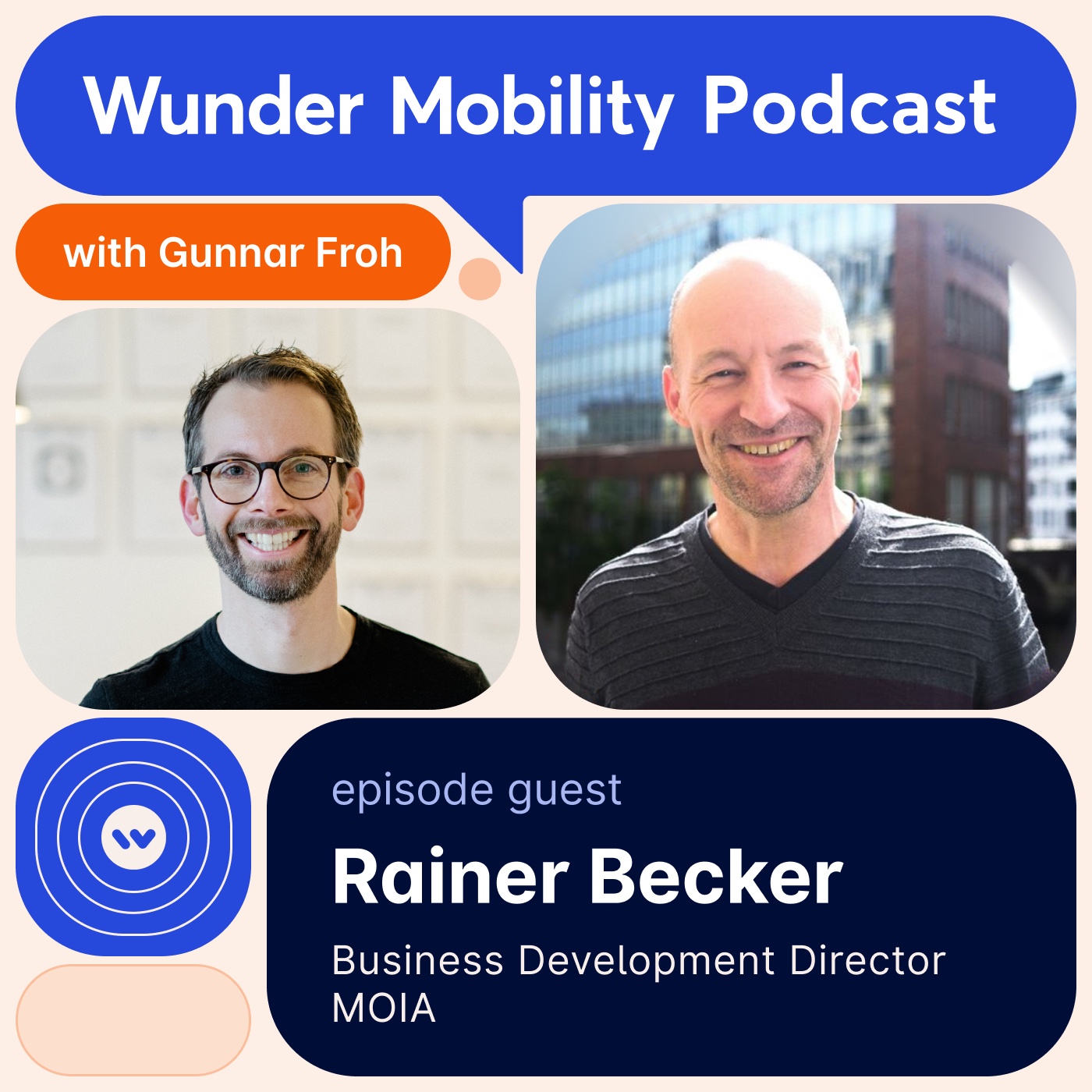
Wunder Mobility Podcast · hosted by Gunnar Froh, CEO & Founder
In this episode of the Wunder Mobility Podcast, Gunnar Froh speaks with Rainer Becker, Business Development Director at MOIA, Volkswagen's mobility company. Rainer is an aeronautical engineer from RWTH Aachen and has spent almost three decades in automotive and mobility, running shared fleets on three continents. He was COO of car2go in Europe when free-floating car sharing was brand new, and he negotiated its launches in Hamburg, Vienna, Amsterdam, Lyon, Düsseldorf and Berlin. He then moved to Beijing as President and CEO of car2go China and launched Chongqing, which reached 100,000 customers in a few months. After that he worked at GM's Maven in Detroit, built a ride-hailing business at the EV startup Byton in Shanghai, and led the commercial side of the sharing platform SharingOS. He joined MOIA in Hamburg in 2024. The conversation starts with the car2go years. Rainer explains why testing on the street beats planning, why Calgary became one of the best cities when nobody expected it, and why every city has its own dynamics. He also talks about the biggest costs in car sharing: damages, insurance and parking. Back then, only around 20% of damages could be charged to a customer, mostly because there was no proof of who caused them. From there they compare how people respond to new mobility in Germany, the US and China, and why so many carmakers closed their mobility services: selling a few large orders to dealers is a very different business from sending a hundred thousand small invoices to drivers. The second half is about MOIA. Its ride pooling service has run in Hamburg since 2017 with around 500 cars and drivers, and this July MOIA started taking passengers in self-driving ID. Buzz vehicles in parts of the city. Rainer explains why MOIA now offers its technology to local operators instead of running every city itself, and why the industry has no standard model yet. Then the question for anyone running a car sharing fleet today: should you get involved in autonomous vehicles now? His answer is to watch closely, but if you depend on investor money or run on low margins, wait until the market settles, which he expects within two to five years. The episode closes with a quick round: what Europe should copy from China, and whether robotaxis or pooled shuttles will win in most European cities by 2030.
0:00Speaker 1: Well, come back to the Wunder Mobility podcast.
0:03Speaker 1: I'm Gunnar Ho and about fifteen years ago a new kind of car sharing arrived in Hamburg... ...and i was living half-in-city at a shared apartment where we were all excited about these new cars on this street giving us freedom into city.
0:16Speaker 1: No stations no paperwork.
0:18Speaker 1: you found your car on your phone drove it across town left it on the street And that person who negotiated that launch did same in Vienna Amsterdam Lyon Düsseldorf Berlin.
0:29Speaker 1: As my guest today, Rainer Becker is an aeronautical engineer by training from AirVTHA Aachen.
0:35Speaker 1: He has spent almost three decades in the automotive and mobility industry... ...and he's run shared fleets on three continents which very few people can say!
0:44Speaker 1: He was COO of Cardugo in Europe when free-floating car sharing was brand new.. ..he then moved to Beijing as president CEO of Cardigo China And launched Chongqing which reached a hundred thousand customers in just the few months.
0:59Speaker 1: The fastest ramp up card ago ever had, and after that came to Detroit as CEO of GM's Maven And then to Shanghai where he built a ride-hailing business at the EV startup Biden.
1:12Speaker 1: some people remember that spectacular car?
1:14Speaker 1: He led the commercial side of their sharing technology platform Sharing OS also in Shanghai.
1:20Speaker 1: Since twenty twenty four has been now director of Business Development at Moya back in Hamburg, Volkswagen's mobility company.
1:27Speaker 1: And this July Moja started carrying passengers and self-driving ID bus vehicles... ...in different parts of the city.
1:34Speaker 1: so quite an interesting milestone!
1:36Speaker 1: So todays question is a practical one for everyone listening who runs their own fleet?
1:41Speaker 1: when car drives itself what changes?