
WTF Bach · Evan Shinners
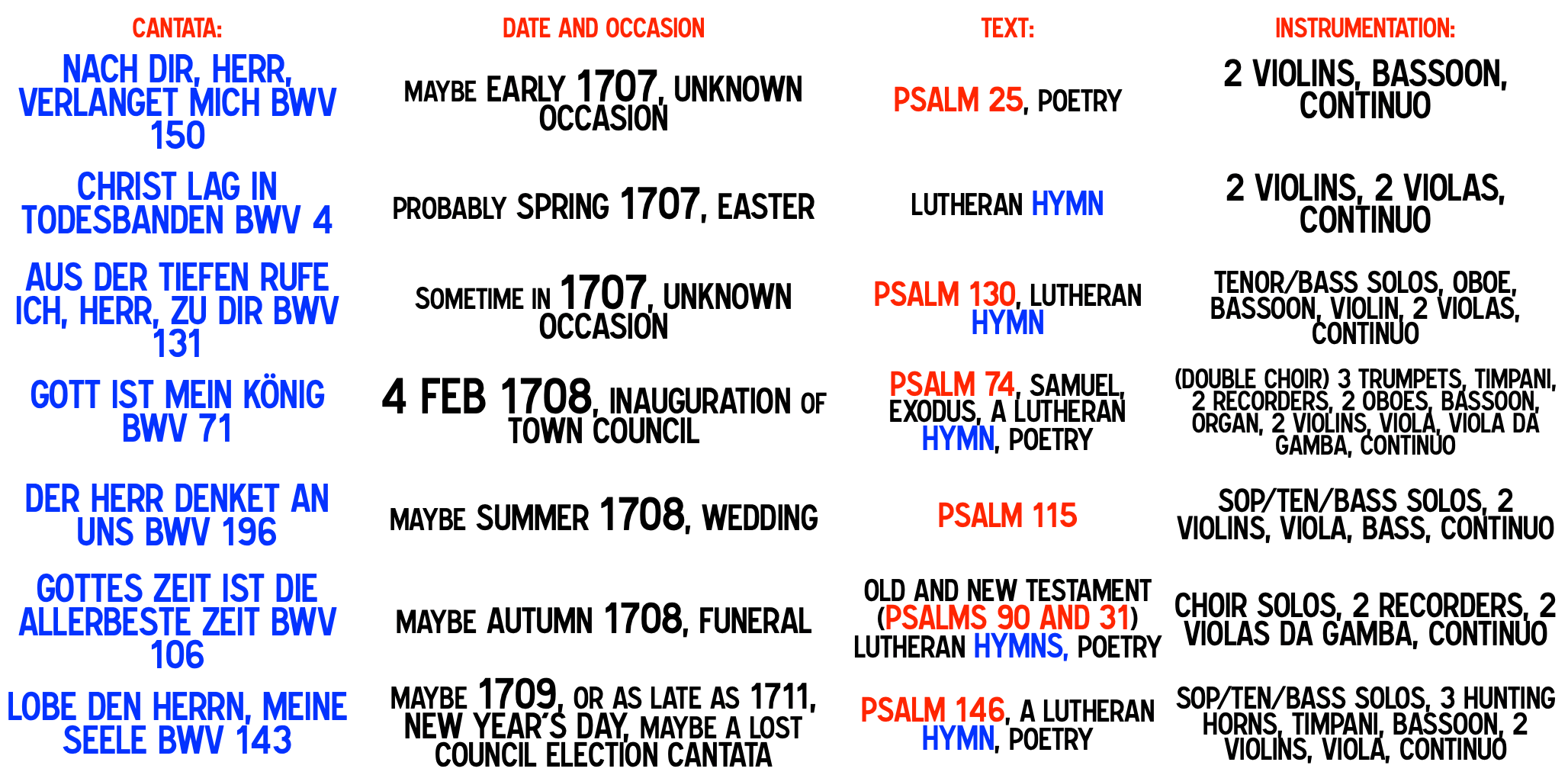
We’ve now covered the seven surviving earliest vocal works by Johann Sebastian Bach! This episode is a brief tour through the episodes we dedicated to these pieces, refreshing our memories and attempting to identify unifying stylistic features. All the episodes covering the Arnstadt/Mülhausen cantatas can be found at:https://wtfbach.substack.com/t/early-cantatas Wanna Cantata? Here’s an image that might help you wrap your head around the earliest cantatas: For the first time I spoke about Bach’s librettists. We will meet them as our study moves into the later cantatas. There are five identifiable poets, and one anonymous. What did you think about my mnemonic? Solomon Franck (a.k.a Solomo)Erdmann NeumeisterGeorg Christian LehmsChristian Friedrich Henrici (a.k.a. Picander)Christiane Mariane von Ziegler S-N-L-P-Z (Saturday Night Live PiZza…Anyone?) And wasn’t it thrilling to hear the similarities of styles between the cantata composed by Bach’s third cousin, Johann Ludwig Bach, JLB 7, and BWV 143? The JLB cantata survives in a copy by JS himself. Have a look at JL. See the relation? Johann Georg Sachs’ organ music, as promised. He was the cantor who gave Spitta the (once misattributed) cantata BWV 223.https://imslp.org/wiki/Charakteristische_Orgelstücke_(Sachs,_Johann_Georg) Write That Fugue! We Rely Exclusively on Paid Subscriptions! Help WTF Bach endure:Join at WTFBach.comYou can also make a one-time donation here:https://www.paypal.me/wtfbachhttps://venmo.com/wtfbach A new Telegram group is slowly forming! Singing through chorales and doing other cool Bachian things. Join here: https://t.me/+86a_lET5XKdmYTk0 Spotify Listeners: New AI software has unjustly removed episodes. They are deaf to appeals. Stick it to the robot by listening on the Substack app.Thank you for your support! Summary: Bach’s early cantatas, seven surviving works from his Arnstadt and Mühlhausen years (BWV 4, BWV 71, BWV 106, BWV 131, BWV 143, BWV 150 and BWV 196), are quite special works. Their texts use mainly the Psalms and Lutheran hymns rather than freely composed poetry. Instrumentation in these early cantatas is generally light: five of the seven use five parts or fewer, apart from the singers and continuo. Recitatives, closing chorales and da capo arias are almost entirely absent. The choir runs through the works rather than appearing only at the beginnings and endings. Tempi and meter shift freely, and suddenly, and the text appears to drive the music. We also conclude (or try to conclude) our thoughts on the authenticity of the cantata BWV 143. We also discuss the case of BWV 223, a fugue snippet left by Spitta, thought to be a lost Bach cantata until about 2004, but now attributed to Handel (and still missing? Anyone able to clear that up?) Performers featured were Koopman and Suzuki. Get full access to W.T.F. Bach? at wtfbach.substack.com/subscribe
0:00[music]
0:22SPEAKER_01W.T.F.
0:22SPEAKER_01Bach here.
0:23SPEAKER_01Thanks for tuning in.
0:25SPEAKER_01Thank you for listening.
0:28SPEAKER_01This is the promised conclusionary episode to Bach.
0:49SPEAKER_00Bach's early cantatas,
0:51SPEAKER_00we are going to sum up the features,
0:53SPEAKER_00the stylistic ideas behind Bach's earliest written cantatas.
0:58SPEAKER_00As I've said in the past few episodes during this study, there are seven of them.
1:03SPEAKER_00Indeed, we've had seven episodes on this topic.
1:06SPEAKER_00That will be the first link in the description,
1:09SPEAKER_00a link to one page containing all seven of these episodes if you want to know.
1:13SPEAKER_00I thought, what?
1:14SPEAKER_00Eight?