
WTF Bach · Evan Shinners
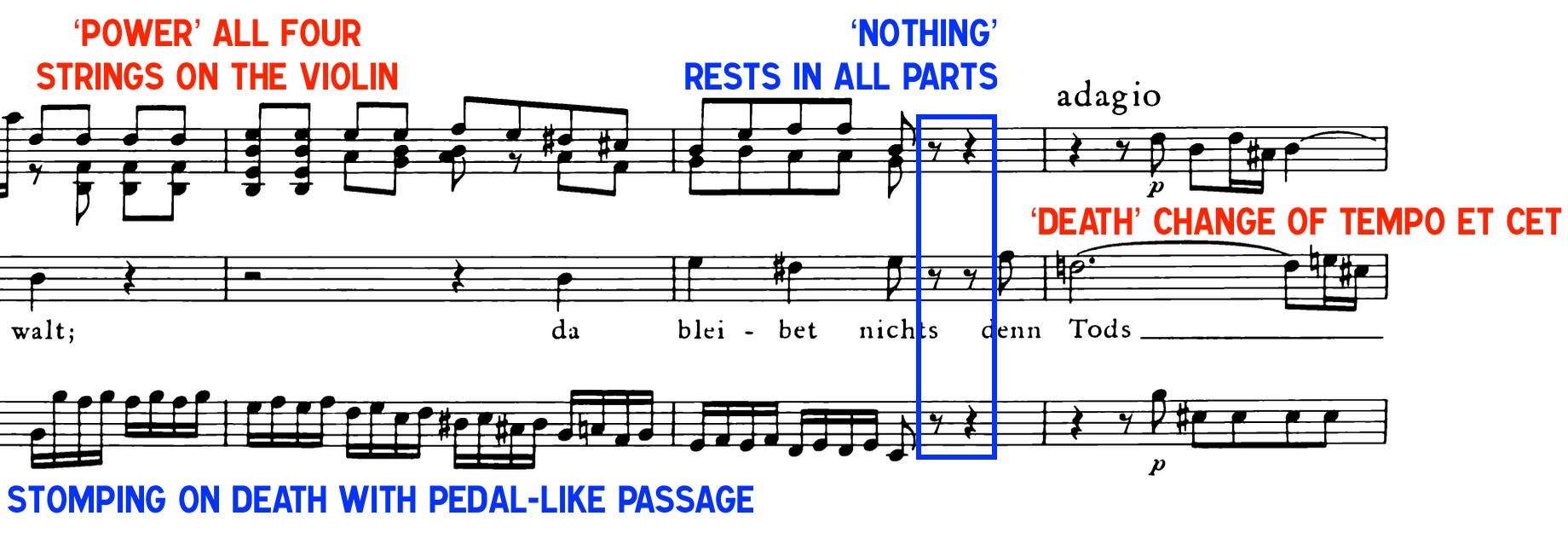
“The consummate expressiveness of {BWV 4] has always been marvelled at. Each verse is as if chiselled in music.” -Albert Schweitzer, Vol. 2 Bach’s early Easter cantata remains one of the most beloved in the entire canon. Barely 22 years old, he is already in full command of his tone-painting. Here are three measures particularly packed with symbolism: Filling the music with rests at the word nothing, ‘one death eating another’ through the closest possible canon, crosses both in shape and every note ‘sharped’ (gekreuzt,) dripping blood on the Passover doors with short 8th notes, leaping a diminished 12th (!) in the bass aria at the word death, this cantata is a dictionary of text painting. …und singen Halleluja! The chorale cantata was probably composed for Bach’s Easter Sunday audition in 1707 for the organist post at St. Blaise’s Church in Mühlhausen, left vacant by the death of Johann Georg Ahle. Bach’s older cousin, Johann Gottfried Walther, had an audition for the same post, but withdrew— possibly because Bach himself was interested! Later, Bach revived this cantata his first two Easters in Leipzig, 1724 and 1725. Only the Leipzig parts survive, hence the original 1707 version is lost. Any differences between the revised and earliest versions— which may have been substantial— are lost. In any case, the remaining style certainly reflects his early vocal writing par excellence. The cantata is one of only a handful of per omnes versus cantatas, going through all seven verses of Martin Luther’s 1524 hymn text. Theologically, the text goes deeply into Lutheran ideas linking Jewish Passover— the blood-marked doorposts and unleavened bread— to Christian Easter, reading the Passover lamb as a prefiguration of Christ’s crucifixion and the Eucharist. Such deep theological reflection was something Bach understood and made apparent in tone. Spotify listeners! Some new AI is taking down episodes on Spotify without warning. Check the episode numbers to see if an episode has been removed! Be sure to check on wtfbach.com to make sure you’re caught up with all the episodes. Thanks! PS! Shelly conveniently does in fact quote the biblical, ‘O Death, where is thy sting?’ but the poem I was thinking of was Pope’s, The Dying Christian to his Soul: VITAL spark of heav’nly flame!Quit, O quit this mortal frame:Trembling, hoping, ling’ring, flying,O the pain, the bliss of dying!Cease, fond Nature, cease thy strife,And let me languish into life. Hark! they whisper; angels say,Sister Spirit, come away!What is this absorbs me quite?Steals my senses, shuts my sight,Drowns my spirits, draws my breath?Tell me, my soul, can this be death? The world recedes; it disappears!Heav’n opens on my eyes! my earsWith sounds seraphic ring!Lend, lend your wings! I mount! I fly!O Grave! where is thy victory?O Death! where is thy sting? Write That Fugue! We Rely Exclusively on Paid Subscriptions! Help WTF Bach endure:Join at WTFBach.comThis is the only place Evan checks comments...
0:05[music]
0:34SPEAKER_02It's Evan Shinners.
0:35SPEAKER_02How are you doing?
0:36SPEAKER_02Today we are concluding our tour of the earliest cantatas by J.S.
0:41SPEAKER_02Bach with one that is beloved.
0:44SPEAKER_02Krieslag in Todespanden, BWV4.
0:47SPEAKER_02That is the melody playing in the background.
0:49SPEAKER_02That was the introductory music.
0:51SPEAKER_02Where do we start with this piece, however, this very famous early Bach cantata?
0:57SPEAKER_02Well, maybe with the death of one Johann Georg Ahle, A-H-L-E, an interesting man, this J.G.
1:05SPEAKER_02Ahle, born in 1651, Bach himself born in 1685.
1:12SPEAKER_02Anna, born in 1651, succeeded his own father as organist at St. Blaise's Church in Mühlhausen.
1:19SPEAKER_02So we've got father and son organists.
1:22SPEAKER_02The son was named Poet Laureate by Emperor Leopold I.
1:25SPEAKER_02And the son is also a writer.