
Write or Die Show · Randi-Lee Bowslaugh
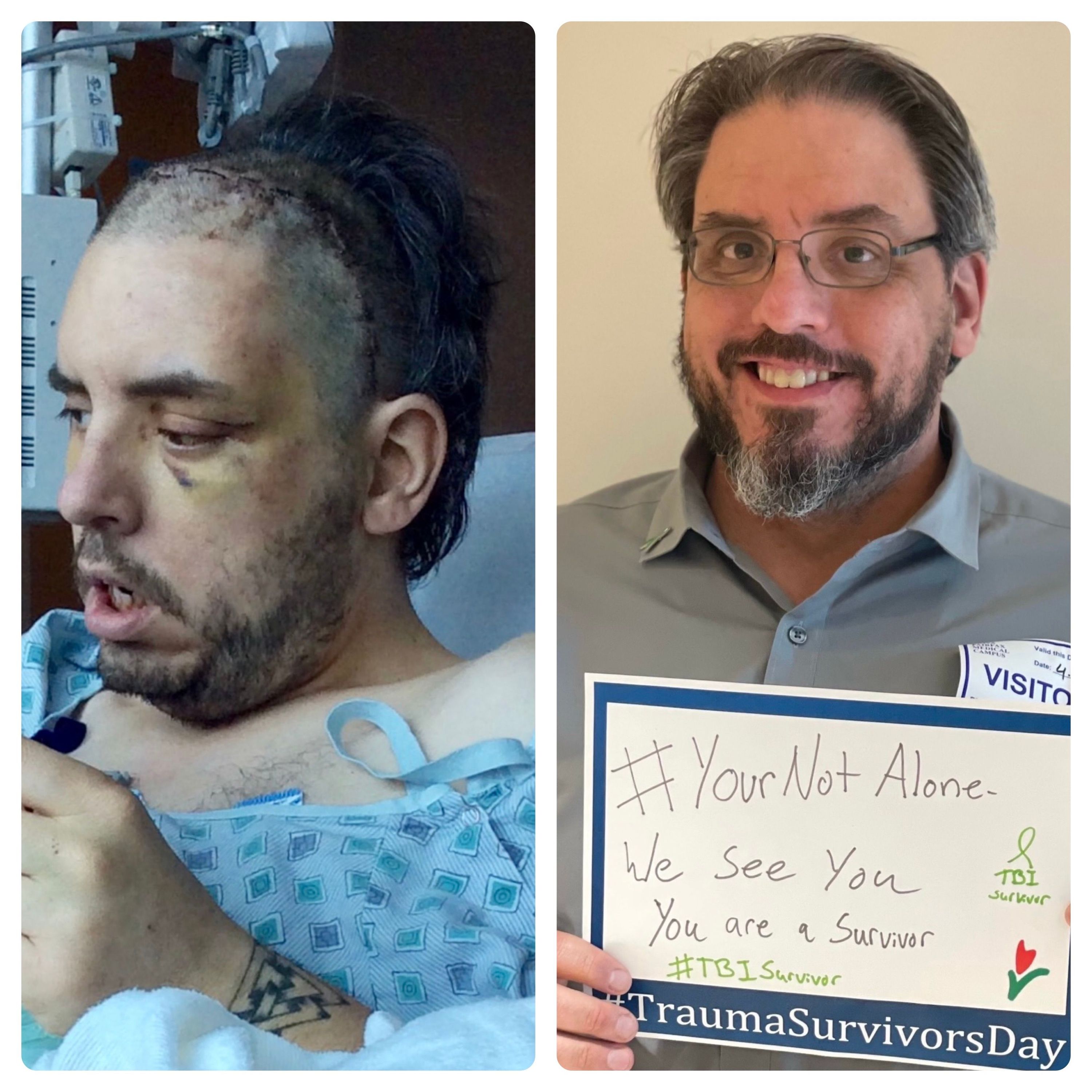
About Nicholas Ruchlewicz was in a single vehicle motorcycle crash on March 15, 2016, and suffered a separated pelvic circle, broken Sacro-iliac, crushed left orbital, massive concussion, and a right-side brain bleed and hematoma. He was in ICU, for 2 weeks, non-cognizant, then in an acute rehab hospital for 2 weeks, learning how to focus, move his left side, and see. His trauma and brain injury have allowed him to become an advocate, he calls it “A Gift of Perspective”. He is very vocal about his mental health, and advocates for males, and others for mental wellness. He is a volunteer for https://www.traumasurvivorsnetwork.org/, a Peer Mentor” at an Acute Rehabilitation Hospital, as well as a political advocate for accessible mental health and support. He believes we all have emotions, and its “Okay to not be OK”. He has done a lot of work with Cognitive Behavioral Therapy (CBT) before his trauma, and that is a reason, he believes, he is “still here.” He believes that, ""Our minds can be dark, and it's important to look at the corners for the light. Life is a 4-letter word, it depends on how you use it. Follow https://linktr.ee/giftofperspective Want to be a guest on Write or Die Show? Send Randi-Lee Bowslaugh a message on PodMatch, here: https://www.podmatch.com/hostdetailpreview/1625705973680x271582554008346080
Randi-Lee Bowslaugh: And welcome to the Right or Die Show. I'm your host, Randy Lee Bozlaw. Isn't it just a beautiful day today? Or night or morning? Depends when you're listening. But if you're joining us right now, it's a pretty good night. I mean, it's a little bit rainy here, but that's alright. Rain, rain is a good thing. let's see what what is new and happening? The movie. So, for those who have been following, you know exactly what I'm talking about. Ya newbies here. the movie Goodbye Too Soon. We have made a lot of headway on it. It's fantastic. so we now have a producer, Haley. She is kind of guiding me through this whole brand new making a film thing, which I have no idea what I'm doing, but it's gonna be great. Because I also had no idea what I was doing when I made a podcast. And look at this. Five years later, I'm going strong. big shout out, of course, to our sponsors. We have Gangam Moon Yoga. And J L Flooring in Niagara Falls. Thank you so much for supporting us. And then stay tuned. There's gonna be a few big announcements coming. We're tweaking a few things in the background. it's gonna be great. It's gonna be great. So stay tuned. Stay tuned. All right. Now enough of my rambling with us today. And he gave me his name phonetically, so I'm gonna try to not screw it up, but with us today, we have a Nicholas P. Rucklavic. Did I yes Yay Nicholas P Ruchlewicz: Very good. Yep, great. Randi-Lee Bowslaugh: So hello how are you today? Nicholas P Ruchlewicz: I'm not too bad. How are you? Randi-Lee Bowslaugh: I am pretty good. We actually we went to the Jays game today and they crushed it, so that was kinda nice for Nicholas P Ruchlewicz: You're in downtown t you're in Toronto area? Randi-Lee Bowslaugh: I'm a couple of hours away from Toronto, so I just got home about half hour ago. But yeah, yeah, it's not it's not too Nicholas P Ruchlewicz: Gotcha. Yeah. Randi-Lee Bowslaugh: too far from us, which is kinda nice sometimes. Yeah. The Sky Dome was open, so Nicholas P Ruchlewicz: I'm outside of DC, so we have a lot of terrible rain right now. So my dogs are per petrified because petrified because of the lightning. But you know, it's all right. Randi-Lee Bowslaugh: What kind of puppers do you have? Nicholas P Ruchlewicz: I have two Besengies. They're the barkless dog. They're they're African, they're you know about twenty four pounds, they're about as wide as they are tall, curly tail, pointed ears, they don't Randi-Lee Bowslaugh: I'm looking up a picture. Aww, so cute. Nicholas P Ruchlewicz: Yeah. They are ridiculously cute. Yeah, it's Randi-Lee Bowslaugh: I didn't talk about Nicholas P Ruchlewicz: Yeah, that's a that's a puppy. Yeah, they have the little wrinkly faces and everything else. Yeah, they don't they don't bark. They they yodel or or so. They're they say if I always tell my neighbors, if you hear someone barking, it's not me, I promise. It's Randi-Lee Bowslaugh: Aw, and what are their names? Nicholas P Ruchlewicz: Orion is my puppy. He's five he'll he'll be five next year. and then Athena is my older lady. I mean she's twelve, she'll be thirteen in December. So they're yeah, they are definitely they keep me sane when things are tough. I get them fortunately to kinda help, you know, a lot of grounding exercise and stuff like that. It helps when you're with a dog and helps with a pet and just helps reset what's going on out here and just tries to, you know, bring it in. Randi-Lee Bowslaugh: love puppies. I have two puppies. We had three. We had a whole pack for a while and unfortunately our old guy he's gone now, but I love puppies and kitties and horsies and most fluffy animals. Not all, but most. Because there's rats Nicholas P Ruchlewicz: There's Randi-Lee Bowslaugh: in the neighborhood and they're fluffy and no. No. Nicholas P Ruchlewicz: There's was it not the far side? It's Calvin and Hobbes. a a friend of mine sent me a Calvin and Hobbes cartoon when my Randi-Lee Bowslaugh: those are funny. Nicholas P Ruchlewicz: yeah, when my after my dog passed and it it had Calvin super upset and said, you know, the world's a really mean place and then Hobbes says that's why animals are are are, you know, cute and fuzzy. I was like, Okay, that actually makes a lot of sense. It kinda sometimes Randi-Lee Bowslaugh: Yeah. Nicholas P Ruchlewicz: when Anytime I've had a friend who's, you know, said goodbye to their, you know, their their pet, it I've definitely always reflect on that because it is it is nice to have that, you know, grounding and just yeah. Randi-Lee Bowslaugh: Yeah, they they're they're they're the best. so anyways, what else about you do we need to know? Nicholas P Ruchlewicz: I'm a Leo. No, just kidding. I am a Leo, but no, I'm I That's August. August. August d j Randi-Lee Bowslaugh: What month is that? 'Cause I actually have no idea. is that the end or the beginning? Nicholas P Ruchlewicz: I guess it's middle of July, middle of August. August seventeenth is my birthday. Randi-Lee Bowslaugh: I guess my husband's a Leo too. Look at that. Nicholas P Ruchlewicz: Yeah. but no, I mean I'm I kind of I'm I'm a big can I tell I'm a big nerd. I'm a big you know, but I do go to a lot of concerts and a lot of stuff like that, but you know, I kinda started, you know, going in this space to help you know, speak about, you know, my struggles with mental health and I'm a traumatic brain injury survivor, so I do a lot of work and advocacy for that space with Trauma survivors and you know, just meeting other people and and just, you know, sharing with them their story and understanding that, you know, my story might be very different, but a lot of the similar chapters, it kind of it all makes sense sometimes. Randi-Lee Bowslaugh: Sounds like what we do on this show. We all have similar stories, different, but there's little bits and pieces that connect us all. Nicholas P Ruchlewicz: Yep, it's it's it's true. World's hard enough and sometimes, you know, it's good to be able to come together and let some of the BS behind and and be in this, you know, space. And the nice thing about podcasts and you know, speaking to people across the globe is, you know, they don't have to be in front of us. You know, they could be in their car, they could be on the metro, whatever, and it might resonate with them and you know, I've my trauma happened a little over ten years ago. and I always said I guess if I helped one person I guess it was worth it and I know I've helped a lot of people, you know, all those years. So and I'm continuing to Randi-Lee Bowslaugh: And you're Nicholas P Ruchlewicz: try to keep doing better. Randi-Lee Bowslaugh: and you're about to help some more. Okay, so ten years ago, what happened? Nicholas P Ruchlewicz: nobody really knows what happened for my lovely mental health journey. I I had a a really rough separation and marriage about a little over ten years ago and eleven actually eleven and a half. But I got separated yeah, Randi-Lee Bowslaugh: Time size. Nicholas P Ruchlewicz: yeah. I got separated and then you know, I I got divorced and I made sure like in that time I I made sure I didn't just play video games or anything else, I pushed myself to go out to meet new friends, play games with people, just trying to get out of the house. I knew when my divorce was finalized, everything else, I wanted to get a motorcycle for a while. I friends rode, I had for my motorcycle license for roughly about a year and I wanted to get a new bike. Randi-Lee Bowslaugh: Mm. Nicholas P Ruchlewicz: You know, that's a nice little reset, right? You get a new bike and do it and Randi-Lee Bowslaugh: Right. Nicholas P Ruchlewicz: I'm in, like I said, Northern Virginia area and I got my bike in the end of I guess end of February. and of course it snowed the first week of March. So I don't wanna be out on the road, you know, because I don't wanna ruin the the paint on the bike. And yeah. So Randi-Lee Bowslaugh: Of course not. Or yeah, yeah. Nicholas P Ruchlewicz: nobody knows what happened. I was riding around March fifteenth, twenty sixteen on the Ides of March on the brain injury awareness month. So a good Double jeopardy. nobody knows what happened. I impacted a wall. I was by myself, single vehicle, motorcycle crash. I separated my pelvic circle. I broke my secret iliac, I crushed my left orbital, had a massive concussion, right side brain bleed, sododerma hematoma. So my body lied there roughly Randi-Lee Bowslaugh: Mm. Nicholas P Ruchlewicz: about four hours. and people started, you know, fortunately I had habits, so people were like, Where's Nicholas? His dogs speaking of dogs, they were not they were making noise and fussing, so it was just playing a game of telephone, literally tagging people from Facebook Randi-Lee Bowslaugh: Okay, so Nicholas P Ruchlewicz: and this. Randi-Lee Bowslaugh: hold on I wanna I'm gonna trying to paint the picture in my head 'cause that's how Nicholas P Ruchlewicz: yeah. Randi-Lee Bowslaugh: I see things. So you had this accident. Was nobody else on the road then? Nicholas P Ruchlewicz: So I had a like I said, it it it I had a great snow, so I didn't want to ride it on the main road, so I had a storage unit 'cause I remember I had a a lovely divorce. So I I had a Randi-Lee Bowslaugh: Okay, yeah. Nicholas P Ruchlewicz: a big storage unit, had all my stuff in and I did my bike. So every day for about a week or so I rode it around there every night, you know, for a few hours and I'd come home, blah blah blah. And that's when, you know, my you know, it said dogs Randi-Lee Bowslaugh: Okay. Nicholas P Ruchlewicz: were making noise, my mother didn't know where I was, she called my girlfriend and She didn't know, so she messaged someone on Facebook, got someone else's phone number, and they all came to the storage facility roughly at eleven fifteen at night. called the police, nothing was wrong. My friend broke open the gate, the cop went in there, and then two minutes later, the three minutes later, the paramedics showed up. So my family never saw my body, but Randi-Lee Bowslaugh: Mm. Nicholas P Ruchlewicz: I was technically responsive on the scene, meaning I would make noise when they try to talk to me. You know, I was I would respond to them in some facet. I was never in a coma, but I wasn't cognizant Randi-Lee Bowslaugh: Okay. Nicholas P Ruchlewicz: of anything. so I was taken to a level one trauma center in Northern Virginia. and Randi-Lee Bowslaugh: Okay, so in Canada I'd I d I don't think we say levels or whatever. Does level one mean like super bad? Nicholas P Ruchlewicz: So n that's a good question. So and maybe they use different levels. So level one trauma, so many hospitals or ho you know, hospitals have ERs and stuff. ER is not a trauma unit. level one Randi-Lee Bowslaugh: Correct, yeah. Nicholas P Ruchlewicz: trauma is like that's it that's essentially like the let's just say Gray's Anatomy style hospital. That's the teaching hospital. That is Randi-Lee Bowslaugh: okay. Okay. Nicholas P Ruchlewicz: like they have always have surgeons of all types at all times, always available to handle any trauma, a traumatic Randi-Lee Bowslaugh: Okay, I'm with you now. Nicholas P Ruchlewicz: event, trauma stuff, they would go to a level one trauma center. There's level two traumas and level three trauma centers. They can handle, you know, many things. Level two trauma is fantastic, you know, services. It's just not a teaching hospital. Essentially level one trauma is going to be your teaching hospital. Your your highest you know and there's always someone Randi-Lee Bowslaugh: Okay. Nicholas P Ruchlewicz: at any point that can do X number of things that can handle Randi-Lee Bowslaugh: Uh-huh. Nicholas P Ruchlewicz: brain stuff. lungs, whatever. It's it's always, yeah. So yeah, Randi-Lee Bowslaugh: Okay, interesting. Nicholas P Ruchlewicz: and Trauma Survivors was I guess a handful of years ago purchased by or they're acquired by American Trauma Society. It started originally in Fairfax, Virginia. and now it's over across the country in like two hundred and sixty locations and Canada and Australia. So and what Trauma Survivors so I was taken to the trauma unit. Let's talk about my story before I talk too much about trauma survivors. Randi-Lee Bowslaugh: Yep, yep, go back. Nicholas P Ruchlewicz: so I was taken to the trauma center. I went right up into the trauma unit. They were worried about the bone piercing my brain. Fortunately, Randi-Lee Bowslaugh: Ooh. Nicholas P Ruchlewicz: it didn't. There was a lot of internal bleeding on my my pelvis. because I I separated my pelvic circle like four inches. So your pelvis is not supposed to do. I never had any abrasions or would have bled to death. There is no question. I have one cut under my eye or a bone. protruded out. so I wasn't aware of anything. I was never like I said never in a coma, never induced in a coma, anything else. I didn't have brain surgery. I'd say that movie face off full of crap. They had to cut my Randi-Lee Bowslaugh: Ha ha ha. Nicholas P Ruchlewicz: head ear to ear and pull down my face to redo my eye. there's mesh and there's screws here and they had to do a pelvic stabilization. and in that point Every brain injury is different. Mine's right side brain injury. So a lot of that is your cognitive thoughts, your compulsivity, your you know, your left side movement, your vision. Well, I was a 35 year old male, and not no male wants to be tied down in bed, right? Gonna do anything. So I would constantly Randi-Lee Bowslaugh: Yeah. Nicholas P Ruchlewicz: fight the straps, and one day I broke the sutures in my pelvis. So they had to go back in, they had to put a plate in. So there's a plate holding my pelvis together with four six screws and then there's a long screw in my SI joint fusing that. And then yeah, and like when they didn't tie my hands down, I pulled the staples out of my head. And again, compulsive. It's Randi-Lee Bowslaugh: Yeah. Nicholas P Ruchlewicz: it's not comfortable being it. And then I remember quote unquote waking up when I was transferred to a an acute rehab facility. Randi-Lee Bowslaugh: Okay. Nicholas P Ruchlewicz: 'Cause that's when things started trying to click and it was weird. I saw two of everything. I didn't understand why. I couldn't move my left side and that's when, you know, the whole thing the whole rebirth essentially had to do. I mean, you can everything can just reset in a second and you gotta relearn everything from just Randi-Lee Bowslaugh: Yeah. Nicholas P Ruchlewicz: simple stuff, quote unquote simple stuff. I mean, walking was not gonna Randi-Lee Bowslaugh: Ha ha ha. Nicholas P Ruchlewicz: be possible for me for a while because I was non weight bearing for twelve weeks. Randi-Lee Bowslaugh: Not with a pelvic injury. Woof. Nicholas P Ruchlewicz: Yeah, twelve weeks and then but the head injury is what I didn't really give a lot of respect to and that's what I definitely needed a lot. I mean, I felt like people were talking to me like I was a little kid, like I was an idiot and I didn't realize that every brain injury is different and I needed to understand certain things I needed to so you know, I needed to slow down some, I needed to take some in and through my you know I said earlier I had a lovely separation and divorce a a year before. my trauma, which and but I was seeing a therapist, which was great and very helpful. My trauma happened, obviously didn't see them in the hospital for roughly a month. Went home, was able to see them when I was in a wheelchair and literally the week later they had a heart attack, so I was felt lost. I mean my therapist for six years has like pulled out from under me and it was it was scary and it I didn't know what to do and you know literally everything in my life felt like it was falling apart and that's you know, I I learned a lot of strategies through it and I speak a lot about mental health, I speak a lot about therapy in any form, be it a dog, be it music, be it a game, or just talking to someone to allow yourself to kind of make sense. So, you know, I Randi-Lee Bowslaugh: I like that. Nicholas P Ruchlewicz: then started this, you know, journey you know, my healing journey is it's been a long time. I mean, we're we're always healing, no matter what trauma or not, and my trauma's different than someone else's. Mine's a medical trauma, trauma center, but you know, through my various facets and trying to reach out for others, I found an organization like I mentioned, Trauma Survivors Network, where we can I can go into the trauma unit, speak to someone that's also been touched by trauma, their family and you know help show them some type of hope because we only see ourselves where we are now. We don't see ourselves on the other side. And it's really important for caretakers and survivors to see like, look at you're going around. I'm like, yeah, I'm still moving around. It just takes a while. We only see ourselves again there. And through Trauma Survivors I've done a lot of really cool advocacy with them. I went to so a few weeks ago I spoke to some EMS and fire fighters students on a trauma course. I've done that a few times from schools, I've done webinars and hell hell, I guess three years ago I went to Congress and spoke to different state representatives about the importance having national trauma system. And I'm actually gonna be talking to my state representative tomorrow at this time, trying to work on a bill. I wanna try help form language to make make mental health a little bit more accessible for others. So I'm a little busy, I try to I try to do, you know, why not me is something I've learned to say. So I keep trying Randi-Lee Bowslaugh: Yeah. Nicholas P Ruchlewicz: to challenge myself to do a little more. Randi-Lee Bowslaugh: like all that. Okay, so hm. Okay. I know. And it's just psh. Nicholas P Ruchlewicz: It's a lot, I know. It's a lot it's a Randi-Lee Bowslaugh: I love that. I love it though. okay, so you get moved to the to the other place. You find out that the person that really has been helping for six years is incapacitated for lack of a better term. And so I'm assuming that you're feeling pretty crappy about stuff 'cause you said it your life was falling apart in in a sense. What was something that really kept you going at that moment? Nicholas P Ruchlewicz: At that moment was I knew that I mean, I did say my dogs, they were such a big part of my healing and going. One of the things I talk about I I like to talk about my nerd street creds really high but before Randi-Lee Bowslaugh: Mm-hmm. Nicholas P Ruchlewicz: my trauma, you know, before my after my separation, I I wanted to like said, not just play video games. So I played tabletop role playing games, tabletop games with friends. And I pushed myself into that space to do more and more. So after my trauma happened, I mean I used everything I could to re-engage myself. So I don't have full feeling on my left side. I had to relearn how to use my my vision together. so I did every single thing was a type of rehab. So if I was playing a game, I would move my pieces with my left side. I would have to do creative to analytical thought. That's a an i issue with right side brain injury. What a perfect way Randi-Lee Bowslaugh: Okay. Nicholas P Ruchlewicz: the making fun of, you know, making imaginary math rocks or whatever. So trying to, you know, engage with that. You know, comic books and and entertainment were very big for me. it was before my trauma. I read a lot of comics and there's only one issue there's only one picture that exists to me of my trauma. It's me holding a a Thor comic and I actually saw the the writer of Thor and there and it was when Jane Foster, Thor in Love and Thunder had cancer in the in the thing and whenever she picked up the hammer, she didn't you know, she was able to, you know, be someone else. And I told Jason Aaron, I said, you know, imagine this being someone that's trapped in their own brain, being able to pick something up. And he was just he was just floored that I said something like he couldn't imagine it was going through. And so I've been able to try to take the little pieces of advice and the little inspiration I've met, you know, through everything and and and keep going. Randi-Lee Bowslaugh: love that. 'Cause it's some people would kind of flounder and give up. I know that I've had moments where not that, but moments where life is just falling apart and you're kind of floundering and grasping at straws and reasons to to not give up. Which can be a whole other challenge. Nicholas P Ruchlewicz: y you might have heard me say earlier, I say why not me instead of why me. I just say why not me I mean I never had a lot of self esteem or self valued, so the only way I can go is up 'cause I mean, you know, it's I'm I'm I'm already down here. Might as Randi-Lee Bowslaugh: But yeah, I wrote I wrote that one down, why not me? 'Cause I like that. It's Nicholas P Ruchlewicz: It's it's been fun. Randi-Lee Bowslaugh: there's a pe there's a song from the movie Wish where they're they're talking about getting ready to to try and fight the king. And like the queen walks in during the song or whatever. And anyways, there there's a line that's something I I can't remember exactly what it is, but it's like basically Why not us? Why not now? Like if not me, then if not now, then when kind of thing. great movie. Everybody go watch it. It's a kid's movie, but I love it, I love it, I love kids movies. and I li I have that song on my playlist because I just I love it. 'Cause it's that, yeah, if I don't do it now with what I know now, then Who's gonna do it? Why not me? Nicholas P Ruchlewicz: Yeah. So yeah, you you said music music was such a a major part of my healing as well. So my girlfriend, you know, would play my now my wife, she would play my my heavy metal station when my brain was out. So it was typo negative, gothic metal. So in the nurses would be like, What the hell's going on? But Randi-Lee Bowslaugh: Wow. Nicholas P Ruchlewicz: when like you could literally when I was going through pain spikes and my blood pressure was up, when I played the music, it literally would lower my blood pressure. So I have that as 'cause I remember I had I said I had this horrible separation divorce when music was what kept me going when I was having hard times there, just did it. And you know, the you know, the sounds and stuff would literally lower my blood pressure and give me comfort. And you know, the the band typo, I mean he passed in twenty ten, never got to see them live, but another band who I always remember actually remember their music her voice when my injury happened, Lacuna Coil, they really their music really meant a lot to me. A lot of their songs were about depression or or trying to, you know, be the best you can. And I reached out to them and told them my story and they were very fascinated. And I mean, heck, I interviewed Christina. I mean and and r talking to her, it really helped propel me talk to people from around the globe after that. And it was just because I said You know, why not me and let's try it and look where it is. Randi-Lee Bowslaugh: Let's try it. That's that's basically like what I'm doing. Like so when I s it was like, I'm gonna make a movie. My publicist was like, Do you know what you're doing? I'm like, Nope. And and basically everyone who meets me where I'm like, Yeah, making a movie, they're like, that I mean that's cool, but do you know what you're doing? Nope. But why not? I'm gonna figure it out. I'm I'm gonna meet the right people and I've I've met some that especially Haley, she's like knows all her stuff and she's I'm like trying to take it all in and I'm like this is so much my head's like gonna explode but also thank you. And poo. but why not, right? If we're gonna we're gonna try something new, we're gonna go go all in. Go big or go home, as my husband likes to say. Nicholas P Ruchlewicz: I d I definitely know that and I I always go big. I'm like the Kool-Aid man. yeah, just slamming Randi-Lee Bowslaugh: Right. Nicholas P Ruchlewicz: through walls. I'm that's me breaking down walls. I'm like five hundred and one. That one was really hard, but besides that Randi-Lee Bowslaugh: that's fantastic. Yeah, my husband was so he was in the hospital. This is going back about fifteen years. He's in the hospital. Just found out he's got type one diabetes. Should have been in diabetic coma. And he's laying there and he's like so out of it. And and he's like, Well, you know, go bigger, go home and what's bigger than almost dying? Like, wow. Awesome. Thanks, honey. Love you. You know. scare me half to death. Was it was when we were engaged, we weren't even married yet. I'm like, my gosh. Am I gonna be married or not? can't even say I'll c Nicholas P Ruchlewicz: Mm. Randi-Lee Bowslaugh: like w when you're engaged, can you even say you're widowed after? 'Cause you haven't actually gotten married. I never pondered that question before. Huh. It's not really important. Nicholas P Ruchlewicz: I don't know, that's a I don't I don't know how that would be. So okay, we we that's a that's a that's a different that's interesting. Randi-Lee Bowslaugh: That's a v Mm, it's a it's a very semantics kind of thing. Anyways. okay, so then eventually you got out of the hospital. And I'm assuming you still needed support and help because you probably weren't a hundred percent quite yet. Nicholas P Ruchlewicz: What's a hundred percent? so I I left the hospital. I was still in a wheelchair. and again I said I I had a I lived in my with my mother, it was great, and a thirty-five year old male and a you know, a re divorcee living with mother. So the only way to get there is to they had to wheel me down a grassy hill in the back and get a wheelchair ramp, had to move the handles off the wheelchair to go and I had a drop down commode, I had no access to a restroom or anything else. but didn't have that options, I would have had to go to a short term care facility or long term stay hotel because I you have to have access to you know certain things. So Randi-Lee Bowslaugh: Yeah. Nicholas P Ruchlewicz: and I left April fifteenth, twenty sixteen and I went I was home for a couple weeks and then I was into outpatient and then s you know slowly but surely you know, making goals, doing, you know, more and and trying to do everything I could to get better. I mean, it took a while till I never lost the ability to read. I just couldn't focus my eyes. I had to re learn how to use my vision. So d occupational therapy, you know, will some do your like hand things, taught me Randi-Lee Bowslaugh: Yep. Nicholas P Ruchlewicz: how to like start moving my eyebrows to get my eyes in focus and then just do eye techniques to get your eyes reworking. so I had to Again, it was interesting trying to relearn 'cause I had a terrible eye patch. and yeah, I had I I was non weight bearing for a while and you know, when you try to walk again, you think you can just walk and it's not that easy after not walking for twelve weeks. just think of a baby Randi-Lee Bowslaugh: yeah. Nicholas P Ruchlewicz: bottom. When a baby's walking their little bots Randi-Lee Bowslaugh: Ha. Nicholas P Ruchlewicz: like a a gyro ready to fall. It's exactly what it felt like to me. So I did a lot Randi-Lee Bowslaugh: Yeah. that's hilarious. Nicholas P Ruchlewicz: of anything I could to try to, you know, do and challenge myself. It wasn't easy by any means. but I kept trying to do a little more and a little more and and part of my healing was going back into the hospital and talking to patients that are in the rehab facility w in the in the acute rehab. When I was in trauma the chapter was was on hiatus so we didn't have the support there, but the acute rehab there was well for me part of my healing was wanting to go back and help other patients just to show them support and that really helped give me a better purpose. I still worked. I mean I was part time for a while and then went slowly back to work and but it Randi-Lee Bowslaugh: What kind of stuff were you doing for work? Nicholas P Ruchlewicz: I give the gift of low expectations. I'm a project manager. So I I I I managed I manage technology, like audio video technology, telecommunication builds. big office buildings, you know, stadiums, schools, whatever. I I handle all the and I used to be an installer and a a manager, engineer, blah blah blah, did all that stuff. So it was tough to try to get back to it. I don't I never really felt I lost anything, but I needed to push myself to slow down. So before my trauma, I defin my my traumatic brain injury, not just trauma. Before my traumatic brain injury, I had very high function ADHD. There's no question I had it. But right side brain injury, I think really it really put a lot of light on the stuff that I might have helped overcome. And I couldn't really I couldn't focus. It was really hard for me to try not to get too distracted and I've learned a lot of nice techniques through brain injury services and remember always to count to three. Randi-Lee Bowslaugh: Wha what's what's some of your favorite techniques? Give me like two. Nicholas P Ruchlewicz: just the the one technique I can I can easily say and will always do is always just try to count to three. Take a breath and count to three because when you can do that, you control the you control yourself, you control your own reaction. You don't have to spit it out and spit it out, just count to Randi-Lee Bowslaugh: okay, yeah. Nicholas P Ruchlewicz: three. And Victor Frankel, he wrote, you know, the space between stimulus and response. Is where the power lies. So sometimes allowing myself not to respond right away is what's giving me. It's another technique, like and it's simple, simple. It's a grounding technique. What do you see? What do you smell? What do you hear? And just Randi-Lee Bowslaugh: Mm, mm. Nicholas P Ruchlewicz: try to put yourself in that, and it'll help whatever worry, whatever, not gonna go away, but allow you to refocus something else. So Randi-Lee Bowslaugh: Nice. Nicholas P Ruchlewicz: Like even today if I go into a meeting, I know it could be contentious. I will always have on top of my paper one, two, three, just on my paper to remind myself just to count to three. And, you know, I say I you know, my trauma gave me a lot. I learned again, I I saw another therapy. I saw a therapist a few months after I was out of the hospital, I found a new one and it took me a while. I remember her asking me once, What gifts did your trauma give you? And it pissed me off when they asked how dare you ask me that. I still can't do this. Randi-Lee Bowslaugh: Mm. Nicholas P Ruchlewicz: And then you know who would you not have in your life? And you know, some of my you know, my my first mentoring speech is where I proposed to my girlfriend and I recorded it and people came from all over and my hospital therapists were there. And some of those therapists were at our wedding. So I wouldn't want to not have them in my life. and I that's why I say that's where I kinda had the whole nomenclature a gift of perspective. My trauma gave me a wonderful gift of perspective. I see things very differently now. I think I saw the world very well before, but now there is no blinders and I see I try to see everything as it is. And you know, I learned I try to do what I can to take in more information, try to learn more and try to see I always try to look at myself in the third person. How am I handling this? What do I like Randi-Lee Bowslaugh: Mm. Nicholas P Ruchlewicz: what do I look like in this position? Do what do I feel? And I saw something once. It was a picture of someone with sympathy standing over someone. I'm so sorry for you. But when you're of empathy, you're walking with someone. And I always try to make sure I'm always in that empathetic route to walk with them. I'm here for you. And I say that my trauma, my brain injury made me better at my work. You know, it taught me to slow down. It taught me to speak out loud before I, you know, not just put all the information out there after I type it, I will read it out loud, read it to myself, allow myself to slow down, see what I'm trying to do, to comprehend. And it would, you know, make me a better communicator with that. I learned about servant leadership and I was always like that. Now I put a term to something, you know, where it already was and it's just who I was as a person just, you know, I I believe personally that traumatic brain injuries brain injuries will amplify certain things about ourselves. And you know, again, that's Randi-Lee Bowslaugh: Mm. Nicholas P Ruchlewicz: where I right side injury is very much ADHD is compulsivity, it's it's very much the Very common for someone with a right side injury to do that. That's why a lot of people say when someone has a head injury, they're very angry. Well, it's their brains responding to things sometimes after major concussions, stuff like that. People can be very angry because of it because our the way our emotions are handling it or where we're going it we're having a hard time to control it. And again, I learned a lot through therapy before my trauma and I learned that anger is a secondary emotion. And for me, what triggered my anger was always frustrator and belittlement. And nothing's more frustrating than someone having to clean up after yourself or trying to see if you need something that you you should be able to take care of all the time. Randi-Lee Bowslaugh: Mm-hmm. You're the second person on the show and we've had over three hundred episodes, okay? But you are Nicholas P Ruchlewicz: That's all, yeah. Randi-Lee Bowslaugh: but you are only the second person to mention that anger is a secondary emotion. And I really love it. Because I had never considered it and now it's like repeating to me, which I love. Nicholas P Ruchlewicz: Yeah, I've again I've learned a lot and I've pe I tell people if therapy's easy you're not doing it right. It's not supposed to be easy. It's supposed I mean, it shouldn't be miserable. You you want to be able to get through it, but you have to ask yourself the hard questions. And like I said, for me, what would really set me to anger was being frustrated or feeling belittled. So what I try to do is I it's kind of like the I try to do the antonym for that. When I'm frustrated I will now try to take my time to explain it to myself and someone else. here's how we do this and that's way it's taking its power from me and I'm able to control it. As I tell people, control the narrative. If I feel belittled, I'll take that to help the person next to me feel better. And again, that is me controlling it where it used to have so much power over me, now I've been able to empower myself and You know, I get frustrated now and then when I get angry. I remember talking to my therapist about that. I like, I shouldn't be angry. I've worked so hard in that. And she's like, Welcome to being a human, you're allowed to be angry. You know, it's when you're angry all the time, something like that, it's different. But, you know, you are allowed to have these feelings. You are allowed to do that. It's just called being a person. So and it took me a while to try to do because again, I had to really focus a lot in speech language pathology, speech therapy, you know controlling my anger, controlling my emotions and my more response and stuff like that. Randi-Lee Bowslaugh: Yeah. I'm I'm picturing the inside out movie 'cause it's all little motion people. If if you can't tell, we watch a lot of cartoons in my house. Everything relates back, but it works. It works so well. okay, so before we move on to our shameless self promotion, what is some kind of piece of wisdom that you would give to somebody who Who is the the spouse or the girlfriend, the significant other of somebody who just went through a traumatic brain injury? Nicholas P Ruchlewicz: Hope is a free medicine. Randi-Lee Bowslaugh: That's a good one, I'm reading that. You have a lot of good ones I've written down. Nicholas P Ruchlewicz: I I've I like to s that's why I'm a Nicholas Peter Uklevic, NPR for short. So it's like to I like to talk a lot. So it's I always I one of the things I also say is life's a four letter word. It depends on how you wanna use it. So you can be kind, it can be hard, you can be easy, it could be filled with love or you know, or however you wanna choose to do it. That's how I always try to, you know, do it. I I've learned a lot about myself and this, so I have a handful of tattoos, one of them here is after my brain injury, it's a green ribbon and then it's a semicolon. Yeah, so Randi-Lee Bowslaugh: With the semicolon. Nicholas P Ruchlewicz: it's again it's I tell people your trauma, your injury, your illness, it didn't end in a period. It's just part of the story. It's it's up to us now how to carry it on and continue on. it does feel I've done a lot of these talks on loss and grief and you know any change of life is a is a cause for grief because you're grieving something that was or it could have been, but if we are able to try to only thing we can control is our own actions. And control is one of the biggest lies we tell ourselves. But the only thing we can do is our own actions. So now you know I'm choosing to engage in ways that make me want to feel healthy and make me want to see valued and to help others. Those are the choices I'm making. I'm not letting it choose me. I'm the one trying to do this and and I've made a tremendous amount of friends through my journey, who I'm grateful to have to this day, you know, again, over ten years and and I'm still keep keep doing more. I I joke that I've I have I might be forty five or forty six, but I've a tread of a ninety year old. But I've lived a lot of lifetimes in ten years and, you know, it's fine. I'll I want to keep doing a little bit better each day. Randi-Lee Bowslaugh: I love that. Alright, so not that you haven't had the floor the whole time, but the floor is yours now to shamelessly self promote. W Nicholas P Ruchlewicz: I wish I was a better sales guy promoting. I don't do any I eventually I'm I I have a simple link tree where I put like YouTube and videos podcasts like with yourself. I have different videos of mine that I've done, webinars, my interview with Christina, Randi-Lee Bowslaugh: Yes. Nicholas P Ruchlewicz: Scavi with Kunakoil, I've done international engagements with you know Amelia Clark. From Game of Thrones, I don't know if you know she's a she's a traumatic she's a brain aneurysm survivor. she has brain aneurysm on after first season of Game of Thrones and multiple brain surgeries after, but she started a foundation in London called same you.org and they feature me as a as an advocate for brain injury and stuff like that. So and I've done Randi-Lee Bowslaugh: Very cool. Nicholas P Ruchlewicz: through them, I've did work with University of Cambridge over in, you know, United Kingdom. to how couples how they you know in you know how training brain injury has affected couples and stuff. So I've done a lot of cool stuff. I mean talk to Harvard, Randi-Lee Bowslaugh: Mm-hmm. Nicholas P Ruchlewicz: you know, again surgeon councils and keep doing what I can. So I do this for a passion. I mean I do it because I want to help others because I don't Randi-Lee Bowslaugh: Mm-hmm. Nicholas P Ruchlewicz: want to feel I know what it's like to feel like you are alone. And one of the biggest lies I told myself is I was invisible and Definitely wasn't true. I wasn't Randi-Lee Bowslaugh: Yeah. Nicholas P Ruchlewicz: invisible. And I try to do what I can to let others know that they are seen and that they're out there. So that is my self promotion. Just wanting to give others and help others and and hopefully my story might give someone that hope they need their loved one went through something, maybe they can do something different or or like, hey, listen to this this guy and look at what he's found to make him whole or make him better. And it's it's been pretty powerful when we can say thank you to someone in any thing and and when you thank someone else it shows them the value of what they're doing in whatever way. Be it like I said, media, just in over hoping holding the door for someone can really mean a lot to someone Randi-Lee Bowslaugh: Mm-hmm. Nicholas P Ruchlewicz: when you just acknowledge them. Randi-Lee Bowslaugh: So much. Is do you have anything that's like coming up that people can be paying attention to? Nicholas P Ruchlewicz: not yet. like I said, I need to be a better self promoter. I'm but I am I'm excited to see what I'll learn when I try to talk to my House delegate tomorrow and learn a more about the the the potential bill and I do a lot of work with different government contractors and one of my old contractor in Tennessee, he's trying to talk to me as well once I get this to help write policy potentially. So I don't know, I mean we have a really fun election coming up in the States. It's gonna be great. but Randi-Lee Bowslaugh: Ha ha ha. Nicholas P Ruchlewicz: I do know that I did talk to my state my United States Senator, his office and the state congressman, but they're in for re election. So after this crazy thing, maybe next year I'll be talking to them, you know, again to keep this keep the conversation going. Let's see what I can do in Virginia, let's see what I do at state level and let's try to move try to do more. Randi-Lee Bowslaugh: I love that. and I know you said you had your link tree, but if you just want to quickly tell people where they can follow you Nicholas P Ruchlewicz: I Link trees Linktree at Gift of Perspective. I'm NPR nerd, NPR underscore nerd on YouTube and I don't do much on Instagram. I just put pictures of my dogs or Randi-Lee Bowslaugh: No! Nicholas P Ruchlewicz: the different podcasts and stuff I'm on. But besides that, yeah. Randi-Lee Bowslaugh: that's the best one then. Nicholas P Ruchlewicz: so yeah, that that's it. Like I said, I wish I one day I'll maybe take all my stories I like to tell and maybe I will some a couple other people I've had did interviews with they said I should write a book and I said maybe who knows Randi-Lee Bowslaugh: Yeah. Nicholas P Ruchlewicz: I I need to there's a lot of this stuff going on in my life. I'm just trying to find the balance and one of the things Randi-Lee Bowslaugh: Yes. Nicholas P Ruchlewicz: I've learned is this is for me this is a this is a joy I have. And someone told me once because you have no expectations in it. And I'm like, you know, that is true because when you have expectations of something, it could take away the joy. So Randi-Lee Bowslaugh: Yeah. Nicholas P Ruchlewicz: I'm trying to Okay, when I'm ready to do. I mean, if I could do it tomorrow, I would become a recreational therapist and work in the hospital and ha with brain injury and survivors. But that's a fifty percent pay cut and that's a golden Randi-Lee Bowslaugh: Very cool. Mm, yeah. Nicholas P Ruchlewicz: handcuffs are really heavy, so Randi-Lee Bowslaugh: Yeah, yeah. But that's cool that you have something that would bring you like joy and passion because you can just turn that into something else like you're doing with trying to get a bill passed and stuff. It might not be exactly what you had s d just said with the with the working with I can't even talk anymore, it's late guys. but finding something that you can still be passionate about and be h a help. Nicholas P Ruchlewicz: Yeah, it's it's definitely it's neat and I'm I'm grateful for I'm grateful for how well I healed and I don't wanna take anything for granted and know that I could do it 'cause I know I did well and it was hard work to heal. It wasn't easy, wasn't overnight. and I just keep doing what I can. I mean, again, I I joke that where's my, you know, donation star on the hospital because my hospital bill was only eight hundred and seventy five thousand dollars. Like where's That's much insurance paid. That's much insurance paid. Yeah. Randi-Lee Bowslaugh: Yeah, but still whew. my little dog got up. Nicholas P Ruchlewicz: Yeah, so it's I I yeah, I hear I hear a little dog. I heard some little yeah, yeah. Randi-Lee Bowslaugh: She's a little beagle. She's she's an old lady beagle and she's thirteen. Nicholas P Ruchlewicz: Mm. Randi-Lee Bowslaugh: awesome. Well thank you so much for joining us this evening. yeah, you so I take I I take like quotes from everybody because I keep saying one day I'm gonna make the Rade or Die Show quote book. I don't know which one I'm gonna pick because I wrote down a bunch from you, so you might get more than one page. We'll see. Nicholas P Ruchlewicz: I I appreciate that. I mean I I have, you know, again, I've done all my stuff's out there. Like actually the webinar I did, it was the National Anxiety and Depression Association of America. I was like, boy, you guys are busy. but I actually in that one I actually took the band I'm friends with, Lacuna Coil, I actually took their latest albums all about a lot about depression. media anxiety and I put seven different sets of lyrics and put it in the entire webinar. So Randi-Lee Bowslaugh: That's so cool. Nicholas P Ruchlewicz: I just you know, I'm very fortunate that I'm I'm good with language and I'm able to just you know speak it out of the heart and just you know, I'm an open book and I just wanna I wanna try to make it a little bit better each day. Randi-Lee Bowslaugh: I think you're succeeding. so thank you everybody for joining us. Whether you were joined us live or on one of the recordings, thank you. hit the like and subscribe button if you haven't already, because obviously we talk about really important things and we have fun while we do it. And I get off track and we talk about puppies. Sometimes kitties, sometimes other things. So obviously we're having fun. and we these messages that we're sharing, right? They're personal stories. They're the guest personal stories because I think I love my therapist. Really love doctor well, I shouldn't say really love doctors. The concept of them. Some of them are great. Some of them I will see. but I love that we have research and all that stuff. But what we need on just a human base is these stories, this personal connection with others to know that we're not by ourselves. It's great that we can have research, that we can have science, but knowing that we're not alone, that I think is what gets us through. even if you never meet in person. Sometimes that's what you need. Nicholas P Ruchlewicz: And hu humor humor can do it too. I mean, some people say like you have a dark sense of humor. It was like, Well, if someone that went through something, that's that's a good way for them to do and you know, I'll leave it this. I was very fortunate in so many ways. My orthopedic surgeon, they're now the head of trauma orthopedic surgery in the hospital and I did a I was a conference, I I gave a talk at a conference and he was there and I said that he was the nicest man to ever screw me. Got it and so you Randi-Lee Bowslaugh: I love it. I love it. Nicholas P Ruchlewicz: gotta have fun with whatever, whatever you got, you know? Just make it your own. Make it your own. Randi-Lee Bowslaugh: The only way to end the stigma of mental health is to speak openly and honestly.