
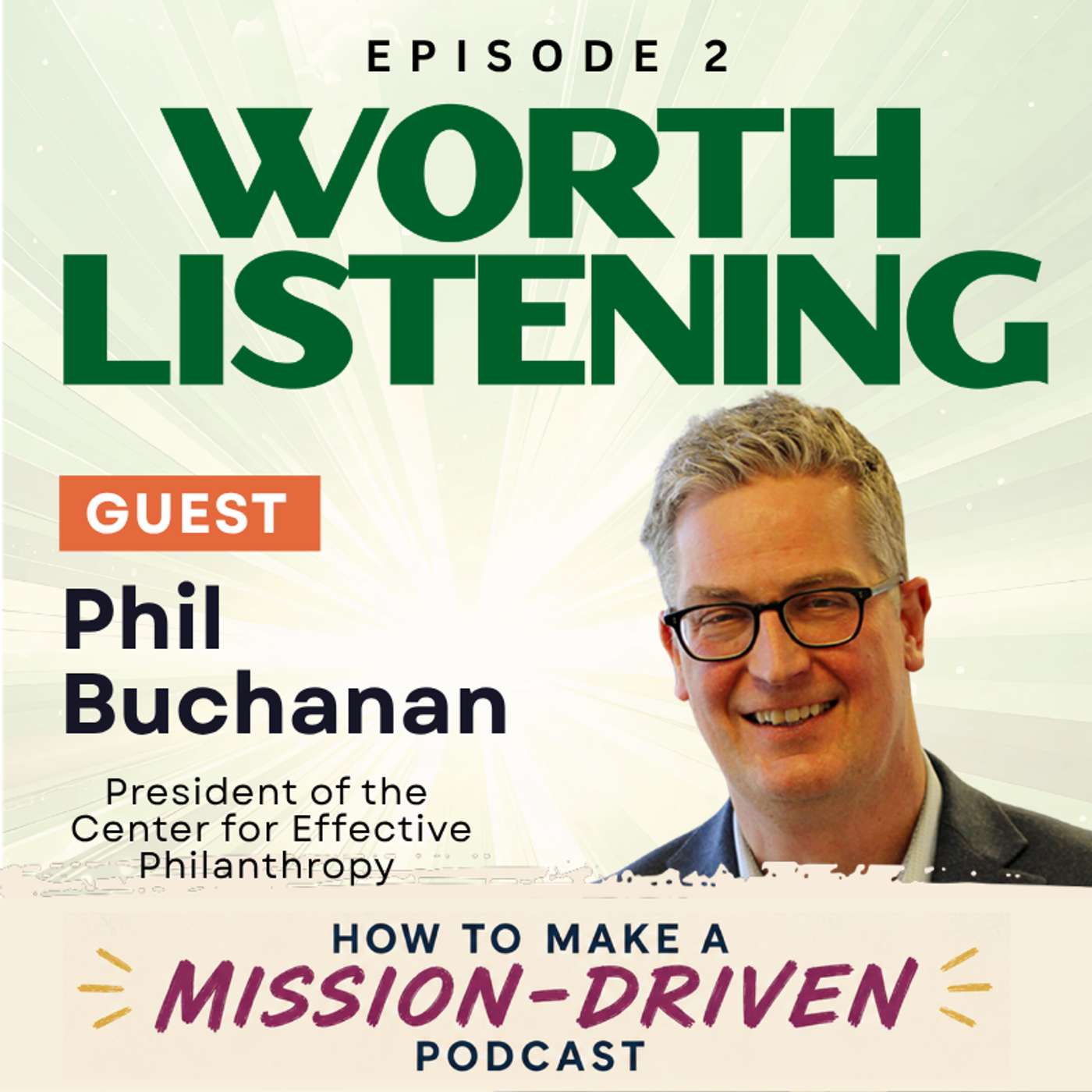
Worth Listening: How to Make a Mission-Driven Podcast · Next Chapter Podcasts & Voxtopica
Giving Done Right started during the pandemic and was recorded in a dining room and a closet. Phil Buchanan, president of the Center for Effective Philanthropy (CEP), explains how the show reached its sixth season with help from the Chronicle of Philanthropy and a network of donor advisors. He covers what hosting takes in time and staff, why CEP hired an outside producer, and the two things he would tell any nonprofit starting a podcast. Phil Buchanan, president of the Center for Effective Philanthropy, says a nonprofit starting a podcast should do two things first. It should find an experienced producer and line up distribution partners who will put the show in front of its audience. His own show, Giving Done Right, is in its sixth season at 10 or 11 episodes a year, and it reaches donors through the Chronicle of Philanthropy, wealth advisors, donor-advised fund providers, and community foundations. Buchanan joined CEP as its first employee in 2001. He started the podcast during the pandemic to carry the ideas in his 2019 book of the same name to a wider audience. He tells JT and Richard how the audience grew to include foundation staff, how a season is made within a five-week recording window, and what an outside evaluation could and couldn’t show about the podcast’s impact. Key points Buchanan said the Chronicle of Philanthropy posts each Giving Done Right episode on its website the day after it reaches podcast apps and promotes it in its email. The Chronicle has no role in producing the show. After CEP saw how many foundation staff were listening, it changed how it describes the show. Buchanan said it is now for “anyone who gets to give money away,” whether an individual donor, a program officer, or a foundation president. CEP records almost all of a season’s episodes in about five weeks. Buchanan said this means a longer wait between recording and release but frees him for the rest of his job, and timely episodes get turned around quickly while less time-sensitive ones are released later. Buchanan doesn’t send guests interview questions in advance because he worries they’ll script their answers. He sends a few bullet points on topics instead. A third-party evaluation by Impact Architects found some evidence that the show’s stories influence how listeners give. Buchanan noted the limitation: only listeners willing to be interviewed or surveyed are counted, and a show can’t identify everyone who listens. About Phil Buchanan Phil Buchanan is president of the Center for Effective Philanthropy, which he joined as its first employee in 2001. CEP now has 60 staff in Cambridge and San Francisco and does research and advisory work for funders, including its Grantee Perception Report. Buchanan wrote Giving Done Right (2019) and hosts the podcast of the same name. Mentioned in this episode Center for Effective Philanthropy Giving Done Right podcast and book Giving Done Right, Season 6, Episode 2, with KaBOOM! CEO Lysa Ratliff The Chronicle of...
Worth Listening — Episode 002 Transcript (auto-generated, no speaker labels) [00:00:00] Welcome to Worth Listening. How to Make a Mission Driven Podcast. I'm JT Jeremiah Tittle. And I'm Richard Fawal. And today we're speaking with Phil Buchanan, president of the Center for Effective Philanthropy and host of the podcast, Giving Done Right. Giving Done Right just started its sixth season and I have to say I'm hooked. It's a really fantastic show. So thank you so much for joining us today, Phil. Thank you both, JT and Richard for having me. I just want to establish a bit of background. Tell us, or tell the audience a bit about the Center for Effective Philanthropy, what you do, and maybe how you got started there. - Yeah, sure. I was a first employee hired. in 2001 actually. And it was a founding board, actually kind of the dysfunctional founding board, which is a whole other story maybe for a different podcast. and We... began developing resources initially it was large private foundations in the US. Now the audience that we've defined for ourselves is much broader than that. And I think we'll get to that in the context of the podcast. But that's how we started out. And we created a variety of different [00:01:20] assessment and advisory services. I think the thing we were known for initially was A survey we would do of nonprofits and that we still do is called the grantee perception report. Their experience with funders, which we put in a comparative context. So it's a way for a big foundation, which tends to be surrounded by people who. tell them what they think they want to hear to actually get candid comparative feedback. And that became widely used. We developed a research agenda. We do research on all the topics that folks struggle with about philanthropic effectiveness. how does strategy look different in a philanthropic context. We did a big research project recently on Mackenzie Scott's giving, you know, We all know who she is, I think. Her massive unrestricted gifts to nonprofits, what happened. when those organizations received those gifts. And we developed other resources over the years, regular conference. webinars, blog. different kinds of ways for folks to access both networks and information. that would help them be better at giving money away. morphed a bit. in the sort of 2017, 18, 19 time period to, okay, not just foundations. And by then we were working with foundations of lots of different shapes and sizes all around the world. But how do we also reach individual donors with some of what we've come. [00:02:47] to know about what it takes to be effective. [00:02:50] freaking awesome man. You've been doing this for a long time, right? So you've been there since when? I started when I was 10. No, I've been there since 2001, so it's been 25 years. And we were just two, three, four staff initially, and now we're 60 staff in Cambridge and San Francisco. We have one colleague who works in Europe with our European clients. She's based in Spain. Um. So yeah, we've grown and developed, added the different. [AUD to the sort of suite of resources that we provide to funders. That's fantastic. Really, really fascinating. All right, let's now get to the reason we're here. Which is... giving done right. Tell us the origin story of how you guys decided to do a podcast. Yeah. So. Giving to Unwrite the podcast, shares its name with a book I wrote that came out in 2019. also called Giving Done Right. We're not very good at thinking of new titles for things. (laughing) - We're great at branding, one of the two. - Yeah, we're on message. - Here you go. [00:04:08] book was an attempt to distill. what we had learned over our years of work, about what it takes to be good at giving. And it was targeted toward individual donors, but it's also, I think, relevant for those whose job it is to give money away at foundations or whatever. And that was motivated by... a sense of frustration that I had with watching donors make the same predictable mistakes. you know, thinking that like, oh, I made my money in Silicon Valley and now I'll Now I'll take my brilliance and I'll use it to like, you know, disrupt hunger as if, you know, it's Uber disrupting the taxi business, you know, and not recognizing that. These are the toughest problems that nonprofits are working on. They are... often the problems that have defied government. and market solutions. And so it's not so easy and you're not gonna learn everything you need to know about being a good philanthropist by reading Harvard Business Review. Like you need... to understand the nonprofit sector, the unique challenges of the work that nonprofits do. the uniquely complicated and interdependent nature of many of our most vexing social problems. So frustration was a motivation for the book, but so also then was the flip side of that, the inspiration. [00:05:28] of seeing what it looks like when folks really do give effectively. the kind of change that can be made. And I believe, you know, at least in this country, which is the place that I know best, that many of the good things we take for granted. clean air. clean water. trails to walk on. [00:05:49] basic human rights. don't exist for everyone in the way they should. But the progress that we've made. [00:05:57] culture, resources for kids after school who don't have somewhere to go. Like so many of these things are nonprofit stories, nonprofits funded by philanthropy. So So we put out the book, the pandemic hit. You know, and honestly, we were just sitting around thinking like, what do we do now? Like we're not wasting all our time commuting anymore. No, actually I like being in the office. So I just want to make that clear to my colleagues. But, but, uh, you know, we, we couldn't have the conference that we were planning. Uh, well, what do we do to get our message out? How do we build on the book and reach people? reached donors, it felt like philanthropy was especially crucial in that moment, kind of like the way it feels right now, again to me with a different kind of crisis. And so I said to my colleague, Grace Nicolette, who was for 15 years until just a couple of months ago. my close colleague and for much of that time, our vice president for programming external relations, you know, what if we, what have we did a podcast? And she was open to the idea and... again, because of the number of things we'd had to stop doing because of the pandemic, we kind of had the time and energy to be able to do it. [00:07:17] And so we decided to do it as a sort of experiment and as a way to try to continue. build out this new emphasis on trying to reach individual donors. And so that was That's morphed a little bit since, but... in terms of the audience definition, but that was the initial audience definition. And if you listen to the first... season, you know, it's very low quality in the sense that like, you know, Grace was in her closet, you know, trying to hide from her young kids in the middle of the pandemic. You know, I was in my dining room. You know, it was a little bit more. Yeah, we were just beginning, but we kind of built it from there. [00:07:57] The amount of podcasts hosts we've had to talk into the closet. as a method for actually improving quality is quite commonplace, I'd say at this point. Yeah, into the literal closet. Yeah, exactly. Just to be clear. We are not talking about the metaphorical closet here. Yeah, very sure we are being very literal. But it's a great way to dampen the sound. And maybe we learned it from the pandemic, but it's-- It hasn't gotten old for me, although we're getting into the studio more and more these days. But I wanted to ask you a little bit more about the process at CEP. I love hearing about the podcast, but we're talking to folks who are maybe podcast curious. And so your process, how you got from season one to now season six is really interesting to me. But getting into the nitty-gritty, how do you see the podcast as a means of helping CEP achieve its mission? Are there any specific examples maybe how the podcast has served CEP directly? Yeah, I mean... It's such a good question. I mean, I And I probably under-emphasize this in my description of CEP, but we're all about data here. You know, a lot of what we do is developing data that we play back to funders. [00:09:15] And I have, you know, come to believe that. as I've heard. others say this is certainly not. an original expression of mind, but that it's like no, no data without stories, no stories without. data, like in terms of influencing people. And I think we were sort of. short on stories in the early years of our existence. And that podcast became a way to humanize, personify, tell the story of Um donors who were being really thoughtful or donors who learned from mistakes so that others could recognize that they don't wanna make that same mistake and benefit from that. or just stories of nonprofit leaders that would illustrate. for donors, just how challenging that job can often be. I often say it's... takes everything it takes to. run a nonprofit that it takes to run an equivalent size business and a lot more. Well, how do you explain that to people? Me saying that like sounds cute. me talking to a nonprofit leader who describes what her job is like, you know, the all of the different things that she has to balance is just a better way, you know, to illustrate the point. So. [00:10:39] I think that... We've seen that, you know, that we've seen people use the podcast. as a way. to talk as a family about their philanthropy. We've seen folks at foundations use it as a way get their staff talking or their. FOUR- We've, you know, we've, we've gotten a lot of feedback about people finding it practical and useful. We also hope it inspires them, right? Like to do more, like you can actually. make it a difference in a community. So, you know, we try to have like a range of different people on so Um You know, we had Jeremy Lin, the NBA star known for, you know, Lin sanity and apparently was for a period of time the most popular human being on planet earth. you know, and he talks about like, Why does he? care so much about trying to. do more than just be. known as a great basketball player, you know, why does he want to give back and what has he learned about that? We have... [00:11:55] you know, nonprofit. leaders like person who described leading a community health organization in Texas in the middle of the pandemic and just how challenging that was, or we'll have a foundation president like Mark Sisman of the Gates Foundation in the in the days after, you know, or months after the dismantling of USAID, like what did that mean for... countries and communities impacted and what could donors. do to try to make a difference, even as obviously you can't make up all of that lost funding. And in a funny way, like, you know, we judge obviously by like listenership and we, I mean, we can get into this. We did like a formal evaluation with a third party recently. But it's hard to know what the return is. It's hard to know in some definitive... you know, in complete way. But one of the things that I would... is that it's meet us better? in other aspects of our work. Like I am a better public speaker at a conference about philanthropy because I draw on those stories and those interviews that I've done, right? I think it's changed my orientation to communication even. So it... [00:13:20] You worry about it because you worry about like, is this just like. Are we doing this because I really find it fun? You know, like, and the only person I had to pitch because I'm the president of the org, like. You know, we had the money for it. And so I just sort of informed the board chair. Well, I was really lucky my board chair hosts a podcast, you know, so he was like, yeah, do it. You know, I had like a receptive that he's not the board chair anymore. But, you know, I had a receptive kind of audience. And in the scale. of, you know, it's time. It's not a huge amount of expense, you know, relative to our budget. Interesting. I want to circle back to something that you mentioned earlier because this is one of the things that I know with the nonprofits that we've worked with. over the last, I guess, six, seven years now. um [00:14:10] One of the things we have to talk to them a lot about is who's your audience for this podcast? Very often they just sort of come into the podcast and go, "Well, yeah, this is what we do, and so here's our podcast." And we have to sort of pull them back a little bit and say, no, this you know, to a certain extent, it's entertainment to a certain extent, it's performance, you really have to think about your audience and who they are. And a minute ago, you mentioned that the audience, you know, when you started has sort of evolved. over time. And I wanted to ask you, like, was how did that evolution happen? Where, what was, who's the audience initially and who is it now? And was that an audience that Were the audience, you followed the audience or did you decide that the audience needed to change? I think it's more the former in the sense that like we... We thought, okay, this is a podcast for individual donors. And we definitely reach a lot of individual donors. And by the way, like. How do you reach people is like super challenging, right? Because I mean, I did say when Grace and I were talking about whether we should start this. I said that I worried that there were more podcasts. than people who listen to podcasts. And one of my kids... set at one point like. just what the world needs like another white guy with a podcast. I mean, she was just messing around. - Out of the nails of babes. - Yeah, it's kind of funny. Anyway, so. [00:15:35] So. We thought, okay, we can reach individual donors and. Partnerships were key to us reaching our audience. They're not going stumble onto you. So it's using our relationships with wealth advisors. donor advice fund providers, community foundations that started to push it out as a resource because they, it made their job easier. They're trying to educate donors about effective philanthropy. Well, let's use this podcast. So. Another partnership that was really crucial to us from the beginning is the Chronicle of Philanthropy, which is like... Um, you know, [00:16:16] probably the leading trade publication said, oh, we would love to host it. on our site. So even though it's, they're quite clear, it's, they have nothing to do with a day after the podcast goes out on the. [00:16:29] podcast apps, it's up on their website and they run a little blurb about it and they push it out in their. So all of that was really helpful to us. And then we realized, oh, a lot of foundation folks. are listening to this podcast. And so let's recognize that and be more deliberate about saying, And this is a more recent change in terms of like the way we describe it. This podcast is for anyone who has to. Anyone who gets to give money away, you know, anyone who's doing philanthropy, whether because they're doing it personally or because whether it's their job, you know, or because it's their job as a program officer or president of a foundation. And I do think. that the content is relevant to both audiences. And so we decided to just make that explicit. and broaden that out. That's beautiful. I love a good partnership like that. It's something that oftentimes when we're in the early stages of building a podcast and we talk to talent or the client and think about those things, who are the aligned potential partners here? It sounds like that one was a perfect fit and I think tremendous advice. [00:17:45] for those out there that are considering how do they grow an audience, how do they find their audience? Because those... Those are the toughest things to do. uh... when you're trying to put everything together. But I was curious, how did your expectations of hosting sort of match the reality? Oh, it's more work than I thought it would be. I mean, because I, you know. And it's sort of guest dependent, right? Like because some guests, I feel like, okay, I don't really need to prepare. Like I know this person, I know their work. I mean, I need to prepare, but not in a big way. And then there's other folks, you know, you have. someone on who's interesting and they've written a book and you realize, oh my gosh, it's three days before, you know, I'm interviewing this person. I got to read the book, you know, like, um, So I think the preparation. and time commitment is bigger than I expected. [00:18:39] Let's see that that would be one one thing I learned. Another thing I learned is that it's more work like for all my colleagues than I thought it would be, you know. Like a typical person in a. in a role like mine, I'm like, oh, how much work could it be? And then they're like, well, it's actually a... a shit ton of work, you know, like there's the episode descriptions and there's the managing the relationship with the various partners and there's the email blast and. There's a million things. Now, we initially, we were doing that a lot of that in-house. I had a colleague who basically just like taught herself to be a podcast producer, and then... Eventually, I had like an intervention with her and I was like, You're great at this because she's somebody who's like great at everything. Like she's the ultimate generalist. She can do anything. I'm like, that's not the highest and best use of you. Let's outsource the production to somebody who does this regularly. and time. And I think she recognized, yeah, that makes sense. And I mean, it was cool. She got to learn this new skill and she did a great job. But like when we outsourced the... production and we work with a great production company and our producer has taken on more of the writing associated with the podcast and stuff and that's been. [00:20:02] That's been huge. Yeah, it's just like a lot of work. Even just like scheduling guests, you know, takes time, right? All this stuff. So I think it's not to be gone into lightly. Like you got to be committed to actually doing it. But that said, the kind of flip side, the positive piece is it's like more fun than I expected. Like it's super fun to hear people's stories. And actually it changes your relationship with someone after you interviewed them. Like sometimes we have on. people I've never talked to before. Like I interviewed someone today for the podcast who's... Someone I've watched on TV a lot, but I had never met her. It was kind of cool to meet her. other times. I'm interviewing someone like I've known for a long time. I know they've got an important story to tell their work is really interesting, but then you learn things about them, you know, in that interview that. didn't know, you know, and you didn't know the things that you didn't know. So that's just fun from a sort of human relationship and learning standpoint. Yeah, that's great to hear because it's one of the things that We often tell our clients and the people that we're working with this like, this is going to be more work than you think it is, right? Yes. We get approached a lot. I think, JT, this happens to you. Do we get approached by a lot of folks who are like, oh, we just need somebody to edit the audio. We've got everything else. And we're like, OK, are you sure about that? And often we'll help them with the audio. And then-- [00:21:28] three months into it, they're like, please help us with all of these other things because it's a lot of work. Yeah. Like I think it's really interesting that you say that because when we started, I think it was season four using a like an outside producer, I think. Initially, we were sort of like that we only need you to do this and that. And it's only over time that I've realized how much I can learn from him. And I think only over time did he learn that we actually wanted to learn from him. Right. And so, so now it's, it's a really different relationship where like, you know, we were recording an episode yesterday where [00:22:08] It's a nonprofit leader who's been. dealing with just brutal challenges related to federal funding cuts, related to being targeted simply for what they do. I mean, it's just a really stark illustration of the stuff that's happening right now. And he will now say to me like beforehand, "Hey, Phil, I suggest that you start go straight into the story of what she's dealing with. work in the context and the background later. Don't start by asking her like. about our organization because his story is really compelling. Get right into it in the first 10 minutes, you know, and it's like, it took a while for us to have that relationship where like he knows that I'm receptive to that kind of. 'Cause I'm not a pro in this. I don't know what I'm doing. He knows I'm receptive to that coaching. And I know that I have a ton to learn about this. So it's been fun. to try to get better at I would just add real quick. I loved the CEO, Lisa. of Kaboom. Oh yeah. And you just jumped right into it. It's something that I maybe I just wasn't expecting that conversation with episode two to episode two of season six here is. Yeah, just jumping right into the timeliness of it all. It just felt very fresh and like responsive to what's actually happening in the world today. [00:23:32] Yeah, yeah, yeah, she's someone. where I benefit from the fact that I have some history with her. So I think there's a certain kind of openness and comfort that can come with that. Yeah. Well, listen, because our audience is-- is made up of people who work at nonprofits and other mission driven organizations, some of whom may have a podcast, many of whom are thinking about a podcast. Let's get a little technical for just a second if you don't mind. Very quickly, walk us through now today, what's the process of making this show? How does making your show, and your show is seasonal. So you're not doing an episode every week or an episode every other week. You're doing blocks of time. But just to give others a sense of sort of how you go through this process, just walk us through it really quickly if you don't mind. Okay, I should have been prepared for this question. Let me try to do this concisely. I mean, you know. because of the nature of my job and the amount of travel that I have to do. We do try to compress. compress it into a certain period of time, right? So I think for this latest season, [00:24:43] we started talking about who might be good guests. What issues did we wanna cover? in like May, June, you know, and then started. started inviting folks. uh, around that time, early July, and we line up, you know, the interviews. such that we record almost all the episodes within like a five week period or so. So that has its pros and cons. I mean, the con is that there's a... longer lag between when you record and when it comes out. The pro is that then it's done and you know, you can get on with the other stuff. So, and then we try. I mean, we recorded today an episode that actually is quite timely. So we'll just. turn that one around quickly and put some of the other more kind of timeless ones later. But anyway, so the scheduling is always like a [00:25:42] It's hard, get those locked in 'cause it's gotta work for the producer. It's gotta work for me. In the past when Grace was co-hosting her too and the guest. And then we do some background research. on the person. I don't like to send, I don't know what you guys' philosophy on this is. I don't like to send guests like. questions. because then I fear that they're gonna like script themselves with the answers. And then it's gonna be stilted and no fun whatsoever. So I send an email kind of like what you guys did with just a few, with me, just a few bullet points of these are some of the things I wanna cover. Um usually that's fine. Sometimes you'll have people like they're nervous. They want more, you know, and you sort of have to reassure them, especially when it's like. as well sometimes. We'll have people who are like household names on the podcast. Like, you know, we have an interview. He's at least a household name in the nonprofit sector with Bryan Stevenson of the Equal Justice Initiative, which is, I was like, so excited to be able to talk to him. But then we'll also have an interview with someone who runs. you know uh... [00:26:59] $2 million budget community organization in a in a small city or whatever the particulars are. person might not have done a lot of things like this before. And they might ask for like, you know, give me more. And I have to say, no, you're going to be great. Like, you know, everything you need Anyway, so yeah, so then we get the guests lined up, we get the research done, we get the email out about like what we're gonna talk about. And then our producer cleans it up and edits it and... And then we have all the collateral marketing stuff that we got to work out and... and get ready and on and you know, and then we have to think about the order like. I think I'd delude myself. Like there probably aren't that many people are listening like each week. for like the arc of the season, you know, but I do kind of think about like, okay, well, like this isn't like Lisa Ratliff, who you mentioned. Runs a big national org. You know, and we started with a couple that's that are funders that are giving away half their. net worth in five years. That was our first episode. And then I wanted a nonprofit perspective after that. And then the next one is a little bit more theoretical. It's a bit of a debate about how much to spend, how quickly to spend and short term versus long term. So you try to think about sort of the rhythm of the season such that people are getting a variety of different. [00:28:25] perspectives, you know, I. Um. somebody coming up who's more of like a conservative. thinker who's like a bit of a critic of big foundations and he and I have pretty different perspectives on some things, but that one's a little bit more of a debaty kind of format. And anyway, so thinking about the order and the sequencing of it. That's, I don't know, that's kind of like how I would describe the arc of the work. But it gets kind of front loaded and then the episodes come out and there's less work for me anyway after they're all like in the camp. Yeah. How many episodes? How many episodes do you do a year, roughly? I mean, it's varied. We're just doing 10, possibly 11 this year. And I know, I mean, I know that's like nothing compared to people who put out, you know. 40 a year or whatever, but it's just like. It feels like the responsible number for us to do well given. that we have a lot of other stuff going on and this is not like my full-time job. Yeah. Yeah. Yeah. Of course. Well, on the advice front, Richard, I want to take it here. [00:29:39] When does it make sense for a nonprofit to consider podcasting? And when should they not in your opinion? That's such a great question. I mean, I'm sure you guys, I'd be really curious how you guys would answer that question. I mean, I'll start and say, you know. Like I think we had a hypothesis that stories and examples... from donors and nonprofits could influence our audience. approach their work differently. Um. Like I said We did have a third party evaluation by a little firm called Impact Architects that did a great job and did a bunch of interviews and surveys for us. they found some evidence that that was true. Then again, who's going to agree to an interview or a survey? You know, it's the people who. Like it's not like you can just survey the population of listeners, right? You can't identify who they are. So it's a hard thing to evaluate, but I think we have some evidence to suggest that that's. true. I don't. So I think-- being clear about your purpose. and why a podcast for that purpose. is really important. What are the... [00:30:54] And I think for us, it was like something was missing. We felt like we could... we could use stories in a different way and compliment the data that we have and that it might have... influence on folks to give more and to give more effectively as we define it. Um. I think nonprofits should try to answer those questions for themselves. You know, exactly what is the thing, who are we trying to influence? and in what way? And would a podcast be the best avenue for that? Or might it be something else more straightforward, like... [00:31:29] a gathering or emails or a media strategy. So, Yeah, and I don't think you'll ever know for sure exactly whether you're achieving your goals, but I think you should try to know as much as you can about what your goals are. and what, and get some evidence as to whether you think you're on the right path. I don't know. Would you guys answer differently? I'm curious. I mean, I'll start and just say, no, like that is the conversation that we have with every prospective client that we ever have. which is, okay, what are your goals? What is it you want to accomplish? And then who is it you're trying to reach? And we have had clients where those conversations have led us to say, I don't think podcast is really what you're looking for, right? It's your goal and your audience. You should spend this money elsewhere to achieve that goal with this particular audience. um oftentimes What that really helps us figure out is, okay, what kind of show should this be, right? Everyone defaults to the interview style show, which is what we're doing here and it's what you do, Phil. It's the easiest to make. - Right. It's the cheapest to make. It's still a lot of work. But we have definitely had conversations with clients. [00:32:46] where that goal that they have and that audience they're trying to reach really works better if they're doing some sort of narrative storytelling. And our reaction to those is like, what you really need is 10 episodes with a story arc that tell the story you're trying to tell. in these 10 episodes where you, you know, one of the things we do is we always talk about three acts, right? So, you know, you wanna, we're gonna, in the first two episodes, we're gonna establish the problem and really explain the problem. And in the next few episodes, we're gonna really explain what the solution that you're proposing to this problem is. And then we're gonna end this with a few episodes that talk about how this strategy, how this, how this solution should be implemented. talk to your lawmakers or sort of petition, whatever it is. And that's your eight to 10 episodes. But what this podcast is, any podcast is, for a mission-driven organization or a nonprofit is... What are your goals? Who is the audience? And answering those questions should define everything that comes after within what you think you want to do with the podcast. That's how I'd answer it. - I would just add... And we just add the idea that Let's say your social is lacking. you know, kind of a good representation of whether it's the CEO or. [00:34:04] brand ambassadors or whatever figure heads or storytellers you may have already in house. um Maybe this is a way to get that storytelling out there. I really like what you said earlier, Phil, about-- sort of how you could kind of up your game in the storytelling to match the data. And maybe I don't want to take it out of context exactly how you said it, but I just feel like You saw the opportunity there to really kind of-- you know, fill in that gap. We work with a history museum in North Carolina and they were between buildings. And so it was a real benefit to them to kick off where we're now about to do a fourth season with them launching in November. And they just had found so much value in the storytelling. and the digital footprint that they didn't have when their brick and mortar footprint was going to be gone temporarily for a number of years. It just added a lot of value for that reason in particular. to kind of just bring their voice. nationally, internationally, beyond just Charlotte, North Carolina. So yeah, I think it's really a case by case, but. I think there are a lot of... [00:35:21] There's a lot of opportunity in podcasting for nonprofits to be able to do the storytelling and for it to be living right there on their LinkedIn or Facebook, Meta, wherever. and not be something you have to walk in the door to hear that story. [00:35:40] Let's bring this to a close. I'm going to ask you one more question, Phil. Again, as somebody who's sort of an expert in this field, right? I know that you work mostly in what the center is really focused on is sort of the people on the giving side, right? You know, you have been doing this podcast for a while. It's highly successful. And it's, by the way, I'll just say it is incredibly well produced. That's one of the things that I mean, that's one things that you listen to when you work in this business is like it really gets sucked into the stories that you're telling and that your guests are touring, but I'm also like, this sounds fantastic. So. [00:36:21] My last question for you is if you were going to advise a nonprofit, what do you think was the first thing that they should do if they've already decided they're doing a podcast? What was your one piece of-- Here's what you should pay attention to when you're starting Well, first of all, thanks for that nice comment on the production. All credit there goes to... John Parati is his name, our producer whose company I think is now called Cold Italian. But also you guys, I'm sure are awesome at your jobs as producers as well, which leads to my answer, which is like, you know, find somebody. who knows how to do this. who can help you to do it well. I do think, I do think, You know, we were a little late to realize that and I, and I, I still feel like I owe my colleague Sarah Martin, who is the person I referenced earlier, who kind of turned herself into a podcast producer. I, I owe her kind of forever because I, we shouldn't have, we shouldn't have made her do that. You know, it's, it's, it's, it's a, it's a hard thing. And, and, uh, And yeah, I mean, she had some relevant experience and she was, like I said, really, really good at it, but like we needed her to be working on other stuff. And. [00:37:37] Yeah, that experience of like having done it a lot is, you know, and helping to be able to guide people. I think that's really important. And then the second thing I think we already touched on. but would be this question of distribution partners, you know, like. How will you break through? Because I know folks who've started podcasts that nobody listens to, right? And some of them like doing it anyway, which is totally fine, right? But I think if you're running a nonprofit and you're reporting to a board and you feel some accountability for the use of resources, then I think you got to push yourself like, "Okay, we define this purpose." It involves reaching this audience. Like how are we gonna do it? And I think it's easy to overestimate. like your own ability to just drive. Traffic like you actually need a lot of partners and people who who you kind of win over as ambassadors for. for the show and I think That can sometimes be guests, like guests can be really helpful. And you have a guest on who's got a great platform because their organization has a broad reach. [00:38:53] That'll help you a lot. But you really gotta think through that piece too. [00:39:00] Thank you so much for joining us today for all these insights. Really appreciate your time. I appreciate you guys talking with me. It was fun. Yeah. Thank you. Thanks. Thank you, Phil. All right. So if you like what you've heard on this podcast today, please share it with someone else that you know who's working in a mission driven organization who's communicating in that environment, who may be navigating some of these same questions and subscribe. Follow Worth Listening wherever you get your podcast. We'll be back in two weeks. to learn how the podcasting team at the Brookings Institution earned internal buy-in. [00:39:38] (upbeat music)
More Worth Listening: How to Make a Mission-Driven Podcast episodes →