
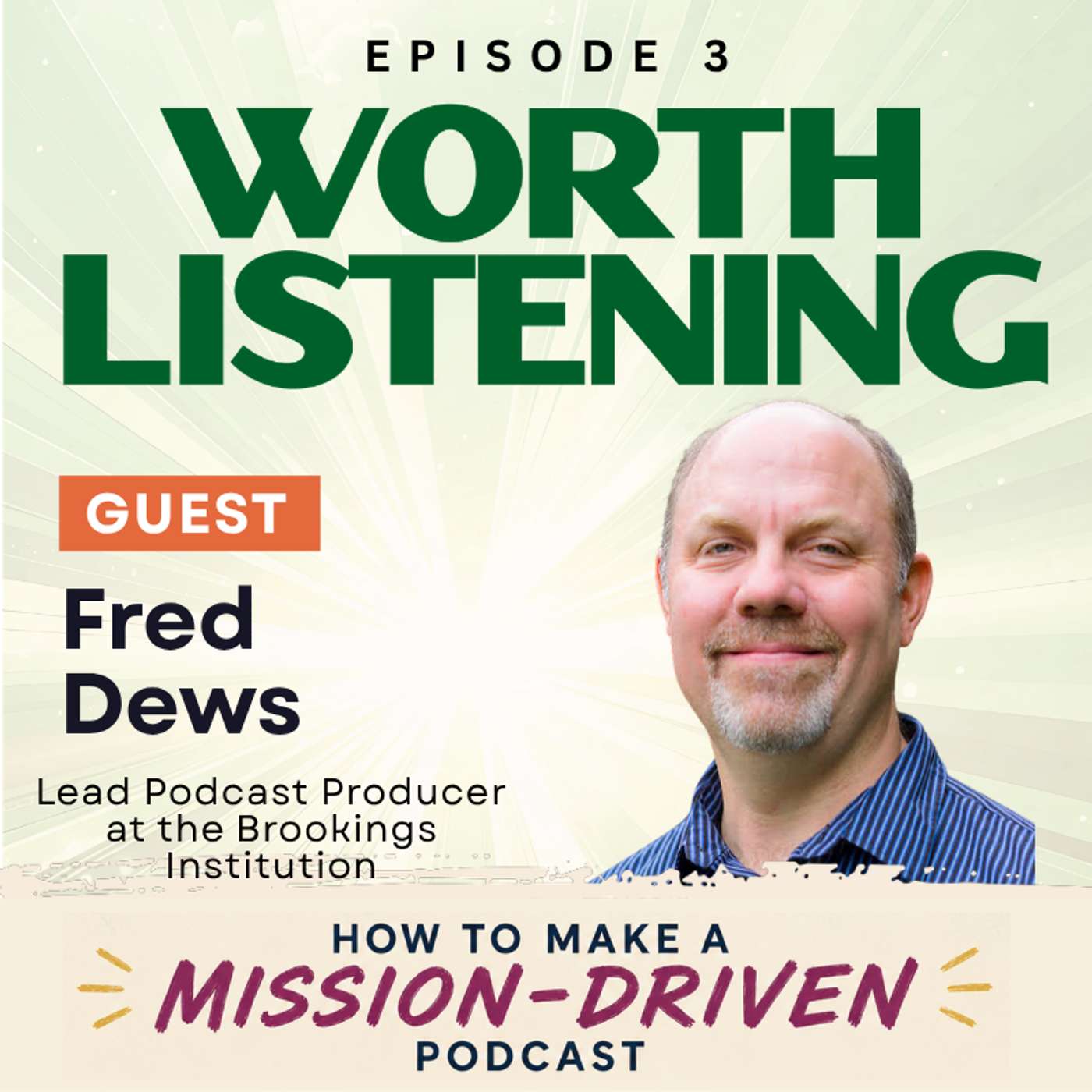
Worth Listening: How to Make a Mission-Driven Podcast · Next Chapter Podcasts & Voxtopica
The Brookings Institution started podcasting in 2013 with the Brookings Cafeteria, a weekly interview show first recorded in a makeshift studio. Fred Dews, lead podcast producer at Brookings, explains how that one show gave rise to seven shows covering multiple policy areas. He explains how a new show gets approved, how Brookings measures impact beyond downloads, and why podcasting hasn’t replaced any of its other channels. Brookings shows include The Beijing Brief and a show about rural America. Each one starts with a concept note from the scholars who want to make it. Fred tells JT and Richard how an internal team reviews each show’s results at the end of a season, and why his goal is to constantly learn more about how audiences use Brookings’ multimedia work. Key points A new Brookings show starts with a concept note from a scholar or program team. Dews said the note covers the host, format, release cadence, whether it’s a limited or ongoing series, and how it fits the scholar’s research plan, and senior leadership signs off before pre-production begins. Brookings looks beyond audio downloads to YouTube views of each full episode and the two or three vertical clips cut from most episodes, along with Instagram engagement and feedback that scholars hear at conferences. A group compares the results with success metrics set in pre-production, usually at the end of a season. Dews described a show with low download numbers whose host was approached at a conference by a senior government official from another country who had listened to an entire episode. Brookings wound down the Brookings Cafeteria after eight and a half years and more than 400 episodes. Dews said an internal study found scholars wanted shows on specific topics, and a weekly grab bag might interest a congressional staffer on a foreign affairs subcommittee in only one episode out of ten. Dews said podcasting hasn’t replaced any of Brookings’ other channels. Scholars still testify on Capitol Hill, speak at events, and publish books and papers, and a video crew may film a short vertical video with a scholar right after a hearing. In the listener mail segment, JT and Richard answer two questions from Rika: how an organization can tell the stories of vulnerable people such as refugees without exploiting them, and whether a limited series or an episodic show offers more value. About Fred Dews Fred Dews is the lead podcast producer at the Brookings Institution, where he is in his 30th year. He launched the Brookings Cafeteria in 2013 and hosted and produced more than 400 episodes before ending the show in 2022. The Academy of Podcasters named it Best News & Politics Podcast in 2015 and Best Education Podcast in 2017, and it was nominated for an Ambie in 2021. Coming up next: In two weeks, we’ll talk with Zoe Goldman, a podcast producer at Getty, about building a podcast program inside an art museum and making audio about art that listeners can’t see. If you found this episode helpful,...
[00:00:04] Jeremiah Tittle: Welcome to Worth Listening. I'm Jeremiah Tittle [00:00:08] Richard Fawal: and I'm Richard Fawal. Today we're speaking with Fred Dews, lead podcast producer at the Brookings Institution, one of the nation's oldest and most respected think tanks. [00:00:17] Jeremiah Tittle: Brookings has been podcasting since 2013 and currently has quite a few shows in its lineup. going to tell us about how he manages it all. Fred Dews. Welcome to Worth Listening. [00:00:29] Fred Dews: Thanks, JT. Thanks, Richard. Great to be here. [00:00:32] Jeremiah Tittle: Brookings is pretty famous, but just in case our audience isn't familiar, can you give us a quick rundown of what Brookings is and does? [00:00:41] Fred Dews: All right, uh Brookings is policy research organization known colloquially as a think tank. It's the home of about 100 resident Scholars, we call them senior fellows. They are experts across a wide range of policy issues domestically and globally. Uh and They research topics, they write papers. They participate in events, they're on podcasts, other multimedia. And The aim of Brookings is to reach decision makers with the best research on these policy issues to help drive. positive outcomes for the U.S. and for the world. [00:01:20] Richard Fawal: So all right, Brookings has a bunch of podcasts, but Let's start out by going back to the beginning. Tell us how podcasting got started at Brookings. And I have to give the audience a little bit of a disclaimer here because I worked with Fred at Brookings back when podcasting really got started there. So I know the story. But I want the audience to hear it from you, Fred. [00:01:38] Fred Dews: Right, Richard, you were there at the beginning. So I had been managing the Brookings website for 14 years coming into. 2012, 2013. A new vice president for communications, David Nassar, joined the team in fall of 2012, I think. And as new leaders do, he surveyed the landscape. He surveyed his team. And he saw me having been doing the job for 14 years that I was doing very well, but he wanted to shift. Um My work. And the question was: what is Fred going to do? Richard, I think you had joined the team by then as well. And you were actually set to take over as director of web operations. And so collaboratively, you and I and others on our team started talking about this phenomenon that wasn't new. But it was new to think tanks podcasting. And the decision was taken that we should have a podcast. Well, the question was: who should host the podcast? Uh and my name came up because I'd been at Brookings for a long time and worked with a lot of the scholars. And so over that summer of 2013, We developed a show that we eventually called the Brookings Cafeteria, a nod to the actual. That's here at the Brookings Institution on. Massachusetts Avenue. And We had an audio engineer on staff and I was able to Start setting up scripts and identifying a first guest. And so, again, collaboratively as a team, we identified the first few episodes, who the scholars would be, reached out to them. And in August of 2013, we sat down in a makeshift studio. And I did my first interview. And then we did another interview and another interview, and we kept going. And so started the Brookings Cafeteria podcast. [00:03:29] Jeremiah Tittle: How many shows is Brookings putting out now? Are you in charge of all of them? And what is the pod? How's the podcast team set up? I'm curious. [00:03:39] Fred Dews: All right. Well, to answer your first question, right now I have seven shows. in some state of production. Most of them are in production now. I'm publishing another one soon. That in pre- production, but that's getting to technical seven shows. Uh that I manage. There's another show that you would see on our page showing our podcast brookings.edu slash podcasts. that is produced by an outside company. So eight shows, seven of them. I'm the senior producer on, if you will. And it's a lot. And Uh we might get more into this later, but I used the word collaboratively earlier. And that's the word I will use again. Mm-hmm. Producing all these shows. [00:04:26] Richard Fawal: I want to get into that and sort of how all that's. But before we get there, I want to know. How shows get evaluated, right? So let's start with the new shows. Like, how does a new podcast typically come into being at Brookings? That is a great question. And there's different ways. Um [00:04:48] Fred Dews: Fundamentally, it starts with a scholar or a group of scholars here at Brookings. has an idea to do a show because they think that is a one good way to distribute their research and ideas. by talking about their research or by interviewing. Other experts in the field, experts at Brookings, experts not at Brookings. And starting to Put out their research and ideas in the multimedia space as opposed to the more traditional spaces. of Capitol Hill testimony reports events. Um So we would have. Scholar or their program team write what we call a concept note. Which they used to explain what the podcast would be about, who the host would be, what the format would be. For example, is it going to be an interview? going to be more narrative. They would talk about in that concept note what they expect the cadence would be. Do they want to do once a week, once every other week, once a month? Whether it's a limited series, we'll do eight episodes, whether they want to have it be an ongoing series. Uh they would talk about in this concept note. How it fits into their Overall research plan, Brookings scholars have A research plan that they follow. There's some connection to their funding. I won't get into that. So they come up with concept note, then I would assemble a larger team of people including Supervisor Multimedia here. Uh the scholar the scholars Team, research assistants. some of our communications and outreach people. And we would start to evaluate is this something that we could build a show around? Um We have ideas for a name. And do we have an expected launch date? Mm. kind of have to run all of this past our senior leadership, our vice presidents, but let's assume it gets greenlighted. Then we move into what we call pre-production. We come up with a show name. We come up with a show jingle. We come up with some show art. And so we start this iterative process, this collaborative process. Yeah. To get To the point where we've identified uh audiences and Outreach strategy and eventually a schedule, and then guests, and then the production calendar, and all of that good stuff. [00:07:19] Richard Fawal: That's a well-structured Sort of system when you have, like you said, I think over a hundred scholars at Brookings. Because just out of curiosity, like, How How likely is it if somebody brings you a plan, brings you a concept note, that that show ends up getting made? Are you doing 50-50 or is it just all over the place? [00:07:43] Fred Dews: I would say if they've gotten that far. Pretty likely. That we would execute on a show eventually. Um at some point They've had some discussions we're probably not privy to. in which they've established that doing a podcast is going to be part of their Their work plan, their research plan, their communications plan, more broadly speaking. That's great. [00:08:12] Jeremiah Tittle: Yeah, I was also curious in terms of news shows uh how much maybe the The writing begets the podcast versus the podcast becomes the opportunity to interview. smart people about important subjects that feeds sort of the the work. [00:08:30] Fred Dews: Um the written work potentially. Uh [00:08:33] Jeremiah Tittle: Kind of chick of the egg question, but I was just wondering if you encountered that one is more dominant than the other. [00:08:40] Fred Dews: That's a really interesting question. For the scholars who are doing podcasts. No matter what the format is, I think There is a relationship, obviously, to their. What you might call writing. The research that they do. whether it's going to become a book or a paper that's on our website. informs the kinds of activities are going to do in the multimedia space. Uh be it video or be it audio. Um There is a show we have and a scholar who hosts the show. Where His The show, the fact that he's hosting the show. research program. He talks to people around the country about issues in rural America. And that informs him on what people on the ground in rural spaces are thinking about economic development and so on. Um we have another show, the Beijing Brief. where the scholars are experts in US-China policy. Sometimes An episode might pretty close to something that they've written. Other times kind of research work that they do and the outputs they do or Connected obviously to the kind of guests they have and the people they talk to. But as experts, they are. participating in a lot of different kinds of digital channels. So it's not like the Episode itself is directly connected to the paper that they published last week. It could be. but it's just a reflection of the kind of things that they're thinking about. AI, for example, a lot of our Episodes of the Beijing Brief touch on aspects of the US-China competition in the AI space. And one of our scholars is an expert on these AI issues. Now he's he's doing a lot of activities. focused on this AI question. He comes on the podcast, he talks about that. doesn't have to connect directly to something he just wrote. [00:10:50] Jeremiah Tittle: And that's a constantly evolving situation. So even if it were the same people you spoke to last week. You know, Jiping comes to US soil and all sorts of new discussion points are, you know, revived, let's say, as it evolves. But I wanted to ask you a little bit, since Richard asked about how you evaluate concepts, turning them into podcasts, kind of the new frontier, what about existing shows? What are the metrics you're looking at? And how do you evaluate and measure a podcast against Brookings mission, I'm wondering. [00:11:25] Fred Dews: JT, the question on metrics, measuring impact as we might call it here at Brookings is really important. And I know you guys have talked about this on other episodes of Worth Listening. but we try to go beyond the simple metric. of the audio download. I know everybody wants to have huge downloads. But in the public policy space and the think tank space. We're trying to achieve something that we call impact, which we could have a whole other show about. Um we're not a uh We're not a talk show. We're not an entertainment show. We're here to Have our scholars talk about their research, their public policy ideas. So when we talk about measurement, Of a show or of episodes, we're looking at the broadest range of engagement possible. So we do look at those download metrics from our How many downloads to this episode get. But we're also looking at Views of the video of the full episode on YouTube. We also, for nearly all of our shows, extract Two, maybe three short vertical clips. We post those on YouTube. So we track The views of those, which typically get a lot more views than the full Video. you know, it's just an audio file, but in on the on the video platform. We look at Instagram engagement. We looked at then we looked at what we call attack data. Are our scholars going to a conference and somebody's coming up to them and saying, hey, I listened to your recent episode and it was great. So we factor that in. Um And so we're trying to build a more comprehensive view. of engagement with The media? Rather than just simple downloads. Again, collaboratively, we'll have a group of people come together usually at the end of a season of a show if we do seasons, and we'll talk about. Did we hit these? Metrics that we identified in our pre- production phase. I should have added that in that pre-production kind of Um Ideation phase. We talk about what success metrics might be, but now we're at the end of a show run or at Some halfway through a season or through the year, we're going to look at those. but look at that broad range of metrics and try to assess as a group. Is this good? Compared to what? I mean, obviously, again, not compared to biggest shows that you'll see on Apple Podcasts. Compared to Well, actually, maybe not even compared to anything, but are they achieving our Is the multimedia product that we're putting out there. reaching audiences that we care about? Are we hearing that? And then we look at the numbers and do the numbers seem to add up. And one of the shows that we did in the past few years. Pretty low download numbers for the raw audio. The scholar who hosted it told me. They were at conferences. For that topic area. And people came up to the scholar and said, I love that episode on whatever it was about. I listened to the whole thing. And this was a pretty high-level government official. uh from another country who was involved in that that policy space. That's fantastic. [00:14:39] Richard Fawal: One of the things that I'm so glad you said, and that we talk about to our clients and the people we work with all the time, is. How important is it to think about the metrics that define success during the planning phase? So that you know that both you are designing a show that can achieve those metrics, but also so that when you launch the show, you know what you're looking for, you know what you're trying to achieve. So often we talk to people who. Don't think about the metrics until the show is actually in release. And then they start going, well, how do we know if this is working? It's like, well, what do you want it to do? So I'm glad that you brought that up and said that so that our audience. can sort of internalize that and recognize how important that is. [00:15:29] Fred Dews: And I think it's important in our space, in the nonprofit organizational space, that we communicate those expectations ahead of time. Two stakeholders who might listen to a lot of great podcasts and they might be expecting massive download numbers. And so, what we have to do is design a program that says. We're not chasing. downloads. We are interested in Impact That we can measure across. a range of metrics beyond just the simple download. Impact. [00:16:02] Richard Fawal: It all comes down to impact. And that's when you're working in the mission-driven space, like that's what everybody is aiming for, right? Is to is that have some impact. Your mission is all about creating impact. Your podcast should be too. Now Let's talk a little bit about your sort of seven podcast empire that you're running over at Brookings. That is certainly not the norm for most mission-driven organizations. Brookings is unique in multiple levels, I know, but let's talk about. What? Benefits the organization, Brookings is saying. So, what benefits have you seen from building shows around the specific initiatives and the research that the scholars are doing? Versus sort of one overarching show, like most organizations are generally doing one overarching show that sort of covers everything that they're doing. What benefits have you seen around sort of Doing the siloed approach. Maybe siloed isn't the right word, but you know what I mean. Like focusing on these specific initiatives rather than just here's Brookings in a podcast. [00:17:08] Fred Dews: I'll start with the Brookings Cafeteria because that was Eight and a half years. the one overarching show I interviewed I did over 400 interviews. with scholars. every week. Could have been on any topic. And We ran kind of an internal Uh study. of podcasting needs and multimedia needs. And there was an interest across the organization for many scholars and programs. More specific Podcasting opportunities. So, yeah, the Brookings Cafeteria might be on tax policy this week and foreign policy the next week. uh some uh political issue the next week. But is that taking time and resources away from the ability to start to make? shows that we're more specifically tailored to policy interests. And we took the decision in Yeah. To wind down the Brookings Cafeteria so we could open up resources. we could free up my time. shows that were more Specific. So we did one on uh the Millennium Development Goals, for example. Now that's not still a policy issue that A wide swath of people care about, but for the people who care about it, it's super important. We have some of the top experts on. Uh now the sustainable development goals. And so we ran a show. speaking to that audience. We've kept up that. philosophy for the past few years. on a range of shows. Right now I have seven shows under production. But since the Brookings Cafeteria podcast, I think all told, I have published and or produced. 17 or 18 shows. including the ones I have now. And many of them were Limited runs. Some of them ended after a few seasons. And if you think about the media An information landscape. Day is as fractured as it's ever been. There are so many different sources of media everyone's listening to. and consuming different information even people who Be a lot like you in terms of Your politics and your social interests, and what sports team you like. Even if you go on the same platform. you're going to get different information. And I think having a variety of branded shows on specific policy issues. Kind of speaks to that. Where we can then Try to find the people. say the decision makers. Whoever however the decision makers, however we might define them. and the influencers on decision makers. With Episode content with video content with multimedia content. That's going to help them. better decisions. to help them learn more about a specific topic. You know, with with I love the Brookings Cafeteria. Uh I enjoyed hosting it for many years. But it was a grab bag. You never knew what you were going to get from week to week. And maybe say you work on Capitol Hill. And you're on a foreign policy subcommittee, a House Foreign Affairs Subcommittee on some specific topic. maybe one in ten of my episodes. been of interest to you. Uh now we have some shows if they're foreign policy based, we can more specifically target them to you. Knowing that our show content, our experts are going to speak to the issues that you care about. Now we have seven of them, so we're still covering a broad range of issues. A follow-up to that. [00:21:00] Richard Fawal: Do you think well? First, I'll ask this. Did the introduction of podcasting? And obviously, you've been at Brookings for now, what, 30 years? So you have seen. The Evolution of media overall since you started and have been through numerous like website redesigns. And the introduction of social media and the introduction of podcasting and all these different things that Brookings and Brookings scholars can use. Podcasting and the evolution of podcasting since the very beginning of the Brookings Cafeteria. Placed any communication channels that Brookings had been using? Or is it just sort of Cherry on top, you know, sort of just one more thing in the in the playbook of Brookings. [00:21:52] Fred Dews: I don't think it has replaced anything. Yeah. The advent of Email uh can Processing. Did that cut down on our paper usage? Absolutely not. burning through printers at a faster rate than ever. Um podcasting, multimedia in general. is just an evolution of One more channel. People use to get information. Sure, 30 years ago when I started at Brookings. We had events, we still have events. Uh scholars would go testify on Capitol Hill. They still do that. There's a level of more private briefings and communications and contacts that scholars have. With people Um we have books, we've always had books, white papers, policy briefs, that kind of those kind of publications. Mm-hmm. But over the But over time Technology changes. Media consumption habits change. diminish. I think if anything, we're all getting More information. For more channels. And we ever have. Yeah. Compared to 10 years ago, compared to 15 years ago. You might have been getting A lot of information from a couple of the political blogs. Some of the big news organizations were coming online. Maybe you were new in the podcast space. Today, you're still getting just as much information or even more information, but from a variety of channels. Uh that wherever you are, where you're traveling, how you're commuting to work. uh how you choose to spend your time on the weekend. And so on. [00:23:46] Jeremiah Tittle: Well, I think when you talk about the just hearing about Brookings' cafeteria and sort of the evolution of Offerings from Brookings in the podcast space specifically. Now you're talking about seven podcasts or 17 that you've touched over this period of time. So I'm just curious. What do you think? Did the podcast reach people that your other channels may miss? Is this something that you're noticing more and more, maybe interactive feedback at the conference from one of your podcast hosts? And how is it evolving, do you think, in terms of how people are consuming the podcast content? [00:24:23] Fred Dews: As you all know, I mean, multimedia is uh It's a broad spectrum medium. I mean, anybody can. To any podcast, they can go to YouTube, watch any video. And I think it's just meeting the moment. of where people are. There is still a Very important. Role for books. Yeah. written material. But how are those presented? You can buy a book, you can download a book, you can listen to an audio book. You can come to a Brookings event and pick up a copy of the paper. where you can find the PDF online or you might just consume a short video clip. And and maybe that'll induce you to go to the full paper. I see the multimedia Ecosystem as additive. And also use the word again, collaborative. With all these other Ways of talking about policy ideas, about research, and trying to reach audiences that all kind of reinforces the other. So we have A scholar go testify on Capitol Hill. That testimony will be on our website, but also we might send a small video crew to do a stand-up vertical video of that person right when they're finished. In the hearing room. Telling an audience who they are and what they just did. And to learn more, visit our website, brookings.edu. [00:25:51] Richard Fawal: All right, Fred, so what's next? What's the future for the Brookings Podcast Network look like? Oh [00:25:58] Fred Dews: That is a really good question. Uh with seven shows, I'm just trying to to figure out what's tomorrow. Part of the future is We're going to continue doing What we've been doing. One of the really important pieces for an organization like Brookings, or for any mission-driven organization. is to really understand that audience piece. And I would like to spend more time. trying to understand how our audiences are consuming. our multimedia offerings. How that interacts and reinforces all the other kinds of ways that they get Brookings research. And One of our watchwords is, and I kind of referenced this in Why talk about metrics is it's a focus on quality over quantity. And that has to do with both The metrics, again, not just focusing on the download. We're focusing on the you know, who is listening to or who is watching our multimedia content. But also the quality of the programming. you know, podcasting is such an intimate You have Headphones on usually. And you choose to download and listen to content creators offering You know, is it worth your time? Is it is it? informing you, is it making your day better, is it interesting? But is it high quality as well? [00:27:30] Richard Fawal: And you know, is it worth listening? You [00:27:35] Fred Dews: You will say, yes, you must say, is it worth listening to? Excellent. Um so the future of podcasting um I think we'll continue to have podcasts. podcast or audio and video format. And I think we're going to continue to think about and expand our understanding of audiences. Um And kind of what moves that impact needle, if you will. Fantastic. [00:28:02] Jeremiah Tittle: Fred, I knew we'd get along based on everything that Richard had shared before this, but when you drop a quality over quantity, you're ours for life. So thanks for joining us today. Really appreciate all these insights. [00:28:14] Fred Dews: Glad to be here. Thanks, Richard. [00:28:16] Jeremiah Tittle: Thank you. [00:28:17] Richard Fawal: Well, JT, I am so excited to tell you, man, that we are just, what, three episodes into the show and we've already got listener mail. Woohoo! So great news. I got some tough questions for you. So Rika wrote in to ask for our thoughts. This, okay, this is interesting, right? How do we handle ethical dilemmas faced by organizations that serve vulnerable people like refugees or survivors of domestic abuse? And how can an organization tell those stories in a podcast? Without seeming like they're taking advantage of people's situations. So I thought that was a fascinating question. I'd love to hear your take on it. [00:28:56] Jeremiah Tittle: It really is. And it actually made me think of my wife, her best friend growing up actually works with refugees. And so I. I wouldn't say I'd been firsthand, but maybe secondhand sort of understanding. it's like to aid those people. I've thought Since the beginning of understanding, kind of my wife's best childhood best friend, you know, what she does in the world, which is admirable work. that a podcast would be phenomenal. Um, I she's based in Germany, so it's uh with the language barrier. I haven't you know pushed for this in terms of the practicality of it all, but um, but I do think. There is the mission of trying to elevate these stories for the benefit of. I think public perception of understanding, people of differences, people coming from war-torn areas, sort of their plight. And, you know, I feel like the benefit of getting those stories out for people. Situations and people who I think are um While while it's very sensitive and treating it with sensitivity and empathy, et cetera, there may be some candidates or actualities that are a little bit more maybe comfortable telling the story and not as much maybe in danger in any way. I think you really have to make sure that the subjects, the actual humans that you're dealing with, they're okay. That's where you start. And then you graduate to okay. Can we tell the story? But not in a A gotcha situation, or that we're trying to take advantage, as the question came in from Rika, which I think is a really sensitive and smart question. But really, what's the mission? Back to what we often ask, always ask our partners, folks who approach us to. Their stories be told professionally through podcasting is that if the mission is to elevate these stories for some greater good. Then as long as that intention is pure and you remain with your um with all the work that goes into telling these stories with care. then I think you're on the right track and and and any of the the potential pitfalls, you you can kind of navigate those as long as you're being thoughtful about it throughout the process. [00:31:24] Richard Fawal: Yeah, that's I would agree. So Rika, my short answer. Is that as if you start with the place where what you're focused on is achieving the mission. and the stories you're telling and the people you're t you're talking about are R Are you supportive of that mission? You're probably going to be okay. But like JT said, you got to start with making sure that they're okay. Um And then you should be all right. If you start with the stories to try to raise You know, an audience's hackles, for example, right? Then you're probably approaching it the wrong way. All right, one more practical question. And I thought this was a good one. Rika asks, is there more value for a mission-driven organization in a limited series or an episodic podcast? I think Fred touched on this a little bit, but I'd love to hear your take on it, JT. [00:32:17] Jeremiah Tittle: My take is: I'm not going to answer it directly. I'm going to say it is Much more difficult to produce. Um A limited series, a narrative. Series Um And therefore The value to the Organization, the mission-driven organization, you have to keep in mind that. Some subversive or even in narrative, if you are being very direct in terms of the mission and the objective. Um, it's just so much harder to make narrative than it is to make an episodic podcast from my perspective. So, limited series, you're thinking about the last episode before you even start the first episode. Yes, you should do that in all cases, but I guess what I'm getting at is like it's much more complex, the limited series route. Than the episodic. So you're already making it harder for yourself, I think, out the gate. So value because you have to put so much energy and effort in. To a limited series, I think the greater value would be an episodic, but it's a case by case. [00:33:25] Richard Fawal: It very much case by case. And in in the work that we've done over the years we've found that You know, the limited series makes the most sense when there is a particular single story to tell. So in an episodic podcast, you're covering a topic over multiple episodes and that topic changes over time. And like Fred was saying, right, like when they were doing the Brookings Cafeteria, we sort of covered everything that Brookings was doing and it was a grab bag week by week. And so if you are working on, let's say, higher education, right? There's a lot of different topics you can talk about in an episodic podcast about higher education. And that those topics can change. You can do an episode on AI. You can do an episode on enrollment. You can do an episode on, you know, what are the best Degrees that students should be seeking, all of these different things. Mm-hmm. But with a limited series, which is a lot more work. If there's a single story, a single powerful, impactful story you want to tell, that's when a limited series makes sense. When you can tell a story that you can arc across six or eight or 10 episodes, right? That's that's a limited series. So. Well everybody, I hope you found this episode useful. Please share it with another mission-driven communicator who's navigating these same questions if you like what you've heard. [00:34:42] Jeremiah Tittle: And subscribe to Worth Listening, where we get your podcast. We'll be back in two weeks with more great conversations about mission-driven podcasting.
More Worth Listening: How to Make a Mission-Driven Podcast episodes →