
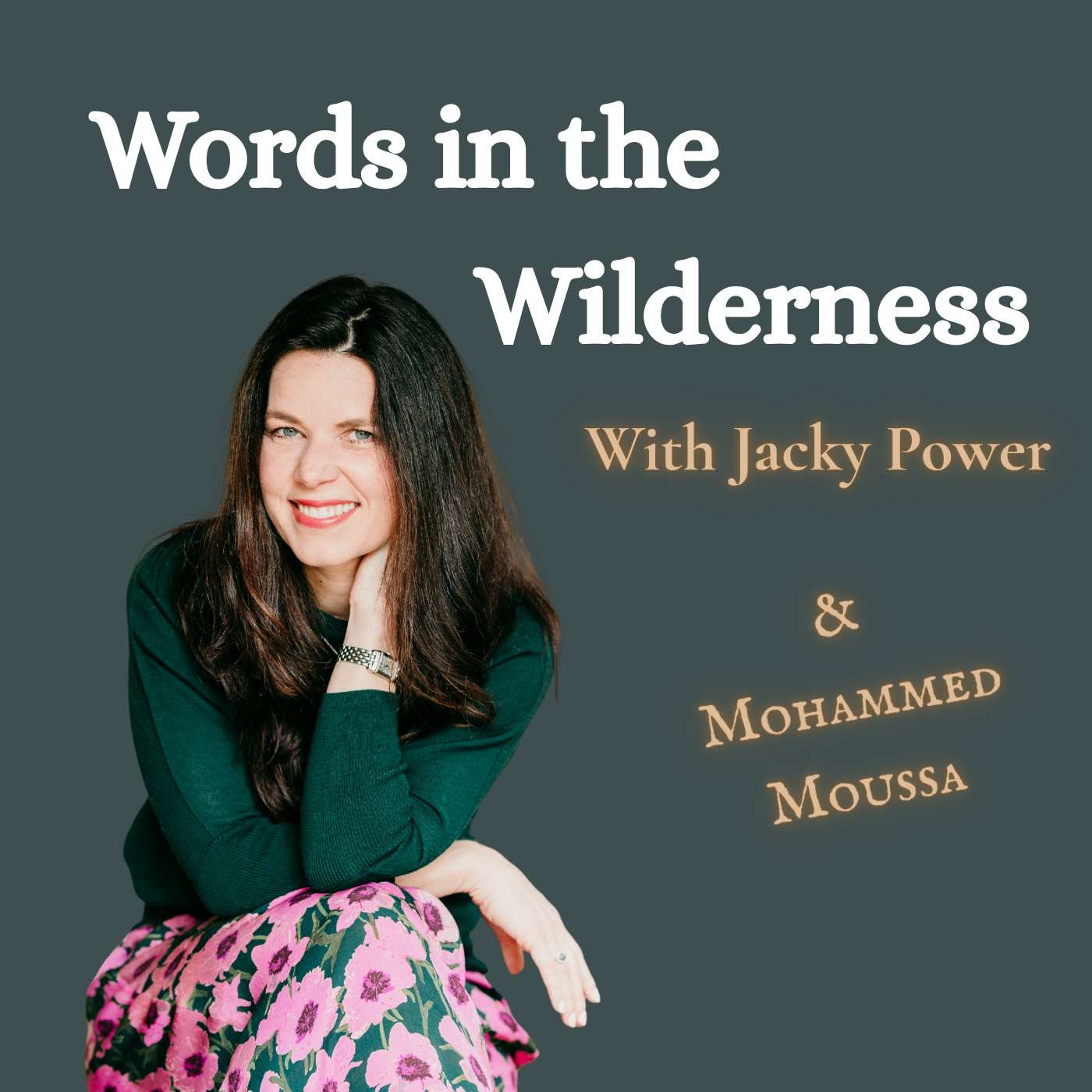
Words in the Wilderness · Jacky Power
In this episode, Jacky Power talks with Mohammed Moussa, a Palestinian poet, journalist, and founder of the Gaza Poets Society, about the role of poetry in bearing witness to displacement and grief, writing across English and Arabic, the link between place and memory, and the art of noticing. Moe reads from his forthcoming poetry collection, Where to Lay This Heart, and Jacky shares two of her own poems in response. About Moe Moussa Moe Moussa is a Palestinian poet and freelance journalist from the Gaza Strip, and the founder of the Gaza Poets Society (2018) and Gaza's Creative Allies. His poetry collections include Flamingo (2020), Salted Wounds (2023), My Death Is Not a Song for You to Sing (2025), and the forthcoming Where to Lay This Heart (2026). Substack (Moe Moussa): https://moemousa.substack.com/ Instagram (Moe Moussa, @gaza.guy): https://www.instagram.com/gaza.guy/ X / Twitter (@MoeMoussa25): https://x.com/MoeMoussa25 Gaza Poets Society Founded by Moe Moussa in 2018, the first spoken-word poetry community in the Gaza Strip, publishing and connecting Gazan poets with the international literary community. Website: https://www.gazapoets.org/ Substack: https://gazapoetssociety.substack.com/ Gaza's Creative Allies An international collective led by the Gaza Poets Society, uniting artists, writers, and creatives in solidarity with the Palestinian people. Substack: https://creativeallies.substack.com/ Instagram: https://www.instagram.com/gazascreativeallies/ The Book Where to Lay This Heart, Moe Moussa's fourth poetry collection, is due for release on 1 August as an e-book, published by the Gaza Poets Society. Readers interested in helping fund a print edition can get in touch via the Gaza Poets Society Substack. Poems Featured in This Episode "Tell It to the Sky" - Moe Moussa "Where to Lay This Heart" - Moe Moussa "Under the Same Sky" - Moe Moussa "Bulbs Not Bombs" - Jacky Power "Come Lie With Me" - Jacky Power "Beauty Within" - Jacky Power Follow me on Instagram: @the_therapeutic_poet Get my book Check out my website Join my Awakening To Presence course on Insight Timer Get my self-paced course: Permission To Feel Loneliness(Use the code TOGETHER for 10% off)
Words in the Wilderness - Episode with Moe Moussa Jacky Power: Welcome to another episode of Words in the Wilderness. I am really delighted to introduce my guest today, Moe Moussa, a Gazan poet and the founder of Gaza Poets Society and Gaza Creative Allies. Welcome - thank you so much for finding time to join me today for this conversation. Moe Moussa: Thank you, Jacky, for having me. It's always an honour to talk to you, and I'm really glad to see you again. Jacky Power: Glad to see you too. We met virtually last year, didn't we - just in the ether of the internet. I'd written some poems, and you had created Gaza Creative Allies, so I sent you some of those poems. You mentioned you were writing another poetry book, and we worked on that together - me going through some of the poems, helping edit, and so on. I was really struck by what was in those words. One of the poems in there talks almost about how poetry was betraying you, because you couldn't find the words to express what was going on. I often say poetry is a place we can come to, a space where we share our human experience - but yours seemed to turn that on its head. I'd love for you to talk about your experience of writing. You're not in Gaza anymore; you've been displaced, and you've lost many members of your family. Another thing that struck me in your poems was what you said about place - about how place is linked to memory. When you don't have the buildings or the places of community you used to have - the signposts, the landmarks - it isn't just those landmarks that are taken away, but the memories that existed with them. So I'd love to hear your thoughts on all of that. Moe Moussa: First of all, that's two questions, not one. Jacky Power: I know! You find that with me - I get enthusiastic, I talk too much, I ask too many questions, and then I say "discuss" and you're like, "what?" Moe Moussa: No - it's just that I need to focus. Sometimes I get lost when it comes to answering questions. To answer the first: I love poetry. I've loved reading and writing it from a very young age, as I've mentioned before. Studying English literature opened my eyes to literature more broadly - you read translated works, translated poetry into English, and it opened my eyes to poetry from around the world. Now, that's one thing - and being Palestinian is something else. No matter what you do, no matter the craft, no matter the art, it will always be political, in my opinion. So, why has poetry been a problem - or not a problem, honestly. I love poetry, and I am a journalist, but most of the time I find myself wanting to express my thoughts in a poetic way. I don't know how that happens - maybe because you read a lot of poetry, you don't read a lot of novels or fiction. I read mostly poetry, because I'm interested in what poetry is. In the early days of what has been happening in Gaza, I was shocked - I was unable to do my job as a journalist, or even to talk. Poetry, with its directness and its urgency, helped open a window for me to talk to the world. But even so - how do you talk about something like this, something I hadn't seen before, hadn't lived before? I felt trapped as a poet. What should I say? What language should I use? So I was silent, overwhelmed, confused, drowned in my own misery for a very long time - unless the poet inside me kept shouting, say this, say that. I couldn't be a journalist in the early days of the genocide, or write any journalistic piece, because my nerves couldn't handle what was happening. Poetry was the answer at that time - I found a way to talk to the world through poetry, to express those mixed emotions inside you. Should I speak in English? Should I speak in Arabic? What is happening isn't only a Palestinian issue, a Middle Eastern issue, an Arab issue - it's a global issue. I've loved the English language from a very young age, and it offered me a space to talk to the world, to talk about my grief in a different way. I speak of my grief in English differently than I do in Arabic. So that's another layer of it. As for the second question, about places - I lived most of my life in Jabalia camp. To me, the word is that camp. Now, when the world hears the word "camp," people have their own image of what a camp is. But to us it was a life - family, childhood. Jabalia camp no longer exists on the map because of what happened. My house no longer exists on the map. My sisters, nieces, and nephews are trapped in central Gaza and can't imagine having a house again - going back to that big family house that used to gather us all, because now it's an occupied area. That's the conflict with memory as a Palestinian - you're always in conflict with memory. The past comes back again: my grandfathers came to Jabalia camp because they were expelled from their towns. Now my family has left Jabalia camp for central Gaza, and they tell me that even this misery isn't the same as the Nakba, the first catastrophe - because at least my grandfathers had a place to escape to. My family right now doesn't have a place to run to. They're renting a house, but they don't know what they'll do in the future. The places - as I mentioned - live in you. The people you met and grew up with live in you. You remember the places because you grew up with them. Their faces live in you, their voices live in you, their words live in you. So something inside you is always missing when you want to talk about your life, about what you love - because half of the places you grew up in no longer exist, and half of the people you grew up with no longer exist. You live with that conflict as a Palestinian, from a very young age. And as I mentioned regarding memory - there's a void inside you. You know what I mean? Because I talk about what Jabalia camp is, but it no longer exists. I talk about what family means to me, and half of my family no longer exists. So you ask yourself - did these places exist before? Did I meet those people before? Jacky Power: Yes - because part of memory is around sharing stories and storytelling, and I really hear the layers of that void and its complexity. I'm also really interested in what you say about language, and choosing whether you write in Arabic or in English. It's an interesting word, "camp," isn't it - by its very nature it's temporary in English, it evokes certain images. But you're talking about big houses within the camp. So even that one small word carries so much weight - a prejudice of impermanence - once it's translated into English or used in English. Going back to you writing in English - I always think of poetry, for me, as something that's let me put things at arm's length, when it's felt too much or too raw. I can put it in a metaphor, and then I can pretend to myself that I understand what it means, even if other people might not, and that's okay. But it sounds like for you it's almost the flip side - that writing in English has let you be raw and precise in a way that's been really helpful. Moe Moussa: Thank you for saying that. Developing that voice in a second language was really tough, because you don't usually meet people from different backgrounds and nationalities in a place like ours. As someone who loves multiculturalism, who loves meeting people from different backgrounds, it was like a prison - as it still is now - for people like me who want to know the other, meet the other, talk with the other. Studying English literature helped shape that voice. Being Palestinian is also part of that journey, because there's a narrative about you that doesn't say anything right about you. So whenever the world meets you - "Hey, where are you from? What happened?" - you always have to answer so many questions as a Palestinian. I'm just here for poetry, not to be interrogated. If a Palestinian worked as a teacher or a taxi driver, people wouldn't ask about the lesson or the destination as much as they'd want to talk politics. So you need to tell the world who you are - and I also love literature, English literature, world literature. All of that mixed together shaped my voice this way. I'm grateful for the English language - it offered me a space to talk about my grief while sitting with somebody who doesn't share my language, which is Arabic. We wouldn't be talking about my grief in that way otherwise. It wouldn't let me talk about my emotions like that. It was generous, and I was glad to develop that voice. It wasn't easy, because no matter what you say as a Palestinian, people will sometimes misjudge you - they don't accept the truth as much as you want them to. Jacky Power: It already comes with different lenses. I'm interested in what you say about how English has helped you express emotions. I don't know any Arabic, so I don't know what it's like to express emotions in it. I speak Spanish and French, and I've always been struck by how nuanced English is compared to, say, Spanish. Is Arabic less nuanced in that way? Is that what you mean by English giving you that opportunity, or is it something else? Moe Moussa: It was something else, because Arabic is a very poetic language - a complete language. What I wanted to say is... sorry, what was the question? I've lost it. Jacky Power: That's okay - I was asking why English gave you that place to talk about your emotions, rather than your own language. Moe Moussa: Right - thank you for repeating it. I told you about my focus. Jacky Power: That's okay, honestly - my questions aren't particularly focused either, so we'll muddle through. I really want to understand more of what you're saying - about how, when you say you're Palestinian, anyone who isn't Palestinian comes with a certain lens. And I want to make sure I'm seeing you - Moe the man, rather than "the Palestinian man" or "the Palestinian poet." So I'm just really interested in understanding more. Moe Moussa: Arabic, as I said, is a complete, poetic language. What I meant is that having a second language, as someone going through this, offered me a space to express those mixed emotions differently - to talk about my grief differently. That's what I meant. It wasn't a matter of choice, though. If I go back to being Palestinian - did I choose to speak in English? I speak in English because I have to, in a way. But I also love world literature and English literature. If I answer as a Palestinian man, I'd say - did I choose that, or do I have to talk, because it's a global issue and everybody is talking about you, so you have to tell the world who you are? You don't always know if it's a choice or a necessity. You mentioned speaking French and Spanish - have you expressed yourself in either of those? Jacky Power: It's funny - there's a poet, Harry Baker, who writes poetry in German because he lived there, which always amused me. But I've never written in Spanish. There was one phrase I remember - a friend used to say, "I just haven't got the ganas to do that." Tener ganas de means to feel like doing something, and there was something about "I haven't got the ganas" that helped express things more. That's one tiny example. But no, it's not something I've explored. Moe Moussa: Let me tell you something interesting about Palestinian poetry translated into other languages. When I was studying English literature, I'd read translated Palestinian poetry and notice the themes it brought into English. That was interesting to me as a Palestinian - that I could contribute my voice to this language and its poetry. There was always a void I needed to bridge, in the way I talk about myself or about Palestine - bridging the silence between two languages, because I'm not a native English speaker, and maybe I'd lost the way to talk about certain things in Arabic. The way I bridged that silence, as a speaker and as a poet, was poetic. When I read Palestinian poets - Darwish, Samih al-Qasim, and others - I saw how they brought new themes into English poetry. In a small way, my voice could bring something new too. Not that the language needs my voice, but it's a different flavour, if you read the themes of Palestinian poetry and how they carry into the languages they're translated into. I was inspired by that journey - the journey of Palestinian poets - to write in English. Some people ask, "When you read Darwish, don't you want to write in Arabic?" I say - when I read Darwish, I didn't feel I wanted to write poetry in Arabic; I felt I wanted to write in English. Darwish isn't an English poet. That was something new for the Palestinian experience - not for us, because we've lived it, we've studied it, and it opened our eyes to how poetry moves around the world, how it sounds different in each country, each place, each language. That was interesting to discover as a poet - but we can't separate it from being a Palestinian poet. Jacky Power: You said poetry has been part of you since you were growing up. Was your family into poetry, or is that where you discovered it? Moe Moussa: Not my family so much, but growing up, poetry was everywhere - poetry at funerals, poetry at weddings, poetry as murals on the walls, poetry in school. You're surrounded by it, in songs - the legendary Darwish, poet of Palestine, whose words were often sung by Marcel Khalife, the Lebanese singer and composer. You're always surrounded by poetry, wherever you go in Palestine. Jacky Power: I don't know what it was like for you growing up, but the way we were taught poetry - and even now, when I talk to people about it - there's often real fear around it, that it's academic, or that it doesn't really apply to them. And yet, exactly as you said, it's about those moments of acute emotion, when we transcend our own personal experience into the wider human experience. That's what poetry can do - that's why we have it at funerals, at weddings. Moe Moussa: You've brought up something important. The world often looks at poetry academically - "that's too much for me." But I look at poetry as a normal conversation, one I have with people and with myself. This is the way I talk to you, and the way I talk to myself - so this could also be poetry. When I mentioned poetry at weddings in Palestine - I know there's something similar called a rap battle in England, and spoken word battles in the US. In our weddings, families would sit facing each other and exchange poetry - it's part of the culture. You need to be ready, as a poet. Jacky Power: My god, the pressure! Moe Moussa: But it also teaches you that being a poet isn't that difficult - but it's not that easy either. Jacky Power: I think there's something about getting into the rhythm of it. There's a way of being in being a poet. Moe Moussa: Exactly. And being a poet isn't easy, because you have to nurture that voice inside you. There are so many times you'd ignore that voice - because of life, because of what you go through, because of responsibilities. I think the most difficult part was listening to that voice, understanding it, nurturing it. Because you have to look at the world from a certain point of view to be a poet. You can't be a "normal" person. An empty cup of tea, a clear sky, should teach you something. Walking alone on a road full of people should teach you something about poetry. I was sitting on a metro once, looking at the ventilation holes, and I thought - all these holes are like my memory, my attempts to escape. You need to look at the world from that point of view - crazy enough to write poetry. Jacky Power: Do you find it painful when you're not listening to that voice? It's like a painful and beautiful existence at once, isn't it. I say you're a poet if you notice things - it's all about noticing. Like you noticing that grill on the metro and it taking you somewhere, into thinking about all the times you've escaped. That noticing can be really painful, because it's acute. But the gift of it is what you create as a result of noticing - and if you don't give yourself that outlet, I think that can be really painful too. Moe Moussa: Yes - absolutely. Like that time on the metro, I thought of a poem and told myself, I don't need to write it now, I'll remember it. Once I was off the train, I'd forgotten it. I thought - how could you do this to yourself? Why didn't you listen to your voice in that moment? Now that poem will never come back. This happens with anything - I might be shopping, and a poem comes; you might be going through a difficult time, and a poem visits you - you need to write it down. It's an unwanted, unexpected guest, but it's up to you as a poet whether to open the door. Jacky Power: How do you nurture it - the poet part of you? Moe Moussa: As you said - reading, and noticing. You need to see the simplicity of existence, and at the same time how complicated it is, even in the tiniest things - looking at the sky and doing nothing, staring at the waves of the sea. In anything you do, you need to notice, and analyse everything, which isn't easy. Jacky Power: No. I have a voice that comes too, and it's like a pang - I have to download it now, or it'll go. Sometimes it's really prolific, there all the time, and I'll write three poems a day. Other times - like this last year - it's been completely silent, and that's felt really hard. So I've done things to help - I know I'm most creative when I get out on nature walks every day, when I'm doing something that helps me feel embodied, like yoga. I've been really focusing on that. I have this image of my poetic part - she's six years old. Sometimes, in my ranty poems, she's quite teenager-y, but mostly she's this delighted six-year-old going into the world open-eyed, in wonder and awe. Do you have a sense of a character to your poet - or is that just me? Moe Moussa: This is what makes Jacky unique - the way she sees herself and the world. She lives with the child inside her, the teenager, and the woman she is now. But that doesn't mean I should be the same as Jacky. I have a child inside me too, and I listen to his voice from time to time. I have a sixty-year-old man inside me, someone who's already lived - living in a different universe - and I listen to his voice too. Every poet is different, like a DNA test. Our voices, the way we look at life, are really different. But I think the difficult part is how seriously we take that voice - because there's a thin line between the sanity of poetry and the insanity of existence. Jacky Power: God, that's an amazing line. Moe Moussa: There's a thin line, because I'm living in this world, thinking like this, and the world around me doesn't. I was in Gaza, locked in an enclave nobody would visit, where you'd never seen the world, and you'd still write poetry. The first poem I wrote in English was: I was born in Gaza, the city of lost yearning, fading memories, and missing hope. When I was born, dreams are buried alive. I wrote that out of nowhere, and read it aloud during the 2014 war - the world around me was burning, and I was busy talking like that to the world. It's something as fluid as water, as faith, as life - it isn't stable, isn't hard. Jacky Power: No - there's a real flow to it. You've been touring a little, haven't you - you came to the UK, went to Belfast, and were in London... Moe Moussa: I didn't go to Belfast - they didn't allow me. I joined them by video conference. Jacky Power: Oh, you didn't go there. That's a real shame. How did you find the UK - travelling and sharing your poetry? Moe Moussa: One of my dreams as a Palestinian poet from Gaza is to visit poets from around the world and see them perform on stage. When I founded Gaza Poets Society in 2018, the only way to connect with poets elsewhere was through Zoom - I'd never been able to host a poet in person, or perform on a global stage alongside poets from around the world. Visiting the UK was a really beautiful experience. In Newcastle - I want to talk about you first, but I'll come to that - I visited many beautiful cities where the poets, once they stepped onto the stage, became different human beings. Living that was an unexpected experience, and I really enjoyed it, from the bottom of my heart. Each place, each poet, each accent - I shouldn't say accent, I should say language - each language is beautiful and unique in its own way. The way the poets in Newcastle performed, the way you performed, the way the poets at Greenbelt performed - Jacky Power: And Exeter, didn't you go there too? Moe Moussa: And in Exeter. Every one was different and unique. And you were amazing on stage - once you step onto the stage, you're an example of that too. Jacky Power: That was a great evening, wasn't it - that was in January of this year. Moe Moussa: January 31st. Jacky Power: A full room. I wrote a poem after that event, which I'd love to share, because I think it speaks to what you've been saying. Let me find it - I'll read it from the screen. They promised me your viciousness. Conjured callous caution as the only rebuke. Nuke, nuke, nuke. So why do you speak of your grandma's falafels? Why do you invite people into your home who speak of planting bulbs, not bombs? You write of holding hearts, not hate. You speak of flying kites to escape the horror of the remnants of bloodlines rooted in the rubble. You don't speak of revenge. You only, even now, even still, speak of love and grief - which is only and always love lost, but never let go. Moe Moussa: That was really beautiful. "Love lost, but never let go." Jacky Power: That evening had a really big effect on me. I was conscious of the poems I'd brought and how vicious they sounded - I'd talked about children clawing stars from the skies. Meanwhile, a lot of the Arabic poets there spoke of grandma's falafels, of growing flowers and bulbs. It was such a stark reminder of how a narrative gets internalised - that even in trying to support and be an ally, I was still speaking quite a violent language. The gentleness other people brought to it was deeply humbling. Moe Moussa: I really enjoyed your poem, and theirs too. I think sorrow and grief teach our hearts how to behave. When we go through what we as Palestinians go through, I don't think a human heart or body can carry that much weight - that heavy memory, that heavy pain. What loss has taught me is that the world is big enough to carry it - your loss, and others' losses. It feels like it won't end, but you have to let it go, let it grow somewhere else. It doesn't leave you, as long as we breathe, as long as we exist. There are people still going through tough times, still battling life in different ways. You have to listen to your grief and know how to talk about it, because it will accompany you your whole life. The way people talk about these crimes, about what's happening in Gaza and elsewhere, in that gentle, heartfelt way - that teaches our hearts to behave, in times like these, and not to be as violent as the people burning the world around them think the solution should be. Jacky Power: Well, I really appreciated that - it's a big, humbling lesson for me. You've got a book coming out in August - a poetry collection. Is there a poem from it you'd like to share? More than one, if you like. Moe Moussa: First, I want to say thank you for helping me with where to lay this heart. There were times I couldn't go back through these poems again, and you were there to help. So thank you, Jacky - without you, this book wouldn't be out yet. Jacky Power: It was an honour. Moe Moussa: The honour is mine. I'll read Where to Lay This Heart, and maybe Tell It to the Sky. Moe Moussa: Tell It to the Sky - this is one of the poems closest to my heart. Tell it to the sky. I was so thirsty, begging for its tears. Tell it to the sky. I was so hungry, I never found even a stale piece of bread, or even a crumb from a dead sun. Tell it to the sky. Tell it, I love life. I never hated the sky, but I hate its long arms. Tell it to the sky - this heart is tired of lacerating goodbyes, of running away every day from fleeing memories, of defeats stocked in blood and sand, of wounds torn open by bombs. Of kids dying of bombs. Of kids dying of hunger. Of pain. Of loved ones dying. Of the rubble covering my face, choking me. Of words left unsaid. Of the heat of tents. Of burial chambers that never close. Of full graveyards. Of empty ones. Tell it to the sky. Tell it how my body has become a ravaged city - only rubble and dust inside, living in darkness, dying in darkness, of being unable to bury my body, my mother's, my whole family, of standing in queues for water, for food, for a shroud. Tell it to the sky. Ask it - will life ever be the same, during or after a genocide? Or will there ever be a life after a genocide? There were times when, if your family in Gaza was alive, they'd be denied food because of the siege. If your family was dead and under the rubble, you weren't allowed to get them out to bury them - not even allowed to visit and check who survived and who didn't. So this poem could have been a prayer - poetry being a conversation, we always look to the sky whenever we see what's happening around us, especially in the early months of the genocide. Where else to look, and to ask what's happening and what's going on. So it was like a prayer to the sky. Jacky Power: When you talk about maintaining a soft heart by letting things go - by telling it to the sky, by the world being big enough to hold all of our pain - I think that poem really speaks to that. Moe Moussa: True - I feel like your body and your heart, as a human being, can't handle the magnitude of this atrocity, these crimes. It's something bigger than who you are. And the act itself is bigger than who you are, and how you look at the world. So where else to look, and ask what's going on, but the sky. Jacky Power: Thank you for sharing that. Is there another one you'd like to share? Moe Moussa: Let me try to find it. Jacky Power: Take your time, no rush. Moe Moussa: Would you like to read something while I look? Jacky Power: When you were saying "tell it to the sky" - I love that - we could have a poem exchange. I love cloud watching, I used to do it as a kid - there's something beautiful about looking up and making shapes from the clouds. This one's called Come Lie With Me. Come lie with me, whilst you're looking for yours. Come lie with me - there's nothing to be too busy for. Come lie with me, come live life from the floor. Yes, the daring skydiver, and the angel dancing there. You can crow just like that cockerel, and roar just like that bear. Come lie with me, to remember - hear the whisper from the ground. The stars may shine for sages, but dreamers catch the clouds. Moe Moussa: Goodness, that's so beautiful. That's also an example of the art of noticing things, looking at the world from a different perspective - you're there watching the clouds, dreaming, noticing, and writing. It's an example of how a poem gets made. Jacky Power: I have another one, about a spider - sorry, I don't want to hog, but it speaks to the same thing, so I'll share it and then hand back to you. When you see a spider on your kitchen floor and shriek in disgust at its spindly scuttle, before you reach to shove, brush, chuck, squish it out of your life - remember this: there is beauty within. Because spiders make spider webs, and what's more beautiful than when you go for a walk on a crisp, cold morning and see a dew-covered spider's web. That comes from something we're disgusted by - a spider. I just think that's beautiful. Moe Moussa: And nobody would ever have thought of this without you saying it - you brought this up with your words, your imagination, your talent, to help the world think about existence, and about spiders. Another example of how talented you are as a poet, and of how important the art of noticing is - noticing everything, which isn't easy. It makes you a very sensitive human being, and you shouldn't give up that sensitivity. You should always be the person who feels too much, who thinks too much, who gets lost. Jacky Power: Yeah - I was told that as a kid, "you're too sensitive." But when you're told that, you kind of think - I don't actually know how else to be. This is just who I am. Moe Moussa: Exactly. Jacky Power: All right - over to you now, because I asked you to read a poem and ended up reading two of my own! Moe Moussa: But I think it was beautiful, because it's a conversation we're having. And it's also an opportunity for me to hear these poems from you. Jacky Power: I'm delighted to share with you, because I know you get what I'm going on about with the noticing. Moe Moussa: And there were two beautiful poems, as usual. Jacky Power: Thanks. Okay - what are you going to share? Moe Moussa: Where to Lay This Heart. How many times a day should the sky weep, so that I know where to lay this heart? I sleep at night, and every dawn I ask. I still pray alone in my demolished house. No angels around. I teach kids new jokes, so they know how to make death laugh, so they know that heaven feels like home. Jacky Power: That question - "where to lay this heart" - is such a brilliant description of grief. Moe Moussa: I agree. Because where would you go, with your heart, with all these memories, with all of this? Jacky Power: The image is devastating - carrying your heart around, wondering where you get to put it down, where it gets to beat. Moe Moussa: Under the Same Sky could be a second poem. What does it mean to write this final poem to you, under the same sky, as I leave my body at home to be eaten by the heat of the missile? Under the same sky, I look for meaning - a memory, a metaphor, a body. I want to freeze this moment with you, turn it into a poem to share with strangers I may meet under a new sky. That's the second poem from the upcoming book, Where to Lay This Heart, edited by the talented and exciting Jacky - I say exciting because once you meet Jacky in person, you'll feel the excitement too. Jacky Power: That's really sweet of you. I love the way the universe works - I got to meet you, and we got to connect through poetry. It's crazy. Moe Moussa: After communicating virtually, we got the chance to meet in person - it was a beautiful coincidence. Jacky Power: Yeah, it really was. Moe Moussa: It wasn't planned - my visa was about to expire, so I went to launch the book before that. But a week earlier, the Palestine House contacted me about the event, so I came, and it was a great opportunity to meet and hear the amazing poets again in person. A beautiful experience. Jacky Power: It was a brilliant evening. I want to thank you for your time. Is there anything else you'd like to share - anything I haven't given you the chance to say? Moe Moussa: Honestly, I just want to say thank you for the opportunity, and to everyone interested - the upcoming book, Where to Lay This Heart, will be out on August 1st as an e-book, published by Gaza Poets Society and Gaza Creative Allies. If any publishers are interested in helping us produce a paper version, please get in touch. And please don't forget to support Palestinian poets and the community. Thanks to everyone listening, and thank you, Jacky, for the opportunity to talk on your podcast. Jacky Power: Thank you for your time. You have a Substack too, don't you - the Gaza Poets Substack - so people can find you there as well. Moe Moussa: Yes, Gaza Poets Society - they can follow us there. Jacky Power: And on Instagram. Moe Moussa: And on Instagram, Gaza Poets Society. Jacky Power: Brilliant. So lovely to see you, even virtually. Thank you so much for your time. Take care - bye.