
What The Chip Happened - Jose Najarro AI & Chip Stocks · Jose Najarro
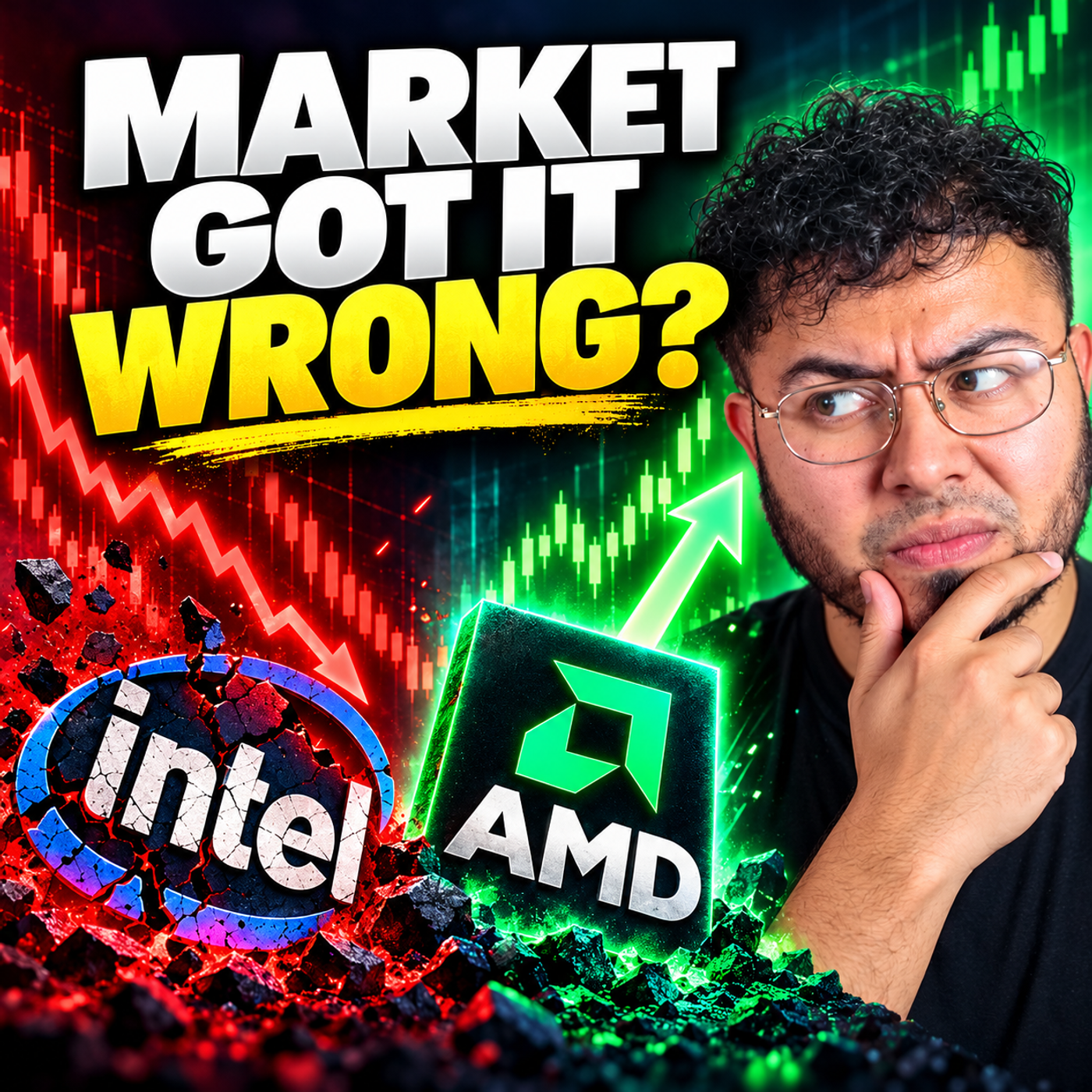
https://www.whatthechiphappened.com/ Intel stock just suffered a brutal selloff, but could this be great news for AMD investors? Intel Corporation (INTC) reported $16.5 billion in quarterly revenue, up 21%, yet its disappointing Q4 guidance sent semiconductor stocks tumbling. Advanced Micro Devices (AMD) reports earnings November 3, 2026. With Intel's data-center revenue growing 78%, we'll explore whether demand for server CPUs could help AMD deliver a major earnings surprise, plus the PC-market risks investors can't ignore. DISCLAIMER: I am not a financial advisor. All content provided on this channel, and my other social media channels/videos/podcasts/posts, is for entertainment purposes only and reflects my personal opinions. Please do your own research and talk with a financial advisor before making any investing decisions. 0:00 Intel's Massive Miss and Market Impact 0:48 Analyzing Intel's Revenue Breakdown 5:02 The Root Causes of Intel's Supply Issues 9:20 Can AMD Capitalize on the CPU Shortage? 14:20 Qualcomm and ARM: The Alternative CPU Plays
AMD Episode: Intel recently reported earnings and unfortunately they missed massively in their quarter four guidance, causing the stock to drop nearly 30% the day after. Now, this is also unfortunately creating a bit of a bearish sentiment to other semiconductor CPU companies. AMD was down nearly 11%, Qualcomm was down over 11%, and ARM was down nearly 10%. The market is questioning. We keep hearing this story about a CPU shortage. But yet Intel reported guidance that was way lower than expectations. Make it make sense. And that's what I'm hoping to do in today's episode. So let's take a closer look and get started. But before we begin, if you're serious about semiconductor and AI investing, I break down major earnings and conferences inside my community. Institutional quality research built for retail investors. Get 33% off at what the chiphappened dot com. All right, so like I mentioned, the main topic here is. Can anybody else benefit from Intel's CPU shortage issue? And I think the biggest opportunity here of who can benefit from it is going to be AMD. But we're also going to take a closer look quickly at the other players, Qualcomm and ARM. Before we kind of understand what happened to Intel, I think it's very important to look at their numbers a lot closer. So for quarter three, year over year, they did see a massive growth in the data center space. The data center market was up 78% year over year. Unfortunately, we are seeing a weakness in the client computing space. The client computing space was actually down 5% year over year. Now, the thing that is important is it's important to remember how companies make money and how their revenue segments is broken down. For example, for Intel, quarter three revenue data center was 7.3 billion, client was 8.1, total revenue was 16.5%. So about $1 billion in other aspects, right? In other aspects, about $1 billion. But pretty much client makes up a little bit over 50%, about 50% of total revenue. Data center makes up somewhere around 40%. So that is incrucial because if you see a slowdown in one, it can truly impact the total business, especially between the client space. And that's exactly what's happening here. So for this most recent quarter, right, we saw those strong numbers in data center, but the company, when they gave guidance, guidance was $15 to $16 billion. That would be a sequential decline. And also analyst expectations were close were expecting closer to 16.8. They missed massively in that quarter for guidance. And again, the market is questioning: hey, if there is a server CPU shortage, how? How are you not seeing sequential improvements? More importantly, how are you missing expectations? And the stock got punished dramatically. We also saw a miss in earnings per share, in overall margins as well. And we're gonna explain a little bit of what's happening there. But regardless, the question is is saying there's something fishy going on in the server CPU space. Let me sell everything. I'll rather act now and ask questions later. But again, when we started off in this episode, I wanted to start off with kind of some the Distinctions of the revenue breakdown. Intel, when we see the server space, you still expect it to growth for quarter four. Quarter four is expected to grow mid-teens sequentially on data center. Right? That is massive. That is massive coming from a 7.3 base. That's making this going to be an over $8 billion part of the business. Now, the downside is there is a massive, massive headwind in the consumer space. And luckily, we've been talking about this in this channel. That the pricing of memory was going to create a massive headwind in the consumer space. We talked about this in December of last year, and we're finally seeing it play out now. But if you're expecting to see over a 20% decline in a business that is over or close to 50% of your business, you're definitely going to see a massive, massive loss, and you're going to miss expectations, especially when the market was not pricing this type of decline. So 20% decline in quarter three base of roughly $8 billion. That's at least $1.6 billion loss. So you're expected to grow your data center just fine, but you're going to see a bigger impact in the revenue because of that client computing business. And that client computing completely outweighs the server market. Now we're going to explain a little bit more, but if you are ever curious about my thoughts, I do have exclusive live streams in my community, what the chiphapen.com. Three exclusive live streams per week. You get to come in, ask any questions you want about the overall market. We get to look at any stock you want to. We have deep dives on earnings and we have so much more. Right now, 33% off if you go to what the chip happen.com and just join using that link. Automatically the code is given at coupon. the code is given at checkout. Now I want to go back again here for Intel. What are some of the issues that Intel faces and why can't it supply the market? One of the big things is they are seeing wafer output still missing the current demand. And that's for two reasons. While they are getting improvements in their nodes, there's still much more improvements that they can do. Right? They don't have enough cu supply chain lines either because historically they've had to break down their supply chain line for certain products and then consumer products, whatever, whatever, right? So the supply chain that they have is. Is not just focused on server CPUs, is focusing the rest of the market. So if they need a transfer, a sub a market, a supply chain line that was focused on the consumer space, it takes time. So the other thing is actual materials, things like substrates, which are needed for advanced packaging, which is needed for a lot of these server CPUs, are in a massive shortage. The final thing is they have FAB28, which is a facility in Israel that's seeing disruption. And that disruption is creating near term hits on older node server supply. And some of the people might be wondering, Jose, these are older nodes. Why does that matter? Because in the current shortage, you can actually be selling older node server CPUs and the market will still eat it up. Now, unfortunately, unfortunately for this FAP28, it's almost all 10 nanometers, like I talked about, but it does create about a 300 million dollar impact of revenue for the company. It does impact gross margins by about two percentage points. And that is going to be just on quarter four alone. They actually believe quarter one early impact is ext estimated to be similar. Now the market is also punishing Intel. It's like, hey, these are just early estimates. Could it actually be worse than this? And what happens if it's worse than this? What happens if it goes beyond quarter one? What happens if it moves on to quarter two? Are we going to continue to see this pressure? the other thing is, hey, Intel, you're supposed to be a manufacturing player. Why are you not ready for this? Why are you not ready? You have everything under your control, right? You own the chip design, you own the manufacturing. What is going on? Now, I would say one of the strengths and weakness about kind of running your own supply is if you are executing correctly and you have all the materials and you also have all the equipments and everything's going your way, you have total control of your product. And Intel's server CPUs going from Intel 10 all the way down to Intel 3 and Intel A, which are being worked on right now, Sapphire, Emerald Rapids, Grand Knight Rapids, Sierra Forest, Clearwater Forest, all those are based on Intel notes. So if Intel was actually doing really well with allocating everything and having the right supply chain lines, this would have actually been really good for Intel. Now the downside is if you don't do really well because you're focusing on so many things or so many. Variables that you might not be able to control are hurting you, then you're gonna get hit hard, right? You don't have another partner to be able to focus just purely on the foundry side. Now, future capacity takes time. One thing that they are doing is, like I mentioned, improving their overall yields on a quarterly basis. They're also converting certain plants in Oregon, they're converting a plant of Intel 3 to support more server CPUs. Unfortunately, They don't really expect production there to really start ramping out until the second half of 2027. Diamond Rapids, which is going to be on Intel 18 AP, the sampling now, but production ramp is not really planned for 2027 as well. And the overall improvements of yields that takes quarterly improvements. It's not like a big jump every single quarter. So the market is saying you're having these supply issues. You're the only one that can control your supply chain. Yet a lot of the things that you're telling us is production ramp. Is really going to happen in 2027, some even in the second half of 2027. So why should we give you a premium when it comes to the server CPU side? Also, in this during the earnings call, they mentioned that market share is only going is next year is going to be a function of supply. Whoever can supply the most server CPUs is the one that's going to benefit. This brings me on to AMD. Now AMD, if we look at their Latest quarter two report, data center revenue was 16.7 billion. Client was 3.1. Then they have others like their silenx acquis silent products. They did a little bit, I forget the other, it was a little bit over close to 11, 12 billion dollars in revenue, but we can see a good portion comes from the data center side. And a smaller portion comes from the consumer side. And this is important because now you're having the opposite effect. Of Intel and then the much drastic impro. Remember for Intel, and let's just kind of go back on the numbers. For Intel, data center was 7.3, client was 8.1. So the client overtook it. So even for AMD, if you took a hit in the client market, you really won't see too much as much pressure, as much pressure as you saw Intel. And if the data center market is as big, is bigger and is growing at the same rate. You're gonna see even a bigger push on revenue. So the revenue breakdown matters. And I do believe AMD is gonna benefit dramatically. In the most recent quarter, they actually gave us some strong numbers, right? They told us that in the second half of 2026, they expect over 80% revenue growth in the CPU market. For full year of 2027, they expect over 70%. And they reiterated these numbers in their September event with City. I believe it was September 8th. Yes, September 8th. So Intel's. Loss in not being able to provide the server CPUs could be a win for AMD if they are working with partners that could. And I do believe they're working with partners that could. At the same time, these numbers that they gave us a month, two months ago, three months ago, reiterated about a month or two months ago, are also numbers that I believe management will only share if they were confident with the allocation that they have. I think Lisa Sue's very conservative woman. When she gives any form of guidance. The market hates her for that sometimes. But then to me, it tells me that these numbers she told us are real numbers, are real growth values at minimum of what we're gonna see. Now, what else do we have here for Lisa Sulisis who has told us that the server CPU supply chain is tight right now? But she does expect situations to improve in 2027 versus 2026. Now, another thing that we hear AMD doing is that they're investing beyond Wait for Order. Right. They're not just placing orders on wafer, they're also increasing their supply in advanced packaging. They are improving and helping their manufacturing partners. One thing that they mentioned they're doing is they're helping co-sign or purchase the equipment to bring it over to their manufacturing partners to increase the output that they can get. Right. And they're doing this a lot for their server CPUs, mainly the Venice, which is the two nanometer node. But AMD is giving us a plan that look. We're not gonna miss a B. Regardless, capacity is still below what AMD wants. And this is where the shortage takes place. Maybe in the future we are gonna hear some discussions of average selling price increasing dramatically, like we've seen in the memory space. But I don't think Lisa Sue is gonna go too much in that direction. here we can see all of AMD's server CPUs that matter right now, even I believe the 7 nanometer are all based on TSMC's output. And again, TSMC we continue to see an increase in cap in capex. To improve 3 nanometers, to improve 4 nanometers. They even just talked about it most recently that they believe in 2027 they are gonna double their two nanometer capacity. And the upcoming products for Venice and Vedano are gonna be TSMC 2 nanometer product line. And again, the other ones, the Turin, which are 4 nanometer, 3 nanometers, are ones that TSMC is also improving capacity manufacturing line for. The downside here is working with TSMC is. Obviously, you're also selling some of the supply chain line to a lot of the other players, right? Your Nvidia's, your your your Broadcoms, and whoever else is building CPU and GPUs aligned. So it's not like AMD can truly get everything. But if I had to pick a player right now, I think the partnership that AMD has with TSMC is a more of a b is more of a benefit than Intel having its own fanufacturing line and unfortunately not succeeding or executing. As expected. customers for epic CPUs continue to win. I mean, we see that Meta is doing millions of Epic CPUs deployed. Oracle also just announced some massive orders of Epic. Everyone's using Epic, right? It's very rare to hear it when we talk about market share in x86 and CPU, AMD is winning. And because of the supply chain constraints, I think they are gonna continue to grow a lot faster than others. Now I want to talk about a different company, right? Qualcomm. Qualcomm has an opportunity in the CPU space, but not necessarily in the server CPU as of yet. Right now, they are kind of entering into the Windows market, right? The PC market. But as we hear, the consumer market is pretty, pretty weak. I don't think it's gonna be any different for Qualcomm. Now, Qualcomm does have a server CPU opportunity, but that's expected later into 2028. And this is where I believe the market, it's hard to determine how a stock is going to react. Because if the consumer market is weak, it's not just the PCs, right? I would expect phones and other consumer products, consumer tech to also be weak. So I don't believe Qualcomm is going to give great results. But it's not always about the results, it's about what's next. And Qualcomm, if you are a Qualcomm investor, a few things can come out that could be bullish that could create a nice bullish sentiment for the stock price. Sure, we know consumer market is going to be weak. If it's actually weak, less weaker, not as weak as expected, not as weak as expected, that could be bullish within itself, even if we see a decline. The other things is even though their CPU opportunity is not expected into 2028, if they can give us maybe, hey, we actually expect server CPU to be an opportunity in 2027. Any small changes like that could help benefit the stock. The final thing is Qualcomm. While they don't have server CPUs, they do have other forms of data center products coming on at the second half of this year. If those are also driven by the current shortage and can help them beat data center revenue, that could be a reason for the stock price to go up. That's why it's very tricky. It's very tricky to try to time in earnings because you have all these variables coming in taking place. As a long-term investor, right for AMD, is I don't know if AMD will completely crush this upcoming earnings. But what I do know is that as a long term investor, they're building the foundations line, right? That foundation base to be able to win throughout this whole cycle. So maybe this earnings won't be as crazy, even though Intel's was crazy on the other side. The guidance could be crazy. The guidance for next year could improve, right? As long as you give me those bullish sentiments, that's what I'm looking for as a long term investor. Then you also have ARM, right? ARM has two different approaches to this CPU market. First is the license and royalty fees. They work with anybody working making really a CPU right now. Nvidia building tons of CPU. Google has the Axion. Microsoft has the something as well. Maybe I I forget who they have. Amazon has the Graviton. All players are building their own CPUs. There's some form of licensing and/or royalty fees, depending on the partnership that they have. ARM is also working on their own GPU, the AI, AGI CPU. Sorry, CPU, not GPU. And those products are coming to sell pretty soon. Commercial shipments of AGI CPU expected in late 2026. Now they have support capacity for roughly $1 billion. Demand though is described as over 2 billion, at least more than 2 to 1. I think they gave the ratio. so the shortage could be a benefit factor, could provide a benefit for ARM. Here is more of like timing favors. To me, if I had to pick one player that can benefit in the near term, AMD. AMD already taking market share, working really good with supply, already shipping a lot of production. For me, Qualcomm is kind of like that. If you're looking for long-term opportunity, the Windows PC side, Is gonna be weak. Server 2028 could be something investors would like to hear, but still unproven. For ARM, partner royalty is definitely a big win. AGI CPU is also happening this second half of this year. Any conversations there could be exciting for the stock. The only thing I would say is watch valuations, right? Qualcomm sitting at forward PE ratio of something around 16 tells me even if they miss. I don't think their values are gonna contract as much. AMD, same. If they miss, not not the same. A little bit opposite. AMD, if they miss, yeah, we'll see some contraction. If they if they if they don't miss and they actually be, it's not necessarily gonna be a massive pull-up either. For ARM, it seems like a lot is priced in. So personally, if I had to pick one, it would be, or if I would pick in level, I think AMD would be my best my number one choice. Qualcomm would be my number two. ARM would be my number three. If I had to add Intel in this list, I think two and three would either be Intel or Qualcomm. I would switch it between. And last one would still be ARM. Not necessarily bearish on it. It's just the valuation doesn't meet my price to risk to reward ratio. so yeah, the next test is gonna be Intel's earnings, which is November third. We also have Qualcomm's earnings this upcoming week. I believe maybe even ARM. So we are definitely getting the CPU test. For AMD as a long-term investor. I believe they're going to continue to win market share. And I believe their partnership with TSMC is going to be a massive, massive asset for this CPU shortage. So very excited. Stock prices can continue to go down regardless as a long-term investor. I'm here for the bullish plan. The commentary from Lisa Soon, understanding her plan, understanding if there's been any changes to the CPU market, any changes to revenue guidance. And if she gives us a lot of great numbers, no matter what the stock does, I'm gonna continue to be a strong shareholder. So take care, have a good day, and see you all next time.
More What The Chip Happened - Jose Najarro AI & Chip Stocks episodes →