
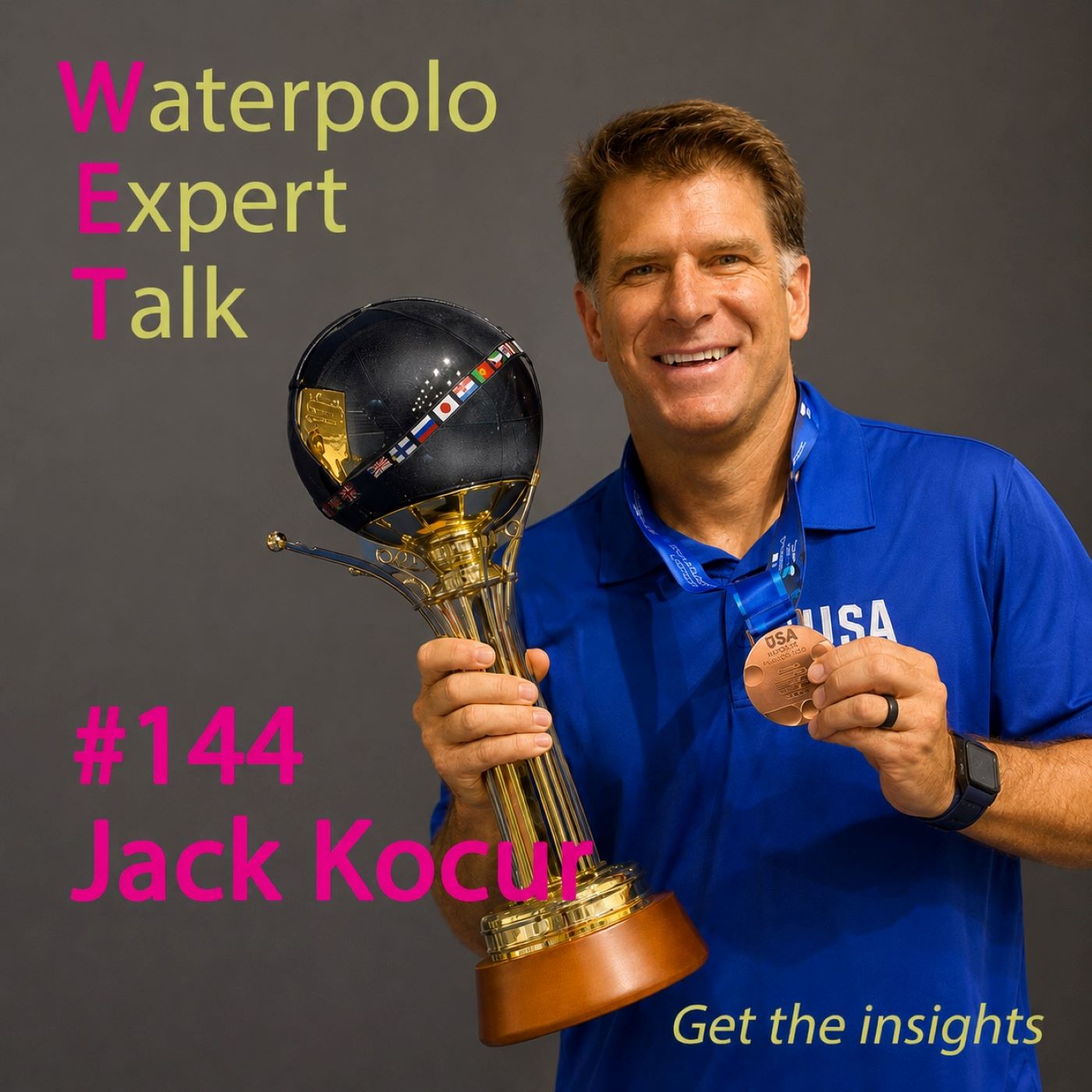
Waterpolo Expert Talk · Andreas Schulze-Kopp
In Part 2 of my conversation with Jack Kocur, we dive deeper into coaching, player development and the mental side of modern water polo. Jack shares lessons from three Olympic Games, explains why young players need international experience and a growth mindset, and discusses why cognitive awareness can be just as important as physical skills. We also explore his coaching philosophy, the importance of connecting with athletes before directing them, and why young coaches should stop trying to be somebody else.
0:01speaker-0: Welcome to this podcast.
0:14speaker-1: Water Polo Expert Talk. Get the insights.
0:34speaker-1: When you mentioned that you are playing in Greece and seeing right now your guys from the national team, younger guys playing also in Greece and Spain, are there any, did you get any emotions, any emotional things in mind saying, okay, that's great to see, yeah, so these guys playing in my pool.
0:54speaker-0: Yes. And and sharing the stories too and and wearing wearing the threads, you know, wearing the the the three leaf green clover that, you know, Panathanikos has. And the other thing that you know, Deanadovich has done an amazing job of getting more players connected to European teams and getting our young athletes these opportunities to go play and grow amongst the best of the best. We you cannot compete. An underdog can never compete if they can't get in the same water. so we're we're Dan has done a great job. Some of our other collegiate programs have done a great job of placing their players some places and in rising the tide of our players and we're reaping the benefits now. You know, in the last four years, Team USA has been on the podium at some age level. That's never done been done before. we had two silver medals at twenty Us. We have now a silver medal at eighteen U, and we have a bronze medal in the Olympics. That has never been done before. so we're blessed. And it has there's so many people that have their hand in that, that have helped our program get to where it is. And I feel like we're just we're right there, we're we're getting there. And hopefully in the next couple of days, we can do say the same for our sixteen U team.
2:05speaker-1: Yeah. Yeah. So I think I remember on the, on the headline of the podcast with Dejan saying, okay, it's really essential and mandatory thing for us and our players to play in Europe. because only in Europe, they get the experiences for playing for the U S playing under pressure, playing on a high level of competitiveness and so on. So that's mandatory for us and for players to be successful. And then. think the podcast I think two or three years ago, you know, so time is running, then that's the fruits, then you mentioned that's going out everything in the same direction or in a good direction then.
2:50speaker-0: And and it to go to that and go go even go younger, go at the younger ages, you know, even when we go to Europe to play, you know, we travel to your Italy or we travel to Spain, we travel to Hungary, whatever one of those countries, right? The first week, we're getting our kit. We are getting kicked. And we're like, wow, this is faster, more explosive, this is more physical. Wow, they can still function mentally in through all that contact. And our athletes are like, what is going on? By day six, day seven, we start to adapt, we start to grow. And it's not just us, you know, any country, Australia, Brazil, Puerto Rico, and anybody that wants to go in Canada, when they go to these countries, because we live in the small bubble, we don't get the exposure and experience. But then day on it opens us up. Now we're starting to travel more, we're starting to get our butts kicked, we're starting to see the level of competition. And we are just now rising to that. And I think it's really spreading. And and you can see like this weekend, 16 years. Russia. Russia's destroying teams. And we're like, where do they come from? Well, they haven't been on the market for the last four to six years. But now they're beating teams that were like, well, this is phenomenal. Now they used to be dominant teams, you know, back in Sydney and Australia in the Olympics. I think Russia might have gotten top three. And now they're coming back into the stage, and that probably has a lot to do with Filipovich now leading that group and and being part of that. But it's just great to see When you well it's great to see when you get the opportunity, how these athletes can then rise. And that's part of us just trying to send as many as we can over there.
4:23speaker-1: Yes, also another statement from another US player with the legs bone said, okay, you have to be coachable. Yeah. So it's not really then only the fact that you are have talent or go frequently to the, to the practice that you have to be coachable for your coaching stuff or your coach. And that's maybe if I understand it correctly, that is what your meanings are that they are able to. to adapt during the first, I don't know, six, seven, eight days during a practice camp saying, okay, there is something different, but maybe it's not on the other side, it's on us to adapt to the next level, yeah, so to the opponent on the other side.
5:10speaker-0: And that usually comes with athletes that are not afraid to fail. Being adaptable and being understandable are not the ones that are emotionally tied to the failure of those first four days and they can't recover emotionally. If they can disconnect their emotions to their behavior, right, and then just see the moment as it is and grow from that instead of wallow or dwell in the misery of it, those kids can get a lot further along. They have a growth mindset. So once we can break that free, and I feel like there's more and more kids right now that are struggling in that fact, at least here in the States, it might be other places too. we really have to teach that. And and that's why I think our whole sport, you know, w here in the States, I don't know if it's happening in other places, I'm sure it is, is we're spending more time on the mental capacity of it, the emotional capacity of it as athletes that complement the physical. Where I said earlier. Physic physical was our always our first option of teaching. Let's just teach them how to do the skill. But they have no concept how to do it in the game. And there's the discussion whether they're emotionally tied to the situation or they're mentally puzzled. Like mentally, and then what happens is the skill set doesn't come in place because they're frozen in time because they have no clue how to function mentally.
6:31speaker-1: Yeah. Yeah. So this is maybe you, you mentioned that you are a little thief of other sports. Yeah. So this is maybe, but when I'm thinking about it, maybe something coming from other sports as well, where this is happening over the last decades. I don't know. from, from, from football, soccer in Germany, for example. So it's happening the last 20, 30 years. Yeah. So maybe, and this is something coming from other sports saying, okay, we need to get this somehow adopted. And this is maybe also a reason for the increasing speed or increasing complexity of the game. maybe this is a result of that.
7:15speaker-0: Without a doubt. And again, I'm I'm doing a deep dive into Barcelona soccer, Barcelona soccer right now. I'm really trying to learn as much as I can about Tiki Tok. Tiki Tok. I'm not probably not even saying that right. but I'm trying to grow in that and just understand their development program, how they're doing it and and try to adapt their football style and cognitive awareness. And that's something that we want to try and adapt here is adaptive cognitive awareness is what we really are pushing now, we're gonna enter this into our phase of our pipeline programs and emphasize more of that than these twenty-five yards or twenty-five repeative skills. No, we need to get their mind challenged, then their body follow it.
7:59speaker-1: Yeah. Yeah. So then maybe Barcelona, it's really the first place to go. Yeah. So we just, not only regarding water polos, it's regarding football and ball, basketball, you can name it. Yeah. So it's, of the sport then. Without a doubt. So when you see, example, the World Cup soccer, yeah. So it's at the end, it's not only Barcelona, yeah, but Spain.
8:26speaker-0: It's correct.
8:28speaker-1: Same school. You mentioned that it's maybe not at the end works out for you as a player to go to Olympics, but also attending three times the Olympic Games in several roles and several functions. When you joined the Olympic Games for the first time as a coach or video analyst or whatever, so what was that for feeling when you know, okay, I'm aware of my history and the story behind me? regarding all the reasons why it not happened as a player, what was it for the feeling as a team part of the coaching staff, for example, to join the Olympics the first time.
9:09speaker-0: Yeah. You know, I I I was thankful that Terry Schroeder brought me on as a scouting coach in two thousand twelve, in London. And it was one of my most memorable Olympics because First of all, London did such a phenomenal job of hosting and the experience of all this venues and living in the village and outside the village and all that stuff. It it was a memorable moment for me, just to be part of it. And you know, he brought me in and I got to do all the things with the team and and really get the the exposure and experience I was always wanting as an athlete. And unfortunately, you know, it didn't happen that way for me. but I knew that I had to do whatever I could do to help the team in whatever c fashion that was for me to be part of that. so I'll always remember London. And then I was blessed enough to get hired on as the assistant coach for 2016 in Rio. And it was a different experience. I was an on deck coach and and growing in my own behaviors and manners of being an assistant coach. And, you know, I I struggled. I struggled a lot through the Rio Olympics. I grew a lot. I I think the team struggled and we learned a lot through that phase, Dayan and I together and trying to what how are we moving in this direction of of USA water polo? And but from that, again, being brought into Paris as my personal strengths is that's the scouting side of it. That's the dissecting of the game and tactics and seeing the game inside the game. I was thankful that Dayon trusted me and brought me back in and being part now of three Olympics, I feel like it's part of my D DNA. It's something that I I need. I I want to be part of. I see great value in it for not only the athletes but also the development of our sport here in the States. I want to try to implement the high level thinking that we're going in the right direction for Team USA. and that's that's part of creating the 16 under, 18 under, 20 and and bringing it all the way to all the way through the patterns from the senior team all the way down. the hardest part I'm recognizing for me is
11:16speaker-0: Taking what's in my head and what's in Dayon's head and then translating it to other coaches, I'm trying to find the right path for that. I pr might not be the sharpest tool in the shed to to process those thoughts and put them on paper so other people can understand it. so I'm trying to surround myself with quality people that are strong in my weakness that can disseminate that information and with other other information and and come together and try to create. player education opportunities, coaching education opportunities, so that here in the States we can grow. at the same time, you know, help other countries, help the neighboring countries around here that we can compete against Europe. 'cause it's not just a Europe game, it's it's worldwide.