
Warfare of Art & Law Podcast · Stephanie Drawdy
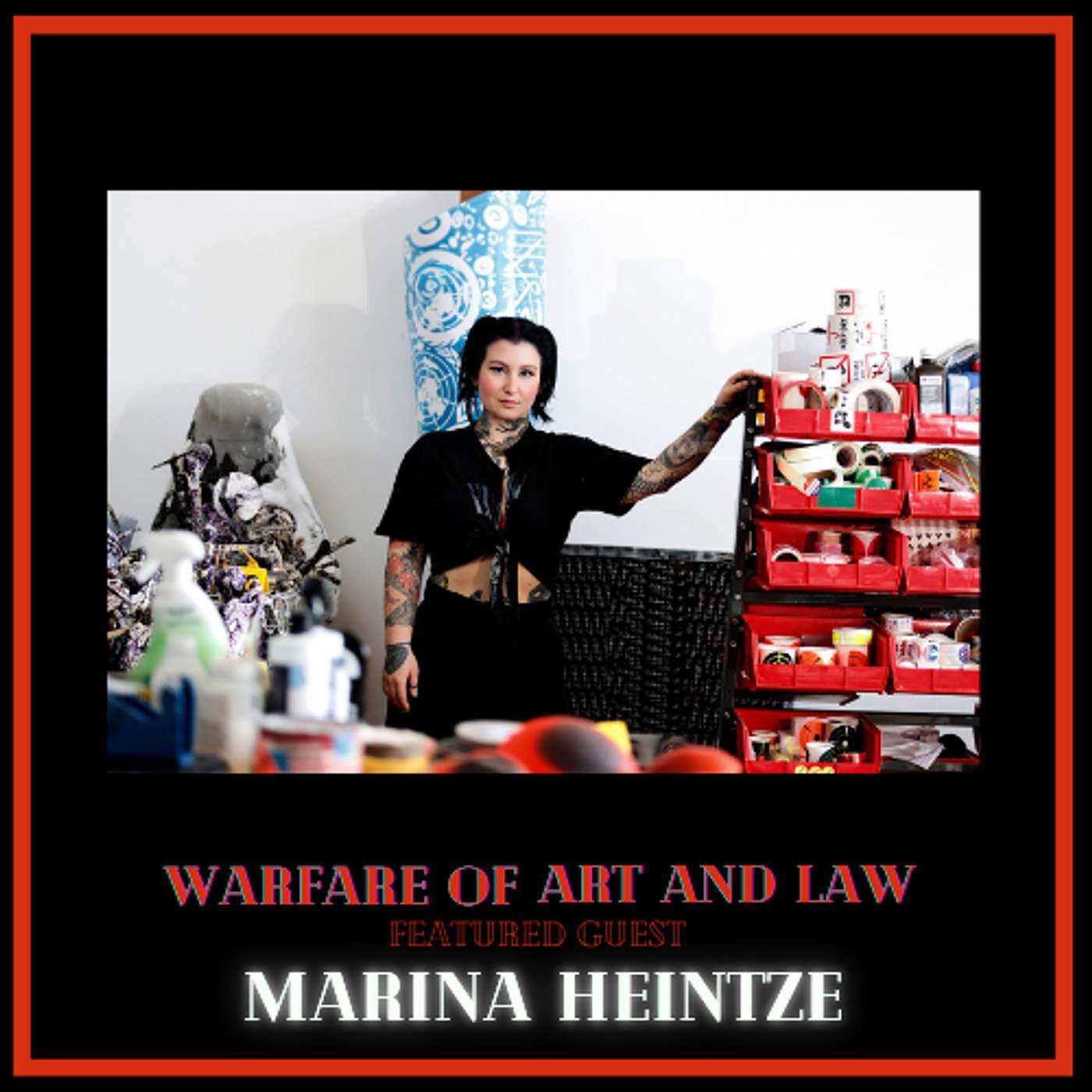
Send us Fan Mail Link here to learn more about Marina Heintze. Show Notes: 1:00 Heintze’s background in the arts 2:30 sculptures of Heintze's father 3:30 Heintze’s use of materials 5:30 current events addressed in Heintze’s work 6:20 Politics series – gerrymandering 7:25 Bullet proof vests – assassinations and deviseness 7:45 Holocaust addressed in her work like “Gentian Violet Violence” 8:30 "Yitler” and “Dog Whistle” pieces 9:50 Heintze’s family research that led her to work with bone planters 11:20 archival research used in her work 13:35 "The eyes are the windows to the neshama/soul" 15:20 Lure series regarding nefarious organizations 19:50 how/whether her works address justice/injustice 21:50 work related to B2 bombers 22:50 Tunnel Talk / Vision series 27:25 feedback on Tunnel Talk / Vision series 31:40 Banksy image removed from Royal Courts of Justice 34:15 Holocaust denial and free speech 36:40 Alan Robertshaw – importance of work on the Holocaust 38:45 David Irving v Penguin Books and Deborah Lipstadt – 1996 UK Judgment 42:20 facts of genocide/terrorist acts 48:10 camouflage IP 50:30 design of Arab nation flags Please share your comments and/or questions at [email protected] Music by Toulme. To hear more episodes, please visit Warfare of Art and Law podcast's website. To leave questions or comments about this or other episodes of the podcast and/or for information about joining the 2ND Saturday discussion on art, culture and justice, please message me at [email protected]. Thanks so much for listening! This podcast and its content may not be used for training or developing AI systems without permission. © Stephanie Drawdy [2026]
0:00Speaker 1children.
0:01Speaker 1Yeah, yeah, sorry, sure it's a multi-rology, actually it's.
0:14Speaker 1It's hard to talk about that.
0:16Speaker 1It's not, you know, an exhibition, fools well, an exhibition in the complete meaning, in the sense, on the full sense of the word, because it's a rather a place of commemoration, place where people just come and it only has a video with the names of the children killed by the Russians, names each and place where they were killed, that's all it's.
1:04Speaker 1It's rather not an exhibition is people just come and bring toys and there's a tree, but it's the tree tree it was.
1:17Speaker 1It looks like a burned down, you know, because without children, the tree of life, it stops growing.
1:30Speaker 1Just just one more simple, sorry, still cannot talk.
1:37Speaker 1You know, on some of the topics I cannot always verbalize, you know there are a lot of emotions.
1:48Speaker 1Key region was the occupied on April 1st and they went to the settlements, to the occupied settlements on April 2nd and she meeting was the occupied on April 2nd.
1:58Speaker 1So the trip to Chimew started April 3rd and lasted over a week and they gathered the artifacts they could find.
2:06Speaker 1It was both the artifacts and oral history.
2:09Speaker 1They recorded the, you know, as long as the memories are fresh, they recorded the recollections of people regarding, well, what happened to them during occupation and that actually, these artifacts, they became the basis.
2:27Speaker 1We understood that we have all these artifacts now we have to exhibit them now, we have to show them to the world.
2:32Speaker 1So that's how it all started.
2:34Speaker 1Yes, because one one thing you see it in media, you know in video coverage or in pictures but quite another thing when you see all these artifacts right in front of you and you can feel, you can get immersed in the yeah and what's going on?