
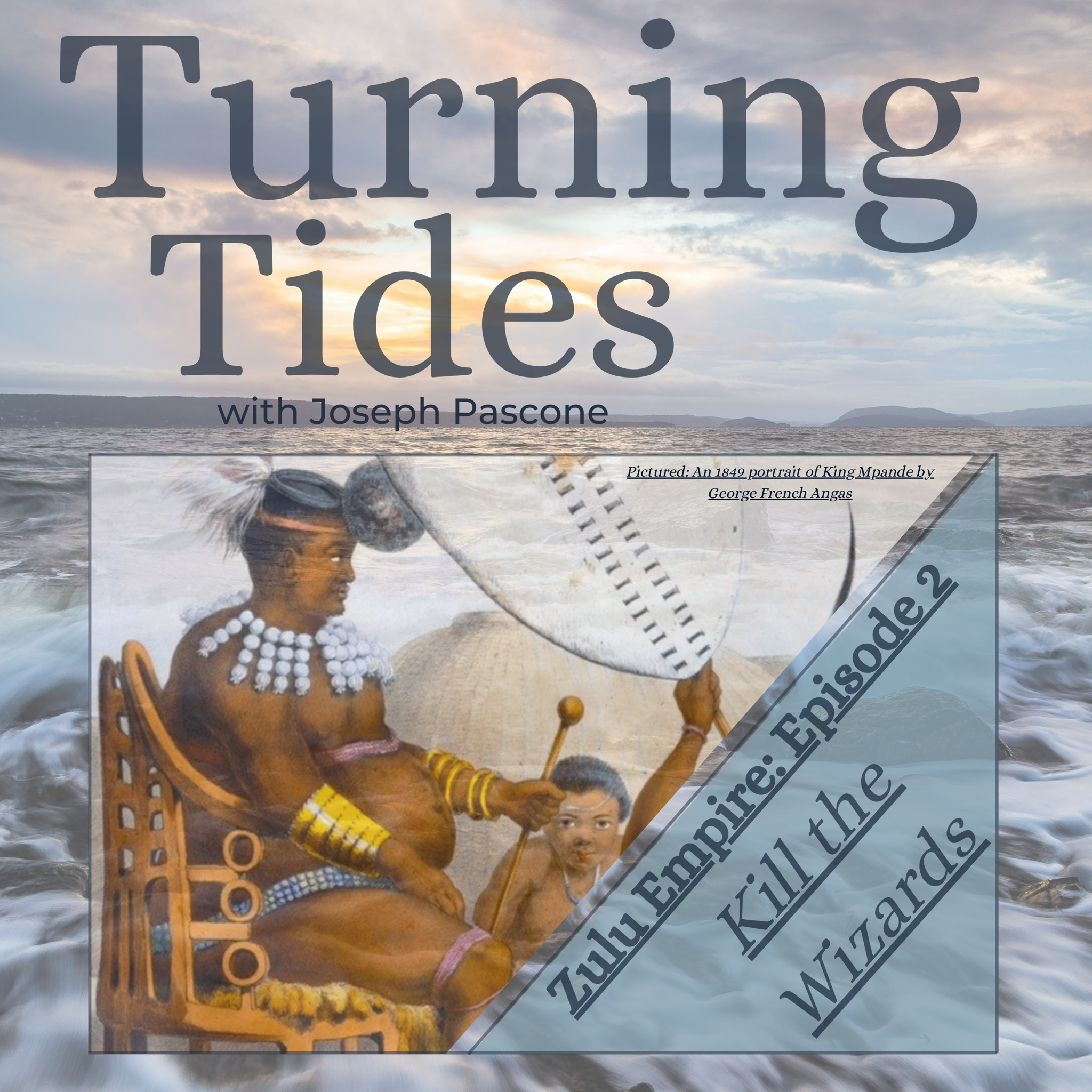
Turning Tides · Joseph Pascone
Turning Tides: Zulu Empire will discuss the rise and fall of the Zulu Empire. The second episode, Kill the Wizards, will cover the period from 1829 to 1872, in which Dingane leads the Zulu Empire into a disastrous conflict with the Boers, and Mpande attempts to pick up the pieces. If you'd like to donate or sponsor the podcast, our PayPal is @TurningTidesPodcast1, or you can donate to us through our Buy Me a Coffee link: buymeacoffee.com/theturningtidespodcast. Thank you for your support! Produced by Melissa Marie Brown and Joseph Pascone in affiliation with AntiKs Entertainment. Researched and written by Joseph Pascone Edited and revised by Melissa Marie Brown Intro and Outro created by Melissa Marie Brown and Joseph Pascone using Motion Array Website: https://theturningtidespodcast.weebly.com/ IG/Threads/YouTube/Facebook: @theturningtidespodcast Bluesky/Mastodon: @turningtidespod Email: [email protected] Bluesky/Mastodon/IG/YouTube/Facebook/Threads/TikTok: @antiksent Email: [email protected] Episode 2 Sources: 1. Zulu Empire Decolonised: Epic History of the Zulu from Pre-Colonial Times to the 21st Century, by Shalo Mbatha 2. The Zulus and Matabele: Warrior Nations, by Glen Lyndon Dodds 3. The Zulu Kings, by Brian Roberts 4. The Anglo Zulu War: Isandlwana: the Revelation of a Disaster, by Ron Lock 5. Africa Through the Eyes of the Other: A Collection of Observations made by European Colonizers, Explorers, and Missionaries in regard to the Zulu, published by abū Firnās & Co., Kharțūm, Sūdān 6. https://www.worldwildlife.org/initiatives/stopping-elephant-ivory-demand#:~:text=Overview,-%C2%A9%20A%20ran&text=Each%20year%2C%20at%20least%2020%2C000,fueled%20this%20rampant%20poaching%20epidemic. 7. Wikipedia
!WARNING! *** RACISM WAR VIOLENCE TORTURE RAPE MURDER GENOCIDE CHILD ABUSE *** “We stand here before the Holy God of heaven and earth, to make a vow to Him that, if He will protect us and give our enemy into our hand, we shall keep this day and date every year as a day of thanksgiving like a sabbath, and that we shall build a house to His honour wherever it should please Him, and that we will also tell our children that they should share in that with us in memory for future generations. For the honour of His name will be glorified by giving Him the fame and honour for the victory.” - “The Vow,” as interpreted by Afrikaaner, W.E.G. Lowe in 1966. For months, the Boers had endured the hardships of travel, and they also had the Zulu with whom they needed to contend. The Afrikaaners had hoped to be welcomed into the Zulu domain as guests and be granted tracts of land to farm and work. Instead, they were betrayed by Emperor Dingane, and the Boer leaders, their wives, and children were butchered in the hundreds by marauding Zulu impis, or “divisions.” They had fled Cape Town to be free of British overlordship. They wanted to maintain the “conservative” Dutch lives they had always lived; this included trafficking and enslaving African peoples; they also detested any form of central authority. Their “Great Trek” north had brought them into conflict with numerous African tribes, but their conflict with the amaZulu was beyond anything the Dutch colonizers had experienced before. Dingane was everything Shaka was not. There were no heroic tales of Dingane’s early life. He was not athletic; he wasn’t a great warrior, nor commander; he had no epic praise songs written about his deeds. Even amongst Zulu historians, Dingane has few admirers. Where Shaka was lean and tall, Dingane was short and stout. Where Shaka was loud and boisterous, Dingane was quiet and naturally conspiratorial; even speaking with his hand perpetually over his mouth. This last trait may have been acquired to hide his exceptionally small teeth. Historians also agree that Dingane was an incredible dancer, who often choreographed his own dances, which he performed on several occasions in front of the British and other colonizers. Brian Roberts said dancing was the only activity Dingane performed voluntarily. He was also incredibly obsessed with personal hygiene, while counterintuitively, enjoying the smell of cow dung. Dingane’s first task as the new monarch was to ensure the leaders of the various clans who swore allegiance to the Zulu remained loyal. He ended Shaka’s policy of state-regulated marriage, allowing his subjects to marry whom they pleased. He forbade the death penalty as a punishment, save for the most serious offenses. He disbanded the female regiments which Shaka was in the process of arming with European weaponry. Finally, Dingane forbade any future wars of expansion, which had been commonplace during Shaka’s reign. It seemed that peace, benevolence, and kindness would rule the Zulu Empire from here on out, but Dingane enacted all of these reforms in the hopes of ingratiating himself with his vassals, not because he genuinely believed in their efficacy. Regardless, people began calling him uMalamulela, or “the savior.” All too quickly, the savior unfortunately became the butcher, and he would rescind many of these reforms. In many ways, Dingane would prove himself to be every bit as ruthless – if not more so – than Shaka. Many oppressed tribes within the Zulu Empire saw this early streak of benevolence as their chance to break away and reform their shattered states. Among the first to attempt this was the Ndwandwe clan. Next, Nqetho and the last of the Qwabe tribe marched north, only to be attacked by Dingane. The Zulu snatched many of the Qwabe cattle in the campaign, but otherwise let them escape unscathed. Dingane was beset by paranoia, and he acted ruthlessly to keep the Zulu Empire together, killing many clan heads and replacing them with men who were loyal to him alone. Upon hearing this, the ever rebellious commander-in-chief, Mdlaka, confronted Dingane at his new capital, asserting that Dingane had no right to to call himself a savior and that if he didn’t shape up, he would be replaced with another one of Senzangakhona’s many sons. It was as brazen a threat as you could make, and Dingane responded as you might expect. First, he replaced Mdlaka as commander-in-chief and then had him executed in his sleep. Next, Dingane dealt with the amaNgwane; the tribe was extinguished. Dingane had the tribe’s leader, Matiwane, brutally executed, gouging out his eyes, shoving sticks up his nostrils, and then throwing him from a cliff. Henceforth, this became the royal Zulu execution site, known as Matiwane’s cliff. He then exterminated the Qadi and Cele tribes for no apparent reason. During this time, he was in the process of building his new royal capital, called emGungundlovu. This name translates to either, “the Place of the Great Elephant,” or “Elephant Swallower,” likely an allusion to Dingane’s murder of Shaka, who was often called “the elephant.” Once he took the throne at emGungundlovu, Dingane took a sharp 180. The key difference between Dingane and his predecessor was that Shaka handed down the death penalty to punish those he considered to be “cowards or witches,” while Dingane arbitrarily killed anyone, for any minor infraction. Whereas Shaka left many of his siblings and relatives alive (many times to his own detriment), Dingane made it a point to execute several of his siblings who could have challenged him for the throne. One who was saved from this culling was his brother, Mpande, who watched his family die, while he was belittled and saved for being a “simpleton.” Brian Roberts compares the reigns of Shaka and Dingane aptly, saying, “whereas Shaka’s ruthlessness reflected an iron will, Dingane’s brutality mirrored little more than willfulness fed on fear. He ruled by imitation rather than determination.” Another important aspect of Dingane’s early reign was his placement of Ndlela and Dambusa as his chief advisors. In time, these two advisors would hold most of the power in the Zulu domain, as Dingane proved himself incapable or unwilling to administer the realm, train the troops, or attend to necessary business. Dingane was only sure of a few things; he wanted to maintain friendly relations with the British, he wanted to maintain absolute power, and he wanted to stop the Zulu Empire from hemorrhaging population. Thousands of former Zulu subjects were fleeing from Dingane’s parasitic reign to the neighboring British colony of Natal. The missionaries and the handful of colonists living there were bewildered. In order for Dingane to remain on good terms with the British, he needed a steady supply of ivory. Ivory does not grow out of the ground; it is harvested from the tusks of African Elephants. Every year, at least 20,000 elephants are killed for their tusks. Over the past sixty years, it’s estimated that over four million elephants have been killed to keep the horrific industry in business. Dingane used his stocks of ivory to trade with Europeans. In return, he received European weapons of war. This included cutlasses, gunpowder, and muskets. Some of these muskets were allegedly tampered with before being traded, rendering them inoperable, but many did work. The years passed, and Dingane continued his senseless and bloody purge of anyone whom he considered disloyal. One of the more notable to fall victim to Dingane was Jacot, sometimes spelled Jacob, a Xhosa interpreter who was instrumental in establishing contact between Shaka and the white colonists. Much like Mzilikazi, he was in charge of a semi-independent clan when his domain was attacked by white marauders, and he died in the fighting. Many years before his death, Jacob met with Dingane and his councilors, and he warned them not to trust the white men or their “promises.” He said that white traders will come, begging meekly for land. They will be followed by white missionaries in robes, who control the population with their religion. When these “men of God” feel threatened, a white army will follow, and then “all will be lost.” Jacob was clearly ahead of his time, as he succinctly prophesied exactly what would happen – not just in South Africa, but across the entire continent and a good portion of the Global South. Shalo Mbatha writes that Mkabayi, the “ultimate custodian,” was being asked to come out of retirement, and “People were saying ‘Buzani kuMkabayi’ (let Mkabayi provide a solution)...” Throughout Dingane’s early reign, his armies had only been raised twice – once against the Qwabe, which ended in a stalemate, and once against Mzilikazi and the Matabele. This campaign took Mzilikazi by surprise; a Zulu impi was deep in Matabele territory before Mzilikazi managed to scrape together an army. When the two forces met for battle, the Zulu were leaderless, and as a result, they did not execute their famous “head & horns” attack. Instead, they reverted to the traditional tribal style of warfare they had known prior to Shaka. Both armies stood across from another, calling each other names, and then both sides charged. The fight was over in an instant, with the more numerous Zulu able to brush aside the Matabele, but they dithered in their pursuit of Mzilikazi’s broken bands. Come the next morning, the Matabele had vanished, defeated but not destroyed. The Zulu commander, Ndlela, arrived the next day, and he was satisfied with his absentee victory. He chose to withdraw rather than risk another field battle. Additionally, there was an indecisive campaign against Faku and the mPondo Kingdom to the south. These threats were nothing when compared to the increasingly large migrations of Voortrekkers, or “pioneers,” coming from the south. Starting in late 1834 or early 1835, the “Great Trek” was the name given to this mass migration of Dutch Afrikaaners to their supposed “Holy Land.” They left for numerous reasons, the main one being the recent decree that all forms of slavery were abolished wherever the British flag waved. This was a dealbreaker for the human traffickers amongst the colonizers, and they set out north – first, in small groups, then entire townships and villages. They were looking for the literal Holy Land but failed to appreciate the vast size of the African continent. They settled for modern-day north-eastern South Africa and parts of Botswana. Many would unknowingly travel directly into Zululand. Some would settle in the British colony of Natal, renamed Durban during this time. Here, they would found the short-lived Republic of Natalia, a sovereign Afrikaan/British state. Sometimes called Boers, the Dutch/French Huguenaut colonizers were the descendants of the colonizers of the Cape Town area from the early 16th century. Brian Roberts describes their ideology succinctly, saying, “They were born conservative and born rebels.” He continues, “For the Boers, British law did not represent justice; it was an unwarranted encroachment which undermined the God-ordained structure of their society.” This “justification” is essentially the same erroneous claim made by confederates in the United States and conservatives the world over. There was also a four-way political battle playing out between the Zulu, Dutch, British, and native African interests. Usually, one side would attempt to ally itself with the other, either to gain leverage over – or to support – the British. Britain had already shown itself to be uncompromising in its crackdown on any unity between Boer and native African people which would potentially compromise their imperial designs. In 1815, Dutch farmers started a rebellion in order to protest British annexation of the Cape. The Dutch sought aid from a neighboring African tribe, but it arrived too late, and the rebellion was extinguished; its ringleaders were publicly hanged. Compounding these issues, the Sixth Frontier War with the Xhosa was being waged on the eastern border, and several homesteads had already been sacked, their inhabitants slain. This further accelerated the Boer push for new lands. It took many months and years for the Great Trek to gather steam, but by late 1836, thousands of Afrikaaners were surging in three directions; north, north-west, and east. Some tribes were accommodating to the Trekkers, while others were incredibly hostile, killing whole caravans of colonizers. The Zulu had been cautiously peaceful with the caravans of white Boers they encountered. Dingane had always attempted to maintain Shaka’s policy of friendship with the white colonizers; however, the Boers were nothing like the British. They had failed thus far to give khonza, or pay homage, to Dingane. They planned to make up for this slight by dispatching a diplomatic mission to the Zulu monarch, which would be headed by Piet Retief, arguably the head of the colonizers and one of the main voices behind the press campaign which publicized the Great Trek. At the head of six other men, Retief rode for emGungundlovu. He writes of Dingane’s royal residence, “the king’s hut does great honor to native architecture. It is very spacious, lofty and exquisitely neat, the floor is bright with polished marble… and the roof formed of sticks closely compacted together supported by 20 pillars covered in beads.” Dingane claimed that he was prepared to give land to the Boers, but first they had to show their loyalty to the Zulu and recover stolen cattle, along with the suspected poachers. The Boers did this relatively easily, but trepidation was swelling amongst the most pessimistic Trekkers. They were telling Retief that he should not return to Dingane and that their next meeting would be a trap. Retief refuted their worries; he was sure Dingane could be trusted. When British missionaries in the area came to camp and said the exact same thing, Retief would respond by saying that Boers were “able to understand Black people more than the English.” In hindsight, we can say that Reitef was being incredibly optimistic and downright naïve about his survival odds. Dingane routinely purged and killed his own people when they dared to upset him, so how else should he have acted when confronted by a heavily armed enemy, who had refused to give khonza and would fail to return with the poachers? To make matters worse, Retief penned an absolutely incredulous letter to Dingane in the wake of his departure from emGungundlovu. In it, he said, “From God’s great Book we learn, that kings who do such things as [Mzilikazi] has done are severely punished, and not suffered long to live and reign; and if you wish to hear more fully how God treats such wicked things, you can enquire of all the missionaries in your country.” All of these things undoubtedly weighed on the mind of Dingane and heavily influenced his next move. In late January, 1838, sixty to seventy Boers, alongside an undetermined number of trafficked African and multi-ethnic people, approached emGungundlovu for the last time. Dingane was immediately upset that they failed their mission. Dingane’s mood cooled, and he supposedly granted the Boers a huge tract of land; this included the British colony in Natal, as well as all the land between the Tugela and Mzimvubu Rivers. It’s important to point out that this discrepancy over the validity of the “land grants” continues to be a point of contention for the Zulu today. Shalo Mbatha explains that in Nguni society, no one could truly “own” the land. It could be occupied, worked, and lived on, but such an idea as “owning land” simply did not exist to the Zulu. Even the Zulu monarch was only considered a “custodian” of the land. She further speculates that these “land grants” were complete forgeries and used to justify Boer and British claims to the area for hundreds of years, which seems to be the most plausible explanation. As the Boers danced and drank with their new Zulu “allies,” hundreds of Zulu warriors were streaming into the capital. In another affront to Zulu sensibilities, Shalo Mbatha claims that the Boers were found sneaking around the Zulu harem. This usually meant immediate death, and if Dingane was unsure about his course of action up to that point, the illegal actions of the Boers sealed their fate. On the morning of February 5th or 6th, the Boers met Dingane for a farewell gathering at the royal palace; they were asked to come unarmed. As the Boers sat on the marble floor, polished to almost resemble a mirror, a troop of Zulu warriors stomped in, fully armed. They began a traditional war dance accompanied by a song. They sang, “...my fellow Zulu in the empire, they were responsible for their tragedy… oh yes, oh yes, my fellow Zulu in the empire, you arrived, you gave orders, iwawa! mbo!” The codeword to strike was “iwawa,” and as it was sung, Dingane sprang to his feet and shouted, “Seize them!” Totally surprised, the Boers never stood a chance, and after a brief tussle, they were all in Zulu custody. Next, Dingane supposedly shouted, “Babulaleni abathakathi!” or “Kill the Wizards!” The Boers and their trafficked victims were dragged out and brought to Matiwane Hill. Each one was tortured and then executed. Peter Retief was forced to watch, as his men and his son were killed in front of him, until he was finally dispatched with heavy war clubs. The first blow of a decisive conflict was struck, and the Zulu celebrated the destruction of the Boer leadership. The impi then took off in all directions to kill all other Boers who resided in their Kingdom. The easternmost Boer encampments were wiped out. Almost one hundred Boer men and women were killed, alongside two hundred children; several hundred trafficked multi-ethnic people, and an undetermined number of trafficked African people were killed as well. The loss of cattle was also astronomical; over 35,000 animals were pilfered by marauding Zulu warriors. Several years after this conflict, the Boers returned to the site of this massacre and built a town called Weenen, or the “place of weeping.” It was an unmitigated disaster for the Trekkers; their promised land of milk and honey became a killing field. The Boers wasted no time mourning and immediately began setting up revenge parties to hit back at the Zulu. Francis Owen, a missionary in the Zulu realm, prophesied disaster for Dingane and the entire Zulu Empire. He said, “God is now humbling the pride of the nation, and the chiefs in particular, he has permitted them to fall by their own pride, self conceit and wickedness into such an atrocity as will in all probability bring ruin upon themselves and the nation, from which it will never recover and thus the way will be prepared for the missionaries of the word.” The Boer Kommando parties set out in early April to exact bloody vengeance on the zulu. At eThalani hill, they came upon a herd of their cattle being watched by a small force of Zulu. When they charged this force, they quickly realized they were in the middle of a well-placed Zulu ambush; as they tried to retreat from the encirclement, Piet Uys and his son, Dirk, died fighting, alongside nine others. At the same time, a force of white and African men, under John Cane, invaded Zululand from the south via the colony of Durban. They destroyed numerous Zulu Kraals but were likewise ambushed and massacred. The colonizers in Durban fled for their lives, as their settlement was sacked in late April by an impi, led by Dingane’s brother, Mpande. The Boer offensive was off to a poor start, to say the least. To make matters worse, disease was tearing its way through the Boer camps, killing cattle and people alike. One of those killed was the leader of Boers, Gert Maritz. For months, the Boers were leaderless, until the arrival of Andries Pretorius on November 22nd. Pretorius was a seasoned frontiersman and had been involved in numerous battles during the many Frontier Wars. He immediately instilled energy and vigor into the faltering morale of the Boers. Next, he gathered five hundred fighting men to raid the Zulu capital. They set out in late November, and by December they were on the Waschbank River, where a supposed “vow” was made by the fighting men. Shalo Mbatha presents four separate versions of the vow. She says “One version is that Andries was suddenly overcome by piousness and assembled his unit into a tent and recited ‘a vow’. The second version is that a general meeting was called on the back of the stream and everyone attended and Sarel Cilliers led a prayer called ‘The Vow’... The third version is that a meeting took place on the banks of the stream and the ‘vow’ was taken but the English and their African and [multi-ethnic] servants and slaves were excluded… The fourth version is that no meeting ever took place anywhere and no vow was ever made.” This vow and its contents were not recorded at the time, and they were only first put to paper many years after the fact. Regardless, on December 15th, 1838, the Boers, accompanied by their wagons, stormed through what is known today as the Boer Pass of the iNtibane mountain. Around the iNcome River, they latched their wagons together in a laager. It resembled a capital “D” in shape and was protected by both the iNcome River and a small tributary of the same river. A wagon laager is basically an improvised defensive structure consisting of wagons which have been latched together to prevent penetration by the enemy. Babur used the wagon laager to devastate the numerically superior Delhi sultanate and Pretorius hoped to do the same against the Zulu, who supposedly outnumbered his forces more than ten to one. Much like the vow and its interpretation by future historians, the events surrounding the, “Battle of Blood River,” are just as murky. If one were to accept the “official” account of the battle, the Zulu came forward and were completely routed and killed in such large numbers that the iNcome literally ran red with blood; hence the name, “the Battle of Blood River.” In their telling, the Boers claim the Zulu impetuously attacked the wagon laager formation after crossing the river. From here, they were bogged down by the defenses and the accurate, point-blank fire of the Boers. As the Zulu route became a mad stampede for safety, Pretorius sent squads of men to kill as many Zulu warriors as possible. Many Zulu were supposedly picked off as they tried to retreat across the iNcome, only to be shot down in the water. This account can be found almost anywhere, but the Zulu side of the battle has been ignored by most western historians. In the Zulu account, the “left horn” of their army was engaged in heavy fighting, while the center and right were completely out of the fight. The left horn was suffering heavy casualties from the Boers, and they decided to retreat and readjust their plan of attack. It was then that Basotho mercenaries – on the side of the Boers – attempted to enter the laager. The left horn of the Zulu realized this, and they quickly pounced on the Basotho, who were now caught between a literal rock and a hard place. The Boers to their front shot wildly into their allied soldiers, while Zulu warriors on their rear stabbed and clubbed the rest. This interpretation is completely missing in most accounts of the battle, but it goes a long way toward explaining the lopsidedness of the casualties reported, which were supposedly sustained by the Zulu. Whatever truly happened, the Zulu retreated, and the Boers remained. Undoubtedly, thousands of African people died in this fight. Pretorius was amongst the casualties, as he was speared through the hand during the battle. One of the most important lessons we can glean from the Battle of Blood River is how one-sided history can sometimes be. This is the main reason it’s so important to read a variety of sources from different perspectives to find the truth in the middle. If a subject is only seen from one perspective, it is likely that perspective is flawed. In Zululand, political intrigues and conspiracies were now gaining active support from vast swathes of the population. Dingane had not wiped out the Boers in one fell swoop, as he had hoped, and the prolonged conflict was sapping manpower from his already depopulated domain. He decided to evacuate the Zulu capital and live as a refugee. Pretorius and his Kommandos followed close behind Dingane and the remnants of the Zulu state. They came upon the remains of Retief and his party, gave them proper burials, and then burned emGungundlovu to the ground. In late December, just outside the capital, the Boers were ambushed by an impi who managed to kill six Europeans before the Boers escaped, while numerous African Boer allies were killed by friendly fire during this fight. Dingane’s retreat from the capital left the leadership of the Zulu Empire up in the air. Mkabayi was forced out of retirement to manage the empire until stability returned. The Boers proclaimed a republic, with a capital located in a new settlement – Pietermaritzburg. It was named after the two leaders of the Boers who died before Pretorius took command. The Boers grabbed Zululand by the throat, and the empire was in no position to resist. Dingane pleaded for peace terms, which were dictated by the Boers and forcibly accepted. The supposed “land treaty” granted to Retief was forcibly upheld. Additionally, Dingane was told to hand over 19,000 heads of cattle. Dingane dithered in his payment of these cattle, buying time. When a Kommando unit went into laager on the new Boer-Zulu border, Dingane got the message and promptly sent thousands of cattle and sheep to the Boers; he promised there was more to come. In late 1839, Mpande arrived at the Boer capital. Many Zulu and Boer people considered Mpande the best option to replace Dingane. He came to the Boers seeking an alliance and offered them a friendly monarch on the Zulu throne in return. Invited to the capital to speak his piece, Mpande enraptured and won over any skeptical Boers. He said the Zulu people only wanted peace, and with Boer assistance – as well as a tract of land on which to live – he could usurp the Zulu throne. David Roberts concludes, “Only a matter of months earlier, the Boers had been seeking permission to settle in Natal; now it was they who were granting permission to the Zulu to live in their former territory.” Mpande and Dingane were as different as two people could be. They were both heavy-set and both enjoyed luxuries and women, but this is where the similarities stopped. Mpande was jovial, carefree, and gregarious. He ruled with the carrot, as opposed to the stick. He rose to prominence after he led the impi that sacked port Natal; he had been steadily gaining followers ever since. Realizing that things were in a precarious place, Dingane dispatched Dambusa, his loyal councilor, to speak on his behalf; however, upon arrival, Dambusa was denounced by Mpande as a murderer and a villain. These denunciations were doubled by rebel Zulu chiefs, who had come to swear allegiance to Mpande as he invaded Zululand. At Blood River once more, Pretorius held an impromptu “trial” of Dambusa and his companion. Once more, Dambusa was denounced as a murderer by Mpande. In the face of these accusations, Dambusa stood stoically. He denied nothing, he refused to beg pardon, but he asked his companion be spared, as he had done nothing wrong, save for accompanying Dambusa on this mission of peace. Pretorius sentenced both men to death by firing squad. Standing at eternity, Pretorius called upon Dambusa to acknowledge God, and throw himself at His mercy. Dambusa refused, saying he “only knew one master and his name was Dingane; if some other master existed, then that master would surely reward him for remaining faithful to his King.” His final request was that he be killed by men and not boys. The first volley killed Dambusa’s comrade instantly but failed to kill the induna. He rose once more to his feet, severely wounded, and presented himself to the firing squad. A Frenchman observing the scene was appalled at the Boer sense of “justice,” arguing that Dambusa was a diplomatic messenger and should have complete immunity from harm. Unable to sway the Boers, he said of Dambusa and his comrade’s final moments, “These men know how to die.” Thus began the first Zulu Civil War. Unfortunately, Dingane and Mpande would play right into the hands of the colonizers and allow themselves to be divided and conquered. Mpande and Dingane’s factions met one another in battle in late January of 1840. During the fight, many of Dingane’s forces defected to Mpande’s side. The few who remained loyal to Dingane followed him into the northern forests around the Swazi highlands. They sang that Dingane was the “King of Kings, leopard of the Zulu empire, exposer.” The words rang hollow, and the “savior” of the Zulu was trying to find someone to blame for this latest betrayal. He singled out his commander-in-chief, Ndlela, and accused him of treason, which was likely true. He was brutally executed, and his body was left to the elements. Dingane was next to die, he was tracked by Swazi warriors, and his hut was attacked. His last few followers fought bravely, but Dingane was partially disemboweled by a poisoned spear. He died in septic shock several days later. Pretorius bought Dingane’s scalp and jewelry for a mere twenty cattle. On February 10th, 1840, Mpande kaSenzanghakona officially became the new monarch of the greatly diminished Zulu Empire. In many ways, the Zulu were, once again, little more than a vassal state to their larger neighbors. Mpande promised complete and uncompromising support to the Boer and colonizers’ cause, saying he was ready to sacrifice his whole army if necessary. Upon Mpande’s ascension, the Boers gobbled up more land from the Zulu, pushing the boundary back from the Tugela to the Black iMfolozi River. They also kidnapped over one thousand Zulu children and trafficked them into slavery. Mkabayi was beside herself at these ludicrous terms, and she likely began conspiring against Mpande. The new Zulu monarch made it a point to deal with his meddlesome aunt, first and foremost. He internally exiled her to the distant northwest of the Zulu domain and placed her under constant supervision. Virtually cut off and isolated from anything she had ever known, Mkabayi mourned for the life she was never allowed to live. She devoted her life to maintaining, enriching, and controlling the Zulu people, who turned around and called her a demon spawn or a web-weaver for her efforts. In her last days, her only regret was her involvement in the death of Shaka; besides this, she felt no remorse whatsoever for killing anyone who dared threaten the Zulu. Her laudatory praises show the intense fear, admiration, and hatred the Zulu had for her. “Great manipulator… the sweet-talking destroyer… the trusted walking-stick of Menzi, that ambushed people and tore them apart, I saw it as she destroyed Noehela son of Mlilo, the fire that burnt down all mountains, the cow that bellows at iSangonyana hill… the virgin whose private parts dried up.” The Boers of the Republic of Natalia were now the true shot-callers in Zululand, and they made this fact known without a shadow of a doubt on October 13th, 1839. They called Mpande and his heir, Cetshwayo, to the Volksraad, or Boer parliament. Once in the Republic, the thirteen-year-old Cetshwayo was set upon by Boers who cut off a piece of Cetshwayo’s ear, in the same way they would to a cow. They claimed this was done so that everyone would know who the next Zulu heir was. Aside from this thinly veiled attempt to threaten and instill fear in the Zulu, life was somewhat peaceful for both groups of people; however, Zulu people were in the process of being dispossessed from their ancestral homelands and forced into the most rugged parts of Natalia. Those that resisted were publicly executed. The financial situation of the Republic was not improving, regardless of how much native land the Boers stole. In 1843, the Republic admitted defeat, and it was formally annexed into the British Empire. Far from being the salvation of the bedraggled Zulu people, the British ramped up racial persecution in a major way. For example, they introduced the ishibhalo work system to southern Africa. Basically, it was trafficking and enslavement with another name. The ishibhalo system required any male over the age of ten to report themselves for physical labor in clearing forests and cutting sugarcane. Then, in 1846, the British had a sham land commission proclaim that the Zulu were “foreigners” in Natal, thus granting legal sanction for their expulsion and the dispossession of their property. This commission recommended that “native reserves” be set up where the Zulu and the hunter-gatherers could live away from colonizers. Meanwhile, white people were allowed to gobble up as much land as they wanted for free. Needless to say, the Africans who were robbed of their land were not – and have not ever – been compensated. Attempts by the current South African administration to repossess land for the common good of their historically dispossessed citizens have been met with cries of “white genocide,” by Trump and his fascist cronies. Throughout the 1840s and 1850s, the British sent thousands of colonizers to southern Africa. By 1870, 18,000 British people were living and working in Natal. The Boers had largely abandoned their former conquests. They headed over the Drakensberg Mountains, into what is remembered as the Republics of the Tranvaal and the Orange. Mpande spent this time consolidating his rule, “removing” rival claimants, and attempting to acquire new lands in the north, to the detriment of the Swazi. Mpande was by no means as vicious or ruthless as Shaka or Dingane. He still understood that bloodshed was necessary to keep his crown atop his head. He killed scores of Zulu who had converted to Christianity and chased out thousands more who supported rivals to the throne. Once he felt secure, he sent his armies against the Swazi, who were successful in pushing back the Zulu at first. They invaded again in 1848, and this time, the Zulu were able to force the Swazi King to heel. In 1852, however, the Swazi begged for aid from the British, who formally asked Mpande to withdraw his forces. He complied and pulled his men back. Additionally, Mpande sent Zulu impis to the northeast, where they successfully placed a puppet in command of the Maputo tribe. Save for these sporadic engagements on the far-flung corners of the empire, Mpande was the most peaceful of all the Zulu kings discussed thus far, but his campaigns against the Swazi were incredibly violent affairs. In 1853, he attacked the Swazi once more. Cetshwayo was in command on the ground, and he maliciously forced the Swazi out of their hiding places with the fumes of fires placed at their cave entrances. This propelled Cetshwayo into the spotlight. The king’s council allowed him to build his own kraal, which he called Ondini, or uLundi. However, Chetshwayo had another brother, Mbuyazi, who was beloved by Mpande. In Zulu culture, the heir did not have to be the firstborn son; instead, it was usually the first born of the king’s favorite wife, or it was whoever the king chose. Mpande seemed to intentionally antagonize and deepen the rift between his two sons, saying, “Two bulls cannot live together in the same kraal.” Cetshwayo and his followers, called the uSuthu, and Mbuyazi and his followers, the iZigqoza, were destined to clash. In 1856, the two bordering factions met on the field of battle for the brief, decisive, and incredibly bloody Second Zulu Civil War. The battle was over in an hour. Cetshwayo’s men were superior to those of Mbuyazi. As Mbuyazi attempted to cross the Tugela River, Cetshwayo’s uSuthu pounced and completely overwhelmed them. Those that weren’t eaten by crocodiles were drowned in the swollen Tugela. Mbuyazi – alongside twenty thousand men, women, and children – were killed. This place has since been dubbed, Mathambo, or “Place of Bones.” Following this decisive battle, Cetshwayo became the true ruler of the Zulu, while Mpande became a figurehead. That same year, Theophilus Shepstone was named the Secretary for Native Affairs by British authorities. His job was to maintain the unstable peace which had reigned between the native Africans, Boer, and British for more than a decade. In 1861, he officially named Cetshwayo the heir of the Zulu, and began laying the groundwork for the complete annexation of both Zululand and the independent Boer Republics. This was part of a larger British strategy of consolidating southern Africa into a single governmental unit, in the hopes of “increasing the stability” of the region. Their efforts would lead to hundreds of years of instability, as well as one of the most oppressive regimes in human history, Apartheid South Africa. Mpande spent his last years maintaining the uneasy friendship he had promised to the British and the Boers. His kingdom was in the middle of an unprecedented time of peace, one which would have made Shaka shutter. Realizing his time was fast approaching, Mpande’s final wish was that his body be wrapped in the skin of a lion before he was finally entombed. On October 18th, 1872, Mpande, the longest reigning Zulu monarch of the 19th century, was dead. Power was now formally handed over to Cetshwayo, who was determined to change many of the aspects of Zulu life which had become commonplace under Mpande. Chetshwayo wanted to see the Zulu return to dominance on the South African stage, both militarily and politically. In spite of his hopes and dreams, Chetshwayo would come face-to-face with the reality of the British Empire – but not before the underdog Zulu delivered one of the worst military defeats to the British that they’ve ever experienced. Cetshwayo’s coronation was a true spectacle, as he was crowned first in the traditional Zulu manner and then by Shepstone, the British Secretary for Native Affairs. Following his coronation, Cetshwayo wished to see a demonstration of British firepower. He asked to see the two cannons Shepstone’s guard had brought with them fired. Following the cannons’ blasts, Shepstone condescendingly asked Cetshwayo to show off his “spear power.” Cetshwayo obliged him, and 60,000 Zulu took up the British challenge. The male regiments stomped ferociously, chanting a war song, while the female regiments swayed with the rhythm and sang, “the descendent of Ndaba, he is the quietest in the whole country, please give us permission to kill the foreigners.” As the song concluded, the 60,000 thundered, “Sigidi!” and the ground shook, frightening the British horses, and causing Shepstone to tumble backward into the mud. “Spear power,” as it turns out, was incredibly effective. To hear about the disastrous Battle of Isandlwana, the heroic last stand at Rorke’s Drift, and the plunder and destruction of Zululand by the British, you’ll have to tune in to the next episode of Turning Tides. Thank you all so much for listening, and I hope you all have a great day.