
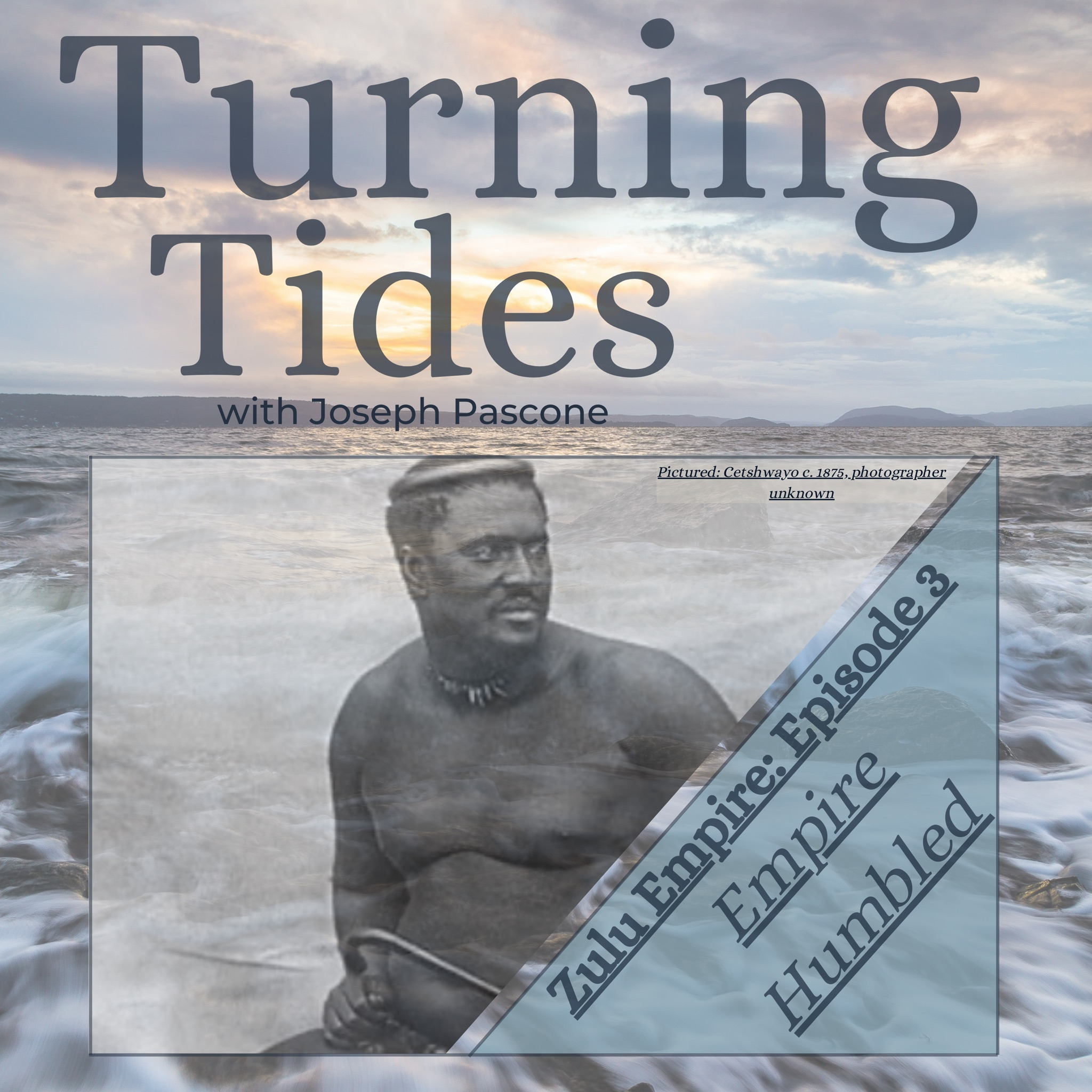
Turning Tides · Joseph Pascone
Turning Tides: Zulu Empire will discuss the rise and fall of the Zulu Empire. The third and final episode, Empire Humbled, will cover the period from 1873 to Present, in which Cetshwayo defends the Zulu Empire from British invasion during the Anglo-Zulu War and afterwards. If you'd like to donate or sponsor the podcast, our PayPal is @TurningTidesPodcast1, or you can donate to us through our Buy Me a Coffee link: buymeacoffee.com/theturningtidespodcast. Thank you for your support! Produced by Melissa Marie Brown and Joseph Pascone in affiliation with AntiKs Entertainment. Researched and written by Joseph Pascone Edited and revised by Melissa Marie Brown Intro and Outro created by Melissa Marie Brown and Joseph Pascone using Motion Array Website: https://theturningtidespodcast.weebly.com/ IG/Threads/YouTube/Facebook: @theturningtidespodcast Bluesky/Mastodon: @turningtidespod Email: [email protected] Bluesky/Mastodon/IG/YouTube/Facebook/Threads/TikTok: @antiksent Email: [email protected] Episode 3 Sources: 1. Zulu Empire Decolonised: Epic History of the Zulu from Pre-Colonial Times to the 21st Century, by Shalo Mbatha 2. The Zulus and Matabele: Warrior Nations, by Glen Lyndon Dodds 3. The Zulu Kings, by Brian Roberts 4. The Anglo Zulu War: Isandlwana: the Revelation of a Disaster, by Ron Lock 5. Africa Through the Eyes of the Other: A Collection of Observations made by European Colonizers, Explorers, and Missionaries in regard to the Zulu, published by abū Firnās & Co., Kharțūm, Sūdān 6. https://www.justice.gov.za/trc/media/1997/9705/s970527e.htm#:~:text=In%20that%20month%20over%20600,KwaZulu%2DNatal%2C%20it%20said. 7. https://www.theholocaustexplained.org/what-was-the-holocaust/what-was-genocide/the-herero-and-namaqua-genocide/ 8. https://www.theguardian.com/world/shortcuts/2013/sep/01/winston-churchill-shocking-use-chemical-weapons#:~:text=%22I%20am%20strongly%20in%20favour,gas%20against%20natives%20are%20unreasonable. 9. https://www.saflii.org/za/cases/ZASCA/2024/82.pdf 10. https://www.bbc.com/news/articles/cgr5xe7z0y0o 11. https://www.dailymaverick.co.za/article/2025-05-23-five-of-six-farm-murder-victims-were-black-police-minister-senzo-mchunu-rubbishes-trumps-white-genocide-lies/ 12. Wikipedia
!WARNING! ***WAR, VIOLENCE, CANNIBALISM, ANIMAL CRUELTY, RACISM, RAPE, SEXUAL ASSAULT, CHILD ABUSE, GENOCIDE, ETHNIC CLEANSING*** “The Zulu joint committee of the military high command and the king’s council held an emergency meeting to consider the [British] ultimatum… To break the deadlock, they agreed to solicit the army’s opinion… Cetshwayo explained their predicament. When he finished, the thousands of men assembled jumped to their feet in military precision and performed ingomane (war dance) and shouted “Sigidi!”... [Cetshwayo] was convinced the whites were the ‘swallows’ that Shaka had said would try to destroy the Zulu empire… [he] sent the royal messenger… iMboza… to announce ukhukhulelangoqu (national call up) in the entire empire… Female regiments and retired warrior women were mobilized, and they too made their way to the capital. Civilian women reorganized their homes to reflect a kingdom at war. They covered their faces with special herbs, wore their leather skirts inside out, while grass mats, brooms and other household items were kept upright. Livestock, food, valuable items, the weak, the aged and children were moved into caves.” - Shalo Mbatha, Zulu Empire: Decolonised: The Epic Story of the Zulu from Pre-Colonial Times to the 21st Century, iZigi Publishing, 2021 Location, 5283 - 5305 of 8545 The British redcoats and their African allies were in the predicament of a lifetime. They were in the process of being slowly surrounded by the Zulu “bull and horns” pincer formation. Their camp was out in the open, perched on a rise that the natives called “Isandlwana.” To the British soldiers, it resembled a sphinx-like hill. As the encirclement was completed, the Zulu rushed forward impetuously, and the British held the camp with rifle butt and bayonet. These proved very effective in single combat; the Zulu were being struck down time and again by the British soldiers. The Zulu changed their tactics; they began to fight the British in twos and threes, like they would during a lion hunt. As the melee unfolded, a partial solar eclipse began, covering the camp in an eerie shadow. British resistance was faltering, and in a matter of minutes, it would crumble entirely. Over one thousand British redcoats and their African allies lay dead, alongside thousands of Zulu warriors, who were laid out in piles, in and around the camp. A bloody lesson had just been taught to the British empire and the colonial authorities who planned the invasion of Zululand. They assumed that there was no way African soldiers could best the “greatest fighting force on the face of the planet;” they had just realized how wrong their assumptions were. There were many reasons the British gave for wanting to unify the entire South African peninsula into a single colonial unit. They said it would “bring stability to the region,” they believed the vast resources in the Boer Republics of Orange and Transvaal – as well as Zululand – would enrich British companies and spread capitalism, and finally, they believed both these peoples were incapable of governing themselves. They considered the Boers to be hot-headed nuisances. The Zulu struck fear in the hearts of the British, since they believed the Zulu were the only native tribe in the area which was capable of uniting the disparate African peoples living in the region into a single martial nation that could threaten Cape Town, as well as the vital trade which occurred there. In 1870, diamonds were discovered in modern-day Kimberly, South Africa. Once the world heard the news, 50,000 people looking to strike rich arrived from across the globe. They turned the great mountain into a massive pit; the damage was so egregious that it is still noticeable today from space. In Zululand, the patriarchal way-of-life was wearing thin on many women. During the reign of Mpande, he reintroduced the ludicrous state-regulated marriage system initiated under Shaka. For all his faults, Dingane allowed his soldiers to marry whom they pleased. Cetshwayo wanted to emulate Shaka, who might have been his illegitimate father. In 1876, nineteen-year-old female warriors were paired off with a male regiment consisting of men in their fifties. The female regiment refused the marriages, saying, “Tell Ndaba’s descendant… we refuse to marry these old men who will soon die and make us widows.” This was a truly stunning and brave act; they were the first regiment to refuse a royal decree. They were pressured by their families, their friends, and the empire at-large to accept the marriages, and many of them bowed to the societal pressure placed upon them. Others fled to safe places or across the border to British Natal. About ten refused to escape or accept the marriages; seven were killed by their male relatives for “shaming” their family. This horrific incident would be used by the British to justify their “moral crusade” against the Zulu. The media, of course, was on the side of Britain. They claimed that the British were fighting for civilization and women’s rights! The cry of “women’s rights” being used to justify colonial expansion and the oppression and subjugation of native peoples is wildly hypocritical and cognitively dissonant, considering the same people who ordered these invasions usually voted against women’s suffrage back in their home countries. Lord Carnarvon was one of the main forces behind the consolidation of South Africa into a single colonial unit. Jeffrey Guy states, “By confederation, it was hoped that a strong, united, white-dominated South Africa could be created, one that was suited to the demands of expanding capitalistic development and, at the same time, would be able to carry out its own administrative and military costs, thereby reducing the direct responsibility of the British Government in the region without harming its interests.” The main obstacles in the way of this parasitic relationship becoming reality were the Boer Republics of Transvaal and Orange, which clung to their independence in spite of their failing economy. Carnarvon’s plan was carried out by Sir Bartle Frere, the appointed Governor of the Cape Town colony. He wanted, “British rule over [Black people]… he envisaged putting them to civilized labour for wages, so they could spend their earnings on European manufactured goods to the benefit of white colonists, and to their own advantage.” Eventually, he would go above the heads of Queen Victoria, as well as the British parliament, to send an ultimatum to the Zulu, demanding their submission. In April of 1877, Frere's job was made easier when both Boer Republics submitted to the British and became protectorates. This whole time, Zululand had been petitioning the British to support their land claims, which conflicted with the Boer Republics’. They clearly did all they could to appease British interests – even submitting to Shepstone’s decrees at Cetshwayo’s coronation, which banned several Zulu practices and laws. The main task of British authorities was to demonize Cetshwayo and the entire Zulu Empire. Frere was at the head of this smear campaign. He said of Cetshwayo, “The monster Chaka [sic.] is his model… to emulate Chaka in shedding of blood is as far as I have heard his highest inspiration.” The first major flare-up of armed conflict was not between the Zulu and British, but the British and the Hlubi tribe. This occurred a few years prior to the Boer Republics’ submission to British demands. The Hlubi were, once more, tearing through the borderlands between Zululand and the British colony at Natal. In order to silence the threat, British soldiers were dispatched alongside their African allies; however, during their first fight, the British were ignominiously routed by the Hlubi, who ambushed their military convoy while it was marching. It was the first of several embarrassments to befall British arms in Africa over the years to come. Eventually, the head of the Hlubi tribe was captured by the British and sentenced to a lifetime of exile, but Cetshwayo attempted to intercede on the Chief’s behalf. He asked the British to release him into Zulu custody. The British refused, and the Chief of the Hlubi spent most of the rest of his life on Robben island. Two incidents followed this altercation on the borderlands. The first was that several wives of Sihaya kaXonga fled over the border into British Natal. Sihaya’s son took matters into his own hands; he crossed the border with a small strike team, kidnapped the women, and once they were over the border and back in Zululand, he had them executed. Another incident occurred a few weeks later; two British colonists were found “surveying” territory in Zululand. They were both captured; they claimed they were ignorant and that they were lost. They were returned unharmed, but they were shaken up. Ron Lock believes there is a high likelihood that this two-man team was carrying out reconnaissance for the impending invasion, as one of these two individuals would go on to become a member of Colonel Durnford’s military engineers. Regardless, these two incidents – greatly embellished by authorities and the colonial press – were spun into a web of lies that was supposed to “justify” the invasion of Zululand. During this time, Cetshwayo was more concerned with his northern borders, which were continuously being violated by colonizers from the Boer Republics. He was hoping that the British Land Commission would declare in his favor, but he had no idea how much this seemingly innocuous land commission would change the course of his life and the lives of countless people in Zululand. Cetshwayo was in the process of rolling back reforms in his kingdom. He claimed that the Christian religion was ruining the Zulu people and turning them into devotees, as opposed to devoted warriors. He made his disdain for the religion abundantly clear, threatening to execute any of his subjects who dared convert or talk about converting. When he made good on his threat and executed a seventy-year-old man for his public adoration of the faith, Christian missionaries added fuel to the fire by attempting to turn the man into the first Zulu-Christian martyr. Additionally, Cetshwayo cracked down on his subjects who were attempting to finagle their way out of military service. He even drafted medicine men and herbalists, who were hitherto exempt from conscription into military regiments. The Land Commission was hard at work, and in a completely unbiased assessment, they ruled in favor of the Zulu claim, asserting that neither Mpande, nor his predecessors, ever allowed the land in question to be sold or worked by the Boers. This was in line with British designs, as they had planned to annex Zululand anyway, so they wanted to be able to gobble up as much territory as possible. Frere decided that, in combination with the Land Commission’s decision, he would present an ultimatum to Cetshwayo. The ultimatum would be tantamount to a complete surrender of Zulu autonomy. It was designed to be rejected. The Zulu diplomatic mission, which was composed of the great indunas of the empire, was anxious but hopeful to hear the Land Commission’s decision. They arrived under the “Ultimatum Tree” on December 11th, 1878. Sheptsone was there, and he read the findings aloud to the Zulu dignitaries. They were overjoyed at the Land Commission’s findings; ALL Zulu claims were recognized. Then, Shepstone read from another document, Glen Lyndon Dodds writes, “Shepstone presented the British ultimatum to the increasingly incredulous Zulu embassy… the perpetrators of the border incidents were to be handed over and Cetshwayo was to pay a fine of 500 cattle… The Zulu army was to be permanently disbanded; all Zulus were to be free to marry upon reaching maturity; missionaries were allowed to return and operate without hindrance… and a British Resident was to be stationed in Zululand to enforce the conditions.” It was a ludicrous ultimatum for which the Zulu diplomats had no answer. They were completely befuddled that a nation they had strived to maintain peaceful and friendly relations with since the reign of Shaka would so openly demand such unreasonable retribution for two incidents, which – while heinous – had very little to do with the Zulu state or with Cetshwayo. Upon hearing the news, Cetshwayo was probably bewildered. He had to try and put on a brave face in front of his subjects, but he had to realize that he was about to come face-to-face with the largest empire in world history. He raised his grand army, which likely numbered around 60,000, and awaited the British advance. He wanted the world to understand that he was being invaded, that he was not a monster, and that his small country had little with which to defend itself in the face of a concerted British invasion. In short, he would attempt to fight a defensive war and only allow his men to do battle if Zululand was invaded. It was a decision based in the hope that the Zulu monarch would gain sympathy from the British public and the world. Keeping his armies in Zululand did gain him global sympathy, but if he chose to, he could’ve devastated the countryside in every direction, especially after the British defeat at Isandlwana. On the British side, the mood was high amongst the British regulars and the militiamen from Cape Town who had been called upon to participate in the invasion. However, morale was more shaky amongst Africans in British employment. Only one in ten was given a rifle, and these rifles had only two rounds of ammunition. They had no uniform besides a white armband, which denoted their friendly status. This led to numerous instances of friendly fire, as a fucking white arm band isn't enough to delineate your soldiers from the enemy’s during a battle. They were given no lodging and expected to sleep on the floor, while their white counterparts were all assigned tents. The rest of the expedition was equipped with top-of-the-line technology, like the .45 Martini-Henry breech-loading rifle, capable of firing twelve shots a minute. Comparatively, the 1861 Springfield – the main weapon used by the Union during the United States Civil War – fired only three rounds a minute, and that's if you were proficient at loading. The bayonets used were the longest ever employed by the British, at 21.5 inches long. The invasion forces also had a handful of cannon which could fire a range of ordinance, as well as rockets – which were largely obsolete at this point. The main and undeniable advantage the British had was in their technological superiority. Conversely, the Zulu completely outclassed the British in terms of mobility. They ran circles around the British in this regard, literally and figuratively. British soldiers who fought against them second this opinion. Trooper Symons described an encounter with the Zulu during this conflict, writing, “...from one end of the ridge to the other, as if by magic, rose a long line of Black warriors advancing at the double at short intervals of skirmishing order. It was a magnificent spectacle that no British regiment could excel in... They uttered no sound and on reaching the brow of the hill the entire centre halted while the flanks came on forming the noted ‘horns’ of the Zulu impi. We all thought we were about to be attacked but a shout came from the hilltop answered by one from the right horn. The impi then halted, another shout and the Zulus slowly retired til only three or four were visible on the ridge.” This advantage in speed would have to be countered by an elastic offensive. To achieve this, Lord Chelmsford, leader of the British military expedition, split his many thousands of men into four separate columns, designed to invade Zululand from four separate directions. It was hoped that this would entice the Zulu into attacking one segment of the column, forcing a decisive fight. His plan worked a little too well; No. 3 Column, containing over 4,000 soldiers, would be the deciding factor in this fight. As the deadline for the British ultimatum expired on January 11th, 1879, the first British troops splashed across the Mzinyathi River, which separates Natal and Zululand. As this happened, 40,000 - 60,000 Zulu warriors were at uLundi receiving their final blessings before battle. First, they were forced to vomit into a large pit dug for that purpose; this cleansed the body for the next ritual, which is intense – to say the least. Each warrior took a swig from a concoction containing, “herbs, the flesh of brave animals such as the lion and buffalo…” and the “body dirt of the Nation.” This is the grime which develops on an object from constant human contact. Finally, the brew may contain body parts of fallen enemies who had proved their mettle in battle; this sometimes included the fallen warrior’s rectum, as it was believed the enemy would suffer from diarrhea on the day of the battle if this was done. The Zulu performed a final ritual in which a bull is let loose on a group of Zulu warriors. The warriors were meant to subdue and kill the bull with their bare hands; they did this by mounting the animal and then wrenching the animal’s neck around until it snapped. It was not uncommon for Zulu warriors to die or become injured during this final ritual. After killing the bull, the warriors skinned and gutted the animal, taking turns eating the raw meat they pulled from the carcass. It was only after these rituals that the war priests deemed the soldiers ready; the rest was in the hands of the great Zulu deity, Unkulunkulu, or “he who is of himself.” As they invaded, the British began to plunder like only the British could. Within days, they had stolen 7,000 heads of cattle from the poor herdsmen of the border area. Next, they moved on Sihayo’s homestead. As they entered the homestead, they were set upon by a small band of Zulu. They fought hand-to-hand with the African troops in British employment. Outnumbered, the Zulu fell back to the broken ground around their Kraal and began trading shots with the British; their weaponry was no match for the British Martini-Henry rifles, and the Zulu fell back into the mouth of a cave. Trapped, the Zulu eventually gave in and fled in all directions. The first “battle” of the Anglo-Zulu War was a victory for the British. At the cost of twelve casualties, they killed or wounded twenty-eight Zulu, captured numerous heads of cattle and other means of supply, and finally, they burned Sihayo’s homestead to the ground. The jingoists in Natal and elsewhere saw this first engagement as proof of the might of British arms. The correspondent for the Natal Witness wrote, “...I have seen the bare green hills of Zululand enlivened by the white tents, and the red or blue uniforms of men who have been gathered there to vindicate the just cause of an offended civilization, and to assert the outraged authority of the British Crown. I have seen the climax of a policy which must end in the undisputed supremacy of British rule over all the native tribes that live south of the Limpopo [River].” Cetshwayo undoubtedly heard about the capture and burning of the homestead; the Zulu, like the Puebloans of the American Southwest, could relay information rapidly via line-of-sight points. The British called this practice, “the Zulu telegraph.” Four days later, No. 3 Column had made just ten miles of slow progress through the Zulu countryside. It had finally stopped raining, and the one rise in the area was the Sphinx-like Isandlwana Hill. It was here that No. 3 Column decided to set up the first British base camp. Chelmsford was warned by veterans of Blood River to laager the wagons he had, but he refused to do so, considering it “overcautious.” I would submit that the only thing worse than being overcautious is being under-cautious – a lesson Chelmsford would learn the hard way. Henry Francis Fynn Jr., whose father was one of the first British men to write about the Zulu, was there as well. Like his father, Fynn Jr., was considered a Chief amongst the Zulu, even allowed to wear a purple-crested Turaco feather in his hat – a right which was usually only granted to Zulu nobility. Fynn Jr. was sure his information regarding the disposition and location of the Zulu army was correct, and he convinced Chelmsford to break off a huge portion of his force to set off in search of the Zulu army. Ron Lock asserts that Fynn Jr. was probably tricked by his Zulu subjects and that this was likely a part of the grand Zulu strategy to isolate part of one column for assault and destruction. If true, it was a masterful subterfuge, and one in which the Zulu routinely excelled. Chelmsford detached 1,500 men from No. 3 Column and took off toward the supposed location of the Zulu army, about a day's march north. His soldiers left their gear, provisions, and other “unnecessary” equipment in their tents; they were expecting to be back in a few days, drenched in glory. At first, it seemed they would come to blows with the enemy, as several hundred Zulu were reported in the area. This seems to be another expertly crafted Zulu diversion. They wanted these several hundred men to be spotted and followed so that their army of tens of thousands could descend on the isolated camp at Isandlwana. Ron Lock writes that the Zulu, “would lure Chelmsford into taking almost 70 [percent] of the column’s strength on a wild goose chase.” On January 22nd, as Chelmsford spent valuable time chasing his elusive foe, he received a frantic letter brought in by an exhausted messenger. It told of a Zulu attack back at base camp. At first, Chelmsford thought nothing of the missive; he was on the trail of the Zulu, so there was no way the camp was under any kind of serious attack. A second messenger appeared with the same news; Isandlwana was under attack by as many as 15,000 Zulu. This last message was penned by Commandant “Maori” Browne, nicknamed for his tours of duty in New Zealand. He had a reputation for being stoic in the face of danger, but not this time. Instead, he wrote, “For God’s sake come back, the camp is surrounded and must be taken [by the Zulu] unless helped at once.” The Zulu were headed by Ntshingwayo kaMahole, a commander from the days of Shaka who was now in his seventies, and Mavumengwana kaNdlela, the son of Dingane’s Commander-in-Chief. Their impi had been holding the Siphezi mountain tops, carefully keeping out of view of British scouts. On January 22nd, the day of the new moon, the Zulu hand was forced when a portion of their men were discovered by British cavalry who were scouting the area. The uMcijo regiment surged forward to disperse the horsemen; their comrades followed, and – without orders – began forming the “head and horns” on the plateau. Their formations began a methodical encirclement of the British camp; they knew the other British columns would be in no position to support their comrades, as they were too far away. Mehlokazulu kaSihayo fought on the left wing of the Zulu formation, and he says that as the British forces retreated, firing in skirmishing order, the Zulu slowly advanced, firing as they came forward. He says his regiment was taking heavy flanking fire, forcing his unit to retreat temporarily further to the left. His unit, alongside the uVe regiment, were the first to come in contact with the British. He continues writing, “When they ran out of ammo for their big guns, they used revolvers and when those ran out, the British forces stood tightly together shoulder-to-shoulder. Then they fought with the bayonets attached to their guns in the hand-to-hand combat. We speared many of them to death and some of us even stripped them and wore their colorful uniforms.” As the struggle on the left was still in question, the center chest and right horns were also completing their envelopment of the camp. Not being in laager meant that the few stones and rocks which broke up the terrain became the only place of refuge for the British and their African allies. They made the Zulu pay for every inch of ground they captured. Thousands fell by sword, bayonet, revolver bullet, and lead cartridge, but the Zulu kept coming, like warriors possessed. The British now fought desperately for the camp itself, each tent becoming a final resting place for Zulu and Brit alike. The commanding British officer, HB Pulleine, was found writing a final desperate letter to Chelmsford, begging his CO for assistance. He shot the Zulu warrior who discovered him through the neck, but the warrior rushed the Brit and speared him to death, gaining the sobriquet, “he who decides the matter.” Some began a mad dash back to the Natal border. Many hundreds drowned in the swollen river, which had already claimed a life during the entirely peaceful crossing eleven days ago. Amongst those who died, the last moments of Lieutenant Teignmouth Melvill and Lieutenant Neville Coghill are amongst the most spoken of in the annals of British military “heroes.” Coghill had managed to cross the river using a drift, henceforth known as Fugitives' Drift; instead of fleeing to safety, he turned back when he saw Melvill, the regimental flag bearer. Coghill watched as Melvill’s horse was shot from under him; he decided to re-ford the river and save Melvill from a watery grave. Unfortunately for them, Coghill’s horse was also killed, and the two were so exhausted from their flight that they were unable to continue their escape. They were both killed by the Zulu. In total, over 1,100 British soldiers and African allies were massacred with only a handful of either escaping to tell the tale. The Zulu suffered much worse; many died days and weeks later from their poorly-treated wounds. In total, anywhere between 1,000 and 3,000 Zulu died as a result of the battle at Isandlwana. The “loins,” or reserve of the Zulu impi, were disappointed to say the least. They were hoping to cover themselves with glory and deliver the coupe de grâce to the white invaders. Realizing this was not going to happen, they took off west, intending to find more foreigners to massacre. Crossing the border into Natal, they came upon Rorke’s Drift, a small trading outpost founded by a Scandinavian missionary, which was then being used as a forward supply dump for the British. It was manned by around ninety British soldiers and was recently reinforced by fugitives from Isandlwana, bringing the total number of soldiers defending the small outpost to around one hundred and fifty. The Zulu reserves numbered around 3,500 and were composed of the veteran fighting men of the Zulu armed forces. Many of these men probably fought in battles against the Swazi and in the Second Zulu Civil War. Its commanding officer was hoping to be in and out with lightning speed, but instead, he would grant the British an immense propaganda victory. In several disjointed Zulu attacks, the garrison of the trading post resisted ferociously. Over the course of the night and the next morning, over 300 Zulu fell, while over thirty British soldiers were killed and wounded. Unable to capture the trading post – but satisfied they were able to participate in battle – the impi cheered their success several times and departed the area to return to the main army. Following the defense of Rorke’s Drift, the British government awarded eleven Victoria Crosses to the garrison, and British newspapers dubbed the battle “a perfect example of the heroism of British arms.” However, the defense of a small outpost could not simply overcome the fact that over 1,100 men, alongside all of No. 3 Column’s supplies, ammunition, and wagons, were absolutely destroyed or captured by the Zulu. The invasion could not continue, and the bedraggled men had to pass by their burned out camp on the way back. The government back in London had its hands full in a never-ending conflict in Afghanistan and was beside itself that this “small war” in South Africa was now front-page news across the country and around the world. Back in Zululand, Cetshwayo could not celebrate the victory his soldiers had won. He was anguished at the immense number of casualties the Zulu suffered. He said, “An assegai has been thrust into the belly of the nation, there are not enough tears to mourn the dead.” His army seemed unfazed and instead sang, “we fear nothing, we fear nothing, we routed the invading whites, we are excited by our bravery…” Lesser-known battles took place all across Zululand, corresponding with the other routes of British invasion. On the eNtombe River, a Chief of the Zulu killed dozens of soldiers protecting a supply caravan. At the battle of eHlobane, the recently reconstituted women regiments of the Zulu proved their mettle and killed over one hundred British soldiers, forcing them to retreat or risk another massacre. Finally, Louis Napoleon Bonaparte, the only son of Napoleon III was killed in a minor skirmish. His sword, which was used by his great uncle on the field of Austerlitz, was handed over to the Zulu Emperor as a prize of war. It was another disaster for European arms. British Prime Minister Benjamin Disraeli lamented, “A very remarkable people the Zulus, they defeat our generals, they convert our bishops and they have settled the fate of a great European dynasty.” The second claim of “converting bishops” was an allusion to one of the great Christian contrarians of all time, the Right Reverend Bishop John William Colenso. He was the first Anglican Bishop of Natal, as well as an advocate for African peoples and their traditional cultures, for most of his life. He was the first person to translate the Bible to isiZulu, the traditional Zulu language, and he went on to question the doctrines of eternal punishment, as well as the belief that communion is the only way to salvation. Additionally, he rejected the story of Genesis as being a literal creation story. Finally, he argued that the separation of Zulu husbands and wives upon conversion was a great evil. He said, “..the usual practice of enforcing separation of wives from their husbands, upon conversion to Christianity is quite unwarranted and opposed to the plain teaching of our Lord… What right had we, to require this man to cast off his wives and cause them in the eyes of all their people to commit adultery because he has become a Christian? What is to become of their children? Who is to have the care of them? And what is the use of our reading to them the Bible stories of Abraham, Israel and David with their many wives?” All these “heresies” resulted in his expulsion and excommunication from the Anglican Church. However, Colenso would become one of the main advocates for the Zulu people in the months which followed the war’s conclusion. The Zulu could no longer maintain standing armies against the increasing pressure the British were putting on their country and their manpower reserves. They decided to end the formal campaign against the British and begin a guerrilla campaign behind the lines. This infuriated the British soldiers, who took out their frustration on the populace. Shalo Mbatha says, “They tortured and castrated men, raped women, disemboweled small children, broke the legs of cattle they could not loot, torched granaries, homes and plantations.” Cetshwayo was sending letters back and forth to Lord Chelmsford; he was desperately seeking a peaceful solution to the war in which the Zulu maintained their national sovereignty. Chelmsford said the Zulu monarch had to accept the previous demands and, additionally, hand over all of the Zulu weaponry. This would be unacceptable to any sovereign, so the war continued into the heart of Zululand. The eMashobeni valley was devastated and its kraals burned. The redcoats continued impetuously to uLundi. On the 4th of July 1879, uLundi was plundered and burned to the ground. One of Cetshwayo’s servants recounts the days which followed, saying, “...from that day on, we never slept in any homestead but under the open dark skies. My responsibility was to look after the 11-year-old Crown Prince Dinuzulu… The king ordered us to move only at night. I still remember walking through thorns at night without a footpath to guide us and we could not see where we were going. The most difficult part of our march was when we had to cross the waterless region of oBonjeni. We the Zulu are really a tough people.” The British continued their military campaign based on “women’s rights and capitalistic progress” until they captured Cetshwayo. They found him deep in the iNgome forrest at a kraal called KwaDwasa on August 28th, 1879. They marched him on foot for three days and nights back to uLundi. Out of thousands of huts which once stood around the Zulu capital, only ten remained standing. The rest were given over to the flame. Arriving at his former home, Cetshwayo was shown a modicum of respect by the British who had captured him. They formed a 100 meter honor guard, which saluted the emperor as he walked by. At the end of this procession was Sir Garnet Wolseley. He informed Cetshwayo that the Zulu Empire no longer existed and that Zululand would be divided amongst the chiefs who showed the most loyalty to the British. He also told Cetshwayo he was no longer an emperor but a prisoner of war; then, without warning, he ripped the lion’s claw necklace from the emperor's neck and sent him on his way. Cetshwayo arrived in Cape Town on September 15th, 1879. There, he was informed in detail what would occur to his former empire; it was to be split amongst thirteen separate “kings,” all answerable to a London-appointed official. Cetshwayo languished in jail for several months, when relief finally came in the election of a new government. The people of Great Britain were obviously tired of paying for the foreign dragons their government kept insisting they needed to slay, and they voted in William Gladstone and his Liberal Party, who supported clemency for the Zulu King as a part of their electoral platform. Public opinion was swinging in Cetshwayo’s favor; many considered him a king who bravely stood up to foreign invasion, just as King Arthur had done against the Norsemen and Vikings. He was also bolstered by Lady Flo Dixie, a suffragist who campaigned hard for Cetshwayo, considering him a victim of British imperialism. The “stability” Great Britain so desperately craved in South Africa was nowhere in sight. In late 1880, the Boers invaded Natal and defeated the British in some minor engagements, leading to the two Boer Wars of the 1890s, in which Boers were imprisoned in British concentration camps. In Zululand, the people starved, while their new “leaders” routinely raided and killed their new subjects if they were found with weapons. In early 1882, 5,000 Zulu people marched together to the Natal capital in order to protest for Cetshwayo’s release. Back in Cape Town, Cetshwayo had numerous supporters and well-wishers visit him and offer their support to his cause; amongst them was the future British king, Prince George, later George V. Cetshwayo was appreciative of all the support, but he was heartbroken to learn his wives had been evicted and told to find new husbands; they had all refused and moved back home. His son, Dinuzulu, was also at the forefront of his thoughts. On September 26th, 1882, Cetshwayo had finally been granted approval by the British government to visit London and present his case in person. He left immediately, and upon his arrival in early August, he was greeted by hundreds of fascinated Brits. The workers at Brighton Warehouse composed an acrostic poem to his name, it went: Cetewayo! Zulu King! England thee is welcoming, Thy misfortune through sad war, English hearts have watched afar, When returned to Afric’s shore, After thy brief visit, Young and old hope thou again, Over Zululand mays’st reign!” Queen Victoria formally invited Cetshwayo to Osborne House on the Isle of Wight on August 7th, 1882. Almost immediately, the incredibly patriarchal nature of Zulu society provided an awkward moment. Cetshwayo asked if instead of negotiating with a woman, he could negotiate with the queen's servant and lover, John Brown. Victoria stared incredulously at the African monarch and said she was the, “Queen of Great Britannia,” and he had to accept conversing with her. The queen also demanded that Cetshwayo look her in the eyes as they spoke, but once they locked eyes, Shalo Mbatha says, “...Victoria began to bleed, and the talks were ended abruptly. This bleeding phenomenon happened for a week until, finally, she agreed to talk to him but without them locking eyes.” The main point of contention was with the abolition of the Zulu army; Gladstone and his government made it clear they wanted the Zulu army entirely disbanded. Cetshwayo relented but would not budge on the need for some sort of security force to protect the royal cattle and the grain fields. This was reluctantly agreed upon, and before departing, Queen Victoria presented Cetshwayo with several objects of interest, which included a silver cup and a huge Bible with the words, “I respect you as a brave enemy who will, I trust become a firm future friend.” Cetshwayo was going back to Africa and back to his native Zululand. When he returned home, there were few Zulu around to greet the reinstated king. This was because the British had threatened to shoot any Zulu who tried to congregate around the beach. His subjects were waiting at Dingane’s Watering Hole in the heart of the eMothanjaneni Valley. Cetshwayo was now one of many power brokers in the area, but by no means was he the most powerful. One of the new “kings” the British instated was Zibhebhu, who immediately set about subverting Cetshwayo’s authority. Calling a great meeting, Cetshwayo was named the emperor once more, and his former soldiers began rallying around him in order to overthrow the power of the new kings who acted so ruthlessly. Zibhebhu was their main target, as he was by far the most ambitious and bloodthirsty of all these new kings. The Third Zulu Civil War began in late March of 1883, and on the banks of a crocodile-infested river, the two factions vied for the supremacy of Zululand. The battle was brutally fought by both sides, with many of the fallen being devoured by crocodiles. It is unclear who won this fight, as both armies retreated after suffering casualties in the thousands. On July 21st, 1883, Zibhebhu stormed into uLundi Palace and killed numerous members of the royal family, military high command, and councilmen. Cetshwayo was on the run once more, after serving as king for under a year. During his second exile, Cetshwayo ruled what was left of his supporters and raised his son. After a lunch with Melmoth Osburne, the British overseer of Zululand, Cetshwayo became sick and passed out – his health was never the same. He declined rapidly, but not before confirming his son, Dinuzulu, as the next Zulu heir. Officially, Cetshwayo died of heart disease, but there are plenty who claim Cetshwayo was actually poisoned, by either Osburne or Zibhebhu. Dinuzulu would reign for years, even assisting his people during a rebellion against the British Poll Tax in 1908. Despite these brief moments of sovereignty, Dinuzulu was, for all intents and purposes, powerless to the British behemoth, which routinely and violently cracked down on dissenters, especially if they were Black. This policy did not change with the progression of time. For example, Winston Churchill argued vociferously for the use of poison gas against “savage tribesmen,” and European powers universally disregarded their own rules of war when it came to African “rebellions.” The British were not unique in their harsh treatment of natives in their African colonies. For example, the Germans have since admitted to perpetrating a genocide in Herreroland. The French were responsible for the deaths of millions of Algerians, both during their conquest and in their attempts to hold the colony. Meanwhile, the Belgians have killed as many as 100 million Congolese people. Amongst the many crimes that Great Britain perpetrated in South Africa, one of the most heinous was the introduction of Apartheid racial laws in order to segregate African citizens. Millions of African people were forced from their homes by a ruthless, conservative Boer government bent on controlling the lives of the poorest and most disenfranchised amongst them. Throughout the 1960s, 70s, and 80s, tens of thousands of Africans were killed because of political violence begun by ultra-conservative Apartheid regimes. In time, this system gave way, but not before the deaths of true heroes to the cause. A prime example of this is Stephen Biko, who was beaten to death by white police officers while in police custody. Today, the same conservatives who preach about free speech and once wore “Hang Nelson Mandela” t-shirts have the gaul to say that a political chant like, “Kill the Boer, kill the farmer,” is causing a “genocide” of white South African citizens; however, the police statistics prove otherwise. The only genocide that has taken place in this area was perpetrated by European colonizers. Today, African countries like Burkina Faso, and – to a lesser extent – South Africa, have started to assert their independence on the world stage once more. African leaders, like Ibrahim Traoré, have been the target of numerous Western-funded assassination attempts. Whenever Africa has tried to assert itself and forge its own path, their movements and their leaders have been targeted and destroyed. This is true throughout the continent, but I believe that Africa will – sooner or later – surpass not just Europe, but also America, in terms of economic output, especially if Trump keeps “making America great.” In short, there’s a reason African regimes are tarnished with cries of backwardness, corruption, and white genocide, and that’s because African regimes have always scared the white western world. If Africa does decide as a whole to give the rest of the world a taste of their own medicine, the majority of our “civilized western world” will go completely dark, as the resources we use for energy largely come from Africa. In short, the rest of the powers that be will try to keep the continent in chains for the foreseeable future. However, chains rust, and empires are always humbled, just as stone is worn down by the changing tides. Unfortunately, South Africa is still suffering today, through the efforts of megalomaniacs like Donald Trump. During their confrontation, Trump’s lies were juxtaposed so perfectly by the grace and dignity of South African President Cyril Rhamposa. It is clear that not much has changed in three hundred years in the realm of western propaganda. Since the Zulu Empire’s destruction as a sovereign and independent empire, the Zulu have become a cultural phenomena. They are referenced by music groups, like A Tribe Called Quest, and artists like Kendrick Lamar. They have also been vilified by their detractors. They are one of the most important peoples to have been born out of a melting pot of cultures, languages, and belief systems, which all existed many years prior to European arrival. They forged their nation by themselves and maintained an empire in the face of colonization, conversion, and exploitation for quite a long time. Thank you all for listening; I appreciate every single one of you for tuning in. After a short break to catch my breath and research a little bit more, we will be heading north on our tour through history and time, to the Iberian peninsula in the middle of the 20th century. A civil war was about to erupt between the two halves of Spanish society. To hear the story of the Spanish Civil War and the rise of fascism in Spain, you’ll have to tune into the next episode of Turning Tides. If you haven’t already, drop a review of the show on iTunes, share it on social media, or subscribe to our YouTube channel; it really helps us reach more people. I'm your host, Joseph Pascone; have a great day.