
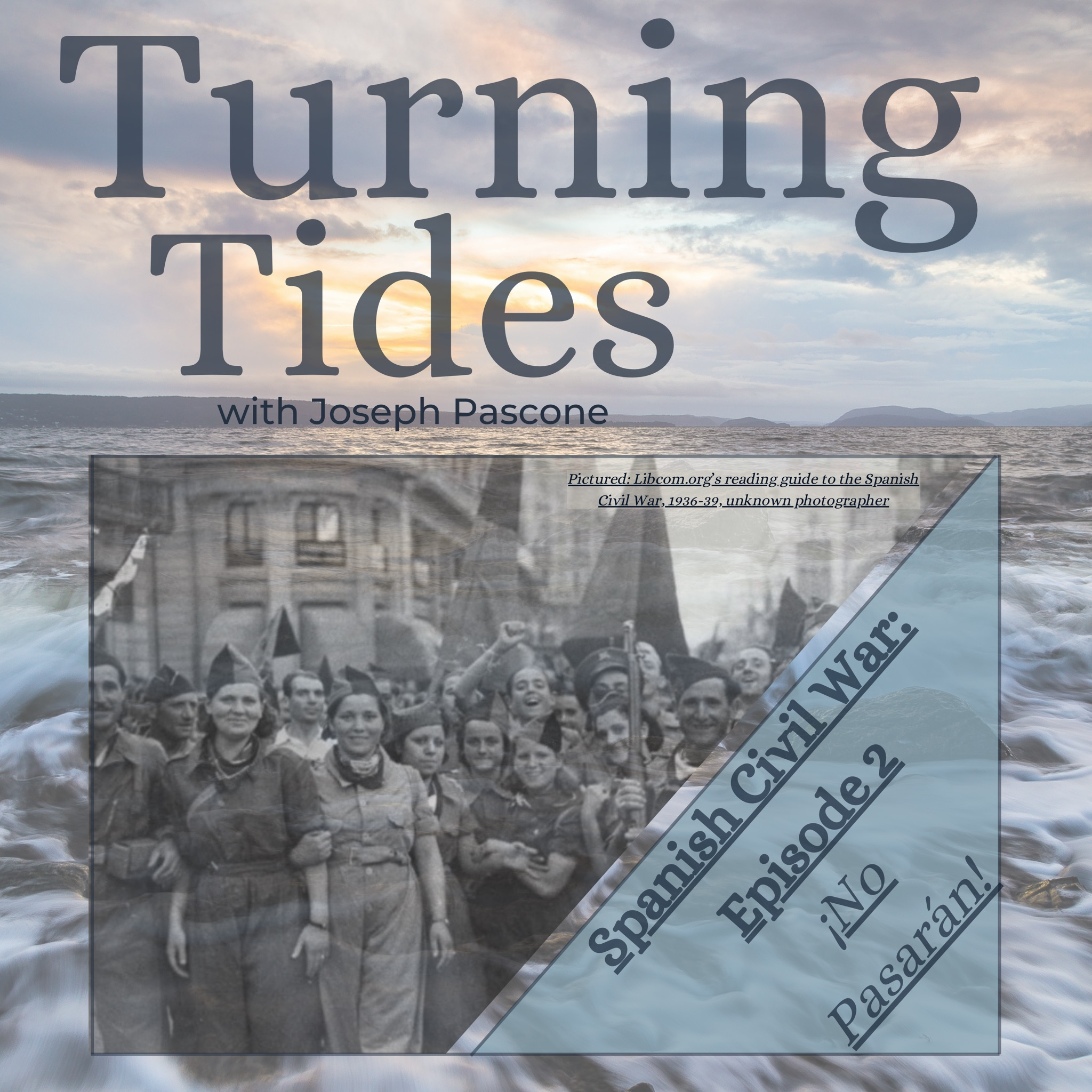
Turning Tides · Joseph Pascone
Turning Tides: Spanish Civil War will discuss the conflict which shaped modern Spain. The second episode, ¡No Pasarán!, will cover the period from 1936 to 1937, in which the civil war explodes into horrific acts of violence, oppression, and calamity. Outro music: A las barricadas by El violinista del amor & los pibes que miraban, available on Bandcamp and major streaming platforms. If you'd like to donate or sponsor the podcast, our PayPal is @TurningTidesPodcast1, or you can donate to us through our Buy Me a Coffee link: buymeacoffee.com/theturningtidespodcast. Thank you for your support! Produced by Melissa Marie Brown and Joseph Pascone in affiliation with AntiKs Entertainment. Researched and written by Joseph Pascone Edited and revised by Melissa Marie Brown Intro and Outro created by Melissa Marie Brown and Joseph Pascone using Motion Array Website: https://theturningtidespodcast.weebly.com/ IG/YouTube/Threads/Facebook: @theturningtidespodcast Bluesky/Mastodon: @turningtidespod Email: [email protected] IG/YouTube/Facebook/Threads/TikTok/Bluesky/Mastodon: @antiksent Email: [email protected] Episode 2 Sources: 1. Fascism in Spain: 1923 - 1977, by Stanley G. Payne 2. Homage to Catalonia, by George Orwell 3. Franco's International Brigades: Adventurers, Fascists, and Christian Crusaders in the Spanish Civil War, by Christopher Othen 4. Forgotten Places: Barcelona and the Spanish Civil War, by Nick Lloyd 5. The Last Miles to Huesca: An Australian Nurse in the Spanish Civil War, by Judith Keene 6. Camaradas: Ode to the Spanish Civil War: An Anthology of the International Brigades, by Eric Weinert 7. Spartacus Educational: Spanish Civil War, by John Simpkin 8. Spanish Civil War: History of a Battle for Europe's Soul: Spain's Great War (Required Histories), by George Levrier-Jones 9. The People's Army in the Spanish Civil War: A Military History of the Republic and the International Brigades, 1936 - 1939, by Alexander Clifford 10. Stolen Babies of Spain: The Book, by Greg Rabidouz, Mara Lencina, and Enrique Torres Vila 11. History of Spain from 1900 - 2000, by Dr. Cervantes Unuro 12. Long Live Death: the Keys to Victory in the Spanish Civil War, by A.H. Lloyd 13, https://speakola.com/political/dolores-ibarruris-no-pasaran-spanish-civil-war-1936 14. https://files.libcom.org/files/AgColls.pdf 15. https://teachwar.wordpress.com/resources/war-justifications-archive/spanish-civil-war-1936/ 16. Wikipedia Etc...
!WARNING! *** WAR, VIOLENCE, MURDER, TORTURE, CHILD ABUSE, RAPE, SEXUAL ASSAULT, SUICIDE, RACISM*** “Workers! Farmers! Anti-fascists! Spanish Patriots! Confronted with the fascist military uprising, all must rise to their feet, to defend the Republic, to defend the people's freedoms as well as their achievements towards democracy! Through the statements by the government and the Popular Front, the people understand the graveness of the moment. In Morocco, as well as in the Canary Islands, the workers are battling, united with the forces still loyal to the Republic, against the uprising militants and fascists. Under the battlecry 'Fascism shall not pass; the hangmen of October shall not pass!' workers and farmers from all Spanish provinces are joining in the struggle against the enemies of the Republic that have arisen in arms. Communists, Socialists, Anarchists, and Republican Democrats, soldiers and (other) forces remaining loyal to the Republic combined have inflicted the first defeats upon the fascist foe, who drag through the mud the very same honourable military tradition that they have boasted to possess so many times. The whole country cringes in indignation at these heartless barbarians that would hurl our democratic Spain back down into an abyss of terror and death. However, THEY SHALL NOT PASS! For all of Spain presents itself for battle. In Madrid, the people are out in the streets in support of the Government and encouraging its decision and fighting spirit so that it shall reach its conclusion in the smashing of the militant and fascist insurrection.Young men, prepare for combat! Women, heroic women of the people! Recall the heroism of the women of Asturias of 1934 and struggle alongside the men in order to defend the lives and freedom of your sons, overshadowed by the fascist menace! Soldiers, sons of the nation! Stay true to the Republican State and fight side by side with the workers, with the forces of the Popular Front, with your parents, your siblings and comrades! Fight for the Spain of February the 16th, fight for the Republic and help them to victory! Workers of all stripes! The government supplies us with arms that we may save Spain and its people from the horror and shame that a victory for the bloody hangmen of October would mean. Let no one hesitate! All stand ready for action. All workers, all antifascists must now look upon each other as brothers in arms. Peoples of Catalonia, Basque Country, and Galicia! All Spaniards! Defend our democratic Republic and consolidate the victory achieved by our people on the 16th of February. The Communist Party calls you to arms. We especially call upon you, workers, farmers, intellectuals to assume your positions in the fight to finally smash the enemies of the Republic and of the popular liberties. Long live the Popular Front! Long live the union of all anti-fascists! Long live the Republic of the people! The Fascists shall not pass! THEY SHALL NOT PASS! - Dolores Ibárruri, 19th July, 1936 This episode is the second in a four-part series on the Spanish Civil War. It will cover the first eighteen months of the conflict, from the initial military revolt of July 15th in the Nationalist sector to the ensuing Social Revolution in the Republican sector, and from the culling of the forces on either side during April and May of 1937, to the beginning of a battle remembered as “Stalingrad in Miniature.” It is a story about how the world appeases fascists for their own convenience and how the bravery of a few thousand internationalists could make a difference in the fight against totalitarianism. The left had submitted meekly to the fascists in Germany and Italy with little real resistance, but in Spain, the left refused to go out without a knock-down, drag-out fight. A few armed workers, inspired by Socialism and Anarchism, prevented the fall of Madrid in the face of determined thrusts by hardened combat veterans; these veterans preached a new Iberian crusade – this time, it would be against the “Reds.” Although it ended in eventual defeat for Republican forces, the lessons learned during this war would prepare an entire generation of anti-fascists for a war which lasted nearly a decade. July 18th, 1936 is considered by many to be the official beginning of the Spanish Civil War. In the days previous, a “pronunciamiento,” followed by a failed military coup, had sparked numerous insurrections and uprisings throughout the country. Led by Emilio Mola, the uprisings were only truly successful in two places – North Africa and Seville. Throughout the rest of Spain, the uprisings were met by determined resistance from the working class, especially in Madrid and Barcelona. In Barcelona, the right-wing uprising was led by General Fernández Burriel, who called his conscripts to arms at four in the morning and granted his soldiers a double ration of rum. The plan was to seize the key buildings in the city before the unions realized what was happening; they were supported by local Falangists and right-wing citizens. Unfortunately for the fascists, CNT spies had become privy to their plans. The union’s leaders had all the sirens at the ports and warehouses ringing, warning their workers of the impending danger. In the city center, the soldiers – who were told they were putting down an Anarchist uprising – attempted to build barricades to fend off the armed workers. They were being systematically picked off by lone snipers, bomb-throwing militia members, and taxi drivers who drove their cars into the barricades in a suicide mission. As the dust settled in Barcelona, 450 people lay dead, and another 2,000 were wounded. As the military uprisings failed across Spain, a Social Revolution sprang up in its wake. Workers collectivized and seized their factories, people sprung prisoners from their cells, and poor farmers took over the large estates for which they had once toiled. Much like in the Cultural Revolution of Maoist China, many of the great excesses of the revolution were committed by mobs of formerly disenfranchised people who were now in the saddle; they were not the result of state policy. Unlike the Cultural Revolution in China, the Social Revolution in Spain was much shorter-lived. By far, the most violence was committed against Falangists and the Catholic Church during the fighting. Proportionately, more priests and nuns died during the 1936 Spanish revolution than in the Russian Revolution of 1917 and the Russian Civil War. Estimates of priests, bishops, and nuns killed during the war stands at almost 7,000. This number was tallied almost entirely in the first few months of the conflict, with Republican-related slayings of the clergy falling to zero once the government was able to reassert central control. Most of those killed were priests, as nuns were seen as “captives of the Church” by many Republicans, and all attempts were made to “liberate them from their confines.” That being said, over 1,000 of the 7,000 killed were in fact women of the cloth. Additionally, numerous churches across Spain were burned down, as many Spanish leftists believed that Catholic churches were corruption-ridden institutions, which supported the international racket of capitalism. However, not all churches were burned; in fact, upon learning the Church they were vandalizing belonged to Protestants, a mob of Republicans immediately ended their pillage and began firefighting their own arson. Franco and the right-wing press the world over took advantage of these massacres to elevate their own goals. The right-wing press was reporting that nuns were being paraded naked through the streets and that it was Republican policy to sexually assault nuns and kill the religious. This was far from reality, and although there were individual instances of Republicans – and people who claimed to be Republicans – sexually assaulting and raping nuns and women who sympathized with Franco, these were never endorsed by the state. This was just not the case in Nationalist Spain where rape, sexual assault, and public humiliation were committed regularly against women who were accused of being “leftist.” The Republican ideology surrounding religion was much more complex than the interpretations espoused by right-wing “historians” like A.H. Lloyd. Many Republicans maintained their personal religious beliefs. This was especially true in the northern strip of land which was still controlled by the Republic. When the Nationalists took this area in late 1937, they shot several frocked priests who were traveling with – and praying alongside – the Republicans. Judith Keene was an Australian nurse for the Republican side who arrived in Spain several months into the conflict, so she missed the worst of the Republican mob violence, but she did witness what she called, “the sincere ceremony,” of a church burning. She writes, “It was a definite ceremony symbolizing the destroying of the corruption which had crept into the church. A sincere ceremony of purification such as Christ himself might approve. The foreign journalists… reported it was an act of vandalism – the Spaniards cannot comprehend how their foreign brothers can misinterpret such an act of faith.” As mentioned, not all churches were burned – one church, of which George Orwell detested the sight – was left intact because of its "artistic merit,” while others were taken over by community members and converted into state or community-run orphanages, schools, or living spaces for the unhoused. Churches weren’t the only buildings taken over in order to improve the lives of the poor; mansions and the empty summer houses of the rich were given over to the people. The former residents of these places departed to their secluded retreats in the mountains to wait out the war. They usually did this with Republican permission, or they assumed the guise of the working class until it was “safe” to be their bourgeois selves once more. How effective were the collectives and worker cooperatives which sprung up in many areas of Republican Spain? A.H. Lloyd, a conservative, claims they were a total disaster – he offers no evidence for this assertion, and that is because reality is quite different. Collectives only made up a small percentage of the industries in Spain. In terms of agriculture, only 18.5% of the land in Republican Spain was collectivized throughout 1936 and 1937; the rest belonged to small holders or private land owners who remained loyal to the Republic. By far, the largest number of collectives was in Aragon, a hotbed for the Anarchist movement. Here, upwards of 40% of the land was collectivized. Most of the time, collectives were created voluntarily and spontaneously after the large landowners and bosses fled. However, there were instances of forced collectivization by leftist militias, which usually failed – for obvious reasons. The spontaneous collectives were much more successful, and in many instances, they became completely self-sufficient communities. This was to the detriment of the government and the war effort, as collectives hoarded their resources. This is understandable in wartime, but it was detrimental to the Republic, overall. The collective experiment would officially end with the ushering in of the Negrin government in mid-1937, but this did not mean collectives stopped springing up. It only meant that the government was not endorsing them and advocating for their creation anymore. In reality, more collectives were created after they were no longer supported by the government, especially around besieged Madrid. The overall effect of collectives on Spain is clear; today, Mondrágon, which is one of the largest companies in Spain, is entirely worker-owned. Bosses are chosen with a vote, and the average GM’s salary is not allowed to surpass five times the amount the poorest employee makes. The fact that collectives in 1936 and 1937 were not necessarily efficient in terms of money-making and handing over supplies to the Republican government has more to do with the realities of wartime economic conditions, the poorly administered state bureaucracy, and the attempts by large swathes of Republicans to fundamentally change the world they lived in, while also combatting a vicious foe. Collectives were both effective and ineffective; they were effective at granting communities of poor farmers autonomy over their lives and the resources they created for the first time in – perhaps – thousands of years, and they were ineffective in terms of substantially supporting the Republican war effort. Regardless, the violence committed against churches did nothing for the Republican cause, and it turned many liberals away from supporting the legal Spanish government. For others, it turned them fully to the side of the Nationalists. Amongst those who supported the Nationalists was J.R.R. Tolkien, as well as the Spanish artist, Salvador Dalí. The Republicans received much broader support from the artistic world, as well as the support of most public opinion polls taken outside of fascist Europe. In general, however, the “liberal democracies” of the planet shrugged their shoulders at the civil war in Spain and preferred not to be involved at all. Many countries went even further, demanding their citizens remain home and not attempt to volunteer for the war; those that fought could have their citizenship stripped from them. When all else failed, a Non-Intervention Committee was created in order to curtail any involvement in the conflict by any nation. This Committee was headed by Great Britain, who practiced an early form of appeasement by ensuring the Republicans would have nothing in the way of war supplies, unless it was from the Soviets, while the Nationalists received a never-ending stream of supplies from both Italy and Germany. Great Britain created the conditions which would push Republican Spain to align with the Soviet Union. The military aid sent by the Soviets did not come for free; in return, Russia received all the gold in the Republic’s banks. It remains in Russia to this day. The Republic also received military aid from México, as well as sporadic shipments of weapons from Poland and Paraguay, both of which were dumping their shoddy weaponry at a huge mark-up. In short, the activity of the Non-Intervention Committee wasn’t very non-intervening of them. Although Republicans committed atrocities against the Nationalists, the atrocities and massacres committed by the Nationalists trumped anything the Republican mobs ever could – or would – commit. Their mass graves and victims are still being uncovered, and it's unlikely to end any time soon. Whereas Republican leaders – like Indalecio Prieto – stressed the need for cool-headedness and a return to normalcy, the Nationalist leaders stressed crusade and vengeance against their political enemies. There were numerous instances of wholesale slayings of political prisoners and captured Republicans. These slayings mainly occurred at the beginning of the war, and they were truly frightening. Badajoz, Málaga, and Zaragoza were all drenched in the blood of their leftist defenders. At Badajoz, over 5,000 were killed. At Zaragoza, over 3,000. And finally at Málaga, up to 17,000 Republicans and Republican sympathizers were shot. By far, one of the more famous victims of the Nationalist slayings was Federico Garcia Lorca, a well-known Spanish poet and playwright. While he was sympathetic to the Republican cause, Lorca was largely apolitical. What singled him out for persecution and execution was his job and his sexuality. He was a poet, which Nationalists considered inherently “left-wing.” Additionally, Lorca was a gay man, who was said to be infatuated with Salvador Dalí. These two pieces of evidence were enough to condemn him. In one of his more chilling works – written several years before the Civil War – he writes, “Then I realized I had been murdered. They looked for me in cafes, cemeteries and churches .... but they did not find me. They never found me? No. They never found me.” His remains have never been discovered, a chilling testament to a man who was targeted for things that affected no one but him. These brutal wartime slayings say nothing of the intense Nationalist repression which followed the war. Even Stanley G. Payne, a conservative Francoist sympathizer, claims the most reasonable tally for those killed by the Nationalists is probably around 90,000. This estimate is around the average for Nationalist casualty figures, but Sir Professor Paul Preston says the correct tally is probably closer to over 200,000. Comparatively, the highest number I’ve seen for the Republican repression of Falangists, the clergy, and other right-wing supporters lies at 75,000, with the average figure usually resting at around 50,000. It was true that both sides engaged in massacres and extra-judicial killings, however, the killings by the Nationalists were not only condoned, they were relished as a way to weed out and purge the “Reds.” Many leftists and trade unionists trapped in Nationalist Spain found their only means of escape – strangely enough – in the Falange, which accepted members with little question about former loyalties. It was perceived to be a serious problem for the Nationalists, and once fully in power, Franco made it a point to purge these so-called, “crypto-leftists,” from the ranks of the party. It became something of a joke for Nationalist soldiers, who said that the new name for the Falange should be the “FAIange,” a reference to the Anarchist association, the FAI. There were clandestine attempts by radical Falangists to reach across the trench-line and negotiate with Anarchists in the hopes of combining against Franco. Most famously, Pedro Durrutti, brother to the Anarchist leader, fought for the Falange and was shot by Franco during the Nationalist purge of 1937, after being accused of reaching out to Republican fighting units. All of these attempts at negotiating and creating an alliance between Anarchism and fascism fell through, largely because the Anarchists refused to take part in any negotiations with fascism. The same day Dolores Ibárruri made her famous speech, Francisco Franco released his own “manifesto” calling for the “true patriots” of Spain to rise up and overthrow the government, which he considered to be little more than a Soviet satellite state. In neighboring Portugal, the man slated to become Caudillo, José Sanjurjo, was boarding a plane intended for the Nationalist zone of control. The volunteer Spanish pilot tried to inform the general that his luggage had made the plane overweight and asked if he could leave behind some of his many carry-ons. The general refused, claiming he wanted to “look good” when he landed triumphantly in Nationalist territory. The pilot's warnings proved all too prophetic; upon take-off, the overweight plane, combined with the already short runway, resulted in a fiery crash. The pilot managed to escape, but the general died in the flames of his own wardrobe. Emilio Mola was in Navarre, leading the Carlists in battle against a handful of Spanish army units, as well as the recently composed and state-armed Anarchist militias. The begrudging arming of the workers was a desperate move by the Republicans, who had failed to stifle the rebellion within its first few days. Instead, they sat on their hands, allowing most of north-central Spain to fall to the Nationalists. A more sympathetic view is that the Republican government had its hands full with revolts and upheavals all across the country and simply couldn’t respond. On July 24th, thousands of leftist militia members were dispatched across Spain. Many were led by Beneventura Durrutti. They were bound for Zaragoza, a hub of Anarchist thought, but a city which fell to the Nationalists early in the rebellion due to police betrayal. ACAB. Granada fell to the Nationalists on that same day; this offered a port for the elite units under Franco to enter Spain safely and consolidate their forces. Additionally, Adolf Hitler agreed to give military aid to Francisco Franco, who was now considered the front-runner on the Nationalist side. By October, he was officially the head of the movement. Franco was already rather famous, if by proxy; his brother was the first Hispanic person to fly across the Atlantic – taking off in Huelva, Spain and arriving in Buenos Aires, Argentina, approximately fifty-nine hours later. Additionally, Franco commanded the only elite unit in the Spanish army, the Foreign Legion. The Legion was devoted to Franco, and this devotion showed in their loyalty to the Nationalist cause, as well as their zeal in the persecution of leftists in their midst. Two days after Hitler and Mussolini agreed to support the Nationalists, the Republicans were bolstered by secret aid from the Soviet Union, who agreed to send arms, tanks, and planes to the Republican side. They also promised to form International Brigades composed of anti-fascist volunteers from across the globe. There were clandestine recruiting centers in London and Paris, as well as newspaper campaigns dedicated to garnering donations and attracting volunteers to fight against fascism. Tens of thousands responded; amongst them was the British writer, Eric Blair – better known by his pen name, George Orwell. He was sent to Spain to write articles about the Republican government and the state’s experiment with socialism. He decided instead that, in this instance, the pen was not mightier than the sword; he joined up with the Marxist-oriented POUM militia. After several days of training, he was dispatched to the now-quiet Aragon front. His unit was not associated with the Internationals, who largely fought in and around Madrid, or wherever the fighting was thickest. Amongst the Internationals’s ranks was the Abraham Lincoln Battalion, as well as the Garibaldi Brigade – composed of American anti-fascists and Italian ex-pats. However, the vast majority of soldiers on the Republican side were Spanish conscripts and militiamen and women who all had varying degrees of loyalty to the Republic. Conversely, the Nationalists had many more foreigners fighting for them than is usually advertised in either version of the historiography for this conflict. In fact, whereas just 2% of the Republican fighters hailed from different nations, over 13% of the Nationalists were foreigners to Spain. This included several thousand Portuguese “volunteers,” as well as tens of thousands of Italians and Germans. Additionally, there were small units of men from Ireland, led by former-IRA-freedom-fighter-turned-fascist, Eon O’Duffy, as well as a unit from France which called itself the “Joan of Arc Battalion.” There were also a handful of other European nationalities represented in smaller numbers. Finally, tens of thousands of Moroccans would serve with the Nationalists. Why exactly did largely Muslim Moroccans throw their support behind Franco’s militant Catholics and the Nationalist cause? The answer is multi-faceted. First of all, the largely conservative population of the Magrebi nation had plenty in common with the Nationalists in terms of cultural ideology. Secondly, there was intense racism shown to Moroccans by leftists and trade unionists. Many considered them a source of cheap labor which would depress the wages of Spaniards. Instead of attempting to bring them into the Spanish labor movement, laborites intentionally excluded and scapegoated them, much like Black Americans were scapegoated by white union leaders during the early stages of the American labor movement. In my opinion, the greatest failure and hypocrisy of the Republican side lies in their treatment and revilement of the Moroccan people. Instead of reaching out to them as equals and supposed supporters of “internationalism,” they made it a point to single out Moroccans in their racist stereotyping and propaganda. Many Moroccans were accused of rape, torture, and the mutilation of Republican civilians, wounded, and dead. These accusations have not been fully substantiated, but the Nationalist officers who ordered their Moroccan soldiers to commit atrocities should be held responsible to the same degree, if not more so. The total casualties for the Moroccan soldiers was immense; out of 78,000 Moroccans who fought for the Nationalists, over 55,000 were killed or wounded, an absurdly high ratio for modern combat. Following the failure of Durruti and his Anarchists to capture the city of Zaragoza, Durruti moved to Madrid, which was in danger of falling to the Nationalists. Needless to say, if the city was captured, it would be a major blow to Republican morale and would have probably ended the war. Mola’s men, as well as the first trickling of reinforcements from Nationalist North Africa, were marching on the capital. Mola had four converging columns of soldiers at his command; he told reporters embedded within his army that he had “Fifth Column in Madrid.” This is where the term “Fifth Columnist” comes from, and the “Fifth Column” would be the name given to the extensive pro-Francoist population living in Republican Spain, who were bent on sabotaging and subverting the legal government. Madrid was being defended by a few thousand militia members, but Mola’s men were not enough to capture the city outright; he patiently waited for Franco’s forces to arrive, but Franco had made a crucial decision, which possibly cost him and the Nationalists an early victory. He diverted his forces to Alcazar, near Toledo. Here, a small garrison of Nationalists had been besieged since the start of hostilities. The only thing that prevented the fall of their barracks was the lackadaisical nature of the besieging Republicans. Franco made it a point to liberate these fighters. This, he did relatively easily, brushing aside the militia in his path, but this gave the defenders of Madrid time to prepare. They were further bolstered by Benventura Durruti’s Anarchists. For nearly the entire month of November, the first of many battles for Madrid would rage. The Germans, sent by Hitler, remembered as “the Condor Legion,” first saw combat over the skies of Madrid. They went head-to-head with the Soviet I-15 and I-16 planes, remembered as “Chatas” or “Moscas” by the Republicans, and “Ratas” by the Nationalists. The sturdily built and compact Soviet planes proved their superiority and downed many Germans Heinkels. This aerial superiority would be short-lived, as the Nationalist Airforce was soon bolstered by hundreds of new planes from Italian and German aerodromes; this included the German Messerschmit fighter and the Italian Savoia-Marchetti Bomber. Both were leaps and bounds ahead of anything the Soviets could field. Additionally, the Republican air corp was dependent on formation flying. Conversely, Nationalist pilots had free reign to operate independently. Another short-lived advantage enjoyed by the Republicans in the early stages of the war was their armor and tank superiority. They were supplied with the newest model T-26 tank from the Soviet Union. For its time, it was a state-of-the-art piece of equipment, which was leagues ahead of anything the Nationalists could supply from either Italy or Germany. At this point, Germany was behind the Soviet Union in tank design. The Italians had nothing comparable to either the German or Russian designs; they fielded tankettes, which were effective against barbed wire but little else. Unfortunately, the Republicans squandered their tank advantage, and many T-26s were pilfered by the Nationalists in order to bolster their own tank columns. Shroedinger’s communist; a lazy freeloader and a necessity in the quest to win the war, all at the same time. The Republicans had a defensive advantage, and the urban terrain helped to hold back the Nationalists. Air and armor superiority allowed the attacks launched at the capital city to be rebuffed. The battle raged, and numerous casualties were tallied on both sides, but what made Madrid different from the other battles was the large civilian presence. They suffered intensely from bombing runs, food shortages, and privation. Hundreds died in this early period, just in Madrid alone. Throughout the course of the conflict, at least 15,000 civilians were killed on either side of the lines as a result of bombing campaigns by each sector's respective air commands. Contrary to popular belief, it was actually the Republicans who were responsible for more aerial bombings, but these were not large-scale terror bombings, like those which were employed by Nationalists when they targeted Barcelona and Guernica. Additionally, Republican bombings resulted in much fewer casualties; the Republicans were responsible for an estimated 4,000 civilian casualties, while the Nationalists were responsible for over 12,000 civilian casualties. In any case, Republican bombings were usually a direct answer to much more ferocious Nationalist bombings. When world opinion decried the senseless slaughter of innocent people, the Nationalists launched a press campaign asserting that it was the Republican militias who were responsible for dynamiting their own cities. Photographs taken by the Nationalists, as well as diary entries made by Nationalist pilots, contradict this blatant attempt at misinformation. In the end, the attempt by Franco to bulldoze the stalwart defenders of Madrid ended in failure. His army was denied the triumphant, easy victory they had been promised. The Republicans were not without losses; amongst the fallen was Buenaventura Durruti. He died at some point in the fighting in November, perhaps a day before José Antonio was executed. In both cases, their deaths were covered up by the respective leadership of either sector, in the hopes of keeping morale high amongst the fighting men. Also, in November, the first of the vaunted International Brigades began arriving in Spain, usually headed by a military commander, as well as a political commissar. Contrary to the “western” idea of how a commissar functioned, their role was largely supporting, usually from the front and to their own detriment. There were certainly instances of commissars dealing out extra-judicial justice to recalcitrant internationals, but no more or less than occurred on the Nationalist side. Regardless, the arrival of the Internationals bolstered the spirits of the Republicans. At the same time, the Nationalists were gearing up for a new offensive, which would attempt to encircle Madrid and cut it off from easy resupply. 1937 was a monumental year in the conflict. The contradictions present in both sides would bubble up and threaten to bubble over. On the Republican side, this manifested itself in Anarchist and Left-Communist agitations against the Republican government, which they felt was not doing enough to progress the revolution for which they were fighting. On the Nationalist side, the issues arose from revolutionary Falangists who wanted their own “National Revolution,” hoping that it would prevent a Marxist uprising. They were led by Manuel Hedilla, the new head of the Falange Espanola de las JONS. Wilhelm Faupel, the Nazi attaché to Nationalist Spain, said of Hedilla, “[He] was a completely honest person, but by no means equal to the demand imposed on a leader of the Falange. He was surrounded by a whole crowd of ambitious young persons who influenced him instead of being influenced and led by him.” In short, he was no José Antonio, but he was still a fascist. His vision would clash with the cautious and conservative Franco, who wanted a return to, “the traditional Spanish way of doing things.” The Nationalists began their offensive to encircle Madrid in early December of 1936. They first attempted to cut off the Corunna road, but they were rebuffed. Then, in February 1937, they attempted to cut off the Valencia road. They met determined resistance at Jarama, where the International Brigades blooded themselves for the first time. The Abraham Lincoln Battalion – alongside Yugoslavian, French, Irish, Scandinavian, and British soldiers – were decimated. On February 27th, the Abraham Lincoln Battalion was sent into action against formidable Nationalist defenses. Robert Merriman, the officer commanding the battalion, was shot through the shoulder almost immediately. He was one of the lucky ones; out of 263 men in combat, only 150 survived. He wrote later, “The battalion was named after Abraham Lincoln because he, too, was assassinated.” Edwin Rolfe was a soldier in the thick of the fighting, and he wrote, “When we were pulled out of the lines I felt very tired and lonely and guilty. Lonely because half of the battalion had been badly shot up. And guilty because I felt I didn’t deserve to be alive now, with Arnold and Nick and Paul dead.” Fred Copeman fought with the British Internationals, who suffered even more appalling losses than the Americans. Out of 600 soldiers, only 160 were left to man the defensive lines. The British had fought alongside an Irish unit which was equally devastated. Copeman was wounded early in the fighting; he was in the hospital with a dying Kit Conway, the leader of the Irish Internationals. Copeman writes, “The simple sincerity of people like Kit makes the struggle for social justice the inspiring thing it is. Kit was in terrible agony, and yet his one concern was that he may have been responsible for the slaughter that had taken place. Six hundred and thirty men had entered the line and there were not more than eighty left unwounded, and the percentage of killed was very high. It was hard to convince him that our fighting had taken place in the toughest bloodiest battle of the whole Spanish campaign, and that it had been decisive in the defense of the Madrid-Valencia road.” The fighting was indeed decisive, and Franco’s units were frustrated once more. Both battles around Corunna and Jarama cost the two armies at least 30,000 casualties on each side. The heroic resistance of Madrid gained the capital a new name, “the Tomb of Fascism.” In southern Spain, the Nationalists were having more luck in their endeavors. They were largely assisted by “volunteers” from Mussolini’s Italy. Amongst them was a unit of men who believed they were heading to Spain to shoot a movie, only to be thrown into the firing lines upon arrival. These Italians were instrumental in the assault and capture of Málaga. Mussolini – always interested in good publicity – went above the head of Franco and formed his fighting units in Spain into the Blackshirt Truppe Voluntarie, or the CTV. They operated independent of Franco’s orders for a time, and they attempted their own encirclement of Madrid – this time, around Guadalajara. In March, a snowstorm compounded with the natural topography of Spain greatly hindered Italian vision, air support, and speed, creating a perfect opportunity for the Republicans. The resulting “battle” was a humiliating rout of Italian forces, who were ambushed by Republican planes and then attacked by Republican infantry. Thousands were killed or captured. The humiliation at Guadalajara was the last clear-cut victory the Republicans would achieve, and its disgrace only made Mussolini more determined to insert himself in the Spanish conflict. As a result, Fascist Italy would be responsible for sending upwards of 50,000 troops, thousands of planes, and millions of lire to the Nationalist cause – all in the hopes of erasing the perceived stain of Guadalajara. Realizing he was making minimal progress in both southern and central Spain, Franco moved the bulk of his forces to the north. This was likely the one place where he believed he could gain an easy victory and free up reserves. This northern area, comprising the regions of Asturias, Cantaria, and the Basque country, had been cut off from the rest of Republican Spain since the start of the war. They received little in the way of Soviet supplies, ensuring their front was the most neglected of all the Republican sectors. Additionally, Republican leadership in this area was divided amongst competing political and religious factions, ensuring lack of cooperation amongst the forces tasked with defending it. For all these reasons and more, the north was seemingly doomed to fall to the Nationalists. Throughout April and May, the Nationalists threw their units at this northern area. The Condor Legion proved its efficacy in the first mass bombing campaigns in history – first against Durango and then, infamously, against Guernica, which became immortalized in Picasso's painting, which goes by the same name. Hundreds of civilians died in these bombings. The Basques were heavily reliant on a defensive perimeter known as, “the Iron Ring,” to blunt the Nationalist offensives. However, the ring was flawed; segments of it were unfinished, and some positions were incredibly exposed to both aerial and artillery fire. The Basques’s position was faltering and would have fallen in early June were it not for the death of General Emilio Mola in an air crash. His death prevented the fall of Bilbao for several days, and it also removed any impediment to Franco seizing ultimate power of the Nationalists. By June 16th, however, the offensive had resumed, and Republicans were fleeing toward Santander; they had lost all of the Basque Country. Had the Nationalists chosen to, they likely could have continued the offensive until all of northern Spain was under their control, but they rested and hesitated. The reason for this is complex, but it largely had to do with disturbances behind the lines and the consolidation of Nationalist leadership under Franco’s personal command. In April of 1937, Franco officially set in motion the creation of the FET, or the Falange Española Traditionalista, a fusion organization which sought to combine all the branches of right-wing thought under a single umbrella. This was done to better coordinate the new state’s ideology, as well as grant complete power to Franco alone. Most Nationalists accepted Franco’s enforced combination with minimal complaints, but there were some Falangists and Carlists who wanted nothing to do with one another. Carlists considered Falangists to be Marxists in disguise, while radical Falangists considered Carlists to be reactionary enemies to the Spanish people. One of these Falangists was Hedilla. He was spurred on by the German ambassador, who saw Hedilla as a perfect puppet for Hitler’s regime. Franco, on the other hand, exuded a natural cautiousness, which made him less pliable. Falangists who supported Franco and his merger confronted Hedilla. They arrived armed to his home, claiming they had the votes to remove him from power as head of the party and that he had to accept what was tantamount to a coup. On April 16th, Hedilla’s supporters stormed Salamanca and took over several Falangist headquarters. When they tried to enter the home of a pro-Franco Falangist, they were met with gunfire from a personal bodyguard. In the fallout, two people died. By the end of the month, Hedilla was in jail, alongside many other radical Falangists who received various – usually light – sentences. On the Republican side, the problems faced by the Socialist-and-Communist-led government were much more imperative than a random gun fight between party members. The main point of contention lay between Left-Communist and Anarchist groups, which wanted the Social Revolution accelerated, and Communist and Socialists in the government who wished to halt both the excesses of revolution and maintain a tenuous relationship with the liberal democracies of France and Great Britain. The trouble began in Barcelona on May 1st. Huge demonstrations in support of the revolution were planned for the day’s celebrations. The authorities actively forbade these celebrations. George Orwell points out “Barcelona, the so-called revolutionary city, was probably the only city in non-Fascist Europe that had no celebrations that day.” Two days later, the Assault Guards, a sort of state police force, attempted to storm and occupy a CNT-controlled Telephone Exchange. Having failed to take the Exchange, the Assault and Civil Guards mobilized for battle, while the Anarchists and Left-Communists did the same. At first, it was believed by many combatants that this was only a battle between the police and the workers. It was only afterwards that the awful truth came out; this assault was a manufactured ploy by the Republican government in order to end both the Anarchists’ participation in government and the CNT’s influence in Barcelona. For months now, the Republican government had been engaged in a not-so-cold war of propaganda against the Anarchists and the POUM, especially. A popular poster at the time was of a dirty-looking POUM militiaman removing a hammer-and-sickle mask to unveil a swastika. As the street-fighting in Barcelona developed, the POUM and Anarchists built barricades with the cobblestone sidewalks of the city, while the Guard units occupied important landmarks and high points in order to snipe the Anarchists. The fighting went on and off for several days, with the Anarchists getting the better of most of the fighters – but at a great loss. Estimates from the May Day Riots claim that as many as 400 people died, and thousands of others were wounded. This says nothing of the tens of thousands who were arrested in the fallout from the fighting. This moment forever divided the two halves of leftist thought. It was referenced by the alternative rock band, “Against Me!,” when Laura Jane Grace screamed, “You fought for Stalin; I fought for freedom.” The reckoning in the wake of this disaster was swift, and the Republican government acted quickly to arrest and detain the leader of the POUM, Andrés Nin. Under NKVD torture, he refused to admit to any involvement in espionage against the Republican government. He was subsequently executed. They also arrested thousands associated with the POUM and moved them to secret prisons, where they were held incommunicado. George Orwell, who had been recently wounded on his return to the front, only narrowly escaped the police dragnet. The Communist press across the globe usually fell in line with whatever Moscow reported, and they claimed that the May Day disturbances were actually a calculated rising by the “misguided Anarchists” and their “Trotskyist” handlers, who were the ones “truly responsible” for “colluding with fascism.” They claimed militiamen at the front were in the process of returning to Barcelona and would attempt to occupy the city. They also said that artillery was brought to bear against the Republican government. This misinformation campaign was highly effective, with many left-wing newspapers parroting the claims of sabotage and collusion with Franco. In reality, the fighting was between disorganized bands of workers, soldiers on leave from the front, and police forces. Furthermore, there is a rich history of street fighting in Barcelona. George Orwell said it would probably be a good idea to number the cobblestones of the city, so as to better construct and deconstruct the barricades. Finally, the idea that artillery was used by the Anarchists while street fighting is preposterous. The Anarchists’s militias were usually deprived of the best equipment; this included access to basic things like machine guns, let alone artillery. The few pieces of artillery available to the Republicans were all at the front, in the hands of Communist-aligned units. The ensuing crackdown by central authorities blemished the spirits of many Republicans, who came to realize that this war was not about revolution; it was about preserving the inherent order and all the ills that came with it. Largo Caballero was forced out as premier; he proved he was no “second Lenin.” He was replaced in June by Juan Negrín Lopéz, a Social Democrat who belonged to the pro-Soviet, some would say “Conservative,” branch of the Socialist Party. As this new government rose, plans were in the works to launch a major Republican offensive to relieve the embittered and besieged north. The plan was to attack the Nationalist positions outside of Madrid and hopefully pull their forces away from the north, as well as relieve pressure on the hard-pressed capital. Clifford Alexander writes, “Brunete, as the battle would come to be known, would be the People’s [i.e. Republican] Army’s first major offensive of the war, and it was to be the Republic’s Somme.” The attack, which began on July 6th, was designed to be a surprise maneuver. The main objectives were two critical points in the Nationalist lines: the Romanillos Heights and the town of Navalcarnero. The heights overlooked roads which ferried large swathes of Nationalist supplies, and their capture would force interruptions in the entire military supply chain. Meanwhile, the town of Navalcarnero was the center for rebel logistics in this area. Clifford Alexander maintains, “A significant flaw with the plan was that the only major route with which the offensive was to be supplied and reinforced… was a section of the El Escorial to Mardia road…” This meant that a third of the attacking force had no reliable line of communication, nor supply for their advance. In any case – despite protests from some Republican officers – the attack began as scheduled, and at first, Republican units achieved total surprise and swamped the initial Nationalist redoubts. The Republican attack, which was composed of over 50,000 soldiers, was supported by a good portion of Republican air power, armor, and artillery. However, in this last category, they were severely lacking, especially considering the punching power needed to crash through and rapidly overwhelm the enemy. Fewer than 130 pieces of artillery serviced the Republican offensive, and many of these were antiques. A final piece of the puzzle, which helps explain the disaster the Republicans were about to stumble into, was the intense heat which permeated central Spain. Many men were made casualties by sunstroke and lack of water, which is as important to soldiers as ammunition. Republican NCO Joaquín Masjuán wrote of his harrowing experience during the battle, “We jumped a trench, previously occupied by the enemy, whose defenders had been eliminated by an earlier raid, made in silence with bayonets, to clear the way for the bulk of our unit. The dead were lying on one side of the fortifications, piled up as if they were sacrificed cattle, and I was distressed to see the sorry scene, so frequent in all wars.” The initial success achieved by Republican units was short-lived. Determined resistance was put up by Nationalists inside the village of Villanueva de la Cañada. The Nationalists used their Pak 36 AT guns, destroying as many as twelve Republican T-26 tanks. The village was slowly surrounded, but valuable time was being wasted in its capture. Realizing their untenable position, cowardly Nationalist officers gathered up the town's women and children and herded them to Republican lines, using them as cover; the Nationalist officers attempted a breakout. This failed and resulted in the deaths of many innocent civilians who were caught up in the cross fire. Republican units would finally capture Cañada the following morning, but their plans were already sufficiently upended. The most important victory the Republicans had between July 5th and 6th was the capture of the town of Brunete. Without artillery, air, or armored support, the 100th Líster Brigade gained a serious foothold into Nationalist territory. Líster has since been criticized for his lack of action in failing to follow up his attack. Instead, he advanced tentatively and then began constructing defensive fortifications. His reasoning, however, seems militarily sound; he refused to overextend his men and risk them being cut off and destroyed. Considering the difficulties other parts of the Republican offensive were facing, I do not believe criticism should be levied at Líster specifically. Other Republican officers were much more incompetent, and Líster’s men would show, time and again, their efficacy as shock troops for the Republic. General Franco was in a state of disbelief. Initial reports were much worse than what the reality was on the ground, and he assumed the Madrid front had just caved in. He rapidly detached large numbers of men and air units, which were originally designated for clean-up operations in the north, and sent them back to central Spain. Having done so, Franco inadvertently completed one of the Republicans’ strategic objectives, which was to relieve pressure on their northern enclave. Amongst the Nationalist reinforcements were the newest designs in aircraft; namely, the Messerschmidt 109, which proved more than a match for the comparatively slow Russian I-16s. Their arrival signaled the end of Republican control of the skies. During the next few days, repeated attempts were made by Republican units to expand the foothold they had created, but each attempt was either rebuffed or came at a huge cost of lives lost. One particularly difficult nut to crack was Mosquito Ridge, which was being defended by Moroccan troops and Spanish conscripts. Oliver Law, the first Black American to lead white troops in the field, marched the George Washington Battalion to the ridge. He was killed during the fighting, while attempting to spur his men forward against determined resistance. Casualties were so high amongst the Americans that the two Battalions, the Abraham Lincoln and the George Washington, had to be merged together. Casualties were also immense amongst British, German, and Scandinavian anti-fascists, with the leader of the British unit suffering a nervous breakdown during the battle. On July 10th, some headway was made when Italian Internationals, belonging to the Garibaldi Brigade, captured Villanueva del Pardillo along with six hundred Nationalist soldiers. That same day, the stubborn fastness of Quijorna was captured by the Republicans, after days of vicious resistance. The Battle of Brunete shifted into a defensive fight for the Republicans, who now had to withstand numerous attacks from the Nationalists. Masjuán stated, “Through the smoke that rose from the burning undergrowth, we distinguished a battalion of [Carlists] climbing the slope. I started firing the machine gun immediately. At that moment I became another man, full of fury. The first rows fell dead… The hand grenades soon made their appearance, as well as mortar fire and grenade launchers, which threw soldiers into the air. The attackers, in spite of their courage, were lying on the remains of the barbed wire. Some, wounded, crawled down the hill. I did not shoot at them, they had already done their duty… some of my colleagues did not think like me: they wanted to make them pay for the death of so many comrades… The whole slope of the mountain was covered with corpses dressed in khaki. Some of the wounded tried to move, but it was useless, and soon they were motionless.” For the rest of July, this pattern of combat was duplicated up and down the Spanish slopes. There was no tactical or strategic reason to recapture the lost territory; Franco simply felt that he must recapture any of the territory he had lost. This is how Brunete became a massacre on both sides. On July 24th, however, Republican morale finally gave out, and their center disintegrated. Brunette was recaptured by the Nationalists, and a panicked retreat was begun by Republican forces, which was only contained after the shooting of several hundred “deserters.” The next day was the Feast Day of Saint James, and Franco saw providence in his army's victory. He claimed it was the apostle himself who had given him success. Having righted the ship on the Madrid front, Franco turned his attention back to the north. He has been criticized for this decision, but he chose an easy victory in the north over the “prestigious” and difficult victory around Madrid. Hugh Thomas, a respected authority on the subject of the Spanish Civil War, estimates that during the battle of Brunette, over 20,000 Republicans were killed, wounded, or captured. Comparatively, as many as 17,000 Nationalists met the same fate. Additionally, the Nationalists won a clear victory in the skies, inflicting several dozen “confirmed kills” on Republican aircraft, while losing few of their own in the process. Overall, it was a tactical victory for the Nationalists, but considering that the strategic objective of relieving pressure on the north was achieved, the Republicans also walked away with one goal accomplished. Brunette was the first offensive by the Republicans utilizing their new, “People’s Army,” which did away with the egalitarian system the militias instilled. There were undoubtedly blunders and issues of officer competency, but these are present in all new armies throughout the course of history. Sadly, Republican Spain never had a Trotsky, or Mao, or Che-type figure who was able to mold the Republic’s soldiers and conscripts into a deadly army; and to be fair, most movements and nations throughout history fail to produce such a person. The prospects following Brunete were bleak. The battle's failure, as well as the highly publicized casualties amongst the Internationals, ensured Republican Spain would have few new volunteers trickling in. Meanwhile, the Non-Intervention Committee wasted time investigating whether Germany, Italy, and the USSR were sending weapons to Spain or not. All three nations were members of the committee, and they usually spent sessions lambasting each other for their respective military assistance. The northern offensive was resumed on August 14th, with the Condor Legion and the Italian CTV leading the way with devastating bombing runs. 200 Nationalist aircraft were opposed by just forty Republican planes. They were swamped almost immediately. The 200 planes descended on Gijón, sinking a Republican destroyer and submarine in the process. Using this overwhelming factor to their advantage, the Nationalists made steady progress throughout northern Spain. The strategy was a highly effective one; they would send wave after wave of Moroccans into the teeth of the Republican defenses, while their airforce bombed Republicans into submission. David Granda, an Asturian Socialist was wounded in the fighting; he recounts, “the [Nationalists’] shock troops were always the Arab regulars from North Africa. When they were mown down they were replaced by another wave. The peasants brought out cartload after cartload, piled high with bodies.” This new northern offensive demanded some sort of response by the Republic. They would attempt a new diversionary offensive – this time, against Zaragoza and the western parts of Aragon under Nationalist control. This seemed the most opportune place for an assault, as this region had been relatively dormant since the initial fighting for the hilltops broke out in July and August of 1936. Additionally, this area was free of Nationalist aircraft, who were almost exclusively deployed to either Madrid or the north. The plan was to assault Zaragoza from three directions simultaneously. Two probing attacks were launched from Alcubierre, which were designed to draw in the Nationalists, while the true offensive would be launched from Azalia, which was intended to encircle Zaragoza from the southwest. Belchite was a small objective on the way to the main goal, but the small town became host to a battle which wrought utter devastation. Many of the units destined for combat around Zaragoza had just fought at Brunete; this meant that many of the troops were exhausted and depleted. Overall, around 55,000 were a part of this offensive, with the majority belonging to the southern troops. Against them, 20,000 Nationalists held the peaks and oversaw the valleys. They had little idea a battle was about to begin on their quiet front, where the most pressing duties were finding firewood in the winter and battling lice in the summer. On August 24th, the offensive began; eight separate Republican attacks were carried out with no aerial or artillery bombardment. Almost immediately, there were issues, as a shortage in trucks had prevented many troops from being in position at “jump-off” time. Once the combat began, the lack of artillery on the Republican side proved to be their greatest hindrance, especially against the rough and broken terrain around Zaragoza. Further preventing effective artillery fire, was the fact that the few guns present had been supplied with faulty ammunition, ensuring that several would break down during the course of the first few days of fighting. In spite of all this, the Republicans and Internationals – exhausted and thirsty – performed superhuman feats. The Lísters were at the front once more, and once again they showed their competency as shock infantry, capturing more ground than any other Republican unit. The main point of resistance was around the town of Quinto, where Nationalists held the formidable Purburrel Hill. Republican attacks against it were unsuccessful, so they moved their assault to the town of Quinto in order to flank the hill position. Inside Quinto, the Nationalists took refuge in the local church, which they turned into a fortress. However, the Republicans captured the town's electrical transformer and water tank, ensuring the Nationalists would be hard-pressed to find a drink in the days to come. South of that, the stubborn defenders of Belchite were battling Anarchists who had been reformed into the new Republican army. After a bitter struggle for the village of Codo, Anarchists entered the village to find the slogan “When you kill a red, you will spend a year less in purgatory,” graffitied on the walls. Unlike at Brunete, Franco refused the Republican bait and continued his northern offensive. He reasoned that it was better to lose a small amount of territory in Aragon, which held little tactical importance, than halt operations with the northern offensive, which was about to break through. Instead, Franco dispatched reinforcements from the Madrid front, ensuring that many of the same units would go head-to-head once more. They were ferried to the new front with all haste. Back in Zaragoza, the church bells tolled, warning of the encroaching “Red hordes.” On August 25th, a Polish unit of anti-fascists captured the village of Villamayor, a key point on the road to Zaragoza; it was the closest the Republicans came to achieving their objectives. Meanwhile, the battle for Quinto still raged around the church. Soldiers used “Molotov Cocktails,” for the first time in history, to clear house after house. Members of the Abraham Lincoln battalion were fighting here, and they came upon a mother and her two children. They attempted to escort them to safety, but during their extrication, a burst of Carlist machine gun fire wounded one of the soldiers. This terrified the children, who ran back to their family home and refused to leave. An anonymous soldier continues, “Much as we tried, we couldn’t induce the children to leave the house. It was necessary to bring the mother back who finally brought them out. It was horrible to see little children like them going through such terrible agony and there was a big lump in our throat as we watched them being taken back to safety.” As clean up operations continued in Quinto, the attacks along Purburrel hill began once more. A “rain of steel” fell on the Republicans ascending the hillside. However, the battle was winding down here as well. The Nationalists were out of water, and those in the trenches were now dying of thirst. They would have to surrender soon. On August 26th, the final pockets of resistance in Quinto fell silent. That same day, Purburrel hill was captured in a fanatical assault by Republican units. This time, they were supported by tanks and a handful of artillery, and this proved decisive. Reaching the trench line, the fascists threw their weapons down and cried out for water, as shots rang out from deep in their bunkers; their officers were killing themselves so that they wouldn’t have to admit defeat to “ the Atheist Reds.” Vengeance was meted out to the parched Nationalist prisoners. Hundreds were shot, most of whom were officers. Lluís Puig Casas was pro-Nationalist, but he found himself drafted to fight in the Republican army. He wrote of Quinto after its capture, “Quinto! The village where a few hours ago Mass had been celebrated, had just fallen into the hands of the troops in the service of Russia!... A pleasant and picturesque Aragonese village was now a pile of rubble… All around lay dead bodies, some killed by air raids, others buried under the rubble. We saw horses loose in the streets. We could hear the howling of dogs calling their masters. We saw the village without a single inhabitant… You cannot imagine how terrible war is until you have seen what I saw with my own eyes.” With the capture of Quinto and Purburrel hill, the Nationalist garrison of Belchite was now completely surrounded. 3,000 were trapped in the town, but their encirclement was precarious and thinly maintained by exhausted Republican units; Nationalists would attempt to free the embittered garrison. However, even when their attacks were supported by artillery and aircraft, the Nationalists were unable to break the Republican defenses around Mediana and El Burgo de Ebro. As in Quinto, the Catholic churches of Belchite were the focal points of the Nationalist defenses. The town was attacked from three directions with devastating effects. Starting on the rooftops and working their way down, Republican infiltration units were used to clear houses of Nationalist resistance. It was slow, bloody work, where grenades and bayonets were as effective as bullets. Arriving at the front, La Pasionaria, Dolores Ibárruri, was determined to witness the capture of the town. She writes, “House by house, street by street, our soldiers were taking the city, demolishing the desperate resistance of the enemy. A flag was placed in every important spot taken by Republican combatants… we could see the flags that marked the progress of the battle.” Returning to camp, she came upon a group of Nationalist prisoners who were all terrified that they were about to be shot; they did not recognize the famous communist. After calming their fears, she asked their opinion of Dolores Ibárruri; the Nationalists claimed that, “she was a beast who was actually a man.” In one major way, Belchite was different from Brunete. Aerial support was lacking and ineffective on both sides due to the topography of Aragon, which was not conducive to ground support missions. As August turned into September, Belchite remained in Nationalist hands. Republican units had taken to using tanks to assist in their clearing of buildings. In one of their many assaults on the central church, the Abraham-Lincoln’s got lucky and entered the building through a literal hole-in-the-wall. Robert A. Rosenstone describes what happened next, “As [Bob Merriman, leader of the Abraham Lincolns] ran forward a grenade exploded nearby, and a few splinters tore into his face and arms. Comrades shouted at him to go back but he refused, and with blood streaming from his wounds he led his troops forward until they swarmed into the cathedral, driving the [Nationalists] into the plaza where many of them were shot down and the survivors at last surrendered. Only then did Merriman let himself be led back to the medics to dress his open wounds.” With the capture of this central cathedral, Nationalist resistance was now only present in two places: a smaller church and the town hall. On September 5th, the resistance at this smaller church collapsed, and the last handful of Nationalists attempted several doomed-to-fail breakout attempts. That night, a young New Yorker, Dave Doran, approached the besieged town hall with nothing but a megaphone. He had spent the last few hours composing a piece of agitation propaganda, designed to break the will of the Nationalists who continued resistance inside the town hall. He said, “The Fascists have taken your land. They have oppressed and exploited you and kept you in poverty. The Republic is distributing land. It has brought freedom and democracy. The Fascists are the enemy of the people. When you are on their side you are fighting against your own brothers, against the people of Spain. Our side is fighting for the people of Spain. Our side is the people of Spain. If you remain on the Fascist side you are condemned to death. If you keep fighting for them you will be killed, every single one of you. But we don’t want you to die. You are our brothers and we want you to live. Come over to the people’s side where you will have freedom and democracy, where a new life is awaiting you. Take your choice! Further resistance means death. Death for each and every one of you. Come over to us and live. If you don’t you will all be killed in our first assault at dawn. We have you surrounded on all sides so none of you can escape. Our guns are trained on you this minute, to blow you to a million pieces at the first streak of the dawn. Drop your arms and come over the barricades one by one. All who come over to us will live. Come over the barricades one by one. If you hold out you are doomed. You will all die. There is no escape for you. If you don’t come over you will all be killed in the morning.” In half an hour’s time, 350 Nationalists were lined up in the street, having surrendered to a speech rather than a determined assault. A handful of Nationalists, mostly officers, remained inside the town hall. They disguised themselves as civilians and attempted to break out of Belchite with a group of refugees. Once discovered, the officers fought with daggers and pistols in a forlorn attempt at freedom. They were all killed. As dawn rose on September 6th, Belchite was finally in Republican hands. What was meant to be a small detour on the road to Zaragoza ended up becoming a major battle unto itself, which cost the lives of thousands and completely eviscerated the once scenic town. Even General Franco was moved by the human cost of Belchite; following the war, he declared the ruined town should serve as a monument and never be rebuilt. It remains in this state up to the present day, a chilling testament to the catastrophe of war. Following the battle for Belchite, attempts were made to restart the Republican offensive. They ended in absolute catastrophe when a column of forty-eight newly built Soviet BT-5 cruiser tanks were nearly destroyed by precise anti-tank fire from the Nationalists. Having failed in the initial attempts to surround Zaragoza, Republican leadership should have ceased all offensive operations in order to save as much manpower as possible, but they remained set in their ways and suffered unnecessary casualties as a result. The only area in which they achieved even a modicum of success was the air. In one of the most successful Republican air operations during the war, a squadron of I-15s descended on the Zaragoza airfield and destroyed several Nationalist aircraft which were parked on the runway. However, the whole reason the battle of Belchite was fought was to end the Nationalist offensive in Santander; in this, they failed entirely. The offensive was not held up in any major way. Tactically, one could argue that the Battle of Belchite was more of a success when compared with Brunete or future Republican offensives. They achieved surprise, they captured many towns and villages, and they made the Nationalists pay for their attempts at relieving the garrison of Belchite. All of this has to be weighed against the Nationalists’ ability to prevent serious losses in territory and their effective use of defensive tactics in preventing the fall of several key villages for an extended period of time. In the north, the overwhelming superiority of the Nationalists, backed up by the CTV and the Condor Legion, demoralized fighting Republicans. Try as they might, they could not prevent the fall of Gíjon or Santander. With northern Spain fully pacified and in the hands of the Nationalists, Franco could finally devote all of his men and attention to conquering the rest of Spain and ending any hope of a Republican resurgence in the campaigns of 1938. However, they would find that even a wounded animal could bear its fangs and attack, especially when cornered. I’ll wrap up this episode with a quote from civil rights activist Paul Robeson. In mid-1937 he was at a fundraising event for the National Joint Committee for Spanish Relief, an organization responsible for the welfare and care of over 4,000 Spanish children whose lives were adversely affected by the war. He was asked to speak, and upon taking the podium he said, “Every artist, every scientist, every writer must decide now where he stands. He has no alternative. There is no standing above the conflict on Olympian heights. There are no impartial observers. The battle front is everywhere. There is no sheltered rear… The artist must take sides. He must elect to fight for freedom or for slavery. I have made my choice… The liberation of Spain from the oppression of fascist reactionaries is not a private matter of the Spaniards, but the common cause of all advanced and progressive humanity.” Today, much like in Europe in the 1930s and 1940s, we all have to decide which side we are on – the side of the billionaire class and their fasci-fanboys, or the side of human beings and the protection of our environment and loved ones. We have decided where we stand, and I hope you’ll join us in fighting oppression wherever and whenever it rears its ugly head. In the next episode of the Turning Tides podcast, General Franco and the Nationalists begin the conquest of the rest of Republican Spain. The underdog Republicans hold out bitterly against these combinations and come close to upending the plans of the Nationalists, only to come face-to-face with the reality of world opinion, lack of supply, and economic hardship on the home-front. To hear that story, you’ll have to tune in to the next episode of Turning Tides. I’m your host, Joseph Pascone. Have a great day… unless you're that Jubilee guy.