
Turning Tides · Joseph Pascone
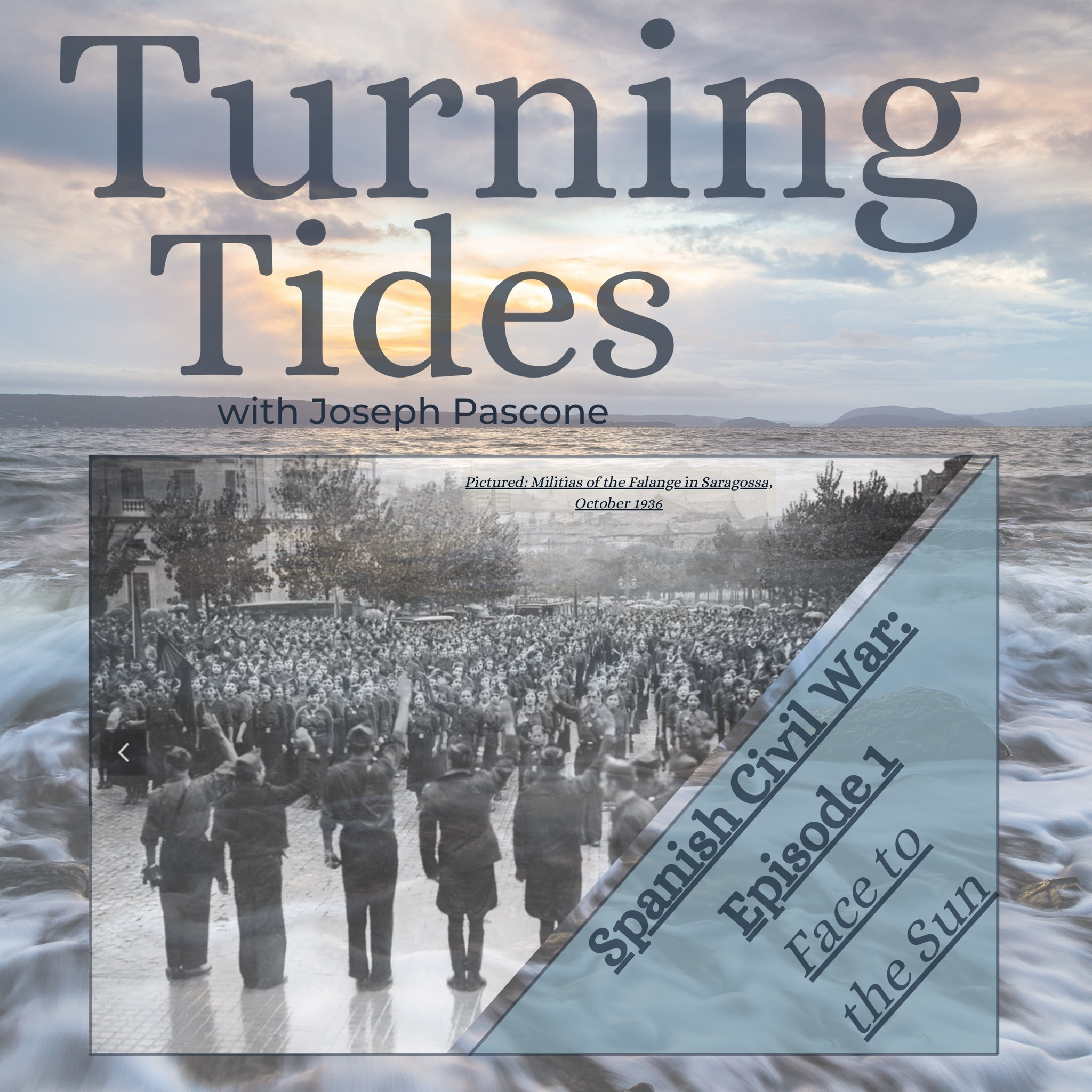
Turning Tides: Spanish Civil War will discuss the conflict which shaped modern Spain. The first episode, Face to the Sun, will cover the period from 1923 to 1936, in which fascism rose to power in Spain before sputtering into anarchism, rebellion, and political confusion. If you'd like to donate or sponsor the podcast, our PayPal is @TurningTidesPodcast1, or you can donate to us through our Buy Me a Coffee link: buymeacoffee.com/theturningtidespodcast. Thank you for your support! Produced by Melissa Marie Brown and Joseph Pascone in affiliation with AntiKs Entertainment. Researched and written by Joseph Pascone Edited and revised by Melissa Marie Brown Intro and Outro created by Melissa Marie Brown and Joseph Pascone using Motion Array Website: https://theturningtidespodcast.weebly.com/ IG/YouTube/Threads/Facebook: @theturningtidespodcast Bluesky/Mastodon: @turningtidespod Email: [email protected] IG/YouTube/Facebook/Threads/TikTok/Bluesky/Mastodon: @antiksent Email: [email protected] Episode 1 Sources: 1. Fascism in Spain: 1923 - 1977, by Stanley G. Payne 2. Homage to Catalonia, by George Orwell 3. Franco's International Brigades: Adventurers, Fascists, and Christian Crusaders in the Spanish Civil War, by Christopher Othen 4. Forgotten Places: Barcelona and the Spanish Civil War, by Nick Lloyd 5. The Last Miles to Huesca: An Australian Nurse in the Spanish Civil War, by Judith Keene 6. Camaradas: Ode to the Spanish Civil War: An Anthology of the International Brigades, by Eric Weinert 7. Spartacus Educational: Spanish Civil War, by John Simpkin 8. Spanish Civil War: History of a Battle for Europe's Soul: Spain's Great War (Required Histories), by George Levrier-Jones 9. The People's Army in the Spanish Civil War: A Military History of the Republic and the International Brigades, 1936 - 1939, by Alexander Clifford 10. Stolen Babies of Spain: The Book, by Greg Rabidouz, Mara Lencina, and Enrique Torres Vila 11. History of Spain from 1900 - 2000, by Dr. Cervantes Unuro 12. Long Live Death: the Keys to Victory in the Spanish Civil War, by A.H. Lloyd 13. Wikipedia
!WARNING! *** WAR, VIOLENCE, ABORTION, CHILD ABUSE, SEXUAL ASSAULT, RAPE, RACISM *** “1. We believe in the supreme reality of Spain. The strengthening, elevating, and magnifying of this reality is the urgent collective goal of all Spaniards. Individual, group, and class interests must inexorably give way in order to achieve this goal. 2. Spain has a single destiny in the world. Every conspiracy against this common unity is repulsive. Any kind of separatism is a crime which we shall not pardon. The existing Constitution, to the degree that it encourages disintegration, weakens this common destiny of Spain. Therefore we demand its annulment in a thundering voice. 3. We have the determination to build an Empire. We affirm that Spain’s historic fulfillment lies in Empire. We claim for Spain a pre-eminent position in Europe. We can tolerate neither international isolation nor foreign interference. As regards the countries of Hispanic America, we favor unification of their culture, economic interests and power. Spain will continue to act as the spiritual axis of the Hispanic world as a sign of her pre-eminence in worldwide enterprises. 4. Our armed forces – on land, sea, and in the air – must be kept trained and sufficiently large to assure to Spain at all times its complete independence and a status in the world that befits it. We shall bestow upon our Armed Forces of land, sea, and air all the dignity they merit, and we shall cause their military conception of life to infuse every aspect of Spanish life. 5. Spain shall once more seek her glory and her wealth on the sea lanes. Spain must aspire to become a great maritime power, for reasons of both defense and commerce. We demand for the fatherland equal status with others in maritime power and aerial routes. 6. Our State will be a totalitarian instrument to defend the integrity of the fatherland. All Spaniards will participate in this through their various family, municipal, and syndical roles. There shall be no participation in it by political parties. We shall implacably abolish the system of political parties and all of their consequences – inorganic suffrage, representation of clashing groups, and a Parliament of the type that is all too well known. 7. Human dignity, integrity, and freedom are eternal, intangible values. But one is not really free unless he is a part of a strong and free nation. No one will be permitted to use his freedom against the nation, which is the bulwark of the fatherland’s freedom. Rigorous discipline will prevent any attempt to envenom and disunite the Spanish people or to incite them against the destiny of the fatherland. 8. The National-Syndicalist State will permit all kinds of private initiative that are compatible with the collective interest, and it will also protect and encourage the profitable ones.” - The first eight points of the Twenty-Six Point Program of the Falange, written by José Antonio Primo de Rivera, September 1934 The following series is dedicated to the men, women, and children who died fighting against fascism, those who died fighting with the belief that a better world was – and is – possible. This episode will cover political movements, the individuals who led them, and the condition of Spain prior to the rebellion of mid-July 1936, as well as the ensuing “Social Revolution.” This series was created using sources from across the political spectrum; Anarchist, Left-Communist, Communist, Socialist, Liberal, Conservative, Falangist, and pro-Nationalist opinions are all represented throughout this series, in order to paint a complete picture of the events that transpired during the Spanish Civil War. In many ways, the story of Spain’s most brutal civil war is extremely relevant today. The Spanish Empire was in the process of having their final pieces of overseas colonial “possessions” ripped away from them by the United States of America in the Spanish-American War. Puerto Rico, Cuba, Guam, and the Philippines were all lost to the U.S. During World War I, Spain remained neutral, and many Spanish companies became rich – trading in arms and assets with both sides. Specifically, they traded large quantities of pistols and sidearms to France. All that remained of Spanish dominion overseas was a smattering of islands off the coast of West Africa, as well as northern Morocco, known as “al Rif,” or “the Rif” region. The rest of Morocco would fall under the control of France, much to the aggravation of Spain, but European control of the Maghrebi nation was always unstable. There were numerous confrontations and armed insurrections, against both Spanish and French overlordship. The largest rebellion, however, was in 1921. Led by General Abd el-Krim, the highly mobile Moroccan guerilla forces delivered a crushing defeat to the Spanish military in the 1921 Battle of Annual. Three thousand Moroccans routed and destroyed a Spanish army of over twenty thousand. It was perhaps the most embarrassing military defeat that any European army suffered at the hands of a native population. Under the leadership of General Abd el-Krim, the warriors of the Rif region occupied nearly the entire territory and proclaimed a sovereign Rif Republic. They moved onto southern Morocco, determined to free this area from the French, as well as the entire country from European control. France and Spain put aside their rivalry in the area and assembled an army of two hundred thousand in order to smother el-Krim’s rag-tag force of under twenty thousand Mujahideen. By late May of 1926, el-Krim was finally forced to surrender. As punishment, he was exiled from the land in which he was born; his defeat ended dreams of Moroccan independence for decades. Back in Spain, the disaster of Annual rocked the government and caused its collapse. Miguel Primo de Rivera was a general from North Africa who was largely credited with holding back the Moroccan tide; he came to power after a pronunciamento – or bloodless coup – in 1923. He was the poster child for decades of nationalist rhetoric. Prior to this, the Spanish government spent most of their energy battling subversive elements within the army, working class, and peasantry. Several powerful movements, often at odds with the central authorities, were gaining serious traction with the Spanish citizens. These movements were sprung by intense nationalism, which sometimes led to regional separatist movements like those in the Basque country, Catalonia, and – to a lesser extent – Galicia and Andalusia. At first, nationalism in Spain was shunned by conservatives, largely because of its association with these separatist movements. Miguel Primo de Rivera – besides being the first official dictator in Spanish history – was the first leader of the country to call for a pure Spanish nationalism based on centralization, Catholic dogma, and basic economic reforms. Those holding power in Spain were terrified of Anarchism. It was an ideology which found many admirers amongst the rural poor and urban workers. Known simply as, “the Idea,” by many, Anarchist trade unions like the Confederación Nacional del Trabajo, or the CNT, and the more militant Federación Anarquista Ibérica, or FAI, were incredibly powerful and had hundreds of thousands of members. The allure of anarchism was – and is – obvious. Anything is better than being under the thumb of an inept and cruel government which is more concerned with lining their pockets than the well-being of real people. Anarchists believed that the state was violence incarnate; they wished to do away with the centralized state, private property, and the dogmatic nature of the Catholic Church. They believed all of these powers worked together to oppress working people across Spain and throughout the world. They were the first group of people anywhere to openly refer to themselves as “Libertarians.” The most powerful Anarchist centers were amongst industrial workers in Barcelona and amongst the peasantry of Andalusia; it became a quasi-religion for the latter group. Anarchists felt electoral politics only offered the illusion of choice, and they sometimes used violence to redress their grievances with central authorities. The government cracked down on these trade unionists and “dissidents.” There were regular gun battles between anarchists and the police forces of cities like Barcelona. Communism and socialism were also popular ideologies throughout the industrial hubs of Spain. The Unión General de Trabajadores, or UGT, was the most popular socialist trade union. It was very powerful in its own right, but its members were never as militant as the anarchist CNT. These two unions maintained a precarious alliance, even striking together in the 1917 General Strike, but they were also at odds with one another when attempting to acquire contracts for their workers. The less militant nature of the UGT would allow them to survive the draconian crackdown on labor unrest which would accompany Primo de Rivera’s assumption of power. The Socialist Party was the political branch of the UGT, and it was headed by the future Spanish Prime Minister, Francisco Largo Caballero, as well as the future Republican Minister of Defence, Indalecio Prieto. Communism was a much smaller force in Spain. The Communist Party only came into being in 1921, founded by dissident Socialists. By the start of the civil war, the communist party – known as the PCE – had only 40,000 members. They would grow significantly in popularity when the civil war began, as Republican Spain was increasingly influenced by the Soviet Union – both economically and philosophically. The span of leftist ideologies has a wide range. However, it’s important to note that whether someone is an Anarchist, Communist, Socialist, or some other leftist group, they all essentially want the same thing – the liberation of the human being from an oppressive and rigid class structure. Unsurprisingly, all three ideologies went about achieving this in different ways. Communism in 1930s Europe was technically the “conservative” ideology among these options. Many communists wanted to preserve the bourgeois order so that they could present a united front to fascism. Socialists held the middle-ground in this ideological struggle, but not all socialists were alike; some believed capitalism could be reformed, others believed it needed to be ended outright. Anarchists believed both of these groups should do away with formalities and set about creating conditions which would make social revolution a reality. For example, where a communist might prefer state-run industries and services, an anarchist demanded the industry be collectivized and run by the workers themselves. Needless to say, this is only a miniscule example of the vast array of political differences which exist between these groups. The Carlists and the politically minded Catholics were on the right and far-right of the political spectrum. Carlists took their name from Carlos V, a pretender to the Spanish crown. Throughout the 1800s, Carlos led a series of uprisings – remembered as the Carlist Wars – against the “Liberal” government of Isabella II. Following his death, his supporters continued the fight for traditionalist values and a Catholic-dominated Spanish government and monarchy. Their main base of power was in the former Kingdom of Navarre, near the French border. They had an extremely regimented and militant following; this following operated in armed squads many years before the civil war began, ensuring their use as elite soldiers – and also as cannon fodder. Until the mid-1930s, Catholicism did not have a political party dedicated to their interests; however, the Catholic Church was an incredibly powerful entity, owning perhaps a third of all the property in the country by about 1930. Since the inception of the Catholic Church in Spain, education, welfare, and other social services had only been given out by the Church – and at their own discretion. When Anarchism and Socialism began to gain traction with Spaniards, the Church openly attacked both groups, going so far as to threaten their flocks with excommunication if they were discovered in these circles. Trade unions and socialists struck back, taking up an intensely anti-clerical stance, which would soon explode into outright violence in the summer of 1936. The new dictator, Primo de Rivera, received broad support from the mass of the Spanish population who supported his center-right policies. Prior to this, the way politics were run in Spain was absurd; the head of government would switch periodically between center-left and center-right parties in a series of manufactured elections – this was called the “Turno Pacifico.” This formula kept the far-left and far-right out of parliamentary politics for a time, but it could not last forever. In the end, it alienated everyone from what they considered corrupt and complicit liberals and conservatives. “La Dictadura,” or “the Dictatorship,” endeavored to change all of this. His supporters refused to label Primo de Rivera politically. Instead, they called his form of governance, “intuitionism.” In reality, Primo de Rivera’s policies were structured to benefit the conservative, Catholic middle-class of Spain. Primo de Rivera made his admiration of Mussolini and the nascent Italian fascist movement plain. He said, “Spain would follow in the footsteps of Italian fascism,” and that “fascism is a living gospel.” The Dictator emulated Mussolini in more than rhetoric; he banned the largest trade union in Spain, the CNT, while also ruling by decree throughout his reign. In Castile and León, enthusiasm for the regime manifested itself in the form of the Unión Patriótica, or UP. It was a quasi-political organization which organized Spanish nationalists for the first time. While not “fascist” per se, a clear line can be drawn from the Unión to the Spanish Falange, and finally, to Francoist Spain. Their main goal was to introduce corporatism to Spain. Corporatist government systems value the input of business people and corporations on the same level as their legislature. Their goal was to synthesize the goals of private enterprise with that of the state. As the years wore on, Spain found itself cemented in a dictatorship. The regime used Catholic ideology to justify the power they held. Besides Primo de Rivera’s crackdown on what he considered militant labor movements, he also cracked down on any expressions of autonomy. This was especially true in Catalonia, where the Catalan flag was banned, and ancient monuments representing Catalonian independence were torn down. In 1927, a national plebiscite was called in order to legitimize constitutional reforms in Spain. Among other things, Primo de Rivera wished to put a corporatist economic system into place. Throughout this time, Spain had been rising meteorically, especially in the field of industrial development. Stanley G. Payne says that from 1923 to 1929, industrial output increased by nearly 50%. This industrial growth did little for Spanish workers, whose wages had decreased by 3% in the same time and whose conditions in the fields and factories had remained abysmal. This was not the case across the board, employees who were women enjoyed a significant gain in wages, and socialist trade union members, likewise, saw moderate wage increases. Compounded with basic reforms to broken Spanish social services, some Spaniards argued that they were in a better place because of the dictatorship. The 1927 referendums showed that the Spanish population still supported the dictator. In spite of the economic growth of Spain in certain sectors, most of the country remained poor, illiterate, and traditional in their outlook. It wasn’t until 1930 that the population of the cities outweighed that of the countryside. George Orwell, who fought with the Marxist POUM militia, described how intense the poverty was and how the lack of modern technology affected the villages in Aragon. In one instance, he recounts a poor farmer using flint, as opposed to steel, while farming, “as they did 10,000 years ago.” This often had to do with the cruel and greedy practices of large landlords. One peasant from Toledo describes the plight of his small village, “Five large landowners practically owned the village. Apart from some 500 smallholders like my father, the rest of the 4,000 inhabitants were landless day-laborers who every morning waited in the village square to be chosen to work by the foremen of the big estates… The only way the landless laborers could keep themselves and their families alive was by cutting firewood on the communal land in the mountains. But this was forbidden, and the Civil guard confiscated the wood if they caught the men.” In spite of this relentless poverty, the Primo de Rivera dictatorship rode the wave of the roaring twenties, as well as the enthusiasm drummed up by early nationalist movements like the Unión Patriótica. His regime (aka his nonsense) persisted until the Great Depression devastated world markets, ending Spain’s brief success. In the wake of this economic fiasco, Primo de Rivera lost the support of Alfonso, the King of Spain, as well as the support of Spain’s true power, the army. On January 30th, 1930, Miguel Primo de Rivera, the first dictator in Spanish history, resigned from his post; he would be dead within two months, killed by poorly treated diabetes at sixty years old. His history is a complicated one; he was undoubtedly a dictator, but he never subscribed to a specific ideological foundation in the way that Mussolini, Hitler, or even Salazar – in neighboring Portugal – did. With the exception of separatists and leftist trade unionists, many considered his rule to be tolerable; even Indalecio Prieto – head of the Socialist Party – said the dictatorship was, “...without executions… if only all dictatorships – though I desire no more of them – were like his.” The former-dictator left behind several children; amongst them was his first son, José Antonio Primo de Rivera. He wanted more than anything to be like his father and to prove to everyone that his father was not a failure. His quest led him to fascism and to the creation of the Spanish Falange, or the Spanish Phalanx. Following the end of the dictatorship, King Alfonso appointed General Dámaso Berenguer as Premier. His fragile government lasted just over a year before collapsing. Spain called a national election for the first time in almost a decade. The results were a shock to the conservatives – and to the king, especially; anti-monarchist candidates swept the elections, largely thanks to participation by anarchist trade unions. King Alfonso XIII decided that the results were tantamount to a rejection of the monarchy by the Spanish people, and he abdicated his throne, ending the monarchy until 1976. In the wake of his abdication, the Second Spanish Republic was declared, and many draconian laws were scaled back. The military was greatly weakened by what the new government deemed to be necessary budget cuts. Unfortunately, the new Republic was not allowed a moment of peace. In late December, José Sanjurjo, a disgruntled conservative general in the Spanish army, attempted a coup against the new Republic; it failed to gain serious support, and he was captured and sentenced to death. When the right won the 1933-34 elections, his sentence was commuted to life imprisonment, and then he was exiled to neighboring Portugal. In August of 1932, Anarchists across Catalonia rose in rebellion against the Spanish state; their attempts to cast off what they considered an oppressive capitalist system failed, and many were jailed. During the first years of the Second Spanish Republic, the right was in a period of immense transition; new revolutionary and nationalistic currents were now inserting themselves into the right-wing political scene. The Unión Monárquica Nacional hosted mass meetings to discuss crusades against socialism and the use of violence against political enemies. Stanley G. Payne asserts that this time period, 1931-33, was the first time in Spanish history that Catholicism was used as a tool for a mass political movement on the right. Prior to this, the Spanish right was a mesh of separate ideologies, all largely focused on the military or the king. With the king gone and the army left impotent, the Church took center stage, and they accepted the role with open arms. Several right-wing Catholic groups came together in 1933 to form the Confederación Española de Derechas Autónomas, or CEDA. They wanted a Catholic, conservative, and corporatist republic, which would impede democratic rights and crack down on socialist and anarchist labor unrest. They claimed that they were not fascist; however, they did everything a fascist movement would do. They used propaganda and fascist rallying techniques incredibly effectively. CEDA would eventually become the largest single political party in Spain; they were largely responsible for the rise of the right, as well as the funding of the early Falange. CEDA was led by an ambitious and young university professor, José María Gil Robles; he was pro-monarchy and extremely nationalistic. As with all right-wing movements, several contrarian “intellectuals” would contribute to the development of fascism in Spain. Ernesto Giménez Caballero, or “Gece,” was the first to openly espouse and promote fascism. He largely based his beliefs around the “success” of Italian fascism. Ramiro Ledesma Ramos was the beating heart of the extreme revolutionary right. He detested both socialism and capitalism, Marxists and Reactionaries. He asserted that society should be ordered by a radical and militant syndicalism based around the worship of violence, the state, and the “Hispanidad” culture. Finally, Onésimo Redondo Ortega was a violent racist and anti-Semite. His ideology was based in Nazi race myths and bunk theories about blood purity. He felt that Marxism was a Jewish-Masonic plot hatched by shadowy figures and bankers in order to subvert and destroy Spain and Europe. Both Ledesma and Redondo would merge their differing branches of extreme right political groups into a single unit called the Juntas de Ofensiva National-Sindicalista, or JONS. This group needed a Duce like Mussolini, and they found their man in José Antonio Primo de Rivera. José Antonio had spent the last years railing against intellectuals and anyone who dared chastise his father’s legacy. He was not afraid to confront his detractors in physical combat and gained a reputation as a bully. Besides his defense of his father’s policies and ministers, José Antonio voiced very little of his political opinions prior to 1933. That year, however, Hitler’s rise to power had reinvigorated the far-right in Spain, which had been sputtering since the end of the dictatorship. The rise of the “Bohemian Corporal” also turned José Antonio towards fascism for the first time. Fascism, for José Antonio, was the next logical step. He considered the Liberalism of the 19th century to be a totally failed experiment. He felt that it was from Liberalism that Marxism was created and allowed to fester. He also felt that an authoritarian, patriarchal system was the only “common sense solution” to these “societal ills.” In short, he wanted a society run the same way his father ran their family home. During the summer of 1933, José Antonio, alongside a handful of collaborators, created the Movimiento Sindicalista Español. Around the same time, JONS raided the Madrid offices of the Friends of the USSR. What followed was a government crackdown against fascist and far-right agitators, with José Antonio’s small movement getting apprehended in the mass arrests. JONS enjoyed funding from the monarchist right and big business elements, but these funds were drying up; it was mutually decided – by José Antonio and the leaders of JONS – to join forces. In late October 1933, the-soon-to-be Spanish Falange met for the first time in Madrid. Fascist salutes were raised and returned by José Antonio, who took the podium and said, “The liberal state came to offer us economic slavery… Therefore socialism had to be born, and its birth was just… But socialism, at first a legitimate reaction against liberal slavery, lost its way, first, in the materialist interpretation of life and history; second, in the sense of reprisal; third, in proclaiming the dogma of class struggle… La Patria is a total unity…; it cannot be in the hands of the strongest class or the best organized party. La Patria is a transcendent synthesis… This is what our total sense of la Patria and of the state which must serve it requires: That all the peoples of Spain, however diverse, be harmonized in an irrevocable unity of destiny. That political parties disappear… We want less liberal verbiage and more respect for the profound liberty of man. Because freedom of man is only respected when he is esteemed, as we esteem him, as the bearer of eternal values, when he is esteemed as the corporeal vessel of a soul that may be condemned or saved. Only when man is considered thus can it be said that his freedom is truly respected, and all the more if that freedom is associated, as we intend, with a system of authority, hierarchy, and order.” In 1933, he ran as the right’s chosen candidate in the city of Cádiz, campaigning as a Nationalist, as opposed to Falangist or a fascist, but almost everyone associated him with fascism, and rightfully so. He won the seat due in large part to sympathy which was aroused when a failed attempt on his life ended in the permanent blinding of one of his relatives. The rest of the country also saw the pendulum swing back to the right in 1933, with CEDA becoming the largest party in Spain; they formed a parliamentary alliance with the centrist Radical Party. The right set to work reversing the reforms of the previous Manuel Azaña leftist government. Agrarian reform, anti-clerical policy, and regional autonomy were all reversed upon the right’s ascension. The extreme left and anarchists, already bitter at the center-left experiment of the past two years, boycotted the elections. With the right’s victory, they were now incensed. In October of 1934, a general strike was called. In the Asturias region of northern Spain, the Socialist and Anarchist trade unions formed an armed alliance, which quickly became an armed insurrection against the state. They launched a ferocious social revolution. The miners tore through Asturias, destroying businesses, banks, and most notoriously, churches. A number of priests were killed, and the nuns were told by the workers that they were free to go – whether they wanted to or not. The rest of industrial Spain failed to rise with the miners, and the government sent in the youngest Brigadier General in Spanish history, Francisco Franco Bahamonde, as well as Falangist militias and North African regulares, to stomp out the uprising. When the dust settled, two-thousand people were dead, and upwards of 40,000 were imprisoned. Amongst those imprisoned, was the former Prime Minister Azaña, who was accused of fomenting the revolution, as well as donating funds and arms to it. His imprisonment embittered socialists, especially, who saw Azaña as their voice in parliament. Eventually, he was found not guilty of any wrongdoing. Just as 1931-1933 were foundational periods for a mass right-wing coalition between Catholics, nationalists, monarchists, and fascists – 1934-1936 was a period of coalition building for the center and extreme left of Spain. In 1935, the Partido Obrero Unificación Marxista, or POUM, was founded by Andres Nin and Joaquim Maurin. It was a relatively small political party, but it would be vilified by the Republican government and the USSR in the years to come as, “Trotskyists.” This was a reference to the exiled creator of the Red Army, Leon Trotsky. He was the supreme boogeyman for Stalin’s USSR, and any association with him was enough to brand reputable leftists as fascist sympathizers at best and fascist collaborators at worst. What exactly were the teachings of Trotsky, and what was the Soviet Union’s big problem with him? Basically, Trotsky believed in a less centralized and bureaucratized version of the Soviet Union, an idea he expressed with the term, “permanent revolution.” This theory purported that the proletarian class – in alliance with the peasantry – should seize the means of production, as well as the social and political mechanisms of their state. This would make it possible for a non-industrialized nation like Russia to achieve true socialism without having to resort to a centralized police state. Stalin and many of his supporters hated Trotsky. This hatred existed since the Russian Civil War, in which Stalin was little more than a pencil pusher, while Trotsky was busy covering himself in military laurels by turning workers’ militias into the Red Army. This army overcame the combined forces of White Russia, the Allies, and Germany. Their power struggle was brought into the open in the wake of Lenin’s death; Stalin proved himself more pernicious and glad-handing than Trotsky. Upon assuming power, he exiled Trotsky, then sent his agents to the four corners of the earth to track his movements in an attempt to assassinate him. Ramón Mercader, the man who killed Trotsky, fought for the Republicans in Spain, and he blamed Trotsky for the loss of his country. This, as well as NKVD propaganda, convinced him he needed to shove an ice pick into Trotsky’s skull. While not openly “Trotskyist,” the POUM’s leaders were close to Trotsky, both personally and philosophically. Nin was his personal secretary for a few months, and the group itself was anti-Soviet, even criticizing their use of mass power and surveillance. Unfortunately for the POUM, it was Stalin’s policy to subvert and overthrow other left-wing movements in order to make communist parties the strongest left-wing parties, paving the way for global “revolution” under Stalin’s command. The battle between Trotsky and Stalin had larger political implications across the globe, as Communist and Socialist parties fractured. This inner rivalry would play out in the Civil war and result in the deaths of thousands of anarchists and left-communists – all at the hands of their ideological “comrades.” In Spain, Trotskyism and the POUM held very little sway; their main base of power was in Lérida and Catalonia, but even there they were a minuscule party. This made them the perfect scapegoat when the two sides came to blows. That same year, Indalecio Prieto was replaced by Largo Caballero as the head of the Socialist party. This was seen as a victory for the left wing of the Socialist party, which, under the moderate Prieto, conceded to the right on several occasions. Largo Caballero described himself as the “second Lenin” and said in a speech that reformism, or the idea that socialism could be achieved peaceably and gradually, should be destroyed, “by its roots.” He was in every way a firebrand who invigorated the left for the coming election, which they believed would be crucial in deciding the future of Spain. The right was also gearing up for a decisive election. The Falange began organizing in a major way, as they targeted university students; they found many willing converts who were not averse to violence. Their student organization often clashed with their left-wing equivalents, and it was not uncommon for people to get seriously hurt or die in these street fights. Stanley G. Payne speculates that this is when political violence began to truly spiral out of control. Both sides pointed to their martyrs and vilified and dehumanized one another. The right was always better funded, better armed, and actively targeting leftists, while left-wing violence was usually perpetrated by individuals or groups of individuals acting on their own initiative. It’s true that a handful of socialist and communist groups were receiving foreign funding, but it was nowhere near the amount lavishly given to the Falange by entities like Mussolini’s Italy and private industry. In any case, it was largely Anarchists who actively battled the right-wing radicals in the streets, with a dedicated paramilitary unit known as, “Solidarios,” who were responsible for numerous politically-motivated assassinations. José Antonio was busy colluding with the right and the military in order to launch a preemptive coup on what he considered a sure victory for the left. Besides these early conspiracies to overthrow democracy, José Antonio was also attempting to gain supreme power in the Falange. Prior to this, power in the Falange was shared in a triumvirate; this made little sense for a group supposedly wishing to implement a single powerful Caudillo, or strong-man. José Antonio had declared himself the Jefe Único of the movement, and his first task was to subvert Anarchist and Socialist trade unions by setting up his own fascist dummy union. This fake union gave out fake work permits to its members, who, in turn, clashed with socialists and anarchists when they arrived at their work sites. This was all part of José Antonio’s not-so-subtle strategy which sought to destabilize the Republic and make conditions ripe for a military revolt or coup. He went on to create paramilitary brigades and battalions, remembered as the Phalanx of Blood. They trained and prepared for this eventual rising. Besides the militant mobilization of the Falange, the Carlists were also mobilizing in a major way under their leader, José Calvo Sotelo. He was technically “against fascism,” in the sense that it was anti-monarchist and in some instances anti-clerical, but in many respects, he aligned with fascist principles – like the call for a corporatist state, a powerful traditionalist centralized government, and a strong army and navy. He was probably the most influential member of the right during his lifetime. José Antonio only became eulogized after his death. While Gil Robles faded into the background with the start of hostilities, Calvo Sotelo’s execution by left-leaning police in 1936 would catapult the nation into civil war. Both Sotelo and José Antonio found common ground in their belief in a traditionalist Spain, which would lead the entire Hispanic world into a new Imperial age. José Antonio would have been at home in today’s political climate. He was not loud and brash, like Hitler and Mussolini. Instead, he was soft-spoken and came from money. This did not stop his open admiration for Mussolini, but he had an adverse opinion about Hitler and his “National Socialism.” Anti-Semitism made little sense to him, and likely due to the lack of a large Jewish population in Spain. Historically, anti-Semitism was an integral part of Imperial Spanish life, and many tens of thousands of Jewish people were forced to flee Spain or convert to Catholicism; many thousands more were killed in pogroms and massacres. Upon Mussolini’s invasion of Ethiopia, José Antonio’s rhetoric became much more racist, especially when he talked about colonial conquests, considering them the natural progression of relations between “strong nations and the weak.” Amongst the Falange, there was a burgeoning group of right-wing citizens who believed another cleansing “cruzada” – this time of the “reds” in Europe – was needed to “save all of civilization.” As the elections of 1936 loomed, brought on by corruption and scandals in the radical government, right-wing rhetoric became incendiary. José Antonio was at the forefront of the offensive, saying, “Spain is irredeemably headed toward the dictatorship of Largo Caballero, which will be worse than that of Stalin… We shall be the fodder for the Russian hordes, who will sweep us away, and thus we have no alternative but to move to civil war…” Right before the elections, the party anthem “Cara al Sol,” or "Face to the Sun,” was composed. The anthem would soon fill the torture dungeons and mass execution sites across the Nationalist zone. The right was clearly nervous, as the left was further invigorated by a change of policy from Moscow. Stalin had declared the need for all communist parties loyal to the Soviet Union to align themselves with progressive bourgeois forces in order to form a “Popular Front” against fascism and the right. Stalin initiated this change in policy, as well as a shift toward basic Marxist philosophy, because he saw the practical need for his country to stand up to fascism, as well as their need for allies. He needed the assistance of countries like France and Britain in order to counteract the forces of reaction coalescing on his western and eastern flank in the form of Nazism and Imperial Japanese expansion. This also explains his abrupt turn, when he signed a non-aggression pact with Nazi Germany in 1939. It was not done out of friendship or collaboration; it was a calculated move to secure one flank, while the question of Imperial Japan’s next target put the USSR’s eastern flank in jeopardy. Regardless, the Popular Front strategy proved effective at temporarily blunting the vast differences of opinion between left-wing groups. Additionally, the CNT ended their boycott of electoral politics and joined the Popular Front. The 1936 Spanish General Election was a chaotic and violent affair. José Antonio had a lot at stake, since he would lose immunity from the many crimes to which he was a conspirator if he lost his seat in the Cortes or Spanish Parliament. He could’ve easily retained a seat by running in deeply conservative Salamanca, but he refused. Instead, he ran the Falange as an independent party in the last election of the Second Spanish Republic. In the final tally, the united left overcame the disjointed right in a close-run contest. What truly decided the matter were the major cities, which voted overwhelmingly for the left; this gave them a clear plurality in Parliament. They now had over 250 seats in Parliament, which would balloon to over 270, compared to the 131 seats which belonged to the right. A smaller centrist grouping of candidates won the Basque country, as well as 54 seats in Parliament; come the civil war, they would have hard choices to make about their allegiance. The Falange was met with electoral disaster; it got .7% of the popular vote. Not a single Falangist was elected, and José Antonio lost his seat and his parliamentary immunity. In spite of this impressive performance by the left, the CEDA remained the single largest party and received mass support in Castile & Léon, as well as in monarchist Navarre. The left performed the best in Catalonia and Southern Andalusia. In fact, if one were to look at the electoral map of 1936, you would get a pretty good idea of the boundaries of either side of the civil war in its first year. In conclusion, the election exposed a bitterly divided society – one in which issues like a woman’s right to choose, the role of religion in the state, the rights of workers, and basic land reform were all attacked by those in power. It was a decisive victory for the left, but in many ways, it was exactly what the right wanted. With the left’s victory, sweeping changes were promised. Largo Caballero’s more revolutionary Socialists were left out of government in the hopes of presenting a more moderate front to the world and the Spanish right. In a matter of days, Manuel Azaña, a moderate socialist and the former Prime Minister, formed a cabinet exclusively made up of left-wing and progressive members. He released thousands of political prisoners; amongst them was Lluis Companys, who reformed the autonomous government of Catalonia, the Generalit, which had been outlawed under the right’s two-year rule. Additionally, Azaña’s government wished to vastly expand public works and social programs, reform the judicial system and the tax code, and build thousands of schools. Finally, Azaña made it a point to move several conservative generals away from the main areas of Spain to its peripheries. Amongst them was Emilio Mola, the head of the entire conspiracy; he was banished to far-off Navarre. This ended up backfiring on the government, as Mola was able to ally himself with the many Carlists living there. Another right-wing general who was removed from his post was Francisco Franco. He was the head of the vaunted Spanish Foreign Legion, which resembled its French counterpart in many respects. The government banished Franco to the Canary Islands. Meanwhile, Largo Caballero was hoping Azaña and his government would fail so that he would be able to form a revolutionary government, like Lenin did to the moderate Kerensky in Russia. Amongst the many new faces in the Spanish government, Federica Montseny was appointed as the new Minister of Health. She was the first woman in Spanish history to be given a role in government. In the few months before the civil war, she attempted to implement numerous reforms. John Simkin says that amongst these were, “the introduction of sex education, family planning and legalization of abortion.” Unfortunately, she was never able to implement these reforms on a national level; the right-wing coup in July made sure of that. After the May Day Riots of 1937, she was forced out of the government entirely. In Catalonia, by far one of the most left-wing areas of Spain, abortion was allowed throughout hospitals in December of 1936. Doctor Félix Martí Ibáñez said of the necessity of this common-sense medical procedure, “We will no longer have to witness the spectacle of mothers who have died because of a failed [clandestine] abortion procedure, or infanticides arising from the hatred towards a child born unwanted, or of women whose lives are ruined by a child who is a stigma or a memory of something that they wish to forget, or of children born to homes without bread and with parents without love.” Of course, the right considered these changes to the patriarchal nature of Spanish society to be “anti-family.” Once the rebellion began, their first decrees were to make abortion and birth control illegal across the Nationalist zone of control. The right would go on to prove how “pro-family” they really were. Following the war, the Franco regime was complacent in the abduction of upwards of 300,000 Spanish babies, who were given out to “proper Catholic families.” This was done to “purge future Spanish generations of the ‘Red’ gene.” Anti-abortion policy would remain the letter of the law until late 1982, when the Spanish parliament finally legalized abortion across Spain. In every single fascist country, the first people disenfranchised were women, who all had their bodily autonomy taken away from them in the name of, “ensuring the health and strength of the state.” Today, the same strategy is being attempted again, and the same arguments are being regurgitated en masse. The reality is that the right doesn't care about real people, and they definitely don’t care about families. What they do care about is controlling the bodies, thoughts, and experiences of women because they understand that if women can be made subservient to men, then anyone can be made subservient to the state. As the government attempted reform, the streets below were awash with extreme violence. Throughout the summer of 1936, three hundred people were killed in politically-influenced murders. Stanley G. Payne, a conservative historian on the subject, asserts, “Falangists were able to calculate later, approximately forty of their members were slain by the left in a ninety-day period; the number killed by Falangists was probably greater. By June 1st, the party’s death toll since its founding had reached at least seventy, and altogether there were nearly three hundred political killings in Spain as a whole between February and mid-July.” By this point, all sides were highly militarized. The left had armed worker militias, which often accompanied the police on raids against right-wingers. In an attempt to contain the violent energy and rhetoric from the right, the government began a mass crackdown on the Falange, banning the organization and imprisoning José Antonio, alongside hundreds of others. By this point, the government had every right to do this; the Falange was openly conspiring with the military to overthrow the elected government, and they were clearly responsible for the majority of the politically-motivated killings in Spain during this period. However, the Republic failed to appreciate the symbol they were making out of José Antonio; more people than ever were joining the Falange or giving money to the now-clandestine organization because of the government’s crackdown. From March until his execution, José Antonio languished in prison. His stay, at first, was accommodating. He was even allowed to write articles for an illegal fascist newspaper, in which he published the names of Socialist and Communist politicians who should be targeted by Falangist gunmen. As he awaited sentencing for a number of charges, the most serious being the conspiracy to overthrow the government, the left had elections re-run in several districts. These were beset by violence and vote-rigging by the left, as they wanted as much power as possible to combat what they considered to be an openly hostile right-wing conspiracy. In the end, through their own violence and corruption, they ended up proving the point of the Falange and the anarchists; liberal- parliamentary democracy only worked for some of the people, some of the time. The rest of the time, it worked to maintain its power by whatever means necessary. Writing on some of the hypocrisy showcased by the government during the summer of 1936, the editor of La Vanguardia wrote, “How many votes did the fascists have in Spain in the last election? Nothing: a ridiculously small amount… Today, on the other hand, travelers returning from different parts of Spain are saying: ‘There everybody is becoming a fascist.’ What has happened is simply that it is no longer possible to live, that there is no government… In such a situation, people instinctively look for a way out… What is the new political form that radically represses all these insufferable excesses? A dictatorship, fascism. And thus almost without wanting to, almost without realizing it, people began to feel themselves fascist. They know nothing about all the inconveniences of a dictatorship, which is natural. They will learn about those later on, when they have to suffer them. Fascism is, in the cases of France and Spain, the sinister shadow projected across the land by democracy itself, when its internal decomposition turns into anarchy. The more the rot spreads, the more the fascism expands.” In early June, José Antonio was moved to a new prison in Alicante. A month later, the violence, which had momentarily subsided, ramped up again in a new and major way. After a round of revenge killings, followed by a round of mass arrests, a socialist Assault Guard, José del Castillo, was gunned down outside his home. His comrades demanded revenge, along with the round-up of prominent right-wing politicians. This was reluctantly granted, and the police went hunting. They arrived at the house of Calvo Sotelo, one of the leading voices of the monarchist right. Amongst the police was a cousin of Castillo, the murdered Guard. While en route to the police station, one of the armed militiamen took matters into his own hands and put a bullet in the back of Calvo Sotelo’s neck. He was dead instantly, but his death took the movement past the point of no return. Prior to this, the murders were largely of lackeys and rank-and-file party members of either end of the political spectrum. The death of Calvo Sotelo brought an end to conspiring amongst the fascists and their sympathizers and began a period of open civil war. The government arrested the officers and militia responsible, but it was too little too late. The event inspired Franco to fully throw his support behind the planned military rebellion, upon which he had only tentatively agreed thus far. As civil war and revolution swept the entirety of Spain, José Antonio, the fomenter of all of this, languished in prison. There were several plans hatched by the fascists and their allies to free him from his confines, but they all fell to naught. José Antonio, for his part, attempted to seek reconciliation between the two vying factions, before this blood feud became a war of ideological extermination. He even put forth a plan where he would negotiate with the right, leaving his family as hostages of the government. These were refused, but there were other plans to trade José Antonio with Azaña’s son, who was being held prisoner by the right. Unfortunately for José Antonio, all of these fell through. During his time in prison, he wrote essays about “racial purity,” the evils of Protestantism, and plans for a future government of national unity. On the 16th of November, he was brought before a military tribunal which read the sentence against José Antonio, his brother, and his brother’s wife. All three were found guilty of conspiring to overthrow the government. There was little argument against the charges; they had all conspired to overthrow the government since it was put in place. José Antonio’s brother and his brother’s wife were sentenced to life and six years, respectively. José Antonio was given the death sentence. José Antonio prepared a final statement on the 18th, naming Fernández Cuesta and Serrano Súñer, two high-ranking Falangists, as the executors of his will. His statement reads: “I pray that mine will be the last Spanish blood shed in civil discord. I pray that the Spanish people, so rich in good and endearing qualities, may find the fatherland, bread, and justice… With regard to my imminent death, I await it without bravado, for it is never pleasant to die at my age, but without protest… I pardon with all my soul all those, without exception, who may have harmed or offended me, and I ask pardon from all those to whom I owe reparation for any offense great or small.” Two days later, José Antonio and four other political prisoners – two Falangists and two Carlists – were shot together and buried in a mass grave; they were soon joined by ten other political prisoners, who were shot later that day. They were only a minuscule portion of the thousands who were dying all across Spain… and the hundreds of thousands who would die in the war which would rage until 1939. However, out of all the victims of the Spanish Civil War, José Antonio remains one of the most remembered, with a quasi-cult springing up around his life, beliefs, and death. No one, besides perhaps the future-caudillo Franco, would gain more adulation in the regime to come than, “the one who is always present,” José Antonio. What made José Antonio so unique among fascist leaders was that he never achieved enough political power during his life to effect serious change, like Hitler or Mussolini did. Instead, José Antonio was able to become a symbol of what his supporters argue was a more “moderate fascism.” They argue that it was a fascism which was based more in traditionalism and Spanish patriotism than racism and imperialism. However, Stanley G. Payne asserts, “...if he had survived he would ultimately have been totally discredited by the practical results of another disastrous fascist regime. Dead, however, he would become the subject of the most extraordinary martyr cult of contemporary Europe, which long guaranteed to him a role that he could never have achieved in real life.” Thank you all so much for listening to this episode of the Turning Tides Podcast. In the next episode, the two sides of this conflict – Republican and Nationalist – will come head-to-head on the field of battle. Behind the lines, both sides will come to grips with the revolutionary currents in their midst and the battle for Spain will draw the attention of tens of thousands from across the globe. To hear that story, you’ll have to tune in to our next episode, “¡No Pasarán!” I’m your host, Joseph Pascone; have a great day.