
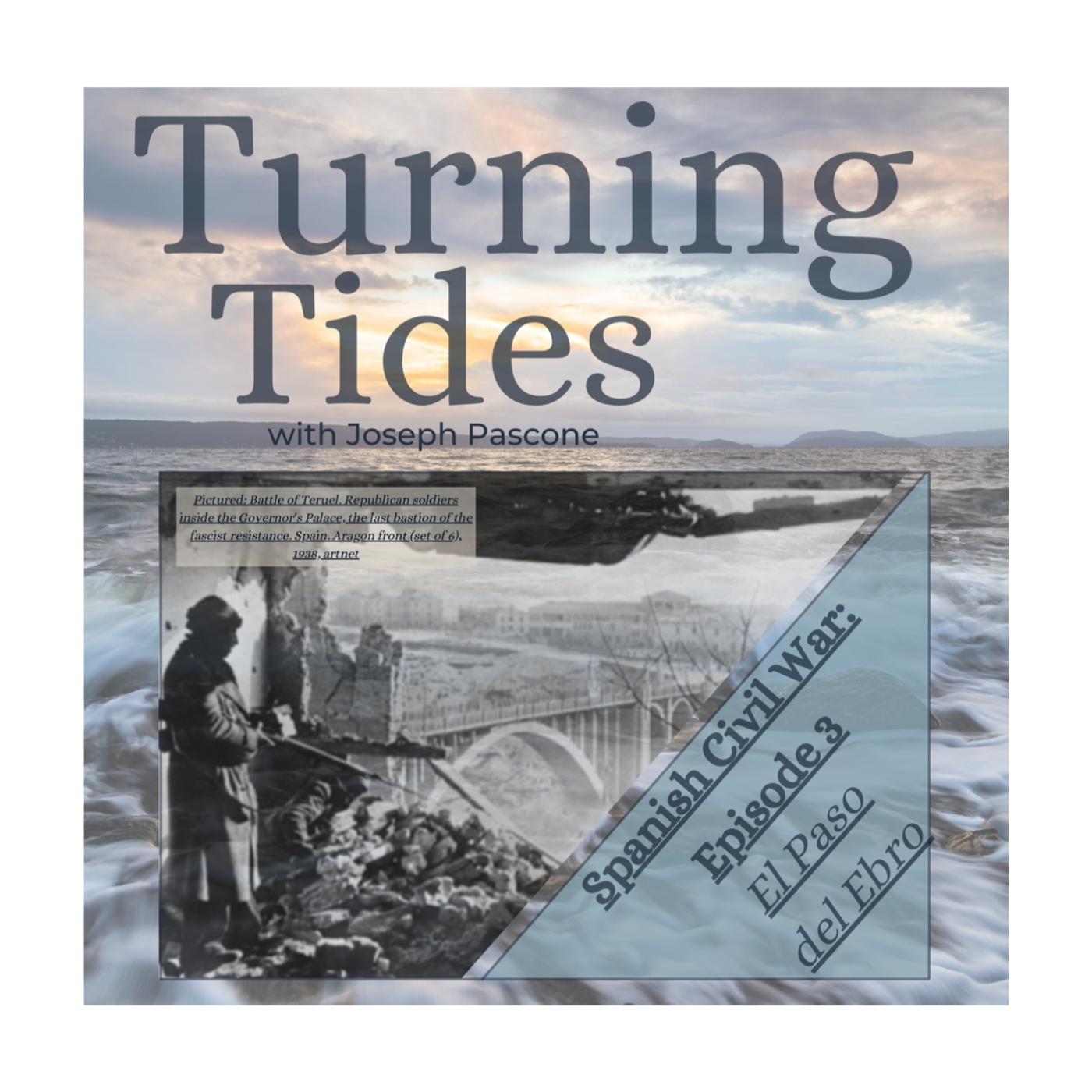
Turning Tides · Joseph Pascone
Turning Tides: Spanish Civil War will discuss the conflict which shaped modern Spain. The third episode, El Paso del Ebro, will cover the period during 1938, in which the Republicans and Nationalists come to blows in the two most decisive engagements of the war.. If you'd like to donate or sponsor the podcast, our PayPal is @TurningTidesPodcast1, or you can donate to us through our Buy Me a Coffee link: buymeacoffee.com/theturningtidespodcast. Thank you for your support! Produced by Melissa Marie Brown and Joseph Pascone in affiliation with AntiKs Entertainment. Researched and written by Joseph Pascone Edited and revised by Melissa Marie Brown Intro and Outro created by Melissa Marie Brown and Joseph Pascone using Motion Array Website: https://theturningtidespodcast.weebly.com/ IG/YouTube/Threads/Facebook: @theturningtidespodcast Bluesky/Mastodon: @turningtidespod Email: [email protected] IG/YouTube/Facebook/Threads/TikTok/Bluesky/Mastodon: @antiksent Email: [email protected] Episode 3 Sources: 1. Fascism in Spain: 1923 - 1977, by Stanley G. Payne 2. Homage to Catalonia, by George Orwell 3. Franco's International Brigades: Adventurers, Fascists, and Christian Crusaders in the Spanish Civil War, by Christopher Othen 4. Forgotten Places: Barcelona and the Spanish Civil War, by Nick Lloyd 5. The Last Miles to Huesca: An Australian Nurse in the Spanish Civil War, by Judith Keene 6. Camaradas: Ode to the Spanish Civil War: An Anthology of the International Brigades, by Eric Weinert 7. Spartacus Educational: Spanish Civil War, by John Simpkin 8. Spanish Civil War: History of a Battle for Europe's Soul: Spain's Great War (Required Histories), by George Levrier-Jones 9. The People's Army in the Spanish Civil War: A Military History of the Republic and the International Brigades, 1936 - 1939, by Alexander Clifford 10. Stolen Babies of Spain: The Book, by Greg Rabidouz, Mara Lencina, and Enrique Torres Vila 11. History of Spain from 1900 - 2000, by Dr. Cervantes Unuro 12. Long Live Death: the Keys to Victory in the Spanish Civil War, by A.H. Lloyd 13. Michael Parenti, Blackshirts and Reds: Rational Fascism and the Overthrow of Communism, City Lights Publishing, 1997, Chapter 1 & 2 14. Wikipedia
!WARNING! *** WAR, VIOLENCE, TORTURE, MURDER, ABORTION, RAPE, SEXUAL ASSAULT, CHILD ABUSE, SUICIDE *** “Up the Paseo de Gracia, people in scuffed jackets, workers, both male and female, their hands black, streamed out of the factories. They carried flowers: chrysanthemums, roses, lilies. Some had both arms full… The International Brigades are [leaving]... From the bourgeois’ stupid face, the expression of uneasiness disappeared, ‘Ah, the foreigners are leaving!’ The girls run forward, pushed on by the crowd. One of them called back, ‘They are not foreigners; they are internationals!’... The flowers kept piling up on the streets. More people brought banners, and Catalan, Spanish, and Red flags were waving from windows and balconies… Suddenly, planes roared overhead. In one fell swoop, the crowd was silent and frozen. It is the familiar sound that makes every Barcelona resident’s blood run cold. Everyone stared fearfully upwards. Many were already pushing to get out… [The planes] roared in only a few hundred meters high, three squadrons. And an unending cry of jubilation broke out, ‘Nuestros, nuestros! Ours! Ours!’ The squadrons made great loops, and as they descended over the square, it rained down from them like clouds of silver dust: thousands of leaflets… upon the crowd. The farewell of the Republican Aviation to the International Brigades [reads] … ‘We will never forget your solidarity, beloved brothers!’ At three o’clock a shot boomed. The parade began. It was the last parade of the Brigadas Internacionales. Foreign attachés and officers of the Interallied Military Commission stood in front of the tribunes… they saw how the people, when they saw the first flag of our brigade, went wild, throwing flowers, raising a hundred thousand fists in final salute… As the brigades turned into Paseo de Gracia, the whole column got out of order. The people crowded into the rows… The entire width of the huge boulevard was now filled with a roaring stream of people. Only when it got dark did everything end… Small groups still stood together on the corners. They spoke as if coming from a funeral. Everyone was in mourning in Barcelona. Flags with the names of our best fallen were still waving above the streets in the stiff wind: Hans Beimler, General Lukacs, Picelli, Robert Fox, Brugéres, Nanetti, Parovič… In the evening, we met with some comrades in the small café Boliche. When we entered, they waved and shouted, ‘Viva la Alemania antifascista!’ They were Basque and Catalan workers. I wish that anti-fascist Germany had heard this greeting. Above the pain for their killed children, knowing it was German bombs that killed them, they did not forget that there is another Germany that exists in solidarity with them.” - Erich Weinert, Camaradas: Ode to the Spanish Civil War: An Anthology of the International Brigades. Ryan Edgar's Translation, 2023, Pgs. 115 - 117 1938 was a momentous year – not just for the people of Spain but for all peoples, everywhere. It was the year when appeasement reached its climax and then failed spectacularly. It was also the last year of relative global peace. Coincidentally, 1938 would be the last year of the war in Spain. This did not mean the conflict ebbed in its intensity; in fact, the war escalated. Both ends of the political spectrum had been brought to heel by Franco in the Nationalist Sector and by Negrín's Communist-aligned government in the Republican Sector. The military situation in Spain was in favor of the Nationalists. They had just crushed the northern Republican enclave in Asturias and the Basque Country, and they were gathering a massive force of approximately 100,000 soldiers outside of Guadalajara. They were attacking the same place from which the Italian CTV had been repulsed the year previous. With this new offensive in the works, Franco was hoping to capture Mardrid, the so-called “Tomb of Fascism,” and win a much sought-after victory which had eluded him thus far. The Republican high-command, hoping to forestall this offensive, decided on an offensive of their own. It was designed to capture strategically unimportant ground and force the Nationalists to battle on the terrain of their choosing. They chose to battle in western Aragon, at a Nationalist salient which created a bulge in the front. The city of Teruel was a part of this salient. It was of little importance, nestled high in the mountains; the only claim to fame Teruel can boast is being the single coldest place in all of Spain. Besides this useless factoid, few Spaniards knew anything about Teruel, and most had not been there; however, due to its important position in this salient, Teruel would soon be home to some of the most brutal urban combat of the 20th century. Prior to this, several events of note, which deserve mention, occurred behind the lines. First, the Republic’s administrative capital was moved from Valencia to Barcelona. Madrid had been vacated by the Republican government early in the conflict. The new Negrín government chose Barcelona because of its importance as an industrial hub, but the wavering loyalties of its citizens were also a factor. After the May Days, the Republican government turned away from Anarchism and ejected many followers of this ideology. In late October of 1937, CNT members became fed up with being ostracized; they decided to officially abandon the Popular Front. Very rapidly, the once broad and encompassing “Popular Front,” was no longer very popular, nor able to display anything close to a united front. Instead, it was a shaky coalition of conservative Socialists, like Negrín, and Soviet-backed Communists. On the Nationalist side, there was no need for coalitions, nor uneasy alliances; either you supported Franco, or you were thrown in jail. In fact, for his time and place, Franco was probably the most powerful individual in Europe. Hitler technically had a Reichstag which could hold him accountable, while Stalin had a Soviet Constitution by which he theoretically needed to abide. Franco had none of these impediments, and he and his yes-men designed the Nationalist sector so that he would never have them. One of his main yes-men, Serrano Súñer, was arguably the second most powerful figure on the Nationalist side. He was mentioned briefly in episode one as one of the executors of José Antonio’s will. At the start of hostilities, he was in Madrid, stuck behind enemy lines. He was discovered and thrown in jail, but he managed to escape after disguising himself in traditional women's clothing and high-tailing it to a foreign embassy. From here, Súñer managed to complete his extrication to the Nationalist side. His two brothers were not so fortunate; they were both executed in the mass reprisals in which both sides engaged during the first months of war. Alongside Franco and his number two, there was Pilar Primo de Rivera. She was the sister to José Antonio and the head of the Sección Feminina. The Sección was the single largest women’s organization in Spanish history during this time. By the end of the Civil War, the Sección had almost 600,000 members. Stanley G. Payne claims, “[It] created a conservative social and moral framework for female activism that took hundreds of thousands of women out of their accustomed routine to a greater extent than any single organization on the Republican side.” Unsurprisingly, Payne, who is a Conservative Franco-apologist, never mentions the darker side of this organization. Thankfully, other historians state the reality of the Sección plainly. The Sección was the main tool used in Francoist Spain to ensure their eugenics policies were being strictly enforced. Pilar and her collaborators monitored the unmarried, the newlywed, new mothers, and citizens formerly belonging to the Republic for any sign of delineation from the status quo. The bans on abortion, sex before marriage, and “sodomy,” as well as the regulations against women passing on the, “red gene,” were all strictly enforced by the Sección, whose members policed their own neighbors and friends, “for the good of the Spanish race.” The Sección acted as the women’s section of the FET de las JONS, which also had a Youth Organization that was created for children as young as seven. In spite of a seemingly ironclad rule, Franco received pushback from some notable Nationalists, especially radical Falangists. The main opposition to Franco was led by Augustín Aznar, who believed Franco was a poor military and political leader. Aznar was of the opinion that, “Franco should be sent to command a division,” as opposed to being the Caudillo of the Nationalist sector. Beyond criticisms of Franco’s leadership style, Aznar felt he was doing a disservice to the memory of José Antonio and his more radical positions. Aznar was thrown in jail for his obstinacy and Franco continued courting the Conservative and Catholic citizens of Spain; this included introducing religious regulations to the Nationalist sector. However, he appeased radical Falangists when he began state worship of José Antonio. Above all, the defining ideology of Francoist Spain was the promotion of Catholicism as the state religion of Spain. Church and state were essentially as intertwined as they were during the era of the Spanish Inquisition. Franco paid further lip service to the memory of José Antonio by promising to promote the Twenty-Six Points of the Falange as the main foundation of the new Spanish state. Besides cementing his rule as the new Caudillo, Franco showcased his independence from both Mussolini and Hitler. Relations were fraying with both powers, as they saw Franco as a poor general who was prolonging the conflict and, therefore, the two nations’ financial and military involvement. They wanted more dynamic leadership from Franco, but Franco was an unimaginative general on the best of days. He largely believed in brutish offensives designed to crush the enemy center; this meant massive casualties for the first waves of his soldiers. These maneuvers were successful during counter-attacks; however, Franco largely failed most of the offensives he initiated. For example, both the initial siege of Madrid and the Battle of Valencia were independently designed and initiated by Franco… to the detriment of the Nationalist forces. The northern offensive was the exception to the rule, as the Republicans were essentially unable to resist. All other Nationalist victories were won by other generals, or they were the result of Nationalist counter-attacks against bedraggled Republican forces. There has been an equal amount of criticism of Republican forces and their decision to launch repeated offensives. Many, like Antony Beevor, claim that this strategy was inherently flawed. He claims the best way forward for Republican forces would have been to have a fast-acting armored reserve which would have been able to operate independently and respond to Nationalist attacks as they came. This idea would not be feasible in practice, with the reality of the military conditions in Spain. Guns were of poor quality. Ammunition was just as bad. Junior officers largely went over to the Nationalist side, or they were former militia members who knew little of tactics and strategy. In short, all the necessary components to maintain a reserve armored column – the likes of which operated in Nazi Germany in 1943 and 1944 – were lacking. There was no conceivable way the Republicans would have been able to institute such a strategy. Undoubtedly, many Republican offensives were rushed and poorly conceived. However, many of these same offensives were taken up in the name of relieving another hard-pressed section of the front, and in this respect, they largely succeeded in relieving another front. Unfortunately, the Republicans never had the time to build a solid doctrine and construct a decent junior officer corp. The Nationalists, who largely retained the pre-war Spanish military structure, were also lacking in certain respects, but they had much more in the way of military doctrine and training. This, more than anything, was the reason the Nationalists were successful. This does not mean the Republicans were lacking in quality soldiers. Many of the International Brigades were hardened veterans from World War I and other European conflicts. Others were die-hard socialists and communists who believed unequivocally in class struggle and dialectical materialism. This sincere belief allowed them to see past the dangers of combat and attack with reckless abandon, usually to their own detriment. In fact, the International Brigades were so decimated that by the time they officially disbanded, most of their units were composed of Spaniards, as opposed to foreign volunteers. That being said, the vaunted 15th and 11th Brigades were truly elite for their time and place. The 15th was the unit which cleared out Quinto and Belchite, while the 11th Brigade was probably the single most effective Republican unit during the war. They were easily on par with the Nationalist “Regulares” or the vaunted “Black Hand” Division. Most of these units would go head-to-head around the frozen and icy hills of Teruel. Beginning in mid December of 1937, the campaign for Teruel was probably the most effective offensive the Republicans would ever launch. As we will see, it was probably too effective. The defenses of Teruel were manned by 20,000 Nationalist troops, who were facing off against as many as 100,000 Republicans. Teruel is dominated by several important heights, of which La Muela, or “the Molar,” is the most important. It was named for its resemblance to a tooth. One interesting aspect of the Battle of Teruel is that many of the Communist and International units we’ve discussed so far did not take part in this battle. At least at first, it was an all-Spanish operation. This fact was touted by Republican propaganda as proof of the Republic’s commitment to remain in the fight. The Republic was presenting a brave front, but the reality on the ground was dismal, to say the least. Soviet supplies had been dwindling ever since the loss of the north, and what little supplies did arrive faced continual harassment from Italian pirates on the Mediterranean. Additionally, the economy of the Republic was sputtering, as interruptions in the supply chain and continual defeat meant creeping inflation was now getting out of control. Small luxuries – like sugar, tobacco, and coffee – were all ridiculously expensive, and the price of basic foodstuffs was soaring. This created a vibrant black market, which hindered the Republic in an entirely new way. Erich Weinert, a Communist volunteer, wrote about the economic struggles of regular Spaniards on the Republican side, “I was sitting at a little table outside the door of a café on a side street of the Paseo de Gracia. A haggard woman walked by, holding several bags, a purse and a bottle of olive oil with her left arm, while she held a small child in her right. The mother seemed to have trouble with him. He struggled and did not want to go on. When the mother went to bend down to him, she must have loosened the left arm; the oil bottle fell on the stone slab and shattered. The woman screamed like an animal, grabbed her child and ran away crying. On the sidewalk, the thick olive oil now ran apart between the thousand splinters. An old man rushed out of the opposite house, an empty tin cup in his hand. He knelt down in front of the pool of oil and now tried to push the oil into the can with his hand. In the process, he tore his skin on the shards and splinters. The oil mixed with blood and street dirt…” The plan for the attack on Teruel was relatively straightforward. The army would circumvent the city itself and instead capture the dominating heights around the city. The attack began in the night and was supported by most of the remaining armor and aircraft belonging to the Republic; this included around 300 planes and over 100 T-26s. Attacking at dawn, Líster's brigade made steady headway, while a reconstituted Anarchist division swept the north of Teruel of Nationalist resistance. A similar attack occurred in the south, and by the end of the day, the proverbial door had been slammed shut on Teruel; there was no communication, nor means of escape, for thousands of Nationalists inside. Besides a handful of hiccups in the initial attack, the operation had gone smoothly. Franco now had a decision to make; he could proceed with his planned offensive, or he could take the bait – as he had done at Brunete – and send many formations of men to relieve those in Teruel. Many of his officers implored him to ignore this strategically unimportant Republican attack and focus on the task at hand, but Franco simply couldn’t resist. He called off the attack on Madrid in favor of attempting to relieve or recapture Teruel. He reasoned that the political implications of losing Teruel outweighed the loss of life which would accompany the endeavor. Meanwhile, the battle for the hills around Teruel was testing the limits of human endurance. New York Times Journalist, Herbert Mathews, was there – he recounts, “No worse weather could possibly be imagined for fighting purposes… the soldiers… have fought through four days and nights of it without relief… Nothing is protection against those icy blasts that come shrieking down from the north, penetrating any amount of clothes… Your eyes fill with constant tears… your fingers swell and become numb… all feeling goes out of your feet… you gasp for breath and cannot stand in one spot… for the wind buffets you like a fighter boring in… Through it all the [Republican] soldiers fought steadily forward…” Ernest Hemingway was also present, and he detailed the fighting around the heights of La Muela, whose near-vertical sides and flat top made its assault incredibly deadly. Hemingway recounts, “Fortified by concrete machine-gun emplacements and surrounded by tank traps made of spikes forged from steel rails, it was considered impregnable, but four companies assaulted it as though they had never had explained to them by military experts what impregnable meant. Its defenders fell back into Teruel and a little later in the afternoon… the last defenders of Teruel itself were squashed or turned.” By late December, Republican troops were fighting within the city limits of Teruel, and the Nationalist officer in charge of the city's defense made the fortuitous decision to pull his men back into the city and defend several key buildings, as opposed to the heights. This made the jobs of the Nationalist defenders that much harder, as they now had to worry about the welfare of noncombatants in their midst, who numbered in the thousands. Miguel Hernández, a Communist playwright who would later die in a Francoist prison after the war, wrote of the exploits of the 11th division, who were holding off determined local counterattacks from Nationalist forces who were trying to relieve Teruel. “The victorious will of these soldiers reached a high point of grandeur on the afternoon of the 19th. Singing the ‘Internationale’ and shouting ‘We are those of Lister!’ They checked a column of Legionnaires and Falangists, who attacked protected by heavy artillery fire. The opposing forces had to retreat decimated and beaten by the valour of our soldiers. If you seek them, you will find them between bullets and explosions; firm in their posts. If you look for them, you will find them in the middle of the snow, attacked by it, melting it with enthusiasm and joy; firm in their posts. If you seek them, you will find them in winter, in the wind, in the cold, lit like bonfires; firm in their posts. If you look for them you will find them conquering fascist towns, snatching arms and land from fascism, saving men, women, children, Spain, from fascism…” Throughout the rest of December, Franco's counter-attacks were stalled by determined Republican resistance. Meanwhile, the news of the success of the battle had reinvigorated the Republican side, with many news outlets and public figures proclaiming the fall of Teruel as a serious victory for Republican arms, destined to be the first of many. However, the fighting had not subsided around Teruel. Still attempting to break the siege, General Varela threw 78,000 Nationalists at Republican lines, and after repeated days of hammering away with air and artillery support, a breakthrough was achieved, and Nationalist units drove deep into Republican territory. As this happened, the weather intervened to stop a Nationalist victory. A massive blizzard completely upended their plans, while fresh Republican units were sent in to stabilize the faltering lines. The Nationalist garrison formally capitulated on January 8th, 1938; however, Nationalist attacks only increased with the city’s capitulation. Fidel Dávila was brought in to lead the Nationalist assault, and with the assistance of Stuka dive bombers, 400 other aircraft, and 500 pieces of artillery, they pushed Republicans off part of La Muela and nearly destroyed the Thälman Brigade of German anti-fascists. Republican units were beginning to falter and show signs of mutiny and insubordination. In one instance, a unit which had captured Teruel refused orders, and forty-six of its members were shot before the entire unit was disbanded. Somehow, Republican morale and cohesion remained intact against this overwhelming offensive. As this new Nationalist offensive sputtered, Republican high command made a colossal strategic error. Chief of Staff, Vicente Rojo, began moving massive amounts of equipment and men to Estremudura in southwestern Spain. Known as, “Plan P,” it was designed to halve the Nationalist sector. But, in moving his best units from the still-active Teruel front, Rojo would ensure that it was in fact the Republicans whose territory would be split in two and overwhelmed in turn. The movement Republican scouts were witnessing was not a Nationalist withdrawal from Teruel; it was a redeployment. A majority of the Nationalist offensive was now aimed north of Teruel and designed to swing in on the city like a gate. 100,000 men from Galicia, Castile, and Navarre made up this massive coup de main, which was executed perfectly in early February of 1938. Their offensive was launched against a few newly conscripted Republican units, who broke almost immediately upon coming under artillery and air bombardment. For miles, the Republican lines were rolled up, capturing 7,000 Republicans in the process. In the skies, Republican air units were being swamped by Italian Romeo fighters and the vaunted Messerschmidt 109. On February 9th, Nationalist units crossed the Alfambra river, but by this time, Republican resistance had stiffened considerably. However, the Republican position now resembled the position the Nationalists held at the beginning of the battle. The Republicans now occupied a salient and held on desperately to the city of Teruel, which could have been easily encircled if the units defending the surrounding heights had given way. The Republicans attempted several offensives in the area, to lessen the burden on the Teruel front, but each failed to achieve the desired results and killed valuable men who were needed elsewhere. On February 17th, the Nationalists launched the final assault on Teruel. In forty-eight hours they had surrounded the city, which was defended by El Campesino, Valentín González. Notorious for his conduct in this battle and the Battle for the Ebro, El Campesino was one of the few militia leaders to be elevated to a professional army officer; however, he lacked basic knowledge of tactics and strategy. In fact, he was illiterate. His position was seemingly hopeless, and rivalries with other officers resulted in their failure – or refusal – to come to El Campesino’s aid. Between a rock and a hard place, El Campesino chose to fight his way out of the encirclement – at the cost of one thousand men and the loss of the city of Teruel. Considering the Nationalists had held out in the same city for almost two weeks, many consider El Campesino’s abandonment of the city to be inexcusable, especially when considering the large number of Republican forces which were already en route to relieve Teruel. By the morning of February 22nd, the Battle for Teruel was over. By far, it was the most costly battle of the war. Both sides suffered tremendously; the Republicans lost at least 60,000 soldiers, and the Nationalists lost at least 57,000. The weather was just as fatal as being pelted by bullets and artillery. Frostbite was incredibly common. Many soldiers lost toes, ears, noses, and fingers to Teruel’s brutal winter, which had been the coldest in a century. In the opinion of Professor Sir Paul Preston, Teruel was, “the military turning point of the Civil War.” Amongst the Nationalists who had frozen and died were a number of the Joan of Arc Battalion. These were Frenchmen who came to Spain to fight for Franco. The Caudillo had an underlying purpose for allowing these foreign volunteers into his ranks. He wanted to use the French unit as a bargaining chip with the Non-Intervention Committee. Franco argued that: as long as foreign volunteers existed on one side, they should be allowed on the other. 1938 also brought about dissent from writers in Nationalist Spain. Amongst them was George Bernanos, a Catholic priest from Majorca; he witnessed some of the Nationalist repression which would soon sweep across Spain. The failed Republican naval invasion of the island of Majorca was a key misstep early in the Republican war effort. It was met with complete defeat and disaster. The persecution and repression which followed was harrowing, and it sickened the devout Bernanos. He wrote of what he saw in, “Les Grandes Cimitières Sous la Lune,” or, “The Great Cemeteries Under the Moon.” In one passage, he talks about a Falangist executioner who routinely robbed the women he had just executed. He writes, “His small aristocratic hand [held] in its soft dimpled palm the secret of a hundred deaths.” Regardless of world opinion, which became more muted as the war went on, Franco was determined to end Republicanism in Spain once and for all. Starting in late February, the Italian air force began a mass campaign of terror bombings against Barcelona, designed to both cripple the city’s industry, as well as dishearten the civilian population. Thousands of civilians – some of whom likely sympathized with the Nationalists – would be dead by the time it was all said and done. The Republican Air Force attempted to respond, launching two similar raids on Nationalist cities, but they were nowhere near as effective. Those injured and maimed in Barcelona were treated in the city’s hospitals by doctors like Professor Josep Trueta, head of the city’s Trauma Service. He revolutionized the way open wounds and fractures were treated, adopting plaster casts, which kept the wound clean until further operations could be attempted. Following the war, he lived in exile in France before moving permanently to the U.K. It’s no exaggeration to say that Dr. Trueta’s technique is responsible for saving millions of lives throughout the 20th century, all across the globe. In early March, Franco unleashed his divisions at the precarious Republican lines defending Aragon. From Zaragoza to Teruel, 160,000 Nationalists swamped Republican positions. Resistance virtually collapsed, and by March 10th, the ruins of Belchite would be back in Nationalist hands. The Republic attempted to make a stand at Caspe, but Nationalist units swarmed the flanks and encircled the town. By March 16th, Caspe’s defenders had all surrendered. During the last week of March, Lerída, the home of the POUM, was attacked repeatedly by the Nationalists. El Campesino made up for his previous failures at Teruel by doggedly defending the city for over a week before being forced to retreat. Erich Weinert lost one of his best friends at Lerída. He was a Polish and Jewish man who was nearly killed in a pogrom in his native land. He became a communist and was shunned by his conservative Jewish family. Ostracized by his family and his country, he left for France, but even there, he was ridiculed and maligned. Upon hearing of the fight against fascism in Spain, Josef crossed the Pyrenees on foot to join up. Weinert continues, “In the first Spanish village, the peasants ran to meet you with their shotguns and embraced you as a comrade, a brother and a friend. The starving, wandering eternal Jew was now a soldier for freedom. He had come to the first country that welcomed him brotherly. Captain Josef, what would your family have said if they had seen you like this!... Wouldn’t they be proud today to know that their poor lost Josef is now an officer in one of the most glorious armies in the world?” Republican forces were in full retreat for over a month, and by April 15th, Nationalist spearheads had reached Vinaroz, a small fishing village on the Mediterranean Sea. This effectively split the Republic and its army. The failures at the front prompted Indalecia Prieto, the Republic’s Minister of Defense, to make unilateral calls for an end to hostilities. His “defeatism” irked Prime Minister Negrín; although the two were close personal friends, Negrín fired Prieto and demanded resistance to the end, saying, "Resistir es vencer!” or, “to resist is to win!” This would become the rallying cry for Republicans who were still faithful to the cause. In France, the Progressive, Léon Blum, became the Prime Minister for the second time. As he was sworn in, Negrín made emergency overtures to Blum, and begged him for aid in whatever form he could offer it. Blum had his hands tied at home; he was bitterly hated by the French right, whose mobs tried to physically assault him on numerous occasions. If he made an open show of overt support to the Republicans in Spain, he would face intense backlash from conservatives and Catholics in France. Many right-wing paramilitary units were already being formed in the hopes of a similar civil war erupting in France and toppling the “communist” Blum. In this situation, Blum made the only concession he could, which was to open the border between France and the Republic in order for Soviet goods to flow freely, at least for a time. Soviet supplies were able to cross the border for the first time in many months, and they arrived without being harassed by Italian naval patrols. It was the last dose of adrenaline the Republic would receive, and they were hoping it would be enough to push the war back into their favor. If the Nationalists had so chosen, they could have swept all of Catalonia of Republican resistance and freed up tens of thousands of men for the final drive on Madrid, but Franco decided to turn his men west toward Valencia. Here, a series of defenses remembered as the XYZ line thwarted all Nationalist attempts at penetration. At the cost of 5,000 casualties, the Republic inflicted over 20,000 casualties on the Nationalists, proving that – when properly entrenched – the Republic was more than a match for the unimaginative offensives planned by Franco. A.H. Lloyd, a conservative, excuses Franco, arguing that the debacle outside of Valencia could’ve just as easily occurred outside Barcelona, which was – in his words – “swarming with militias and overflowing with the massive amounts of munitions that would eventually arm and equip the Army of the Ebro.” However, others – like Clifford Alexander – argue that Franco’s decision not to cross the Ebro into Catalonia led directly to the Republic’s own Ebro Offensive, which came close to upending Nationalist plans altogether. As the Nationalists threw away their manpower against the XYZ Line, the Republicans in Catalonia were able to recuperate and bring up a new class of conscripts. They reformed the units here into a new Army of the Ebro. Many of these new conscripts were children, barely seventeen years old. Veterans jokingly called these new units, “la Quinta del Biberón,” or, “the Baby Bottle Brigade.” This army numbered anywhere from 60,000 to 100,000 “men.” During the days and weeks leading to the Republican offensive, the troops prepared pontoon boats, which they hid amongst the river foliage in order to stealthily cross the river. The main objective of the Republican attack was to split the Nationalist territory and capture or destroy as many men as they could in the process. Everything relied on speed and surprise, as the Republicans were lacking in every other conceivable area. On the night of July 24th and into the morning of the 25th, Republicans crossed the Ebro, virtually undetected. They crossed in an area of the river which formed a natural bulge in the Nationalist lines; this allowed for an attack to be launched. Two diversionary attacks launched in the northern and southern parts of the river. The northern thrust was aimed at the Auts mountain, sitting at one thousand and four hundred feet tall. The southern attack was aimed at the town of Amposta. The northern offensive achieved much more success than the southern one. The Auts were captured relatively easily by the Republicans, but Amposta remained firmly in Nationalist hands. The main offensive in the center went off like clockwork. Town after town inside the central bulge fell, and based on many accounts, few prisoners were taken in these first days. Over the next few weeks, Republican attacks slackened as the momentum dropped outside the crucial town of Gandesa. Additionally, the Nationalist air force descended on the strung-together pontoons of the Republicans, ensuring few supplies would make it across the river. Soldiers were getting desperate for ammo and drinking water in the August heat. In spite of this, the two sides fought doggedly for the west bank of the Ebro and its surrounding areas for the next four months. Peter Kemp was near the Ebro when the Republican attack exploded. He was one of the few Englishmen to fight for Franco, which he did throughout most of the war. Kemp was nearly killed at the Ebro, when an errant mortar shell exploded close behind him and lodged shrapnel into his jaw. He distinctly recalled the sensation of “pebbles” falling into his mouth, only to realize they were most of his teeth. While he recovered, he would be honored and awarded state medals by Franco. His devotion to the Nationalist cause was never in question; he even denied claims of Nationalist atrocities for the remainder of his life. However, one moment stuck with him. He tells of a Republican prisoner, a fellow Brit, whom he was forced to execute. His commanding officer demanded Kemp kill the man, or Kemp would be shot. The key to the Republican offensive was Gandesa, a vital crossroads town which would open the road to further conquest. The town and its surrounding heights were stubbornly defended by the Black Hand Division, one of the most elite units on the Nationalist side. Bob Cooney was there with the 15th International Brigade, attacking the infamous Hill 481, remembered as, “the pimple,” by those who fought there. Cooney writes, “We attacked the ‘Pimple’ for six successive days. The battle reached its climax on 31st July, when we came within an ace of capturing the hill… our marvelous fellows charged and got near enough to lob their grenades at the enemy, but weight of numbers in men and guns plus steel and concrete barriers told against us.” Luis Bolin fought on the Nationalist side, and he writes about the steady influx of Republican prisoners, “Our opponents fought well, at times outstandingly well, yet there were signs of demoralization in their ranks. Threats of drastic punishments were being circulated to deter their troops from giving way to negligence or cowardice. Any man who lost his rifle would be shot without trial and his name would be published; soldiers who abandoned their posts or inflicted wounds upon themselves would also be executed. Those who failed to hold their ground would be forced to recapture it with their officers marching in front. Though these threats were carried out, the Reds surrendered daily in great numbers, trusting more in the treatment they hoped to receive from us than in the fate that awaited them should they return defeated and unscathed.” It was clear the Republicans were on their last leg, and they were doing anything to will their men to do the impossible. However, without the modern tools of war – which were kept from them by the Non-Intervention Committee – Republican soldiers were destined to suffer immense casualties. In the end, overwhelming advantages in firepower, positioning, and aerial superiority all combined against the plans of the Republic. The sad reality is that there was little hope for the Ebro offensive to succeed, and it's astonishing it achieved so much given the situation. The Battle of the Ebro shifted, with Franco throwing his men into the fray in unimaginative advances and the Republicans doing all they could to stem the tide of Carlists, Falangists, and conscripts being thrown at them. Nationalist aircraft went into overdrive, dropping 10,000 pounds of explosives on the Republican lines and constantly harassing the tenuous supply route the Republicans were forced to use. As the Nationalist offensive slammed into Republican units, the dams holding back the river Ebro were intentionally opened. This sent cascades of water toward the Republican supply lines. In spite of all of this, the Republicans made the Nationalists pay dearly for every town they recaptured. The situation infuriated Nationalist commanders, who wished Franco would do something more imaginative than simply take back lost territory. Many were hoping he would attempt to encircle the Republicans from another direction or angle; their hopes boiled over into frustration, as their units continuously came back decimated. At one point, the calm and collected Franco became fed up with his lieutenants and their opinions. He blurted out, “They don’t understand me! I have the best of the Red Army locked up in an area 35 kilometers long, and they don’t understand me!” Mussolini, who was already angry with Franco for prolonging the war, was irate when he heard about the casualties in the slogging match on the Ebro. He said, “The reds are fighters, Franco is not…” Mussolini was more correct than he realized; many of the same “reds” who fought against Franco would take part in the Allied liberation of fascist Europe in a few years' time. The Republican lines could not hold forever, and by mid-November, the Battle of the Ebro was over – five months after it had begun. The Republic was forced back to their start lines and had very little to show for the loss in equipment and men. Over one hundred Republican airplanes were downed during their futile sorties against Nationalist aircraft. Amongst the fighting men, casualty estimates range, depending on what source you read. However, most agree that thousands died on each side, and tens of thousands were wounded or captured as well. It was a battle as terrible as Teruel, and it was the last gasp of life before the Republic was slowly smothered. Behind the lines, moves were being made by the Republicans in the hopes of salvaging the situation. Negrín put forward a solution; he would disband and send away Republican volunteers, in the hopes of the Nationalists following their lead. Franco and his fascist allies were shocked at this decision by the Republic. The Italian Foreign Minister, Galeazzo Ciano, wrote, “Why are they doing this? Do they feel themselves so strong? Or is it merely a demonstration of a platonic nature?” By the end of the Battle of the Ebro, the International Brigades were being sent away. Their send off was magnificent; they were greeted by Dolores Ibarrurí, who said, “Comrades of the International Brigades! Political reasons, reasons of state, the good of that same cause for which you offered your blood with limitless generosity, sends some of you back to your countries and some to forced exile. You can go with pride. You are history. You are legend. You are the heroic example of the solidarity and the universality of democracy [...] We will not forget you; and when the olive tree of peace puts forth its leaves, entwined with the laurels of the Spanish Republic’s victory, come back!” As we know, few would ever return to Spain. The 6,000 Internationals who were disbanded in Spain were all marched into France under armed guard and then herded into concentration camps. Many of these camps were open to the elements, and many Internationals died while in captivity. Others became gravely ill, and supplies were always limited. Come the time of the Nazi occupation of France, many of the Internationals would be sent back to Spain for execution. Amongst them was Lluis Companys, the exiled President of the Generalit, which was the name given to the Autonomous Government of Catalonia. He was executed under Franco’s orders in 1940. During the 1936 Social Revolution, he gave out tens of thousands of passports and writs of safe passage to priests, the rich, and businessmen, who otherwise would’ve been a target of the mobs – he was granted no such mercy. Those who could still fight joined De Gaulle and the Free French Republic in their fight against French collaborators and their Nazi handlers. They fought across Europe, liberating the continent from fascism. In fact, some of the Allied tanks which rolled into Paris bore the names of Spanish battlefields, like Jarama, Belchite, and Ebro, alongside battles that took place in North Africa, Italy, and Normandy. For now, the forces of Democracy and Socialism were in full retreat in the face of Conservative Catholicism marching arm-in-arm with fascists. This trend was not just occurring in Spain, but across the globe. In Czechoslovakia, the cowards in charge of Britain and France made a deal with Hitler to give away the Sudetenland without so much as a whimper of protest. At the same time, countries like Romania, Bulgaria, and Hungary were all on the road to fascism, with Romania advancing their own form of “Christian Nationalism” under the Iron Guard, or the Legion of the Archangel Michael. As new German military equipment entered Nationalist Spain, the final touches were being put on an offensive designed to capture all of Catalonia, once and for all. In anticipation of the attack, the Negrín government moved their capital for the fourth and final time – from Barcelona to Figueras, a city close to the border between Spain and France. Negrín had no cards left to play, and his last hopes lay with the Allies of Great Britain and France. He hoped to prolong the war long enough for the two powers to join on the Republic’s side when the eventual World War exploded. This was wishful thinking at best; France and Great Britain would continue appeasing Hitler until he demanded Danzig. By that time, there was no Republican Spain. Even if there was, all attempts would have been made by Great Britain to keep the Nationalists happy; there is little reason to assume the Allies, who failed to assist the Republic while at peace, would have assisted them while also fighting a World War. Across what remained of Republican Spain, apathy and defeatism took hold, which was only exasperated by the economic situation. Rations had been in place for a long time, and by late 1938, the daily ration for adults was only 100 grams of lentils, which were usually made into a porridge or stew. There was no more olive oil, and arms were critically decimated. Nick Lloyd says, “Although nominally the Republican army in the region still numbered 220,000 - 300,000 men, many were untrained, and even unarmed – with one estimate putting the number of rifles left at just 17,000.” Facing this rag-tag and demoralized force was at least 300,000 hardened veterans who had every conceivable advantage in equipment, morale, and momentum. Within three weeks of the start of their offensive, a third of all Catalonia was in their possession. Barcelona was supposed to be the epicenter of Republican resistance, but its location turned it into a refugee destination, as thousands of people tried to escape Nationalist repression. In total, over 400,000 people attempted to flee via Barcelona, each with varying success. Julián Gorkin wrote, “The last months of 1938 are truly tragic for the Spanish people in Republican Spain: there is almost nothing to eat… Everybody ignores money, you can only get hold of food by barter: cigarettes, medicine, oil… undertakers are refusing to provide coffins or bury the dead unless they are paid in produce. Everything is traded, there are women who will give themselves for half a loaf, half a kilo of rice or a packet of cigarettes…” Sex work would only increase with the Francoist occupation, as some women who had lost their husbands to war simply had no other way to provide for themselves. Previously, brothels were disbanded or collectivized, and the pimps were all chased out or killed. Under Franco, however, the collectives were disbanded, and pimps returned, ensuring the return of beatings and second class status for countless Republican women, whose heartache was only beginning. In the last weeks of January, Nationalist units were making steady progress through Catalonia, and Barcelona was not far from their sights. The last few Republicans who still believed resistance was possible urged all men and women to mobilize for the defense of the city. To assume that the city's citizens would be able to resist a determined assault was wishful thinking at best. Instead of resisting further, the people of Barcelona gave up their city without a struggle. They had been fighting for years, and they just wanted peace to return. Unfortunately, they would get none from Franco. As his forces closed in, the city became embroiled in chaos; people broke into food stalls and raided shops, all in a desperate attempt to eat. The next morning, the pro-Franco citizens, who had been hiding in plain sight, lined up in their thousands to greet their new Caudillo. Their arms were all outstretched in fascist salutes. The Army Corps of Navarre, whose head officer held a bitter enmity towards the people of Catalonia, led the way. It was a sign of things to come. A week later, Nationalist newspapers were calling for, “a biblical punishment to purify the red city, seat of anarchism and separatism as the only remedy to extirpate these two cancers by implacable thermo-cauterization.” Lourdes Rodés was a nurse who was working a 72-hour shift at the time. When she started work, the city was in Republican hands, and by the time she had clocked out, the city was controlled by the Nationalists. She recalls two men who were ecstatic that socialism was defeated. They were saying, “We’ll get rid of the technicians in our workshops and find apprentices who’ll do the work for less money. The unions won’t bother us anymore.” Franco’s talk of Christianity and tradition, like any despot who uses religious jargon to gain power, was merely window dressing. What lay beyond in the dark house of cards he built was reality; Franco and all fascists have the same goal – power without accountability, and money. Over the next eight months, at least 22,700 people were detained, and most of them were shot. The charges which were brought against them were listed as, “military rebellion.” It was a final insult to a revolutionary city, the one place in Western Europe in which George Orwell said, “the working class was in the saddle.” Erich Weinert was a German communist who fought across Spain before being interned in a French concentration camp. He wrote a short story called, “The Sons,” about the immense diversity present across the International Brigades. He tells of three Internationals – a Black man from Connecticut, a Chinese man from Korea, and a Frenchman from Brittany – and their interaction with a local Abuelita. Each of the three were asked about their past, and the American was first to respond, saying, “We were poor slaves, they drove us, before the sun rose, from the lice-ridden, sad barracks on our master’s plantations, until the night forced us to stop our day’s work. And for that there was only a little food. Of all the goods that the world produces, of all the wealth we have had to create, ours was nothing but starvation, beatings, and contempt.” The Abuelita responded, surprised, “Ah, boy, it is no different in this country!” The American agreed; he said, “Our brothers told us that in Spain, they don’t want to be slaves anymore! And as one morning our master whipped me from his horse, I ran away and met a white man. He gave me his hand and said, ‘Come! In Spain we shoot at our masters!’ So I went along. That’s how I got here. And every time I shoot, I think, there are the damned masters over there. And I shall not miss one shot!” The man from Korea was next. He said, “We have experienced [the same] for hundreds of years. There was a fat man from Hakodate, who always shouted, I forbid you to concern yourselves with modern teachings! Who[soever] send[s] his son to university or elsewhere, where he learns doctrines that poison the whole nation, I will violate his so-called rights!” His words rang true with the Abuelita; she said, “It seems to me that you are talking about the old Spain.” Finally, the Breton said, “The old world is the same everywhere. We poor fishermen know the song, too.” The Abuelita then tells the sad story of her son and his estranged child. He went to Fraga to meet the boy he had abandoned. From there, they decided to join the Republican militias together. They fought together as father and son in the defense of Madrid. Next, they fought at Jarama, where the father was killed, and his child went missing, presumed dead. The Abuelita had lost everything all at once and felt she had nothing left. The Internationals from each corner of the globe attempted to comfort her. Erich Weinert told the Abuelita, “Whoever we are, we are your children,” and she accepted them all as, “her boys.” In the next episode of the Turning Tides Podcast, and the last of this series, the final few months of war will change Spain forever and help to lay the groundwork for the longest ruling dictatorship of the 20th century. It would bring economic stagnation, starvation, tariffs, and political repression to a new height, which was entirely supported by Great Britain and the United States (surprise, surprise). The latter gave tens of millions of dollars to Franco in order to prevent his dictatorship from, “falling victim to communism.” The next episode will challenge the commonly held belief that appeasement ended with the start of World War II. In reality, appeasement to right-wing dictatorships ramped up in a major way, which would result in the deaths of millions. Thank you all for listening; I’m your host, Joseph Pascone. I also want to take this opportunity to say thank you to El violinista del amor y los pibes que miraben. They are a fantastic band which was featured in the outro music for our previous episode. Please check them out on Bandcamp and any other major streaming platform! Thanks again, and have a great day.