
Turning Tides · Joseph Pascone
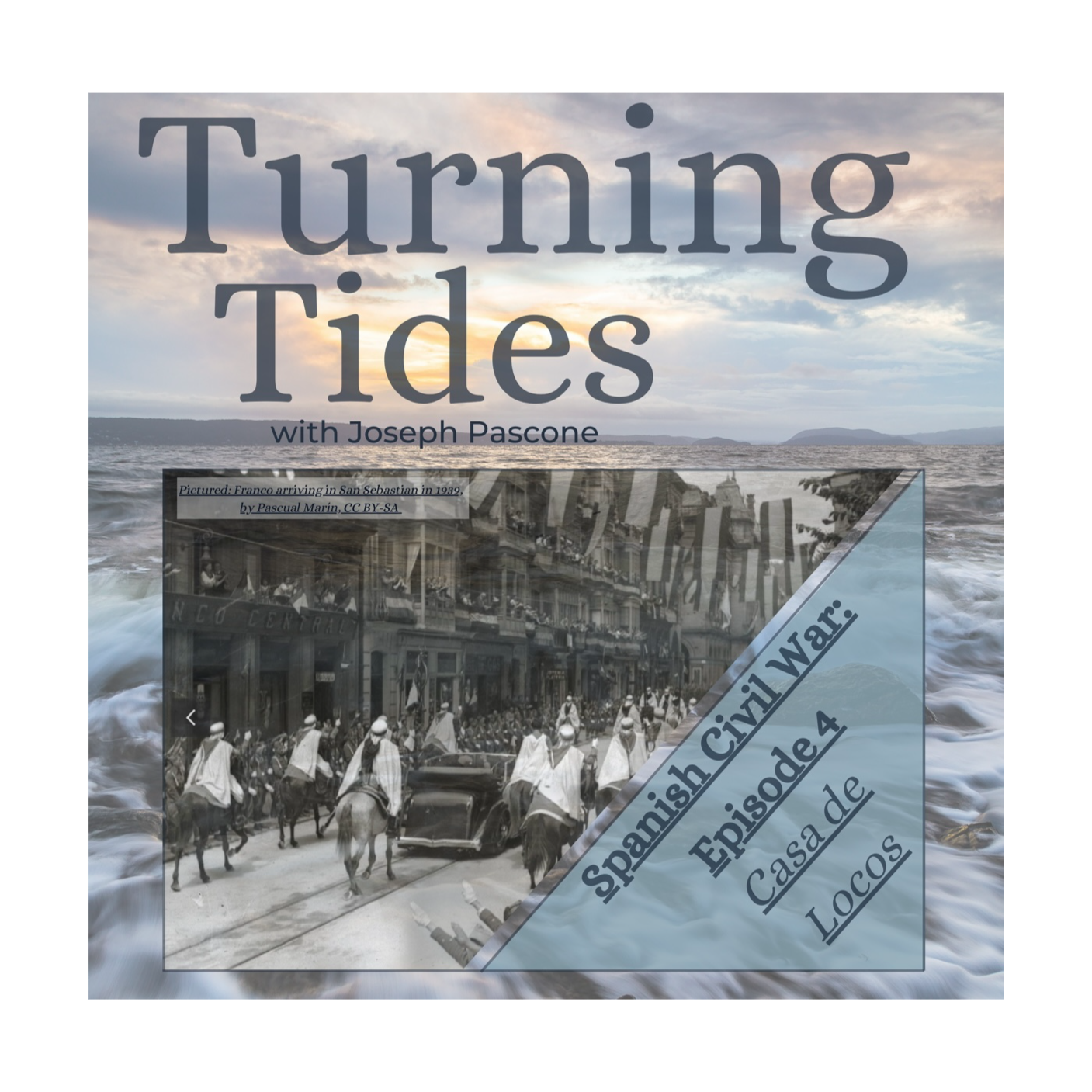
Turning Tides: Spanish Civil War will discuss the conflict which shaped modern Spain. The fourth and final episode, Casa de Locos, will cover the period from 1939 to 1977, in which Franco takes complete control of Spain, manipulates the government to suit his own ends, and creates the longest standing dictatorship of the 20th century. If you'd like to donate or sponsor the podcast, our PayPal is @TurningTidesPodcast1, or you can donate to us through our Buy Me a Coffee link: buymeacoffee.com/theturningtidespodcast. Thank you for your support! Produced by Melissa Marie Brown and Joseph Pascone in affiliation with AntiKs Entertainment. Researched and written by Joseph Pascone Edited and revised by Melissa Marie Brown Intro and Outro created by Melissa Marie Brown and Joseph Pascone using Motion Array Website: https://theturningtidespodcast.weebly.com/ IG/YouTube/Threads/Facebook: @theturningtidespodcast Bluesky/Mastodon: @turningtidespod Email: [email protected] IG/YouTube/Facebook/Threads/TikTok/Bluesky/Mastodon: @antiksent Email: [email protected] Episode 4 Sources: 1. Fascism in Spain: 1923 - 1977, by Stanley G. Payne 2. Homage to Catalonia, by George Orwell 3. Franco's International Brigades: Adventurers, Fascists, and Christian Crusaders in the Spanish Civil War, by Christopher Othen 4. Forgotten Places: Barcelona and the Spanish Civil War, by Nick Lloyd 5. The Last Miles to Huesca: An Australian Nurse in the Spanish Civil War, by Judith Keene 6. Camaradas: Ode to the Spanish Civil War: An Anthology of the International Brigades, by Eric Weinert 7. Spartacus Educational: Spanish Civil War, by John Simpkin 8. Spanish Civil War: History of a Battle for Europe's Soul: Spain's Great War (Required Histories), by George Levrier-Jones 9. The People's Army in the Spanish Civil War: A Military History of the Republic and the International Brigades, 1936 - 1939, by Alexander Clifford 10. Stolen Babies of Spain: The Book, by Greg Rabidouz, Mara Lencina, and Enrique Torres Vila 11. History of Spain from 1900 - 2000, by Dr. Cervantes Unuro 12. Long Live Death: the Keys to Victory in the Spanish Civil War, by A.H. Lloyd 13. Michael Parenti, Blackshirts and Reds: Rational Fascism and the Overthrow of Communism, City Lights Publishing, 1997, Chapter 1 & 2 14. Wikipedia Extended Web Sources Available on YouTube
!WARNING! *** WAR, VIOLENCE, MURDER, SUICIDE, RAPE, SEXUAL ASSAULT, CHILD ABUSE, GENOCIDE*** “For three years of war and for three years of what we wrongly called peace we have had to struggle on in [a] concerted endeavor. No one will be astonished if now, when this phase may be considered overcome, we throw off whatever and whoever would like to deflect us from marching toward fulfillment of our movement. On this depends the destiny of Spain and the preservation of her eternal values, the suppression of which would imply slavery and chaos. On this path we must be intransigent in exacting sacrifices from all for the benefit of our national unity – a guarantee of Spain’s future… All contemporary events show us we are witnessing the end of one era and the beginnings of another; that the liberal world is going down a victim to its own errors, and with it are disappearing commercial imperialism, financial capitalism and mass unemployment. The happiness promised by the French revolution became nothing but barter business, competition, low wages and mass insecurity. Wealth did not go hand in hand with equitable distribution. The important part of humanity was prey to misery. Freedom is impossible as long as bondage and want exist. Cleverly exploited Marxist slogans caught on with the masses because they deceitfully promised a change in the justice of the pressing situation. The liberal world, in giving adult suffrage, made them conscious of their own strength. Then the revolutionary process, accelerated by various crises, started. During the last war Russian demobilization led to a situation in which communism seized power and established a barbarian dictatorship of the proletariat. A similar phenomenon manifested itself in Italy after the war, but Mussolini’s genius instilled all just and human elements interested in the Italian revolution into the Fascists’ aims… Then, whatever projects there may exist now, the historic destiny of our era will be settled, either according to the barbarous formula of Bolshevist totalitarianism, or according to the spiritual, patriotic formula Spain offers us, or according to any other formula of the fascist nations. Neither the feelings of the most numerous social classes, nor the exigencies of the post-war economy, nor the grave problems facing nations, will allow any other path. Those are mistaken who dream of the establishment of democratic liberal systems in Western Europe, bordering on Russian communism. Those err who speculate on liberal peace agreements or a bourgeois solution. We do not work for ephemeral ends, but for a resplendent tomorrow. Our army has in it the flower of youth. Divine assistance clearly has shown itself to us. With it, nothing and nobody shall vanquish us. If we fought hard on our crusade, we would fight even harder if the new danger of new war should threaten us. We know that with us is life, without us, death.” - Francisco Franco, December 8th, 1942, Speech to the Falangist Party The last year of the Civil War in Spain is rarely discussed. It usually serves as a bookend or a minor footnote to springboard into World War II. In reality, the end of the war challenges many pre-conceived notions and beliefs about the conflict. Far from proving how powerful the Nationalists were, the final year proved how divided the Republic had always been. Once more, the Republic was fighting itself, as opposed to presenting a united front to Nationalism and pseudo-fascism. Most Spaniards had accepted the reality of the situation. They tried to pick up the pieces of their broken lives – albeit, under an authoritarian dictatorship; however, the war was still raging on in the remnants of the Republican sector, which still held control over Madrid and Valencia. Without these two cities, Franco could not consider his victory complete. Before the war had even ended, Neville Chamberlain had recognized Franco’s government as the “true government” of Spain. Later that same month, Juan Negrín desperately tried to form a communist-led government of resistance in the central area of Spain still controlled by the Republic. Before he could pick up the pieces, Colonel Segismundo Casado led a group of disgruntled socialist-aligned officers in a coup to topple Negrín and negotiate a peace with Franco, which they hoped would save their own hides. Working with military leaders in Madrid, a majority of those espousing communist beliefs were arrested. Many were shot, alongside Falangists who were still being held as bargaining chips. This coup dispels the conservative idea that Republican Spain was an early imitation of the Soviet, “People’s Republic,” which sprang up in Eastern Europe following World War II. Yes, during 1937 and early 1938, Soviet influence was prevalent throughout Republican Spain; however, their influence in Eastern Europe was even more pervasive. In essence, the Soviet Union’s relationship to Republican Spain is similar to the relationship the United States maintains with Israel; one could affect the other’s policy but never truly dictate it. Franco rejected the new Republican Junta’s attempts at negotiations. He demanded the unconditional surrender of the Republican side. If his conditions were refused, he would continue the war until all traces of Republicanism were stomped out. To make matters worse for the Republicans, the anti-communist coup was not perfectly executed; there were still armed soldiers who fought for Negrín and for communism. During the last months of the war, Republican units who had fought beside one another for the past three years turned their guns on each other, ensuring few – if any – of them were able to escape the impending final offensive. Busy fighting each other, the Republicans offered no resistance to the Nationalist advance, which entered the city of Madrid on March 31st. On April 1st, Francisco Franco proclaimed an end to the civil war in Spain. In total, at least 600,000 people died as a result of the fighting in Spain, with one scholar speculating that as many as 2 million actually died. In the immediate aftermath of victory, Franco sent his executioners to the four corners of Spain to root out any and all leftists who remained alive. In Barcelona, priests made bonfires of any and all left-wing literature they could find. Across Catalonia alone, as many as 50,000 people were executed. This says nothing of the repression throughout the rest of Spain, which may not have been as severe but was no less frightening. Probably no better barometer for political violence in Francoist Spain can be found than the opinions of Heinrich Himmler. He was shocked at the level of brutality shown to former Republicans, and that is saying something! Tens of thousands across Spain were executed, while hundreds of thousands of others were imprisoned in dreadful conditions and used as little more than slave labor for Francoist public works projects. Martial Law was imposed upon former Republican cities, and it remained in place until 1948. Treatment was much worse for women on the former-Republican side. The oppression of Republican women and their families had been a relatively undocumented aspect of the Francoist repression. Recent scholarship, however, has revealed the true scope of the horrors that Republican Spanish women had to endure. The culprit behind their persecution was Antonio Vallejo-Nágara. He believed that Republican women were basically subhuman and that they had no right to procreate, and if they did procreate, it would be bad for the entire Spanish race. Many women were publicly shamed by their new occupiers. There are numerous instances of women being force-fed castor oil, having their heads shaved, and then being paraded naked through town. During these “walks of shame,” the castor oil would induce diarrhea and further imply that the targeted woman was “unclean.” It was not uncommon for these acts of terror to end in the woman’s death, either by Franco’s goons or by the agitated conservative mobs. Other women were thrown in prisons especially designed to break them emotionally and psychologically. Pilar Fidalgo was one of the few women to document the treatment she endured while forcibly interned with her child. She describes one instance where they both became incredibly sick. They begged the prison doctor for assistance. His advice was that it would be better if she was dead, and that the “best cure” would be to kill her baby and then herself. Women would be sexually and physically assaulted in front of other prisoners, in order to “keep the inmates in line.” If any of the women tried to escape, they were executed, or they were assaulted in front of everyone and then executed. The dead were buried in mass graves, then defected on and spat on by the guards. Fidalgo never tried to escape, and she was still routinely assaulted by the guards – and even the priests – because she was, “a coward for not trying to escape.” Vallejo-Nágara was not content with just torturing women and children in state custody. He wanted, “the complete annihilation of large numbers if not all Republicans and the total humiliation and terrorization of any surviving population.” He began implementing Nazi-style eugenics policies, designed to root out the physically weak, the infirm, and – most importantly – the “Red” segments of Spanish society. Vallejo-Nágara decided early on that instead of preventing procreation, he would instead separate the potential, “red carrier,” or baby, from their parents. This was all in an effort to “reprogram” the child into a Catholic and loyal Falangist. In doing so, “mentally deficient Socialist tendencies” would be purged and ensure a true Catholic-dominated “paradise” for future Spanish generations. Considering the Socialist party is currently ruling Spain, his theories were utterly unfounded (and repugnant!). State-sanctioned kidnappings were deemed, “holy,” by many members of the Spanish Church, and babies from across Spain were soon being stolen at a prodigious rate. They would end up living with conservative families, as far away as Puerto Rico. The most targeted were twins. The Francoist rationale was that mothers would not miss one of the babies, since they already had the other twin, and besides, women could simply get pregnant again! Nuns usually acted as midwives and assisted in the delivery process; they were also integral in the theft of babies and often acted as a key go-between, with mothers being completely unaware of the secret “mafia.” When twins were not available, vulnerable pregnant women were targeted by organizations like the Seccíon Feminina; they were simply told their newborns died. Most women accepted this story passively; they were conditioned from an early age not to question the church, the state, and other levers of the patriarchy. And besides, when have women ever been taken at their word? The only thing speaking out would have gotten them is further societal ridicule from a state which only pretended to care about the sanctity of family. In total, upwards of 200,000 babies were stolen from their mothers and given out like trophies to those considered “good Catholics.” This practice occurred throughout the Francoist period and likely continued into Spain’s post-Franco era. The harsh reality is that the civil war never really ended. Following his victory, Franco transferred the powers of the state, the party, and the military into what Sandie Holguín called, “...a violent occupation against those who actively or passively supported the losing side.” As we will see, tariffs and the economic realities of Francoist rule crippled the ability of regular Spaniards to buy basic foodstuffs. Hundreds of thousands, mostly hailing from the south of Spain, died of starvation. Franco blamed the victims and believed their deaths to be, “God’s judgement of their Republican ways.” A main component of Franco’s eugenics policy is internalized racism. Many Spaniards desperately wanted to see themselves as white, or at least white-adjacent, while the reality of 800 years of Islamic and North African conquest tells a different story. Racist, light skinned Spaniards – who usually hailed from the north – saw darker-skinned Spaniards – who usually hailed from the south – as a “mixed” people, while northerners conveniently retained their “white” status. José Antonio even speculated that “true Spaniards” were the descendants of the original Aryan Visigoths who ruled following the collapse of Roman Iberia. In reality, Iberia – like the Italian peninsula – owes much to North Africa in terms of cultural heritage. In Sicily, the Caliphate of Palermo ruled for 200 years and turned the relatively arid plain outside the city into one which was vibrant, with productive plant life. They even named the town, “Corleone,” originally spelled, "Querleyon." Meanwhile, in Iberia, the Cordoba Caliphate was probably the most advanced society in Europe at the time. In short, racism plays a huge role in Spanish and Italian societies, but the reality is that diversity makes Spain and Italy better, along with every other area of the globe. As Franco’s regime cemented itself in place, World War II began. At first, Franco and the Spanish people were opposed to joining the war, in spite of being largely pro-Axis. As the war progressed, and Allied fortunes ebbed, radical Falangists became extremely pro-German and would advocate for Spain’s involvement in the war as a full-on belligerent. Franco presented a bellicose front, but in reality, he had little stomach for a war with either Great Britain or France, let alone the United States. He would only consider joining the war if he was gifted with large tracts of land in northwest Africa, as well as the sought-after Rock of Gibraltar. Besides this, he needed economic assistance for the faltering Spanish economy. On the home front, Franco attempted to wrestle all the victorious factions of the civil war into a stable government, which pursued autarkic policies – or policies that disincentivized foreign trade – in order to push Spain toward self-reliance, promoted a corporatist economy, and intertwined traditional values and religion into all aspects of Spanish life. He received the most grief from the extreme right and from people who wanted José Antonio’s original beliefs to be represented more in the new government. This internal battle begs the question – what were Franco’s supposed beliefs, and is it accurate to call his government a “fascist dictatorship?” Robert O. Paxton argues that Franco’s regime was more indicative of an authoritarian dictatorship and not a genuine fascist movement. Stanley G. Payne argues a similar point, maintaining that the closest Franco comes to “genuine” fascism is in a distorted form of what he and others called, “friar fascism.” Both admit that Franco used fascist symbolism and gestures to align with their beliefs, but the Spanish movement was not entirely taken over by fascists, like in Italy and Germany. Others, like Chris Hedges – a Christian-Socialist – argue that fascism takes different forms based on where in the world it springs up. He maintains that the single most fascist group in American history is the Ku Klux Klan, who wave American flags and talk about the, “traditional American ways of life.” It is true that Franco played a precarious balancing act with Falangists, who belonged to his many cabinets, always trying to subvert them; however, it is also true that every single aspect of life in Francoist Spain matches up perfectly with Robert O. Paxton’s definition fascism. One of the most important additions to Franco’s first post-civil war cabinet was the appointment of Agustín Muñoz Grandes, the new secretary general of the party. With his appointment, the membership of the FET began to blossom, as many former Republicans gave up their protests and joined Franco’s new world order. By 1942, party officials claimed almost one million members belonged to the FET. Other former Republicans refused to stop the fighting; determined armed resistance against Franco would sporadically continue until the end of his regime. This resistance was known as the Marquis. Needless to say, they fought against the entire world, which was determined to keep the Axis weak, even if it meant propping up Franco’s regime. Their struggle is recounted in works of fiction, like Guillermo del Toro’s, “Pan’s Labyrinth,” which touches on the story of a Marquis band. The Marquis were vilified in their day as brigands and thieves, and they were treated as such by the authorities. In one instance, an accused Marquisard was killed by Francoist authorities by garrot wire, a truly medieval way to die. This was the last such execution performed in this manner, anywhere in the world. The day-to-day of Franco’s regime was similar to Mussolini’s Italy. The regime and the party were never strong enough or capable enough to install a mass surveillance state, like that which existed in Nazi Germany. Additionally, Francoist Spain was never as forthright about their intentions as Nazi Germany, nor did they publicly endorse a racist policy of extermination. In fact, Spanish officials and dignitaries – alongside their Italian counterparts – saved tens of thousands of Jewish people from Nazi extermination camps. This did not mean Francoist officials were incapable of anti-Semitism. Franco and numerous pro-Nazi Falangists held anti-Semitic beliefs, but on the whole, Spanish society shrugged its shoulders at anti-Jewish hate, prejudice, and conspiracies. Amongst the intelligentsia, there were attempts – even during the civil war – to differentiate the government of Spain from other dictatorships. In 1941, Laín Entralgo released “Los valores morales del nacional-sindicalista” or “the moral values of the national syndicalist.” In it, Entralgo attempts to justify the use of violence, using religious scripture to “prove his point.” He writes, “This avidity for violent action stems from the most hidden depths of human instinct: the instinct Freud called aggression… The problem lies in uniting this deep and vital urge to violent action with the normative and with justice. With this understood, just and normative violence has for the man who executes it the value of a purification, is almost a ‘catharsis’... and the supernatural equivalent and ultimate mode of just violence will always be the violent action of Christ against the merchants in the temple… The National Syndicalist, without falling into pseudo-religious derivations, knows well the Christian value of just violence, and demands violent action in the service of social justice and of national justice. And, in the highest term, of Christian justice.” As this so-called “intellectual” foundation was laid, the student and women’s section of the FET was expanded. Amongst the students, the most radical of Falangists existed. They wanted to emulate Ramiro Ledesma’s philosophy of radical National revolution, in order to prevent a backslide into either reactionary or liberal tendencies. Meanwhile, the women’s section, under the control of Pilar Primo de Rivera, became more cemented in Spanish life than other aspects of the FET’s existence. Pilar doubled down on the “traditional role,” which she believed all women should play. She wrote that a woman’s only true purpose in life was to procreate, and by so doing, strengthen the nation. Considering she was celibate and had no children, this is lunacy. She also wrote, “Women never discover anything. They lack creative talent, reserved by God for virile intellects; we can do no more than interpret what men present to us,” further cementing the fact that she was a raging, incorrect misogynist. “Donations” the British made to Carlist generals were also causing a resurgence of Carlists. We discussed their ideology in episode one, but just to recap, they essentially wanted a return to the defunct monarchy and an increased emphasis on religion. They were largely pro-British and were interested in maintaining neutrality throughout the World War. Allied intelligence believed Spain was closer to the Axis powers. Franco considered himself much closer to the Axis than the Allies, as well. He fancied himself a virtual belligerent in the conflict, who was fully on the side of the Axis powers. It was only a matter of time until Spain joined the war. Franco had already made several bellicose gestures, which aligned him with Italy and Germany. This included joining the anti-comintern pact and signing a treaty of friendship and mutual assistance with Germany, promising military intervention if either state was attacked. Most threateningly, he occupied the international zone of Tangiers, which could have threatened British shipping on the way to the Mediterranean. First and foremost, however, Franco was concerned with repairing Spain’s image with the Vatican. Pope Pius XII was cautious when dealing with Franco. In recent years, the Pope had been attacked for being too pro-Axis. This was not incorrect, as the Pope had celebrated Hitler’s fiftieth birthday in the Vatican, in addition to signing numerous treaties with Mussolini. These negotiations would take years to conclude, finally ending in 1953 with a mutual agreement between the Holy See and Francoist Spain. When the German military seemed to be unstoppable, many Spaniards believed Fascism was destined to triumph against any Allied combination. All of a sudden, the reserved Franco was shouting about the “Empire” and the expansion of Spain in all directions. On June 12th, 1940, Spain officially changed their diplomatic status in the conflict from “neutral” to “non-belligerent.” On June 19th, Franco dispatched diplomats to Germany prepared to fully enter the war, but he was rebuffed by Hitler, who was sure that Great Britain could not stand alone. As time wore on, Germany changed its tune and became more convinced that Spanish entry into the conflict would go a long way to assisting the Axis in their victory. On October 23rd, Hitler and Franco met for the first and only time, at Hendaye, on the French border. Franco asserted that Spain could enter the war at any moment, he just needed more territory, economic assistance, and military aid. Hitler attempted to circumvent these talking points; he wanted Spain in the war first, and then perhaps they could discuss German assistance. The impasse was insurmountable; Hitler simply detested Franco on a personal level. He told aides that he would prefer, “to have two or three teeth pulled” than have to deal with the, “Latin charlatan,” ever again. Among his gallery of incorrect and bigoted assertions, Hitler also believed that Spaniards were “tarnished” by their Islamic roots, making them inherently inferior to the “white Aryan race.” Following the German war machine's first setback in the Battle of Britain, Spanish military men began to come down from their high. They began to realize that, perhaps, Hitler’s Wehrmacht and his hair-brained Luftwaffe might not be as invincible as they once thought. In early 1941, Hitler penned a furious letter to the Caudillo. In a rambling tirade, he asserts that the war was waged against, “Jewish International-democracy,” and that the Axis powers were on the “side of the people.” He repeatedly asserts that Spain would be destroyed in tandem with the Axis powers and that the Caudillo was inexorably tied to fascism and the Axis. Hitler claims he was ready to grant any number of Spanish claims in North and West Africa, only if he was allowed to dispatch troops through Spain in order to attack British-held Gibraltar. Finally he claims, “Spain will never get other friends than those given [her] in the Germany and Italy of today, unless it becomes a different Spain… Even for this reason alone, Caudillo, I believe that we three men, the Duce, you, and I, are bound to one another by the most rigorous compulsion of history that is possible, and that thus we in this historical analysis ought to obey as the supreme commandment the realization that in such difficult times, not so much an apparently wise caution as the bold heart, rather, can save nations.” He ends his letter, “Your, Adolph Hitler.” Imagine if the Axis won, and we had to deal with the two most secretly-in-love world leaders in history sending incoherent, rambling letters to one another publicly… Oh, wait... Mussolini was next. He met with Franco, for the first and only time, in Brodighera. Italy was in the process of “getting their grapes stomped” by Greece. Due to this, Mussolini was decidedly nonplussed about getting Franco involved. In a few months’ time, Mussolini would be voted out as the Duce by the, “Grand Council of Fascism.” His removal would greatly dishearten Spaniards, who saw the Italian experiment in fascism as the intellectual forebear of their own movement. As we have seen, many Spanish fascists based their beliefs in the supposed successes of Italian fascism. Now that it was faltering badly, they had nothing to emulate, except for the small Iron Cross movement in Romania. Franco was struggling to decide whether to enter the war fully on the Axis side. Serrano Súñer suggested a clever alternative to active Spanish participation. Instead, Spain would raise a, “Blue Division,” of, “volunteers,” who would go and fight in the invasion of the Soviet Union. Consisting of over 18,000 men, the Blue Division was led by Agustín Muñoz Grandes, one of the more pro-German Spanish generals. They were deployed around Leningrad and first saw combat on October 4th, 1941. In addition to army units, volunteer Spanish airmen saw action over the skies of Germany. Finally, over 100,000 Spanish workers were sent to Germany to work in the factories there. This was mutually beneficial, as the Spanish workers sent a portion of their income back to Spain, while Germany was able to send more men into Russia. One of Franco’s pet projects was the spread of Falange messaging to Latin America. This strategy was pursued in the hopes of recreating the Imperial Spain of yesteryear, but in a more modern setting. His overall dream was to bring all of Latin America – including Portugal and Brazil – into one, single economic union, with Spain being the “rightful” head. There were numerous Francoist collaborators in Latin America who believed Spanish colonization would bring “progress” to the area, “as it did before.” In fact, besides Portugal, Latin Americans from México, Chile, Argentina, and Cuba were the most prevalent foreign volunteers in Franco’s ranks. However, the reality on the ground was much different than the one which existed inside Franco’s head. Besides a handful of white Latines who supported fascism, most Latin Americans and their political leaders wanted nothing to do with the spread of Falangist ideas amongst their communities. Even more perturbed by Francoist posturing, was America. The “Land of Liberty” would not allow the Falange to subvert the governments of Latin America – that was their job! The United States’s paranoia was exacerbated by British intelligence services, which made it seem like Franco had much more Latin American support than he did. Back in Germany, plans were being hatched to overthrow Franco and replace him with someone more pliable to German interests. It was Hitler’s hope that he would be able to convert tens of thousands of Spanish Republican prisoners into “good National Socialists” and then use them against Franco to overthrow his regime. These plans never really got off the ground, mostly because Hitler was fucking insane, and Franco cracked down on any dissent against his regime. One of the main tools in his arsenal was his constant and strategic reshuffling of his cabinet – replacing the recalcitrant, and promoting the yes-men. Franco also had other challenges from the more traditional right-wing forces. They wanted a return to the monarchy as soon as possible. However, Franco would dither in his decision to reinstate the monarchy for decades. His main issue with the monarchy lay in their pro-British feelings and the obvious possibility that Franco would be beholden to someone else. The FET was simmering in tension throughout 1941. In May, it exploded; there were several notable resignations from prominent party members, including Pilar and Miguel Primo de Rivera. The brother/sister pair felt the regime was going astray from the core beliefs of their deceased brother. On the streets, Falangists and Carlists engaged in gun battles, resulting in the deaths of several people. Franco’s regime was dealing with its first internal political crisis. It ended with Franco appointing and changing out several ministers, resulting in the initiation of another precarious balancing act, between traditionalists and the José Antonio purists. Stanley G. Payne claimed that this realignment, though seemingly minor, represented the, “high-water mark,” for the party, before it became completely subservient to Franco and his whim. Amongst those ennobled with state power was Naval Captain Luis Carrero Blanco. As a naval officer, he managed to escape the purge of the Spanish Navy by pro-Republican sailors, largely because he was not on active duty during the outbreak of hostilities. When he heard that upwards of 40% of Spanish naval officers were killed by their crews, it awakened an extreme right-wing thought process in him, which had been lying dormant. Blanco would become the ultimate lieutenant to Franco; Stanley G. Payne even went so far as to call him, “Franco’s alter ego.” The similarities between Blanco and Franco are extreme. They were both anti-communist, anti-Semitic, and obsessed with Catholicism. Blanco brought context to what it truly meant to support the totalitarian, Catholic, and corporatist system, which he was attempting to implement with the Caudillo. He genuinely believed that Spain had a religious duty and destiny. Blanco also believed that “the organic scheme of a totalitarian state” was based on five distinct principles. They included: “a) A Caudillo, b) A Party, c) An administrative organism functioning with maximum simplicity, dynamic, active, and coordinated, with a minimal number of functionaries, d) A National Plan, and e) A People who obeys.” Another under-represented aspect of the Francoist repression was their crackdown and arrest of many Freemasons. Franco was of the opinion that masonic lodges were conspiring to introduce communism to Spain. Freemasonry has never had many adherents, and their rituals are mostly benign male bonding. In Spain, only a few thousand people were Freemasons, many of whom were only casual participants. Due to this, it is highly unlikely that the Freemasons were behind the many conspiracies of which they were accused. In any case, they were severely repressed. Any Spaniards within Franco’s government who were found to have been a Freemason were quickly fired and charged with conspiracy, while thousands of ordinary citizens met the same fate, and in some instances, a fate much worse. Throughout 1942, FET membership grew, claiming almost a million Spaniards as members. Many of these members were not ardent supporters of radical right-wing politics; they were regular citizens trying to take advantage of the favoritism and perks given to party members. Amongst this surge of new members, there were many, “Reds,” and “Crypto-Oppositionists,” who were supposedly upending the party from within. It was due to them, and many pro-British Carlists, that Spain remained out of World War II. By 1943, Franco began recalling many of his formations from Russia. As with any one-party state, many ideologies were still present within it. This inherently flawed system created the very mechanisms which would be used to destroy it. A trade unionist, who couldn’t identify as a socialist anymore, could now argue that it was Catholic teachings which spurred him to seek more rights for workers. A former communist could argue the nationalization of certain sectors of the economy would not only assist the working people but also be more efficient in maintaining the “National economy.” The FET members were busy arguing and fighting amongst themselves. In August of 1942, an annual procession of Carlists was interrupted by local Falangists. During the argument, one of the Carlists supposedly shouted, “Death to Franco,” at which point, the group of Falangists tossed hand grenades into the procession, killing two Carlists and injuring hundreds. Six Falangists were convicted, and one was executed the following month. Old habits died hard in Franco’s regime. The Falange would have to be neutered. As a result of the ensuing purge, the Spanish state drifted back into a state of neutrality in the World War. This move was right on time; Allied forces began landing in North Africa in November. Both Chruchill and Roosevelt were quick to assure Franco that their armies had no designs on his territory. This proved an even greater incentive to remain neutral; in spite of Franco’s boasts of recreating an empire, his state was in financial arrears and consistently cut military spending to make up the deficit. Following the loss of Axis North Africa, as well as the German defeat at the Battle of Stalingrad, Germany gave up trying to bring Spain into the war. They were busy suffering from a slow, “Götterdämmerrung,” or, “the Twilight of the Gods.” As bastion after bastion of fascists was captured by the Allies, Franco’s regime began a decades-long period of “de-fascistization.” It would not fully conclude until after Franco’s death in 1977, and depending on who you ask, it has never disappeared. Throughout the entire Franco era, Spanish art and culture, which usually thrived, was markedly declining. There were exceptions – like Salvador Dalí, but he achieved many of his successes through rebelling against the incredibly strict Spanish censors. Later in the Francoist period, these censorship laws slackened, and this led to a veritable explosion of underground art suddenly becoming mainstream. Artists like Antonio López García grew to international acclaim in the 60s and 70s. Most known for his still-life portraits, García inspired future generations of Spanish artists, like the painter Augusto Ferrar-Delmau. Another notable artist of the time was Joan Miró, a Catalan surrealist painter and sculptor. Throughout the Francoist regime, he produced works of art which symbolically represented his native homeland. His work was clearly influenced by Caribbean and African art. His piece, “the Farm,” was considered a masterpiece. Hemingway wrote about the painting, "It has in it all that you feel about Spain when you are there and all that you feel when you are away and cannot go there. No one else has been able to paint these two very opposing things." In October of 1943, Franco’s regime officially ended its diplomatic status as a non-belligerent to become fully neutral in the conflict once more. This meant the thousands of Spaniards fighting for the Nazis were recalled. Out of 47,000 Spaniards who served on the eastern front, 22,000 were killed or wounded. Around 2,000 volunteers would remain in Germany, until being disbanded in 1944. Those Spaniards who remained were incorporated into the Waffen SS and fought to the last man around the wreckage of Berlin. The last stand of the “supreme Aryan race” was fought by Hispanics. As the Second “Great War” ended in defeat for the right and victory for liberal democracy and socialism, Franco’s regime was seemingly isolated in a sea of enemies. At the Potsdam Conference, it was decided to break off relations with Spain. Franco feared that the victorious Allies would turn their armies on Iberia and sweep nationalism into the dustbin of history. As we know, this brief moment of camaraderie between Western democracies and Eastern socialism was short lived, and it would soon evolve into a silent war between capitalism and socialism. As the new battle lines were drawn, Spain was clearly on the side of capitalist powers. This was made apparent with the end of the war, when Franco compared the country of Spain to a ship at sea, saying, “when a ship tries to stay the course, if it is necessary to lower the sails, they are temporarily lowered, which doesn’t mean they are going to be thrown overboard.” This quote demonstrates that the step back from fascism was only meant to be temporary. The more people got a taste of freedom and democracy, the more they wanted it. It also helped that tourists were back in Spain for the first time since the Civil War, due to the new attempts at dismantling fascism. This invigorated the sputtering Spanish economy in a way that Franco’s autarky simply could not. Throughout post-war Europe, big business was on the side of “former” fascists, and they usually supported them during the war as well. This was true for numerous private American companies, including Ford and General Motors. The former trafficked enslaved peoples for free labor in its Cologne plant, while American airmen were given specific instructions not to harm German Ford factories. Additionally, companies like ITT and General Motors were given tens of millions of dollars when their factories were accidentally destroyed by U.S. bombings, when they should have been persecuted and prosecuted for working with the enemy. This shouldn’t come as a surprise to anyone. The reality is that the post-war United States had no problem assisting former war criminals and propping up right-wing dictatorships the world over. In every continent, in every geographic region, in nearly every country, the influence of the United States was felt in the most heinous way possible for anyone who didn’t help to maintain capitalism, terror, and exploitative companies. A perfect example was the coddling of Franco’s regime. The good ol’ USA started their diplomatic offensive in early 1947, vetoing further restrictions and sanctions against Spain at the newly minted United Nations. Then those sweet U.S. dollars started rolling in. Hundreds of millions of dollars were diverted to Spain between 1949 and 1953. Due to U.S. diplomatic prodding (aka bullying), the United Nations’s resolution condemning and sanctioning Franco’s regime was lifted entirely. Of course, France and Britain abstained, allowing “friar fascism” to fester in Europe for decades. Most of this money went toward modernizing the Spanish armed forces, which were facing defeats from a determined resistance movement in the mountains. As the money poured in, Franco was more obliged to liberalize certain areas of Spanish life. This included trade unions, which remained a powerful force in Spain, albeit with little right to strike or effectively organize. However, Franco failed to kill enough socialists, as many were soon elected to their local syndicates. They campaigned on reforms that would HELP PEOPLE instead of meaningless religious rhetoric, so they won. Many of these syndicates, however, remained stooge-run institutions, which were loyal to local officials instead of the workers they supposedly represented. This labor conflict was most present in places which were former hotbeds of socialist and anarchist activity. The workers here knew they were being duped and outwardly refused any attempts to be corralled by their supposed labor leaders. Besides the few brave souls who took to the hills to fight against dictatorship, most remained silent and tried to live as best as they could in a place where human rights violations were not only ignored, but actually manufactured by those in power. Starting in 1954, local elections for municipal councilors would be held for the first time in decades. Amongst those able to vote were, “heads of family and married women.” “The Movement,” the new name of the FET, was legally opposed by a small group of monarchists who were part of the only “opposition” allowed in the elections. The votes gained were usually acquired by coercion, proving Franco was deeply insecure about his popularity within the cities. There were small groups of extreme right-wing citizens who opposed all of these reforms, considering them a backslide into liberalism. If Spain had remained a stagnant fascist country during the post-war era, all it would have led to was more political repression, more money wasted, and more corruption engendered. These evils were all still present, even under the “liberalizing” reforms of the 50s, 60s, and 70s, but they were certainly scaled back. As it is today, the most vocal opposition to authoritarianism and one-party rule came from the universities, where students began forming their own organizations to counter the state-mandated and rigid, SEU. This was the official student organization of the regime. The SEU’s parent organization, the Falange, was in a decrepit state. Herbert Mathews, said the Falange, “...is a shadow, a scarecrow that Franco picks up and waves threateningly now and then. It has no power in itself… The Falange is dead on its feet, and it is surprising how many authorities admit it.” There were attempts at revival, usually from radical right-wing students, which resulted in memorable phrases like, “We don’t want idiot kings,” but they did nothing of actual substance. In the end, far-right politics are like a firecracker – loud, full of smoke, and only bright for a few seconds, tops. As if to confirm the point, Franco called his people together in 1957 to redefine the National Movement. There was no longer any reference to José Antonio and his Twenty-Six Points, nor was there any mention of the Falange or the need to rebuild the Spanish Empire. Instead, the new National Movement was defined by inward growth, unity at all costs, and economic stability. This began an era of technocracy for Francoist Spain, in which it was hoped that rapid modernization would fix the woes of high inflation and a massive deficit. One major replacement, which accompanied the new government of 1957, was the appointment of José Solís Ruiz as the new General Secretariat of the Movement. Solís became the regime’s chief bullshitter, who could lie to anyone about anything. On April 1st, 1959, in celebration of the anniversary of the end of the Civil War, the “Valle de los Caídos,” or, the “Valley of the Fallen,” was unveiled to the public. Upon his death, Franco would be interred here. His remains were finally moved in 2019, after years of public outcry. In 1962, General Muñoz Grandes was appointed to be the Vice President, a new post entirely in Francoist Spain. Stanley G. Payne asserts that there were now two factions vying for support, Carrero Blanco with the technocratic-monarchists and Muñoz Grandes with the regentalists. Both, as their names imply, wanted a return of the former monarchy under the would-be Regent, Juan Carlos Teresa Silverio Alfonso de Borbón y Battenberg, or “Infante Juan.” In 1966, a law was introduced which would greatly reduce the extent of censorship in the Spanish press. It was still unlawful to question the Caudillo, but policies instituted by the government could be protested on an individual basis. It was nothing like “free speech,” but it was a step in the right direction. Franco was still unwilling. Once it was unveiled, a vastly modified law ended up being no more than a clarification of existing censorship laws, which remained harsh. However, this so-called Organic Law also increased the capacity of the National Council to more than one hundred representatives, many of whom would be voted on by the people. During the late 1960s, Franco attempted to find allies and bolster his position in Latin America. Specifically, he reached out to the Peronist dictatorship of Argentina, seeing many similarities in their systems. He also sought friendship with the Mexican Partido Revolucinario Institutional, which had held an iron grip on Mexican politics since the early 20th century. They would finally fall from grace in 1968, when Mexican security forces killed upwards of five hundred student protesters in a pre-arranged assault known as the Tlatelolco Massacre. In Spain, basic collective bargaining was allowed for the first time in the mid-60s. This was soon extended to political “associations” being allowed. Allowing associations was the final nail in the coffin of the one-party state, as these associations eventually evolved into political parties. Soon, what Stanley G. Payne called a veritable, “alphabet soup of acronyms,” came into being, representing all sorts of right-wing political opinions. At least for now, these different political entities had to maintain theoretical adherence to the Movement and its ideals. Eventually, Infante made way for his son, Prince Juan Carlos Alfonso Víctor María de Borbón y Borbón-Dos Sicilias, or Juan Carlos I, to be declared, “the heir to Franco and future King.” At the age of eighty, Franco decided someone else should be the day-to-day president of the country. His replacement was Carrero Blanco, who was a true warhorse administrator for the regime. He assumed the title of President on June 8th, 1973. He would govern for all of six months before he was assassinated. The culprits behind the assassination were a hit squad belonging to the ETA, a Basque separatist organization, which some have dubbed a terrorist organization. Their strike team was named after a martyred member of the ETA who was shot and killed by police earlier that year. They targeted Carrero Blanco for his endorsement of, “pure Francoism.” The hit squad disguised themselves as electricians, laid their massive payload in the middle of the street, and wired it to the detonation device. Carrero Blanco was returning from mass; as his car passed the bomb, the squad activated their device, sending Carrero Blanco’s car flying into the sky. His car cleared the top of a building and landed on the far-side of the roof, killing Blanco, his aide, and his driver. Needless to say, his assassination blew up Franco’s government, and the ailing Franco needed a last minute replacement. The career bureaucrat, Carlos Arias Navarro, replaced Blanco. He immediately voiced his support for more liberal reforms and an eventual return to parliamentary democracy. It was a stunning move from a career administrator, but one which he was probably required to make. “Pure Francoism” would die with Franco; that was now abundantly clear, as it should have been to all from the jump. The only way forward was to join the burgeoning European economic community, or risk further stagnation or obsoletion. There were obviously a handful of holdouts who pined for the “good ol’ days” of tariffs, political repression, and starvation. One of these was Luis María Anson, who wrote that political leaders, “are ready to proclaim the most humiliating repentance [of Francoism] so as they can gain a single sentence of praise from those new leftist journals who hand out democratic credentials or impart Red blessings according to their own caprice.” In late October of 1975, Franco was dying. The only man who sat with the decrepit Caudillo was Solís, the professional bullshitter, who supposedly cried at Franco’s side through the night. It would take a month for Franco to finally slip away – not with a shout, but with a whimper. In one of the strange twists of history, his death occurred within the hour of José Antonio’s death. Over the next two years, the groundwork was laid for a return to a multi-party democracy for the Spanish people. After decades of experimentation, the far-right had been utterly repudiated by the Spanish people, economic realities, and history. In the 1977 General Elections, Spaniards chose a coalition of centrists and liberals known as the UCD, with the Socialist Workers’ Party coming in a close second, receiving nearly 30% of the vote. No right-wing candidate achieved over 10% of the vote. Today, Spain’s government is headed by a coalition of socialists and leftists determined to keep Spain in the 21st Century by not joining the right-wing backslide. Amongst western European countries, they have been one of the first to recognize the legitimate state of Palestine. Spain is currently accepting Palestinian children into their hospitals. These same children are being intentionally starved by Israel’s far-right settler-colonial state, which is also being armed by United States taxpayers. Today, the Anarchist trade union, the CNT, remains a powerful force in labor organizing across Catalonia. On the other hand, the Francoist Party of Spain isn’t even represented in the Cortes Generales. They barely register 2% of the vote in any recently held general election. Yes, the rise of the far-right “People’s Party” is disconcerting, and recent laws passed there stink of a return to Francoist authoritarianism. But hopefully Spaniards remember their history and choose to combat fascism, valuing people over corrupt organizations. The Spanish Civil War may have ended in a temporary Nationalist victory, but I think it is pretty clear that the Republic won the overall struggle for the hearts and minds of the majority of Spanish citizens. If this trend is being reversed, it is due to the continued failing of liberalism when it comes to addressing the multitude of economic and social issues the world is continuously facing. Quite frankly, more of the same – which is what liberals usually offer – isn’t working anymore. People are exhausted by the state of capitalism, which – like Franco – is taking its sweet-ass time to keel over and make way for an economic system that ACTUALLY works for the people. So long as the powers that be remain entrenched in their self-serving ways, be they far-right or liberal, the same issues will always exist. This is especially true when far-right politicians and their supporters argue that they are “revolutionaries,” and that they intend to, “shake things up and drain the swamp.” Michael Parenti wrote of these snake oil salesmen, “when the Right offers a ‘new revolution’ or a ‘new order,’ it is in the service of the same old moneyed interests, leading down that well-trodden road of reaction and repression that so many Third World countries have been forced to take, the road those at the top want us all to travel.” So long as we accept the basic narratives of pop historians and the ramblings of senile old men, we will keep making the same mistakes. What makes the Spanish Civil War so remembered was the fact that writers, intellectuals, and regular people were fighting for something all their own. Yes, the Republicans lost, and they were not perfect by any means, but they showed the power of a people’s army in the face of an authoritarian menace. The lessons learned in Spain would inspire revolutionaries and leftists across the globe and influence their own armed struggles, be they revolutions or struggles against CIA-manufactured coups. The war also influenced countless writers, like Ernest Hemingway, whose work, “For Whom the Bell Tolls,” is based directly on his experiences in the Spanish Civil War. In our next series, we’ll be traveling southeast along the Mediterranean coast, toward the expansive and beautiful country of Algeria. Similar to the atrocities being committed against Palestinians today, the people of Algeria were once subjected to conquest, colonization, and genocide by their French oppressors. The French argued that “they had a historic claim to the land” and that their colonial conquest was “ordained in the scripture.” They were opposed by a philosopher-turned-Algerian-freedom fighter, Abdelkader. To hear that story, you’ll have to tune into Turning Tides after a short break in our scripted series. We’ll be back on September 30th; I’m your host, Joseph Pascone. Have a great day, and we’ll see you then!