
Turning Tides · Joseph Pascone
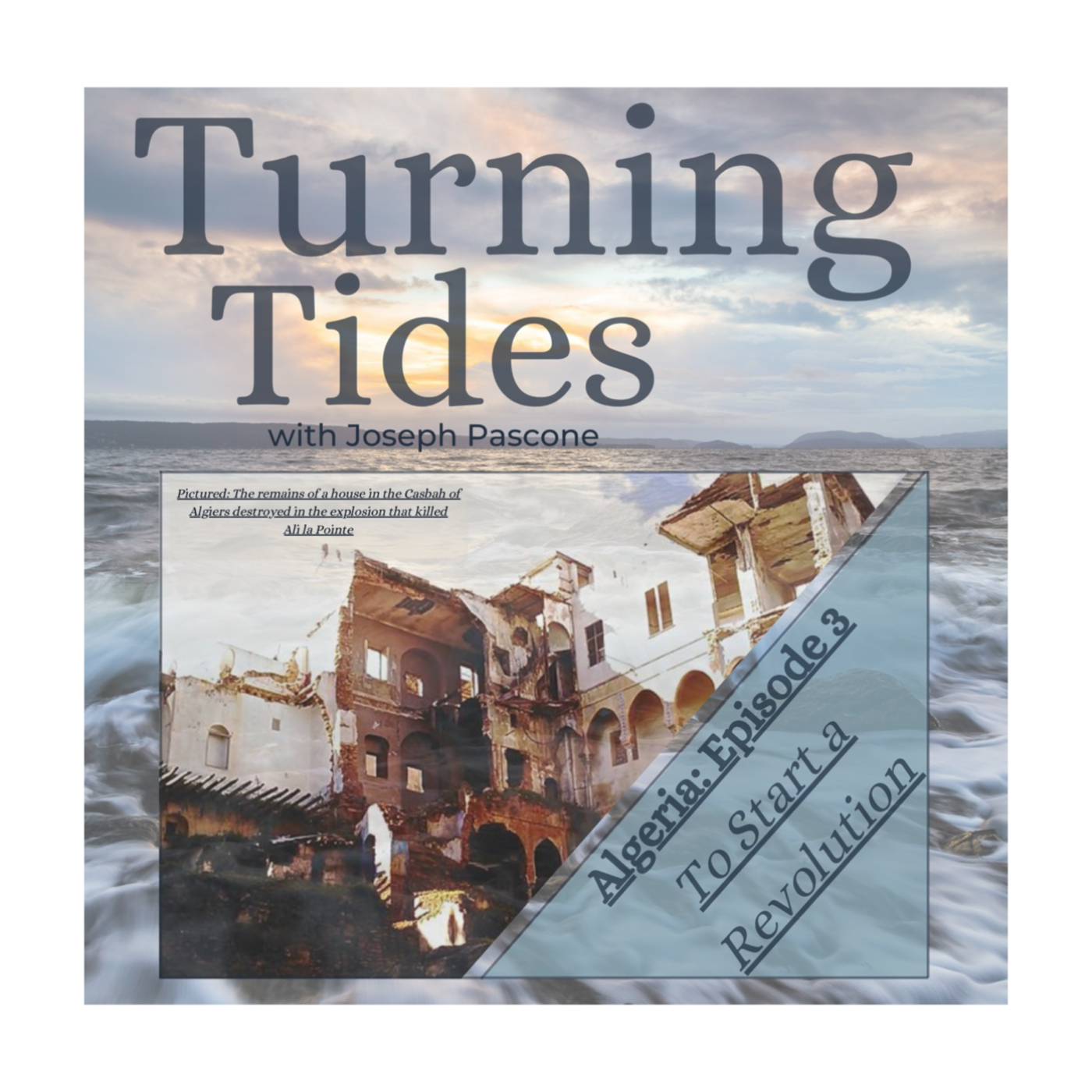
Turning Tides: Algeria will discuss the history of the colonization and subsequent battles which plagued Algeria. The third episode, To Start a Revolution, will cover the period from 1955 to 1957, in which the French attempted to silence the F.L.N. and maintain control of Algeria using genocidal tactics. If you'd like to donate or sponsor the podcast, our PayPal is @TurningTidesPodcast1, or you can donate to us through our Buy Me a Coffee link: buymeacoffee.com/theturningtidespodcast. Thank you for your support! Produced by Melissa Marie Brown and Joseph Pascone in affiliation with AntiKs Entertainment. Researched and written by Joseph Pascone Edited and revised by Melissa Marie Brown Intro and Outro created by Melissa Marie Brown and Joseph Pascone using Motion Array Website: https://theturningtidespodcast.weebly.com/ IG/YouTube/Threads/Facebook: @theturningtidespodcast Bluesky/Mastodon: @turningtidespod Email: [email protected] IG/YouTube/Facebook/Threads/Bluesky/Mastodon: @antiksent Email: [email protected] Episode 3 Sources: 1. French Invasion: Algerian Resistance (1830 - 1871), by S.E. Al-Djazairi 2. The Algerian War of Liberation, 1954 - 1962, Myths and Lies, by S.E. Al-Djazairi 3. A Short History of Algeria, by Lina De Marco 4. Commander of the Faithful: The Life and Times of Emir Abd el-Kader: A Story of True Jihad, by John W. Kiser 5. The History of Algeria: From Berbers to Independence, by Fatima Linda Haddad 6. A Savage War of Peace: Algeria, 1954 - 1962, by Alistair Horne 7. A History of the Arab-Israeli Conflict, by Ian J. Bickerton and Carla L. Klausner 8. Wikipedia
!WARNING! ***RACISM, TORTURE, MURDER, VIOLENCE, WAR, ASSUALT, SEXUAL ASSAULT, GENOCIDE, CHILD ABUSE, SUICIDE*** “It's hard to start a revolution. Even harder to continue it. And hardest of all to win it. But, it's only afterwards, when we have won, that the true difficulties begin. In short, Ali, there's still much to do.” – “La battaglia di Algeri,” a film written by Saadi Yacef, 1966 What would you be willing to do to free your country? Would you be willing to endure obscene torture? Could you forsake your life for an existence marred by privation and hunger? Would you be able to go so far as to plant a bomb in a crowded café to avenge your fallen comrades, even when you knew it would kill and maim innocent people? Three women – Zohra Drif, Djamila Bouhired, and Samia Lakhdari – would have to contemplate their answers to these heavy questions. All accepted their assignment. They were not the first bombers in Algiers; that distinction belonged to the ultra conservative pied noir, who had murdered seventy Algerian men, women, and children with a bomb which had been haphazardly placed in the middle of the casbah. This did not include the tens of thousands of other innocent Algerians who died throughout the country as a result of French policy. The French leveled entire villages with napalm, shot suspected F.L.N. members, and tortured hundreds of thousands of people. How did things get to this point, and why did France cling so desperately to the last vestiges of their “empire?” When hostilities began on All Saint’s Day in 1954, few believed that these insurrections would be the prelude to an eight-year-long war. It did not have to be this way. At the start of hostilities, the F.L.N. made a point to abstain from killing French civilians. This would remain the rule for some time. This did not mean French civilians were not accidentally made casualties. Infamously, the newly-wed couple, Guy and Jeanine Monnerot, were the first two French civilian casualties. Supposedly, they found themselves on the wrong bus at the wrong time, and during a shootout between French yes-men and F.L.N. militants, the two were accidentally shot. Guy bled out before help could arrive, but Jeanine survived the ordeal. The Monnerot's suffering was used as a tool by French propaganda to showcase how “dastardly” the F.L.N. members were. The reality is that French atrocities were the main reason behind the F.L.N.’s eventual targeting of French citizens. At first, the objective of the F.L.N. was to capture French military installations throughout the country; arsenals, barracks, and military storage yards were the main targets. Hit-and-run tactics were utilized in all offensive operations, and all efforts were made to avoid frontal attacks. In spite of their plans, All Saint’s Day was a debacle for the F.L.N. One rebel cell attacked too early and nearly gave away the entire revolution. All major objectives – including the radio station and the gasworks – remained in French hands. All the F.L.N. had to show for their efforts were casualties, a handful of burned bridges, and several captured weapons of various caliber. In Kabylia and the Aurès mountains, the rebels were mildly successful; power lines and telegraph wires were cut, and French fields and infrastructure were destroyed. The reaction to this was swift and drastic. Even the Communist Party of Algeria decried the, “All Saints Day Tragedy,” calling the F.L.N. revolutionaries, “provocateurs,” and “sowers of panic.” On November 12th, Pierre Mendès France, the Prime Minister of France, said, “One does not compromise when it comes to defending the internal peace of the nation, the unity and integrity of the Republic. The Algerian departments are part of the French Republic. They have been French for a long time, and they are irrevocably French… Between them and metropolitan France there can be no conceivable secession… Never will any French government, or parliament, whatever may be their particularistic tendencies – yield on this fundamental principle… several deputies have made comparisons between French policy in Algeria and Tunisia. I declare no parallel is more erroneous, that no comparison is false, or more dangerous. Here is France!” The Minister of the Interior and future Prime Minister of the country, François Mitterand, was more bellicose than Mendès France; he said, “The only negotiation is war.” In Algeria, the pied noir legislature granted the government extra-judicial powers to both the Algerian police and the local military leaders. The ultras blamed Mendès France, as well as his policy of reconciliation with other Maghrebi nations, for the outbreak of violence in Algeria. Privately, Mendès France wanted to introduce an, “Algerian New Deal,” which would have granted full French citizenship to all Algerians; however, with the start of the Algerian War, Mendès France was trapped. He had to continue to foster relations with the pied noir or risk his unstable coalition collapsing. French efforts to end the rebellion were off to a slow start. French forces had failed to learn their lesson from Dien Bien Phu. They arrived on the Algerian beaches with tanks and troop carriers, both of which were basically useless once off-road. Jean Servier, a French officer on the ground, speculated, “If, in 1830, the French Expeditionary Force had had tanks, they wouldn’t have got beyond the beach at Sidi-Ferruch!” The French army had no mules, no horses, and only a single helicopter. The first French reinforcements were units dispatched from the regular army. They were sent deep into the regions in which the rebellion had been most successful; this included the Aurès Mountains and Kabylia. Many French soldiers were struck by the abject poverty in these places. Hunger and desperation were etched on the faces of every person they met. Few prisoners were taken by either side; Algerians considered “loyal” to the French regime were targeted often. Algerian policemen and civil servants who were in the employ of France were found with their throats slit by the F.L.N. When the French were unable to track the F.L.N. down, they often resorted to terror tactics, employing “collective punishment” against the entire population of towns and villages in which F.L.N. attacks occurred. Many areas, including Ichmol, were leveled by the French Air Force. After each French bombing, the F.L.N. unsurprisingly gained a steady stream of fresh recruits. The French were very successful in taking out the leadership of the F.L.N. Numerous local and national leaders were either killed, died mysteriously while in French custody, or were kidnapped and arrested by the French. However, France failed to acknowledge the regenerative quality of the Algerian revolution. Whenever one leader was removed, a more dynamic leader took their place. This was especially true in places like Algiers. Following the destruction of the local rebel cell, a new one sprang up. This process still took time, and in the interim, the French believed the rebellion had sputtered out before it began. As 1954 melted into 1955, the F.L.N. found themselves against the ropes. The arrival of elite French paratroopers whittled the strength of the F.L.N. down to just three hundred and fifty combatants. Comparatively, French forces numbered almost 160,000. Pierre Leulliette was in the thick of the fighting. He kept an extensive diary, which he published after his service. In it, he writes of a standard engagement between French “paras” and the F.L.N., saying, “At one o’clock, with no warning, violent shooting breaks out, followed by bursts of automatic rifle fire. The Berets Bleus of the 18th R.C.P. have made contact with a group of outlaws in front of us. Ahead of us, a rebel hidden in a tree opens fire. No one can see him. In less than a minute, he has mortally wounded two of our lead riflemen. He is single-handedly holding up the whole company, which has stopped dumbfounded, deployed in line. Meanwhile, the other rebels, though already encircled, have been taking position behind boulders. Shooting begins over the bodies of our two comrades, who[m] we cannot yet reach. Beneath one of them, a dark stain slowly spreads. [It is] impossible to locate anyone. The sound of the shots, our only clue… I fire bursts of two or three shots at the objective a lieutenant has just pointed out to me. From the other side, someone who perhaps does not see me either, but who hears me, is just as conscientiously firing at me. I reflect he may well get me in the end, if only by luck. Perhaps that is really all war is: trying to kill someone without knowing whom, or why-and being killed the same way. Who would ever be willing to die if he knew why?” In early 1955, Mendès France’s government fell, but not before he appointed Jacques Soustelle as the new Governor General of Algeria. Soustelle was an ardent anti-fascist, an expert in Mayan and Aztec culture, and an ally of the former Prime Minister, De Gaulle. He promised reform in all major aspects of Algerian life. Among other things, he wanted to do away with the ridiculous electoral system in Algeria, vastly increase the number of native Algerians who were able to vote, and make Arabic a recognized language alongside French. Finally, and most importantly, he created the S.A.S., or the Sections Administrative Specialisées. These sections were set up all across the country and run by French officers who oversaw the administration of remote Algerian towns. Some of the sections became, “intelligence centers,” in which torture was used to gain information. On the whole, however, the S.A.S. was one of the more effective French reforms, and for that reason, members of the S.A.S were targeted more often than any other members of the French administration. This was part of a larger strategy devised by the F.L.N. to completely remove any penchant toward liberal compromise in Algerians. Many other revolutionary movements throughout history have fallen victim to internal decay because they allowed compromise with their oppressor, but Algerians remained stalwart in their collective goal of national independence. Peace negotiations with France would come later. In late August of 1955, the interdiction against killing French civilians was lifted by the F.L.N. The leadership of the group fell into the hands of new, more militant individuals – like Yousef Zighout, who believed French civilians should pay the same price Algerian civilians had paid. Zighout said, “To colonialism’s policy of collective repression, we must reply with collective reprisals against the Europeans, military and civil, who are all united in the crimes committed against our people. For them, no pity, no quarter!” Zighout, who was in charge of Wilaya 1, declared August 20th to be the start of a true, “people’s revolt.” The harbor town of Philippeville and some surrounding areas would rise up in their thousands and kill any Europeans they could find. Compelled by the F.L.N. militants amongst them, Algerians armed with, “hunting guns, scythes, bill hooks, shovels with sharpened edges, [and] knives,” went into a frenzy. Algerians went house-to-house, killing any Europeans they could find. Alistair Horne says, “In houses literally awash with blood, European mothers were found with their throats slit and bellies slashed open by bill-hooks… infants… had their brains dashed out against the wall.” In total, one hundred and twenty-three European men, women, and children were killed in the initial F.L.N. inspired attack. The French response was immediate, and it was exactly what the F.L.N. wanted. French police, army, and paratrooper units were dispatched, and they began a ruthless massacre of any and all “Arabs” they could find. Pierre Leulliette was a part of the initial waves of French reinforcements. He said, “We opened fire into the thick of them, at random. Then as we moved on and found more bodies, our company commanders finally gave us the order to shoot down every Arab we met. You should have seen the result… For two hours all we heard was automatic rifles spitting fire into the crowd. Apart from a dozen… stragglers, weapons in hand, whom we shot down, there were at least a hundred and fifty [dead]. At midday, fresh orders: take prisoners… By seven o’clock we had several hundred… we didn’t get them anything to eat. We had only two days’ rations on hand. Anyway, they had to die. If we’d kept them too long, the Europeans who escaped the massacre would never have forgiven us. They were already angry enough at our getting there too late. They would have come and killed them themselves. At six o’clock [the] next morning, all the regiment’s automatic rifles and machine guns were lined up in front of this mass of prisoners. They started to yell, but we opened fire. Ten minutes later, it was over! There were so many of them that they had to be buried with bulldozers…” In total, as many as 12,000 Algerians died in the French reprisals, which followed the murders in Philippeville. The political reaction to Philippeville was also immediate. Soustelle doubled down on the need to, “crush the rebels.” His total available manpower swelled to over 160,000, while moderate Algerians were unilaterally shocked by France’s policy of, “collective punishment.” It was the wedge the F.L.N. had been looking for. Albert Camus was “equally shocked” by both Algerian and French acts; he tried to get both sides to agree to a “civil truce.” As the name implies, it was an agreement to cease killings and executions against Algerian and French civilians alike. Camus got some backing from the few liberals who remained in Algeria, but his civil truce organization was infiltrated by the F.L.N. and used to spread its message. Deeply upset at being “used,” Camus would only write about Algeria once more before his death. Throughout 1955, Ben Bella was abroad, attempting to internationalize the plight of his native land. He was tracked by French intelligence agencies– like the secretive, “Main Rouge.” They attempted to assassinate him several times, but Ben Bella survived every attempt made. The Algerian cause for independence had several friends abroad. Notably, the other Maghrebi nations of Tunisia and Morocco showed intense interest in assisting them. Additionally, countries in the Global South attempted to have the, “Algerian question,” brought before the new United Nations in the hopes of gaining recognition of Algerian nationhood. Besides this, lip service was paid to Algeria by President Nasser of Egypt, who promoted the Algerian cause in his own state propaganda but did little else to assist the rebellion, save for a handful of token weapon deliveries. In general, the biggest thorn in the side of French domination of the F.L.N. was Tunisia. The Tunisian president, Habib Bourguiba, was incredibly sympathetic to the F.L.N. He gave the organization rights of sanctuary but continued to seek favor with the western powers. Bourguiba played a dangerous game, as allowing Algerian freedom fighters into his country ran the risk of destabilizing the new nation. In Algeria, the new leaders of the movement were making their presence felt. Amongst them was Ramdane Abane, a man of Kabyle descent, who has often been described as the, “Robespierre of the F.L.N.” He had already served time in a French jail for his role in the Sétif Massacre. During that time, he read about politics voraciously, and upon his release in 1955, he immediately joined the rebellion. He believed violence was the only language the colonizer would (or could) understand. His favorite saying? “One corpse in a jacket is always worth more than twenty in uniform.” He believed Algeria’s main enemies were, “the traitors and cowards,” who sided with France. It became a right of passage for F.L.N. initiatives to kill those deemed traitors; if no traitors were on hand, French policemen and officials would be targeted in their stead. In both categories, the F.L.N. was brutally effective; over the course of two-and-a-half years of war, over 7,000 Algerians and Europeans were killed. In a great revolutionary irony, Abane himself would be executed by F.L.N. hit-squads in 1957 because he had attained too much power. The French often accused communist and socialist states of actively supporting the Algerian revolution. The reality of the situation is more complicated. At first, communist states did not support the F.L.N. As a result, the Algerian national movement did not trust the Algerian Communist Party, resulting in the party’s eventual dissolution. Although the party could not be trusted, individual communists in Algeria were instrumental in the revolution’s success. Amongst them was the pied noir, Henri Maillot. When he was called upon to serve, he deserted his post and took a large number of weapons and explosives with him. Maillot then joined, “the maquis rogue,” a communist-oriented rebel cell. He was killed in a French ambush, but the weapons he took would come in handy soon. Besides Maillot, another European communist, Fernand Yveton, was apprehended while planting a bomb in a French gasworks. He was subsequently guillotined, but both are remembered as, “martyrs to the Algerian nation.” Other pro-F.L.N. Europeans aided the rebellion as well. Pierre Chaulet was a surgeon who befriended Abane and other F.L.N. leaders. When Abane asked Chaulet why he would fight with the revolutionaries, Chaulet said to Abane, “We are Algerians like you. Our soil, our country, is Algeria. We shall defend it with you. We are of the F.L.N.” Chaulet’s house acted as a safe-house for many revolutionaries. After his cover was blown in 1958, he was forced into exile in Tunisia, where he spent the rest of the war operating on young, wounded militants. Following the war, he and his wife would choose “Algerian” citizenship; their progeny still live there to this day. Frantz Fanon, the pan-Carribean revolutionary, was also at the forefront of supporting the Algerian cause until his death from leukemia in 1961. André Mandouze, a college professor, attempted to act as an intermediary between French diplomats and the revolutionaries. Finally, the Jewish population of Algeria were largely pro-F.L.N. Many Jewish city-dwellers acted as double agents, infiltrating French intelligence. Politically, the F.L.N. was consolidating itself. Besides absorbing the former members of the Communist Party, they would soon gain the allegiance of Ferhat Abbas and his liberals. Abbas had attempted time and again to oppose, “the radical F.L.N.” He had come to realize that this was pointless, and liberation from France could only be achieved via the barrel of a gun. In early 1956, he said, “My party and I have thrown our entire support into the cause defended by the F.L.N. My role, today, is to stand aside for the chiefs of the armed resistance. The methods I have upheld for the last fifteen years – co-operation, discussion, persuasion – have shown themselves to be ineffective; this, I recognize.” The F.L.N. was now a mass movement, composed of people who believed in varying political ideologies, all trying to accomplish one goal: Algerian liberation. In early 1956, Guy Mollet became the new French Prime Minister. His stint in office would last sixteen months, which is considered a very long time for post-WWII French governments. Mollet, who described himself as a socialist, escalated the war, attempted to reform the situation in Algeria, and began actively employing local Algerians in the defence of their towns and villages. By mid-1956, French troops numbered over 500,000; many of them were Algerians loyal to France. The United States answered the call from their allies and supplied the French military with over 300 helicopters. All this effort failed to make a serious difference in Algeria and amongst the revolutionaries. By late 1956, Mollet was attempting to reach a diplomatic solution with the revolutionaries. The F.L.N. refused to bend, and the war continued. Mollet’s government began the policy of, “regroupment of populations.” They removed entire populations from their towns and villages and “regrouped them” into open-air concentration camps. As many as 2.5 million Algerians were forcibly displaced by French authorities – almost a third of the entire population. Many died during the journey or as a result of disease and overcrowding. This policy was carried out by French officers who were newly arrived from Indochina. They had also studied Mao, and they wanted to ensure that the F.L.N. would get no support from the people; they also created intelligence-gathering centers, which specialized in torture and making people “disappear.” In addition to these barbaric and genocidal missions, French intelligence was busy actively targeting F.L.N. leadership with acts of terror. In March, they used a booby-trapped radio to kill Ben Boulaid, one of the “neuf historiques.” His killing aroused suspicions of treachery within the F.L.N., which was already fracturing. The pro-Ben Bella, or “exterior,” faction and the pro-Abane, or “interior,” faction were taking form. On August 20th, 1956, the first anniversary of the killings in Philippeville, the leaders of the F.L.N. met at Soummam for a conference. The representatives at the conference wanted to prevent anyone from gaining too much power, reform the political situation, and restructure the military hierarchy. For example, they agreed that no one should possess a rank higher than “colonel.” They also agreed to do away with the nine-man C.R.U.A. and replace it with, “the Conseil National de la Révolution Algérienne,” or the C.N.R.A., which was composed of thirty-six delegates from all across the country. Most importantly, the conference agreed that defeating France by any means was more important than the international perception of their struggle. This ensured more power was placed into the hands of military leaders, like Abane and Krim. That same year, special powers were granted to the armed forces and justice departments of Algeria. During a secret cabinet meeting, François Mitterrand approved the use of the death sentence. Throughout the year, dozens of Algerians were executed by guillotine. Hamida Zabana and Abd El Kader Ferrad – two F.L.N. hitmen – were killed in this manner. The F.L.N. was furious at the executions, and they promised they would kill one hundred Europeans as retribution for each of them. On June 19th, the two were executed, and Algeria exploded into violence. In ten days, almost fifty European civilians were killed, while pied noir “ultras” placed a bomb which killed seventy Algerians. This cascade of violence was the catalyst for the Battle for Algiers. Executions of Algerians did not end with a change of government, or even the fall of the Republic and the rise of President De Gaulle; they continued until the final days of the war. Guy Mollet was doing all he could to keep Algeria. He continued the controversial policy of employing conscripts to fight in Algeria. At the same time, he refused to acknowledge that what was happening in Algeria was indeed, a “war.” They claimed it was merely an, “internal police action,” since Algeria was, “a part of France.” Due to this, they refused to give out France’s highest military honor, the Croix de Guerre, to soldiers who had fought and died in Algerian battlefields. In 1956, the French government began awarding the North Africa Commemorative Medal to those who exhibited “bravery” during the fighting in Algeria. One such conscript unit was the 9th Régiment d’Infanterie Coloniale battalion, which arrived in Algeria in early May of 1956. Ali Khodja, of the F.L.N., and his rebel cell opposed them. Khodja had the allegiance of the vast majority of the local villagers in the region; they acted as his eyes and ears. In Amal, a twenty-one-man patrol was ambushed by the F.L.N. and completely wiped out. Khodja and his rebel cell became the main targets of an intense French dragnet. Five days after the “Paleastro Massacre,” Khodja’s band was hunted down and annihilated, but Khodja managed to escape. The rise of Guy Mollet’s government meant the end of Soustelle’s tenure as Governor-General. Robert Lacoste replaced him. Lacoste was a self-described socialist and reformist; his father was shot by the Nazis during WWII. He was determined to change living conditions for the Algerian people, but he was also determined to maintain French domination at all costs, even if meant defending soldiers accused of heinous forms of torture. Alistair Horner states, “Lacoste’s most striking innovation was to decree that fifty per cent of all vacancies in public service should be reserved for Muslims.” To be clear, this still meant that Algerians were under-represented. Ben Bella was still traveling, constantly evading French spies and assassins. He was in Morocco in October of 1956, where he planned to travel to Majorca and then to Tunisia – which had become the F.L.N.'s home-away-from-home. Unfortunately, the French had gotten wind of Bella’s plans. French military intelligence got in contact with the pilot of the plane, who happened to be a French army reservist, and convinced him to touch down in Algiers, as opposed to Tunis. To this day, it's unclear how involved the French government was; this may have been one of the first of many instances in which the French army acted of its own accord. The “operation” went off without a hitch, and Ben Bella – alongside four other F.L.N. leaders – was arrested and detained by the French for the next five-and-a-half years of war. This was a flagrant breach of international law as they kidnapped Bella, but unsurprisingly, this action was praised by the press. Across the globe, autumn of 1956 was tumultuous. In America, it was the height of election season. In the Soviet Bloc, protests against Russian domination would soon explode into chaos and violence in Hungary. In Latin America, the Cuban Revolution was in full swing. In North Africa, tensions between Nasser, the U.K., France, and Israel would explode into a three-nation invasion of Egypt. The Suez Crisis began after Nasser unilaterally nationalized the Suez Canal Company, ensuring its profits would go to the Egyptian people, as opposed to foreign investors. Despite Nasser promising to compensate France and Great Britain, both powers were more interested in asserting themselves on the world stage, while America and the Soviet Union were preoccupied. Additionally, France was perturbed by deliveries of Egyptian arms to Algerian rebels, as it pointed to a larger pan-Arab movement, which would be more difficult to suppress. The British RAF was sent in to bombard Egyptian positions, and a naval landing was successfully executed on the western side of the Suez Canal, while the eastern side was occupied by Israel. For two days, French and British troops fought Egyptian forces; their objective was Cairo, but diplomatic pressure from the east and west forced British Prime Minister, Anthony Eden, to accept a ceasefire. Nasser had his nose bloodied, but he became a hero to Muslim people across the globe, who saw him as an underdog who took on three European countries for the sake of his nation. In total, thousands of Egyptian soldiers died fighting against this combined assault, while over two hundred Israeli, twenty-two British, and ten French soldiers were killed. The Suez War proved that France and Great Britain were no longer world powers. The war, while short, had global ramifications. The conflict pushed Israel inexorably into the orbit of the United States. In true white savior fashion, Uncle Sam was cast as the “peacekeeper of the Middle East.” In Algeria, and throughout the Muslim community, the Suez War allowed Nasser to bolster his standing. The Algerian cause had inertia, and diplomatic efforts were beginning to bear fruit. The Algerian cause needed this artificial boost. 1956 and 1957 would be some of the hardest years for Algerians. French troops, American helicopters, and new anti-guerrilla tactics were employed to try to put a stop to the revolution. The cumbersome French armies of 1954 were a thing of the past; they were replaced with lightning offensives, which utilized American technology. French reinforcements included elite paratrooper regiments, as well as the French Foreign Legion. The Legion was mostly composed of ex-Nazi soldiers who were unable to serve in the disbanded West/East German army. Both of these forces were run like fiefdoms. In time, these policies would cause the army to rebel against the government, eventually resulting in the fall of the Republic. In December of 1956, Raoul Salan arrived in Algeria to take command of the French army. Salan was probably the most decorated and experienced French officer of his generation. He fought as a private on the Western Front in WWI. In the inter-war years, he fought against Bedouin troops in Syria. In WWII, he was stationed near the Somme River, at the head of a battalion of West African soldiers. Following France’s capitulation, he served the Vichy regime and then switched allegiance to Free France. He was part of Operation Dragoon, which liberated southern France from Nazi control. Salan ended his service in WWII as a general. Previous to his occupation of Algeria, he oversaw the French humiliation in Indochina. All of this had shaped Salan; he never wanted to be humiliated again, and he would go to absurd lengths to prevent another martial catastrophe on his watch. Today, Salan is admired by the far-right as someone who, “stood up to liberal government,” laws be damned. However, when he first arrived in Algeria, he was viewed as another loyal lap-dog of the French government. He was so hated that a secret organization of ultra pied noirs attempted to kill Salan in his office with twin bazookas, which were fired off from an adjoining roof. Salan was away at the time; the sole casualty was a French officer, who was wounded in the blasts. Several people were charged with firing the bazookas and conspiracy. Those responsible would never receive significant jail time. One suspect fled to Francoist Spain, and two others would be liberated by right-wing mobs during the infamous, “barricades week.” One of the major changes implemented by Salan and the new French officials in charge of Algeria was the introduction of “Harki” regiments. These were regiments composed almost entirely of Muslim Algerians who remained loyal to France. They were to function as scouts and neighborhood defense militias. They even donned F.L.N. disguises to launch false attacks. At the end of hostilities, there were tens of thousands of Harkis. They were abandoned by France, and many were forced to fend for themselves in a new, hostile country. “Force K” was a bungled Harki operation. The French believed they could manipulate a supposed Kabylia separatist group; however, this group, which was given the moniker, “Force K,” was actually composed of dedicated F.L.N. Kabyles, who feigned allegiance to France. Announcing their true colors, they ambushed a French column in the hills and then sent the following letter to the Governor-General: “Monsieur le ministre, With the Affaire K you thought you were introducing a Trojan horse into the heart of the Algerian resistance. You were deceived. Those whom you took for traitors to the Algerian nation were pure patriots… We thank you for having procured us arms that will help us to liberate our country.” The Battle of Algiers began in January of 1957. Saadi Yacef was the man in charge of the rebels in the city. Following the execution of two F.L.N. members, mass reprisals against European civilians commenced. Pied noir ultras responded by planting a bomb in the middle of the Algiers casbah and killing seventy innocent Algerians. It was only after this incident that the F.L.N. began targeting people with their bombings, as opposed to French property. Yacef’s organization was 1,400-strong. In the densely populated casbah, secret passageways were constructed so that Yacef and his agents could travel inconspicuously. Amongst Yacef’s agents were the three women mentioned at the start of the episode. They all de-veiled and dressed in the latest Parisian fashions. All three had no problem getting past French guards, who were more concerned with flirting than checking them for explosives. Zohra Drif’s target was a local milk-bar. That Sunday, it was packed with mothers and their young children; for a moment, Zohra wavered. Sami Lakhdari’s target was a popular cafeteria, where many young couples were dancing their Sunday away. Djamila Bouhired’s target was an Air France airport terminal. Her bomb failed to explode, but the other two exploded within a few minutes of one another. The first to go off was the bomb placed at the milk-bar; it shattered a heavy glass mirror on the bar’s wall, sending splinters of glass in all directions. In total, three people died as a result of the two bombs, and another fifty were wounded. The twin bombings were deeply frightening to the Europeans in Algiers, who had assumed the rebellion was a far-off thing, occurring in the trackless desert. They lived in a bubble, never imagining the war would be brought directly to their doorsteps. In order to accelerate tension in the city, Yacef planned the assassination of the mayor of Boufarik, Amédée Froger. Ali la Pointe, a revolutionary, was chosen as the button man. On December 28th, 1956, Mayor Froger was leaving his home when he was confronted by la Pointe, who fired three shots at him at point blank range, killing the mayor instantly. The next day, the pied noir community all came out to carry the mayor to his final resting place. La Pointe had planted a bomb inside the cemetery and had timed it to arrive with the mayor’s remains. The large crowd which accompanied the mayor’s body delayed the procession from arriving on time. The would-be bombing incensed the already angry crowd, and they began what they called a, “ratonnade,” or a, “rat hunt.” Several innocent Algerians were beaten and lynched in the streets. In total, four were killed by the mob, and another fifty were injured. General Jacques Salan was brought in to “restore law and order;” he was a veteran of WWII and the current leader of an elite paratrooper unit. He was given full authority over Algiers; his sole objective was to end the rebellion in the city, by any and all means. As 1957 began, the F.L.N. made their first great mistake. On January 28th, they declared a general strike in the city of Algiers. It was designed by Ben M’hidi as a way of inculcating solidarity into the ranks of the Algerians, but the new French military administration seized upon the strike as a means of completely cracking down on any Algerian dissent. The strike was intended to last for eight days. Instead, it barely lasted for 48 hours. French soldiers went shop-to-shop and forced businesses open. In one instance, a tank shell was fired into the shop of a striking Algerian, simply to end their show of solidarity. French officers looted Algerian businesses during these two days. The shop owners and employees were collected with army trucks and forced to go back to work. The next day, the same tactics were employed again, and the general strike collapsed under the sheer weight of state-sanctioned violence. The F.L.N. responded by ramping up bombing attacks against civilians. Yacef gained the allegiance of two women, Danièle Minne and Djamila Bouazza, who acted as the bomb-carriers. They targeted two locations: the Otomatic, a student hangout, and the cafeteria, which had been previously bombed. The bomb in the Otomatic, placed in the woman’s bathroom by Minne, seriously hurt several people. The bomb in the cafeteria exploded under a cast-iron table and cut-down onlookers who were reacting to the bombing of the Otomatic. In total, five were killed, and another sixty were wounded. Two weeks later, another group of women planted bombs in Algiers Stadium, killing ten and wounding forty-five. Following these bombings, a survivor revealed to investigators that he was sure a woman was responsible for the bombings. Up to this point, invasive searches of women were incredibly rare, but with this new information, French security forces began routine searches of both men and women who were coming in and out of the casbah. Next, and more crucially, French intelligence gained several leads, which led to the capture of Yacef’s safe-house. Dozens of kilos of explosives and thousands of detonators were seized. F.L.N. leaders in the Algiers area reconvened and decided the best course of action was to break up their resistance. Amongst those leaders was Ben M’hidi, an ex-comedian. M’hidi was one of the more politically minded members of the F.L.N., and that made him incredibly dangerous to French officials. Acting on a tip, French authorities tracked down and arrested M’hidi in late February. On March 6th, French authorities claim that Ben M’hidi hung himself while in his cell. Did Ben M’hidi kill himself? Probably not; in fact several French officials attest to the fact that M’hidi was shot by French soldiers, after being interrogated and likely tortured. Of the original, “neuf historiques,” only Belkacem Krim was both alive and free of French custody. Ben M’hidi’s death put a spotlight on French “interrogation methods,” with F.L.N. members. In reality, torture, summary execution of prisoners, and numerous other abuses had been practiced by French soldiers and policemen before the start of the 1954 revolution. Torture had supposedly been outlawed in France during the French Revolution of 1798, but this did not stop Frenchmen from committing atrocious acts of violence against innocent Algerian people and their alleged allies, in the hopes of obtaining information. S.E. Al-Djazairi explains the motive behind torture. “The French tortured Algerians in their hundreds of thousands, they did it because a culture had been planted since the previous century that turned Algerians into lesser beings. Although the latter showed the French loyalty and service, it barely altered their perception, the war just gave the excuse.” He continues, “Most of those who tortured were not psychopaths, were never evil, criminal minds, they were just ordinary folks. And when the Catholic Church legitimised the act… torture of suspect Algerians… became even a dutiful Christian act. After all, the same trick was used then as today in 2024: use the other side's isolated evil acts to justify your own, even if yours are disproportionate to the ratio of a hundred to one in scale, intensity and cruelty.” In 1956, torture became commonplace. Pierre-Henri Simon describes the average day in the backrooms of numerous French police stations and intelligence-gathering centers. “The first of the tortures consisted of suspending the two men completely naked by their feet, their hands bound behind their backs, and plunging their heads for a long time into a bucket of water to make them talk. The second torture consisted of suspending them, their hands and feet tied behind their backs, this time with their head upwards. Underneath them was placed a trestle, and they were made to swing, by fist blows, in such a fashion that their sexual parts rubbed against the very sharp pointed bar of the trestle. The only comment made by the men, turning towards the soldiers present: ‘I am ashamed to find myself stark naked in front of you.’” French intelligence gatherers were known for their use of the gégène. This was an army-issued signal magneto, which was fastened to various parts of a suspect's body, usually the penis. Henri Alleg, a Jewish European man, survived the holocaust only to be tortured repeatedly by French intelligence in Algeria. He wrote extensively about his experiences in a tell-all book. He writes that he was electrocuted repeatedly and that the electric discharge was so intense that it locked his jaw shut for minutes at a time. Next, he describes being water-tortured – either by having his head shoved in a bucket of ice water repeatedly, or by being waterboarded with a garden hose. French intelligence used the same hose to cause life-long lesions on Algerian captives, by shoving the hose up their rectums. Women were treated despicably; they had glass bottles shoved up their vaginas and were routinely humiliated while in French custody. When these atrocious acts failed to “break” the suspect, an Algerian-turned-French-informant was brought in; their head was covered with a bag to protect their identity. They made it clear what happened to those who didn’t provide enough information. Many thousands simply disappeared or were “shot while trying to escape.” French soldiers called this, “the wood chore,” or “work in the woods,” because they told prisoners to gather fire wood, only to shoot them in the back. Maurice Audin, a comrade of Alleg’s, was murdered in this way. His body was never recovered. Cowardly French officials attempted to blame Tunisia for his disappearance. All of this torture, all of these war crimes were incredibly hypocritical, coming from a France which had suffered vast abuses from both the Nazis and their Vichy puppets. Countless French Algerian War veterans recognized this too late, refused outright to see the parallels in the first place, or worse, they had no remorse at all. In Algiers, the city was entirely under French control, but French officials still had no clue about the whereabouts of Yacef, nor Ali la Pointe. Yacef began his third and final offensive. His most infamous bombing was in the Casino, where many young couples were dancing and enjoying their weekend. The string of bombings, which were connected to the Casino bombing, killed and maimed dozens of people, and pied noir mobs lynched innocent Algerians in retaliation. The police did nothing to stop this. In fact, they cracked down even harder on the Muslim community. French attention was fully on capturing Yacef. A promising lead was the capture of Djamila Bouhired. She was interrogated and threatened with the guillotine, but she refused to provide the French with any information on Yacef’s whereabouts. Germaine Tillion was a committed French socialist who had survived the Ravensbruck concentration camp. She was determined to end the fighting in Algeria, or least end the killing of civilians. Saadi Yacef joined her on her mission. He had made contact with Tillion in order to convey a possible deal to end the bloodshed. She writes that Yacef was deeply concerned about the human toll his bombings were taking. He wanted it to be known that he did not believe himself to be a criminal, nor an assassin. She wrote, “Very sadly and very firmly, I replied: ‘You are assassins.’ He was so disconcerted that for a moment he remained without speaking, as if suffocated. Then his eyes filled with tears and he said to me… ‘Yes, Madame Tillion, we are assassins… It’s the only way in which we can express ourselves.’” Yacef explained that he was at the Casino in the aftermath of his bombing, disguised in what was traditionally viewed as women’s clothing. He was horrified to discover that one of his, “old football friends,” was one of the pied noir who were now dead, and the man’s young fiancee was now an amputee. Yacef and Tillion spent hours talking; Yacef hoped Tillion would be able to get France to agree to what amounted to a truce, in which pied noir civilians would no longer be targeted, and in exchange, France would cease their executions of alleged F.L.N. members. All these negotiations came to nothing, and the French government continued executing Algerians. Yacef continued bombing, but he made a point to avoid killing any pied noir. Yacef and Ali did not realize it at the time, but they had been infiltrated by French intelligence. It was only a matter of time before Yacef and Ali were neutralized. Yacef was first; he was tracked down to his safehouse at 3 Rue Canton. The safehouse was stormed, and Yacef barricaded himself in one of the many false walls he had constructed for this purpose. After a stand-off, which lasted for several hours and resulted in the wounding of several French soldiers, Yacef surrendered himself to the French, in exchange for the promise of good treatment. Following the war, Yacef became a screenwriter; he wrote the screenplay for the Italian film, “The Battle For Algiers,” in which he plays himself. Ali la Pointe was next. Several days after Yacef’s capture, Ali was tracked down to his safehouse and cornered, alongside Hassiba Ben Bouali and the twelve-year-old Petit Omar. All three refused to leave their hiding places, and the French blew up the building in which they were hiding; this ignited a bomb cache, which demolished several other neighboring houses. The three were dead, alongside dozens of people who were viewed by the French as, “collateral damage.” The Battle of Algiers was officially over. Although the French could reasonably claim that they had been victorious, the reality was not so cut-and-dry. The Battle of Algiers did what years of fighting in the hills and deserts had failed to do, it had internationalized the conflict. Events in Algeria were being covered by the global media, and passive observers now felt the need to choose a side. Overall, 1957 was a disaster for the Algerian revolution; though, glimmers of hope came from elsewhere. F.L.N. losses were enormous; the change in French tactics was clearly taking its toll. French anti-insurgency tactics had forced many Algerian revolutionaries to dissolve and move their operations inside the borders of Tunisia, where they received material aid from the Tunisian government. To counter this, the French began constructing the “Morice Line,” which was a massive defensive line that covered most of the border between Algeria and Tunisia. For thousands of miles, barbed wire fences and steel parapets lined this formidable defensive position. Most of the combat between the F.L.N. and the French military would take place here. This dynamic change would bring the revolution to the point of breaking, but it would never extinguish the revolution. When all else failed, France bombed Tunisian villages suspected of harboring F.L.N. militants. Infamously, the Tunisian village of Sakiet was bombed by France, killing eighty people, including an entire classroom of children and their teacher. It brought Tunisia and France to the brink of war and was viewed negatively across the globe. Additionally, the discovery of vast amounts of oil and natural gas in the virtually desolate Algerian Sahara added incentive for the French to maintain their grip on Algeria. Negotiations over the Saharan oil and who controlled it would prevent peace for years. Diplomatically, 1957 was crucial for the war and for Algerian self-determination. Support came from several unlikely places, including the United States. This bridged party lines; Nixon celebrated Tunisian Independence Day from Tunisia’s capital, and a young Massachusetts Senator, John F. Kennedy threw his support behind Algerian revolutionaries. He asked President Eisenhower and Secretary of State John Foster Dulles, “to place the influence of the United States behind efforts… to achieve a solution which will recognize the independent personality of Algeria and establish the basis for a settlement interdependent with France and the neighboring nations.” As 1957 came to a close, the two sides were still fighting bitterly for any sort of clear-cut victory, either politically or militarily. The F.L.N. had come to realize that direct confrontation with the French military was pure folly. They had largely pulled back into the borders of Tunisia, while a handful of dedicated and bedraggled guerrillas continued the fight against elite French paratroopers in the hills. Meanwhile, the French – although clearly superior in terms of technological prowess – were feeling the strains of modern war. In particular, a new generation which abhorred violence was beginning to protest against a war which was very clearly taking a heavy human toll. Additionally, the French army in Algeria began to act independent of its orders from Paris. Finally, Charles De Gaulle had returned from his self-imposed exile, bent on changing France into something born of his own vision. In order to hear that story, as well as the conclusion of the war in Algeria, you’ll have to tune in to the next and final episode, “I Will Burn Them.” Thank you all so much for listening; I’m your host, Joseph Pascone. Have a great day.