
Turning Tides · Joseph Pascone
Turning Tides: Algeria will discuss the history of the colonization and subsequent battles which plagued Algeria. The fourth and final episode, I Will Burn Them, will cover the period from 1958 to Present, in which Charles de Gaulle rises to power in France, and the F.L.N. finally achieve Algerian independence. If you'd like to donate or sponsor the podcast, our PayPal is @TurningTidesPodcast1, or you can donate to us through our Buy Me a Coffee link: buymeacoffee.com/theturningtidespodcast. Thank you for your support! Produced by Melissa Marie Brown and Joseph Pascone in affiliation with AntiKs Entertainment. Researched and written by Joseph Pascone Edited and revised by Melissa Marie Brown Intro and Outro created by Melissa Marie Brown and Joseph Pascone using Motion Array Website: https://theturningtidespodcast.weebly.com/ IG/YouTube/Threads/Facebook: @theturningtidespodcast Bluesky/Mastodon: @turningtidespod Email: [email protected] IG/YouTube/Facebook/Threads/Bluesky/Mastodon: @antiksent Email: [email protected] Episode 4 Sources: 1. French Invasion: Algerian Resistance (1830 - 1871), by S.E. Al-Djazairi 2. The Algerian War of Liberation, 1954 - 1962, Myths and Lies, by S.E. Al-Djazairi 3. A Short History of Algeria, by Lina De Marco 4. Commander of the Faithful: The Life and Times of Emir Abd el-Kader: A Story of True Jihad, by John W. Kiser 5. The History of Algeria: From Berbers to Independence, by Fatima Linda Haddad 6. A Savage War of Peace: Algeria, 1954 - 1962, by Alistair Horne 7. A History of the Arab-Israeli Conflict, by Ian J. Bickerton and Carla L. Klausner 8. https://index.prosperity.com/globe/algeria 9. Wikipedia
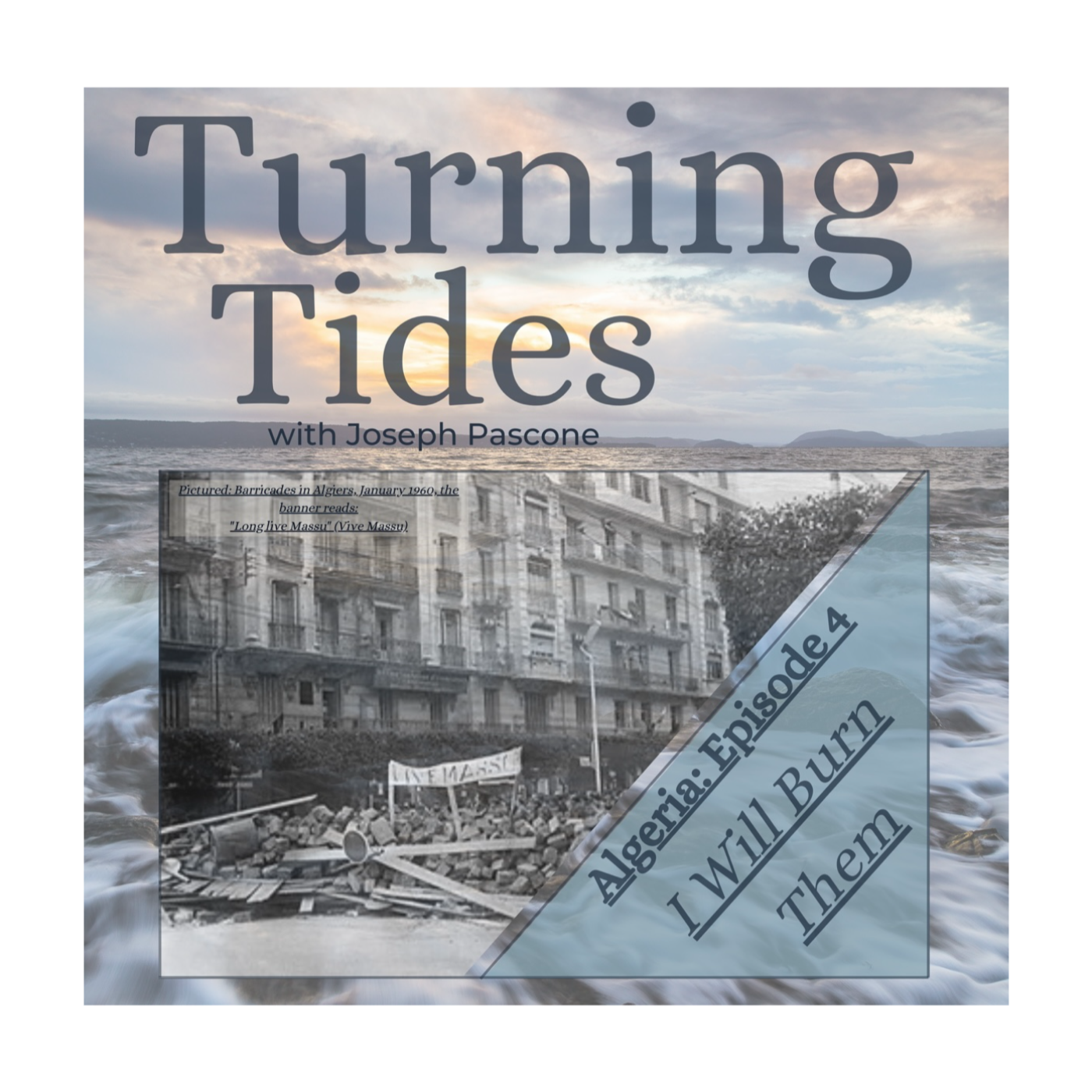
!WARNING! ***TORTURE, WAR, MURDER, ASSAULT, SEXUAL ASSAULT, CHILD ABUSE, RACISM, GENOCIDE, VIOLENCE*** “I will burn them as they burned me. I will not burn a child, however, because the children haven’t done anything wrong. Those who burned me, however, I will make suffer, and I will kill them. And I will not ever forget those who burned me; even if they come and ask my pardon, I won’t pardon them.” - Ten-year-old F.L.N. fighter, Mustapha Tébessa, on the French soldiers who killed his parents and then tortured him when he was seven Before we start today’s episode, I need to offer a correction for something I said in the last episode. I mentioned that Raoul Salan was brought in to crack down on violence in Algiers and end the general strike called by the F.L.N. This was incorrect. I meant to name General Jacques Massu in this instance; he led an elite paratrooper division as a part of Salan’s army. I apologize for any offense or confusion this may have caused. Thank you. De Gaulle had done it. Over the course of a month, he went from being a retiree, busy writing his memoirs, to becoming the president of the new French Republic. He had already served as Prime Minister following WWII, but he was so disillusioned with party politics that he resigned from his position and promised to never return. Due to this, he was not present when the war in Indochina came to its disastrous conclusion, nor was he held responsible for the outbreak of the Algerian War. He was heralded throughout his Tom Brady-esque retirement as the only Frenchman who could get the country on the “right track.” Detested by both the far-left and the far-right, de Gaulle is viewed as a hero in centrist circles. He was, at his core, a master manipulator. The catalyst for the return of de Gaulle occurred in early May of 1958. The F.L.N. had announced that three French soldiers in their captivity would be executed on the charges of torture, rape, and murder. It has been argued that these soldiers were chosen at random, but as we have discussed, these atrocities were committed by the French military at large as a part of their strategy of “collective punishment.” This execution doubled as retribution for three Algerian soldiers who had been executed by the French earlier. The executions of the French soldiers enraged the French military, and they began plotting. Conspiracies which had previously only been whispered were now out in the open. These conspiracies would nearly throw France into a civil war. On May 13th, plans were put in motion to place de Gaulle back in charge of France. He had many ardent admirers from both the center-left and center-right; socialists – as well as social conservatives – called themselves “gaullists.” The former Governor-General of Algeria, Jacques Soustelle, was one of his biggest supporters. Additionally, there were French Army personnel involved in this vast conspiracy. Colonel Jean Thomazo, who led the infamous pied noir militia, took part, in addition to paratroop leaders, like Pierre Lagaillarde. Pierre was most interested in gaining power for himself and the French army. De Gaulle spent his time away from politics writing his memoirs and spending time with his family. He spent a great deal of time speaking to his daughter, who was non-verbal. She died of Bronchitis in 1948, at just twenty-years-old. Her loss devastated de Gaulle, who forsook public life altogether and focused on his writings. Right before the Algerian War began, the first volume of de Gaulle’s memoirs were released, and it was an immediate international bestseller. He gave all the proceeds, about 600 million francs, to foundations which supported people with Downs Syndrome, in honor of his daughter who had been diagnosed with Downs Syndrome. By 1958, de Gaulle was openly speculating about a return to power, as he considered the current carousel of French governments to be feckless and incapable of protecting French interests at home or abroad. However, de Gaulle was fickle. He insisted that he did not wish to be at the mercy of a single faction or political party, and he definitely did not want to come back into power as the result of a military coup. De Gaulle wanted to be justly appointed to the system he would then tear down in favor of a more assertive French executive branch. He believed Algeria was a mere sideshow to the greater issues facing the nation. He wanted a just peace in Algeria, but one which would “hand power over gradually to the Algerian people,” when he believed they, “proved themselves capable of self-government.” Following the execution of the three French soldiers, Algiers became a hotbed for pied noir protests against the Metropolis, as well as any ceasefire which involved French abandonment of, “French Algeria.” On May 13th, protesters were out in full force; Lagalliarde seized the moment and called on the crowd to occupy the Governor General’s headquarters. Robert Lacoste, the acting Governor General, had already vacated his post and left in the dead of night, never to return. Both France and Algeria were left without French leadership, as France was also searching for a new Prime Minister. Upon their arrival at the Governor General’s Headquarters, the mob demanded the installation of a, “Committee of Public Safety.” The few bureaucrats on-hand telephoned the mainland for instructions; they were only told to not open fire on the protesters. With no means of resistance, the headquarters capitulated and was seized by the pied noir, who began to ransack the building. Generals Massu and Salan were forced to accept the committee; Salan soon proved himself to be an adept politician, consolidating power for himself quickly. The news of the insurrection and seizure of government property deeply disturbed the ruling powers in Paris. They began assessing their capacity for resistance, should the French army which was stationed in Algeria attempt to force the mainland to heel. Numerous French politicians were pleading with de Gaulle to return to power and “right the ship” once more. On May 15th, he told the nation he was prepared to “...assume the powers of the Republic,” should the need arise. In Algiers, celebrations were held by the pied noir community, and additions were made to the Committee of Public Safety. One of these new additions was Soutelle, who received broad support from the pied noir population. During one such street demonstration held on May 16th, upwards of 30,000 Algerians joined their pied noir neighbors in celebration. It has been alleged that these demonstrations were rigged by the French Army, but the fact that so many Algerians attended points to either a genuine interest on the part of Algerians, who saw de Gaulle as someone who could end the war which had been violently fought for years, or a fawn response in anticipation of a new – and possibly more deadly and conniving – power. Throughout these crucial days, de Gaulle was in negotiations with various government officials to take over Algeria. These negotiations proceeded slowly, and there was talk amongst the pied noir ultras that a military coup would forcibly install de Gaulle if negotiations continued to drag out. “Operation Résurrection” was a plan in which army units loyal to Massu and Salan would effect a paratrooper landing in Paris and seize the major buildings associated with the French government. The Communist Party Headquarters and the headquarters of the major trade unions were primary targets. On May 24th, the French army of Algeria invaded and occupied the island of Corsica. When asked if there were casualties, a French officer responded, “Of course not! It was a revolution, not an election.” The government in Paris attempted to salvage the situation and prepared to defend the mainland. The Communist Party had thrown their support behind the preservation of the republic and promised 10,000 militants at a moment’s notice. For a brief moment, France was on the brink of a full-blown civil war, with the conservative pied noir and a majority of the French army on one side and the far-left and the powers that be on the other. Although many parallels can be drawn between the situation in France and Algeria and the beginnings of the Spanish Civil War, France had de Gaulle. He was able to moderate emotions on the right and prevent a true right-wing coup. Instead, de Gaulle captured the initiative, and on May 27th, he announced that he would begin setting up a legitimate government with the intention of upending the French political system which had existed for decades. The communists were isolated in their protests against de Gaulle, even being abandoned by the socialist party, which had previously stood by them for decades. In spite of broad support, de Gaulle only ascended to his new post as Prime Minister (soon-to-be President) of France with a parliamentary vote of just 329 in favor, and 224 against. Two days after being sworn in as Prime Minister, he was in Algiers on the balcony of the Governor General’s Headquarters. The crowd below was filled with many of the pied noir who felt responsible for his ascension. They were joined by many Algerians, who cheered for “French Algeria.” For several minutes, de Gaulle could not make himself heard over the clamor. Finally he shouted, “I understand you,” and the crowd erupted in jubilant applause. Supposedly, a sniper was about to kill de Gaulle, but upon hearing those words, he broke down crying and instead listened intently to the speech. De Gaulle had won over the pied noir community, even claiming that France and Algeria would remain as one forever. In reality, de Gaulle promoted a policy of reconciliation for F.L.N. rebels and wanted a swift end to the war, while still promoting French interests. De Gaulle’s main focuses were crafting the new French constitution and ruling by decree. He tried to fix France’s monetary system, modernize France’s military, and return France to international relevance with an independent foreign policy. His new constitution was overwhelmingly approved by the French people via referendum; the only real opposition were the communists, whom de Gaulle claimed worked alongside the F.L.N. Returning to Algeria in early October, de Gaulle continued his campaign of reconciliation with the F.L.N.; he released thousands of Algerian prisoners of war and called on the F.L.N. to sign the, “Peace of the Brave.” He continued, “wherever they [the F.L.N.] are organized for combat, their leaders need only enter into contact with the French command. The old warrior’s procedure, long used when one wanted to silence the guns, was to wave the white flag of truce. And I answer that, in this case, the combatants would be received and treated honorably.” The F.L.N. saw these “olive branches” for what they were – tactics used to keep Algeria under European control. The revolutionary leadership maintained their position: any attempt to negotiate with the colonizers would be folly and could only serve to keep Algeria under French control forever. The F.L.N.’s goal was national independence first, peace negotiations after. Undoubtedly, de Gaulle changed the playing field, but the game remained the same. This rebuff to de Gaulle’s “generous offer” shocked the Prime Minister; it was his first of many failures to get the Algerian revolutionaries to consider “compromise.” He never stopped to consider that the French were to Algeria, what the Nazis were to the French. Next, de Gaulle shook up the military leadership in Algeria, replacing General Salan, as well as the absentee Governor General, with two hand-picked replacements. Finally, de Gaulle’s constitutional referendum victory was followed up by a victory at the polls; many anti-Gaullist members of the communist opposition were voted out of parliament. In early January of 1959, Charles de Gaulle became the first President of the Fifth French Republic. This whole time, the war in Algeria did not stop and acts of political violence continued to be perpetrated everyday. However, the year of 1958 was definitely a low point for the revolution. The F.L.N. attempted to maintain a bold front and countered the appointment of de Gaulle with the creation of the Provisional Government of the Republic of Algeria, or the GPRA. Many countries immediately recognized the new government as the legitimate government of Algeria; amongst the first was Maoist China. They were soon followed by many Arab nations. The creation of the GPRA was able to halt some of the French momentum, and it reinvigorated the Algerian cause on the world's stage. Militarily, the F.L.N. began an insurgency on the French mainland, which harbored hundreds of thousands of disillusioned and isolated Algerians. It is calculated that between August 24th and September 28th of 1958, eighty-two people were killed and one hundred and sixty-eight were wounded on the French Mainland. The French police responded with a brutal crackdown against migrant Algerians. Many hundreds – and perhaps thousands – of migrant Algerians disappeared after being picked up by the police. Inside Algeria, the situation was incredibly dire. Only around 15,000 Mujahadeen and 30,000 irregulars fought and died in nameless battlefields against the overwhelming might of the American-backed French military. Tens of thousands were supposedly killed by the French in the first half of 1958, but the F.L.N. continued to grow despite this. By 1959, Algerian officials claimed they had 100,000 men, including those training in Tunisia and elsewhere. Ever since Abane was executed by the F.L.N. in 1957, the movement had lacked a general direction, save for armed struggle at all costs. In late 1958, the movement gained a new strongman in Houari Boumedienne. Born Mohammed Ben Brahim Boukharouba, Boumedienne had trained in combat in either Egypt or Iraq. He rapidly ascended the ranks of the revolution, as he had a great talent for administration. In no time at all, he found himself amongst the revolution's leaders. He proved his decisiveness and his ruthlessness when he executed four F.L.N. colonels who were attempting to usurp the leadership of the GPRA. Following their deaths, Boumedienne declared an end to the fruitless and costly penetrations of the Morice Line. The Morice Line was a defensive perimeter, thousands of miles long, which covered a good portion of the border between Tunisia and Algeria. This change in tactics deceived the French authorities, who believed they were smothering the revolution; in reality, it was only growing more powerful. As 1959 began, French authorities hoped that replacing General Salan with Maurice Challe would end the war. Challe began what is remembered as the, “Challe Plan,” a military initiative whose main objective was the destruction of the handful of F.L.N. guerrillas still operating in the country. Alistair Horne explains, “Challe adopted as his guiding principle the slogan ‘Neither the djebel [hills] nor the night must be left to the F.L.N.’ Once hit, a rebel unit must be hit again, and remain hit… Life must be made enduringly unendurable for the moudjahiddine.” A Harki unit, composed of Algerians loyal to France, would begin the chase against F.L.N. revolutionaries. Following close behind, the Commandos de Chasse, or “Hunter Commandos,” would pin down the F.L.N.; if all was successful, the militants would be wiped out. It was a strategy which required a large number of reserves. These reserves, in spite of the hundreds of thousands stationed in Algeria, were not available. In total, France had around 15,000 men ready for offensive operations; the other 400,000+ were deployed across the country in various roles. In order to make Challe’s Plan work as intended, France would have likely needed over one million men. As it stood, France had to accept the reality that a handful of rebels would always operate within Algeria. This did not mean that the Challe Plan was unproductive. In fact, the first few months were very successful. Southeast of Oran, Challe’s lightning offensive killed thousands of F.L.N. militants, as well as capturing another four hundred and sixty. In late July, Challe began, “Operation Binoculars,” designed to smother the rebellion in the Kabylia region. Following his devastating invasion of the region, the F.L.N. forces in the area nearly disintegrated. Over 3,700 were killed, wounded, or captured during the operation. In retrospect, Alistair Horne says Operation Binoculars, “represented the peak not only of the Challe Plan but of all French military efforts in Algeria.” Challe’s Plan was so successful that many began speculating that the rebellion had been snuffed out in Algeria. Thousands of Kabyles were sent to open-air prisons – or more accurately, concentration camps – in which the people routinely starved and died of disease. De Gaulle addressed the nation on September 16th, 1959. He spoke primarily about Algeria and about the need for the Algerian people to choose their own way. He said, “we can now look forward to the day when the men and women who live in Algeria will be in a position to decide on their destiny, once and for all, freely, in the full knowledge of what is at stake. Taking into account all these factors… I deem it necessary that recourse to self-determination be here and now proclaimed.” De Gaulle went on to speak directly to the Algerian people, saying they had three choices before them. The first: complete secession from France. The second: integration within the French nation, including full citizenship and voting rights. The last choice was association, similar to Canada’s relationship with the United Kingdom. De Gaulle concluded his speech with a threat toward the F.L.N. leadership, asserting he would never “[discuss] the fate of Algeria,” with people he deemed to be, “ambitious agitators.” De Gaulle’s speech was a watershed moment for the Algerian War. Far from uniting the country, de Gaulle’s self-determination speech sent ripples and shockwaves across the political spectrum. The pied noir community was especially shocked that the Prime Minister who “understood them” would end up being the President who promised self-determination to Native Algerians. The F.L.N. saw that their strategy of resistance was beginning to bear fruit; Belkacem Krim said, “Your struggle has obliged the enemy to talk of self-determination, thus renouncing the oft-repeated myth of Algérie française. His retreat is the fruit of your effort.” The transition from 1959 into 1960 was one of the most tumultuous periods in French and Algerian history, as they would decide the fate of “French Algeria,” once and for all. It began with the fallout from de Gaulle’s “self determination” speech. The ultras of the far-right formed The Front National Français, or the FNF, under their leader, Jo Ortiz, a Spaniard and a local business owner. The FNF was an unabashedly pseudo-fascist organization which wanted to maintain French control of Algeria by any means necessary. Meanwhile, the F.L.N. began a new round of bombings and terrorist attacks. They chose this strategy in order to antagonize the French public. The F.N.F. responded with their own attacks and bombings. The brief moments of solidarity between the pied noir and Muslim Algerians were done. The F.N.F. was now plotting a major insurrection in Algiers; they just needed an excuse to start their own “revolution.” The excuse came in the form of a sensational interview with General Massu, which was published in the German newspaper, Süddetsche Zeitung. In the interview, Massu, who was an ardent Gaullist, expressed his displeasure with the President. Massu claims that de Gaulle had betrayed the army and that the President was now, “a man of the Left.” Besides this completely erroneous statement, Massu claimed the majority of French officers were ready to disobey orders. The fallout was swift; Massu, who was spared de Gaulle’s previous army purge, was now re-stationed to the city of Metz on the French mainland, never to return to Algeria. In Algeria, Ortiz and the ultras used Massu’s removal to launch their own coup, with the hope of the French mainland caving once more to pied noir threats. This time, the government in Paris was more organized, and the pied noir ultras were more disjointed. This time, blood would flow in the streets of Algiers. Ortiz rapidly prepared a demonstration, which he planned to turn into an insurrection. Before he could act, Lagaillarde made the first move; he occupied a building around Algiers University, alongside his men. He promised he would fire on anyone who came within thirty yards of his position, including Ortiz. There were now two pied noir rebel factions, one which was highly disciplined and organized… and one which was not. Ortiz and his militia occupied a building belonging to the Compangie Algérienne. Meanwhile, Challe called upon the local gendarme units to blockade any egress in or out of the city. Around 2,000 gendarmes were then concentrated for a dispersal operation; they would dispel Ortiz and his men from their barricades without firing a shot. The success of the operation hinged on perfect timing, as well as the assistance of a local paratrooper unit. The only problem is that this unit held divided loyalties; many of the officers and soldiers were sympathetic to the would-be insurgents. Due to this, they would make themselves scarce for the operation. On the morning of January 24th, 1960, the gendarme units all prepared to storm the barricades and then force the crowd into the city of Bab-el-Oued. Explicit instructions were given that the mob was not to be fired upon. This order was followed to the letter; officers went soldier-to-soldier and made sure no rifle had ammunition in it. As the gendarme moved forward, the paras's absence was apparent. The militia stationed at the barricades anxiously awaited the assault. Several pistol shots, fired by an unknown man, broke the quiet anxiety. The F.N.F. militia then opened up a murderous fire on the unprepared gendarmes. The gendarmes made a hurried retreat before firing back, as they had to load their weapons. Frenchmen were now killing one another in the streets of Algiers. In total, the insurgents suffered six dead and twenty-four wounded. The gendarme lost fourteen killed and one hundred and twenty-three wounded. When confronted, the para unit’s leader made half-assed excuses as to why his unit was not on-hand. He claimed he was held up by Lagaillarde’s barricade, but a tunnel existed which ran underneath this obstacle. In reality, the paratroopers likely chose to abstain. Following the “fusilade” on January 24th, “Barricades Week” began. The F.N.F., their militia allies, and the pied noir community were hopeful that soon, de Gaulle would be forced to step down – or at least end any talk of, “self-determination for Algerians.” The pied noir were not prepared for just how obstinate de Gaulle could be. Once he decided something, there was no changing his mind. De Gaulle considered any amount of compromise, especially with an armed mob, to be the ultimate sign of weakness. He refused to step down, and he refused to negotiate; instead, he demanded the mob return home, or suffer. For an entire week, the barricades remained occupied by the far-right and their supporters. The stalemate was broken by de Gaulle. He did not storm the barricades with soldiers, nor bomb them from the sky. Instead, he delivered a speech for the ages. He reiterated the need for the Algerian people to freely choose their future for themselves, but he still hoped they would choose to be friendly with France. He then called on the army to remember their duty and remember their orders. He demanded an end to factionalism inside the armed forces and a return to normalcy within the chain of command. He then turned to the people of France, saying that if he submitted to the mob’s demands, then France, “would become but a poor, broken toy, adrift on the sea of hazard.” This speech, combined with the incredibly dreary weather in Algiers, broke the will of those at the barricades. On February 1st, both pied noir rebel factions surrendered; Ortiz fled to Francoist Spain, while Lagaillarde was placed in French custody… but not before marching out of his position with full military honors. For the first time in French history, Paris had out-willed Algiers. The ultras were forced to concede; their militias were disbanded, and their leaders were in jail or in Spain. Native Algerians watched this happen but did not actively participate. The F.L.N. viewed the barricades fiasco as proof that French nerves were fraying and that French loyalties were shifting. The F.L.N. was now in the driver’s seat despite the continued success of Challe’s offensives. The French failed to realize that in guerrilla war, the key objective was not to win battles or kill more combatants; it was to outlast your opponent. Whereas the new leaders of the F.L.N. were seen as decisive, careful manipulators, de Gaulle was increasingly being seen as an ambiguous figure, who said a variety of things when it suited him but consistently refused to give a straight answer on his true intentions or motives. From 1960 to 1962, French politicians who wanted an end to the war were frustrated with de Gaulle’s indecisiveness and refusal to be forthcoming about his intent. The same man who spoke of Algerian self-determination was also speculating that France could remain in Algeria forever. He called independence for Algeria a “monstrosity;” at one point, during the stalled peace negotiations, he threatened to turn Algeria into two separate states – an “Arab” interior and a European coastal nation. This “solution” would’ve undoubtedly ended in continuous bloodshed. In reality, de Gaulle was hedging his bets; he was hoping to get something out of an Algerian peace, which he knew would likely end in Algeria's total independence. In May of 1960, de Gaulle was confronted by social strife on the home-front – farmers were protesting against his agricultural policies, and 1.3 million civil servants went on strike for higher wages. The leadership of the F.L.N. and the Algerian Provisional Government were also facing backlash. Hardliners were seeking to oust Belkacem Krim from his position as Minister of War and replace the singular position with a committee of generals. Krim was livid, but the subdued puppet-master, Boumeddienne, had the support he needed to change the GPRA’s constitution. Although he was not formally a part of the new government, everyone knew it was Boumeddienne who now ran the Algerian nation from the shadows. On the battlefield, the F.L.N. could only muster up 8,000 fighters, and they were dying at an unprecedented rate. Starvation and French bullets ravaged them. The leader of Wilaya 4, Si Salah, sought an end to the fighting in his sector. He was attempting to negotiate de Gaulle’s, “Peace of the Brave.” His resolve to fight for Algeria had not waned, but he could not abide by the way the “exterior” refused to supply – or care about – their men dying in the field. The French believed they had stumbled upon a truly decisive moment in the war. With Si Salah’s capitulation and cooperation, the French believed they could secure victory, presented as a “compromise.” In reality, Si Salah’s attempts at negotiation had more to do with his animosity towards the revolution’s new leaders in Tunisia. De Gaulle was convinced enough that a diplomatic breakthrough had been achieved that he flew to Algeria and met secretly with Si Salah; he tried to convince Si Salah to reach out to the neighboring rebel sectors in order to begin ceasefire negotiations. The GPRA used the ongoing negotiations to their advantage; they publicly announced that de Gaulle had reached out to one of their leaders in hopes of seeking peace. This deeply upset the French military, who were under the impression that there were no peace negotiations. Si Salah was subsequently ordered by the GPRA to stand trial in Tunisia, but he was killed on the way there in an ambush by French patrols. The Si Salah incident was the last time that a ceasefire which would benefit France could have been achieved. In June of 1960, the F.L.N. was officially invited to France to negotiate peace. During these first rounds of talks, both sides remained obstinate; the French demanded a ceasefire first, then they would discuss, “Algerian self-determination.” The F.L.N.’s representatives remained stalwart in demanding national independence first, before any peace could be negotiated. It was clear nothing would be achieved here, save for the press victory scored by the F.L.N.; now, the organization could claim they were the legitimate governing body of Algeria – even in the eyes of their enemies. The F.L.N. continued their campaign against French colonizers and their culture. French schools were replaced by makeshift Algerian schools. These schools attempted to teach children about imperialism and the revolution necessary to overcome colonization. Algerian children scarcely needed lessons in these subjects, when their horrific experiences with the French already allowed them to see the depravity of imperialism first-hand. Diplomatically, the F.L.N. attempted to bridge the gap between east and west; although, their main allies were socialist nations – like Tito’s Yugoslavia and Maoist China. The USSR was ambivalent toward the Algerian revolution. They attempted to align themselves with France, as de Gaulle had expressed interest in leaving the North Atlantic Treaty Organization. It is incorrect to call the F.L.N. a communist organization; it was a national liberation movement first and foremost. Yes, communists were a part of the F.L.N., but upon admittance, they forswore all other allegiances and fought strictly for Algeria first. In reality, the F.L.N. preached a decentralized socialism, which also put Islamic teachings at the foundation for their new state; eventually, Algeria would become a state capitalist country. 1960 was the first year in which serious anti-war protests were held throughout France. Young people forced into the army via conscription returned with horror stories from Algeria. Some Frenchmen, like Francis Jenson, believed it was their Christian duty to aid the F.L.N. and French soldiers who had deserted. As the mainland began to adopt an anti-war mindset, the pied noir doubled down on the need to maintain French control in Algeria. This was especially true in the army. Officers began openly defecting from their units and plotting assassinations and coups. When de Gaulle came to visit Algeria in early December of 1960, there were numerous plots to assassinate him afoot. One plot involved a pied noir uprising, which would give sympathetic French army units a pretense to arrest de Gaulle and hold him hostage until he agreed to their demands. During de Gaulle’s visit, he was shunned by the pied noir community but hailed as a hero by the native Algerians. In Orléansville, de Gaulle narrowly escaped being assassinated by a carefully laid pied noir ambush. The triggermen for this operation would go on to found the infamous O.A.S., a shadowy paramilitary organization that bombed and killed influential Frenchmen and Algerians who were supportive of the Algerian national movement. In Algiers and Oran, the pied noir population began riots and started gunfights with the gendarmes. For two days, the pied noir ultras exploded bombs and caused general chaos in both Oran and Algiers. In Algiers, pied noir protesters attempted to force their Algerian neighbors to join the protest, resulting in the death of several Europeans. The next day, December 11th, 1960, was one of the most momentous in Algerian history. Contrary to popular opinion, the F.L.N. had not been defeated in Algiers; their leaders were arrested or killed, but the foundations of their organization remained intact. It continued to operate in the shadows from 1957 through 1960. They had been planning for December 11th for a long time. They enlisted the help of local seamstresses to stitch together thousands of Algerian flags; they distributed them to the population, alongside placards and banners displaying pro-independence messaging. The European community was utterly astonished on the morning of December 11th. They saw thousands of placards, banners, and flags held by the Algerians amongst them. They heard their cries of, “Long live the F.L.N., long live de Gaulle!” and their earnest yearning for their country to be returned to them. As the peaceful marchers laughed and sang in the streets, pied noir snipers began shooting into the crowds. This begot violence against the pied noir community. One man had his throat slit. Another was burned to death in his car. European businesses and homes were sacked. The pied noir militias who started this violence and had been fighting for MONTHS now begged for protection from the “Muslim terror!” Paratroopers were dispatched with simple orders; kill anyone on the streets, regardless of race. Of course, this meant Algerians peacefully protesting were overwhelmingly targeted by French security forces. Over the course of the protest, over one hundred and twenty people died, and another five hundred were wounded. Only eight of this number were Europeans; the rest were Algerians, brutally killed while peacefully protesting on their land. To say this senseless massacre made France look bad in the eyes of the world is an understatement. Upon his return to France, de Gaulle pushed forward with a second referendum, directed toward Algeria specifically. He asked the populace, “Do you approve the Bill submitted to the French people by the President of the Republic concerning the self-determination of the Algerian population and the organization of the public powers in Algeria prior to self-determination?” It was basically a vote of confidence for de Gaulle. 75% of those who voted chose, “oui,” and endorsed Algerian self-determination. The GPRA ordered Algerians faithful to the cause to abstain from voting, as they saw any sign of approval of France as a compromise with the colonizer. As a result, around 40% of people abstained from the referendum. In early January, 1961 an outspoken liberal lawyer was stabbed to death in the streets of Algiers by two former-French soldiers. The two assailants were a part of a larger terrorist group known as the Organisation Armée Secrète, or O.A.S. Mostly composed of right-wing insurgents and former-soldiers, they believed they could make Algeria French again if they killed enough liberals and socialists. Their murder of an influential liberal would not be the last or most heinous of their crimes. For the next two years, the O.A.S. would compete with the F.L.N. in targeting French officials. The O.A.S. – and their campaign of bombings and assassinations – came at a time when French “offensive operations” had come to a halt. This lack of killing was meant to “foster goodwill” between the F.L.N. and the French, who were in the middle of peace negotiations in Evian, Switzerland. As French diplomats negotiated in the Alps, French generals plotted in Algiers. At the forefront of the newest conspiracy was Challe, who had recently been replaced and had grown deeply bitter at being relegated. Alongside him was Salan, who would return to Algeria one day into the plot. Additionally, some French historians believe the CIA was deeply involved in the so-called “General’s Putsch.” On April 20th, 1961, the Putsch began. The main administrative buildings in Algiers were seized by French units loyal to the conspirators. Challe announced on Radio France, “I am in Algiers… in order to keep our solemn promise, the promise of the army to hold Algeria, so that our dead shall not have died for nothing.” Challe and his conspirators simply expected their fellow officers to throw their support behind the putsch. Unfortunately for them, most French officers stationed in Algeria were against the uprising from the beginning. Save for military personnel in the city of Algiers and its environs, few French officers joined alongside Challe. The next day, Salan arrived from Spain. He was seen off by his friend, who also happened to be Franco’s brother-in-law, Serrano Suñer. Suñer told Salan that the generals in charge of the Algerian putsch had no spine and that if Franco was in charge, he would have shot the recalcitrant. News of the General’s Putsch was met with a frustrated sigh from de Gaulle, who dispatched an underling to handle the problem. When asked what would happen in the coming days, he said, “Oh, it’s not difficult to guess: these are men of narrow vision; they will very soon be faced with problems that will be beyond them…” There were plans to move on Paris; thousands of paras were hiding in the nearby woods, awaiting their signal; however, the mainland coup was foiled by the fast-acting minister of the interior, who arrested the lead conspirators. A state of emergency was declared; this enabled authorities to hold suspects for up to fifteen days without formal charges being levied against them. On April 23rd, de Gaulle addressed France and the conspirators directly. He called the leaders of the putsch, “a group of ‘small people,’” and accused them of debasing the honor of France in the eyes of the rest of the world. He called on the loyal members of the military to forswear any allegiance with the plotters and demanded that their orders be disobeyed. The next day, the major trade unions and left-leaning political groups in France got together to call a day-long general strike in support of de Gaulle. The communists – who at one time denounced de Gaulle as a fascist – were now prepared to rally 15,000 of their militants to defend de Gaulle’s government. Meanwhile, in Algeria, everyday soldiers were disobeying the orders of their mutinous officers. In several instances, conscripts who had been inspired by de Gaulle’s speech seized supply depots and even attempted to kill their rebellious officers. The next day, the General’s Putsch was over. Challe submitted to de Gaulle’s authority and was prepared to accept the charges against him, which likely carried the death sentence. Besides the generals who were punished, an entire unit of paratroopers was disbanded; they responded by setting off dynamite in their own base. These troops were merely the tip of the iceberg; perhaps 14,000 soldiers and several hundred officers were a part of the putsch. Many suffered loss of rank, but considering what could have happened to them, their punishments were incredibly light. In general, French officials tried to move on as quickly as possible from an embarrassing situation. The first rounds of peace negotiations between the GPRA and France were turbulent, to say the least. French diplomats still refused to fully recognize the right of the GPRA to be the sole negotiators for the Algerian nation. The French also continued to ask for a ceasefire first. In response, the GPRA broke off peace negotiations entirely. The same day, pied noir ultra assassins murdered the Mayor of Evian because his town hosted the talks. Internationally, France was losing allies everywhere because of the Algerian War. The USSR had promised Algerian diplomats recognition, and the Algerian cause received sustained support from both Yugoslavia and the PRC. France had also sufficiently alienated Tunisia. In 1961, Tunisian officials demanded the French withdraw from the naval base in Bizerta, which they still occupied. When French authorities neglected to respond to this ultimatum, Tunisian army units launched a prolonged assault against the naval base. Following the battle, dozens of French military personnel were dead, alongside thousands of Tunisians, military and civilians alike. Many countries who were part of the United Nations condemned France for the carnage in Bizerta. Turkey, Norway, and Denmark were now siding with the nations of the Global South. The F.L.N. sensed the momentum was now on the side of the Algerian national movement. They doubled down on their hardline stances, insisting the colonizers were the ones who would (and should) capitulate first. At the same time, pied noir ultras belonging to the O.A.S. began an indiscriminate bombing campaign in both Algeria and mainland France. One bombing severely scarred the face of a French girl. In response, tens of thousands marched in the street against the O.A.S., requesting peace in Algeria. The demonstration was rowdy, and there were skirmishes between protesters and police. When Paris police charged, many protesters sought the protection of the underground metro, only to find the gates barred. Paris police then began a brutal massacre of the crowds of people trapped on the stairwell below. Alistair Horne asserts that police hurled iron tree-guards and rolled marble table-tops onto the heads of the protesters. In total, nine were killed, and hundreds more were hurt. Their funeral procession was attended by 500,000 angry Parisians. All this killing came at a time when the two sides were attempting to negotiate a peace which would allow a sovereign and free Algerian nation to exist. De Gaulle’s main concern was whether France would maintain possession of the Saharan oil fields. De Gaulle and French diplomats argued that the Sahara was not truly a part of Algeria. Algerian diplomats argued it made no sense for France to expect the Sahara or any resources that lay therein. Fed up, de Gaulle dropped his claims on the Sahara and pushed for an end to the war at all costs, lest another coup or military uprising occur. Meeting in Evian for a second round of talks, F.L.N. leaders and French officials got to work on a peace which would be acceptable for all. On March 19th, after nearly a decade of war, an agreement which resembled peace was made between the representatives of the new Algerian Republic and the French Republic; this peace was known as the Evian Agreements. The Algerian nation was recognized with full sovereignty. The French citizens of this new nation could retain their citizenship for upwards of three years, and then they could choose to become Algerians or remain French. If they chose this latter option, they would be considered foreigners in Algeria. The pied noir community was granted further concessions, including the promise to respect private property and to fairly compensate those dispossessed. Finally, they were assured freedom of speech, worship, and association. These were all things which had never been granted to Algerians under French rule, but the Algerian people did not want revenge; they wanted freedom. Militarily, the Agreements gave the French military a 12-month-long window to fully withdraw from the country. Economically, the franc was still utilized in Algeria, and Algerian migrant workers were welcome to remain in France. The F.L.N. hailed the agreements as the fulfillment of years of struggle and congratulated the Algerian people on their victory against colonization. In France, people were more relieved than joyful that their national nightmare was over. Some on the left criticized the Agreements and their mass clemency clauses, as they felt French torturers should have been punished. In the pied noir communities of Algeria, the Agreements were met with stunned disbelief. The O.A.S. reacted violently and began attacking random Algerians in the street; next, they called for a general strike against the peace. They ordered all European businesses to bar Muslim employees; small business owners agreed because they were afraid of the O.A.S. Apartheid reigned, and Algerians demanded revenge against the killers. For the first time, French and F.L.N. soldiers worked together to maintain peace and prevent a full-blown war. At Bab-el-oued, French military units fought against the pied noir community, resulting in the deaths of dozens and the arrests of thousands. At Rue d’Isly, forty-six pied noir were killed by French military units who had come under fire from unknown snipers. Stuck in the middle of this no-man’s-land was the Jewish population of Algeria. They were targeted by militants on both sides. The O.A.S. was soon decimated; its leaders were thrown in prison, but this did not stop the cascade of violence for which they had provided the catalyst. Terrorist attacks by pied noir ultras rocked Algeria, as the country desperately attempted to transition to an independent state. On April 20th, twenty Algerians were killed in Algiers. On May 2nd, over sixty Algerians were killed when a bomb exploded at the port in the same city. The week ended with seven elderly Algerian women, who happened to work for Europeans, being gunned down in the street. The F.L.N. responded to this week of depravity by targeting known O.A.S. hangouts. In the fallout, seventeen Europeans were killed. In turn, the O.A.S. killed twenty-seven Algerians. On June 17th, 1962, the O.A.S. and the F.L.N. agreed to a ceasefire. Finally, the Algerian War was truly over. Following the ceasefire, a mass exodus of the pied noir began. In June alone, 315,000 people had left their homes in Algeria and moved – mainly back to France. Cars and furniture were abandoned or burned in the street; the pied noir argued, “it was better than it falling into the hands of Algerians.” Alongside the pied noir community were around 100,000 Jewish people who chose mainland France or Israel, as opposed to the new state. Some O.A.S. members and far-right militants still wanted the “Palestinisation” of Algeria, in which Europeans would be granted the profitable coast, while the natives were relegated to the interior, but their hopes and dreams were rightfully dashed. The Algerian people had won their nation back, and most Europeans left. Some left for Canada, Argentina, and Spain, but the vast majority went to France, where they helped reinvigorate the French economy. There would be only one instance of violence between Algerians and Europeans before the official inception of the Algerian Republic. It took place in Oran; Europeans opened fire on a column of F.L.N. fighters, who responded by launching an attack against the remnants of the European quarter. On July 4th, 1962, the French flag was lowered, after one hundred and thirty-two years of occupation; in its place, the white, green, and red flag of Algeria was raised. In total, as many as one million Algerians died as a result of the Algerian War. Ben Bella and his fellow revolutionaries were finally freed from prison, and he assumed the title of the first President of the Algerian Republic. He would soon be replaced by Boumeddienne, whose machinations finally came to fruition in 1976. He would only serve two years before dying of a rare blood disease. We can learn so much from the Algerian people’s struggle for national independence. Against every conceivable foe, the revolutionaries of the F.L.N. proved that a determined group of people could overcome any challenge, as long as they maintain their principles, aid their brothers-in-arms, as well as civilians, and refuse to compromise with their oppressors. In spite of all the factionalism and infighting which affected the F.L.N., the revolutionaries never lost track of their main objective: Algerian liberation and self-determination. Beyond this, the Algerian strategy of seeking allies in the international arena proved to be incredibly successful and would inform future revolutionary movements. On the French side, de Gaulle had achieved his dream of peace in Algeria, and although he could not keep the Saharan oil, he managed to maintain his position as president and led France into a better economic situation. Algeria, the world’s tenth largest country, finds itself in an interesting place in the modern world. For decades since the revolution, the country has suffered through growing pains, which can only be expected when their nation was ravaged by genocide, colonialism, and neocolonialism. They have had military confrontations with Morocco over boundary disputes, as well as a counter-insurgency campaign targeting Islamic fundamentalists. Even through all this turmoil, Algeria now ranks high in security, living conditions, and health, compared to other nations. That being said, Algeria is still criticized for lacking opposing political parties; the country existed as a one-party state until 1988, when those in charge were forced to democratize in the face of overwhelming popular protests. In summation, the War in Algeria not only provided a blueprint for the fight against imperialism, but it continues to inspire revolutionaries all over the globe. Additionally, the tens of thousands of Europeans who live and work in Algeria today attest to the fact that Algerians were never interested in creating an “ethno-state;” they simply wanted their land and freedom back. Yes, Algerian freedom fighters committed acts that would be considered atrocious in any other situation, but imperialists, colonizers, and abusers alike should note that the reaction did not even come close to matching the original action taken by the French, who believed everything they saw was theirs to control. I’ll leave the last word to Belkacem Krim; when he was confronted by French diplomats during the Evian negotiations, they pressed him on what exactly he meant by, “Algerian people.” He responded, “[it is] constituted by the indigènes who had resisted over a long time the French conquest. They are united by language, religion, customs, a common history which contains much fighting and suffering. The war… has demonstrated the force of their national conscience, but this people has had to submit, since 1830, to the fact of colonialism.” Thank you all so much for listening to this series. It’s our last scripted series for 2025. The show has grown so much in the past year, and that is thanks to you all listening and sharing it with your friends and family. We hope you’ll join us again next year, as we tackle some extremely sensitive topics surrounding religion. I’m your host, Joseph Pascone. Thank you all again, and have a great day.