
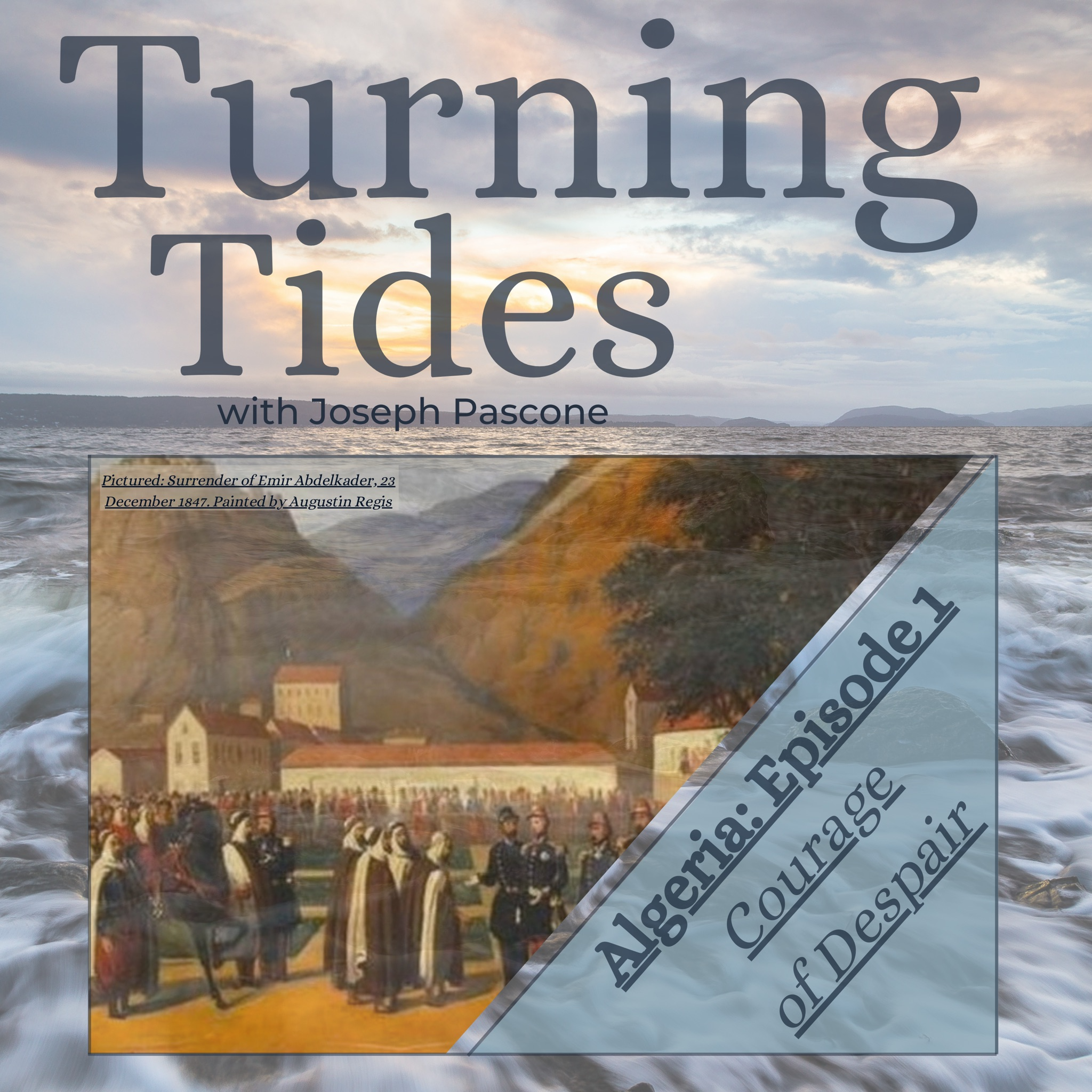
Turning Tides · Joseph Pascone
Turning Tides: Algeria will discuss the history of the colonization and subsequent battles which plagued Algeria. The first episode, Courage of Despair, will cover the period from 1830 to 1871, in which Algeria was invaded and colonized by the French -- all while managing their own internal secular struggles, as well as Emir Abd al-Qadir's stalwart defense of his people and the Islamic religion in the face of genocide. If you'd like to donate or sponsor the podcast, our PayPal is @TurningTidesPodcast1, or you can donate to us through our Buy Me a Coffee link: buymeacoffee.com/theturningtidespodcast. Thank you for your support! Produced by Melissa Marie Brown and Joseph Pascone in affiliation with AntiKs Entertainment. Researched and written by Joseph Pascone Edited and revised by Melissa Marie Brown Intro and Outro created by Melissa Marie Brown and Joseph Pascone using Motion Array Website: https://theturningtidespodcast.weebly.com/ IG/YouTube/Threads/Facebook: @theturningtidespodcast Bluesky/Mastodon: @turningtidespod Email: [email protected] IG/YouTube/Facebook/Threads/TikTok/Bluesky/Mastodon: @antiksent Email: [email protected] Episode 1 Sources: 1. French Invasion: Algerian Resistance (1830 - 1871), by S.E. Al-Djazairi 2. The Algerian War of Liberation, 1954 - 1962, Myths and Lies, by S.E. Al-Djazairi 3. A Short History of Algeria, by Lina De Marco 4. Commander of the Faithful: The Life and Times of Emir Abd el-Kader: A Story of True Jihad, by John W. Kiser 5. The History of Algeria: From Berbers to Independence, by Fatima Linda Haddad 6. A Savage War of Peace: Algeria, 1954 - 1962, by Alistair Horne 7. Wikipedia
!WARNING! ***WAR, MURDER, GENOCIDE, SEXUAL ASSAULT, TORTURE, ENSLAVEMENT, RACISM, CHILD ABUSE, SUICIDE*** “If you think God is what the different communities believe – the Muslims, Christians, Jews, Zoroastrians, polytheists, and others – He is that, but also more. If you think and believe what the prophets, saints, and angels profess – He is that, but He is still more. None of His creatures worship Him in His entirety. No one is an infidel in all the ways relating to God. No one knows all God’s facets. Each of His creatures worships and knows Him in a certain way and is ignorant of Him in others. Error does not exist in this world except in a relative manner.” - Abd al-Qadir ibn Muhyi al-Din The Sultan of Morocco was bearing down on the Emir’s west. At the same time, a French column was closing in on him from the north, as well as the east. The only way out was to the south, into the unmerciful Sahara desert. There, he hoped to join forces with a tribe which still swore allegiance to him, after which they would continue the Jihad against the Christian invaders and their collaborators. Instead of finding relief, his men found French cavalrymen blocking the way. The French had disguised themselves to conceal their identities among the locals, who usually acted as the eyes and ears of the Emir. Fortunately, the French only had a paltry force of two hundred cavalrymen. They could be swept aside easily by the highly mobile, veteran Mujahadeen, commanded by the Emir. Unfortunately, if their escape was successful, the elderly, the infirm, and the children would all be left behind. The Emir reminisced over the seventeen years of war, which had stolen pieces of his life he could never recover. Many of his family members were already captives in French custody; some had capitulated to the French willingly. As a leader and as a practicing Muslim, forcing his men to abandon their families for the sake of a resistance which would most assuredly be met with retribution from their enemies, was unconscionable. He thought back to some verses in the Quran, a book he had memorized in its entirety when he was just 12-years-old. He recalled Mohammad’s beliefs about Jihad – that one should continue the struggle up until the point when all means of resistance have been used up; only then was it possible to submit honorably to one’s foe. The Emir turned to those still faithful to him and said, “Believe me, the fight is over. We must lay down our guns. God is our witness that we have fought long and as hard as we could – so long as there was hope of liberating our country. But most of the tribes have quit the struggle. My own brothers have submitted… Now Muslims are killing Muslims. The sultan has imprisoned our brothers in arms… and sold their wives into slavery… I would rather put my trust in those whom we have fought against than those who have betrayed us. If I thought there was still a possibility to defeat France, I would continue. Further resistance will only create vain suffering. We must accept the judgement of God who has not given us victory and who in his infinite wisdom now wants his land to belong to Christians. Are we going to oppose his will?” His caliphs and soldiers all agreed, and they surrendered themselves to the French. Who was this man, who was equal parts feared and admired by his enemies? What were his core beliefs? And how did he defy the French Empire with little more than his natural ability and his religion? The man who would come to be known as the Emir was born Abd al-Qadir ibn Muhyi al-Din. His native land was known as the Regency of Algiers, and it was a subordinate – but largely autonomous – Ottoman-dominated territory. This had been the case since the 16th century when the Greek-Muslim pirates, remembered as the Barbarossa brothers, captured the city of Algiers and turned the rest of the Algerian coast into a den for pirates. Prior to this, the North African coast was no stranger to upheavals and invasions. The Romans and Carthaginians fought doggedly for this fertile territory throughout the Second and Third Punic Wars. In time, the area would become an integral part of the Roman Empire. Two Roman Emperors – Septimus Severus and Carcalla – were from the North African region. After Western Rome’s collapse, Byzantine General Belisarius captured many areas in the Maghreb, or, “the place where the sun sets.” After the Byzantine governorship fell, Arab conquerors made their way through the desert, intent on spreading the new religion of Islam to this strategically and economically important region. They met stiff resistance from the Berber people, who resisted all occupiers with a similar ferocity; however, the Berbers eventually found a natural fit within the Islamic belief system. They believed they could use the religion to counter the rebelliousness of the tribes and cement a family’s – or group of families’ – “religious right to rule” an area. While Islam spread throughout the area, Algeria was incorporated into various Caliphates. Some, like the Fatmids, were native to the region; others, like the Barbarossa brothers, were foreign. These Caliphates went head-to-head with Christian military expeditions, which were attempting to consolidate power across the Mediterranean. Each side dealt the other blows in this centuries-long struggle, but the Muslim states eventually fell behind economically, as well as technologically, due to the sheer vastness of European possessions and exploitation. Muslim seapower would eventually deteriorate during the Battle of Lepanto in 1571; the result was a North Africa which had become virtually cut off from the rest of the Ottoman Empire. To counter their lack of military power, the handful of Turkish officials stationed in the Maghreb were forced to grant autonomy to various tribes in the interior. In spite of this, many of the tribes still considered themselves loyal to the Ottomans. As the power of the Ottoman Empire began to dwindle, the power of state-sanctioned pirates, or corsairs, increased exponentially. All across North Africa, the “Barbary” pirates harassed and impounded European vessels and trafficked the least fortunate into slavery. The common myth of the pirates is that they held sway over the entire Mediterranean and left “poor, defenseless” Europeans cowering in their wake. The reality is that piracy and human trafficking were practiced by both Muslim and Christian nations. The English “Sea Dogs” are a perfect example of this, as well as the Portuguese navy, which routinely targeted and destroyed boats carrying Muslim pilgrims on their way to Hajj in Mecca. Regardless, Muslim pirates were a serious thorn in the side of European powers in their never-ending quest for domination of the world’s trade routes. Numerous military campaigns were waged to quell the corsairs. In fact, the first two foreign wars started by the United States were to defeat the “Barbary Pirates.” The Spanish and British had their share of grievances with these privateers, as well. Of course, these pirates would eventually be used as a reason to “justify” the invasion and colonization of all of North Africa. However, before that could happen, the French Revolutionary Wars and the Napoleonic Wars began. During this time, Alexander Mikaberidze argues that Napoleon became the first liberal European colonizer, with his invasion and temporary occupation of Mameluke Egypt. Napoleon even sent spies to survey Algeria and the rest of North Africa, as he planned to steal that land next. As we know, Napoleon’s dream of a hegemonic French Empire never came to fruition, but French designs on North Africa remained alive. Several years after the last French soldiers were kicked out of Egypt – around 1807 or 1808 – Abd al-Qadir was born. His father was a well-known “Marabout.” A Marabout is essentially a wandering holy man; Maraboutism is still practiced throughout North Africa today by certain segments of the Islamic community. Abd al-Qadir was an exceptionally gifted equestrian, marksman, and general. His talents did not stop on the battlefield, though; he was an especially talented theologian and intellectual as well. By the time he was 13, he could recite the entire Quran, as well as the thousand sayings of the prophet Mohammad, or, “the Hadith,” by heart. As he grew up, the influence of the Ottoman Empire, which still nominally controlled the Regency of Algiers, was declining. A handful of Turkish officials still maintained nominal control of the state’s bureaucracy, but for the most part, the tribes of the interior governed themselves. In France, Charles X was attempting to maintain his place atop his crumbling throne. Just like in Algeria, tribalism was extremely common in post-Napoleonic France. Liberals, Catholics, and former-Bonapartists all vied for power in the new state. Additionally, these groups all had a vested interest in French expansion to North Africa. The Liberals felt this expansion would – in effect – be a “humanitarian mission,” in which the native populations would be “liberated” from their Turkish oppressors, and French “civilization and learning” would take its place. The Catholics felt that the conquest of North Africa would “recapture” formerly Catholic lands, while also bringing “the light of Christianity to the ‘heathen’ followers of Islam.” The Bonapartists felt that imperialism was only natural; they saw their country as the successors to the Roman Empire, who took these same places. In short, all three used dubious claims of historical lineage and hypocritical, ignorant statements to justify an invasion which ultimately killed nearly one million Algerians over the course of the invasion. Since the French Revolutionary Wars, France had owed a huge financial debt to the Regency of Algiers for the deliveries of grain and wheat, which had helped feed the French population at a time when the Revolution was failing. For decades, successive Algerian Deys had attempted to get France to pay the debt they owed, or at least to negotiate with them. On April 29th, 1827, matters came to a head when the French consul, Pierre Deval, and Dey Hussein got into a heated argument. The Dey demanded that the French King honor his obligations and pay back the debt owed to the Regency. Deval responded, “The King had other things to do than replying to someone of your kind.” Dey Hussein flew into a rage at being treated so disrespectfully by someone who was supposed to represent France abroad. He grabbed his fly swatter and struck Deval across the face, while calling him an “accursed infidel.” Finally, he demanded that all French citizens in Algiers leave posthaste. France should have immediately dismissed Deval, apologized to the Dey, and made the necessary arrangements to make sure their financial debts were paid in full. Instead, France decided to begin preparations for a pre-meditated, full-scale military invasion. The only section of French society who protested was the far-left, who felt the invasion was a carefully manufactured distraction, which was designed to push the country to the right, just in time for elections. These arguments found little headway with the blood thirsty ministers of France, but several influential French papers, like Le Journal des Débats, wrote, “Let reason try to tell us what we are doing in Africa. Is it to seek glory? What glory is there in attacking Arabs in poorly fortified towns that cannon can easily diminish? Can one speak of glory when 35,000 French soldiers face a garrison of 5,000 demoralized Janissaries? Is it for the glory of our sailors in the face of pirates who can’t sail a bark? The glory of our officers defeating imbecilic tribal chiefs of barbarian hordes? So, is it a point of honor? But have the insults and impertinences of the Dey hurt France? The interests of Christianity? They are nonexistent, just as are the supposed acts of piracy.” The opinions of the left – then and now – moved few to action; their protestations were ignored… until after the war when they were proved right. The first real obstacle for French preparations were the other European powers. Their diplomats began a series of negotiations with Russia, Austria-Hungary, Prussia, and Great Britain. France did not want a “small colonial war” to balloon into a general European conflict. Their efforts were met with success, with every major power agreeing with the French pretext of invasion – save for Great Britain, who abstained. The stage was set for a “glorious French crusade,” one designed, “to root out slavery and piracy.” At least that’s what they told the people and the press, and perhaps, themselves. In late May of 1830, a massive fleet of French ships, carrying over 35,000 infantry and an unspecified number of cavalry and artillery, set sail from Toulon, bound for the North African coast. They were delayed by bad weather, but by June 13th, the French fleet was positioned outside the Bay of Sidi Ferruj, on the outskirts of the city of Algiers. The hastily mobilized Algerians decided that the best course of action would be to allow the French to land and then throw them back into the sea. The poorly armed Algerians were extremely mobile and ferociously brave, but they lacked all the necessities of modern warfare, especially artillery. Regardless, the French were set upon by ferocious resistance. S.E. Al-Djazairi states that as many as 6,000 Frenchmen were killed, wounded, or otherwise incapacitated as a result of Algerian resistance. However, many more Algerians were made casualties as a result of French Artillery, which eviscerated and demoralized the Algerians more than any other branch of the French military. During these initial battles, it was the belief of French officers that the native population of Arab, Berber, Koughuli, and Kabyle peoples would side with the French invaders over the Ottomans. This belief was utterly unfounded – the Ottomans shared many cultural practices and religious customs with the natives of Algeria, and while it is true that the Turkish administration was capable of great cruelty and arbitrary rule, it’s also true that the same Turkish administrators allowed for large amounts of autonomy in many of the tribal communities. In short, the natives sided with the devil they knew, as opposed to a completely foreign entity, who preached freedom and liberty but behaved much worse than the Turks ever did – and on a much larger scale. Hadj Ahmed, the leader of Algerian resistance in the east, organized his troops for a major battle around Staoueli. Once more, the Algerians proved that they were brave and tenacious, and once more, French artillery dispersed Algerian resistance with severe losses. Additionally, French units were under strict orders to loot and destroy as much of Algeria as possible. This included livestock, harvests, and fruit trees; severely upending Algerian life. To the dismay of the French, their tactics only made Algerian resistance more ferocious and desperate. Algerians understood that they were not just fighting for their traditional way of life; they were fighting for their farms and for their families. The French army continued their destructive and deplorable march, slowly creeping up to Algiers, all the while facing attacks from determined Arab cavalry and follow-up maneuvers by Kabyle infantry. Coming upon Algiers on the 29th of June, French forces assaulted the main fort defending the city, which was garrisoned by the famed Ottoman Janissaries. Usually, Janissaries were enslaved Christians who were chosen in youth to convert to Islam and fight in the Sultan’s armies. They were akin, in many respects, to the Praetorian guards of the Roman Emperors, as they were usually charged with defending the Sultan and his family. Their defense of the fort was heroic but doomed to fail. After four days of fighting, the fort was finally captured but not before the French lost around eight hundred men. On the 4th of July, the Dey of Algiers asked for the French terms of surrender. The next day, the centuries-long French occupation of Algiers would begin in earnest. Upon taking over, the French began the ransacking of the Algerian treasury. Hundreds of years of captured gold and loot, belonging to all nations, was rapidly purloined by the French officer corps. How much was stolen? The world will never know. French officers used incriminating documents to light their victory cigars, ensuring the amount lifted would never be uncovered. Meanwhile, the city was turned into a garrison for the occupying forces. Mosques were defiled and turned into stables, while houses were ransacked and used as firewood. Pellissier de Reynaud, an officer in the army, writes, “Perhaps never, even in the age of the barbarians, has there been an occupation carried out with such disorder as that of Algiers. The hordes of the north who grabbed the remnants of the Roman Empire behaved with more reason and wisdom.” After the army had its “fun,” the French capitalists began to run roughshod through the city. They coerced and finagled the locals into selling their family homes and farms for essentially nothing. The capitalists would then dump the property off to the highest bidder; these colonizers became the first generation of “French Algerians.” A similar process of economic dispossession of the native population was implemented by Zionists in Palestine during the “First Aliyah.” Back in France, this “short colonial war,” which was supposed to drum up enthusiasm for the faltering monarchy, had the inverse effect. After a failed coup, which had been designed to negate the people’s vote, Charles X abdicated in favor of his more “liberal” cousin, Louis-Phillipe, the Duke of Orleans. He agreed to turn France into a constitutional monarchy. Affairs in North Africa were becoming more violent, as the tribes who were nominally loyal to the Turks now turned on each other over petty disputes; crime and murder ran rampant. When they weren’t fighting each other, the tribes turned their guns on the French, continuously pursuing and killing isolated French units. As of this moment, there was no counter to the highly mobile guerrilla tactics employed by the Algerians. The French were still attempting to fight a European-style war against an enemy that refused to cooperate with their strategy. This negation of France’s main advantage clearly perturbed the soldiers on the ground, who routinely took their frustrations out on innocent villagers. In 1832, one of the most infamous of these massacres was committed against the Uffiya tribe, which had actually pledged loyalty to France, but even this fact could not stop their destruction. Perhaps 12,000 men, women, and children were killed by roving bands of Frenchmen. Wilfred Blunt writes, “Old men silently awaiting the death-blow, women crying for mercy, and children, who did not know what was to befall them, were unmercifully slain by the sabre and the bayonet.” Things quickly escalated from there, as French atrocities fueled Algerian resistance and counter-reprisals. The “short colonial war,” which was billed as, “a war of liberation against the oppressive Turks,” was – in reality – a genocide of the Algerian people. Colonel L. Francois de Montagnac summed up his army's rule succinctly, “Everything must be taken, sacked, without distinction for age or sex. Grass should not grow anywhere the French army sets foot. In a word, eradicate everything that does not crawl at our feet like dogs.” The French would come to learn a crucial lesson fighting in Algeria. It was a lesson the Italians would learn in Libya, the Americans would learn in Afghanistan, and the IDF is currently learning in Gaza. The lesson is: in spite of every technological advantage and piece of material aid, a peoples’ will to resist oppressive forces is more powerful than any force poised to harm them. Resistance may rest, but it will never cease. French officers in Algeria learned to fear and admire their industrious enemies. Throughout the sources I’ve used for this series, there are French officers offering profuse praise for their enemy – whether it was their magnanimity as captors, their ferocity as warriors, or their bravery while facing execution. Writing about his experiences during the 1837 Battle for Constantine, Marechal St Arnaud said, “All the walls, all the houses, all the windows are filled with defenders…. The people of the city fight with the courage of despair. They fire at us, and we kill them… They are formidable soldiers; our bayonets kill them all. We take no prisoners…. Bullets shower us and fall all around us.” In 1832, the French took possession of the harbor of Bône. This move opened the door to the eastern half of the regency, which was still nominally controlled by Hadj Ahmed. Without access to the sea, Ahmed’s job of resisting French occupation was made much more difficult. Yussuf, a Corsican who was trafficked into slavery in his youth and converted to Islam, was placed in charge at Bône. He would institute a reign of terror against the people of the city and make it that much harder for the French to claim they were “liberators.” Several years later, in the fall of 1836, the French decided to launch a major military expedition into the east to silence their opposition. The French columns first saw the city of Constantine in November of 1836. At first, the French general was confident he could capture the city without a battle and that the inhabitants would simply surrender to the overwhelming might of French arms. Instead, the city responded to his calls for surrender with their own show of defiance. The large horns which usually called the populace to prayer now called the populace to arms, and thousands of Algerians, armed with all manners of weaponry, launched a ferocious assault on the French vanguard. There was no mercy shown to the invaders, and French heads soon decorated the parapets outside the city. The French were forced back, but the next day they launched an assault of their own – it failed spectacularly, as did a night-time assault with scaling ladders. Realizing he was woefully unequipped to tackle such an obstacle, the French commander retreated, leaving hundreds dead with nothing to show for his effort. The people of Constantine had saved their homes and repelled a dreadful enemy, but their suffering was not over. They knew the French would be back before long, with new and more competent leadership. Following the signing of the Treaty of Tafna with Abd al-Qadir in the west, the French were able to form a huge force of over 20,000 men to attack Constantine. This time, Hadj Ahmed would employ scorched earth tactics against the French. He ordered all the villages en route to Constantine to be burned and their populations moved into Constantine for a more concentrated defense; this ensured the French would have no access to local supplies, nor information. General Damremont was prepared for such a move, and he came adequately stocked with supplies and local scouts. Throughout early October, a similarly bloody battle occurred between native Algerians and the French army. Like in the first engagement, the Algerians initially surprised the French. Unlike the first engagement, this surprise did not totally demoralize the army; instead, they held their ground, and even forced the Algerians back into the city. Realizing they would be in for a siege, the inhabitants of Constantine set about turning every courtyard, street corner, and bedroom into a small fortress which would have to be stormed. During this siege, the superiority of French artillery was on full display; they rapidly silenced almost all the guns the Algerians possessed, and their mortars rained havoc all over the city. On the outskirts of the city, Hadj Ahmed was fighting alongside his Arab cavalry, while the garrison made sallies from the city, trying desperately to break the French siege. On October 12th, Damremont demanded the surrender of the city. The military leaders in the city responded, “If the Christians are short of powder we will send them some; if they are short of biscuits they may share ours. But so long as one of us remains alive they shall not enter Constantine. We shall defend our city and our houses to the last; they shall not become your prey as long as a single defender lives.” Damremont was amused at this; he laughed and said, “They are brave men! Well, the struggle will be more glorious for us.” The bombardment continued until a significant breach was made in the city’s walls. Sensing his moment was near, Damremont rode to view the exposed breach. His officers were wary at being so exposed and made their feelings known. Damremont refused to extricate himself from danger, telling his officers that all was well. At that moment, a cannon-ball ricocheted off a boulder and bore a hole deep into Damremont’s chest, killing him instantly. The impending infantry assault had to be rescheduled for the next day. It was Friday the 13th when the large breech created by French artillery was finally assaulted by the French infantry. The Zouves, clothed in red-trousers and traditional North African head-pieces, led the way. Behind them, the French Foreign Legion sounded the bugle call for assault, while other units formed up for the second and third waves. The fighting at the breech was hand-to-hand and incredibly deadly. Arabs, Turks, Berbers, Saharans, and Kabyles fought and died side-by-side, while Frenchmen from Brittany, Toulouse, and metropolitan Paris did the same. Bodies began to pile up – in and around the breech; the French were slowly advancing; the weight of their assault compelled the Algerians back. St Arnoud was in the thick of the fighting; he recalls, “What a scene it was! What slaughter! Blood stood in pools on the stairs. Not a cry escaped from the lips of the dying. Death blows were given and taken with that frenzy of desperation which makes one clench one’s teeth, which stifles one’s cries. The Turks made little attempt to get away; and those who did, made use of every inch of cover to fire on us…” The fighting continued like this for the rest of the battle, with the Algerians pressed at their front, as they were slowly compelled to withdraw. On October 13th, the surrender of the city was agreed upon. Utter devastation and carnage plagued the land; bodies lay so thick around the breech that it was impossible to walk without standing upon the dead. On the northern end of the city, the civilian population – rightfully wary of French intentions – congregated around a rock-face that drops near vertically. Many had already ended their lives in an effort to get away; Moritz Wagner claims he counted over two hundred broken bodies on the rocks below. Others had miraculously reached “flat ledges to nowhere” and had to be rescued by French engineers. One woman with her newborn refused all attempts at rescue and demanded only a jug of water for her and her child. Returning the next day, Wagner says, “I do not know what became of her… she had disappeared, together with her child.” The east fell under French dominion, but they would not have a moment of respite. Abd al-Qadir would ensure that. From his base at Mascara, the Emir was slowly building up a militant nation-state which would be able to compete with French hegemony. First, he brought the ever-rebellious tribes under his command, using a mixture of justice, bribery, and brutality in order to cow the many different factions; however, his adherence to the Islamic faith and his knowledge of the Quran were the foundations for his rule. A group of Jewish merchants and businessmen were in charge of the Emir’s diplomatic efforts. Since the time of the Spanish inquisition, Jewish people have lived in North Africa in significant numbers. Prior to European arrival, anti-Semitism was virtually non-existent amongst the majority-Muslim populations of the Regency. It was only after French arrival and the granting of French citizenship to all Jewish Algerians that they began to be ostracized. The Emir saw no contradiction in employing Christians and Jewish people in his nation. He based much of his belief system in Sufist doctrines, which emphasize that the differences amongst the religions were all a part of God’s plan and that all viewpoints were necessary to come to the truth. Amongst these Jewish administrators and diplomats, the most well-known was Judas Ben Duran, who acted as a go-between for secret negotiations between the Emir and various French leaders. Between 1830 and 1833, the Emir fought against the French, utilizing lightning hit-and-run tactics to befuddle his enemy. General Desmichels had to meekly seek peace terms with the Emir in 1834. Amongst other things, trade was permitted to flow between the two powers – the Emir provided wheat, while the French provided arms and ammunition. The French hoped that the “Algerian headache” was finally over and that the Emir would work in the interests of France by stabilizing the volatile political situation. Likewise, the Emir needed time to secure his support amongst the ever-rebellious tribes and to lay the groundwork for his new state. As with many colonial documents, the 1834 Treaty is full of incorrect translations and secret clauses. Needless to say, it caused great contention in France. Many felt Desmichels had gone beyond the scope of his job by independently negotiating with a foreign power. Overall, the Emir could claim victory in the war and had a treaty, which had been pushed forward by the French, to prove it. Trouble first arose when tribal chieftains beyond the Chlef river pleaded with the Emir for protection against roving bandits. The Emir agreed to protect these tribes, seeing it as his sacred obligation as a Muslim. Only, the territory beyond the Chlef river was supposed to be French territory, so the Emir had broken the treaty by appointing Caliphs to adjudicate the tribes there. Then, in February 1835, Desmichels was officially replaced when matters surrounding his botched treaties came to the surface. It became quite the scandal in the French parliament. One delegate said that he would trade, “all of Algeria for a shack on the Rhine.” Desmichels was replaced by General Trézel, who acted entirely differently than the relatively moderate Desmichels. Trézel was already a veteran of the North African campaigns. He had just returned to active service after recovering from a saber cut to his thigh. It was his second major wound sustained in service to France. Prior to his thigh wound, he lived with a bullet in his head for two years, when John W. Kiser states, “by a miracle of physiological rejection, it [the bullet] worked its way down his respiratory duct to exit from the roof of the mouth.” Trézel was obsessed with getting the Emir to submit to France, so when two rebellious tribes came to Trézel seeking protection from the Emir, Trézel could not help himself. He threw his support behind these two tribes, in spite of his superiors wishing to keep the situation calm. The Emir was furious and considered this a complete French betrayal. He argued that he was chosen by his people to maintain discipline and order and that these two tribes had violated his laws numerous times. They could not escape his justice, and if the French harbored these criminals, then the Emir would refuse all trade and negotiations with them. He closes his dispatch to the general by saying, “You decide, otherwise the God of war will do it for us.” Trézel believed the Emir would not seriously stand up to French might, but he failed to appreciate how important tribal loyalty was to the Emir. If the Emir lost two tribes, he could easily lose them all. He had to show his people he would not lie down and accept what was tantamount to treason, in his eyes. In late June, 1835, Trézel decided to attack the Emir in his capital of Mascara. He collected over 2,500 men, alongside a regiment of light cavalry and several pieces of artillery, for his offensive. Approximately 10,000 nomadic warriors, who knew their terrain and were fighting for their homes, opposed the French. On the banks of the Macta river, the two sides clashed. In a one-sided engagement, the Algerians totally routed the overconfident French. All their artillery was captured, and six hundred of their soldiers were killed or wounded. Trézel was forced to resign, and conservatives – like Adolphe Thiers – were decrying the Algerian situation as a, “war, badly waged.” The future butcher of the Paris Commune chose the next Governor General for France, Betrand Clauzel. He understood Algeria was a colonial project and that the eventual goal was the outright removal of the natives. He said, “We will create through perseverance, a new people who will grow more rapidly than the one that began on the other side of the Atlantic over a century ago.” Clauzel arrived just in time for his army to be devastated by Cholera, which took the lives of 1,600 soldiers. Clauzel bided his time and recouped his forces until he had an army of over 11,000 men capable of offensive operations. The objective of the expedition was to take the Emir’s capital of Mascara. This time, the limits of the Emir’s soldiers were on full display. Instead of routing the French, it was the Algerians who were completely defeated. In a day, the Emir had lost all of his allies, who left at the first sign of trouble. The French entered Mascara, but then – curiously, they left for no apparent reason. Returning to Mascara alone, the Emir called his former allies around him and shamed them for their hasty departure in the face of the enemy. His former allies fell to their knees and begged forgiveness. They promised him devotion until the end, so long as the Emir took up the mantle of leadership once more. Abd al-Qadir accepted, and his old allies rallied to his side. In the wake of the French retreat, the reinvigorated Algerians followed and harassed the French rear guard. Clauzel then moved on to Tlemcen, a city he wished to occupy as an outlet to the western edges of the country; however, the Emir was there first, and he had evacuated nearly the entire population of the in-land city. Those who remained greeted the French as their saviors, but this tune quickly changed when Clauzel demanded a collective contribution of 100,000 francs from the inhabitants. This sum was impossible to obtain, so people were beaten and tortured for being poor. This incident was utilized by the Emir to demonstrate the brutality of the Christians. He argued, “if this was how they treated their friends, how would they treat Muslims who resisted?” The Emir gained more followers, as neutral tribes decided to fully throw their weight behind this Jihad. Clauzel was ecstatic with his recent campaign; on his return to Algiers, he declared, “The war is over! Abd el-Kader has fled to the Sahara to lick his wounds.” This was very far from the truth. The reality was that Abd al-Qadir had likely reached the height of his power. Clauzel would be ousted as Governor General in November 1836, after his failed attempt to capture Constantine lost 3,000 Frenchmen. The next man up in the rotation of French generals was Thomas Bugeaud, a veteran of the Napoleonic Wars. He had fought against Spanish guerrillas during the Iberian campaigns, and he would use the expertise he learned there to assist him in fighting Algerian guerrillas. He despised intellectuals and socialists and “jokingly” suggested that these types should be sent to Algeria so they could be killed in combat. In his first battle in Algeria, Bugeaud demonstrated his prowess as a tactician, inflicting one of the worst defeats the Emir would ever suffer, outside the gates of Tlemcen. This defeat relegated the Emir’s government to the inland cities, like Tagdempt and Boghar. Both sides were growing wary of war, and both needed time to recuperate. This is how the 1937 Treaty of Tafna was signed, in which an uneasy peace would prevail with western Algeria and France for several years. Much like with the Treaty signed between Desmichel and the Emir, there were numerous inconsistencies between the Arab version of the treaty and the French one. Additionally, there were numerous secret clauses which granted Bugeaud hundreds of thousands of francs, while the Emir received French weaponry and ammunition. It was another scandal for the French government, which had to remove Bugeaud, leading to the elevation of Damremont. After several years, Bugeaud came out of retirement to become the Governor General once more. He was invited back at a crucial time; the Treaty of Tafna had been broken by the French, and French gains in the new conflict were paltry. It would bring the Emir and Bugeaud head-to-head for the last time. The final straw, which ended peace between the Emir and the French, was the issue of an overland route connecting Algiers and Constantine. Such a deal would severely compromise the Emir’s ability to defend his territory and people. The Emir sent diplomatic ambassadors to the four corners of the earth, seeking support for his nation. He received little besides well wishes, but he became a celebrity in the British and American press, who rightly saw him as an underdog standing against a world empire. One American so greatly admired the Emir that he named a settlement in Iowa after him; Elkader, Iowa, remains the only city in the United States named after a Muslim. When his attempts at outside mediation failed, the Emir wrote directly to the French King, Louis-Philippe. He said, “Great King of the French! God has appointed each of us to govern some of his creatures. You are in a position far superior to mine by number, power and riches of your subjects; but on both of us He [God] has imposed an obligation to make our people happy. Let us look together at our position, and you will agree that on you alone depends the happiness of both our nations. ‘Sign’ you say, ‘and if you refuse there will be war.’ Well, I will not sign, yet I want peace and only peace… If war breaks out again there will be no more trade, no more security for your colonists, prices will go up and production down, the blood of your soldiers will be shed in vain and it will be partisan war to the death. I am not so foolish as to believe I can oppose your troops head on, but I can harass them ceaselessly. I shall lose ground, no doubt, but I will have on my side the knowledge of the country, the frugality and toughness of my troops, and more, the arm of God who supports the oppressed. If… you wish for peace, our two countries will be as one. The least of your subjects will enjoy the most perfect security among the tribes. The two peoples will intermix more and more and you will have the glory of having introduced into our lands that civilization of which the Christians are the apostles of.” All of his entreaties came to nothing. This conflict would be nothing like the ones waged previously, in which single objectives were taken, and frustrated French armies were forced to capitulate. This conflict would be a total war, designed to crush any hope for the Emir and his ten thousand Mujahadeen. In short, Bugeaud would steal a page from the Emir’s playbook and employ constant harassing tactics, designed to shatter the enemy and make their survival in the desert near impossible. Fast-moving French columns were sent to the deepest parts of the Algerian interior to scout, harass, and destroy. They were only given three days of rations; the rest would be plundered from the locals, who began to starve and were rendered unable to pay the Emir’s increasingly excessive taxes. Bugeaud was given permission from his government and the international community to destroy the Algerian nation down to its very roots in order to ensure resistance fighters would be incapable of opposing their militant rule – sound familiar? In May 1839, the Emir beseeched the French king once more, asking, “Doesn’t France have enough glory, enough space, must it acquire still more…” Once more, he was ignored, and military preparations continued to gain momentum. France now had 50,000 men in Algeria, a number which would soon balloon to almost 100,000 men, or one-third of the entire French army. In late October, a French military column intentionally violated the Treaty of Tafna by marching overland from Algiers to Constantine. The Emir and his Caliphs immediately declared Jihad against them, and their detachments went to work destroying the frontier colonies of the French. Throughout November, French colonizers and exposed military outposts were assaulted, especially in the Mitidja Plain, outside of Algiers. The Algerians were even capable of harassing the French merchant marine. As in the days of old, Barbary Pirates prowled the Mediterranean, even capturing a French merchant vessel in January of 1840. The French were, once more, confined to a handful of heavily militarized settlements along the coastline. Reinforced to 100,000 men, the French moved out from their coastal defenses into the interior. From March to June of 1840, the French occupied several important positions, including the town of Miliana; however, the general war situation remained a stalemate. As in previous campaigns, the people of Algeria showed a strong will to resist. St Arnoud, a French officer writes, “Every day, brother, without exception, for five or six hours we are involved in a ‘fight of titans.’ We are attacked from all directions, and always are obliged to charge with bayonets. We have won positions covered by Kabyles who fight hand to hand, and who even when dying bite you, and still hit you with their ebbing limbs. These people are the bravest on earth. They rush towards us to be blasted by our artillery fire only ten paces away. Once, a father fell; his two sons rushed to give him aid; and whilst we were thrusting our bayonets in them, they were still shielding him.” All across Algeria, French units were destroying everything – villages, livestock, harvests, and lives. Entire communities were wiped out, and the populace were moved into concentration camps, where many died from disease and starvation. In eastern Algeria, Hadj Ahmed continued fighting, albeit with fewer troops than the Emir possessed. Ahmed kept fighting until his death, eleven years later. Throughout this time, both sides had captured prisoners of war; something the Emir demanded, as he felt the usual practice of decapitating enemy soldiers was barbaric and contrary to the laws of Islam. The Bishop of Algiers was approached by the wife of a French officer in the Emir’s mobile prison.The Bishop went above the heads of his government, which forbade any negotiations or discussions of prisoner swaps, and wrote directly to the Emir for the man’s release. The Emir responded, “I have received your letter and I understand. It does not surprise me based on what I have heard about you. However, permit me to note that in your double role as servant of God and of men, you should have asked me not for the freedom of only one, but of all the Christians who are imprisoned. Further, would you not have been twice as worthy of your mission, had you not only asked for the liberation of two or three hundred Christians, but offered to extend the same favour to an equal number of Muslims who languish in your prisons? It is written: ‘do unto others as you would have them do unto you.’” In no time at all, the Emir released numerous French prisoners, and he hoped this sign of goodwill would lead to the release of Algerians in French detainment. Unfortunately, the government policy against any prisoner swaps was still strictly enforced, in spite of the protestations of the Bishop of Algiers. Since the colonization, there has been an active effort to pin the vast abuses committed by the French on Bugeaud alone. In reality, the policy of extermination, murder, and assault was followed by most French officers. Undoubtedly, since Bugeaud was in charge he remains responsible for his officers’ and his men’s behavior; however, if we simply blame a single person for the faults of an entire system, we risk perpetuating the same mistakes of that system over and over and over again. The blind complacency with which violence is committed when war is waged in the name of “civilizing” native populations undoubtedly turns even “moderate officers” like St Arnoud into bloodthirsty killers, due in large part to the fact that this already flawed pretext begets a superiority complex which allows for the cognitive dissonance necessary to carry out such atrocities. Additionally, these soldiers were indoctrinated to carry out orders without question, which is always a slippery slope that allows for hideous acts of carnage. In October 1842, St Arnoud wrote, “Today I am making a halt to continue emptying silos and burning villages and huts. I shall show them no peace until they submit.” A few days later he wrote, “I shall not leave a single tree standing in their orchards, not a head on the shoulders of these wretched Arabs… I shall burn everything, kill everyone…” In January, 1843, he wrote, “I reached Haimda. I burned everything in my path and destroyed the pretty village… When the day dawned we saw two foot of snow had fallen… we had hardly made a quarter of a mile when we came upon a horrible sight… heaps of bodies huddled together, frozen to death during the night. They were the Beni-Naâsuer whose huts I had burnt…” By 1845, St Arnoud was herding whole villages into mountain caves and then starting massive bonfires which suffocated hundreds of Algerians together. Meanwhile, in Kabyle alone, upwards of 300 towns and hamlets were eviscerated. St Arnoud wasn’t even the most vicious French officer in Algeria, but this example shows how rapidly war consumes and defiles the souls of its soldiers. In June of 1845, seven hundred and fifty Algerians were killed with their pack animals, after being trapped in a cave and suffocated to death. The eyewitness accounts are horrifying. “Bodies lay in heaps together in the furthest recesses of the caves – women with their infants in their arms, young men and old, girls, children – their blackened faces convulsed with the agony of their suffering before they died… Babies lay amongst dead sheep and sacs of beans. Many piled onto each other resembling a boiled mass. In places children lay under the clothes of their mothers who had sought to protect them.” Another eyewitness recounts, “What brush should paint this picture… a corps of French troops kept an infernal fire, whilst the sounds of moans and groans of men, women and children inside the cave… I saw a man dead, his knee on the ground, his hand grabbing the horn of a bull. In front of him was a woman holding a child in her arms. This man had been asphyxiated at the moment he sought to preserve his family from the rage of the animal. We counted 750 bodies.” All these actions were defended by Bugeaud on the floor of Parliament; he argued such measures were “necessary” to force the population to support the French regime and to show – in no uncertain terms – what would happen to those who resisted France’s expansion in North Africa. Things were going poorly for the Algerian resistance fighters. They were not prepared for the French military’s tactics, which greatly resembled their own. In 1841, the Emir lost his major capital at Tagdempt, as well as his secondary capital at Teniet in 1842. For all intents and purposes, the Emir controlled no cities, nor land, but he still had the loyalty of his people who travelled around with him in a Smala, or a mobile tent community. Unfortunately, the tent community was attacked and overrun by a French detachment in May of 1843; some 30,000 people were dispersed. Later in November, one of his most important and influential tribal allies was captured by the French. He was beheaded, then his decapitated head was salted and marched from Algiers to Oran. It was a brutal message to all those who still dared to oppose the French; if this is what could happen to a respected tribal leader, then what would happen to you and your family if you dare to oppose the French? The Emir had nothing left in Algeria, and he departed with his remaining followers for Morocco to regroup and build up their fighting capabilities once more. He was passively allowed to remain in the country, due to his reputation as a holy man. Morocco was still independently governed by Sultan Abd al-Rahman, but he also had to negotiate the complex political situation at home and abroad. Like in Algeria, tribal politics played a huge role in the Sultanate. The Emir had fled to Morocco in the hopes that the French would pursue him and violate Moroccan territory. Following this, he hoped the British would intercede to protect their interests in the Sultanate. British aid never truly materialized, but French maneuvers in Moroccan territory greatly angered the Sultan. He mobilized his army of nearly 50,000 to confront the much-smaller French army, led by Bugeaud. The two sides met on the Isly River. The results were an utter disaster for the Moroccans. All of their artillery was captured, and over 2,000 of their soldiers were killed or wounded. The rest fled as far from the battle as humanly possible. Bugeaud was ennobled as the Duke of Isly. Following his stunning victory, Morocco was forced to declare Abd al-Qadir an outlaw. Bugeaud was doing a victory tour of France in 1845 when a general rebellion exploded in Algeria. It was led by a man named Mohammed Ben Abdallah. He believed he was a Muslim warrior prophesied in local legend to drive the Christians into the sea. His followers called him, the “Bou Maza,” or, the “Father of the Goat,” after a small goat for whom he cared. In a matter of months, there were dozens of people claiming to be the “real” Bou Maza; all of them led their own militia bands against the French. Another rebel claimed to be the resurrected Jesus Christ; he demanded his followers go into battle unarmed and assured them that their enemies would be struck down by supernatural means. The general uprising of 1845 was defined by national resistance against the French. The French were bewildered at this turn of events. A French officer asked an Algerian prisoner, “How can Arabs hope to conquer us when they are led by chiefs who have no army, no cannon, no money?” His prisoner responded, “Victory comes from God. When He chooses, He makes the weak to triumph and casts down the strong.” Using the uprising as cover, Abd al-Qadir crossed into Algerian territory with over 6,000 horsemen and an undetermined number of civilian followers. Lieutenant Colonel Montagnac learned the Emir was spotted close by, and he set out to capture him once and for all. In late September, he set off into the wilderness with over four hundred cavalry. They ran right into a well-laid trap. For several days, the hastily organized expedition was forced to drink their own urine and suck the moisture from the grass. Called upon to surrender, they began singing the “Marseillase” and said, “Shit on Abd el-Kader!” They slipped away one night and made a forced march back to French territory. Only seventeen soldiers returned to their base camp, the rest were dead or captured. Of these, four would die in the coming days. A few days after this debacle, a detachment of the Emir’s men captured another two hundred French prisoners. The Emir hoped his presence in Algeria would reinvigorate the tribes and their desire for renewed Jihad. From the end of 1845 until mid-1846, he traveled all over his former domain, all while avoiding eighteen separate enemy columns, which were hunting him. Contrary to what you may believe about Algeria, the winters can be unbelievably cold, especially for French soldiers stationed in the mountains. Around Setif, there are reports of over two hundred Frenchmen freezing to death. The Emir tried to convince the once loyal tribal leaders to rejoin the cause, but they were out of resources. Their harvests, their animals, and their families had been destroyed by the French war strategy. One tribal leader explained to the Emir, “You are like a fly that torments a bull, after you have angered it, you disappear, and we are the ones who are gored.” In April of 1846, one of the Emir’s men ordered the execution of all the French prisoners who were still following the Smala. In total, one hundred and seventy prisoners of war were executed. Abd al-Qadir was away at the time. He was privately furious with his lieutenant; publicly, however, he supported his lieutenant’s actions and deemed them necessary. The news of the killing of the prisoners angered many French people who felt that there should have been more negotiations between the two sides. Bugeaud had to explain the reasoning for not negotiating a prisoner exchange with the Emir. The reality was that the French did not want their soldiers to think they would be treated well by the Emir if they were captured. Additionally, the French could easily replace soldiers lost in combat or captured by the enemy; the Emir simply could not. 1847 began with bad omens; the general uprising of the copy-cat Bou Mazas was crushed, while the Emir’s loyal Caliph, Ben Salem, submitted to French control. The Emir was forced back across the Moroccan frontier, where he hid in the mountains and crags of the earth. The Emir would outlast Bugeaud, who – for health reasons – was forced to resign as military governor. His replacement was the Duke of Aumale, who was determined to do what countless other French generals had failed to accomplish thus far, by capturing the Emir and ending the war. Abd al-Qadir had just 1,400 men left under his command, but even with this, he could cause trouble. He attempted to break free of the Atlas mountains and enter the vast Sahara desert, where he hoped the nomadic tribes would back his war with the French. That was not the case; the Emir was surrounded and – quite frankly – exhausted. He missed his family and the simpler days of travelling with his father to Mecca. He wanted an end to the war he never wanted, but one which he felt necessary to fight to its bitter conclusion. His terms were accepted, and he was greeted by his foes as a true genius on the battlefield. Bugeaud had nothing but praise for the Emir. He claimed that the Emir was “a genius” and that his administrative systems were all retained in the French occupation. Abd al-Qadir was forced into exile from the land for which he had fought so long and so hard. He chose Damascus as his new home and attempted to live the rest of his days in peace. However, trouble always seemed to follow the Emir. In 1860, the Mount Lebanon Civil war erupted, and Christians were targeted by Muslim crowds in and around Damascus. Many Christians were personally saved by the Emir, who arrived unarmed and brought order to the chaos. This act of magnanimity made the Emir a legend in the eyes of the European press, who rapidly latched onto his example of religious tolerance. The Emir would come to be a celebrated figure in France, even being awarded the Grand Cross of the Legion d’Honneur for his service to the French people in preventing the spilling of innocent blood. Back in Algeria, the messages preached in France about “civilization and humanity” fell on deaf ears. The administrative systems were put in place to favor the first few generations of French and European settlers, also known as the pied noir. The name may be a reference to the “African sun,” which the French thought was somehow different from the sun that shone in Europe, assuming the “African sun” would literally turn their feet black. It also may have been a reference to the black dress shoes worn by the colonizers. Either way, the French set about dispossessing native Algerians of their land and their property, while offering very little compensation in return for their pillaging. Between 1830 and 1871, it is calculated that upwards of one million Algerians died in battle, or as a direct result of the French invasion. Considering the population of Algeria was fewer than 3 million in 1830, this was a massive genocide. To this day, France has refused to acknowledge its role in the genocide of the Algerian people. That is a disgrace, not just to the Algerians who were murdered by greedy imperialists, bastardizing religion for their own ends, but it is also a disgrace to the French people, whose children are being indoctrinated with false information. On the next episode of the Turning Tides Podcast, Algeria will come into the 20th century. It will experience two separate world wars, while gaining a national consciousness, which would be harnessed by a handful of young people in order to create the modern country of Algeria. These men, women, and children would use the example Abd al-Qadir set to bring the fight to the foreign invader, never compromising on their principles and objectives. Thank you all so much for listening; I’m your host, Joseph Pascone, and I hope you have a great day.