
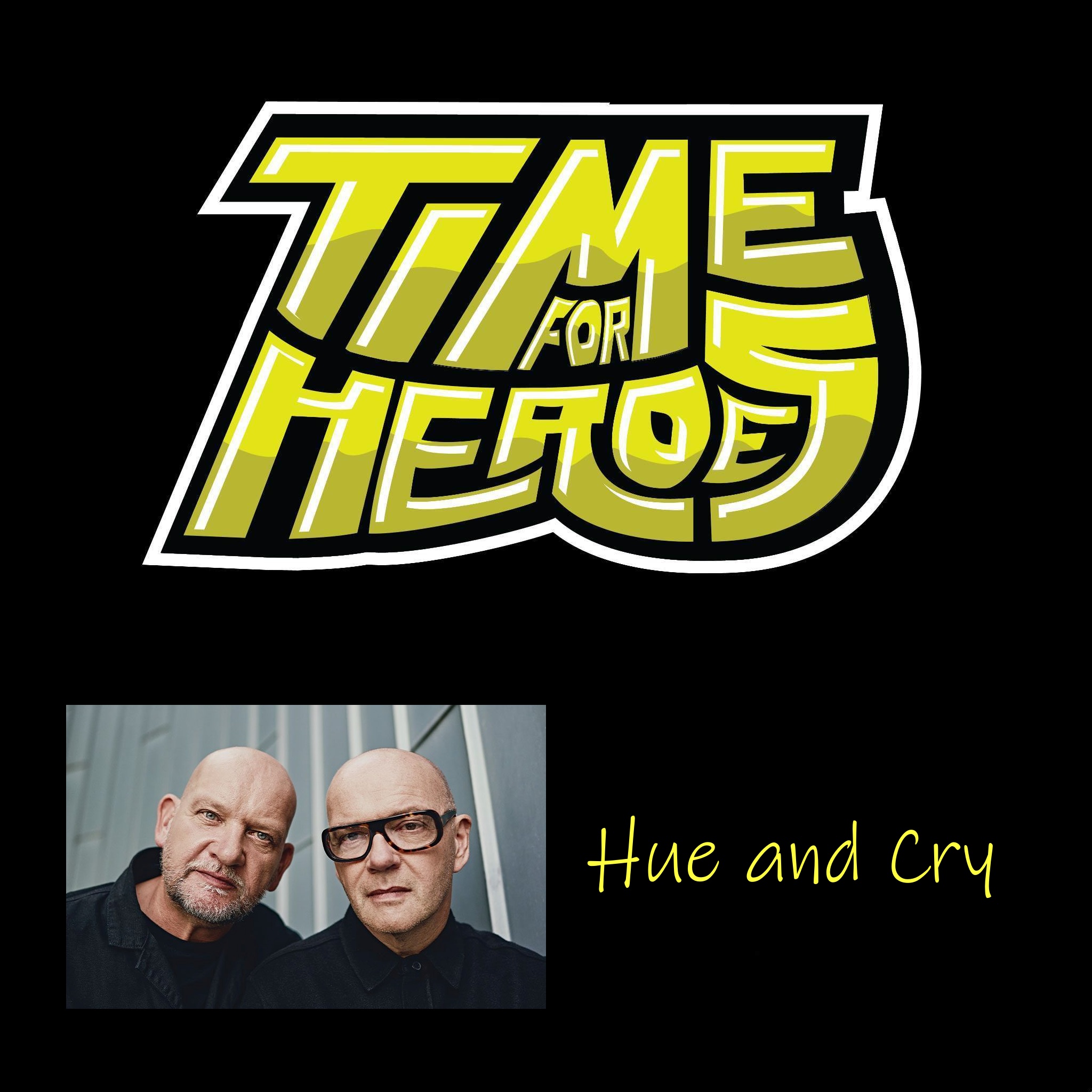
Time For Heroes · Martin Morel
This time out I speak to Scottish music royalty, Pat and Greg Kane of Hue And Cry, with a career spanning over 40 years we covered it all, from the early days in Coatbridge right up to now on the cusp of another album release, 'Everybody' is out on May 29th and you can pre-order it here: Official HUE & CRY Store At the end of the chat the boys picked their heroes as usual, another fine selection! Here's all the links you need: 2026 Hue And Cry Release ‘Make My Day’ Single Hue And Cry | Brothers who make music together | Patreon Instagram Facebook Hue And Cry (@hueandcry) / X Hue and Cry | Spotify Hue & Cry - Apple Music Hue And Cry | Make My Day [Lyric Video]
Greg Kane: name's Greg Kane, I play on band with him, ⁓ Kane, a hewn cry. And you're listening to the Heroes podcast. No. What the fu- Pat Kane: That's who we are. Martin Morel: Class, class, think it's better when there's a wee mistake there as well. ⁓ been alluding to Comedy Gold before we started, so aye, aye, that fits out that more, Greg. Pat and Greg Kane, otherwise known as You and Cry, new coming out May the 29th. We're gonna talk about that, but we're gonna get right back to the start. So what was life like for... Greg Kane: Bye. Mm-hmm. Martin Morel: a young Pat and Greg growing up in Lanarkshire. Pat Kane: Lanarkshire, well, North Lanarkshire. was ⁓ an ⁓ working class experience by which I mean some but lots of aspiration. ⁓ I mean the most Lanarkshire thing about it is is my father had saved up 400 pounds was it to go and see Celtic. Greg Kane: North Lanarkshire Martin Morel: Mm-hmm. Pat Kane: play in Lisbon in the European Cup final. And in 1967, my mother's dream house came up in the street across from the scheme from where she was then living. And no greater love does a man have for his wife than to give up his £400 that he was going to spend going to Lisbon to see Celtic play in the European Cup final, to put down as a deposit for a house. So that's how upper working class we were. Martin Morel: Yeah, that- no many guys who'd have done that back then. When you hear all the stories of people leaving their missus at the altar and all that to get to Lisbon. Pat Kane: Well, ⁓ showed the quality of my father. was a high romantic. Martin Morel: Yeah, yeah. Greg Kane: He was very proud of that house though, I think he made the right choice. Pat Kane: Yeah, yeah. Martin Morel: And so, round about the house then, were your mother and father, were they into music? How did that kind of shape your music? Greg Kane: Our grandfather passed away, my mum's stepdad, and he bequeathed an upright piano. So I remember that arriving in the house when he died. And then my father was a great singer, so he was always singing around the house. Yeah, there was an awful lot of music all the time, I must admit. But it was... Pat Kane: You heard Mrs Buchanan, two doors down. Two doors down. Greg Kane: My piano teacher. Yes, so there was a piano arrived in the house. The piano teacher, my piano teacher from when I was seven years old. She was what, two or three doors down pat. And then my mum and dad had bought this house that they couldn't really afford. So they worked every hour that God sent them. So we were raised by a Nana. She was an elderly lady who was an old neighbour. And she had a son who was a nightclub owner in London. And then when he passed away, he bequeathed his record collection to us. So these boxes of records, mean, original Rolling Stones, original Bob Dylan, original Sinatra, Peggy Lee, the variety performance ones, I can't remember them, we used to collect, I think Uncle Bill was a wee bit camp, so he liked his Peggy Lee and his variety performances, and obviously he's Dylan and his Beatles and his Stones, and then... Pat Kane: Yeah, rubber saw and so forth. Greg Kane: So it took us quite a while to go through that record collection but Mum bought us an old white Fidelity record player that sat on one the sides of the bay windows in the living room and then we went through Uncle Bill's record collection and that was very formative for two young guys. Martin Morel: Yeah, mean that's what a sort of collection to kind of get into, to be gifted into, kind of take the time to go through at a young age. Greg Kane: And then because I ⁓ piano, there was lots of slowing down the records to try and work out what they were playing. So a lot of that going on with me. And then I got to school, 13 years old, started playing saxophone and we had quite a healthy music department in the school that Pat and I went to. So they were very encouraging for anybody that showed any signs of wanting to be involved in entertainment. Pat Kane: In terms of singing, mean, just remembering we had a real one singer, one song tradition at Christmas parties. So everybody had to have that. And then the other thing for myself would be a stage show every year from that music department. Carousel, Joseph and the Technicolor, Dreamcoat, whatever you wanted to do. And I was in most of them as some major lead part. So yeah, actually when you think about it, it's quite a rich stew of influences. And then along comes punk and punk and post-punk and that's a whole different experience. Martin Morel: The one singer, one song, all the parties, I can find the same sort of recollection for Hug Me Now has gone by. it was, it's kind of, I've stayed in a block of flats, like six in a block, and come Hug Me Now, every door was open, you could just go between all the flats. And that sense of community and kind of belonging and, as you say, like the one singer, one song, It gets you that way where you're no scared to perform in front of your peers and your relatives and all that. I mean, that kind of, that probably gives you a up right away for ⁓ you get into music, because you're no fear of anything then. Pat Kane: Well, certainly some of our uncles and aunties, you'd have to be feared their name, that's for sure. If you weren't, if you weren't, if you weren't, I'd accept Mark. But then, but you're right, because everybody, I mean, I remember with an uncle, God, I've forgotten his name now, the Edinburgh one's Doodles. Not Doodles. Mike, Uncle Mike, he would do this version of Solitaire. And Solitaire's the only game in town, and every road that takes me, takes me down. Greg Kane: Dylan, Mike. Pat Kane: and he would completely deliver it. And he didn't have much of a voice, but I mean, he did completely, he lived that song to the nth degree, to the very last lyric. And that was him. He was Solitaire, Solitaire was him. it's a great tradition, ⁓ formative. Martin Morel: At what point then, obviously, if you were doing piano and were into your singing, performative side, at what point did it come together and it become, right, we're going to be a band and we're going to take it seriously? Pat Kane: You go again? Greg Kane: different recounts this isn't I was in, when we passed on with the punk thing, because I was playing piano and saxophone, there wasn't much need for me when it came to punk music. So I kind of watched a wee bit from the sidelines as all my friends put punk bands together. But thank God for the beat and UB40 because I eventually needed a saxophone. So was in and then Boomtown Rats a wee bit. So when I was in young punk bands, we could all play. Our lead singer was a Pat Kane: Yeah. Greg Kane: handsome Mark was a big handsome guy but we'd no words so I asked Pat if he could write us some words and he would jot down some things and give us some paper and I bring it into the room and the guys would, Mark would love it and he said, oh my, sing this is great. So Pat started singing, Pat started writing lyrics for a punk band I was in and another band I was in the singer left and the bass player tried to play bass and sing at the same time but he couldn't do it. Pat Kane: Yeah. Greg Kane: It was quite embarrassing actually some of those rehearsals, you just couldn't separate. So I said, why don't we get our brother in? My brother in and they said, what the guy, the swatty guy? Because Pat was a bit of a swat at school. I said, hi, Pat can sing and he can write words. So Pat came in and it worked out great and we did a couple of demo sessions in the studios and we got played in the radio as this band called The Winning Losers. But then Pat and I started to write songs for them and they hated the songs. they chucked us out. ⁓ And then we did some things on our own. ⁓ went through to Palladium Studios in Edinburgh as kind of duo. And that's where the Cocktail Twins did a lot of their stuff. The guy, John Turner. And ⁓ we some demos there. And again, they got played on the local radio stations in Glasgow. And that of attracted the attention of... Pat Kane: Yeah, I'll be today. Greg Kane: managers and companies and other people so yeah it kind of happened quite naturally when I think about it. Martin Morel: So what's the age difference then? Obviously there's two years between you two but you get another brother as well. What's the age difference we have? Greg Kane: was born So four years. My mum wanted a girl and when my younger brother Gary John was born the midwife says, me you've not got your ballerina. Pat Kane: I said no, it's empty. Martin Morel: Cheers! So, was there never any thought? Greg Kane: So for the first two years, for the first two years we called him Mary Catherine. Pat Kane: Level 652. Martin Morel: never thought of getting him involved because obviously I see he's played bass with the Proclaimers for a number of years. ⁓ Greg Kane: Nah, he's not the biggest jazz fan in the world, is my wee brother. He's played a few times with us in our heyday. I think my mum said, get Gary John on that stage. So we got Gary John on the stage and he played some old soul stuff with us. No, he's done well with the Proclaimers. He's been on with them 20 years. Martin Morel: Is that it? You Pat Kane: Yeah, Martin Morel: Yeah. Greg Kane: So Charlie and Craig obviously brothers in music business and their mother was a midwife the same as our mother so there's lots of kind of synergy there. I think they're starting to get up and running again. I see some pictures of those rehearsals and socials. Fingers crossed it goes okay. I think they're going down to record their album in June. So we'll see what happens. Pat Kane: Yeah. Martin Morel: So we're talking like kind of mid to late 80s when everything started kicking off. obviously the political environment that we were in, in you're Britain and stuff that, how did that kind of shape your music? Was there any political side to your music back then or how did you kind of deal with being a musician politically? when about that period. Pat Kane: You were dancing around really. Because we were interested in punk and post-punk, everything had to have a message. Songs like I Refuse or Lookin' for Linda or Labour of Love all had social stories about them. Labour of Love was the voice of a working class Tory realising the scales falling from his eyes. So that's the twist of the song. But if you do the pop confidently enough, you can kind of get the message under the wire. And so, just at the time when there was a big general election in 1987, we were having songs in the charts with the ⁓ Withdraw My Labour of Love Strike for the Right to Get Into Your Heart. I I'm not quite sure how we managed it, but we did manage it. We felt as if there was a wee bit of a silent. approval on many of the DJs that were there to kind of get this record out. said, it might make a difference. But it's interesting, mean, sometimes think, have things ever changed with the rise of reform and so forth, you know? So the song, ⁓ when you Labour of Love nowadays, it seems as relevant as ever. Sometimes it feels as you're talking to sometimes the same constituency of people, you know? But there was lots of contradictions. You you were wearing designer suits and doing videos in Los Angeles and all the rest of it. So there's no shortage of the cry of hypocrisy of designer, champagne socialist, Bollinger Bolshevik, whatever you want to call it. I take it board. But I think we ⁓ were inspired by people Greg Kane: Jim. Okay, bye. Pat Kane: The Temptations and Sly and the Family Stone and Stevie Wonder. Not noticeably doer characters, not noticeably unflamboyant, but delivering amazing messages in their music, incredible stories of resistance and defiance and idealism. So that's how we cope with it as best we could. Martin Morel: And those early songs, like you touched on, Laboury Love, Looking for Linda, still, as you say, still get that relevance today. But back then, they're massive pop hits as well. So obviously, you touch on your kind of jazz side, but those are just kind of pop classics now when you look back at them. Greg Kane: I think, I think... Pat Kane: Not much to do with me as Gregory but that. Martin Morel: Yeah Greg Kane: think it's a looking back, but I remember there's a guy, Ian Smith from our hometown, his nickname was Miff, which I thought was a great nickname, Miff. He always says to me, says, that summer of 87, you couldn't avoid Ewing Cry. So things just, we'd great PR people. I they were calling in favors from everybody. And in that year we played with U2 and Madonna. So playing in front of massive audiences and I guess U2 are rock. Martin Morel: Was that, was that something here that I? Greg Kane: No, the Heatherie Bar. Shut up, The Heatherie Bar was the bar in Wishy that we, Davey Press, and used to drink in, Pat. We were talking about the Heatherie Bar. But infamously, YouTube made in the Heatherie Bar. Same as the Clash played in the Hall in Woodlands in Glasgow. what I talking about? Aye, it was a summer. Even Labour Love only got to number six in the charts, it was the sign of the summer in the UK. Martin Morel: you Pat Kane: ⁓ my gosh. ⁓ my. ⁓ Greg Kane: because we'd done those gigs with Madonna and the gig with U2. And we did, I think in one week, we did the Roxy, Top of the Pops and Terry Wogan on a Saturday night in one week. And the front cover of the NME in the same week. So I mean, I think things just align. So I mean, I don't know if you can plan that. I don't think you can. It's just, somebody, mean, that cover the NME, that summer of August 87. The Smiths had split up that week, but they still decided to put two guys from Quote Bridge on the front cover. I I'd put Horacey and Johnny Marr on the front cover, to be honest, but they put Hugh and Cry and a wee bit up the top saying, Smiths split. So was lots of things ⁓ fell ⁓ place with us and right time, right place, right song. I mean, we never kind of chased, we an early version of, sorry, last Martin Morel: Yeah. Greg Kane: the singer and living in a box, Richard Derbyshire passed away. And I was kind of remembering he was an in-house producer for a publishing company and it's attached him with trying to make sense of these two jazz loving guys from Coatbridge. And Richard made a kind of big bombastic go west type version of Labor Love. I it was impressive. I mean, was like, that's really good, but it still wasn't the sound that Pat and I were looking for. So the sound that we were looking for was more organic and more sort of Pat Kane: And then Greg Kane: Latin jazz soul, more leaning towards that we want a soul band ⁓ It more Latin jazz, heavily influenced by Ian Dury and the Blockheads and for me, early Joe Jackson, looking for girls and Luke Sharp and all that and I'm the man. All that stuff was and it was introduced to me to Elvis Costello and all these sort of things. Yeah, we're a difficult band to pigeonhole. ⁓ I guess because of those reasons Labour Love was born. It was the perfect sort of example of how confused and confusing Huon Chri were. We had big pop aspirations but we loved our jazz and our Latin and we were quite political so that's what you got. Martin Morel: And those early albums, so like 87, 88, 89 free albums, like looking nowadays at like kind of young, up and coming artists, they might go five years where they're drip feeding singles before they even think about an album. So for yous to have free albums and quick succession, was that just a done thing in music at that time? And how do you... Greg Kane: We'd ⁓ a very astute manager who sussed out pretty quickly that the two guys that signed us had just left Island Records and they were looking after you too and Robert Palmer and Bob Marley and goes to Hollywood. They were looking after big acts so they left to form their own thing with not much money. So they did a deal with Richard Branson and I think he lent them some money but it wasn't enough. Martin Morel: How do you feel it's changed now? Greg Kane: to run a record company. So our manager said to us, I don't think these guys got enough money. Make as much music as you can as quickly as you can. So Pat and I have reflected upon it. What workload, I can't believe. I all the and the two producers we used were Americans. So they would fly over to New York or fly from New York over to Glasgow. and then Pat and I would go over there and sometimes we'd bring some of the musicians with us. So was a kind of a transatlantic thing, all constantly on the go. I can't believe, but that was our manager. He read the tea leaves and went, right, we need to do this as quick as possible. And he was right. Martin Morel: the third album, Bittersweet, there's Marra cover of Mother Glasgow, which is ⁓ just that. It's a truly beautiful song, which ⁓ signifies Glasgow me. It signifies that When I think of Glasgow, I think of all the stuff around about the 80s, like Gregory's Girl and... All that sort of stuff, all the hogman issues, Scotch and Rye, it all kind of blends into How did that song come about, obviously? Did approach Michael? Pat Kane: Well, no, no, we did, I can tell you specifically when I first heard it was ⁓ a gig in the Third Eye Studio recently known as the CCA, recently closed down. And it was ⁓ lineup, I don't know why this was the case, Gregory, but I was singing a cappella. Marty Pello was singing with his keyboard player. Deacon Blue were on. Paul poured into the CCA. And then Michael Marra was in the mix and he did two songs, one a song called Australia instead of the stars, which is completely beautiful and Mother Glasgow. And I remember saying it, going to afternoon, said that was because he was like a kind of he was like a Scottish Tom Waits. It was full of brilliant stories, brilliantly crafted lyrics, just enough Scots to make him distinctive, but just enough blues to make him soulful. And I remember going up to him and saying, I'd love to sing that song. We'd love to sing that song. And he was like, you do what you want, just spell my name right, you know? And every time we play it, and we play it in every gig, right up to next week, last week, always try to make sure to remember to say this song is by the late, great Michael Marra rather than give the impression that we'd written this. But the reason why it fitted is because we were doing piano vocal tracks as well as the big bombastic funk soul orchestra things. So it fitted right into, we were already singing Kate Bush and Tom Waits and Elvis Costello songs as well, shipbuilding. So you stand on the shoulders of giants, as they say, as the old phrase has it. Michael is definitely one of those for me. I like the way we do it. think it's interesting. I've sung it so many times, you think we've sung that song Gregory, thousands, probably thousands, at least thousands. Greg Kane: One of the last times I spoke to Michael, he bought me a pint and he says, thanks for putting my wings through school, Pat Kane: Ha ha ha ha ha ha ha Greg Kane: This is my pleasure. My pleasure. Pat Kane: Yeah, pleasure. Martin Morel: came from Lockheed and Dundee, didn't he? Which is probably similar to Pope Bridge and the areas that I grew up in as well. it's that kind of, the working class environment. That is probably, there's a lot to do with that connection. Obviously you mentioned as well, you mentioned the CCA, which ⁓ I had never heard of, up until a couple of months ago. I got a ticket, so I'm going to see Dave McCabe of the Zootons. So initially he was playing at CCA. So it must have shut down recently then. Pat Kane: Yeah, it's cool for them, Greg Kane: Yeah, because I went out, I guess to go and see a guy called Clark, who's an old electronic guy from the 90s. And I was at the CCA and I was so looking forward to it, going, this is going to be brilliant. And then it was October that it closed. So I went to St. Luke's over next to the Barras. They moved it to there. Pat Kane: Try to do something again. Martin Morel: So it. I'd never heard it. love it if I'm going to a gig and it's somewhere I've never been. And I thought I was really excited. And then it got moved. So he moved it to Cotters. And I thought, I've never been there. That's brilliant. I mind. go to this one. Then I got an email just last week, so it's in Monday. He's moved it again from Cotters to the Hug and Pound. So. ⁓ Greg Kane: Hmm. ⁓ this is good. Poor promoters. I saw the blue Nile in the courtiers. Pat Kane: There you go. Martin Morel: So I. Greg Kane: many many many moons ago that was a brilliant gig. We've played it a few times. If you go onto our Patreon, patreon.com forward slash you and cry there's a whole I think there's about eight songs from a gig we did in Cotiers Park it was an amazing gig ⁓ and then the guy only recorded it onto that so Pat Kane: I remember, I remember, he was playing Mario Calabi in base and stuff. Greg Kane: as it is but it's so good because that place sounds so good but you sang so well my god. Sonny Ink, Sonny Cries on that. There's a live version of the Harry Connick Jr song. Absolutely. Pat Kane: Yeah, yeah. That's when I heard a voice. Greg Kane: So I can't recommend courtiers enough. And they're quite, it's on the circuit now, the gigs. I mean, think James Grant and what's his face, Bernard Butler and Norman Blake did the things at courtiers at a weekend there. And you get acts that are kind of a wee bit higher, they'll do a weekend. So they must do them a good deal where they think, well, we can just stay up rather than play somewhere a bit bigger. They'll just play courtiers. And it's in a beautiful part of the West End of Glasgow as well. So yeah, I'm a big supporter of courtiers. Martin Morel: Yeah, I mean, last year I was the first time I've been to the Oranmore as well. Here, I'm out at gigs all the time, but... Greg Kane: Do you not get it much, no? Where do you get your hand that he bought? Pat Kane: Hahaha! Greg Kane: Glasgow's a UNESCO city of music, come on! Martin Morel: ⁓ I know. Well, the last month I was at the art school. That's the first time I've been in the art school as well. Greg Kane: I'm oldie, Do know what? I walked over, ⁓ met my pals for a pint in the State Bar just off Suckeale Street last week. I got off the 17 bus at the other side of Garnet Hill and I walked right over that Scotch Street by St Aloysius College and the art school union. God, it's a sorry place, isn't it? That's the whole kind of side entrance to the ABC Park and all that and the art school. It's absolutely horrific. It's so sad. And then I was telling my pals about it when I got to the pub, saying, God, the art school in Scotch Street is just so horrible. And my mate Kenny's like, see all these alumni that all pipe up about how brown it was. They should all just chip in and just get it fixed. Get it fixed. Stop complaining. You're all multimillionaires. Chip your money in and get it fixed if nobody else is going to do it. So I was like, all right, Kenny, that's quite a good one. I like that one. Pat Kane: Yeah, terrible. Well, yeah. Martin Morel: after three albums then, into the 90s, and a lot more different sounds coming into the records, is that because obviously on those four free albums you kind of cemented yourself and you're then able to kind of to change things up a bit? You've got that of that reputation to fall back on? Pat Kane: think in the early 90s, right up until we start to do the records with Linn Records in the mid-90s, think we're trying, mean, Greg if you like, but I think we're trying to redefine our pop jobs, you know, and trying to big songs again and make big albums. but also I think we're trying rely on our own talents as much as we can, although... Showtime's a big record, that was collaboration, effectively a collaboration with a guy called Richard Niles. But that didn't feel right either. And so we kind of ended up, don't know how we got onto Linn Records, Greg, I can't even remember the process. But Linn... ⁓ Greg Kane: Well, I think what Martin's talking about, the 90s records would be Stars Crash Down. Yeah, think that's it. ⁓ Pat Kane: ⁓ hey, is that what mean? Alright, well, still shooting for the moon with Dars, Dars, Down, still trying to write the best record we ever could. mean, that's motivational factor when you're doing any record is you're trying to make something that could be regarded as a classic. I mean, I don't think I would be embarking on Music with Gregory if I didn't think we were going to maybe try and create some classic sounds or classic tracks that shoot for the moon. Just try and do everything that a pop song can do. make you dance, make you cry, make you laugh, make you think, get you agitated. all those albums, every one of those, any of these albums that we make have that kind of ambition, I think. Martin Morel: And once he signed to Records, he signed on the basis of a ⁓ of albums, which only two ended up coming out, coming to Friarshton. So was ⁓ behind was just kind of a change in musical climate. Greg Kane: I think, yeah, we three albums in our manifesto and nobody ever lives up to their manifesto's duty. Pat Kane: many ⁓ Greg Kane: What happened? We did two jazz albums for Lin. The reality of jazz is jazz musicians really really celebrate being poor. It's kind of a part of... Are jazz musician? Yeah, well you're poor then. But those gigs were tough. I remember doing the Cork Jazz Festival, a week at the Cork Jazz Festival. Pat Kane: Chaos. Greg Kane: And I'm not saying we were in a tent, but a tent would have been bit more luxurious than where we were. And I think at one point, Pat, you and I looked at each other went, jealous thing is like, we a bit of luxury. Pat Kane: Yeah. We liked some bourbon creams with our tea. You and you know the joke, it all proves the joke about how do you make a jazz musician a millionaire? You give them two million pounds. Greg Kane: At least. Yeah, so I mean, we had a great time in Lynne. We made two fabulous albums that still get spoken about today, but it was hard work for not much return. And I think the kind of, I don't know, the realists in us went, you know what, this is an awful lot of work and you're not getting much back. But we did it. There's one reason, one of the reasons I have remembered doing it for is during our pop career, Pat Kane: Cheers! Yeah. Greg Kane: You weren't allowed to mention the J words. even in interviews the people would say don't mention jazz, don't make puts people off, puts people off. And then after your pop career peaks and you come back down, I saw that as the opportunity to go well we could be one of the biggest jazz bands because you know we'll take some of the fans with us and that's why Linn Records signed us because they saw an opportunity and it kind of worked like that those albums did really well for Linn and did really well for us so but a lot of hard work being a jazz musician I don't we play with some of the best jazz musicians in Scotland that make up our backing band and you see the things they do other than play in front of two and a half, three thousand people with us at these big venues and you think, goodness me, that's just... But they love it. That's all part and parcel of being a jazz musician. So I think they like coming to play with Hugh and Craig because they get a bit more than a custard cream. They might get a four-fingered Kit Kat. Pat Kane: lot of picture for you. Yeah. Martin Morel: It's funny though that you say that, we're talking like second album coming out in and then obviously a period where he's stepped a wee bit. But see, it's only six, seven years. Jamie Cullum, Amy Winehouse, all this, you know what mean? ⁓ They were steeped jazz. ⁓ Greg Kane: Yeah? Mm-hmm. Pat Kane: Yeah, ⁓ Martin Morel: We've only five or six years. Jazz is kind of the next big thing and everybody's into it. Greg Kane: What a hell of Pat Kane: Our timing has always been immaculate, Martin. Martin Morel: in those intervening years, what were you sucked to? Greg Kane: I was working with lots of other bands. was working with the Scottish National Jazz Orchestra as an engineer. So I kind of went more towards engineering and front of house sound and stuff like that. I think, Pat, you were involved in the newspaper, weren't you? Pat Kane: Well, I started up at Sunday Herald in 1999, then went and wrote a book called The Play Ethic in 2004. And in the run up to that book, I was doing consultancy, creative, using my sort of experiences in the music business and as a writer to help organizations come up with better ideas for their products and services. That's what I was moving into. I enjoyed it, it took me around the world, actually took me all to at least four continents, the only one missing was Africa. It still continues a tiny wee bit at the moment. But ⁓ we would do the occasional gig together, right? Someone would sort of drag us out of the undergrowth and pull us together and to do the occasional spot gig. But I think the thing that brought us back together to do ⁓ to be doing stuff like this and to be... regularly producing records again was this TV show, Hit Me Baby One More Time, the Saturday night TV show that we did for ITV. And that was an achievement for me and Gregory to get to decide to do it in the first place, because I think he was going off in a very indie, indie band direction. I was going off in another direction, but I said, ⁓ come on, darling, let's do it. get our glad rags on. Let's jump in the limousine for God's sake. Let's just do it. Martin Morel: Yeah. in a cover of the book, honestly. Greg Kane: I was on tour with the Kings of Leon when you phoned me. Pat Kane: ⁓ beg your pardon. Pardon me. Greg Kane: the hours. What? I'm not doing Saturday Night TV. ⁓ Martin Morel: So what were you doing with Kenzie Leigh on where you didn't like the loud sound there? Greg Kane: I was a young band called the Ronnels that I was the front of house and tour manager for so they got a big leg of the UK European tour ⁓ the Kings of Leon. It's good, good. Martin Morel: And in that time I'd be working with them, you were thinking, I want to cover Beyonce's Crazy in Love. Greg Kane: No, it's when Pat phoned me and said, I want to go on Saturday Night TV. And there was a girlfriend of mine, not a girlfriend, friend that was a girl, Claire. And her party piece was, she would go up on top of the coffee table and do Beyonce's Crazy in Love. And every man had sort of diverting their gaze. And her husband's watching as all like, don't you look at my wife. But she was particularly beautiful, so you can appear through your fingers. then she ⁓ They all knew about this TV show and she said, you should get Pat to sing that. I said, why? She says, it kind of reminds me of You Better Love the Verse. And all right. So I kind of mentioned it to Pat and I think the drummer at the time, Paul Mills is an American drummer and he mentioned the band, Shy Lights, which the cover Are You My Woman? That's the riff, that's a sample that Jay-Z and all that used. and he sort of played us some stuff for the Shylights and I really liked that and I thought, God, this stuff's great, old 70s Chicago soul. So musically it kind of worked for me. Pat's one of the few guys that can sing, Crazy In Love, I remember listening to him sing it. In fact, on the album that it's on, Open Soul, at the very beginning of it, there's a wee kind of prelude to it and that's him making a cup of coffee or a cup of tea, singing it in my kitchen. And it really, I don't know, it just really suits his voice. We've played it recently. We played it at the... Pat Kane: Tom and Clef awards. Greg Kane: Yes, it was requested that we play it. So we were on at the end just after midnight. And of course the dance floor is full of these wonderful looking ladies giving it full B. And every minute of it ⁓ I remember. Pat Kane: But contact lenses at that point. Martin Morel: Ha Greg Kane: But yes, and the TV shows production team were a young production team. Vernon Kaye was a presenter. He's always been really supportive of us and we get treated so well. And I remember after it was all said and done, we asked the production team if we could get some of the data. Like how many people phoned and voted for us, blah, blah, demographics, stuff like that. So there was nearly 160,000 people across the UK voted. for Hue and Cry. So that's 160,000 people picking up a phone, spending whatever the charges was to say Hue and Cry. So I mean, that was, know, Pat and I kind of reflected upon that and thought, right, let's try and find them. How do you find, this is all pre-Facebook, pre-social media. How do you find 160,000 people other than get the phone number? I mean, the production company didn't give us their phone numbers, but they just gave us some of the data. So some of the research that we did, these people would be on, there's no email addresses, there's addresses. So we had to devise a way of trying to find these people. And we kind of created something called the Hune Cry Music Club, which was pre ⁓ a social media platform that we built. And time we did a gig, we would fly it with like, you know, little postcards and stuff like that. And we met, we gathered our tribe and we got to about six, seven thousand members. And then Facebook. kind of took over everything. So we migrated over to Facebook. So, mean, Pat and I capitalised on that TV show as much as we could. then that was also the rise of the ⁓ music festivals, Let's Rock and Rewind and all these things that were incredibly popular. And then because we'd done that show and we'd done well on the show, we were put forward to doing these things. So, yeah, that felt like the kind of ⁓ of the ⁓ revival for me. Martin Morel: Yeah. Yeah, because all those festivals are massive now. I had retro fest done here as well. obviously that's when you kind of, after that period, you support Jamie Cullum as well. Hogmanay appearances, stuff like that. So all of that mixed in is kind of aided to come back. And obviously all the work you put in with the research, with getting this fan base back together. And then once you look at Greg Kane: Mm-hmm. Martin Morel: Kind of that going forward. It's kind of, from then on, it's sold out to her another sold out to her. Just chucking in wee support slots here and there, opening for Al Green and stuff like that. ⁓ does it feel kind of like the, this is like the second coming of Hugh and Cry? Pat Kane: Third coming I think. ⁓ ⁓ coming, first pop, early 90s pop, second following our nose musically, just where we wanted to go for about a decade. And then getting really good management. ⁓ Dugi is the guy who manages this and we formed a company with him and ⁓ a great... Martin Morel: you Greg Kane: Yes, sure, sure. Pat Kane: He's a great guy, he's a great capitalist. He knows how to ask for money, he knows how to try and make money. He's got strong instincts for how to do that. An example would be the new album that we've got coming out has got a beautiful box set with it. He's got a wall of box sets in his office. So he knows exactly what he's talking about, but he also knows how to get people to pay money for special things, and he knows how to ask artists to put special stuff into these boxes and merchandise. So the act of buying something becomes a special thing for human kind. You can buy an album any format you want, but there's always something special, it's always a gift element or a celebration element to it. And a lot of that is associated with our ideas, but also, Doogie's doggedness, we're very... I'm very grateful to him as a character and as a manager and as a collaborator, actually, a kind of colleague. So that helps. And what that does is it liberates you into thinking about making music the best that it can be rather than thinking too much, although we do think a lot about how to market stuff. And it's much better. mean, the third age is also that you are completely eyes wide open. You know what's in the bank account. ⁓ You know what you can spend, you know what you can't spend. So that's kind of a grown up way to do the music business. I don't think we were that grown up to begin with. maturity has come upon us. Martin Morel: leads us then to 2035 when you were awarded the outstanding achievement award at the Scottish Music Awards. ⁓ Pat Kane: We call it a stow-standing achievement. Martin Morel: ⁓ mean, after 40 years of human cry, so how did that feel then to kind of get that recognition? Pat Kane: Fabulous. Well deserved. Greg Kane: ⁓ I dined out on it for a week. my pals and I said, you've got a week, right? You could be outstanding for a week and then that's it over. So yeah, I ripped it, I set it for a week, which was quite funny. ⁓ enjoyed that. We played really well that night, the band were brilliant. then it was a bit kind of, ⁓ that's first time we've done sort of red top sort of interviews, sessions ⁓ and ⁓ meet greets. It's horrible, isn't it? ⁓ my goodness me. It's like do something shocking please so I can write something shocking about you. And it's like, must be tough out there. know, both of it as a journalist, it must be really, really, really tough. And as an artist trying to do something shocking, was a bit I took away from all that. I enjoyed the band's performance. Pat Kane: Yeah. Greg Kane: we did well, we looked well, this photograph looked great, but that press round of half-interested, do something shocking please, or why are you not doing anything shocking? Do you not know the rules now? It's all that. That's the take away I took from it all going, hmm, I need to be careful. And Pat and I are getting a lot of attention again because of our new album and we've got some mainstream things coming up and I'm going to have to get myself in a headspace for it because There's an imp in me that's... I know, I know, we've got a thing happening at the end of... Is it this week? I need to get that out because I'm so tempted. Anyway. Martin Morel: Yeah. It an outstanding achievement to be recognised ⁓ all the work that you've done throughout the years and for the length of career you've had. We're really only a couple of years out when you look at that 40 years. ⁓ spoke to bands on the podcast. I spoke to one I know that long ago. They were out in the 80s, the ⁓ of Stone Rose's period and they never brought an album out. in like 30 years during the line that's him releasing the album that they should do. So, you know what mean, it could have went the other way, whereas yous have been that 40 year period basically still releasing music. Pat Kane: It's kind of stunning. mean, I think that was my thing about the outstanding achievement and also the 40th anniversary tour that we did up and down the country as well. It's kind of, it's very up and down world, ⁓ flexible, world. happen, break apart, start again, break apart again. I mean, I think 40 years has ⁓ very much been based the fact that we're brothers and we're simpatico. on a deep level. Also, I think that we admire each other. I think that helps. But also, think certainly, I think we're curious, permanently curious. Gregory never sees a music technology that he doesn't want to get his hands into and wring its neck so that something different can happen with it. And that's been the ways, I I've always turned up to Gregory's house and some new bit of technology has assailed me from. whatever happening next week, probably, or this week again. So I'm a mood, I know what you're saying Gregory about Red Talk Press, but I'm of a mood to bask in my own glory over these 42 years. I'm just warming hands at the fire. there's nothing else to do, because if they deploy tactical nuclear weapons in a theater of war in the Middle East, so the meantime, enjoy ⁓ 42 of consistent musical exploration and soul searching, why not? Greg Kane: Thank Martin Morel: leads us to this ⁓ album, Everybody, out May 29th. So us a bit about the ⁓ album. spoke Greg obviously before we started recording. It still sounds fresh. It sounds like it's ⁓ of this But it's got the Hue and Cry sound as well. ⁓ Maybe just the two of you speak about the album, how it came about and what sort of messages are in it for people that are maybe swithing and wanting to part with their cash for it. Greg Kane: weather and weather depart from their cash. I like it Martin. Basically here's give me your pitch you two. Alright. gonna go part with I go. Martin Morel: Thanks Pat Kane: All right. I think you should go now. Follow up. Greg Kane: of the reviews we've had saying it's undeniable, Hue and Cry, but it's very off now. Because Pat and I made it, it's going to sound like Hue and Cry. It's what we've not really, we all just follow our instincts when we make music. don't really set out with a plan and ⁓ adhere it. We kind of let it just take its own journey and it's where it goes. And we're experienced enough now that if it's going far too... one direction we can haul it back musically. This was a journey for me. ⁓ I didn't know much about electronic music six years ago when Pat said I want to make an electronic album. Now I know everything about electronic music. So this record was made when I was learning. So there's lots of happenstance, there's lots of fortune, there's lots of... When I listen back to it sometimes... I thought I'd be peeing through something I listen back to and just turn it off because I can't listen to it again. But there's a kind of there's a there's there's a usefulness and a naivety about it from the musical point of view, which is really attractive to me. don't it's like an old guy listening to an old guy learning how to do new stuff. And he's quite good at it. And he kind of go right. OK, ⁓ I don't know. It's one of the it's a it's the first album of ours for it's a 16th album. and it's the first one for a long time I can listen to on repeat. I don't know what that means, Pat, but I don't know. It seems to be near perfect for me. It's never a moment I go or flick forward or... Pat Kane: Yeah, I think, mean, dates are important. ⁓ we wrote it in the year before COVID lockdown. Now it's interesting, and a very energetic, optimistic sounding record. Myself, I was in ⁓ a tiz. know, I was kind of struggling with where I in the world. ⁓ What are powers that I can resist and that I can assert? which is the state of the planet, ecologically minded. Virtual reality and cyberspace were kind of doing all the things that they were doing. So there's a there's a ball of confusion in my head. And when I look back at the lyrics, I can see all that. It's almost as if pop music can be quite prophetic. It can anticipate things happening in the future. It's like an early warning system, like a radar system that can pick up on early tremors. ⁓ And so the lyrics are kind of struggling with their complicated environments and sometimes succeeding and sometimes not. Sometimes rushing for love as a solution to it and sometimes rushing for technology as solution to it. So a complicated world lyrically, but ⁓ a of the music of it is literally, as says, us struggling with... a level of electronica which goes its own way. The classic when you switch on an arpeggiator or a hydrosynth in the morning, you're not quite sure what it's going to do. So there's a sense in which the machines are setting the pace for a lot of this record. And ⁓ I'll be it's also me having been a bit of an electro punk in the late 70s, early 80s. and Gregory, footering around with a machinery and me going, that's the noise. And he's going, that's not the noise, that's a terrible noise. No, no, that's the noise. Put a melody to that. so there's a lot of, if you listen carefully, we've got a single out, an impact track, I your pardon, called Make My Day, which is out at the moment. And it sounds, at the surface, it sounds like just a driving house track. But if you listen to it very, very closely, there's some complete chaos in there. To do do do do do And that's because I wanted to keep it in because I wanted the machines to be in partnership with us almost. That was my vision was that we were like Centaurs, half human, half machine. And Gregory's got a quote from Robert Moog, the guy who created all the great 70s synthesizers, where he says something like, you know, each of these synthesizers and sequencers and arpeggiators has a character. and work with those characters, work with what they bring to you that particular morning. So I think that's why you can listen to it over and over again, Gregory, because I think it's partly not you or not us. It's partly the machines themselves having a certain logic. the story you can tell about the ⁓ song guy and what the advice that he gave us? Greg Kane: There you go, yeah, I never thought that. Yeah, so when I started learning about electronic music, six, seven years ago, the community is so helpful. what's his face? Vince Clark replied to me and a few things that I reached out in some forums. But this guy, Sam Battle, who was known as Look Mom No Computer, he was really supportive. And he said, Greg, turn your computer off. You don't need your computer to do this. I well, I don't understand. How's it all gonna work? He says, all the machines talk to each other. Make sure one machine's the primary machine and everybody's all, all the other machines are linked to it. So it tells you what the tempo is. It tells you pretty much what the arrangement is, if you can program it to do that. But the other, all the machines talk to each other via a language called MIDI and do that and just turn the computer off. So, I mean, it was a leap into the dark for me, but it worked. I mean, sometimes it was a wall. of cacophony coming from these, there's like 27 of them on that wall through there in our studio. And I wouldn't use all 27 at once, they've all got their own distinct sounds. So I would maybe just, I would maybe use one part of the wall, eight or nine synths at once. And then once it was making a noise that Pat liked, then we would then develop it. So I tried to make it as varied as I possibly could, but there was nothing under 123 beats per minute. There was stuff up at 150 beats per minute. We didn't want to make a kind of chilled out ambient electronic record. We wanted to make a kind of in your face pop electro record, which is what we've done. So. Yeah, it was a journey for me, but it was really so supportive. And then the guy that mixed the album, Yoad Nevo, I met him through these forums as well. And he'd mixed the Sugar Babes, Juran Juran, the Pet Shop Boys, Sophie Ellis Bexter. And because he was so helpful for me and we'd had so many different conversations and we can't really afford a mixing engineer like that. But he said, yes, our business partner Dougie contacted him and he said, I'd love to do it. So we've got a really high end engineer that's mixed it and I think he's brought a lot to it, Pat. People that I've talked to that like to the record sounds great and it's, know, every time we do these radio interviews and you hear it in the radio studios, think, ⁓ that sounds really good. And that's Johad. It's you and I, but it's Johad putting the finishing touches to it. So it's, everyone's kind of fallen into place, Martin, you know. And I'm pleased with it. Pat Kane: Mmm. Martin Morel: It sounds amazing and if this is an album you use just learning that stuff, I'm looking forward to the next album, you've mastered it completely. ⁓ Greg Kane: Well, I'm pretty much on top of it now. I'm so on top of it now, I'm researching VGing. So a big part of electronic music is the kind of animations. So there's two pieces of software I'm learning just now. One's called Resolume and the other one's called, it used to be called Milkdrop, it's called Nestrop now. So now I'm back to Particles again with VGing. because I know how all those synths work. I've said to Pat, I want you to write another album. I know how the synths work. ⁓ he's like... Martin Morel: day. Pat Kane: We did a telly Martin, we did a telly. Every time I got up to the studio there's another bit of bloody technology to deal with. Greg Kane: Yeah, but yeah, I'm excited about the next one, Martin, because I think again, and Greg's manifesto of three, we'll do three electronic albums. I'd like to get three out this because we spent, I've spent a lot of time building the synth wall that's in the studio here and the synths will pretty much do the same thing, but they're quite distinct in how they do it. So it's taken me a while to learn how to do it. So would be a shame not to use that knowledge to go again. Pat Kane: Alright, good. Greg Kane: because it has been a good six years of learning and relationships falling to bits, daughters scratching heads going, daddy, can we go out and do this? No, I need to learn how to do this. ⁓ kind of sacrificed quite a lot for it. So I'd like to go again at least a couple more times. Pat Kane: Agreed. I second that emotion. Greg Kane: But then live, you got to come and see Hugh and cry live because I know I've got the synths set up live. Somebody I met Andy Gillespie, Pat on Trune Beach, I was down walking and Andy was a keyboard player with Simple Minds. Great, great keyboard player. He came after Mick McNeil. And he's like, I saw your post, you and Pat do your electronic thing. How are you doing that? And I said, well, it's just two synths. This is our laptop. I said, there's no laptop. It's all me live and then. I've made it flexible enough so when Pat comes in I can follow him. You can follow him? says, aye aye. He says does it break down? says aye. How often? I says no, maybe five or six times a set. What do you do? Do get a back up? I says no, I just start again. I don't know where I've got the bravado from because I'm not really like that. Sometimes there's been a few moments where I've maybe played one of the songs for the first time and I've been a wee bit nervous but Pat's been, come on this is brilliant, you're going to love it. And I'm going Pat, calm this down, this might not go that well. And there's been a... bit of friction there between the two of us, but it's just my kind of hesitancy compared to his kind of, this is going to be brilliant. And it invariably is brilliant. And I get the file, I film every one of our gigs with seven cameras. I've been doing that since 2008. So we've got a vast archive of performances. And every time I get a month off, I'll just go through, I do gig reports, and there's a PDF with all the files and I go through and I mention the songs. after we've packed all the gear, we have to go the gig. I'll write down the songs that I thought were good. So I've got these gig reports going back, my God, 18 years. So I just go back. Once we kind of finished promoting our electronic record, we did a funk record called Hotwire. And there's a gig in Dunfermann, We played at the Carnegie Hall in Dunfermann. ⁓ my God. That's about eight tracks off it. So I'm going to go back to that. So I film all the stuff that we do. So we did a version of Stronger, which was the first impact track of our new album, Everybody. Pat Kane: Mm-hmm. Greg Kane: And that was the one I was a bit nervous about and Pat wasn't holding back. I was trying to hold back, but what a performance it is. I don't know what it is what's wrong with me. Sometimes when you're in the depth of a performance, you can't be objective. You don't know if it's good or not. So I'm so glad that I have this discipline where I film everything. And then when you go back to you think, God, that was really good. I can't remember it being good when I was doing it, but there's the evidence there. So. Pat Kane: Yeah, that's great. Greg Kane: Yeah, playing at the Electronic Stuff Live is great fun. We've got a high pressure gig in London the week after next, so we'll see how well that goes. Martin Morel: Yeah, that sounds amazing and I mean the explanation for the album and everything that comes with it, that's made me more determined to come and see you live and to get the album. For all you and Cry fans, they're going to love it and I think you're going to put in a lot more with the stuff you're doing. Greg Kane: Yes. Pat Kane: Harris, welcome. Here's what we planned. Greg Kane: On the socials can see it, on the socials you can see people sort of going, I didn't really think about you before but this is great and they've usually got the kind of suffix DJ or whatever kind of use to kind of indicate that they're you know doing a bit of DJing at some point so yeah it's all positive Martin I can't ⁓ waiting for the fall because music business is all about peaks and troughs so we're on a peak right now so there's only way you can do it from a peak maybe not maybe a higher peak I don't know Pat Kane: Maybe higher, before we fall cruelly to the ground from the higher peak. Martin Morel: Yeah. ⁓ been an absolute pleasure speaking to you. The last part of the podcast, obviously, it's called Time for Heroes. I asked my guests, I don't know if the PR told you this part, I asked my guests to pick four heroes to come for dinner. Why are they your heroes and what would you cook for them? ⁓ Greg Kane: 40 years in the music business, we know. Thanks, Martin. Pat Kane: Did you take food, Greg Kane: You take two, I'll take two. Martin Morel: can be dead or alive, can be musicians, sports, whatever you want, they can be. Greg Kane: I thought you would be like they can be dead or alive you have to bring dead or alive I can't bring Frankie Goes to Hollywood no dead or alive right okay I don't really know much about dead or alive have I got I've had to go first my goodness first one's got to be Jesus Christ isn't it? As you said, anybody you want. So God's son Michelle Obama. Pat Kane: All right, okay. Hi Bar. Greg Kane: doesn't get much higher than that part sorry Pat Kane: No, not really, not really. OK, I'll probably, I'll probably... Oh, Christ. Not him, not him. Greg Kane: There you go. Martin Morel: Ha ha ha. Greg Kane: We'll go a different track then. They're at the same dinner table so you can talk to Jesus and Michelle as well. They're already there. Pat Kane: Okay. Right, well has to be Stevie Wonder. has to be there. And terms of non-music, if I any hero that would come the table, it would be Shakespeare. Greg Kane: There's a table. Pat Kane: I'd bring Shakespeare and sit him next to Stevie Wonder and get them writing songs together. Martin Morel: that out. Greg Kane: with Michelle Obama and Jesus Christ. There's a table. What would we cook them though? Pat Kane: It's a brilliant about me Jesus Christ. Spaghetti Bolognese. Martin Morel: Yeah. Greg Kane: Would you have your oaks smoked out to chugs? Pat Kane: they would be in the mix. Martin Morel: You gotta go to spaghetti bolognese. Pat Kane: Spaghetti, Greg Kane: was lost. When's this happening? Martin, can you make this happen? Pat Kane: Turns out, Martin Morel: I mean, I'm nearly 150 episodes and we've basically set up 150 dinner parties so I don't see why that's one canny hat. Greg Kane: Well, I've got AI now, I'm gonna go into AI after this and make it happen. Martin Morel: a bunch of heroes and it's been an absolute pleasure speaking to yous. Wish yous all the best with the album coming out and I'll be ⁓ looking coming to see yous. ⁓ Pat Kane: Well, make yourself known when you come, Martin. Be nice to see you. Nice to meet you. Martin Morel: Especially if he's playing somewhere new that I haven't been at. Greg Kane: We're gonna come play there, there you bar. Me can't. Pat Kane: The Arlington bar, see you there. Martin Morel: But aye, it's been an absolute pleasure, please. Thank you very much. Enjoy the rest of your day and enjoy everything that comes with the album. Greg Kane: Thanks, Martin. Pat Kane: Alright man, thank you so much. See you next time. Bye.