
THRIVE 120 Podcast · Mike Okouchi
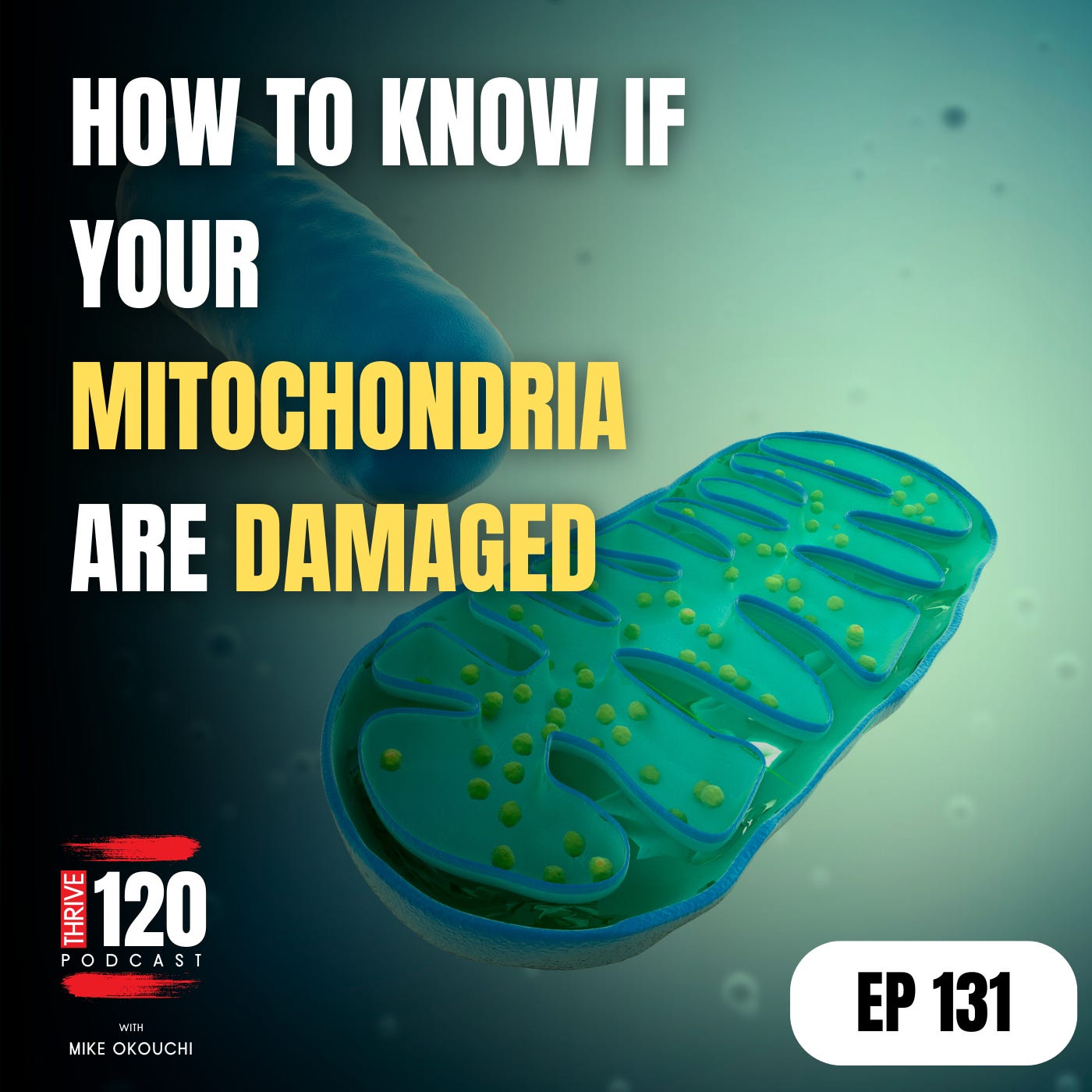
A Nobel Prize-winning discovery from 1931 described a cellular “fermentation switch” tied to cancer. That same switch shows up — in a much milder form — in millions of exhausted, foggy, always-cold people who’ve never had the right tests run. TLDR: Fatigue that sleep doesn’t fix. Brain fog. Always cold. Muscle heaviness. Crashing after a workout. These aren’t personality traits or “just aging”; they’re often signs that your mitochondria, the tiny power plants inside every cell, aren’t running the way they should. In this episode, I walk through: * What mitochondria actually do (in plain English) * The 6 physical warning signs your body sends when they’re struggling * The 5 lab markers that reveal mitochondrial stress — most of which your standard panel isn’t interpreting correctly * Why your body’s pH and proton gradient might be the most underrated marker you’ve never heard of * 8 ways to start rebuilding mitochondrial function this week, starting today What Mitochondria Actually Are (In Plain English) This is a very rudimentary explanation… Every one of your roughly 37 trillion cells contains tiny structures called mitochondria. Their job is to take the food you eat and the oxygen you breathe and convert them into a usable form of energy called ATP (adenosine triphosphate). Think of it like currency exchange. Food is your paycheck. But you can’t pay your bills with a paycheck directly. You have to convert it into cash first. That’s what mitochondria do. Your heart, brain, and liver cells are packed with hundreds to thousands of them, because those organs demand the most energy. So the real question is: what happens when those mitochondria get damaged? The Warburg Connection And What It Actually Tells Us In 1931, German biochemist Otto Warburg won the Nobel Prize in Physiology or Medicine for his work on cellular respiration. Part of what made him famous was an earlier observation: many cancer cells generate energy primarily through fermentation (a process called aerobic glycolysis) rather than through the oxygen-based process healthy cells typically rely on - even when plenty of oxygen is available. Warburg’s Nobel Prize was officially awarded for his discovery of the respiratory enzyme, and part of what he demonstrated along the way was that cancerous cells can live and develop even in the absence of oxygen. This pattern is now known as the Warburg effect. Here’s where I want to be careful, because this is the kind of claim that’s easy to oversimplify. It’s tempting to say “damaged mitochondria cause cancer,” full stop. The real picture is messier and still debated. Researchers have gone back and forth for decades on whether this metabolic shift is a cause of cancer or a consequence of it, and more importantly, later research found that in most cancers, the mitochondria aren’t actually broken. Subsequent research has shown that mitochondrial function is not impaired in most cancer cells, even though those cells still preferentially ferment...
0:00SPEAKER_00There's a Nobel Prize winning scientist who proved in 1931 that
0:05SPEAKER_00when your cells stop using oxygen for energy and switch to fermentation,
0:11SPEAKER_00that's the beginning of cancer.
0:13SPEAKER_00And here's the thing, that same switch, it's happening in millions of people right now.
0:19SPEAKER_00Today I'm going to show you exactly how to know if it's happening to you.
0:28SPEAKER_00Aloha and welcome to The Thrive 120 Show, Your Health GPS.
0:32SPEAKER_00I'm Mike.
0:33SPEAKER_00Each week we cut through the noise and give you an easy-to-follow roadmap
0:37SPEAKER_00that you can implement right away.
0:39SPEAKER_00Whether you have gut issues,
0:40SPEAKER_00hormonal imbalance,
0:41SPEAKER_00weight struggles,
0:42SPEAKER_00or navigating cancer, the unique frameworks we discuss here will give you clarity.
0:47SPEAKER_00If you're ready, let's dive in.
0:52SPEAKER_00The Japanese have a concept called Ma.