
THRIVE 120 Podcast · Mike Okouchi
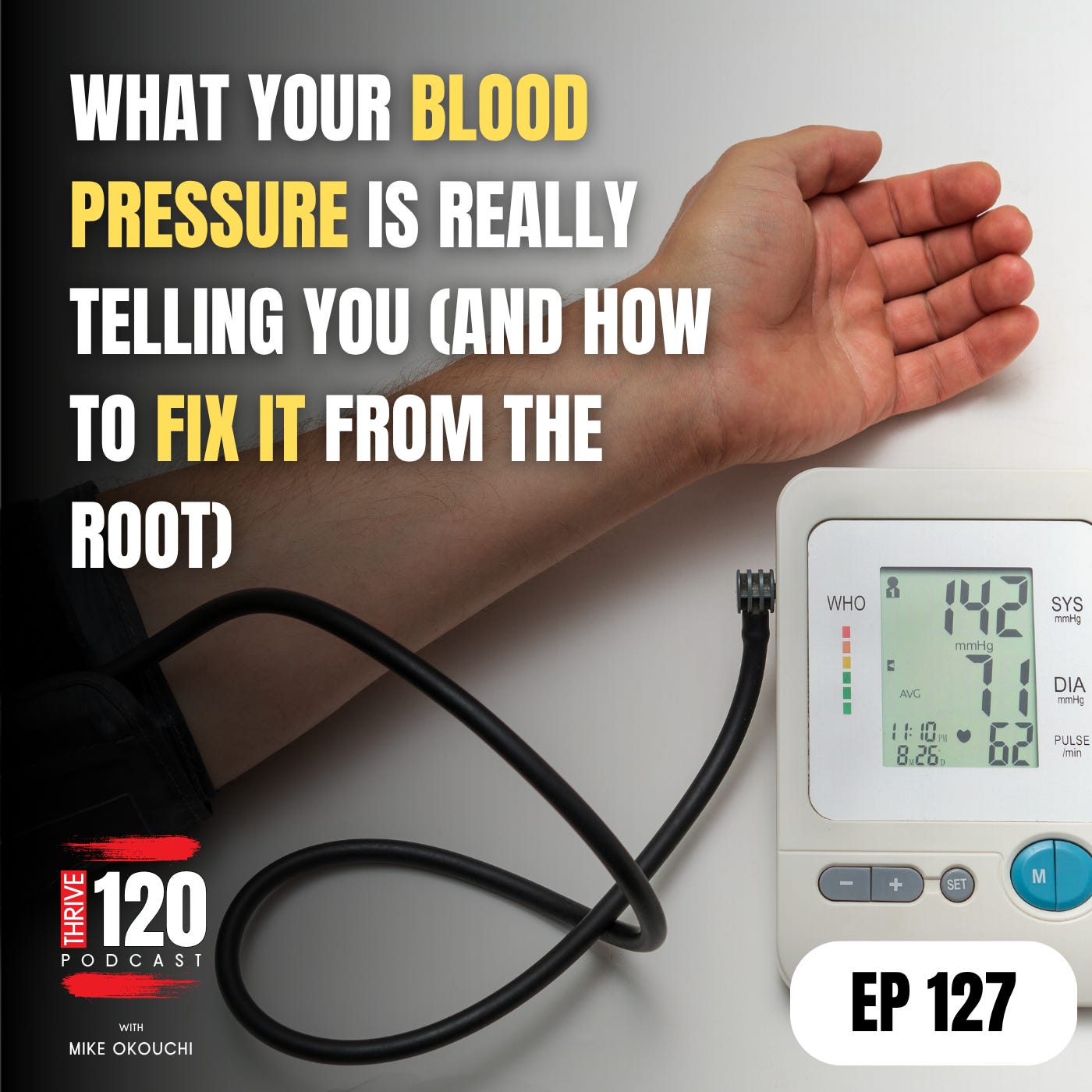
A 42-year-old man walked into my office. Blood pressure: 165 over 100. His doctor had already written the prescription. He was sitting across from me, looked me in the eye, and said: “I don’t want to just manage this. I want to fix it.” Four weeks later, his blood pressure was completely normal. No medication change. No direct blood pressure treatment. Because here’s the thing — we never once directly treated his blood pressure. We treated the system that was producing it. That’s what this episode is about. The Reframe That Changes Everything Most people — and most conventional medical appointments — treat blood pressure like it is the problem. The number is high, so we lower the number. Done. But blood pressure is not the problem. It’s a report card. It’s your body’s way of showing you — in a very measurable, very undeniable way — that something upstream has gone wrong. Think of it like the check engine light in your car. You don’t put tape over it and drive off. You open the hood. So today, we’re opening the hood. Before we do — let’s make sure we’re speaking the same language. Blood pressure is two numbers: * Systolic (top number): pressure when your heart contracts and pushes blood out * Diastolic (bottom number): pressure when your heart is relaxing between beats Conventionally, 130/80 or above is classified as Stage 1 hypertension. A lot of people are sitting in that zone, being told to “keep an eye on it.” That advice isn’t enough. Something created that pressure. And until we find out what, we’re managing a symptom — not solving a problem. The 6 Root Drivers of High Blood Pressure From a functional and metabolic medicine standpoint, there are six primary root drivers I look at when someone walks in with elevated blood pressure. Almost every time, it’s not one of these in isolation — it’s a combination. 1. Insulin Resistance This is the big one. And it is criminally underdiagnosed. Here’s the mechanism: when insulin is chronically elevated — from too much processed food, too much sugar, not enough movement — the kidneys start holding onto sodium. More sodium means more water in the bloodstream. More volume means more pressure. Basic physics. On top of that, high insulin activates your sympathetic nervous system — your fight-or-flight response — which causes blood vessels to constrict. Less room for the same amount of blood? Pressure goes up. Here’s what makes this especially tricky: your blood sugar can look completely normal on a standard lab panel, and you can still have significant insulin resistance. That’s why I don’t just check fasting glucose. I look at fasting insulin, hemoglobin A1C, and when needed, a glucose tolerance test with insulin levels drawn at multiple time points. 2. Chronic Inflammation Inflammation damages the endothelium — the delicate inner lining of your blood vessels. When it’s damaged, vessels lose their flexibility. They can’t dilate and constrict properly. And a key molecule called nitric oxide — your body’s...
0:00SPEAKER_00This guy walks into my office one day.
0:02SPEAKER_00He hands me a paper and all I see on it is 165 over 100.
0:09SPEAKER_00And his doctor had already wrote a prescription for a medication.
0:13SPEAKER_00He hands this paper over to me and he looks me in the eye and says, Hey, doc.
0:18SPEAKER_00I don't want to just manage this.
0:19SPEAKER_00I want to fix it.
0:20SPEAKER_00Four weeks later, those numbers were normalized.
0:24SPEAKER_00No medication change.
0:25SPEAKER_00And here's the thing.
0:26SPEAKER_00We never once directly treated his blood pressure because that's not what we do.
0:31SPEAKER_00That's not what I do.
0:32SPEAKER_00I could care less about the disease name because we don't treat diseases.
0:36SPEAKER_00We help the patient to normalize their body.
0:39SPEAKER_00And that's what today's episode is all about.
0:46SPEAKER_00Aloha and welcome to the Thrive 120 Show, your health GPS.