
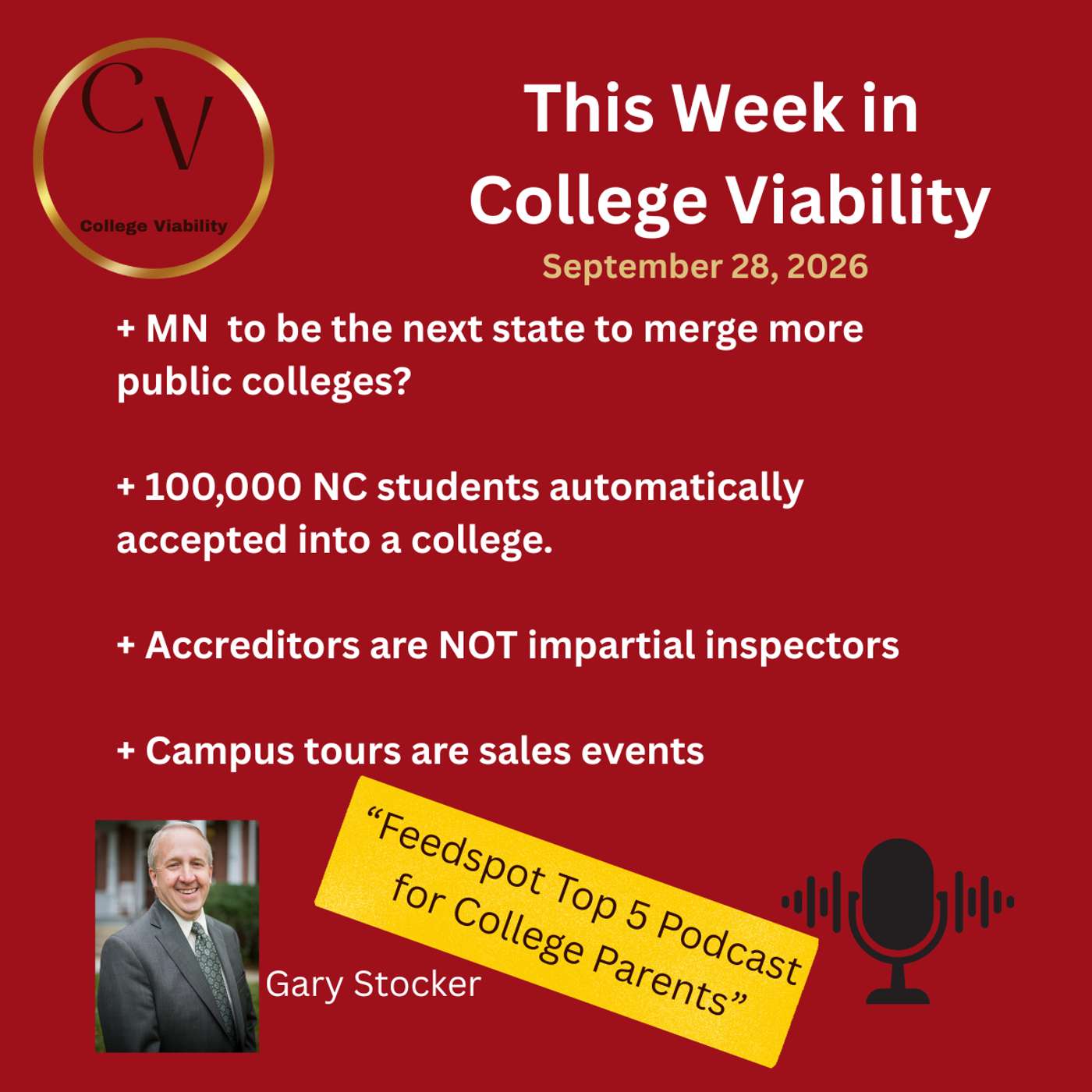
This Week In College Viability (TWICV) · Gary Stocker
In this week’s podcast, I challenge the value of college rankings and the way institutions use small movements in those rankings as marketing victories. I argue that families should pay far more attention to measurable indicators such as financial health, graduation rates, enrollment trends, student revenue, and endowment strength. I also look at financial pressures across higher education, including planned layoffs at Commonwealth University in Pennsylvania, possible campus consolidation in Minnesota, enrollment challenges at Baylor, and enrollment claims at Bradley, Missouri State, and UMKC. My recurring question is simple: enrollment growth sounds good, but how much tuition revenue is actually being generated to produce that growth? I also examine direct admissions in North Carolina, question whether college accreditors can truly be considered independent when their revenue comes from the institutions they accredit and remind families that campus tours are ultimately sales events. My message throughout the show is that families need to look beyond rankings, marketing, beautiful campuses, and enrollment announcements and conduct their own due diligence. I’m not trying to predict which colleges will close; I want families to have independent data that helps them decide how much financial and institutional risk they are willing to accept before committing to a college. Show notes: College Viability Inspection Reports My College Decision Lens Free sign up Commonwealth University plans to lay off up to 175 staff and faculty at Lock Haven, Mansfield and Bloomsburg campuses Minnesota State may close campuses, merge schools in effort to 'right-size' Baylor’s undergraduate enrollment level falls to lowest level since 2014
Gary Stocker (00:00:00) It is Monday, September 28th, ⁓ 2026. Yes, time again for another podcast episode of this week in college viability news and commentary. ⁓ And as always, sitting in front of the Blue Yeti microphone and the smooth running riverside.fm podcast site. And of course, this is the podcast that talks about higher education, talks about colleges. We focus on financial health and viability, ⁓ public and private colleges, and we use data. And details and I think perspectives I I've not seen offered anywhere else. And I gotta start off the show with noting the fact that I have a headache, a neck ache. Not a real one. I I read so many social media posts in the past week about colleges climbing up the rankings. All the rankings were released last week. ⁓ And I kept shaking my head back and forth, back and forth, I kept shaking, in disbelief. That these colleges really think rankings are meaningful. So ⁓ so here's what I came out of it with. Is there any college? Is there any college in America that did not rise in some ⁓ abstract, insignificant detail? In the newly released rankings for US News and World Report and other ranking sites? Maybe something like they moved up 12 spots to number 196 in regional public colleges for social media awareness on Tuesdays. I missed my sarcasm alert. I got another one coming up. So what I did, I played a small scale game of something I'll call you boast. I post. And I did this last week, ⁓ for most of the week. For some colleges, touting some silly rise in the ranking, some silly, insignificant rise, meaningless rise in the ranking. I posted one of the college viability inspection reports, something we do here at college viability. Gary Stocker (00:02:01) Now, I couldn't do it for all of them. There were just too many, just way too many. Plus, I kept screwing up the typing on my iPhone as we were traveling last week. Now, interestingly, some of those college viability inspection reports were quite positive. There are many colleges doing well. I've talked about that before. Others, though, other ⁓ college viability inspection reports really made me wonder about the overall usefulness of rankings. ⁓ Outside of their profitability to the ranking organizations. And I guess here's my sarcasm alert. I wish I had music for this stuff. I wonder how long it will be until I see t-shirts that say, T-shirts that say, we are number 236. We are number 236 in regional colleges that have snow removal tractors. Goodness gracious, that's that's at least a single jeech, not a double jeech. Just You're ⁓ getting listened, getting the audio only, but I'm sitting here behind the microphone with my head shaking. That colleges think the world is so culpable. Not culpable is not the right c culpable is not the right word. The colleges, the students and families really make note of an insignificant change in a ranking. Layoffs and cutbacks. ⁓ Commonwealth university plans to lay off up to 175 staff ⁓ and faculty at their Lockhaven. Mansfield and Bloomington campuses. This is Pennsylvania. ⁓ WPSU had the story and Danahe had the details on September 24th. ⁓ It's in an effort to lower costs and balance its budget. And three campuses I already mentioned. According to a statement from a university spokesperson, we always love those. The goal is to create a financially sustainable university for the long term and to address the institution's recurring structural deficit. We hear that. Consistently, constantly in press releases from colleges in trouble. Now it's ⁓ to to go back a little bit, Commonwealth University was created back in 2022, four years ago, and they brought together the that Lockhaven, Mansfield, and Blooms Bloomsburg campuses. ⁓ and it made a push in recent years to increase enrollment by offering scholarships to many students. So again, ⁓ avoiding revenue. Gary Stocker (00:04:28) Avoiding revenue just to get students in the door. And again, they'll say we want access and and ⁓ make whatever business decisions you want, but access does not equal success. And I won't rant and rave on college graduation rates this time, but I will later in the show. Page two. Minnesota State may close campuses, ⁓ merge schools in an effort to rise size. Now it's kind of an awkward heading, ⁓ awkward headline. It should be the state of Minnesota may close campuses, merge schools in an effort to rise. Chancellor Scott Olson says a quarter of schools in the Minnesota public system are in financial distress. Kent Erdall had the story on September 25th at K-A-R-E, Channel 11 NBC ⁓ in Minnesota, somewhere. So here is from Kent Erdall's story. The Minnesota system is a massive network of 33 colleges and universities spread across 54 Minnesota campuses. But its Board of Trustees has given Chancellor Scott Olson a clear directive. ⁓ Shrink the physical footprint. And ⁓ the Chancellor, yeah, the Chancellor Scott Olson says maybe that means fewer campuses. ⁓ Maybe. And maybe that means fewer buildings on the campuses that we now have. A lot of qualifications there. Olson says audited financial statements are still being tallied for the last year, but Minnesota faces a structural deficit. guessing all colleges in Minnesota doesn't really say in the story ⁓ face a structural deficit of at least 30 million dollars. I can't imagine each one of them faces a deficit of 30 million dollars. And it really doesn't matter what this year's financial state, the trend is already there. We can look back at the data from last five to 10 years, five to eight years, and see what that trend is. And he goes on to add, the chancellor goes on to add by the time we get this November audit, ⁓ one in four, I don't even know what this means. One in four of our institutions will be in some kind of financial distress. They're already in financial distress. And it's not by November, it's already a case. And they have some kind of threshold they're looking at. They don't define the threshold. Gary Stocker (00:06:38) Olson goes on to say, despite recent enrollment growth and two straight years of tuition hikes, they still can't keep up with rising costs, and it cannot count on the state of Minnesota to make up the difference. They've done mergers before, looks like it's going happen again. And he ⁓ he makes a rash to the reporter, Mr. Erdall says, hey, that sounds like a lot of job cuts coming. ⁓ And Chancellor Olson said, if we align and merge institutions, we don't see so many presidents. And so many vice presidents on the campuses here in the system office. Again, I'm not quite sure what that means. Would also be the case for the other campuses, not just the system office. Probably means shrinking the size of administration. Okay, we know that. So ⁓ here here's ⁓ What's wrong? What's wrong with consolidating the academic and non-academics across all campuses? They're dancing around the issue, they're dancing around the story, they're dancing around the solution here. ⁓ For example, we've talked about this before. There have to be many, ⁓ many low-enrolled, upper-level courses in, for example, finance or biology or accounting or math or whatever that be could be consolidated. How many How many upper level, even lower level, but for the purposes of our discussion, how many upper level courses across those 33 campuses, 25, whatever that number was, have enrolled three or four students? And they're paying faculty, either pulled full-time or adjunct to teach those. Why not consolidate them? ⁓ I don't think there's they're pondering outside the proverbial box here. ⁓ Onward, we must go. Baylors, undergraduate enrollment levels, ⁓ it falls to its lowest since 2014. ⁓ Han Webb had that story on September 25th. The numbers aren't important. Baylor continues to struggle with enrollment. They're keeping their price high. I think that's a big part of the issue. Bradley University, Illinois. Peary, Illinois sees a 36% increase. 36% increase in first-year enrollment. Now you can't throw that headline out there and not expect me to say, no, that can't be right. Kenny, Kim D. Caldwell had the story on September 24th. Gary Stocker (00:08:48) I got the version from Yahoo. I'll give you the link ⁓ in the show notes. So there's no total enrollment, FT enrollment, part-time enrollment. I have no idea. High school, temporary enrollment, whatever the case may be. So here's here's from the story. And this is from Ms. Caldwell, I guess. Kennedy Caldwell's story. The university completed its annual fall student census with 1600. I remember that number, 1,600 new students. Enrolled for the fall 2026 semester. The numbers include 876 first year students, 180 transfer students, and 104 graduate students. Now you know me. I have data nerd stamped across my forehead. I did the math. You add 876, 180, and 104 comes, it adds up to 1,160. ⁓ 1160, not 1600 new students. What am I missing here? Now they're gonna say, well, we didn't include everything. Well, okay. They need to do better reporting, do better writing, or clarify that. 36% is a big number. ⁓ And and when I went to the data, ⁓ Bradley University had declining enrollment in each and every single of the preceding five years. It was down 21% from 2021 through 2025, I believe. Student revenues in that same period were down 17 million. Student revenues went down. Seventeen million from the number they had in twenty twenty one to the number they had in twenty twenty five. And again, like I've I've shared in in recent podcasts. They're only noting raw enrollment numbers. ⁓ If indeed they can document 36% increase, here's the follow-up question any informed reporter should ask what was the tuition discount rate required to bring in this class? And is the projected student revenue going to increase or decrease? Nobody anywhere shares that number. That's why I'm here. This transparency. Gary Stocker (00:10:52) Colleges on occasion, not often, on occasion reference it, but they don't do it. Rarely, if ever. Enrollment at Missouri State in Missouri steps one point one percent, but growth plan continues. Janice Researt, the Springfield news leader, ⁓ on Friday, September 25th. The strategic plan is aimed at reaching 20, reaching 30,000 students ⁓ by 2030. And they're just a little bit below 27,000 now. And ⁓ Gary Stocker (00:11:27) Again, my head is still shaking here behind the microphone. Growing in enrollment in a declining and highly competitive market is not a realistic option. Unless you're giving away the store, and many colleges are doing that. I I'd I'd I'd love to see the strategic plan that details how ⁓ they are going to get to 30,000 students in less than four years from now. I'm guessing somebody typed it on document. You know, ⁓ 27,500 next year, 28,500 next year, 29,500 and 2029, and 30,000 and ⁓ can't have if they can, God bless them. It's just not likely. And it's just delusional. It's management by public relations. Big leaps. ⁓ Boy staying in Missouri here. Big leaps from the University of Missouri in Kansas City, from the state of the university. The Chancellor shares major university milestones. Great, welcome to do that. I again the headline caught my attention, so I'm gonna post the link to a college viability inspection report for this college. The this piece was just too warm and fuzzy, and I'm not gonna bore you with the details. It was just too warm and fuzzy when I read it. And of course, that turned on my spin alert alarm. My spin alert alarm is very sensitive these days. And and so the the One thing I noticed among many in the inspection report that we do here at college viability is out of the nine measures that we do, four of them for UMKC were red. And and like I have shared with many other colleges, they're trying to fool us. Their four-year graduation rates are not even averaging 30% over the last five reported years. And before I go to page three, remember two other podcasts. Kitchen Table College Chat is one I do with Mark Debor. And it's really designed and and set up for students and families going through that college decision making process. It's a ch we know it's a challenge, and Mark and I address a wide range of topics. On occasion, we have experts like Mark Stucker a few weeks ago, and then we just it's a perspective piece. ⁓ And we do it every Thursday. We record it, post it shortly thereafter, and take a look at that. You can you can do Google searches on Kitchen Table College Chat, and I post the link everywhere. And then the other one that I do is something called Beyond the College Brochure. Gary Stocker (00:13:51) And that's another podcast that I do not as regularly. And it's it's a it's a it's one that takes the college discussion way beyond what the college marketing brochures and websites talk about. It's it's kind of a Paul Harvey-like story about colleges and started actually started with a college student interviewing me about the college decision process. So just look out for both of those kitchen table college chat ⁓ and beyond the college brochure. Page three. We've talked about direct admissions quite a bit recently. ⁓ And ⁓ this headline comes from WRAL News on September 16th. I think it was a staff story. ⁓ And the headline reads more than 100,000 North Carolina high school seniors automatically accepted to college. What to do next? So reads the headline. Underneath it says if the student graduates this spring, as expected. They'll have at least one spot already reserved for them at a two-year or four-year college in North Carolina. All right, so I pondered this one because I've talked about direct admits and the credit card analogy in previous shows and on some of the social media that I post. ⁓ So we're going to start calling this tap dance admissions. ⁓ Tap dance admissions. Colleges admit you, then they ask you to tap dance through all sorts of steps to actually get enrolled. So here's what's happening in North Carolina. I'll step you through it. 100,000 seniors in North Carolina only. It was interesting when I read the details of the story. Not ⁓ not everybody, not every college is participating. The brand name colleges, the colleges doing well, like Duke and Elon and ⁓ UNC, ⁓ North Carolina State, and some others, are not participating. Those, ⁓ the colleges that are participating, not so much brand recognition. That's so much so good on financial health, which ⁓ makes sense. They're desperate for students, and that's what they're trying to do. Student seniors and parents can find out about their offers to these colleges by logging into their ⁓ NC College Connection accounts. Well, good luck with that. But they also receive offers in the mail, I presume snail mail. Anyone who is on track to graduate, regardless of grade point average, was offered a spot at their local North North Carolina community college. Gary Stocker (00:16:16) Four-year opportunities, four-year college opportunities, require students to have at least a 2.8 weighted GPA and to be enrolled in and later pass a fourth-level math course. I have no idea what that is. This is according to the UNC system. To remain eligible, here's the tap dance part continues. To remain eligible for their college offer, students must continue to meet the admissions requirements for each school's eligibility varies by college. Get those taps out. Tap into the back of the shoes. Go to it. Students who receive an offer must complete a short form for each college they want to continue pursuing. Again, head shaking here behind the microphone. According to the College for North Carolina, completing the form or claiming a spot does not enroll a student at the school. The forms are often free, but could cost between twenty and seventy-five dollars at some schools. You know, I wish I had that that's tabby tapping on my desk. ⁓ Tap dancing. Each college will have a different deadline for students to accept an offer. And enroll. So hey, put those tap shoes on ⁓ and wait for your unsolicited credit card. ⁓ Wait for your unsolicited credit card. No, I mean unsolicited college admissions offer from North Carolina and from a variety of other states and colleges in the country. So hey, next headline: a federal grab. Federal grab for college oversight could put students at risk. Right? That's a biased headline. Here's why. ⁓ It was written by the National Education Organization, Association, excuse me, the NEA. And here's some here's some data from from the story. ⁓ And it's summarizing the changes ⁓ proposed by federal agencies. And the story from the NEA says these changes push college accreditation away from its original purpose of quality assurance and make it a weaker system, a weaker system that can be easily evaded and used to push federal public federal Gary Stocker (00:18:23) political agendas leaving students to pay the price, says a report from the Center for American Progress. The the author of this story goes on to write, ⁓ no one claims accreditation is perfect, but it provides a measure of transparency, no it doesn't, and accountability, no it doesn't. Samuel Deniets, who's an an NEA senior college senior policy specialist, so National Education Association senior policy specialist. Compares accreditation to a home inspection. They're stealing my stuff. They're stealing my stuff. He says, ⁓ you've ⁓ again they're just stealing my stuff. You've fallen in love with the charming Cape Cod house across from the park. But is it structurally sound to find out you need an impartial inspector? Now listen to this. Just like a home inspector, Denise says, just like a home inspector, accreditors are independent. ⁓ Not beholden to institutions or to the government, Denitz says. ⁓ mister Denit Denitz? Yeah they are. Accreditors get their revenue from the colleges they accredit. Did you miss that detail? That's not independent. They can't survive without the revenue they they get. And when and it's my understanding, most of the revenue comes from the colleges they accredited their credit. They're not independent. That's what I've harped on for years. How can they possibly want to put the hammer down on colleges that deserve it for quality issues, for ⁓ outcome issues, for financial issues, when every time they they Gary Stocker (00:20:10) put a college on probation ⁓ or do sam do something that leads to a college closing. They lose revenue. Mr Denit Denise, do your homework next time. And the last story today just reinforces what I've talked about so many times. Campus tours have never been bigger. ⁓ Inside Higher Education had this story on September 21st. Joanna Alonso wrote the story. ⁓ The subheading reads: As it becomes increasingly evident, increasingly evident that getting a student to visit a campus is one of the best ways to convince them, ⁓ to convince them to enroll colleges are overhauling their tours. And this story pops out every few years. So you can you can guess what's in the story. Huh. How to sell your college better than the other guys. That's my words, not theirs. And for sure, college tours have value. I can still remember doing them for myself, long, long time ago, and for our two kids. See the campus, talk to folks, get the sales pitch. ⁓ Nothing wrong with that at all. As long as you realize that it's a sales event. It's not my it's not. Marketed that way, but it's a salesman. They're selling you the college. They're welcome to do that. But it's just like when you visit a car dealership to buy a car, they're selling you the car. There's no difference. Different product, different service, but there's no difference in the process. ⁓ Here's an example: Southern Illinois University Edwardsville. The chancellor of the university took a tour himself just to spot imperfections. All right, fair enough. Welcome to do that. Following his tour, they completely changed the face of our quad area on campus. Everything's branded. We have beautiful flowers now. ⁓ We have beautiful flowers now everywhere around campus. It just feels like a more cohesive, thoughtful kind of space. Colleges have worked also to cultivate star teams of customer service reps. Welcome to do that, but it's a sales event. Gary Stocker (00:22:15) This is a sales event. Nothing wrong with that. Just recognize it for what it is. And that's why when we put together the college tour challenge AI tool, ⁓ it helps you ask, prepare and ⁓ assess and ask tough questions when you're doing these tours. Tough questions for the college admissions rep. Tough questions for the financial aid reps. You can sign up for free at mycollege viability.com and even the college decision lens that created. Gives you a pre and post visit tool to see if the college matches your interest, to see if the college matches your interest ⁓ and your needs. Page four. Jeff Salingo always writes good stuff, always ⁓ very good thought process, very thorough in what he does. And he posted, I don't remember where, might have been on LinkedIn, on the US News and World Report Rankings. And I'm gonna read to what to what Jeff posted. Where rankings aren't useful. Gary Stocker (00:23:16) Tracking a particular school from one year to the next. ⁓ This fall, Slingo writes, I saw headline after headline in student newspapers and elsewhere about a college rising or falling a few spots. Nothing happened on those campuses. The faculty, the dorms, and the advising are all the same as last September. What moved, what changed, was the formula. Or maybe a competitor's data, Slingo writes. He continues, sometimes it isn't even the formula. The University of New Haven ⁓ sent a press release last week celebrating its first ever national ranking. New Haven didn't change. Its Carnegie Carnegie Carnegie classification. Did change, and US News uses Carnegie to sort colleges into the national or regional lists. So after a more than a decade in the North Region Ranking, New Haven now sits ⁓ at ⁓ at number 276 of 425 national universities. Put that on the t shirt. The release describes that as the top 10% of all degree granting institutions. I'm sure the math is accurate. I'm guessing they took a great poetic license for that. Now, folks, here's another jee. And I'm using Slingo's example. Colleges are playing you in in many cases, maybe in most cases. And as I talked about at the top of the show today, is there any college in America that did not rise in some abstract, insignificant, ⁓ nude detail in the newly released rankings at US News and World Report and others? What does it mean? ⁓ What does it mean other than the marketing folks have have a creative press release to write and promote? It's it's just plain silly. It's the data that matters. Not opinions of other college leaders, which is a big part of these rankings, not dorm food, not party scene, not most innovative in whatever. What's the four year graduation rate? Gary Stocker (00:25:32) Is there enough in the endowment to provide the college with a buffer when things get bad? Is the college making money or not? Nobody looks at all of these. It's just ⁓ a sideshow of subjective tools in most cases. So let's do a wrap. College year has started. Title IV checks will be arriving soon ⁓ with revenue. Many colleges, if not most colleges, need to survive. And how many colleges, how many colleges will look at that check and finally realize they can't keep their doors open? It'll happen. ⁓ It's just so tough to say when ⁓ or how many, although I have an idea. And that's why we have created what are effectively insurance tools. Look at the measure in our apps and make your own decision. ⁓ Make your own decision on how much college risk, how much college risk you are willing to take based on the data, not on whether they have good dorm food or not. We'll show you. We compare it to other colleges for you. We'll show you the trends, both the good trends and the bad trends. And I am never, ever, ever, ⁓ ever, ever going to tell you that a college will close. Can't do it, won't do it. I will and I do. The tools we develop do give you the information you can use to decide how much risk you are willing to assume. How much risk your risk you are willing to assume in choosing any college on your list. And here's a tip: it's not that a college will close that should be top of mind. ⁓ Many will close, most will not close. It's it's that a college with poor financial health is less likely to provide a high quality college education. Gary Stocker (00:27:31) And we said it first here, you wouldn't buy a house without a thorough inspection. We just did that this past March for the house here in Colorado Springs. And I encourage you to say to use the same due diligence when you're choosing to buy a college. Until next Monday, as always, I'm so grateful for listening. Thanks for listening at College Viability. I'm Gary Stocker. I'll be back next week.