
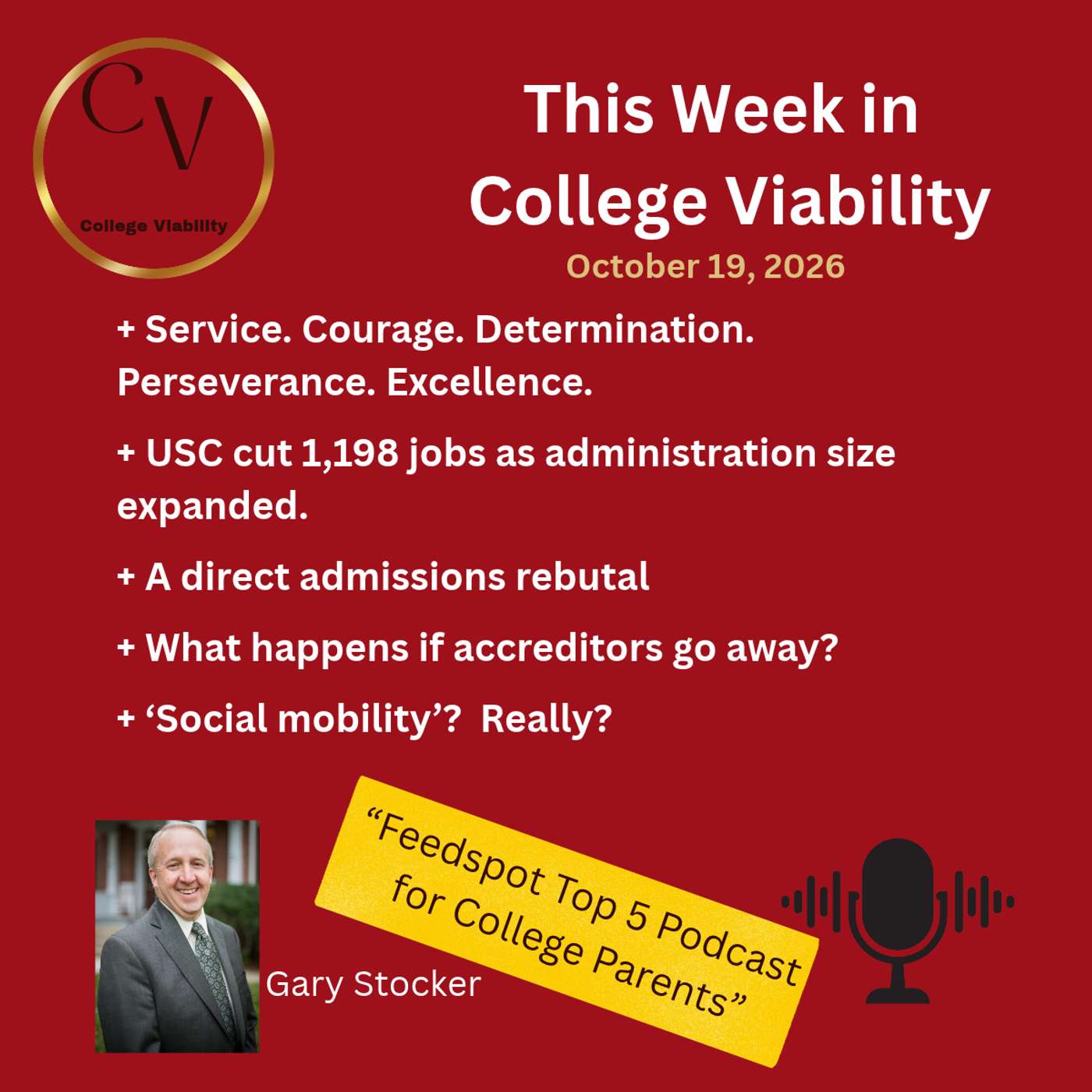
This Week In College Viability (TWICV) · Gary Stocker
In this week's This Week in College Viability News and Commentary, I begin with some positive reflections on visits to the U.S. Air Force Academy, the Olympic and Paralympic Training Center, and the Olympic and Paralympic Museum in Colorado Springs. I then turn to the financial realities facing higher education, including nearly 1,200 layoffs at USC despite growing administrative expenses, Bennington College's $18 million structural deficit and potential faculty reductions, and Marquette University's encouraging enrollment and graduation trends. I also challenge George Mason University's promotion of direct admissions, arguing that making it easier to admit students does not necessarily help families determine whether a college is affordable, financially healthy, or capable of delivering strong outcomes. I examine changes in accreditation, Albion College's tuition reset, and the growing financial pressures facing college families. I conclude by challenging the meaning of the widely promoted "social mobility" college rankings. While these rankings recognize graduation outcomes for Pell Grant recipients, I point out that they do not actually measure whether graduates improve their economic circumstances. I explain how the College Viability Pell Equity Gap provides families with a transparent comparison of graduation rates for Pell recipients and other students. My message throughout the show is that rankings, admissions offers, tuition discounts, and college marketing should never substitute for independent financial and academic due diligence. Colleges know a great deal about students and families through the admissions and FAFSA processes. It's time for families to know just as much about the colleges asking for their investment. Show notes and links: USC cut 1,198 jobs while its administration grew — the deficit story nobody in the C-suite wants told Bennington College tells faculty a third of them could be laid off Marquette: fifth straight year of growth, 8,238 undergrads
Gary Stocker (00:01) It is Monday, October 19th, 2026. Hi, everybody. Gary Stalker back in front of the Blue Yeti microphone with another podcast show of this week in college viability news and commentary. And of course, this is this is the only podcast that talks about the financial health and viability of public and private colleges with data and with details and probably with perspectives offered nowhere else. And I want to start off. Today's show. You know, sometimes you don't have to travel very far to be reminded what makes this country, the United States of America, an extraordinary country for so many reasons. Over the past three weeks, I've had three such reminders here in Colorado Springs. First, a couple weeks ago, my wife and I went to a football game at the United States Air Force Academy. The Naval Academy team was in town for the event. And before I talk about the other two, I just have to give some detail. So I was looking forward to this. I bought these tickets shortly after we moved to Colorado Springs, Springs this past spring and April, that was, and was really looking forward to this, and I was not disappointed, especially in the pregame. And a couple things stand out that reinforce what I'm talking about. As the kickoff started to get close, the entire wing of some 4,000 cadets. marched in on into the into the football field floor in what appeared to be company groups of 200 and each company was announced by the announcer, a female announcer, and they marched in perfect step, and I think they eventually had four companies across and six companies deep, something like that, on the field. That was just the beginning. Then this same female announcer, I presume one of the officers or senior enlisted at the Air Force Academy, gave commands. And they were the usual commands, right face, present arms, tension, left face. And every one of the 4,000 US Air Force cadets from all four years in that wing did it imperfect, and I mean perfect synchrony. To the point, I'll be honest, and I may lose my guy card on this. I had tears in my eyes, watching the best. Some of the best, if not the best, in America. And now the football game was fine. It was that both teams run a lot, so not lot of passing. But the pageantry, and then there were I think a half a dozen parachuters landed, I think, on the same exact spot as they came in separately onto the football field. And then as we anticipated, two B-2 bombers flew low, slow, and quietly over the top of the stadium. So much to be thankful for. And then I went We had some family in a week later or so, and we took them to the Calgary Springs is home of the US Olympic Training Facility and the US Olympic and Para Olympic Museum. And we took those family members to both. And what struck me wasn't just the impressive facilities for any of the three: the Air Force Academy, the ⁓ training facility for the Olympics, and the and the museum. It was These the qualities of the facilities and the people, more so, really transcend politics. They transcend geography. They transcend generations. And yet I think too many times we don't reinforce that this country has the best of the best. It is people who believe they can accomplish extraordinary things. And it certainly goes beyond the Air Force Academy, it certainly goes beyond the Olympics. And Olympic athletes to many, many, many others. But let's remember the talent, the skill, the vision that we have amongst those so many in our country. And I had the privilege, and it was a privilege, of seeing all three examples right here in Colorado Springs. So let's get started. Page one. The University of South, the University of Southern California cut almost 1200 jobs. While its administration grew. Now here's the headline. You'll see slash jobs administration size explodes, expanded, and it came out of the Annenberg Media, which is effectively Southern Cal's own student newsroom. And there are quite a few reporters, let me name them all. Malik Gamble, Carlotta Escala Baim, Jeremy Wong, and Rayo. And it was edited by Catherine Contreras Hernandez and Scott Hills. And I'll put the the ⁓ URL in the show notes. So Some not quite 1,200 people laid off since May of 2024. And this came from California's war notices, where you're warned of layoffs. And it was also as a rope for found in the Form 990s, which is an IRS form that under the category of management and general expenses. The university had its deepest operating deficit in 13 years of filings, some $700 million deficit in fiscal 22. Fiscal 2019 operating loss was nearly 400 million. And in that time period, the data from the National Center for Education Statistics and its iPads database shows that the management staff pool, that's the term they used, grew by more than 400 full-time equivalents from 2018 to 2025. So what we have here is a university laid off professors and advisors and healthcare workers, it appears, to fix a deficit that its own filings suggest was driven by management costs. And this is why, this is why families and faculty even need independent data instead of press releases. And that's why we're here. That's why we're here at College Viability. Bennington College in Vermont. Tells faculty a third of them, that's one in three, could be laid off. Bennington Banner had destroyed Jim Therion at Vermont News and Media Correspondent, and then the URL will be posted in the show notes. The numbers show an $18 million structural deficit, and that was confirmed by President Daniel Egan. Faculty were told roughly one-third of full full-time faculty, roughly one third of full-time faculty could face layoffs. Undergraduate enrollment was 708 as of January 2026. That's a small number. And in August 2025, the college had already cut 15 non-faculty staff positions. Now, what happens here is this this Bennington is now on this, I guess it has to be a small, private New England college watch list. It's the same regions already lost. Southern Vermont College and Green Mountain College and Goddard and Marlborough. And now a new president inherits a deficit. And layoffs are going to follow. And layoffs typically but not always mean program eliminations follow. So the new president's line, President Dr. Egan, I guess we'll say that. Daniel Egan's line was we are fortunate not to have the same unfavorable, this is important, the same unfavorable debt structures as many other colleges. And so what we want to ask for is the audited financial statement, and I've got that, behind the $18 million deficit figure. And ask whether the va whether the voluntary and in early retirement incentives was created to mask forced cuts. And also I want to ask how much of that $18 million deficit is recurring versus the one-time loss. Now I jumped on Matt Hendrix's college viability college financial compass and I showed about $50 million in debt and a UNAP, which measures essentially cash available. as a negative number and neg a negative UNAP is never ever a good thing. It's the data. And again, this is why I'm standing, sitting in front of the blue Yeti microphone. Colleges will spin things. Colleges will not engage in transparency. I'll try and say they are. And I'm here to show share the data. And and good news. Marquette University, Milwaukee, fifth straight year of goal of growth. The Marquette Wire, again, the student newsroom had the story. Noland Leonard was a news reporter. Some 8,200 undergrads, up nearly 1,000 since 2021. Applications up from 15,000 to 20,000 in the last four years. And here's what is stunning. Last year's first year student, last year's first year students returned at a rate of awe of over 91%. For every 100 students that started at Marquette in 2025, I believe, twenty twenty ninety-two of them almost returned for the second year. Their four year graduation rate is over 74%, and that's versus a national average of of 54%. And I take issue with that because I think that's too high for the national average. And finally, the you know when when the student newspaper is doing good work here. And and Nolan Leonard, take a bow. Nice, nice job. On the other hand, as Teviev would say in Feather on the Roof, George Mason University. Now, this is a university doing well, financially well. ⁓ George Mason University explains how direct admissions flips the script. Now it would be easy for me, and I have in the past and probably will in the future, to pick out a college doing direct admissions when it's not doing well financially. That is not the case with George Mason University. They are doing quite well. But it gives me the chance to point out that this directed mission is not what it appears to be. It's not what colleges are trying to present it as. And I'm going to use George Mason as my test case. So David Burge is the senior vice president for enrollment and student achievement at George Mason University. And he explains in this US News report on October 14th. How direct admissions eases application stress and how families can evaluate their options. Now bear with me, this story is rather long. Mr. Birge, David Burge, writes: direct admission fundamentally changes the emotional dynamic of finding the right college or university fit for the student. He goes on, traditionally, students spend months wondering. Wondering whether they will be admitted, often viewing the process through the lens of ambiguity, amen, and a looming threat of rejection or potential rejection. A direct admission offer from George Mason University or any others provides an affirmative signal, in this case from George Mason, that we see the student not only as capable of succeeding with us, but that we actively want them to choose us. And he continues and c and concludes here, providing that clarity up front can reduce anxiety and increase confidence. Well, this is a one way story. Sure, George Mason wants these students based on whatever criteria they set up. They're more than welcome to do that. But do those students want George Mason University? This is a one way solicitation. And I'll get into the details here in a second. He goes on, Mr. Bridge goes on to s to write. Directed missions can also expand the range of options students see for themselves. A student who may not have considered applying to a particular university or who may have questioned whether they belong there now has no my now has an institution, I'll add the word unilaterally unilaterally, affirmatively telling them that they are qualified and that the college is within reach. And sarcasm alert. Do these do these colleges like George Mason and the others offering direct admissions, do they include an unsolicited credit card offer? Like you and I get in the mail so frequently? Do they include these unsolicited credit card offers to eighteen year olds? The statistics for George Mason was almost one third of their newly enrolled students, I think this was from 2025, were admitted to the university's direct admissions program. That's a big number. I'm I'm fascinated by that. And they go on to say, demonstrating how significant this pathway has become for its students. Well, okay, and again, George Mason, every other college is welcome to do that. But moms and dads and grandpas and grandmas and aunts and uncles and students, it's a marketing tool. I'm not going to use the word gimmick, although I should. It's a marketing tool to get more students to enroll. Nothing wrong with that, but let's look at the other side. The fundamental problem, the fundamental problem with direct admissions is that it makes it easier for colleges to recruit students without necessarily making it easier for students, without making it easier for students to determine whether those colleges are worth attending. For a wide variety of reasons. Direct admissions solves, potentially solves a recruiting problem, but it really doesn't necessarily solve a student decision problem because there are so many factors that I'm gonna talk about in minute involved in this. And for decades, we know the history, colleges have required students to compete for admission. We're special. And you're special now that we've accepted you, was the essential message. Directed missions changes that, changes that relationship by allowing colleges to approach qualified students with offers before they complete the traditional application process. Now, again, college is welcome to do this. That sounds student-friendly, but consider the college's motivation. We all know from many sources that colleges face increasing competition for students. Pressure to maintain enrollment and significant financial incentives, discounts, merit aid, same thing, to fill available seats. Direct admissions gives colleges, colleges, and an opportunity to identify prospective students earlier, reduce recruiting friction, and potentially improve enrollment yield. Nothing wrong with that. In fact, George Mason reported that of the 1,283 new students, 30% of its incoming freshman class, Enrolled through direct emissions. We talked about that in a But successful recruiting is not the same thing as successful outcomes. And at George Mason, they only graduate about half, a little over half, of their students in four years. Above the average for sure, but still not, you know, graduating just around 50% is nothing to write home about. That means, and we'll use 50 as a number, George Mason's a little bit higher than this. That means for every 100 students, 50 don't graduate for every one hundred for every 100 students. 50 don't graduate or take more than four years to do so. And for each additional year, each additional semester, there's tradition costs, there's living costs, and what nobody talks about is the opportunity cost of missed income, lost income. And if you use the number of $40,000 per year, which is kind of low. For every extra year a college student has to go to college to get that bachelor's degree, that's forty thousand is a bare minimum of lost income they will never have the opportunity to earn again. And again, we even the the affordability piece is what not addressed at all by George Mason. Now they do it, I'm sure, after the fact. An offer of admission is not an offer of affordability. One of the most important distinctions that families need to understand is the difference between being admitted to a college, that's easy enough to do, and being able to afford that college. Much more challenging. George Mason explicitly states again, this is George Mason's approach. explicitly states that students admitted through its direct admissions program do not automatically do not automatically receive a scholarship. They must pursue the app the applicable financial aid process and merit scholarships read discount separately. And and that that distinction deserves greater emphasis. Imagine a high school senior receiving an unsolicited acceptance letter from a university. The student is excited, the parents are proud, grandpa and grandma call and come over for dinner, and the family begins imagining the possibilities. But what happens when the financial aid offer arrives? What if the net price exceeds the family's budget? And what if the student must borrow substantially more than anticipated? What if a less expensive institution offers comparable academic outcomes? Getting admitted to a college you can't afford is not necessarily an opportunity. It may be and probably could be the beginning of a financial mistake. And direct admissions should never ever be confused with financial accessibility. Let's take a look at s at accreditation. Page three. The Arizona Supreme Court has approved Grand Canyon University's Grand Canyon University's law school application without ABA accreditation. Now there's a lot, a lot going on in the accreditation space in higher education. And what we have here is a an aggressive college call a GCU. ⁓ Making application for Grand Canyon Universities, school college of law, effectively ignoring the established accreditation process and the state stepping in to say, sure, go get Now, again, oversimplification, I understand. But what happens if this is the beginning of a trend? What happens if states say, we'll we'll accredit colleges? I I don't know that that's on on anybody's doorstep anytime soon, but think about that. It started in Arizona, and you heard me talk about accreditation, and I won't go into that today. But we're we're on the verge of that whole accreditation process. And remember, accreditation gives students and colleges access to federal Title IV funds. Students can borrow money to go to college. Feds paid for it. Albion College slashes sticker price from $60,000 to $38,000. Okay. Again, a student newspaper is my must be my focus this week. The Albion Pliad, P-L-E-I-A-D, is a student newspaper. Reporter is Isabella Treglia. And they the college dropped the tuition from $38,000 to to From I'm sorry, from sixty thousand to thirty thousand, about nineteen thousand dollars per semester. Merit scholarships are are adjusted down. Let me stop here. A tuition reset is not a market. I did a podcast interview with another company this morning and we talked about this. And I gave the example of a college with a $50,000 list price and a 60% tuition discount, which is about average, a little bit higher than average, but make the math easy. So 50,000. Less 60% means, if I did this right, 50,000 less 60% means 30,000 off of that. So it's a twenty thousand dollar net cost of the family. You do the same thing for Albion College. 60,000 less 50% is 30,000. The nineteen thousand per semester times two? Get my fingers and toes out. That's $38,000. That's more than the less price, less 60% discount. This is a marketing move. And Albion's not the only one doing that. Others have done it as well. And there is evidence, probably quite a bit of evidence. I know this because I've read this, that tuition discounts do have tend to have a short-term impact because it will get more students to look at the college because it's not priced at $60,000. is priced at thirty eight thousand. But doesn't have long-term positive impact because other colleges do the same thing. And what I shared with the interviewer this morning was so say a student came to Albion College or any other college doing direct doing ⁓ doing tuition resets, and a student has that tuition reset at 38,000, and another college says, tell you what, we'll do 35,000. Do you mean to tell me Albion won't discount their tuition another 3,000 to get that student if needed? It's a marketing, it's a gimmick. It's a gimmick for and for sure. And and I've seen a lot of editorials recently postings that says colleges should all discount their tuition to what they're actually charging. And again, use fifty percent as the number. So if you're working in a college with, you know, twenty thousand dollar list price tuition, you're probably paying somewhere in the study of ten thousand. But that's not gonna happen. And here's why, and I've talked about this before. So many of us, so many parents and families love to share with their neighbors that their child, their children, got a 30% $30,000 discount to go to a college. Whether it was academic, merit aid, a presidential scholarship, also known as just discounts, or anything else, a flute player or a quarterback or a three point shooting specialist or a golfer. And so colleges love that high price, high discount approach, as do students and their families. And I think I talked about this a couple of weeks ago. Let's do a wrap. And this was a follow-up. Three weeks ago, on the September 28th show, I think it was, I did a bit on college rankings and I called it you boast, I post. And that was a time when the rankings started coming out from US News and World Report and others. And I I I I teased that every college in America, it seemed, had risen in some category nobody had ever heard of the week before. Nothing on nothing changed on those campuses except the formula. And the press release. So today I want to focus on a category just to show how Unsolid and I'm being nice. Rankings are. The category I'm gonna focus on is one called social mobility. It's because it's the one category in the US news rankings that keeps the spotlight on students receiving Pell grants. And then I want to ask the question the press releases never ask. What does the label claim? And what does the formula actual actually count? First, the definition: social mobility sounds like it means one thing. You're moving up in the world financially, and it actually measures another. Per US News World Report and World Report's own twenty twenty seven methodology, that's where the rankings that just came out, the top performers on social mobility ranking uses exactly two factors. Factor one, Pell Grant, excuse Pell Grant graduation rates. How many Pell students graduate in six years? Not four, six. That self is an issue, but I'll leave that alone for today. The six-year graduation rate of students who receive Pell grants. And it's averaged over a few years. And that's with colleges that enroll more Pell students getting more weight. All right, so if you have a higher number or higher percentage, I think it is, of Pell students, you get more weight. Factor two: Pell grant graduation rate performance. Again, the six-year rate, just ridiculous. The six-year rate of Pell recipients compared, this is important. The six-year graduation rate of Pell recipients compared with non-Pell students at the same college. That's the whole formula. Pell access and Pell completion. And then let me be fair, that's not nothing. It is the category that asks out loud, how did this college do with students who arrived with the least preparation? It doesn't include that there. The least academic preparation, the least social economic status. When a college graduates its Pell students at the same rate as everyone else, that's worth knowing. It's worth praising. It's a good thing. And when there's a wide gap between, wide graduation gap between Pell and non-Pell graduation rates, that tells you exactly where the support system breaks down. And we use that number. On our college viability inspection report, we call it the Pell Equity Gap. But here's where we go beyond the college brochure. The label says social mobility, but the formula counts graduation. No part of it, none of it, none of it, tracks whether a single graduate moved up the income ladder, period. It is an access and completion proxy for mobility. Not mobility itself, not social mobility, not financial mobility at all. And it's not the same thing as economic mobility measures you've run across. The ones that are built on graduates' actual earnings data, different inputs, different answers. And a college can finish near the top of the Pell graduation ranking and land much lower when the measure is what the graduates earn because the earnings aren't as high. Which brings me to the part of ranking seasons that entertain me the most. They're not that much fun. The press releases every September. When these rankings come out, I say dozens of colleges, hundreds of colleges, maybe even thousands, hundreds of colleges announce they have been named a top performer on social mobility. They've gone from number two seventy-six to number 197. Whatever. I'm making out the numbers. Being ranked for social mobility, being ranked for social mobility can start to feel like everyone gets a certificate to put it on the refrigerator door. When you can't compete on graduation rates, when you can't compete on financial health, you find something that you can obfuscate, social mobility, and you pull it on the refrigerator. And you put it on the refrigerator. And I like the refrigerator art as much as anybody. We did that for our kids when they were growing up. But a certificate on the fridge is a snapshot. It's not a promise. And it hangs on that refrigerator, it's posted on that refrigerator, whether or not anything changes for the students. And so a ranking is not. A ranking is not an outcome guarantee, not for the college, and not for your student. And when you see the phrase social mobility, ask whether the ranking follows students' income, which is important. Or just the Pell graduation rate, which is much less so. And now the number behind the certificate, the equity gap. The Pell equity gap. It's what we track at college viability. A small gap or a negative gap means the college is serving its PEL students well. And again, this is available at mycollege viability dot com. You'll see the link on the top to go to the college viability inspection report. A small gap or a negative one means the college is serving its PEL students well. A larger positive gap means lower income students are finishing, completing, at a lower rate than their classmates. And that's where you want to ask what the support system is doing within four year within with the four years of institution attrition. So here's what you ask. And it costs you nothing. If you have a college visit coming up, ask them for their Pell equity gap. They're not gonna be able to give it to you, but ask them directly. Say it just like that. What is the graduation rate gap? Grab a pen and paper. What is the graduation rate gap between your Pell students? I'd ask for four years, but you can ask for six years if you want. What is the graduation near the four or six-year rate? What's the gap between your Pell students and everybody else? That would be non-Pell students. If the admissions officer knows the number and they're not, that tells you something. That's good. If they've never heard of it, which is almost always going to be the case, be concerned, especially if you're looking at Pell as being part of your package to finance your education. And if you'd rather not confront somebody at a college, you'd rather skip the phone call or the email, the information's already there for you. Every college viability inspection report at mycollegevaliability.com, it's free, gives you that Pell Equity Gap. It's right there. And you can say, hey, why is yours so small? Or congratulations, I'm pleased to see your Pell Equity Gap is a negative number. You're doing well. And so the data challenge here, when a press release says top performer on social mobility, ask the college. Ask the college for the Pell Equity Gap. I prefer a four-year rate, but go for a six-year eight. And I I'll I'll conclude with this. Colleges know a lot about you. From the FAFSA to all the stuff you put on the applications and essays and whatever else that you do. Colleges know a lot about you. Work to know at least, at least as much about them. Go beyond majors. Go beyond majors offered, not necessarily majors completed, which we track. Go beyond tuition, go beyond amenities and go and other common majors. Look the data. This is an important financial and career style of life, income, decision. Don't let colleges unilaterally drive drive the car. Get in and drive it yourself. As always, thanks for listening. I'm Gary Stalker at College Viability. The data matters, do the homework. I'll be back next week.