
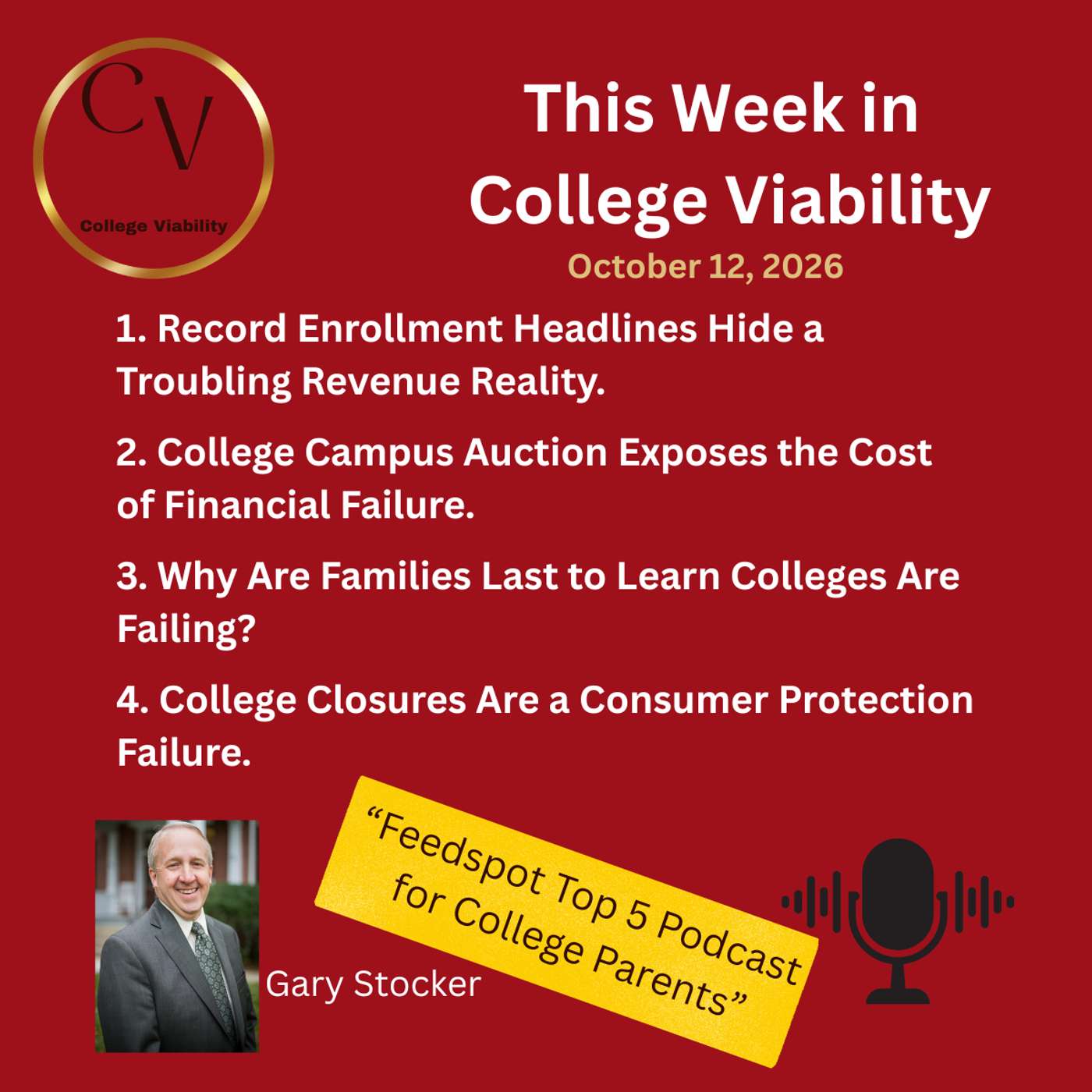
This Week In College Viability (TWICV) · Gary Stocker
In this week's This Week in College Viability News and Commentary, I examine the growing disconnect between what colleges announce publicly and what their financial data actually reveal. I look at the closures and financial fallout at Wells, Limestone, and Hampshire colleges, accreditation concerns at American International College, and faculty and staff reductions at Stockton, Bowie State, and the University of Utah. I also challenge the enrollment headlines coming from Delaware State, Cleveland State, and Alverno College, where impressive percentages can obscure declining student populations, increasing tuition discounts, and questions about actual student revenue. My message is that enrollment growth does not necessarily mean financial improvement, and families deserve to understand the numbers behind the headlines. I close with a broader argument that the financial challenges facing higher education are no longer simply institutional management problems. They are increasingly consumer protection problems. Colleges face declining demand, rising costs, federal policy uncertainty, and growing pressure to consolidate, yet students and families often receive little meaningful warning about institutional financial distress. I highlight Massachusetts' new financial disclosure requirements as a model other states should consider, particularly its requirement for public warnings before families make enrollment commitments. I argue that colleges should be required to demonstrate their ability to meet financial obligations well before students commit their time and money. The bottom line is simple: families wouldn't buy a house without an inspection, and they shouldn't make a major college investment without independently evaluating the institution's financial health and long-term viability.
Gary Stocker (00:00.98) It is Monday, October 12, 2026. Yes, time again for yet another podcast episode of This Week in College Viability News and Commentary. Sitting as always in front of the Blue Yeti microphone and the smooth running riverside.fm podcast studio. As always, and this, of course, is the show that talks about higher education, public and private colleges, and we focus on one thing. We focus on financial health and viability. We use data, we use publicly available filings, and we bring a perspective I've really not seen offered anywhere else. It has been, it is and has been, record enrollment season. If you read all the press releases in my inbox this fall, and and and they all have percentages in it, and I I don't doubt for a second the percentages are technically true. This week, though, some numbers behind the numbers showed up. And here's what I have for you today. One college, one college announced a record enrollment, and and the same college, a one third collapse in the same press cycle. I'll have more on that. One campus is headed to auction, closed campus is headed to auction at roughly a third of what the federal government lent this very same college just a couple years ago. And one accreditation renewal, I guess, will not land until late January of 2027, which will be about three weeks, three weeks after families put down spring deposits. And a state, Massachusetts, finally put a date on financial honesty. We'll have that, and of course, much, much more. Page two, Wells College, Brian Sharp had the story on WXXI News on October 9th. The college is pursuing a piece by piece sale of its campus and properties. Earlier this year, a $12.5 million sale of the campus collapsed, and a state Supreme Court judge has now approved the college's petition to auction off the remaining artwork and rare books and other artifacts. And something called the Hiawatha Institute for Indigenous Knowledge is suing to force a sale at a reduced price, citing significant building decay. Gary Stocker (02:27.842) Here's what I want you to take from Wells. Closed College. A closed college, a closed campus is not an asset. It is a liability with a mortgage. Gary Stocker (02:42.486) Once a college stops operating, the real estate and collections of the sort get liquidated separately on different calendars, and the students are long gone. The students are long gone before either of those things happen. And by the time the art and other artifacts goes to auction, there's nobody left to protect. Let's move on to Limestone University, and this one is the case study of the week. David Jesse had the story at the Chronicle of Higher Education on October 9th. Limestone closed after failing to repay, it's been a while. Limestone closed after failing to repay a $34 million plus dollar loan from the US Department of Agriculture. The core campus is scheduled for auction in November, and a Michigan firm called HTC Global Services has filed what's called a stocking horse bid at $10.5 million. And whatever they get out of this sale, the proceeds will go. To repay the USDA and the First National Bank of Pennsylvania. So do, if you will, the math with me. The federal government lent a small private college, $34 million in change. The market today, not that much later, says that campus is worth roughly a third of that $34 million. And if you're a listener who has heard before and who wants to know, From your college that we have a plan and we have a lender, as they frequently say. A lender's not a plan. A lender's not a plan. A lender is a deadline with dollars to pay attached. That's not a fix. That's a bridge. And the irony, the loan that came from a rural college lending channel, it was there to sub to help institutions like limestone. Instead, ironically, it became the thing that finished the job. Gary Stocker (04:43.778) They borrowed the money, couldn't pay it back. And and and that process is still occurring across the country. We'll see it again and again in college closures and the stories about those college closures in the coming months. And meanwhile, Hampshire College, that's has been well documented in their last semester right now. They're closing here at the end of this year. And and I'll say one thing about Hampshire and then I'm gonna move on. Hampshire is Hampshire, Hampshire. Hampshire is a well known brand for sure. It mostly has a national reputation. It's a distinctive model, absolutely for sure. It has decades of alumni. Gary Stocker (05:26.52) But reputation, reputation is not a it's not in the financial statement. You can't attach a real value to that. Some organizations attach value to their brand, but prestige does not pay the payroll, does not help keep the lights on. And I've I've said that so many times before, and will continue to see to say that. Page two, the American International College, AIC, Springfield, Massachusetts. Chloe Kraft at the Boston Globe had the story on October 7th. The New England Commission of Higher Education has issued a show cause to AIC on the standard for institutional resources for angel health. AIC is projecting operating losses of more than $17 million through 2028. And the college is set to appear in January of next year and explain why it should not be placed on probation or have its accreditation withdrawn. As you and I talk on in mid October of 2026, AIC remains accredited and it remains eligible for financial aid. And here's my question. Here's a question I want you to sit with. What does a show cause protect a student from? What does the show cause protect a student from between October now and January? Actually, late January. Nothing. Protects him from nothing. This is the timing problem, not a standards issue with your creditor. A show cause issued in October is unresolved until late January, which means families making spring deposit decisions right now are making that decision with no answer available from the college. And I want to be fair, I always want to be fair. AIC is being transparent. Nietzsche, the crediting organization, being transparent. The Commission is doing exactly what the Commission is authorized to do. My complaint is not with AIC or with NECI. My complaint and my concern more so, my concern is with a calendar that puts accreditation resolution or not after the deposit deadline. Why not make it december thirty first? So these families can have more information in deciding whether to continue at this college or what will happen many other colleges in the future. Gary Stocker (07:56.47) And now the federal side, and this is a big development. Twenty-three state attorneys general have filed a formal comment opposing the Department of Education's proposed recreation rule. Okay, nothing new about that. Gary Stocker (08:11.586) The attorneys general argue it exceeds the department's statutory authority and on and on. It goes with complaints and concerns. All right, that's fine, they're entitled to do that. They also say that the that the change weakens quality assurance and creates a race to the bottom on standards. And that's certainly a possibility. Now I flagged this in the college outlook letter earlier this month, beginning of this month. And what's happening is accreditation is moving from a sleepy quality assurance function that hardly anybody knew about. Into a full-blown federal policy battleground. 23 attorneys general do not weigh in on sleepy functions. And think about this: if Washington is going to rewrite how accreditors get recognized, then the states become the only functioning consumer protection layer left in the country. And I'll come back to this at the end of the show because Massachusetts has something to say about that. And I guess I'll do one more. accreditation item. And it has to do with cash and assets. The Pennsylvania State System of Higher Education approved a five and a half percent increase in state appropriations. At the same meeting, the system reported its twenty twenty six, twenty twenty seven budget is projected to run a th a sixty-three million plus dollar deficit. And on October 8th, even in light of the factor of a $63 million plus deficit, Fitch, the rating agency, upgraded, upgraded the system, upgraded the Pennsylvania state system to AAAA- with a stable outlook. So what we have here is two true things at once. The credit rating is improving while the operating deficit gets bigger. The bondholder looks at the balance sheet. The deficit The 64 million lives in the income statement. A system can look strong to a lender and still and still be, still be cutting its way through a shortfall. And this is the clearest example of that distinction I've seen in quite a while. Credit ratings measure the ability to repay debt. They do not measure, credit ratings do not measure whether you can afford to keep the lights on in the classroom you already built or meet payroll. Gary Stocker (10:34.602) And be careful to confuse not to confuse the two. Page three. Ganon University and Ursuline College. Crane's Cleveland Business had the story. Both colleges had an announcement. It's completed merger. The Ursulin became a Ganon campus on June 30th. And shortly thereafter, Dr. Walter Owenko resigned as president of Gannon. And Dr. Keith Taylor is the president of Emeritus, is returning to lead both institutions. I say this up, I bring this up. Because of something I said last week that I want to revisit on the podcast, because this is a follow-up. This is a successful merger. Ursula and Gannon, by any account, so far, is a successful merger. I said last week one unsuccessful merger, Antioch and Otterbein was the example. One unsuccessful merger should not be used as evidence that consolidation cannot work. I said the problems last week, I said the problems. demonstrate the importance of clearly defined governance, defined financial responsibility, realistic assumptions, transparency, and sufficient scale. Here's what that looks like in pri in practice. Here's what that looks like with Ursula and Gannon. Gary Stocker (11:52.672) A merger that completed on schedule, followed almost immediately, a couple months, with a presidential reset reset. And I want to be careful about how I frame that. The leadership change here is not a scandal. There is no suggestion anywhere that I know of of wrongdoing. What it is, is a signal about how much operational work a two-college combination actually creates. You d you don't finish a merger and then discover that you need a different leadership posture. Governance is the hard part. I and many others have said that for weeks and months, and this is and this week gave us proof. Gary Stocker (12:38.146) Page four. Gary Stocker (12:41.71) Delaware State University, Beta Bay News has the story, and it's confirmed by the institution's own release. Delaware State is on pace for a record of nearly 7,000 students. That would be the fall, that would be the official record of last year of 6,600 and change. Now, the new out-of-state freshman enrollment at Delaware State is down roughly one-third from last year. They don't actually use a number. Read that again, record enrollment. With one third fewer out of state new freshmen. That of course begs the question: where is the growth coming from? A 7% increase in continuing undergraduates plus graduates and online enrollment. So let me do what I do. The headline is a record, record blah, blah, blah. The segment of the class that generally pays the most and produces the most net tuition shrank by a third. This is a r this is a revenue story. This is a revenue story wearing an enrollment costume. Lower revenue, increased enrollment. And here's it, you gotta ask for this. Ask for net tuition revenue, not headcount. Then ask for the split. Ask for the total enrollment. Ask for the full-time equivalent enrollment. New freshman, out of state, in state, graduate, online. Then ask for the tuition discount rate applied, really to all those groups, but in particular to the interim class. Gary Stocker (14:16.219) And moving on. Gary Stocker (14:20.782) Cleveland State. Cranes, Cleveland had this. Idea Stream and Signal, Ohio also had it. First time enrollment. First time, full time enrollment, Cleveland State has fallen, 1,800 plus students in 2021 to 1,100, not quite 1,200 in this calendar or this fiscal year 2025-26. That's a 36% decline. So what did the college do? Zero tuition starting next year in the fall of 2027. Zero tuition for Ohio residents who graduate high school with at least a 3.0 GPA and come from households earning less $125,000 or less. So here's, I think this is the third data challenge of the week. Free tuition is a discount rate decision presented as an access decision. You get in, no cost. Ask the good folks at Cleveland State for the projected tuition discount rate under the new program. Ask for projected net tuition revenue per student. Ask for the annual cost. Ask for the annual cost to the institution when they ramp this up. Gary Stocker (15:41.728) I noticed as I read the announcement also, there was there's a contingency. And in the announcement that I had, the free and the free tuition at Cleveland State is for eight consecutive semesters. Do the math, get out your fingers and toes. Eight semesters is four years. It's only good for eight consecutive semesters, and I presume you have to pay. The four-year graduation rate, the four-year graduation rate at Cleveland State. Averages less than 30%, less than three in ten, who start at Cleveland State, graduate from Cleveland State in four years or less. That's over the last five reported years. So when we do the reverse math, again fingers and toes come into play, seven of ten students will go beyond eight consecutive semesters. And I'm guessing they lose their free tuition. Now, what that does to completion rates and ultimate graduation rates, I have no idea, but it can't be good. It can't be good. Page five. Higher ed dive on October 7th, Natalie Schwartz had the story. The Department of Homeland Security has proposed something called an optional practical training fee. $70,000 per student. $30,000 for subsequent recommendations, including STEM opt optical practical training extensions. So it's still open to comment, not done yet. It's not the the come public comments aren't due until early November. But let's let's do the math. We we do the math here at College Riability. Let's do the math out loud. A middle-of-the-pack university with a thousand international students, that seems pretty big, is looking at seventy thousand times a thousand. Gary Stocker (17:30.24) $70 million exposure, cost exposure. A research in university with several thousand international students is looking at a number that does doesn't fit any in any budget line the institution has. And here's the context that makes it sharper. There's already a drop in international student enrollment. And now there's going to be a substantial fee to add more students. One can guess what's going to happen. Those numbers are going to stay low or decrease even more. And this doesn't even include the graduate plus loans that will lower the amount of money that families and students can borrow in the course of pursuing undergraduate or graduate degrees. And now, page six. To Massachusetts, we go. Katie Castellini had the story, and I think I had this in last week's show also, at WBUR News. It was also covered by Higher Higher Ed Diet. So the Massachusetts Department of Education is amending its financial assessment and risk monitoring process. Financial assessment and risk monitoring process called farm. Okay. The law already requires the department to identify institutions at risk of imminent closure. They've not done a very good job of this so far. Both Hampshire this year and Anna Maria this year, way late on the notices, not doing a good job. So they changed the rule and To their credit. The change is this an institution judged unable to meet its obligations to enrolled and admitted students for the next 18 months, year and a half, must publicly post a notice by December 31st of that year. And why December, like I talked earlier in the show? Why December? Because that is before the spring deposit deadline. The commissioner's point, it's the right one. Is that college leaders want to wait until spring deposits are received before the before deciding whether they can survive and struggle through another year? Moving that disclosure to December gives families the information before they make the decision instead of after. Makes sense. And for example, Anna Maria, the state flagged that college's finances in April. Gary Stocker (19:54.538) Less than two weeks later, Anna Maria, less than two weeks later, Anna Maria announced it would close at the end of the spring term. Two weeks. Two weeks, that's what the old policy plan offered. Gary Stocker (20:12.696) So let me say this plainly, because I've been advocating it for a long, long time. Massachusetts has drawn the line at 18 months. And they have attached a date. If your institution cannot fund 18 months of obligations, the public find the public finds out in December, not April. That is the disclosure model. And there's nothing radical in it. It is a solvency question, 18 month solvency question with a deadline. And and a financially sound college has nothing to fear from answering it. We're good. A college that can meet its obligations can say so publicly and lose nothing, probably get some attaboys. The rule only burdens the institutions that already are avoiding transparency and already have something behind. And here's the connection back to the 23 attorneys general I mentioned earlier in the show. If federal accreditation oversight is being written in Washington, the states become the only working consumer protection layer left outside of private companies like mine. Massachusetts built a system, Texas doesn't have one. Most states don't have this kind of consumer protection for students. They don't do that good of a job looking at colleges anyway. So, so here's your assignment. If you want a homework assignment, this is higher education. I might as well throw out a homework assignment. Find out what your state requires. They don't require anything, I can tell you now. Then call your appropriate representative or your state higher education agency and ask them to at least think about copying the Massachusetts rule. It is a consumer protection function. Gary Stocker (22:02.658) There are students and families right now looking at colleges that they'll commit to next March, April that won't make it. I know it because I look at the data all the time. But those same students and their families don't, because nobody requires that information to be public. I do what I can to get it out there. We've got tools that help. But if we had the hand of the State Department of Education to help, that would put a lot fewer families in financial distress because of their college decisions. Gary Stocker (22:33.452) And again, you know college viability has the tools. Prospective data science has a higher end level of tools for college leaders. If you're a state leader listening to this podcast, drop me a note, Gary at college viability. I'll show you the tool that Matt Hendrix developed at PDS and you'll save yourself a lot of time and a lot of headaches. Page seven. I'm gonna leave you with one argument. And I have been building to it all year. We have spent this whole show treating college closures as a higher education story. And they're not necessarily. This is really more of a consumer protection story. And we're we're at least 20 years late in saying so as a country. And here's what I mean: if if a bank in your town If a bank in your town were unable to meet its obligations for the next eighteen months, that would be public really quickly. If an insurance company were operating without the reserves to pay its claims, that would become public. Public would know that. If a nursing home could not fund a year of care, a state inspector would be inside the building before you could get your deposit back. But a college, any college, can be 18 months from insolvency, not having any money. Know it inside, know it internally, be quietly making plans and tell you, tell families, tell students, tell the community nothing. And the family writing the check to that college is the last party in the transaction to home. Gary Stocker (24:14.39) And and notice what we ask of the family in that transaction, transaction. We ask a 17-year-old to weigh a hundred thousand plus dollars and four years of his or her life against a viewbook, against a webpage, against a campus tour, against a table of rankings. And as I've said before, th these measure almost nothing, probably do measure nothing, about whether that institution will be there when he or she graduates. We inspect a house. We inspect it, we look at the we look at everything before we sign it, and now I want to do the same thing for colleges. And and I'm not saying colleges are villains. They're trying to protect their business, and nothing wrong with that. Most of the people, almost all the people running these institutions are doing a very difficult job with the least money and the least thanks. And they're trying to keep something alive for their students and their communities, but there are too many of them. There are too many colleges. That's a basic economic fact. That has nothing to do with any single leader's capabilities or lack of capabilities in managing the finances. What I'm saying is that the information to students and families, consumers, comes in too late, comes out too late and doesn't have to. So here's as I wrap, here's what I want to leave with you. And it is small and is specific. Massachusetts has set the number at 18 months. And December 31st is the date the public finds out. It costs the state almost nothing. It costs a healthy college nothing. But it tells a family what it needs to know before it signs. This is not, this is not a regulation for regulation's sake. Gary Stocker (26:02.53) This is the most basic function of a state, making sure that the person with less information, students and families, is not quietly harmed or unintentionally harmed by the person with more. So go ask for it. Not for rescue, not for a bailout, not for free tuition. Ask to be told, ask to be informed. Find out whether your state requires any advanced warning from a college that's in financial distress. If it does not, and most states don't. Call whatever representative you want and tell them, ask them, please. Ask them to copy the Massachusetts rule. And if the state needs help with the data, send them my way. I can provide them with a tool. Gary Stocker (26:48.586) And because the alternatives, what we saw just this week, a campus in South Carolina going to auction at roughly a third of the federal loan against it. An accreditation decision that will not resolve until three weeks after families write their spring checks. And a record enrollment announcement sitting on top of a class, a freshman class, that shrank by a third. One third, that's the number I want you to keep this week. You don't buy a house without an inspection. You should not buy four years of college without one either. The college viability inspection report gets you there quickly. And everything so far we build, everything we build so far is free. And it's at mycollege viability.com. The analytics and stress tests built on the public data. The question guides for your admissions and financial aid meetings. The college decision lens to help you make a decision. The college majors completion tool to make sure that the majors are you're looking at that college has at least a handful or more of graduates each and every year. And if you're sadly in this situation in the near future, the My College just closed, the My College just closed resource center. Do the math. Ask the questions. Ask your state to require that all colleges answer that question. Let's call it a wrap. Hi, Gary Stalker at College Riability. I'll be back next Monday. Thanks as always for listening, and we'll talk again next week.