
This Week In College Viability (TWICV) · Gary Stocker
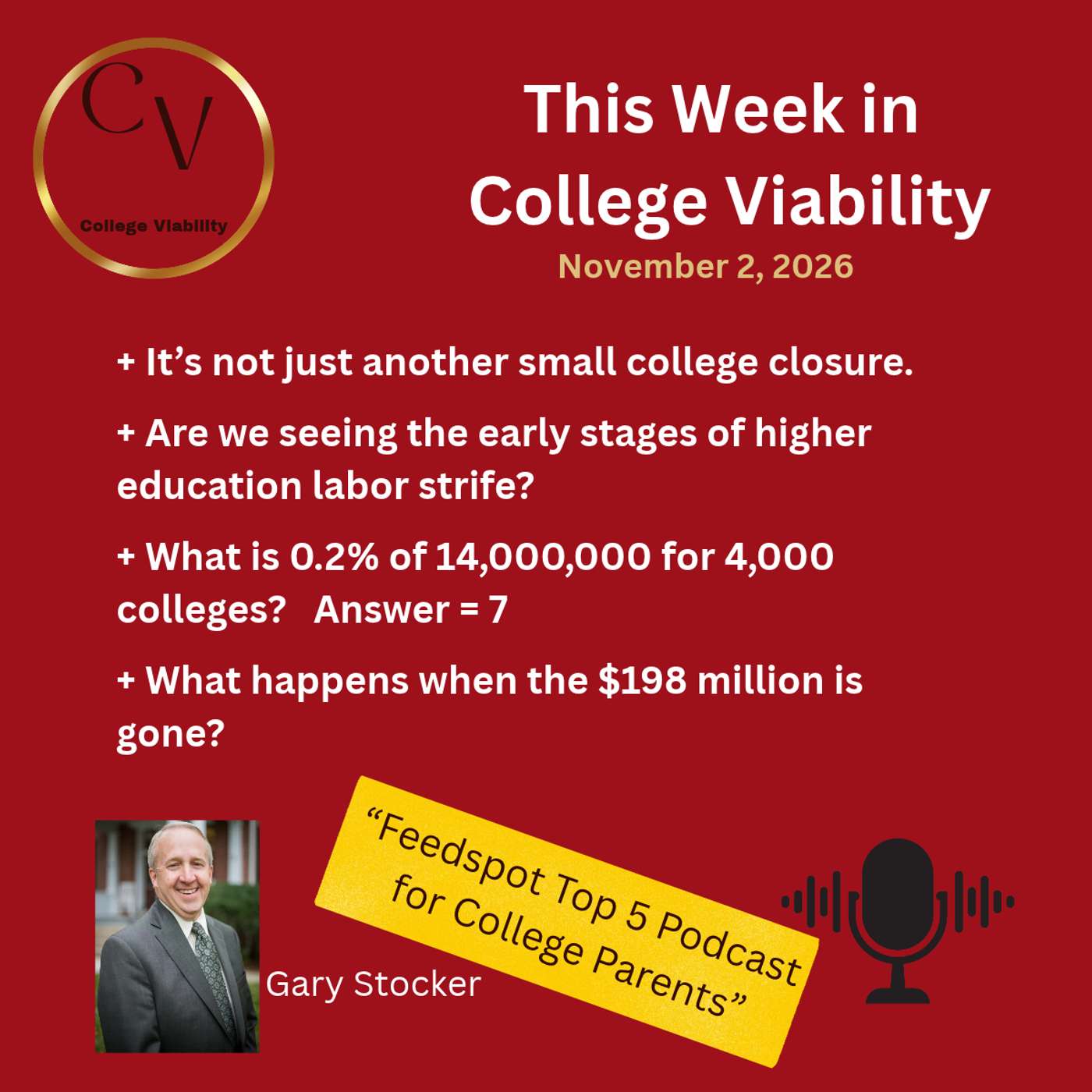
In this week's This Week in College Viability News and Commentary, I examine the announced closure of the University of Providence in Montana, where years of financial dependence on an outside health system ultimately proved unsustainable. I also look at growing faculty unrest, layoffs, and budget cuts at Commonwealth University, Temple, Oregon, Kent State, and across the California State University system. We should start to watch for more widespread faculty labor threats and actions. It is possible that the past year's layoff and cutbacks have reached a point where faculty feel a need to push back stronger than ever. I discuss new enrollment data showing virtually flat national enrollment growth alongside a troubling decline in master's enrollment, as well as changes in accreditation and Illinois Tech's plans to borrow nearly $200 million from its own endowment. I conclude that the University of Providence closure is much more than another small college failure. It illustrates a widespread consumer protection problem in higher education: students and families are often unaware of serious financial risks until colleges announce layoffs, eliminate programs, or close. These warning signs exist at institutions of all sizes, and neither accreditation nor a college's reputation guarantees financial stability. My message remains consistent: families deserve greater financial transparency, stronger consumer protections, and independent information before making one of life's largest investments. Inspect before you invest.
Gary Stocker (00:01) It is Monday, November 2nd, 2026. Hi, everybody. Time again for another podcast episode of this week in college viability news and commentary. And of course, this is the podcast. This is the show that talks about the financial health and even viability of public and private colleges with data and with details and with stories and with perspectives offered probably nowhere else. And as always, sitting in front of the blue Yeti microphone. And the smooth running riverside.fm podcast site. Something, ladies and gentlemen, is going on in higher education. And I've got some theories on that. I'll talk about a little bit later in the show. But here's where we're headed this week a college closure in Montana, University of Providence. It was another small one, but don't fall for the small only closures narrative. You'll hear from higher education pundits, and I'll tell you why in a minute. There are protests, higher education protests in Pennsylvania. Don't mess with temple students or Kent State faculty or California Faculty Association. And then finally a math problem. What is two tenths of a percent of fourteen million? I've got the answer for you later on the show, and it is the data from the National Student Clearing House had their fall preliminary research center report released last week. And it's interesting when you actually look and break down the numbers, what's going on? So the University of Providence in Montana. Announced it will close in August of 2027. First of all, kudos to them for not doing a short notice closure. ⁓ too many times that's happening these days. So next August, ⁓ it will close. ⁓ and and the anatomy lesson is interesting. This story comes from the Montana Free Press. Matt Hudson had the story, and I'll have the URL in the show notes. And I guess the the story here is eight million dollars. Eight million dollars a year, that's what was keeping this Catholic university alive. And when it stopped, the university had two years left. And this is a story not about a college in trouble. This is a college about whose sponsor, the Providence Health System in Montana, got in its own financial trouble. And nobody told the students that the benefactor for this college was in trouble also. Until the closure announcement. So here's let's look at the anatomy. And it's worth walking through this slowly. So for years, the University of Providence ran a deficit. And for years, that deficit was covered, about $8 million a year, give or take, by the Providence Health System. In 2025, the health system itself ran into financial trouble and gave the university two years before the money would end. That would be in 2027. That the University of Providence declared financial exigency last December, cut programs and staff and faculty, explored mergers and acquisitions always a day late and a dollar short, found none that worked. I know why, because nobody wanted a college about to close. And on Tuesday, the president ⁓ said that they had exhausted every viable path. That's what we always hear, and they were gonna close. So 630-some odd students, more than 200 employees. That's a three to one ratio, that's interesting. And a city losing its only four-year university. Here is the lesson for any family listening. The college that your student enroll is not always the only or even the main funding source behind it. It usually is, but not always. And you want to ask your colleges, the colleges you're considering, ask who keeps the lights on, and ask what happens when that benefactor. should stop if they did. And if a college ever declares financial exigency, that is the moment that you should have had full disclosure right then and there. Not the closure announcement a year or two or three later. Now the University of Providence says every student will get individualized guidance toward a degree or transfer under accreditation rules. I would ask to see that in writing because we know the folks are going to be jumping out of the university quickly to find their own jobs, their own careers, to support their own livelihood and needs. So I don't know how long that college will be able to support that intent. And and the rest of the story, again as a late great Paul Harvey would say, this story is playing out, similar story is playing out in hundreds of colleges as I do this podcast. And there is little, if any, consumer protection until the story comes out that we're closing. Now there may be concerns on campus and rumors on campus But the colleges themselves are not transparent. Not a good situation. Page two. And we're well into high into the higher ed college season now, so we're going start to see and lots of more cutbacks and layoffs. And the the show this week is full of them. The Commonwealth University Unions in Pennsylvania took the layoff fight to the Pennsylvania State Capitol. So the Commonwealth University leaders, union leaders, held a press conference at the Pennsylvania Capitol on October 21st, urging lawmakers and the administration to stop the planned layoffs. We're going to hear that all over the country. The university plans, maintains 75 faculty retrenchments. That's the word for layoffs, but union members report receiving 114 notification letters of layoffs. Well, that's not right. And these cuts are supposed to finalize by the end of by last week, then of last week. So the gap between the official number 75 and the notice letters 114 is exactly, it's exactly the discrepancy that makes faculty Distrust published figures and even their own administration. When a university distributes 114 letters to satisfy a contract while publicly claiming only 75 cuts, somebody tell me which number is real. And if you want to challenge the data, ask the Commonwealth University system for the total number of notice letters distributed versus the actual retrenchment or layoff target, and whether their $17 million deficit is recurring. Or one time. That's nowhere to be found in what I was looking at. Temple students and employees rallied the same day, the very same day that its board dissolved the School of Theater, Film, and Media Arts. Susan Snyder had the story for the Philadelphia Inquirer, and Ariana Elise had the story for Temple News. And on October 14th, students and employees rallied against 236, big number, 236 position eliminations and 40 layoffs. Targeting President John Frey's administration at Temple University. The same day, the board approved dissolving the School of Theater, Film, and Media Arts. They moved the theater moves to the Boyer College of Music and the Film and Media Arts moves to Klein College. So just restructuring. And this is effective July 1st of next year. So what's interesting here is the restructuring decisions and the labor resistance arriving essentially simultaneously. A school dissolution inside of a college, a school dissolution inside of a college, approved at the meeting where the workers actually protested the layoffs, means the decision was made while resistance was happening. Think about that. The decision was made while at the same time that resistance was happening, not afterwards. And so again, if you want to challenge the administration at Temple for Data, ask them. For the projected annual savings from those two hundred and thirty-six eliminations, not just in year one, but in year two, three, four, and beyond. Let's go to Oregon. I guess we're gonna go across the country here. Oregon Plan spares tenure track faculty. By cutting graduate funding up to 40, that's four zero, forty percent, in some colleges. Look out, Eugene had this, ⁓ Iris Comar was reporter, and Sarah Brown for the Chronicle of Higher Education also had this story. The shape of the cuts is now public. More than 100 staff positions are limited, and more than fifteen one five graduate programs are phased out, largely humanities, and graduate employee funding cuts substantially. In some colleges with no tenure track layoffs plan, you gotta think, pure speculation on my part, you gotta think that the faculty were the ones involved in that decision to protect their tenure track faculty. Nothing wrong with that, but it has consequences on the other end. So what we have here is the trade shifts the cost of restructuring onto the least protected academic workers and onto program or major's capacity. Research universities we all know have historically protected graduate education as a lost leader. They made money for that, for research output. Cutting it is a change in the model, not just the budget. Let's watch to see if there are any graduate student organization efforts at Temple or other places to follow on with this. I said temple, I meant Oregon. Kent State. The pattern continues. Kent State's tenure track faculty union declared impasse is picketing and is circulating a no confidence petition. What else is new? ⁓ the Kent Stater had the story. Lucy Greetham and the staff reported on this. The Kent State Faculty Association, Kent State University Faculty Association, declared the impasse a month ago on October 1st, picketed and continues no confidence petition against. Put against President Todd Diacon. Even after cost of living memorandum surfaced, the board held a special meeting on October 23rd on the tenure crack tenure track contract. So what we have here is a no-confidence petition tied directly to the budget. It's the budget fight and it's the faculty pressure pattern to watch for. And and and here's what I I worry was happening. I was gonna have this toward the end of the section. And what we're seeing here is a pattern of labor unrest. Across you know, the truth or stories I've had so far, I've got one more coming up here in a second. That I hadn't the the the the the number of them and the immediacy of them is something I haven't seen over the last four or five years. And I'm gonna be watching that closely to see if we are on the leading edge of a pattern. And the next story is a California Faculty Association opens a strike authorization vote at all twenty-three campuses. So the source on this is ⁓ Mac Irvin the third at the sacrament The C the CFA union and the Sacramento Bees Zadie Staley had the story as well. The vote runs from October 26th last week through the middle of this month, November 19th. the union rejected management's 3% raise and 3% one-time bonus. Disputes continuing cover salary, workload, job security, academic freedom, and AI safeguards. That would be interesting to watch. Fact-finding hearings begin in early November. Now, if a strike follows. It becomes the largest faculty action in the country in this academic year. Early in this academic year. And it lands in the middle of the negotiation at the largest four-year system in the nation. The by the way, the authorization vote is a precursor, not the strike. Watch for the no the November 7th, the November 19th close on that action. So let's do a math lesson. What is two tenths of a percent, two tenths of a percent of 14 million? Because the National Student Clearinghouse Research Center announced last week that the preliminary results for the fall of 2026 showed a 0.2% increase in enrollment. So I did some easy math. So 0.2% of about 14 million students, pick whatever number want, but two tenths of a percent of 14 million students is 28,000 students. Let's assume there's about 4,000 colleges. Again, pick your own number, do your own math. 28,000 divided by 4,000 equals, when the figures chose, seven students increase for each of those 4,000 colleges. Now that's a crude number trying to make a point here. It's from the National Student Clearinghouse Research Center data. And seven students does make a big difference to a small number of colleges. You know, figure 15,000, 20,000 intuition revenue, that might keep them from closing or at least keep them from layoffs and cutbacks. But for the most part, seven students. You can fit seven students on a couch to use the couch, the couch money analogy. So what we have here is undergraduate enrollment up point six tenths of a percent, while master's enrollment dropped three point seven percent. Families, so the the master's one is I want to f is the one I want to focus on. Families choosing a master's program for 2027 should ask how dependent the program is. I get this, how dependent the program is on international enrollment. A 3.7% national drop concentrated in the highest net tuition segment is a revenue event because colleges depend on this revenue. It's not just a headcount event. And so if you're looking at that, ask Ask the college, ask the majors, ask the dean, ask the programs. Market that are marketing strong enrollment for domestic enrollment versus international split over the last couple years. If that if it was heavy on an international split, there's reason to be concerned. And then I guess I have to do this to you one more time. The University of Maine unions and faculty and the faculty senate escalated in the same week. Issues with Maine, and the story is they don't like the budget numbers. They delivered 350 signature petition to the president's office last week. And the town hall criticized get this a lack of transparency on the layoff numbers. And the details are there. ⁓ I'll try and put the link in the show notes. Yeah, I'm gonna say this one more time. So we have four to five stories this week on labor unrest in higher education. And I really as I read through these and prepared the show for today, I wonder if we are on the leading edge. Of a national faculty pushback on the layoffs and cutbacks and even AI topics we're seeing across higher education. I'm gonna watch and make sure the searches that I do include ⁓ labor labor conflict, protests, layoffs for higher education for the coming shows that I do. Page three, accreditation, money and deeper issues. And what we have is we've got accreditation agents t two big accrediting agencies had changes last week. The Commission for Public Higher Education in Florida, launched by the Governor of Florida in two June of last year, voted Florida Polytechnic Polytechnic University as its first accredited institution. And they have letters of intent from at least ten institutions in Florida, Georgia, North Carolina, and Texas. No federal recognition yet. And so Florida Poly keeps existing, keeps this existing commission on high on colleges and universities accreditation until recognition arrives. Separately, different activity for an accreditation, the National Association of Schools of Theatre, NAST voluntarily relinquished its recognition effective October twenty second. They cited new federal regulations inconsistent with its accreditation values and and the politization, politization of the department and its accreditation advisory committee. So okay, do whatever you need to do. So two new accreditors with fifteen institutions between them, one accreditor bailing out, and one reaching its narrow scope accreditors, all in two weeks. And what's happening here is the market is unbundling. From three directions at once. The standing questions still apply about accountability, financial health, student protections, outcome comparisons, and even founder influence was an issue with one of the accreditors earlier this year. And add a new one. What does a first-time accreditors review actually examine? Let's look at those standards. Let's see if they include protections for students. And will the standards ever be published in a form that doesn't bore us to death with reading them? And again, I gotta go back. These accreditation agencies have some obligation to protect students, and they're just not doing it now. Illinois Tech plans to borrow 198 million, 198 million from its own endowment. And so SP downgraded Illinois Tech from BB to BB from BB Plus in mid-October, citing a 16% drop in enrollment. So what we have is a university borrowing against its endowment to fund operations and the spending principal of that endowment to cover operations, to keep the lights on, to meet payroll. If a college is borrowing from itself, the enrollment problem is structural, not cyclical. If you're looking at Illinois Tech, this is the indicator to put at the top of your list what's going on with borrowing all that money. So when it's gone, it's gone. And again, I will remind listeners that endowments are there to keep colleges in operation into perpetuity. And when they use up that one ninety eight, it ain't there no more. College closures. And we have here, I think John Marcus had the story on college closures. And he reports that colleges closed at a rate of nearly one every three weeks in 2025. I didn't check that number, I'm taking his word. And about 150 private non private nonprofit institutions have closed or emerged since 2016. College attendance is down two million since twenty eleven. We know all those data points. Confidence in higher education is down. Hampshire College shuts down at the end of December. And its records transferred to the University of Massachusetts Amherst campus on December 31st. So, what John Marcus is doing here is he's doing the sector level, the higher education level version of what we do on this show, college by college. He's taking a big look, which is fine, but what really matters is that the individual by individual by individual college. That's where the listeners and the students who listen to this and the families that listen to the podcast. Want focus on the macro numbers are fine. They can inform us, but it's the numbers for each individual college that we do here on this show, that we do on the College Financial Health Show with Matt Hendrix, and that we have in the College Viability Inspection Report and the soon to be released, really soon to be released, my college decision team. And then finally, let's do a wrap. And I'm gonna go back to the University of Providence. And I mentioned that the higher education pundits will say, Hey, small college, so what? This wasn't just another small college closure. The defenders of higher education will say that this week's announced closure of the University of Providence is just another small rural underfunded college that couldn't survive in today's competitive higher education marketplace. And they're missing the point. They're missing the point. The University of Providence did not run out of money last Tuesday. It didn't suddenly discover that enrollment was declining. And its financial problems did not appear overnight. This was a financial crisis years in the making, as it is in almost all cases. And the warning signs were there for anyone like me willing to look. And this wasn't simply a college that failed. This was a financial model that is somewhat unique, a financial model that depended on someone else continuing to pay a big portion of the bills. And when that financial support disappeared, the college could no longer support itself. So here's my question. How many families enrolling their students at the University of Providence in Montana understood that the institution depended on an outside health system for millions of dollars in its annuity in its annual operating budget, operating support? How many understood what would happen if that support ended? And how many were given enough financial information to evaluate that risk of going to Providence before committing four years of their lives and thousands of dollars to the institution? That's the issue. Not whether the faculty cared about their students, I'm sure they did, I know they did. Not whether the university had a valuable education mission, it did. And not whether the administrators also worked hard to save the institution. The evidence suggests they probably did. The issue is whether students and family had the information they needed to make an informed financial decision. And almost certainly that's not the case. And finally, let's stop pretending. Let's stop pretending that this is just a small college problem. The specific circumstances at Providence may be unusual with their health system advis benefactor. But the underlying warning signs, operating deficits, declining enrollment, inadequate financial reserves, dependence and outside support are not. These pressures exist at colleges across the country, and far, far, far too often. Families don't understand the risks until the institution announces layoffs, limites programs, declares financial exigency or closes. That's, ladies and gentlemen, that listeners, is a consumer protection problem, and we're doing a poor job of creating consumer awareness. We have elaborate Disclosure requirements for mortgages and investments and many other financial transactions. But a family can commit tens of thousands of dollars in four years of a student's life to a college without receiving a clear, independent assessment of whether that institution is financially capable of delivering what it promises. That simply has to change. States need stronger financial disclosure requirements. Accreditors need to communicate financial warnings. In language families can understand. College trustees need to recognize their fiduciary responsibilities, include protecting students from avoidable disruptions. And families, please, families need to stop assuming that accreditation, a beautiful campus, and an active admissions office are evidence of financial stability. They are not. The University of Providence is not simply another college. Another college closure to add to a growing list. It is another, yet another reminder that students and families often bear the consequences of financial problems they did not create and may never have been adequately equipped to evaluate. At college viability, we've been making this argument since 2019. Before you commit to a college, investigate its financial health. We've got tools to help you do that. Before you believe the promises, examine the numbers. And before you invest four years in thousands of dollars, ask whether the institution has the financial resources to keep the promises they make. Because the University of Providence's financial problems didn't begin last Tuesday. Last Tuesday was simply the day the rest of the world learned how the story would end. And that is why we continue to say: inspect, inspect, inspect before you invest. I'm Gary Stalker and this has been yet another episode of This Week in College Viability. I'll be back next Monday as always. Grateful for your listening. We'll talk again next week.