
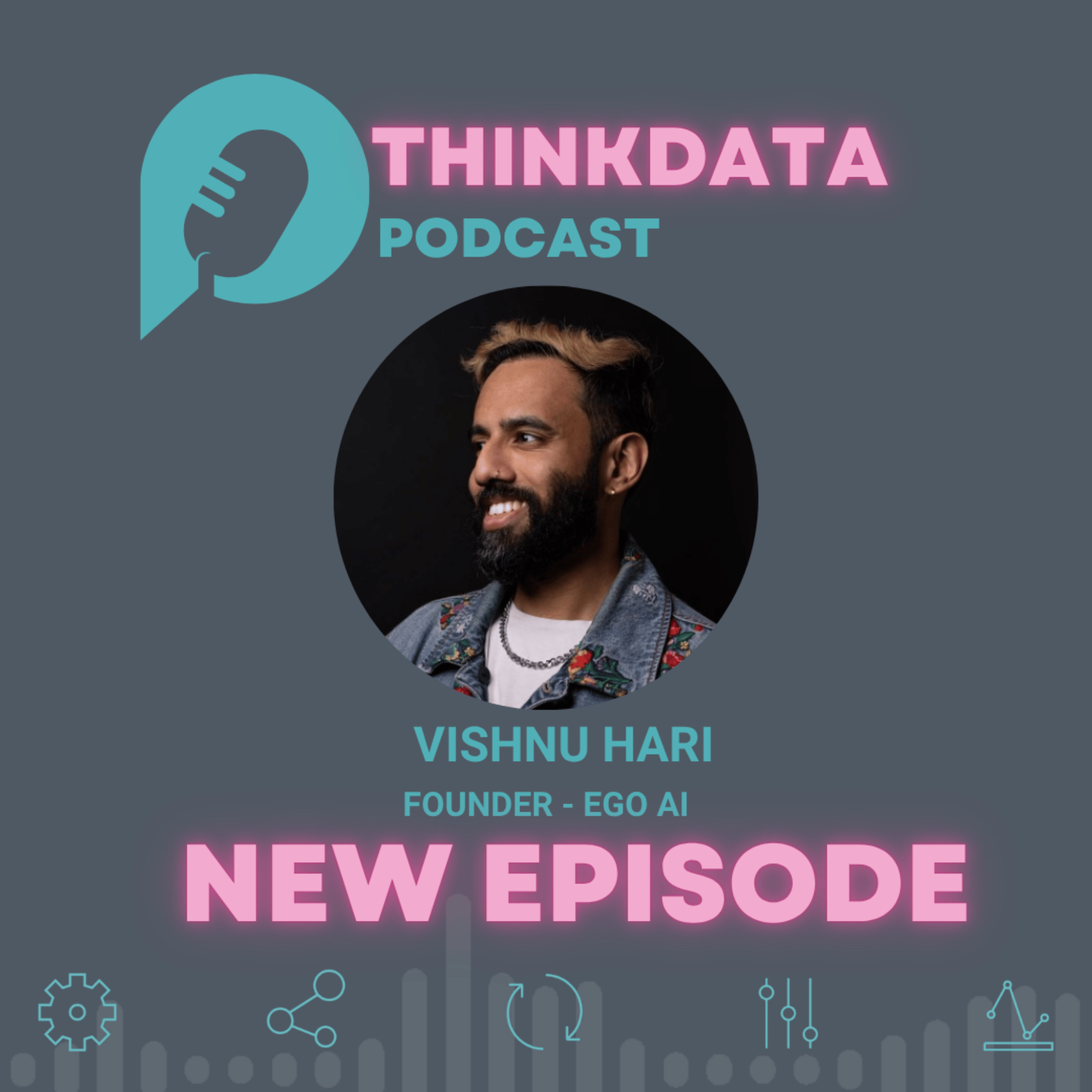
ThinkData Podcast · Dataworks Group Limited
Most AI today is intelligent… but it doesn’t feel human. In this episode, I sit down with Vishnu Hari, founder of Ego AI and former AI researcher at Meta, to unpack what’s missing and why “humaneness” might be the biggest unlock in AI. We cover: Why AI still feels robotic The gap between intelligence and behaviour Why most AI companies are solving the wrong problem And where the real opportunity sits If you think AI is already “good enough”, this will challenge that.
0:03Welcome to the Think Data podcast brought to you in partnership with Mydataworks. If you want to stay up to date with the latest breakthroughs and trends in the world of data and artificial intelligence, and if you're curious about some of the strategies that companies and founders use to launch data and AI products, then you're in the right place. Our aim is to bring together a diverse lineup of fantastic guests from the founders, through to accomplished leaders and product owners at some of the most fascinating data and AI companies worldwide. They will each offer you their own unique insight into what it takes to launch and scale a great data business. Thanks for tuning in, and I hope you enjoy the episode. Welcome to the Think Data podcast, and today's guest is Vishnu Hari. He is the CEO and founder of Ego AI and formerly in AI research from Meta. Ego is a Y Combinator backed startup that is building AI that behaves and talks like human beings in a space where obviously everywhere you look is AI this, AI that. I think I can confidently say Ego and kind of the conversation we've had prior to this has kind of pepped my interest, my curiosity, because I'm really keen to... Drill down on kind of the backstory. I know you had a solid stint at Meta, obviously heavily focused on the AI piece, the research piece as well. But obviously, Ego, what, a couple of years old, Y Combinator backed, gathering a lot of kind of momentum and interest. But I'm interested to kind of take you from big tech to Ego. When was that kind of epiphany and what led you to believe, you know, I'm an entrepreneur, there's a founder of me here?
1:56The epiphany happened when I was 15, honestly, 20 years ago, that I've always wanted this to exist. I started my career, I wouldn't even say career, I started my deep interest in tech by being a video game modder. I started modding video games as a teenager, specifically with Grand Theft Auto San Andreas. And in it, I found the potential to create a World of Warcraft-like experience where the NPCs could potentially have internal lives and their own desires, and I could talk to them the way I could talk to my friends in World of Warcraft, but I couldn't do it. And my interest in AI was seeded at that very moment. It only came to reality when I joined university. So it just so happened that the university that I was studying at was where a lot of modern AI was born.
2:35Interesting.
2:35That's the University of Toronto. Yeah.
2:37Yeah, because I was going to say, what was your degree? What did you kind of graduate in?
2:41Astrophysics. I was doing an undergrad and eventually a PhD in astrophysics. But I did a lot of work in very early stage AI research to find exoplanets. where we use deep learning models to find exoplanets that how that's how i got into the air research space interesting this is in
2:582014 2013 yeah wow fair enough and as i mentioned at the top kind of ego when we had the initial conversation in terms of what you're building how you're going about and also let's be honest some of your you know being featured in forbes there'll be some really interesting articles about you and your really clear vision about how you see this space. But for people who are listening, what is ego and what problem are you ultimately trying to solve here?
3:25We're at Applied Research Lab and we're trying to solve the problem of humanness in AI. When you talk to AI, you know it's an AI. You can feel like it's an AI. It can speak in the language of humans. It can even have maybe minor cadences and stimulate humans. But at a certain point, the mask slips. We're curious to know how we can stop the mask from slipping. That's how ophthalmophysation is innate to every human. We do it to, well, other humans, but definitely Thank you.
3:47pets and maybe even pet rocks we want to now take it to ai interesting and how do you even was that born was that idea born off the back of your frustration with that kind of interacting interaction
4:02with ai was it something far bigger than that yeah i just started from my frustration with interactions it started with npcs scripted npcs and video games and it's evolved into well one chat gpt launched i was obviously like deeply fascinated but i was like it's still staccato like the conversation that you and i are having the cadence we have the way we can read each other's facial expressions can't do that with it i can't have a true collaborator and that's humanness and that's a problem that i was extremely motivated to solve what underpins humanness then in terms of kind of because as you say like you and i having this conversation that the leaning
4:36in leaning out the mirroring but obviously from an ai and actually how people are interacting with ai now is most of it is online they're kind of typing away and actually... We're probably a little way away from having those interactions face to face right now. But what defines humanness then?
4:53We have a thousand years of philosophy to read through to even understand, to even scratch the surface. But I... you know, for the context of this conversation, I think humanness is best when it's felt. You can feel it. And it's not something that's objective. You can't build a benchmark for humanness. In fact, we dehumanize each other sometimes. Real humans will dehumanize and we'll do horrible things to one another. So humanness is the continuum. But for us at Ego, we've decided to like bucket it into certain categories. One, for example, is conversation cadence, right? When you talk to an AI model, it's still very... turn-based. I take my turn to ask a query, the AI responds or asks for clarifying questions, and then I clarify or expand upon my question. And then it gives me some sort of output at the end of the day. That's not how humans work. Maybe bureaucrats work like that. Politicians do, but not humans. We like to go back and forth. We like to think with one another. We like to debate. We like to push back. And that brings us to the second category, which is an internal sense of self-worth in life that allows you to push back on things and allows you to go, no, no, that's not what I meant. Let me clarify. Or, no, I don't think that's super correct. Or, oh yeah, I totally agree with you, dude, in the middle of someone talking. That's another example of you have some sort of deep anchored emotion about the topic at hand and that allows you to then interrupt or initiate or steer the conversation in other directions. That's the second thing. Those are the first two things we're looking to solve with our behavior model, the white paper you can read on our website. And there's many more that are more demonstrated in the body environment, specifically in games. And finally, robotics. But that could be another whole topic of conversation. But that's the first two places for starting.
6:35And why is it so hard to build in terms of, obviously, you know, for people listening here, their probably main interaction with AI specifically, maybe through a chatbot or, you know, some voice AI when they're trying to get ready to contact center. And that's ultimately their only limiting kind of interaction with an AI of sorts. but why is it so hard to kind of... build what you're building so that real kind of human centered ai the one that actually generally feels like you're speaking to because obviously emotional intelligence that kind of ability to interact and react and have feelings and um you know give you that gut feel about things why how's that why is it so hard to build i
7:16split this question into two two responses one it's why it hasn't been built and why why it's hard to build The reason it hasn't been built is actually kind of feeds into why it's hard to build. It's because everyone's focused on intelligence. All the major AI research labs are in the chase towards AGI, the infinite knowledge machine god. That's a very reasonable thing to want to chase, but that's been their focus. So humanness gets lost in the way. The reason why it's hard to build is actually twofold. One, the data you need to have the kind of human-like conversational cadence of extremely hard data to acquire. You see, when you... through all the internet, you can find all kinds of data on people's writings, people's thoughts, even people's videos, them talking to the camera. What you can't do is get conversations like this. Even if you can in podcasts, it's a very structured environment, right? It's not a phone call that you have with your friend. That's hard to get. And even if you did get it, the second question of why it's, the second reason why it's hard to find, hard to build this is because there is no deep intrinsic desire to solve the problem of humanness. And that kind of feeds back into the first point, which is that AI labs are focused on intelligence. But even if they didn't focus on intelligence, most of the business in AI right now, it's kind of B2B SaaS. Does a call center employee really need to have a sense of an internal life or push back on your questions? No, they don't have to. So because they're focused on B2B and not consumer, it just doesn't happen.
8:41Interesting. So obviously you're predominantly a research lab and you're heavily in the weeds here, working on what this future state looks like. But if you... projecting you know you get this really like human ai behavior what what sectors what industries do you feel would benefit first and foremost from this are we talking around just generally that this could be benefit any sectors or do you think there's other sectors that might benefit from this human like ai over another for example so