
The Whitespark Local Update · Darren Shaw & Claire Carlile
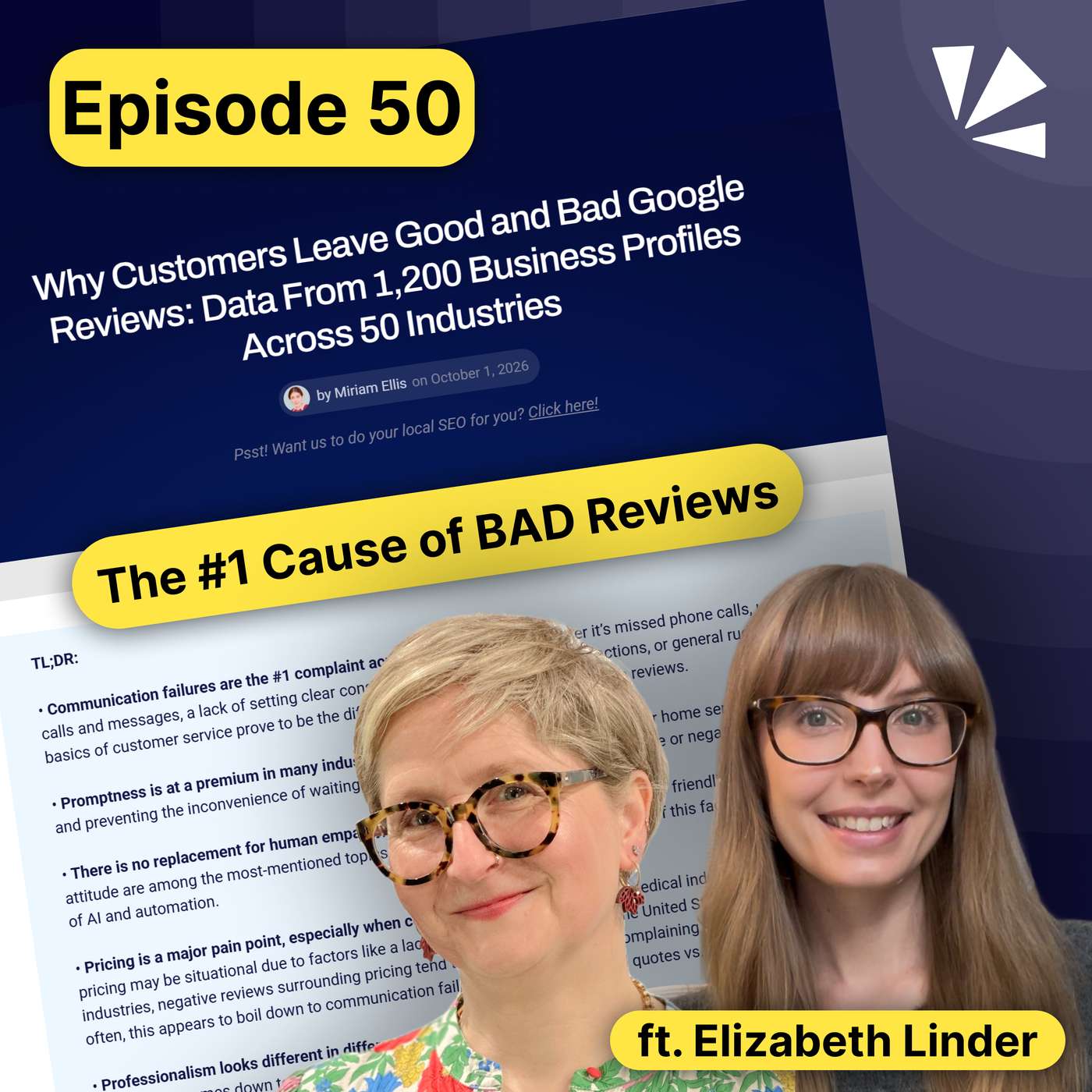
Claire Carlile is joined by Elizabeth Linder to cover the biggest stories and updates from the past week in local SEO, Google, and AI search, including: 📝 Google Business Profiles Policies Adds Misuse Of Support Channels (Barry Schwartz) Google Business Profile third-party policies 📝 SEO & AI Tip: Grade Every Page the Way Google's Quality Raters Would, Then Map Them Semantically and Size Them by Clicks (Dan Hinckley) 📝 Why Customers Leave Good and Bad Google Reviews (Miriam Ellis) 📝 Earlier today I attended the GEO KNOW HOW conference. Here is everything I learned (Malte Landwehr) 📝 GEO Is CRO: Ross Hudgens on Chasing Influence, Not Citations, in AI Search (Near Media) 📝 How to Check What Google & LLMs See in Website HTML (Daniel Foley Carter)
[Claire Carlile] Well, hello, hello, and welcome to the Whitespark Local Update, which is a podcast, which is about local SEO and local visibility, and you love it. And this is where we get to share our exciting linky links from the world of local things. And today I have a special guest who is the very wonderful Elizabeth Linder. Hello, Elizabeth. Hello. [Elizabeth Linder] It's, look at us, you know, I'm very excited to be here. [Claire Carlile] And I am very excited to have you here. So you are the local SEO strategist lead at WhiteSpark. So we are very lucky to have you working with us and we get to work together every day. So lucky me and lucky everyone. So my first linky link today is a piece on Search Engine Roundtable, which is where they pick up on the fact that in the Google Help Docs, in Google Business Profile, they have added another section, which is in their policies for third parties, so agencies that are working with Google Business Profile on behalf of clients. So the bit that has been added here is to do with making inappropriate use of the support channels. So reading between the lines, I think that this is when agencies or people that are solo consultants working on behalf of businesses make lots and lots of support requests within a Google Business Profile. So I think that's what that's getting at. And the reason that is a problem is you can imagine what that does to an already very overloaded support network. So they're pulling them up on it and I think that if you do it and you are found to be very naughty, then they will stop supporting you. What do we think of that? That's just rude. [Elizabeth Linder] No, it's hard because it's just, it can be so unhelpful. It can be so unhelpful and you have to keep following up all the time, all the time. Yeah. I don't know about this one. [Claire Carlile] Okay. That was a, that was hard disapproval from you. I think rather than like, sometimes you do need to be completely tenacious and follow up and follow up and follow up. But the thing is, if you start a million and one support requests for the same thing. Okay. Yeah. Yeah. That's where the naughtiness, that's where the naughtiness lies. So don't do it. Don't do it. People. What have you got to share with us? [Elizabeth Linder] I have, my first link is a LinkedIn post from Dan Hinckley. Uh, he is the head of AI at Herringbone Digital. So this was a really interesting post. It was about rating every page of your site using this AI model based on Google's quality raters and how they would rate your page. And that's just the first step is being able to do that. Um, I believe on their website, they actually have a tool that you can throw in a URL and it does it. Um, but he took it a step farther and basically mapped it semantically. And I think this was really interesting because on his, and I made notes for myself, so he mapped it all out in this really good visual, which you'll see. And he ran 1600 pages and he labels them so that the color of the circle is the meaning in his picture, it's blue is you're all good. And then orange, red, it's low quality. Um, and then the position of where it is on the map is the topic. And then the size of the little circles everywhere are the clicks from search console. Um, and what I like about this is as someone who doesn't love getting so granular into every data point possible, um, it's just a really good way of visualizing quite quickly. Cause I think you said it took him around two minutes to do this. Um, which great. Uh, it might take you a little longer. So be it, but it's a good way to visualize just really quickly. Do I have a quality content problem on my website? I think that's the easiest form of what you can do with this information. I thought it was really interesting. And then you can think of, okay, if I do have a quality problem, what topic or what area or section of my site is that quality issue coming from? And also maybe just an immediate next step, because I think that's the best thing that SEOs can get out of any tip ever. What can I actually do with this information and with the size of the circles I thought was really interesting. So like, if it's a really big red circle and in his screenshot, there's more orangey red, large circles that you can, um, you know, that that's a low quality. Page, but that's getting already a lot of clicks. So start there. And then maybe if you're using this to upload all of your content, you're trying to prune your site or you're trying to clean out a blog, it's a great way to see it. And if you see all these tiny little circles out in the distance and they're red, that's a good flag to just, Hey, prune it. Um, and again, this comes with a lot of caveats. Depending on your site industry and that sort of thing. And again, you know, rating your page on the quality writers using an AI model might not always be perfect, but I think it's just, it's a good way to just quickly visualize. Do I have the issue now? What can I do with it? So I thought it was really interesting. [Claire Carlile] Is that something that you have to build for yourself or is that something that he's already built that you just drop the URL in? [Elizabeth Linder] You can drop your URL in for small ones. Um, you have to build it for bulk, so have fun, you know? [Claire Carlile] Yeah. You can still go and see how it's supposed to work. Yeah. I don't want to build anything. It's far too difficult, but some people really dig that and that's great for them, but it's lovely that there's also the option of just going to see what it looks like and how it works without like having to do something very difficult. Um, so my next link is actually a link to a piece on the WhiteSpark website. So it is the new piece of research from Miriam, which I, I'm actually quite in love with this piece of content. So it's why customers leave good and bad Google reviews data from 1200 business profiles across 50 industries. Um, so in the intro, Miriam sets the context. So it's that, that number of Google business profiles for 50 different industries, and then analyze that data set to find the most common causes of positive reviews and negative reviews. So they bucketed that and found similarities. Um, and so she looks at home services and trades. So that includes plumbers, HVAC, roofing. I think there's like mold, whatever that job is where you go and deal with mold. Legal, so personal injury, medical, uh, animal care, automotive, restaurant and retail. So immediately I'm thinking if you have got a business or clients in any of those verticals, then you need to go and check out the very specific, um, feedback on those reviews. Um, so, and also I'm suddenly thinking, oh, I want to see this type of research run for lots of other industries as well, because you can imagine that the data sets are quite different, uh, but there are commonalities as you would expect. Uh, so what Miriam does is breaks it down, talks about the commonalities between the positives, commonalities between the negatives. Um, and so those are applicable across like the whole data set. So what, what, what do people like? They like people that answer the phones, people that turn up when they say that they do, but also she pulls out little specific parts within each of those different, uh, verticals. And then she talks about generally, what do people like? Well, we humans, you know, what, what do we like? We like people that answer their phones. Quelle surprise! Uh, they don't want to spend a long time waiting on the phone. If you leave a message, they want you to return their call promptly. Being on time. I know it's ridiculous. Being on time for appointments, accurate in time slots, ensuring the estimates are not confused with firm quotes, full explanation of fees. Anyway, this is an absolute goldmine of insight. And so, yes, it's really exciting, but how do you use this? Well, you make sure that you reflect whatever your industry, your businesses, you make sure that you reflect back in your marketing communications, that you're going to be able to deliver the things that people really love. All the positive parts, but that you aren't going to be the person that does all those things that, uh, are the negative parts. And I just think that, you know, being aware of what the key frustrations are with people that are looking for someone that offers products or services in your particular vertical, to know what it is that really makes them cross. Isn't that fantastic? So great bit of research, uh, and surprisingly people still want to deal with, uh, human beings, not chatbots or cool trees or AI. So, um, definitely go, go and read that one because it could change your life. Maybe. [Elizabeth Linder] I hope not. [Claire Carlile] Yeah, there shouldn't be surprises, but there clearly will be surprises. For some people, what is your next linky link? [Elizabeth Linder] My next link is LinkedIn again. I really took that to heart for this though. Um, and it's another thing related to AI, your favorite topic. Um, it's from Malta at Peak AI and this post covered kind of an overview, a bunch of bullet points about a GEO know how conference and yeah, know how conference, and there were two things that I wanted to point out because there's a lot, but two things that stuck out. So under one, it was a general GEO bucket he had and a bunch of bullet points. But one bullet point that really stood out was really funny to me was humans are a flesh API to give LLMs data about things LLMs cannot experience themselves now that maybe people are taking two sides to this one side being. Humans are just here to feed AI. And then we all die. No, not that side. I want to the other side, I want to yell a little louder for the people in the back, because this just comes down to the original of the better input, the better output when you use an LLM. And I think this also, again, goes two ways. I'm a two way street at this point permanently, I think. But I'm pulled in two directions when you're thinking about how to get my brand more visible or seen, you know, like understood in AI, I think there's a lot of language around here and I'm not really sure which words I like yet. But when you're thinking about overall brand presence and visibility, it's what you feed the internet about your brand. And the better it is, the cleaner it is, the more consistent it is. If it's up to date, is it accurate? All of that means most likely a better outcome. Then on the other side, if you're using an LLM to build a skill, to make your workflow a little cleaner, to help analyze some data, the once again, the better input you give, better context, cleaner data, exactly what you want out of it, the better output. I thought that sentence was a really funny way to say what I feel like I've been preaching that I also learned from Brittany Muller, because I always have to give a shout out to her all the time, but yay, Brittany, yay, Brittany. I have to say, I think her course is starting back up again, AI for Actionable Marketers. So I'm sneaking in another link in my link. [Claire Carlile] Check it out. [Elizabeth Linder] I know I'm cheeky. I loved it. I did take it, so I'm promoting it anyway, but yeah, that was a great sentence to explain that. Loved it. My second point of this post was under how to like percentage of getting your page cited more often. And it was all these different ways for on-page factors. And I saw schema mentioned a lot. It was like a 60% uptake with article schema and FAQ page schema. And I think the third one was having three plus schemas on a page, I believe. I'm not on this podcast telling people to go add article schema to every page, please don't. My take with schema as it currently stands, and maybe I'll regret saying this, so matter of fact, is audit your site. If you have schema, make sure it's accurate, make sure it's the right type of schema for that content and make sure that what's being marked up matches what's on the page. And is as up to date, accurate, and consistent with your business's information. That's where I'm going to land off on this, but I want to follow up with Malta. I want to know where this came from because now, now I'm very curious to see because I'm, so that was something that I flagged that I was like, Oh, so I want to know a little bit more about that. And I don't have the full answer. [Claire Carlile] Well, we need you to obviously find that out and tell us, tell us all about it and it wouldn't be a podcast. It wouldn't be a podcast from us if we didn't mention schema. And thank you for, for, for bringing that to the table for today. Right. All day, every day. My final linky link is, we were just talking about Ross Hudgins and it was Ross Hudgins from Siege Media who, gosh, we really are dropping the links and the books in today, but actually has a book, which I would read. So he was on the Near Media podcast video, whatever it is, talking about attribution, well, talking about many things, but the bit that I was particularly interested in and wanted to mention now was him talking about attribution and self-reporting. So the question, what I think that it was, Greg said, okay, you do all this work for clients and they want to know, is it working? You know, how is this affecting our conversions and how people find us? So he was talking about self-reporting, which is something that we've talked about on this podcast before. So asking on a call, asking on a form, asking post-conversion, wherever you do it, asking somewhere. Whatever the wording is, how did you find out about us? Or, you know, what influenced your decision? What most influenced your decision to contact us today? So it's a different set of data and it sits alongside what we can find from, like, say for example, GA4. So I was just having a little think about this and what did he say? He was talking about just using that data and how he preferred, rather than having a drop down there, to have a free form box. So it's like, so rather than saying it was ChatGPT or Claude or Gemini, or it was my friend or whatever, because he said a lot of people will just normally just click the top one to get it out of the way. But if you leave a free form box, there is people, some people don't like it, it's like, this is friction. But I just think that people will just apply their brain and write it. And if they don't write anything, that's fine too. Yeah, exactly. So he was saying, yeah, use the free choice, free, you know, free field box. So I was thinking about that and how we would use it and why it's different to GA4. Which made me think, obviously, GA4 changed from whatever it was, default last click to data-driven, 2023 or something. So it shares the attribution between channels, supposedly. So there's the magic that takes place in GA4, but it doesn't tell you about things like podcasts or anything that can't be tracked, basically. Podcasts, word of mouth, conferences, Slack communities, LinkedIn posts that are read but not clicked. So there's all these different things and also the name of the LLM that will have influenced the journey. So it's not always the last thing that they did, but you can sort of take it that it might be the thing that influenced them the most or that sits at their top of mind in terms of it's the thing that influenced them to make the call or filled in the form. I am in my own reporting at the moment thinking about that data because we collect it where it lives, how we'll make sense of it, how we'll track how different self-reported sources will, what that will look like. So, yeah, just a reminder that if you're not doing it, then make sure that you start doing it and don't let it be one of those things that you collect but never look at. Nodding your head, Elizabeth. I know, I'm nodding a lot. I didn't want to interrupt you. I accept your interruption and encourage your thoughts. Look at your data. Look at it. [Elizabeth Linder] And compare it to other related things too. Yeah, that's fun. It's fun. Data can be fun. [Claire Carlile] All the time. And also just like, yeah, do that thing where on a call, make sure that that's a question that gets asked. And even if it's jotted down on a piece of paper by the person that is answering the phone and then grab those bits of paper at the end of the week, end of the month, whatever and just make some sense of it. It can be as sort of scrappy and hacky as you want it to be. [Elizabeth Linder] Yes, I think like so many, you know, everything's automation, workflows and, you know, and computers and yes, great, you know, and I think depending on your industry or the size of your business, like that makes sense and that might be all you have. But there's so many other options and ways of getting any kind of data and customer data. And it just because you're doing it the scrappy way doesn't mean it's wrong. [Claire Carlile] Yeah, yeah. We embrace the scrappy. Yeah, do it. What is your, I think it's your, yeah, shall I say final link? Because you snuck those secret ones in, but I love that for both of us. So what is your final link? [Elizabeth Linder] My final link is from Assertive from Daniel Foley Carter and it is on checking how to check Google, what Google and LLM see in a website's HTML. So knowing that we know all too well, sorry. Anyway, as it was coming out of my mouth, have to fit in a Taylor Swift reference somehow. So we know that LLMs don't render JavaScript the same. And I think knowing if you have a JavaScript issue or how to audit a JavaScript page or elements like FAQ dropdowns and things like that, there's a lot of SEOs that maybe don't feel as comfortable with the technical side of SEO or how to do these things. And I just think there's no reason for that. I mean, there is, you're allowed to feel scared. That's fine. I was there too. That's good. But it doesn't have to be a hard thing that you don't want to do. And I think, unfortunately, it is becoming more important to be able to identify these things and audit these things when you're thinking about visibility across different LLMs and different AI tools. So he wrote a brilliant post just about how to do it and all the different ways and even what it means and step-by-step of starting and ending and like, oh, this could mean this and look here and do this. And I'm not going to get into the weeds of it because JavaScript, boring. But it's important. Take a peek at this post. It's really helpful. And honestly, thank you, Daniel, for putting it out there. But yeah, he's been sharing a lot of technical SEO resources. They're great. So if you really want to be more comfortable with it, go check them out. [Claire Carlile] Love that, that it's accessible for everyone and really makes people feel more confident about learning those things that can feel a bit too technical. I'm all for that type of content. So that is it. We have done our linky links. All that remains for me to do is to say a very big thank you to you, Elizabeth. Thank you. Do come again. So thanks for being here, listening, watching. Make sure that you listen to the podcast with a friend, leave a review, subscribe, all of those good things. And we will see you next week. Thank you. Goodbye.