
The Whitespark Local Update · Darren Shaw & Claire Carlile
Claire Carlile and Elizabeth Linder break down the biggest news and developments from the past week in local SEO, Google, and AI search, including: 📝 How to Coordinate AI Search Optimization Across Marketing Teams (Crawling Mondays by Aleyda) 📝 How to Coordinate AI Search Optimization Efforts Across Areas (Aleyda Solís) 📝 Google Business Profile Now Has Expanded Dietary Attributes (Lisa Landsman) 📝 You can search in Google Maps directly from Gemini (Andy Simpson) 📝 This Gemini Map feature solved my biggest search frustration in seconds (Haroun Adamu) 📝 How to segment SEO data for multi-location brands (Dayna Lucio) 📝 SparkToro Audience Quiz Tool (Rand Fishkin) 📝 Re-imagining AI Visibility KPIs in a Query Fan Out world (Wil Reynolds): https://www.seerinteractive.com/insights/ai-visibility-kpis 📝 Track What You Can, Let Go of the Rest: Dana DiTomaso on Attribution After GA4 (Near Media, Dana DiTomaso)
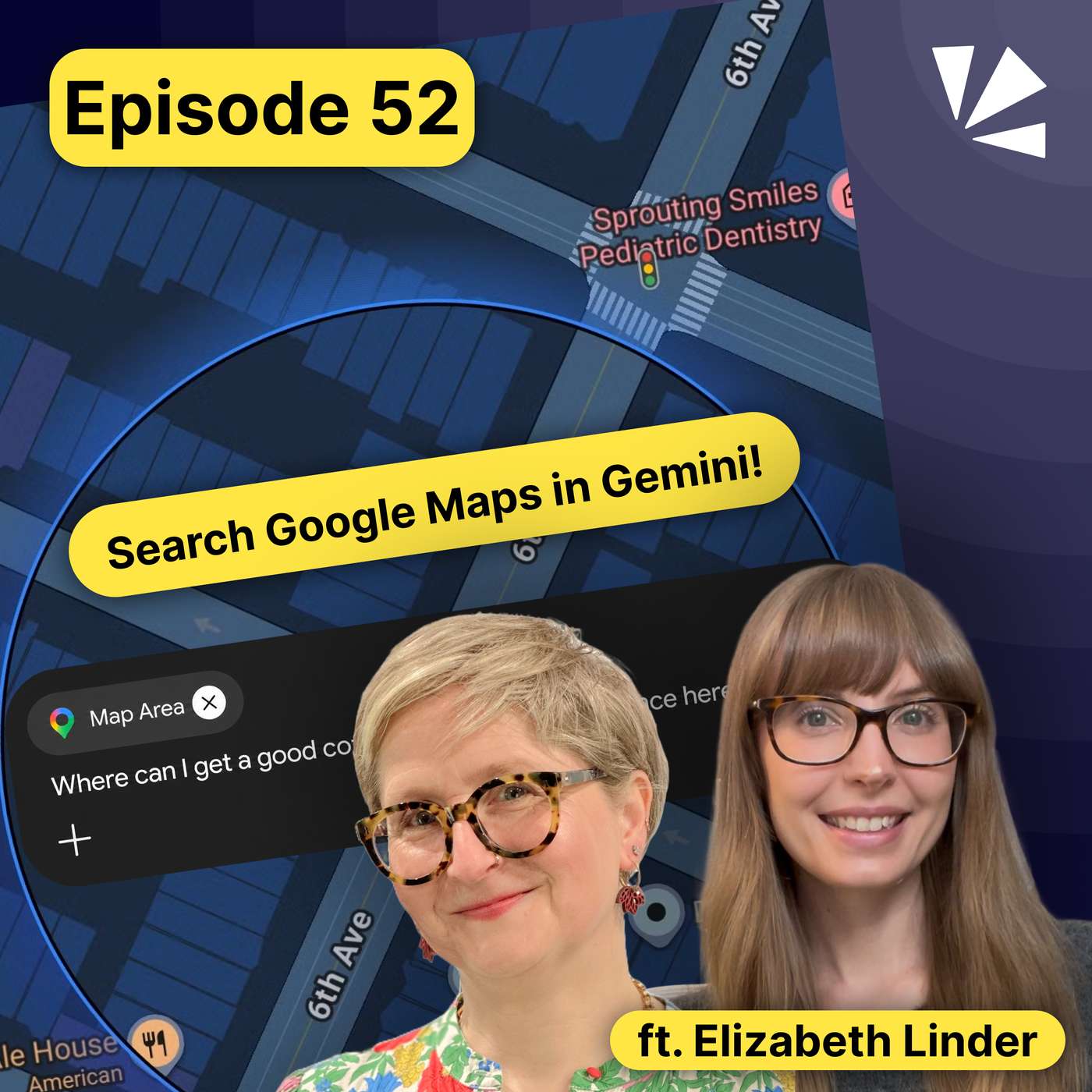
[Claire Carlile] Hello, hello, and welcome to the Whitespark Local Update with me, Claire Carlile. And me, Elizabeth Linder. And we are lucky enough to have Elizabeth here again with us to talk about all the things, local SEO, local visibility, what has been happening, what linky links are exciting. We're going to share them with you immediately. So, Elizabeth, you go first. [Elizabeth Linder] Perfect. My first link is a video of Aleyda's Crawling Mondays, one of her latest episodes with Amina Demiri, Steve Toth, and Raymond Martinez. I wanted to share this because basically it's going back to the importance of just foundational marketing. And with all of this visibility, AI, LLM, SEO, fighting going on, we just need to be good marketers. And so they kind of talk about why it's so important to understand your audience, their pain points, goals. This is all stuff we've heard before, and I always want to keep repeating it. So this is a really good episode. It covered just the importance of having that single source of truth across all different teams in an organization. And while watching this, some people might feel like it's focused on those larger enterprise corporate companies and, you know, trying to find synergy and connection between the different groups and teams. But I think this is also very important for local businesses because that gets lost. That information does get lost. I see it all the time. We all probably see it all the time. So they're talking just why to have it, why it's important to educate teams that this information has to be shared for consistent brand messaging, tone and details. And again, we all know when we're looking at AI visibility and LLM visibility, they care about consistent messaging. So they want to trust that your business is who you say you are, that you do what you say you do, where you do it. So I think this is a really great piece. Raymond actually had a really, I thought it was quite funny, but at the time it's probably not very funny. But we've all had maybe an experience like this with a client where you join a call as an external vendor and the team, the internal team, some that joined are just discovering this project or what you're talking about the same time you're already starting talks as an external vendor. So this stuff happens. My biggest example, probably thinking about local, is there was brand details were discovered with a marketing team, whether it's internal or external. Oh, we do offer a guarantee. It's great. It's 12 months coverage of anything that breaks, whatever that might be. And we find individual location managers or sales call teams have never been given this information. Maybe they're a new hire. They've only been working there a month or two, and they could have closed a lot of leads had they known that that was something that could be offered. So it can be so simple as something like that. So I thought that was just a really good episode of just a reminder of let's make sure everyone is organized and understands the brand and what it wants to do, what it can do, everyone. So that's my first link. [Claire Carlile] I love your first link. What a lineup. I love Amina. She, I've heard her speak at Women in Tech SEO, and she is such a savvy marketer and such a clever woman. I will definitely go and watch the whole of that one. So thank you for sharing that. My first link is another little post on LinkedIn from Lisa Lansman, who is, she's always a great one to follow just for keeping an eye on little new features and bits and bobs that are going on with Google Business Profile. So this time, this is great if you are a local restaurant. So it is dietary attributes, but don't go, oh, I'm not seeing that in the attribute section. These are added at menu level to the item. So I went in and had a little look at one of the profiles I work with that has a menu, and it was super easy. You just go into the menu item, and then there is a little line of chips that, not chips that you eat, chips that you select. So vegetarian, vegan. I think there was halal on there as well. But anyway, go and have a look because if there is the feature and the functionality to add something in Google, then make sure that you're using it because we need to feed as many details about our businesses in as we possibly can. So if you are running a type of business that has the menu functionality in Google Business Profile, go and add your dietary attributes and then reap the rewards. That's what you should do. [Elizabeth Linder] Do it. Do it now. Do it yesterday. I'll jump in. My second link is actually from LinkedIn, and it was a post that Andy Simpson shared with you and Darren. And I'm just doing the work of making sure it gets to everyone. So he shared about you can search in Google Maps directly from Gemini. And then within it, in one of the comments, it was a post from Android Police kind of explaining it a little more in detail. So basically, it was that you can search on Google Maps from a circle radius. And then what you do is basically you'll open the app, you'll scroll over to the map, and then you drag this radius where you want it to be. And then you can ask a question directly in Gemini, like, can you recommend cafes near me? That was the example used. And then it shows you all the recommended businesses within this circle. And then he found the writer that when options were limited, most of the time, there was lots in there. But if they're limited, it would say so, which I thought was interesting, and then recommends stuff that falls just outside of the circle. But a really interesting little tidbit that I thought was that if you asked about landmarks, or kind of dragging or asking first, instead of dragging the radius saying, hey, I'm looking for places near this specific landmark, it didn't do as well as when you actually had a very specific kind of coordinates or an address or street. And while this makes sense, based on how it works, because landmarks to each person can be quite niche if they're not very well known, because I'm a landmark direction. I don't know a street to save my life. So I wonder if that'll maybe evolve for some larger, more well known landmarks the way most people if they're looking in a tourist type city, but it didn't do as well at that. But this is basically to help people just understand and find businesses in an area they don't know a lot about or businesses they don't know a lot about in a new area. I think, yeah, this would be really great for travel, when you're trying to find or on a road trip, hey, I need some breakfast spots here. And let's just tie back in. This is important for I think, local restaurants, really. And those details that you just shared in your link. [Claire Carlile] I tried to look at this and I didn't have this feature or I didn't understand how to find it. So it's an interesting one to go and have a little look and play with it. So I haven't seen it. So I will go and have a little look. Thank you, Andy. Thank you, Andy, for sharing the things. So my second link is from our good friend Dana Lucio from Amsive. And this is on Search Engine Land. And I like that she writes quite a lot about multi-location. And this one is about, so it's how to segment SEO data for multi-location brands. And I just like the way that she suggests slicing and dicing the data that you can get for multi-location shoe. She touches on the data sources, all the normal things that we would expect to use for a single location, but for a location. So we've got GA4 and specifically the location landing page, Google Business Profile Insights. She talks about visibility at a local level, talking about using something like a local ranking grid to understand how much visibility one location has. And she talks about Search Console as well. And then she talks about how to bucket the data from those different places in different ways. So as you would expect, geography is going to be one of them because you might want to just look at, all right, well, just show me the data for my... I'm just going to do the UK example for the ones in England, Wales, Scotland, and then you might want to look by county. That's an example. Another way might be based on, say, for example, that you had like some branches had an additional part. So say you had a supermarket, but some of them have an in-house optician. So you might just want to look at how the ones with the opticians performing. And then another thing that she talked about, which I had thought about before, but I hadn't called it what she called it and approached it from the same way. So she talks about TrueView. I don't know if that's a trademarked thing that Dana's come up with, but TrueView is Dana's way of talking about looking, particularly when you look at year-on-year data, to make sure that you... Because obviously when you are big multi-location, you have a change in the number of locations and where those locations are quite quickly. And so she talks about just having some sort of foundational data set that you look at, especially for the year-over-year. And then you look at the outliers, like the new ones separately. Until at least that has been established for a certain number of years and that you can look at year-on-year. And so anyway, I loved it because it just brought together things that I'd sort of thought of in the past, but it brings it all together in one piece. So if you're working with multi-location and you're thinking about analyzing data over many locations, then it's definitely worth a read because she is very nice and clever and we love her. [Elizabeth Linder] It's always so much. So it's needed. And thank you for writing that. Thank you, Dana. So my final link is another LinkedIn. Grant Fishkin and Casey Henry launched a new build audience feature in Spark Toro. I believe it's free. So basically you can explain who you are, your business, kind of what you do, what you are, and then you can get a full report. But specifically, this was a video made by Will Reynolds using this data and pulling a report of sites and social platforms based on the audience. So Will Reynolds, this is kind of a double down. I hope I'm using that term correctly. This just came out on his 5GEO KPI piece that Darren actually shared in the previous episode. So he was saying how you pull the report of websites that are influential or important or that your audience might be interested in or be active on and all kind of like the social profiles influencers. So with the websites, you can then from this list, you can use Ahrefs to see, am I even getting any links or do I have any backlinks from these sites? Then he used another tool of Rand's, go Rand, you know, I guess. So from these sites, Alert Mouse, just to see if you're being mentioned from those domains as well. And kind of that recency metric a little bit. And then he shared how you can use a tool like Phantom Buster if this makes sense for your business and industry about pulling all of your LinkedIn engagement, if you're posting on there, if that makes most sense. And then you can see, compare it to the list, the export of a CSV of just the social accounts and influencers from the audience tool. And just to see, are these people engaging with my content? And basically, he just kind of broke this down in a really great video, step by step, and just sharing how it helps to answer the first three questions of those 5GEO KPIs. And I already love a good measurement piece in this whole new realm of what brand visibility is, but I like that he followed up and said, here's some specific tools and here's exactly how I would get that data sort of thing. So I think it just, it's a nice follow-up because it's great to see, that's an awesome KPI. How do I do that? Where do I get it? So that was fantastic. So thank you, Will. [Claire Carlile] And thank you for sharing that because that is totally where I get to when I read these things and I'm like, whoa, that sounds brilliant and interesting and so clever. And then I get to the part where I'm like, I don't know how to implement that and I'm going to really struggle with that. So this sort of added layer of, well, I have a great idea and now I'm actually going to do a walkthrough, better still, a video where I'm going to show you how to actually do that. So it's like a double thumbs up, double thumbs up for double thumbs up for that content. I will revisit that and might even get around to actually implementing some of it. Just imagine. So my last link is a interview with Dana DiTomaso and it is Mike and Greg and they are talking about track what you can, let go of the rest. There was a lot of it, like there always is in these videos. So I had a watch and I really liked the way that Dana is explaining how she is having these conversations with clients with regard to presenting the information. When I talk about the information, I'm going to say what my information is in a very visual way. So she's talking about using Figma flow. She's talking about using whatever it is, just give them something that isn't a table that explains what is going on. So that was the first thing. But basically what she's talking about is how, you know, attribution has always been broken generally. I think that before we had GA4, we were a little bit like, yes, we know all the details and the data and we can like in a very sure way tell you where people came from and what the last click was and, you know, who converted and what the attribution was. It was never really been like that, but GA4 made it even more obvious that it wasn't like that. So she talks about how attribution has always been more than a little fictional. I really like that way of describing it. So she's talking about tracking what you can and letting go of the rest. And then going back to something she's always talked about, which is the mindset of being directional. So knowing what it is that we can track in terms of, you know, we might have this many users to the website, but this many are going to fall off when it comes to cookies. This many are going to fall away from how many we can actually track because of where they are geographically. This many are going to fall away because they're using ad blockers. So she's talking about starting off with like, you start off, I'm using my hands to explain something on a podcast. So this is really useful. So you start off saying, you know, there's this amount potentially, and then we lose half because of this and half because of this. So we will never truly know. But what we can do is know that of what we can track, directionality is to do with, and then it went up or then it went down. It doesn't have to be the absolute numbers, but we use that directionality. I don't know if that means anything to anyone, but basically what I'm trying to say is it's important to have an open and honest conversation with your clients. If you're working on data stuff and measurement with them, that you need to like develop trust, give stuff to them very visually. And we need to just go back into this mindset of we can only track this much. And what we can know, we rely on directionality rather than these are the absolute numbers and we will lean into it. Another thing, I'll just do this super duper quickly. She was talking about AI visibility tools. And I was interested to hear her mention a couple that she likes, which were Noah Toa, which I've never heard of, and Gumshoe, which is something that we've used and that we've quite liked. And then finally, she was talking about how to use AI tools. And this is something that I'm sure that most people have got their head around already is it's not about where do I rank or where did I appear for a certain query? It's the idea of what does this AI know about me or my business or my brand? What is correct and what isn't correct? So what do I need to be working on in terms of shaping their understanding of the product, the service, the brand, and all those things? So definitely worth, you know, sit down, have a slice of cake and a cup of tea and watch the whole thing, because it's quite a big lesson. But I recommend it. [Elizabeth Linder] And I think in this new world, well, you know, we've been losing the ability to track, I guess, a lot of things for a while, right? But the earlier you have this conversation, the more clear you are, just the better off your partnership's going to be with any client, ongoing and long term. [Claire Carlile] Me recounting the video was fantastic. [Elizabeth Linder] Yes, and the video itself. [Claire Carlile] In fact, don't bother watching it. Just listen to me do a hack job of trying to describe it. Anyway, that is it. We have done. We have done our linky links. Elizabeth, I love you. You are amazing. Thank you. Thank you. Aww. So goodbye, friends, listeners, watchers. Come back again next week. Like us, subscribe to all the things. Listen with a friend, all of those things, everything. Goodbye. Love you. Bye. Bye.