
The Whitespark Local Update · Darren Shaw & Claire Carlile
Darren Shaw and Claire Carlile are back with another roundup of the news and updates shaping local SEO and AI search, including: 📝 Google Maps 2026 Fan-Favorite Dining List 📝 How to Use AI Mode’s Follow-Up Questions to Create Non-Commodity Local Service Content (Claudia Tomina) 📝 Your competitors’ negative reviews could improve your PPC ads (Laura I. Abreu) 📝 Re-imagining AI Visibility KPIs in a Query Fan Out world (Wil Reynolds) 📝 Google’s Policy Update (Hiroko Imai) 📝 AI and SPAM team up in Alabama and beyond… (Conrad Saam) --- Follow us ❤️ 📑 LinkedIn: Darren Shaw: https://www.linkedin.com/in/darrenshawwhitespark/ Claire Carlile: https://www.linkedin.com/in/clairecarlile/
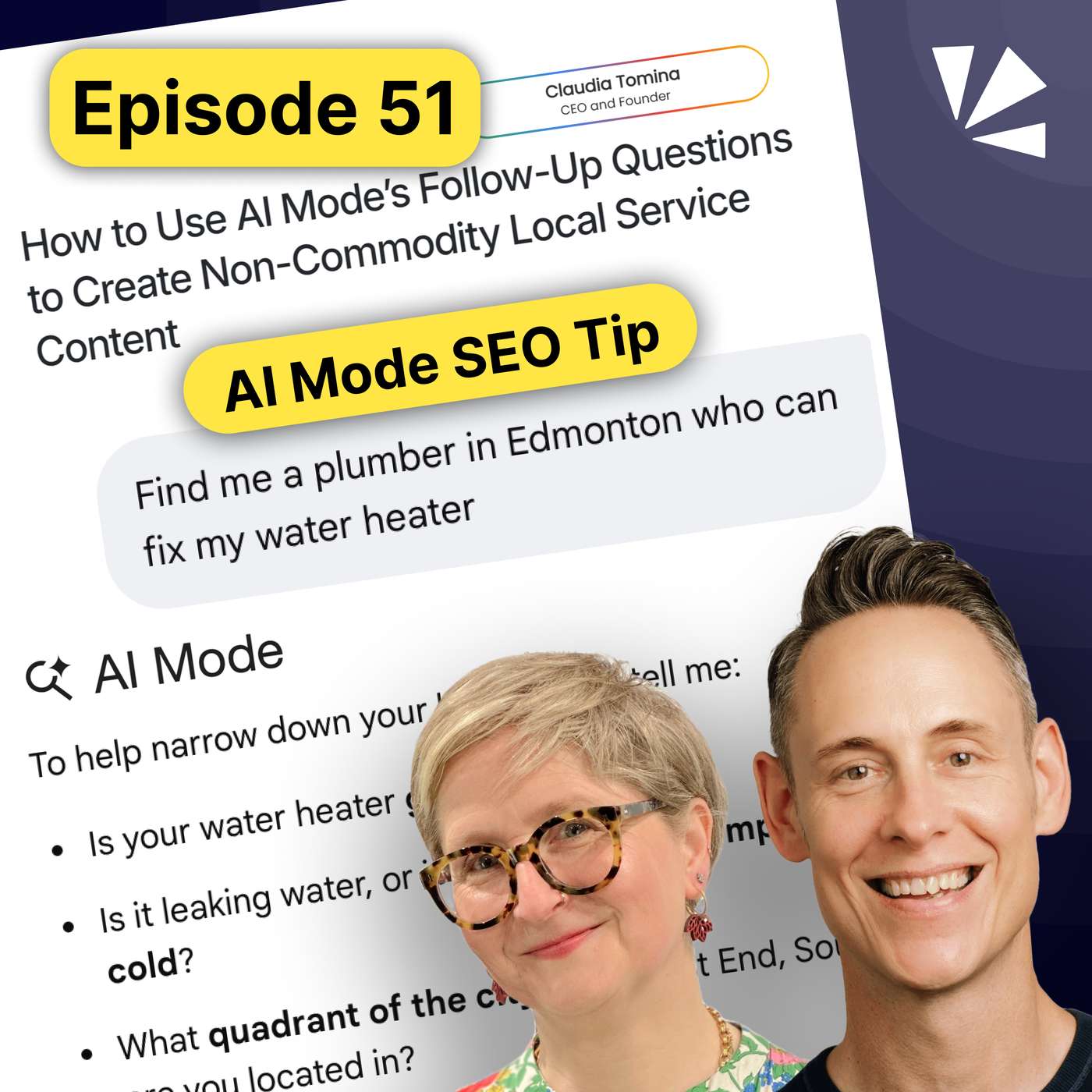
Darren 00:00 Welcome to another episode of the Whitespark Local Update podcast, with me, Darren Shaw. Claire 00:05 And with me, Claire Carlile, and this is the podcast where we talk about all the things in local search and read all the things so you don't have to hooray. Darren 00:14 Hooray. Let's just get a quick summary. That'd be great. We'll tell you what you need to know. And so, I don't know, what do they need to know? Clara, do you have something to talk about? Claire 00:23 I really do. So my first linky link I've actually just seen on LinkedIn now. I'm not sure when it was published, but it was Lisa Landsman sharing a rather delicious and delightful piece of data journalism from the Google. So it's lovely. So it is Google Maps 2026 fan favorite dining list. Darren 00:50 Yeah. Claire 00:50 So what they did, they explain how the data they collected, they say. The fan favorite dining list is selected based on information from Google Maps from the 1st of September, 2025, through to August 31st, 2026. So a full year of data, including reviews and ratings from our local guides community, aggregated searches for directions. Interesting. And a final verification process. It was probably like, does this exist? So what it is, is they have put together a list of delicious and yummy places to go and eat and drink things in various cities. One, two, three, four, five, six, seven, eight, nine, ten, like 11 cities, one of which is London. Different categories of meal, but I just love this. It's such a nice piece of content that's been, you know, one, it's interesting based on the data. Two, it is a delightful piece of content that you would want to. So what you can do is you can save these as a list in your Google Maps. Claire 01:52 And that's something that I love to do when I'm off to a city. I'm like, oh, wow. You know, I look at these pictures of matcha and these pictures of all these delicious things that I want to eat. And then there is a piece on the Google blog where they talk about the trends in eateries and what people are looking for. So this is like interesting on many, many, many levels. Can you imagine if you as a business found yourself on this list? I wonder what is happening to the number of views, interactions, and things that are going on on their Google Business profile. And also, obviously, footfall and people coming in and spending money. So what a list to end up on. So I wanted to share that with you because it's, one, it's interesting data wise. And two, if you love food and you go to one of these cities, go and eat all the things. Darren 02:47 I'm like scrolling through this article and it is so AI generated, but in a good way. And so what's happening is that Google has just like had their AI analyze the reviews and all these cities for locations for food and put together this amazing, they've just, you can extract these amazing details. Like people in the reviews are constantly saying big portions, good prices. And so then you end up on that special list. So it's really cool. And it just tells you as a business, like what people say in their reviews is very important and trying to, you know, encourage people to go into detail about what they liked. And some of the things that were the best experiences that they had at these restaurants. If you can get them to say that in the reviews, I think this is a hint that it will continue to pay dividends. Google is absolutely understanding that data and then using it. Cool. Claire 03:44 I take issue with your description of this is an AI generated piece of content. Darren 03:50 I mean that research behind it. I don't mean the actual writing. Claire 03:54 Yeah. So we just, I mean, if you're not using AI to lean into the analysis of your data. Darren 04:00 Totally. We're doing that. Claire 04:01 You're missing a trick, aren't you? So. Darren 04:03 Yeah. Thank you. I should clarify. I don't mean that it was written by AI. I mean like you can see the AI analysis behind it. You could see like, hey, we have this massive data set of reviews and other information. Let's just get our insanely powerful AI to analyze it and give us some really interesting insights. And then somebody got those insights and they wrote this article with their own hands and brain. Claire 04:26 With their own hands, without doing a tally of the number of times that someone mentioned a thing on a piece of paper and then having to count it, which is what it used to be like when I was doing my master's research. Darren 04:37 That's right. Yeah. It's a whole new world. Claire 04:39 Yeah. Darren 04:40 All right. Well, I have an article to talk about and you got one guess. Clara, who do you think wrote this one? Claire 04:46 Well, I don't know. Could it be Claudia Tomina? Darren 04:50 That's right. Yeah. Claudia Tomina. She's written a very interesting article on her own website blog, ReputationArm blog, how to use AI modes follow-up questions to create non-commodity local service content. So it's pretty straightforward, but it's quite clever. She's a smart person. We know this. So she wrote, so the example is this. You run a query like, find me a plumber in Edmonton who can fix my water heater. I'm in Edmonton, so that's what I would search, right? All right. So I ask the question and then AI mode will give you a list of, here's some businesses. And then you know what AI mode always does? It asks you extra questions. It says, well, to help narrow down the choice, is your water heater gas or electric? Is it currently leaking water or failing to heat? Do you need an emergency dispatch right now? Are you looking for a flexible appointment? And it even freaking bolds them. The words in bold in the follow-up questions, hello, put that content on your website. Darren 05:52 So that's the strategy. It's very smart. That's all you have to do. And then she says, and so what you do is you run this on a number of the most important sort of things and then you extract the follow-up questions and then you interview your client. So if you're an agency and you're listening to this, you interview your client. If you are a small business and you're listening to this, you interview yourself. You can even ask ChatGPT or Claude to interview you on those questions. Then you get the content back, then you put it on your website, and then you are more likely to show up in these AI responses because you cover the topics that apparently AIs want to know about. And they'll tell you what they want to know about. Very smart. Good job, Claudia. Claire 06:31 We love you, Claudia. We're going to sing a song about you when we see you. That was very special. I can feel a little bit of a theme emerging in the things we're talking about. One of the newsletters that I always read, and I make sure I read all of it, is the Women in Tech SEO do a great roundup. And that is where I find some of the gems that inspire me and make me think about things. And one of the ones that popped up this week is on Search Engine Land and it is by Laura Abro. And it is called Your Competitors' Negative Reviews Could Improve Your PPC Ads. Darren 07:16 Wow. Claire 07:18 And so we've got a little bit of a theme here. Last week I was talking about the new bit of research that Miriam has done that is live on the White Spark website, which is mining reviews and like looking at that thematically and how we can use that information. And so I like the way that Laura has applied this to PPC ads or to paid ads. And Laura says, I see every negative review as free customer research. Someone has already explained what they expected, what disappointed them, and in many cases, what could have changed their experience. So you read the reviews, patterns start to appear. So we have got a massive amount of data around that, generally on the new piece that we've just published and also by niche, which is, you know, for me, I think is gold. So Laura is saying complaints help you understand what customers value before they click your ad and where your competitors may be leaving opportunities open. AI simply makes those patterns much faster to find. Claire 08:19 And then she goes on to explain a process, which is exactly what we're talking about, which is using AI to surface patterns and make sense of things. So she talks about scraping the reviews that you want. So you get hold of those and then you run these prompts in your LLM of choice. So you ask it to group these reviews into recurring complaint themes, return a table with the theme, the number of mentions, the percentage of reviews mentioning it on one representative example. Lovely. And then she says, based on these reviews, what do customers consistently want these businesses, but that they don't appear to provide? And then she says, here are my reviews and my competitors' reviews. Compare them and identify my biggest competitive advantages and anything I'm not communicating clearly enough. And then based on the complaint themes identified, generate five RSA. So that's the responsive search ads with max 30 characters that highlight our validated strengths and address those customer frustrations. Claire 09:17 You're like, thank you. I really struggle when I'm filling in like, oh, can't think of another headline or another thing. It's like, get, you know, we've got the data. You're going to get an LLM to write it for you. You can even base it on your own tone of voice or whatever if you let me know about your brand. And then the last thing she says is, okay, you've done that work. That's awesome. Can you just make sure that the messaging that you're adding matches the content on your web page? Darren 09:43 That's smart. Yeah. Claire 09:44 Because if you don't do that, it's a bit like, uh. And obviously make sure that you can deliver on your promises. But if you're being a good business and you are looking after your customers, then you should be able to deliver on your promises. Anyway, well done, Laura. Smart. Love the idea, but thank you for actually walking us through it for people that just aren't as au fait with putting these processes in place themselves. I love this content. Darren 10:08 Really smart. That's a really good strategy. And it's tough because you only have those 30 characters. You're going to write a little headline in your ad. You only have 30 characters. So that's a perfect use for AI, especially when it's based off of those pain points that you just mined out of the reviews. Very, very smart. But I would say it says, make sure that it matches the content on the landing page. I would ask a follow-up. I'd be like, make sure it matches the content on the landing page and tell me what content I should add to my landing page so that we are addressing this on our page as well, rather than like, oh, we can't use this because it's on the landing page. No, no, no. We can use it and we're going to put that on the landing page. Claire 10:45 Maybe Laura run out of Claude credits at that point and she was just like, oh, damn. I've got to use my brain and type the words. Darren 10:55 So I would like to take an opportunity. If you've listened this far, then you could be like White Spark. And I wanted to let you know that we have just launched an API and MCP for our White Spark local ranking grid software. And it is amazing. And one thing that's amazing about it is that the White Spark is the only tool that tracks to 100. And that means for every single grid that we're tracking, we're getting like 300 businesses. So because it tracks multiple times and all the businesses coming in. So we have an insane amount of data on all of those businesses. Now with the MCP, you can just ask Claude, hey, analyze my business, analyze my competitors and tell me some of the things. Now contrast that with their rankings. Tell me, are you seeing any changes they made to their profiles that is impacting their rankings? And tell me what those are so that I can implement those same things. With the MCP connected to local ranking grids, it's an absolute goldmine of competitive analysis. Darren 11:56 And so I just want to let people know that that is now launched in the software. And if you're not using our local ranking grids, it's the most beautiful on the market. It is the most feature rich and it is awesome. So I just wanted to let you know. And then I want to tell you that Will Reynolds wrote an excellent blog post on the SEO blog about reimagining AI visibility KPIs in a query fan-out world. What he's saying is that our classic SEO metrics kind of fail us when we're trying to measure AI visibility. AI visibility, prompt tracking, all that stuff. It's a black box and it's getting worse. It's really hard. Like marketing in general, it's really hard to do attribution. Like we can get some hints here and there, but it never shows you the whole picture. And then he highlights this really interesting example where these prompt tracking tools, all these tools we're measuring, they're measuring mentions. Were we mentioned in the result? And then the tools say, yes, you were mentioned. Darren 12:49 But it doesn't necessarily mean that's a good thing. Because oftentimes the mention might say, whatever you do, don't hire this business. And so the business gets mentioned. And so the tool says, you were mentioned. And everyone's like, yay. Hey, boss. Thumbs up. We're getting mentioned. But it's like for the wrong reasons. And you don't know that. And so what one of his clients challenged him is, I don't want visibility report. I want a recommended report. I want to know, because oftentimes in a prompt, you'll say, hey, I'm looking for this specific thing. The AI will say, here are four businesses. And I recommend this one. You actually get a recommendation. So that's not really being extracted. And so he's talking about what can you do? How do you get better metrics and understanding your visibility in this new world? And so he's looking at new KPIs. What he wants to know is what content on our website did humans love? What percent got referral traffic to our website? Darren 13:49 We got people are coming in from LinkedIn. People are coming in from newsletters. We got links on other websites to our article. Our article got mentioned on these other websites. So he talks about looking in your Google Annex for that. That's a very smart signal of like, is our content working? The other one is like, are we getting linked to and mentioned on trade publications? So he uses Search Engine Land linking to his content as an example. And he says he uses AlertMouse to track that. But like anytime we show up in AlertMouse, we want to know what was mentioned. Why were we mentioned? Was a stat from our article? So that's a good metric to be paying attention to. He wants to measure mentions from influencers. So for example, if Mary Mallows publishes an excellent article on White Spark and then the near media guys cover it, then that's an influencer mention. You want to track that data. That really tells you if you're having an impact with the content. He talks about striking distance. Darren 14:49 Run your top 10 prompts 20 times each. Do you show up on what percent of them? So that's a pretty classic AI visibility tracking move. And then he talks about receipts to compete vector distance between what you launched and what you're known for. So basically, is the content you're putting out matching up with what you're known for? So he says that if you kind of look at those as tracking metrics rather than a lot of the traditional SEO metrics, I would say what you're doing is updating some of the ways that you're tracking. So anyways, smart stuff. Will always has good ideas and he always directs us the right way. Claire 15:26 As you would expect. Darren 15:28 Mm-hmm. Claire 15:30 My numero three linky link is from a Google product expert in the GBP world, which is Heroko, who often sees things. And they flagged up a little change within its prohibited and restricted content policy. And it's the bit on advertising and solicitation. Now, I can't remember what it was like before, but I think it was just one section and it didn't split it into for users and for merchants. So whenever they make these little changes, it's usually as a response to clarifying the rules around something that is happening in the world of Google Business Profile and Google Maps. So on this one, Heroko themselves said, interpreting this update in my own words, the primary purpose appears to be clearly distinguishing restrictions between regular users, so your Google Maps users, and businesses, while also maintaining the reliability of business information. Claire 16:40 Good luck with that. So for users, promotional or commercial content, posting email addresses, phone numbers, social media links, or links to other websites in your reviews. So that's when you post a photo update on a Google Business Profile, which is totally unrelated to that business and might be soliciting business. And I think we all know what I'm talking about here. Darren 17:06 It's a real scam. Claire 17:07 Just random stuff that isn't like related to that business. And then for the merchants themselves, isn't it? It's a bit weird, isn't it? When you've got advertising and solicitation that isn't allowed in a Google Business Profile for a business that exists to advertise and solicit business around that business. Darren 17:27 Business, business, business, business. Claire 17:29 That's sort of what they're for. So in the listing, don't use promotional or commercial content that contains any of the following: time-bound promotions, pricing, or direct calls to action. What? I'm just like, what? And in posts, email addresses, phone numbers, social media links, or links to other websites in your posts that are not related to your business. Darren 17:55 This is contributions to Google Maps. This is when you're putting something on someone else's profile. Claire 18:01 Yes. And I think that's to do with, yeah. So when you go off and you're just like, but then it says for merchants. So for users, yeah, users of Google Maps, merchant, if you're a merchant, then you are the holder of that Google Business Profile, surely. Darren 18:20 I think they need to clarify it more because I actually think they're talking about, okay, I'm just a consumer in the world. If I'm a merchant, I'm like another business and I'm like, I go to my competitor's plumbing page and I'd be like, don't hire this loser. Hire us instead. And then I upload a photo to their profile. I think they're talking about that. Claire 18:42 I don't know. They're talking about something. Darren 18:44 That's a crazy competitor sabotage move. It'd be like, this guy's a loser. And then you're like, you take maybe some of their like worst negative reviews and you take screenshots of them and publish them as photos on the guy's profile. Claire 18:58 I think that it was Amy somewhere on LinkedIn was saying this potentially is to do with when someone that shouldn't have access to your Google Business Profile has access to your Google Business Profile and then starts promoting their unrelated business on your Google Business Profile via posts. I've seen it. I've seen it. So anyway, there's weird stuff that goes on. The reason it's useful to know about stuff like this is if you are working with a business or you're an agency or you work in a business where you're coming up against problems, you know, repeated suspensions, repeated updates to your business profile that are being rejected. The idea that you need to, like, there's all these different places where all the rules exist. Sometimes it is hard to work out what it is that's going wrong. So just another thing to monitor, even though we don't understand what it actually means. Darren 19:55 Yeah. In summary, business, business, business, business, business, business. Claire 20:01 Profile. The end. Darren 20:04 So speaking of weird stuff that's happening, Conrad Sam did an exposé about a network of AI-generated Google Business Profiles with generic names like Huntsville Car Accident Lawyer. These, like, he suspects there's hundreds. He found a whole network of them. All of them, if you call them, they go to this one business called Alexander Shundra's Law Firm. So this guy, Alexander Shundra, we're calling you out right here on the podcast, man. You got a ton of fake Google Business Profiles. They're like, obviously AI-generated. You got AI-generated photos, the descriptions, just like some of the pictures, like they have seven fingers. Like, it's not even good AI-generated photos. Fake reviews getting blasted to these. So, you know, Conrad came across this and then he started doing some digging and he wrote about it. And he's like, what the hell, Google? Like, are you not a good company with amazing technology and the best engineers in the world? Like, how do you let this happen? Darren 21:05 So this is the kind of, like, I don't know. So he's calling it out on the blog, as he should. And then he's also calling out Google on the blog, as he should. And I'm with him. I'm like, you know what, Google? You got amazing technology that you can analyze all your reviews and write up a cool research post about the best places to eat in each city. Do something about this, like, obviously fake spam issue. If it's that easy for businesses to do that, because you know what this means for our personal injury lawyer? You got a hundred Google Business Profiles stood up across the country and they're all calling your thing. It's like millions and millions of dollars worth of cases. Like, personal injury cases are worth a lot of money. So close your loopholes, shut down this garbage, do better Google. That's the final note. Darren 22:01 Any final thoughts, Claire? Claire 22:03 Final thoughts are, oh, thank you for listening. Thank you for being here. Thank you for watching. We love you. Come back for more. You know, what can I say? Darren 22:12 We love you. Thanks for listening and we'll see you next week with more exciting news from the world of local and AI and SEO. Claire 22:23 Business. Darren 22:25 That's right. That's what we do at Weissberg. We do local and AI and SEO marketing for businesses who are businesses. Claire 22:36 Bye.