
The Whiskey Ring Podcast · David Levine
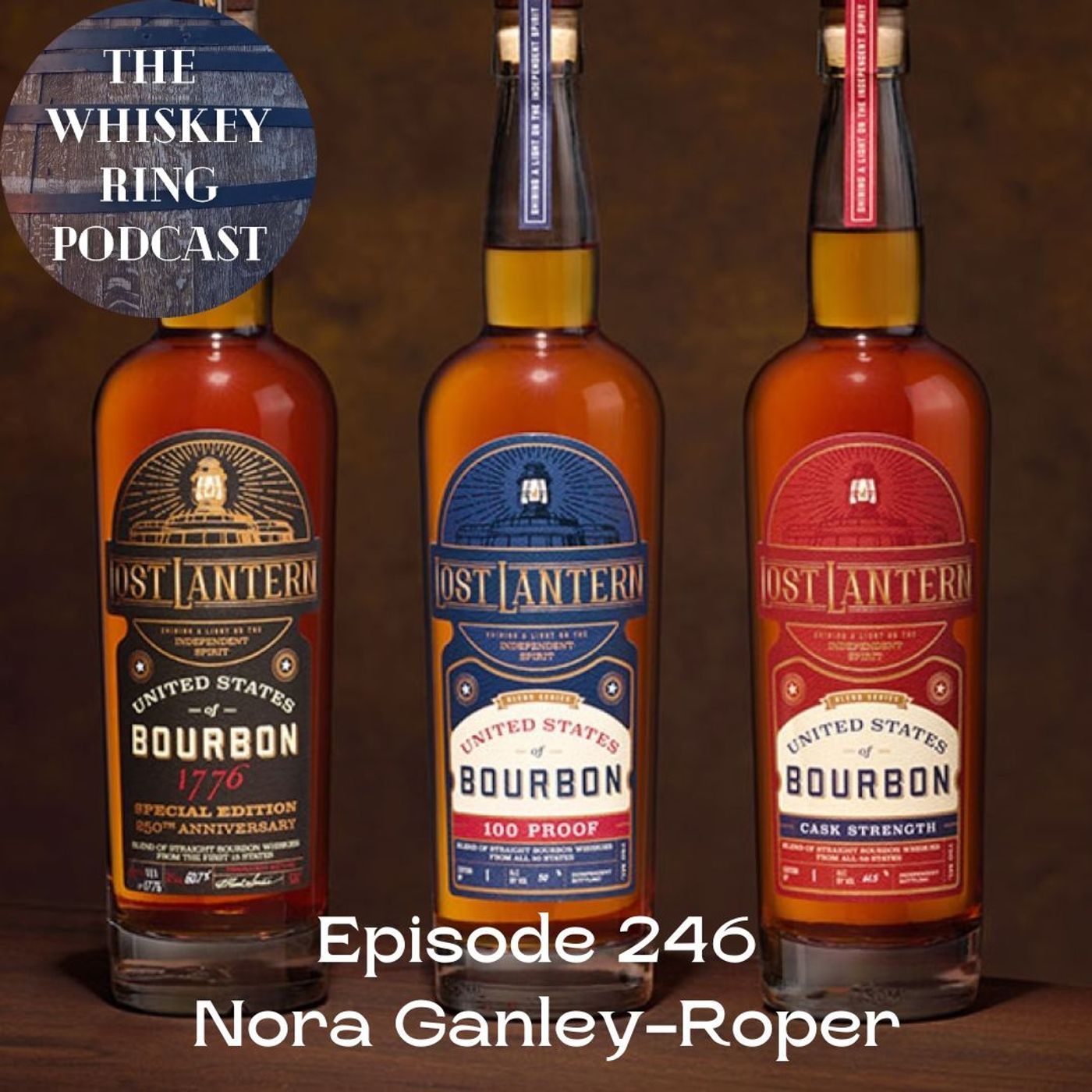
Lost Lantern United States of Bourbon: Nora Ganley-Roper on Blending Bourbon From All 50 States Show Notes: www.whiskeyinmyweddingring.com/reviews/ep-246-lost-lantern-united-states-of-bourbon-with-nora-ganley-roper-show-notes If you haven’t joined the Patreon community yet, please consider doing so at patreon.com/whiskeyinmyweddingring As of December 2025, the $25/month bottle share club level is sold out! Join at the $5/month level for first shot at an open spot when a member retires and to keep receiving ad-free episodes via Patreon. Lost Lantern Whiskey Website: https://www.lostlanternwhiskey.com/ Instagram: https://www.instagram.com/lostlanternwhiskey/ Facebook: https://www.facebook.com/lostlanternwhiskey/ LinkedIn: https://www.linkedin.com/company/lostlantern/`
David Levine: Hey folks, welcome to new episode of the Whiskering Podcast. Today I'm thrilled to welcome back someone who has now, I think with this interview, will be the most frequent guest on the podcast. We have Lost Lantern. And representing Lost Lantern today, we are Grace with Nora Ganley Roper, half of the founding team with her husband Adam Polonsky. thrilled to have you back talking about this incredible triplet release of the United States of Bourbon, the seventeen seventy six and United States of Bourbon one hundred proof. Welcome back. Nora - Lost Lantern: Thanks so much for having me. Excited to chat about these whiskeys. David Levine: Absolutely. so clearly if people follow me, you know that I posted my review of the Cast Strength United States of Bourbon a few weeks ago, shortly after it went live in mid June. Suffice to say, huge fan, was incredibly impressed. I think like numbers wise it came just under the the Lost Lantern Farflung bourbon four. But Nora - Lost Lantern: Mm, mm-hmm. David Levine: I mean it was it was very, very small. Like still platinum metal, my highest rating. and I couldn't be more impressed with it. so I'm thrilled to have you on to talk about it. And let's just jump in. So this project goes back idea wise to even before Lost Lanter begins in twenty twenty. It it goes back to twenty eighteen. give us a kind of an a long term map, like what were the milestones that turned this from a point where it literally couldn't happen in twenty eighteen to you know, early twenty twenty six when you get the the final barrels in and are able to really start getting this underway. Nora - Lost Lantern: Yeah, sure. So United States Bourbon, first blend of bourbon from all 50 states. And we also have a special one off 1776 edition that's for the 250 anniversary. that is just the first 13 states. But we have Hunterproof and Cast Strength, all 50 states. and for us with Lost Lee Intern as an independent bodler. When we were in the very early stages of talking about what that would look like to have an independent bodler that focuses exclusively on American whiskey, we spent a lot of time talking about what distilleries we wanted to work with, our dream list, all of that. But at the same time, in probably 2017, twenty like early late 2017, early 2018, we also would always talk about cool cool products that we might be able to do as an independent bottler, really think extrapolating out. To when we were established, when the industry was a little bit further along, what would be the interesting stories that we can tell? Because for us, all of our blends are really a bird's eye view of a different aspect of the industry, be it shadow, which is peated single malt, be it our farmers' fields, whiskies, which is a state, bourbon and rye. And then with this, the idea was to give people a single taste of bourbon from all across the United States. And we spent a lot of time being like, Actually, not even that much time. It just we talked about how cool it would be if we were eventually able to give people that perspective. Because without an independent bottler, you'd you that just doesn't exist without an IB in the United States. And and so it was one of those were like, yeah, that would be cool, probably will never happen, maybe it'll happen. But it was an ongoing conversation for us about when it would be possible. To your point, what are the the different things that have to happen along the way? And at the time when we started talking about it. We don't think that bourbon was made in all 50 states distilled there. There were probably pl brands that were based in all 50 states that might be sourcing from MGP or other places, but to have whiskey that was distilled, let alone straight bourbon that would work with a in a blend, I'm pretty sure that that just straight up wasn't possible in 2018. So for for us, the the As we were going, as Adam travels around the country, we have been collecting whiskey for this potential release for five, six years at this point. I believe our first purchase was 2021. when a distillery was going out of business in Vermont and we decided to buy some barrels. And every once in a while, we'll buy some inventory and say, Okay, this is we bought this just in case we ever get to do. Our 50 state blend. And then in 2024, Adam came to me and said, I think that I think there that the distilleries are now at the point where we could do this. I think. In theory, there are distilleries in each state. In theory, there are distilleries that we could blend, but I'm not sure that people will sell to us. And so what we did in 2024 is decide to send Adam out to visit the states that could potentially kill the project. For us. So places that only had one or two distilleries. So the Dakotas, we didn't know what the deal was. Idaho, New Mexico. He went to those places that were the Hawaii. I did go with him to Hawaii, but Hawaii, places that if someone said no to us, we would have to then wait. So that he's not spending time or we're not spending time and money buying whiskey from Iowa, where we knew we could get great bourbon that would blend well. and so we spent about two years building everything and then. Yeah, January 2026, everything was in-house and I had a month to blend because my now six month-old son was due January twenty-eighth. So we knew we had to get it done before he came. and yeah, here we are today and it's done and it's out there, and it was quite a secret to keep for all these years, and it's such a joy to be able to talk to people like you about these whiskies. David Levine: And I was gonna mention this more towards the end, but the launch day, I think it was June fifteenth, with with mutual friend Liza's interview in the New York Times. Fantastic Nora - Lost Lantern: Yes. Yes. David Levine: coverage. just thought of a question that I I'd want to make sure I don't forget, which is when you bought that first trench of barrels from the Vermont distillery that went out of business, did you keep that in in barrels or did you Okay. Nora - Lost Lantern: Nope, kept it in barrels. The nice thing about Vermont is it's cold here most of the time. Our production facility is also like up against a bank of earth, so it's cool. So for us, the beauty of being an independent bodler in this kind of space is our a couple of years, five years, doesn't actually change the climate markers. And also it's Vermont to Vermont. we felt like it wouldn't influence the character of the whiskey enough to cause problems for that. David Levine: So you know, when we raised that like when the idea first happened, it it literally might not have been possible. There might not have been bourbon made in Nora - Lost Lantern: And David Levine: state in all fifty states. Nora - Lost Lantern: Yeah. David Levine: there were just states that didn't have bourbon distilleries, let alone straight bourbons, which I know was also a big thing. You wanted them to be at least two years old, so you could say they were straight, no additives, no adulteration, in like that. clearly, you know, you and Adam have your your pulse on craft distilleries. and it Aside from Hawaii, of course. He's more doing like the trips around in recent years. was there any kind of for lack of a better term, like a system you guys had of keeping track of, this state might now have a bourbon distillery? Like even a Google alert or something saying this distillery is opening up? Nora - Lost Lantern: So he had a map that he would color code. so over the course of those years, states would slowly move from red to green. From red meaning I don't think there is anything, or we don't think there are any distilleries that would be open to working with Lost Lantern as an independent bottler, to eventually every state turning green. So from red to orange to yellow, he was tracking that picture pretty consistently as he was traveling and also. as he was hearing about new distilleries popping up throughout the country, starting keeping track of that. Yeah. David Levine: Remember what the last date to come online was? Nora - Lost Lantern: I think it was it might have been Idaho. That was one of the hardest states for him to to get whiskey from. So I believe that was that might have been the last one. David Levine: Yeah, I th I think it was in the New York Times article. if not it was on the one of either Robert Report or or Forbes, but y you and Adam were saying that for Idaho specifically, you know, there there are so few there. I mean, we just talked to Alex at Warfield a couple of weeks ago, and but they only do single malts. So Nora - Lost Lantern: Yes. David Levine: I think Adam had posited like if we couldn't find for Idaho, do we ask Warfield to create a bourbon for us? And then you're still waiting two years after that. Hopefully it's good at two years, you know, all of those caveats. Nora - Lost Lantern: Right. Right. With with their machinery, which is built for single money. Like, yeah, it's we had the conversation and luckily we never had to actually reach out to them about it. But yeah, that was a conver on an ongoing conversation. It's it is at what point we would get creative on on how we got the bourbon. Like we also talked about it for Arizona before we found Santan, 'cause we worked so much with Whiskey Dollbock and love that team. Like, would we ask them to do bourbon? And in every case, we ultimately didn't have to. And that's better in my opinion because it's bourbon distilleries that these are places that people can go and visit and drink their whiskey as well, not just us sh the b having the only XYZ bourbon. David Levine: And in actually gonna skip around question. So the is it also the hardest states, so Idaho of course, North Dakota and Hawaii, Nora - Lost Lantern: Mm-hmm. David Levine: each only had you know, one distillery that made their own bourbon. It's what you said earlier, could have blown up the whole project if they were like either they didn't have it of age yet or they were like, I don't wanna do it. How I guess specifically with those with the distilleries that are used in those states, how much were you biting your nails that they either you wouldn't like their whiskey or they would say no? Nora - Lost Lantern: A lot. And that's why we went there first because we didn't want to waste time with the other things. But the thing that I know about blending is as long as the whiskey doesn't taste flawed or bad, even if it's if it has one dominant note that might not work for our single cast program, it generally blends really nicely. So there are some distilleries that are are younger or their climate is so intense, and they and the whiskey that we're getting from them explicitly is supposed to be single note. Not fully like it, I'm looking for three, three flavor markers in general for buns, but I figured that as long as the whiskey hit a certain bar, which is lower than our single cast bar, it would be okay. And luckily, as with a lot of this, we didn't end up having to have that conversation about whether or not a a whiskey was there. We we were pleasantly surprised continuously, and that was an amazing experience to have. But yes, we were very nervous. Constantly we honestly we were nervous until all the barrels were in in the warehouse about something falling through in the end. A barrel getting lost along the way, like Hochha Town and Oklahoma. They have so little whiskey available and they gave us a barrel and they gave us one for this and that's all they could spare. And what if that barrel went missing? What would we do? And so yeah, until there was a lot of nail biting throughout this process. David Levine: With the just the logistics of of getting from fifty states, I I was surprised at first and then it made sense to someone who asked either on Burberlands or or Drew Hannish over whiskey lore saying you said to them like so many people have been sourcing from MGP or other large scale sourcing facilities that the actual logistics of transportation were not as difficult as people thought. Like Hawaii was an exception 'cause you had to get it by by boat. But and what was the other state that you had to get it by boat from? Was it Nora - Lost Lantern: We got it in Massachusetts 'cause Triple Eight is on Nantucket. Yep. David Levine: It was Massachusetts. Right, right. I know I I got that you put that up as a Facebook post and I got it I got half. I got the Hawaii, of course, but because I figured they wouldn't be shipping a barrel by air freight. I can't even imagine how expensive that would be. but no, that makes sense. but Alaska was able to be gotten over land. Nora - Lost Lantern: Mm-hmm. David Levine: so in in getting all of these all these whiskies from the beginning of the idea, you were pretty adamant that it was like I don't want to do this out there profile. You want it to be a bourbon. And for this, I guess I'm speaking specifically about the the United States of bourbon as opposed to the 1776 so you didn't want to necessarily push the boundaries in this. You want it to be a recognizable bourbon, different from the quintessential Kentucky pr flavor profile, but not so much as to you know, only to only Go to the whiskey nerds, the bourbon nerds. You want it to be approachable for people. so in that sense, how How did you incorporate that into your search for distilleries? Particularly I guess in those states where you did have more options to choose from and you weren't like, Well, this is what we gotta work with or else. Nora - Lost Lantern: Yeah, it would be we we were looking for for the two things that we hope come out in this whiskey. It's both something that was clearly bourbon, that there it it could be something that's more of a kind of cherry profile or butterscotch or whatever, like whatever profile you want to talk about, but it needed to be clearly bourbon when you're tasting it. If we tasted it blind, we would blind taste it as as bourbon. We also wanted something that spoke to the climate of that place. And So that because for me with blending this, I actually wanted all of those flavor notes. I found the 50 state version much easier than the 1776 because there were more flavors that came through. So having all of those different things, like the wonderful density of the southern bourbon, and then the the more delicate, like Pacific Northwest profile that comes from a cooler climate. those were important. But yeah, we were looking for places that It's still bourbon. I mean, that being said, we have so many different unusual grains that go into this. There's some oats that were in one of these whiskeys. Triticale, like all all of the things that people experiment with do exist in this whiskey. They're just not pulling the bourbon so off profile that it would potentially scare away someone who likes more of a standard bourbon profile. We wanted this to speak to All whiskey lovers, not just the Uber nerds like you and me. David Levine: And I do want to note I'm a subscriber to the Discovery Club, which Nora - Lost Lantern: Mm-hmm. David Levine: is a wonderful experience. I had to skip just a couple of months as as things transition, but in those couple of months I think I missed the main Odid bourbon and the Nora - Lost Lantern: Mm-hmm. David Levine: North Dakota one too. So that is I mean, I'm gonna have to see if I can add that to my to this month's order if there are any left at this point. because it's just how often do you it's like how often do you get them? Nora - Lost Lantern: Yeah, I think there are. Yeah. David Levine: I I love oded bourbons. Nora - Lost Lantern: Well, and yeah. Yeah, same. It's just such a unique profile. And so that's the fun of the Discovery Club is secretly part of the reason that we were doing the Discovery Club was Adam was going out and sourcing all this whiskey for the United States of Bourbon. And there were so many cool barrels from these distilleries that we wanted to share with everybody. And so you'll notice as you look through this list and then you look at what you've gotten from the Discovery Club. A lot of the distilleries, be it bourbon or rye or other things, actually were coming from this travel that Adam was doing. So it it it was a little teaser kind of for us at Easter egg that no one would ever get, but still a great way to showcase these distilleries individually. and yes, the Discovery Club, a benefit of the Discovery Club is you will be able to get access to those older bottles. So those should still be available. We like to keep a little bit of inventory of everything. David Levine: I worst case, I'll just have to, you know, make the drive up to Vermont. If if I'm gonna do it, this is the time of year to do it. Let's be honest. So Yeah. Nora - Lost Lantern: Right. True. It's true. It's gorgeous, especially today. Yeah. David Levine: With I I wanna go back to what you were saying about the particular regions, if you will. So you Nora - Lost Lantern: Mm. David Levine: know, you just mentioned kind of a general regionality there. I think it was attributed to Adam in the in Liza's New York Times article that kind of a general regionality. The Southeast has this rich viscous texture, Midwest a little softer, Texas bowl, powerful, oak driven, Northeast is more delicate. You've described your your blending process for this as threefold. The foundation, kind of the more specialty flavors, and then the seasoning on top. when you were looking at the initial what became the initial twelve distillery base blend, did you did you look at it from kind of a regionality standpoint to say each of these things should fit, or was that more of a secondary knowledge but not implemented in this blend? Nora - Lost Lantern: So secondary knowledge, I use that to help me figure out when I've built the initial hypothesis and then I taste those little prototype blends that I that I make as I'm going through this, understanding the climate and what they bring, be it like palette or structure or whatever, it helps me understand. I'm missing this. What barrel should I be looking to to add that component that is missing? So it's It is something that helps with making those iterations faster than they would be otherwise. I always I taste everything and then I for for this especially I pulled a bunch of more classic bourbons because I wanted it to be a classic, more classic. It's not classic, classic, but it's more classic. It's clearly bourbon. I pulled those whiskeys that I felt like would very cleanly fit that profile and started with those. Because as if I'm able to create that, then with those things that are missing, be it a mid palette, be it a little bit of structure or heft or something like that, I can then pull from those less classic bourbons that have those things that help complement that initial blend. So it's it's secondary. I wasn't I a lot of this is not as intentional as it could be. I could have said, I need to have something from every region. But for me ultimately I knew that especially with this first release, it had to be good. It couldn't be something where I was like, equal part. Like there's a lot of stuff that you could do from a marketing perspective, but ultimately it would be seen as a gimmick if the whiskey didn't follow up. So for me, in my head lender role, it was all about flavor. And so everything else went away and it was all about how do I build a bourbon that stands up to the inevitable scrutiny that a whiskey like this with this kind of story would get. David Levine: And I The intentionality piece is I mean, you know, it's very big to me. I I love to know what the blender or what the distiller is intending with this whiskey. 'Cause I'm I might not like something. Obviously Nora - Lost Lantern: Mm-hmm. David Levine: not the case in this case, but I might not like something, but I can still respect the person's intentionality if like I you told me this is what it was gonna taste like or this is what I was gonna get, and I I mean I like it, but that's exactly what I got. So, yeah, points for you succeeded there. Nora - Lost Lantern: Right. David Levine: to Like you said, this is gonna be the the first one. So the 1776, just to reiterate, is the one-off for the 250th anniversary. it's of the thirteen first states, and and it's a different blend, different foundation, different series. So it's just those thirteen states as opposed to all fifty, which whereas the United States of Bourbon cast strength and one hundred proof versions are the same blend but different at different proofs. So with the United States of Bourbon. As you just said, this was gonna you plan this to be an annual release. which honestly I didn't I didn't realize at first when I saw it, but I I immediately saw it and was like, this is also part of the two hundred and fiftieth, and you know, it's a one-off. And frankly, I also saw it and I was like, This was d we know this was difficult to pull off. It didn't enter my mind that this would be an annual repeating kind of release. So as you look at The map that Adam had, the blend that Nora - Lost Lantern: Mm-hmm. David Levine: you've created, and the ratios that you have, you've you said you don't want it to be exactly the same every time. You want it to be different. and with that, especially with these new distilleries or newer distilleries with newer whiskey, newer bourbon coming down the line, do you have kind of a a a list of sorts that you're like, okay, this is a distillery that I think a year or two From now might be better in the foundation in there. Or even hypothetically, you know, we worked with this distillery this year, but I think in a couple in a year or two, this other distillery that we know about is going to have of age or just more mature whiskey that maybe we'll swap out for that state's representative in future years. Nora - Lost Lantern: So Adam definitely has a list of pro prospective distilleries in each state because things happen, people decide not to sell us whiskey, new things come up. And so he has ideas of where of where we can do it. From a blending perspective, I'm not nearly as organized as all that. And honestly, it's both just because we're busy and we we're a small team, and also because I do my very best when I'm blending to check my preconceived notions at the door. And that doesn't mean like I I have an understanding of climate and what I'd expect that to do, but sometimes whiskey and distilleries surprise me, especially if things have been sitting for a long time or like how they work with each other. So as I start tasting things, I'm looking for resonance. So in some ways, like I we have put aside four barrels worth of the cast strength from this year. We're doing our own mini version of a Solera to create that initial structure of the base. We'll add additional base components into it. but beyond that, then I start and I taste the barrels and I see what they're telling me. And I'm definitely like, I'm not a trained blender. I have a trained palette and I lean into the palette and the art side of blending where I kind of just let the barrels talk to me and tell me kind of what is gonna play well together. And sometimes I'm wrong about that, as everyone is, but when I'm assessing things, I'll come in and be like, I think I know what I'm gonna put in this blend, and then I do my initial barrels assessment and it Different things are starting to hum with each other. And I lean into that. So I I high I expect that that will happen with with the next blend of United States of Bourbon as well. the nice thing is it was a lot of work to begin with. We didn't use all the whiskey resourced. We still have a number of barrels or partial barrels and stuff like that available for me to play with. It'll be a it will still be a decent amount of work to make sure we have. inventory for me to blend with, but it's way less of a tall task than it was to get things started. David Levine: And you you both already have a an incredible reputation through Lost Lantern. You had a a previous reputation as as writers and and in the industry that helped start Lost Lantern and get people on board sooner. But now you've got five plus almost six years of more than proof of concept. You've got excellent blends, single bar people know that you're going to not only put out high quality single barrens and blends, but if a brand is coming to you, they know that you're going to treat their their brand with respect and the quality that they're giving you. So in a kind of fitting coincidence, I think, the the immediately previous guest to you is woven whiskey out of Leith Nora - Lost Lantern: Mm. David Levine: in Scotland. And they're they have kind of a similar parallel to you in that in you know, they're not trained blenders. trained palettes, because they were also in industry, but not trained blenders per se. they also started a around the same time. First product in they started twenty twenty, first product in twenty twenty one, so it's more paralleless than I think about now. I should have thought of that when I was interviewing Nora - Lost Lantern: Mm-hmm. David Levine: them. But and and you know, they're they want to showcase particularly New World whiskey now, and you're obviously showcasing American craft and what American craft can do across the major categories. so there are I remember them s to a person on their team of five, they all spoke about a level of imposter syndrome. Nora - Lost Lantern: Mm. David Levine: Because they they they they said like I don't have this trained p this professional blender palette, whatever you want call it, you know but I've done it for a couple of years now. I know I'm confident, I've still I know in my head what my process is. And as I as I was listening to the to interviews and reading interviews that you had done and I was seeing kind of the same thing, like you and I just know you at this point, like you're clearly confident, you'd know what you're doing, you know what you you know, where you need to work on or and you're like, okay, but I can work on this. As you're doing a project of this scale and this size, did you have moments where you were thinking like as a blender, are there imposter syndrome or like can I really accomplish this to the level that I want to? Nora - Lost Lantern: Yeah, I mean, so my background in addition to the industry is in startup in the startup world. And I feel like if you're in the startup world for long enough, imposter syndrome gets knocked out of you. Because for me, the people that are like startup veterans, you move from from imposter syndrome to like, I'll figure it out. I might have to work 20 hours a day to figure it out. Hopefully not. But like you'll find f figure it out one way or another. And so that's that's what I look at is if I do it, if it doesn't work this way, you look at it from another angle. And yeah, there was a chance that we just not put this out. Because if it wasn't good enough, it we just wouldn't put it out, we'd find another use. I would we have Farfung Bourbon, which is a smaller budending project, like not from a volume perspective. Well, yes, from a volume perspective too, but it's fewer distilleries, so at least four distilleries. I knew that a lot of the whiskey could go into that and work well. So I have less imposter syndrome because I'm I'm just very clear with myself on where I am and when I need help. And I feel like it allows me it gives me freedom to not really worry about whether or not I've earned it or deserve it. I am like, yeah, I don't know what I'm doing here. I'm gonna learn. I'm gonna ask people questions. I have a list of people that I can call. And so that's how I process things. I f I feel very fortunate that I've worked through imposter syndrome for I did about a decade ago. and so in this world where yeah, I don't, I'm not a trained blender, but I can trust that I will figure it out or my team will figure it out, or that I can go to the greater industry because we have so many great distilleries that we work with, and one way or another, I'll try everything and it'll either work or it won't. And I it's not all on me too. I think that imposter syndrome also. There's it comes from a place of taking on so much responsibility and f and carrying so much and feeling so strongly about how well you want to do. And for me, I try not to carry as much of it because I have so many people I can lean on that have helped along the way. David Levine: It's one of the most positive answers to that kind of question that I've had, so I appreciate that. Nora - Lost Lantern: Ha ha David Levine: to go one level deeper on that, because again, size and scale of this and the complexity involved, there's no one else who's done a f anything close to this in the US. The I think the closest maybe you're looking at at Scotland with a a massive blender like Johnny Walker or something where you've got forty components or so in the Johnny Walker Black. but even then that's been developed over decades. to do this. So i if you if you did need to reach out to the industry for either guidance or like, you know, I this little piece isn't working here, can you help me with this? Or did you did I mean guess number one, did you reach out to anybody for that kind of guidance and who would you reach out to in that sense? Nora - Lost Lantern: So we didn't. we I ultimately it worked, thank God. David Levine: Yeah. Nora - Lost Lantern: we didn't need to, but we we there are people that we could send samples to and often like even what I do with Adam when it comes to my blends and I'm stuck is I don't contextualize. I I say, Hey, will you taste this and tell me what you think? Cause sometimes I find that I'm so down the rabbit hole that I think something is not working, and he'll take his taste and be like, This is great. What is wrong with you? Stop. Stop worrying. Like the you've been you've been agonizing over this tiny detail that I'm not even aware of tasting it fresh. so people like Susanna Skyver Barton, who Adam worked with at Whiskey Advocate, we have sent her samples in the past without context, just to be like, What do you think? And she'll give us her unvarnished opinion on that. there are like Caitlin Bartle May, who is at Clear Creek, does McCarthy is like she, we haven't sent her samples, but she's someone I call whenever we have issues with barrels to figure out what to do, how to think about like having that Rolodex of people that I can just call and be like, what do you think? but for a blend, it would be taste this, tell me what you think, tell me what's missing, tell me what I should work on. And then that helps give direction. I find for me, as I was talking about with Adam. As a blender, you get so focused on the edges, on the small things, on tweaking. You could tweak and tweak and tweak and tweak and tweak and tweak. And at a certain point, no one else knows what you're talking about because you're you're like, does do I want this to taste like slightly burnt caramel or slightly less burnt caramel? And someone else is just like, This is like you're not, you're not engaged at the same level. So having someone tell me when something is done, and having Adam, who I obviously really trust and who is my partner in doing this, be able to say, I no, it's not there, and he'll tell me that something sucks when it sucks. but then he can also help nudge me when I'm kind of going off the deep end on trying to tweak things forever. So yeah. But we also have people in the industry that help us from that perspective as well. David Levine: Yeah, I I hear you, it resonates a lot with me. just as a person with like I my main day job is nonprofit fundraiser, so writing a lot of grants. And sometimes when you've got a huge grant, like a state grant, and you're just you've been writing it forever, I've looked at it too many times. And so I'm gonna miss something because I've just looked at it too many times. I it's in my head and I'm not seeing those small Nora - Lost Lantern: Yeah, yeah. David Levine: things. And to me what you were saying just it it resonates with that aspect when I need someone else's eyes. 'Cause I'm not gonna see I'm I'm missing the forest for the trees. Going to the blending again, the for the blends you said, you'd you don't usually let Adam taste the blends until they're like eighty, ninety percent done. and then y like you said, he'll say, Nope, this is done or it needs maybe a little like more texture, more finish, more mouthfeel. for For the for this blend, how and it was done over the course of about a month when the actual blending took place. Like you you said earlier, you got the last barrels in and Janu at the beginning of January, finished at the end of January. did you have to go through a lot of iterations and retastings or was it more like a couple of tweaks at the end? Nora - Lost Lantern: in the the like prototyping process or the actual execution of the bunt. David Levine: let's say the actual execution. Nora - Lost Lantern: So there so the execution of the blend was after that January month. So it took me a whole month of prototyping, and then it took about a month to execute the blend. the good thing for us is that so far it'll happen eventually, we'll have to tweak it once we do the full size blend. But for us, we've always found that when we do the full blend, it's always better than the tabletop prototype. And we've never had to make any tweaks. It'll it only it might be like, it's actually a little more teary, but it's delicious and it's better than it was originally. So so we we always taste it and and have ideas of what we would do if something was off balance, but so far it's only ever been better, which is a it's a nice thing for us, for sure. David Levine: And that leads me into a question which as just a full disclosure, I asked Nora for permission to ask this kind of a question before we started, which was as you said, you you wanted to get the prototype done before the end of January because your son was coming. And Nora - Lost Lantern: Yeah. David Levine: you know, obviously during pregnancy and and postpartum for that matter, taste, smell, all these things can change and sometimes change dramatically. I without getting into obviously the private details of of this, the question that came to mind was timeline wise, 2024, you and Adam decide, okay, I think we can do this now. We've there are distilleries, there's whiskey available, like let's see if we can really do this. did the fact that you were pregnant alter how you approached your blending Nora - Lost Lantern: Mm-hmm. David Levine: and did in that sense did you worry that okay maybe my Like is my taste a little off or my smell a little off as I'm doing this? Nora - Lost Lantern: Yeah, it's an interesting question. so luckily for me, my my taste for whiskey, I did definitely not like some food stuff, but my taste, it was because my I was more sensitive. So things that would not have grossed me out in other contexts, I was more sensitive to. And with whiskey, I I drove Adam crazy because I was so persnickety about buying barrels because I was just so, so sensitive to all of the the smells and all of that. And like And so I think it was to the to my benefit with blending. It definitely took longer to blend because I went through a process with my doctor figuring out how to safely do this because without ingesting alcohol, being able to pace myself so the I I wouldn't taste more than six things. And every time I would taste, I had to spit out the whiskey, rinse my mouth out. Start over again. So it was a longer process and I was able to taste fewer whiskies. But so getting getting through all of the barrels that I needed to assess for the fifth, because it wasn't just 50 barrels, I think it was 70 or 80 barrels that we're that took forever. It felt like forever to just do the initial analysis. But then for me with doing because we did flights of iterative blends being limited to fewer, because Historically I would do like eight, ten, whatever, because we're s we're spitting anyway, we're not ingesting it. But like with pregnancy you need to be even more careful. But it allowed me to be more intentional and be and engage with each individual sample a little bit faster than I would normally because I spent the same amount of time assessing, but with fewer samples. so it was definitely stressful because I also had an end date. Like I had to get this blended before the little one came along because There was no way I was gonna blend with the newborn. but I do think like it's an interesting undertaking with all of this the steps with like I didn't get to swallow any whiskey. I actually did have Adam taste more than he would otherwise because I couldn't assess the finish. so I would give it to him and say, think only about the finish and tell me where I am. And so he did engage a little bit more than he would otherwise. But it yeah, it was a long, more methodical process than than it can be with blending. David Levine: Yeah. For sure. The the finish the Nora - Lost Lantern: So it's a big understand David Levine: finish was exactly where I was thinking, was like you if you can't ingest then Nora - Lost Lantern: Yeah. David Levine: that's and for I don't know about you but for for me the finish can be such a a big part of it 'cause it's it's literally the last thing you taste as a drinker. So if you just if you have a great tasting whiskey but then it just falls off the finish y it's always a little disappointing. Yeah. Yeah. Nora - Lost Lantern: ruins it. It for me it ruins it. Yeah. So David Levine: so So thank you for indulging me that question. It was it it was it was too relevant, but also wanted to be sensitive with it. something else like I was thinking of this is a slight change, but thinking about in the logistics of it, you had several distilleries in this blend that are now closed. the one in Vermont, Nora - Lost Lantern: Mm-hmm. David Levine: Sourland Mountain in New Jersey, Rich Grain in Mississippi. These are in you know, obviously in in some ways they're ir irreplaceable. You've got a set amount. I know with with rich grain you were able to buy most, if not all, their remaining stock. Vermont you were able to get a couple of barrels, sour land things, same thing. So with when you have this limiting factor, with these particular distilleries, and certainly in the case actually I think in the case of all three states, like not a lot of alternative options. Do you approach those limiting factors as okay, we have to we know we're gonna have to use less of this because there just isn't enough. So we it can't be, for example, part of the foundational blend. Nora - Lost Lantern: Right. Yes, that's pretty much exactly what it was. These are not in our base blend. I could use no more than one barrel of any of these. If we have a pallet of it, we want to make sure it stretches. I'll probably decrease that in the next amount. But with the idea of not being forced to change distilleries because of liquid constraints, yes, we held back a decent amount from all three of those to make sure that we would have inventory going forward. for a number of years if we wanted it. David Levine: And I've had now multiple I think two single barrels and a blend of rich grain. That is a powerful whiskey to begin with. So that one I knew was was gonna be more on like the seasoning side of things. But I mean Sourland Mountain I've never tried. Nora - Lost Lantern: Yeah. It's surprising Yeah. The rich grain actually blends well with others, unlike most other hazmat whiskies, which is a s which is a has always been a surprise for me. But yes, yes, it's it's it's salt and pepper. David Levine: I I remember you saying that in one of the interviews that the the hazmat is one of the harder things, like hazmat and super oaky. Or the yeah. Assuming everything else, like there's no mustiness or something off about the barrel, those are gonna be the hardest things to blend in. so again, because of these limiting factors, do you are you already putting in plans to to replace these distilleries on the list once that stock runs out? Nora - Lost Lantern: Yes. I mean luckily in Vermont, since we bought the the whiskey that we did, there are a number of distilleries now that we could buy from. But and yes, Adam like in in both New Jersey and Mississippi now there are other places that we could buy from as well. But Adam is yes, he has he has lists of all the places to make sure that there's a plan B C D E if if possible for every state. David Levine: I shared both of your surprise and how few distilleries there were in New Jersey. Nora - Lost Lantern: Mm. I know. Shocking. David Levine: Yeah. Like I d I don't think of it as necessarily like a distilling hub, but I figured there would be more than a handful, but it's just there's not. And even if you were making bourbon, for this project's relevance. so with that, I want to I'm gonna ask this question next. So because of because of Lost Lantern, I've been exposed to so many different distilleries and and new states of the fifty distilleries in the blend, I have had on the podcast or are scheduling with twenty-one of the fifty. And all Nora - Lost Lantern: Also, yeah. David Levine: all but maybe like three or four of those are because of you in one way or another. So, you know, incredibly thankful on on that end. Some of these distilleries that you have have national profiles, the Cedar Ridges, the New Riff, Kings County, just throwing at a couple of names, High West. but some of them are, as we've said, extremely small, very limited stock, very limited reach. I I spoke with Black Fork Farms in South Dakota and they're like, We're in South Dakota and a little bit across the border of each state, 'cause there's not that many people and there's not that many that much whiskey. So If there were don't know, let's say you look at this list of distilleries and you're like, there are three to five distilleries that are either small or newer, lesser known. Which ones do you think people should really pay look more into for more attention? Nora - Lost Lantern: Yeah, it's a great question. so these are mine. Adam would probably have a different list than I David Levine: Of course. Nora - Lost Lantern: do. mine comes from the blending perspective. So distilleries that I would put on that list. As I I'm looking at the back of the bottle. Cause I can not remember all the distilleries off the top of my head. Adam would probably be able to rattle rattle them off. Hocha Town in Oklahoma, which I would will mention, they their whiskey just gets consumed there. It's so good and it's just all consumed there. so it's yeah, hard to find otherwise. Santan Distilling in Arizona, they're a big brewery there, but their bourbon really surprises us continuously, where you think Arizona and you think it's gonna be more like Texas. So like really dense, but it's not. It's more classic. It's it's worth drinking. And I think it's really only available in Arizona, to the best of my knowledge. I would add backwards distilling in Wyoming to that list. High altitude, dense bourbon. They don't make very much bourbon. We're trying to get more from them because we love it so much and they just don't make enough to to sell us that much more. I would also say Dread River in Alabama. Also, like I'm really partial to to these distilleries that are making dense whiskey from a blender perspective. That's what is hardest to find. Like in a in a southern context where it is hot and wet, you get less oak extraction. In some ways, similar to high-altitude places, you get more density with the whiskey rather than everyone knows a Texas style. You the these are more viscous than that because they're not getting they're not getting the dryness and the heat. And I I both love I think they're really fascinating bourbons. They're powerful. They're not for the faint of heart, but they're also from a blender's perspective. That density of flavor is liquid gold because it creates a lot of the mouthfeel that you get in our United States of bourbon. David Levine: From a drinker's perspective too, that the mouthfeel, the texture and viscosity, you can't you can't get that back. As soon as you add something or add water or mix it, you can't get that back. You said earlier, in in the interview that this project could have very easily gone the route of being seen as gimmicky, Nora - Lost Lantern: Mm-hmm. David Levine: whether as as part of the fiftieth two hundred and fiftieth or just like, okay, we're gonna do a blend and throw everything in equal proportions. You know, it could have been done. And I I really enjoyed in one of the interviews, there I think it was New York Times as well that he was quoting Bill Thomas of Jack Rose and Ryan Maloney over at Julio's Liquors. I don't know whether to say Julio or Julio, by the way. I think it's Julio's, right? It is Julio's. Yeah. Nora - Lost Lantern: Julio's. It's Julio's. Yeah. Yeah. David Levine: so yeah, both of them were saying, like, this isn't a gimmick, and it's it's not something that could just be whipped up on a label by a blender or distillery. And even, you know, Bill Thomas was was saying in the context of the whiskey glut, it is another product, or three products, really, that that people can look at on a store shelf or online and say even if I'm interested, like do I spend the money on on this like the eighty for the hundred proof version, the hundred for the cast rank version and As you're as this project was going, let's say from twenty twenty four until its completion, of course we've had more of a whiskey glut plateauing of sales and everything else that we've heard and read about. did you and Adam worry that that this could fall either into the realm of people passing it off as gimmicky or into the realm of it sounds nice, but it's just not in the budget or something that we're going to go after now. Nora - Lost Lantern: We talked about it, but for us, it was ultimately even more important to tell the story in the context where a lot of distilleries are struggling. For us, being able to say, look, it there is great bourbon meat in all 50 states. Here we're gonna prove it to you. That story was even more important to us. and yeah, like we knew what we've seen is exactly what we thought might happen, where there were articles written or there were Posts on Reddit or wherever saying this is a gimmick. Like the the comments on the New York Times being like, this can't be good. Anything with 50 components is gonna be bad. and then we've seen people taste it. And that's why it why having it be good was so important. Because yeah, a bunch of people probably were like, I don't want to spend money. But then if they hear from enough people, wow, it's a really interesting idea, and it has something to add to the conversation from a flavor perspective. That for us, it was worth taking this big swing to have people have that experience, to maybe open minds to another perspective on blending. Yes, there are a lot of companies doing amazing work on convincing people in the American whiskey market that blending is worthwhile. And we felt like this was another way to add to that. But also we we wanted to sh highlight these distillers. These distilleries that are all over the country doing amazing things and remind people in our way, in the independent bottler way, that there's so much to explore. And yes, you may be drinking less or drinking through what you have, but there's always something that you should probably add to your collection. Be it our whiskey or a whisk or a bottle from one of these really special distilleries. This was this is Lost Lanterns just continuing to have a very gentle kind of hand on the back. saying pay attention to these wonderful smaller distilleries doing interesting things. There is still really interesting exploration to be done across American whiskey. David Levine: no secret, I'm a huge fan. Law Center and the Discovery Club and keeping up the releases and also just buying product. I buy so little stuff right now, to be honest. I'm just I drink less, I all this. So much so little comes into the house that I've actually purchased. So when Nora - Lost Lantern: Mm. David Levine: I see that the Discovery Club is coming and I'm like, this is gonna be really interesting or this is something I haven't tried before. Even the the one that's coming this month or you know, next month is my goodness, I'm blinking again. But Redwood Empire. Right. Nora - Lost Lantern: Redwood Empire. Yeah. David Levine: like I had Redwood Empire when they first started. I had the I had their you know their Blender on and she actually introduced me to Caitlin. think about Bartle May. Nora - Lost Lantern: Mm-hmm. Mm-hmm. Mm-hmm. David Levine: and so I know that they they've done card stuff but I haven't tried their their in house distillate at this age and this at this time. Like I tried when they were still commingling with the MGP to eventually get to their own distillate. So I'm really excited because even the one that I've tried, it's something new. So for me that's kind of the deciding factor of am I going to do this service, this subscription service, buy this one off bottle versus most of the other ones have fallen by the wayside, either for cost or 'cause I'm just like, I'm not drinking them. What's what's the point if you're not drinking it? Nora - Lost Lantern: Right. Yep. That makes sense. We like we like to say that people are drinking more intentionally right now. And that sounds like exactly what you're doing. And Los Lantern w we're a great fit for that kind of drinker because we're doing all the curation. David Levine: Exactly. You guys have done so much work f that has benefited me. I can't thank you enough, honestly. so just a couple more questions for you. let it I'll let you go. I know you have the little one to take care of now. you you mentioned earlier you you were surprised that none of the partners or no one you had spoken to about this leaked the story. And you you we you were teasing for a little while, but it was really on launch day with the New York Times article that it came out that this was happening. To put it blindly w were there more like handshake deals or just trust that these people are not going to say anything about the project? or did you make it more formal, like, look, we're really trying to do this. I don't want you to have to sign an NDA, but like, don't say anything. Nora - Lost Lantern: We so we have formal purchase agreements with everyone, but it never includes any requirements on what they are or aren't allowed to say. But what we told everyone is we're working on an exclusive with a national media outlet. Please don't ruin that for us. Like we want because also it's it to all of our distillery partners, it is it's it's a win win. They get this coverage as well as us. And so and no when you're saying, hey, we're hoping to get New York Times to break the story for us. That is a very easy conversation. And all like we we put our trust. I mean, our distillery partners put so much trust in us when it comes to the use of their name. So it's only fair that we return that and say, Hey, we're trusting that you're gonna keep the secret and we're all gonna be able to share this moment together of this great revelation of this thing that we've secretly been working on together. And we're so glad that it worked. I mean, an there were n a number of industry people also that could have leaked it beyond our distillery partners and everyone was just so lovely and game and and it was yeah, it feels like a miracle that it didn't leak. That we didn't accidentally tell anyone, but ultimately the trust was well was was upheld. So yeah. David Levine: been in the postpartum haze too and I know like things just can just slip so easily there. And like I I certainly don't want to put any like blame or aspersion there. It's just it just happens. Like you're you're hazy. Nora - Lost Lantern: Mm-hmm. David Levine: You know you know what it's like. but it really was incredible. And when I when I posted it the day it was launched and I made sure to follow every partner who had social media to make sure I was following it. And so many of them in the that day or days since have reposted the launch article or some other story about this, which like you said, it it's positive reinforcement cycle. It helps you, it helps them, and it I think it also helps, you know, I know you guys are are so transparent about things and you put as much information as possible. I think in this case it was really helpful to not have the exact percentages of everyone that was in the blends. The you I know Cedar Ridge was the the biggest component of the United States of Urban Blends, but other than that the I didn't see or hear any other percentages out there. And it makes sense. I mean you got fifty you don't want to be the one distillery that's like point one percent. Because then you have the question, like was it really good, was it really bad? And they just had to like throw you in there. So don't worry about that. but it was great to see them also picking up and be like, We're part of this. Try this whiskey. so two more for you, and this is a question Drew brought up on whiskey lore, which was You and Adam said, like you'll never say no to a fifty states of rye or fifty states of single malt. Nora - Lost Lantern: Mm-hmm. David Levine: but you're kind of in the same place as you were when you started this project of is there rye? Is there single malt made in all fifty states? and while you'd never say no, like the bourbon project just squeaked through in your own words. Like it just squeaked through with being able to do this. do you think that the rye or the single malt would also fall into that same trap of like is it is it gimmicky because we've already done the United States of bourbon? Like do you or at this point is it just so impractical that you're like, no worry about that a couple of years from now when it's possible. Nora - Lost Lantern: For us, in every with every release, there has to be a reason for it. We have to be showing something, tell giving people access to flavors that they wouldn't get otherwise. So ultimately, for an it be it another 50 state rye or American single mall or whatever, we would have to feel like there's a story there. There's a there there. beyond even the just like, can we logistically do it? Which I don't think we can right now. So for us, it's we'll make the decision when we start being able to think about. what that would look like. And so we never say never, but also we don't have any plans currently to to do either a rye or American single. David Levine: I I have not done the legwork yet to see if there are like I said, if there are in all fifty states, but then again, they may not be ready, they may not be good yet, who knows? I hope there are. last one for you, which is we know you've held a couple barrels back from this year's release. Other than that initial starting point, how quickly are you gonna start on the twenty twenty seven release? Nora - Lost Lantern: I mean, probably this fall. I'd it would be nice to not blend last minute, but the reality is we're always doing everything last minute because buying barrels that we're constantly we have a pretty small space, so we're constantly rotating through things. And I there are times where where Ryan, our production manager, tells me and Adam that we're full and we have to wait. And so it's it's it's a dance. I would love to start working on it sooner than later. For sure. because if I realize we need to call in more whiskey to to get that blend to the level of quality that we've now set, better to have a little bit more wiggle room for that than to have to do it at the the final moment. So we've got some stuff coming that we have to work on before I can can do anything on that front yet yet, but I am hoping this fall I'll be able to get that. David Levine: Nora, always a pleasure to have you on. I'm really excited about these releases. I got to try the cast strength for the United States of Bourbon. Clearly, absolutely loved it. looking forward to adding those other, at least one, if not both, of those other two whiskeys that I missed onto my schedule as well. hang on with me for just a minute and then I'll let you go. Thank you everyone for listening. This very special Nora - Lost Lantern: yeah. David Levine: episode. please go to Losandrinwiskey.com to find where you can still find some of these bottles. They were out of stock. For a little bit because there was incredible reception at first, which great to see. the 1776 is very limited to coincidentally 1,776 bottles. the 100 proof United States bourbon is about 6,700, 6800 bottles, and then the there are 3300 bottles of the cast strength United States bourbon to begin with. So not very many are left, but Go the website, see where you can still get them, either through their website or through one of their partners. check out the review for this product. Absolutely thrilled with it. Please like, rate, and subscribe wherever you found this podcast. Let's keep those five star ratings going on all the major platforms. And I'll see you all next week.