
The Walk · Father Roderick
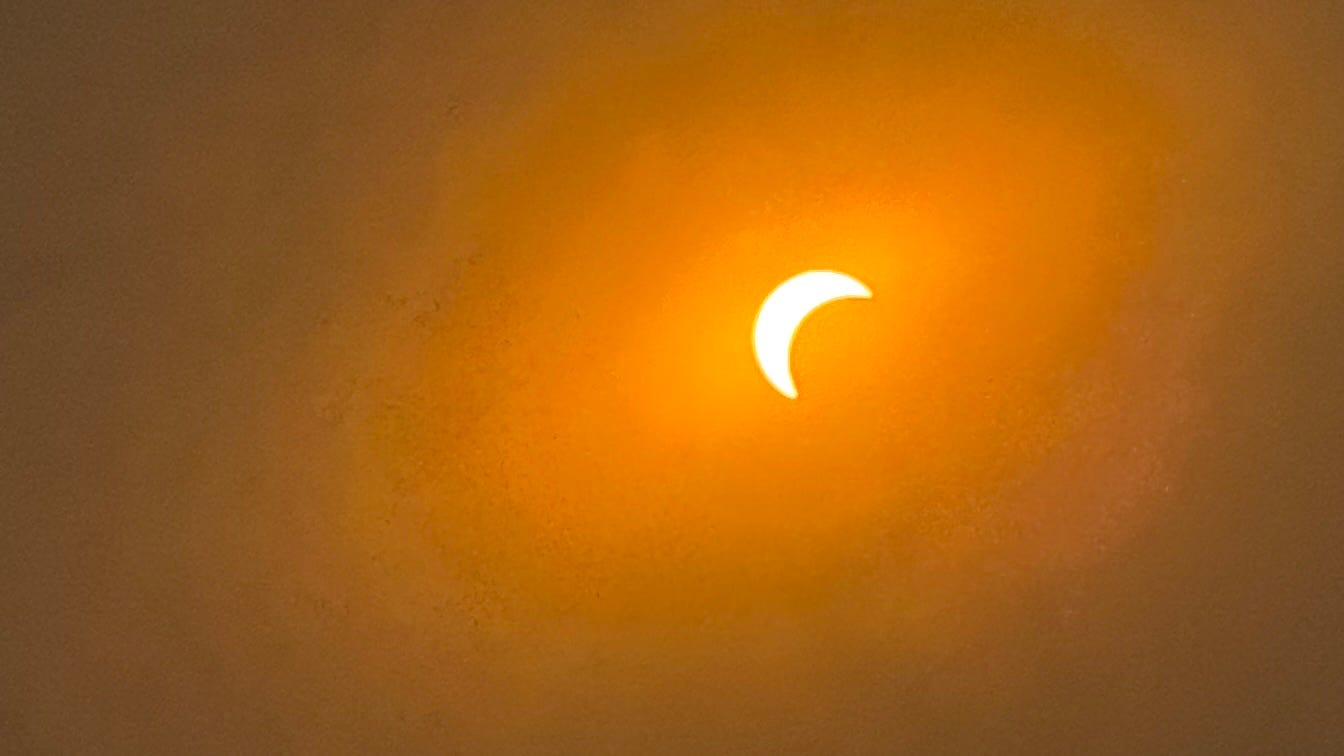
When a partial solar eclipse became visible across Europe this week, I grabbed the most sophisticated piece of scientific equipment I own. A kitchen colander. I’d read that the tiny holes work like a pinhole camera, projecting dozens of miniature eclipses onto a sheet of white paper. It sounded just improbable enough to be worth trying. So I packed the colander in my backpack, walked to the open fields outside my village, and joined hundreds of other people who had gathered to watch the sky. Some had brought telescopes. Others carried homemade viewing boxes or expensive camera gear. A few generous souls let curious strangers peer through their eclipse glasses. Children pointed excitedly at the strange crescent-shaped shadows beneath the trees, while amateur photographers compared lenses and filters. For a brief moment, complete strangers became companions, united by the simple fact that something remarkable was happening overhead. My humble colander turned out to work perfectly. More Than an Eclipse The last time I witnessed a solar eclipse was more than twenty-five years ago. As I stood there watching the Moon slowly uncover the Sun again, I realised how much life had happened between those two afternoons. Back then I had only recently been ordained. Podcasting barely existed. Smartphones belonged to science fiction. I hadn’t studied in Rome yet. I hadn’t experienced burnout. I hadn’t spent years making television documentaries, walked the Camino de Santiago or started writing novels. Standing in that same sunlight, I wasn’t just watching an eclipse. I was looking across almost three decades of my own life. It’s strange how time works. Twenty-five years ago feels almost like yesterday. Yet when I imagine another twenty-five years stretching ahead, it suddenly seems like an impossibly long road. Our memories compress time. The future, meanwhile, always feels endless, until one day you realise it isn’t. What Actually Lasts That thought lingered with me as I walked home. People often worry about the legacy they’ll leave behind. Buildings. Careers. Collections. Recognition. History suggests those things don’t last very long. One of the advantages of having studied in Rome is that you spend your days surrounded by the remains of people who once believed their empires would last forever. Today, even the mightiest monuments are incomplete. Stones have been reused. Statues have crumbled. Names have faded. Perhaps that’s why I don’t find much comfort in the idea of leaving something behind. What matters far more to me are the moments that quietly shape a life. An afternoon spent filming a documentary. A conversation with a stranger. A walk through the woods. Or standing in a field with hundreds of people, all looking up at the same sky. Those are the moments that stay with us long after the photographs have disappeared into forgotten hard drives. As the sunlight slowly returned to normal, everyone packed away their cameras, folded up their picnic...
0:01SPEAKER_01Hey, and welcome to another episode of The Walk.
0:03SPEAKER_01I'm Father Roderick.
0:04SPEAKER_01Normally, for this podcast, I would walk south to go to the woods.
0:11SPEAKER_01But today I am heading west.
0:15SPEAKER_01And that is because today
0:20SPEAKER_01there is a phenomenon that you undoubtedly have heard
0:24SPEAKER_01about, which is the partial solar eclipse that takes place in large parts of Europe.
0:31SPEAKER_01And can also be seen from my country, the Netherlands.
0:34SPEAKER_01However, right now I'm passing by the gelato shop here on my right.
0:43SPEAKER_01And I'm heading down this street that is flanked on both sides by tall trees.
0:52SPEAKER_01And of course I can see the sun shining through the leaves and the branches.
0:57SPEAKER_00But I don't have...
1:00SPEAKER_00A clear view of the sun.
1:01SPEAKER_00Not that I intend to look into the sun, because obviously that would cause
1:09SPEAKER_01damage to my eyes.