
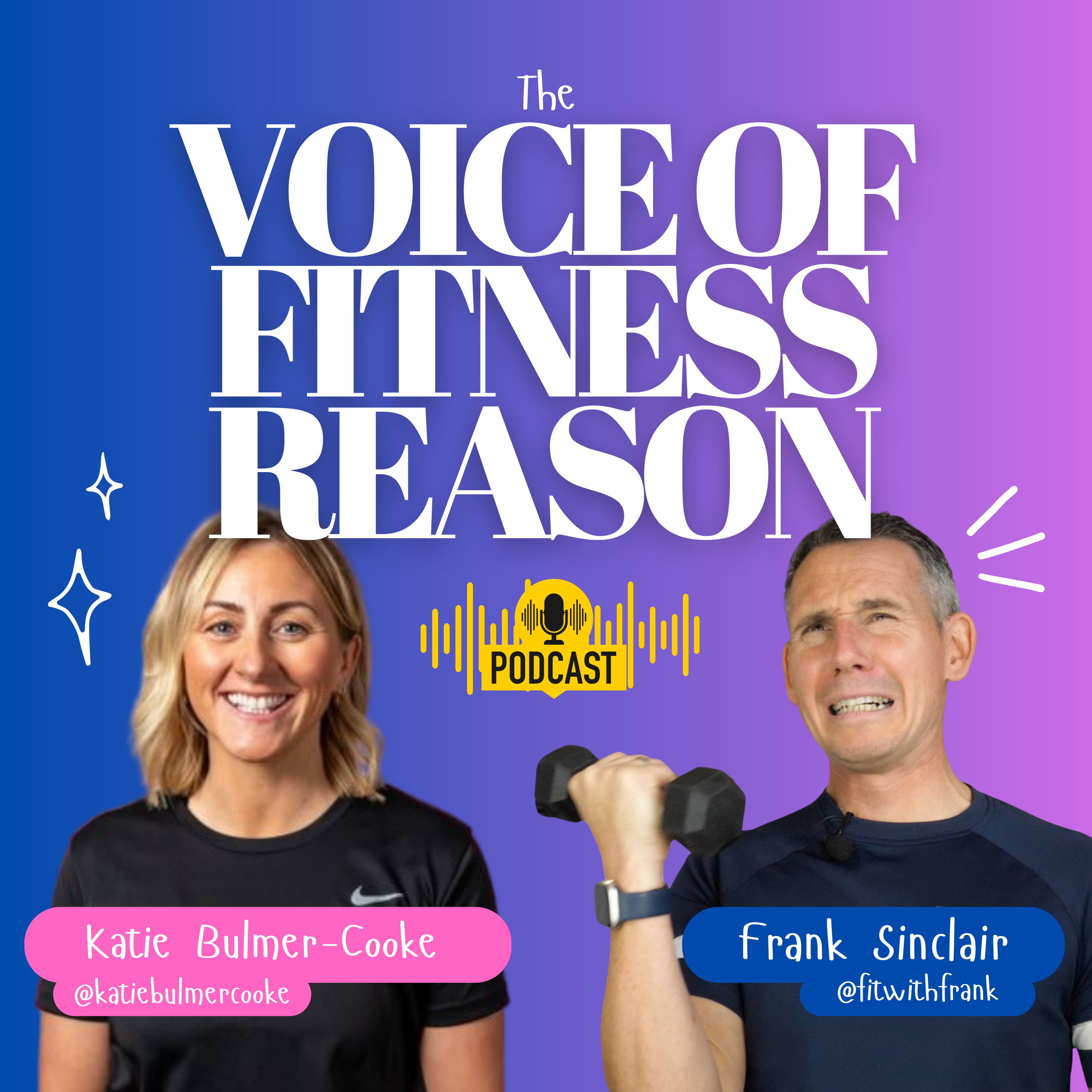
The Voice Of Fitness Reason Podcast | by Katie Bulmer-Cooke & Frank Sinclair · Katie Bulmer-Cooke & Frank Sinclair
Think you’ve left it too late to get fit? New UCL research says think again. 💪 A study of around 6,000 people found that those in their early to mid 50s who lost just 5% of their body weight ended up with heart health similar to people who’d stayed a healthy weight their whole lives. That’s 5kg if you weigh 100kg. Very doable. In this episode, Frank and Katie chat about: What the study found and why it’s such good news Why 5% is a small target with a big payoff Why a good coach starts with you, not a generic plan (and definitely not burpees) How to build belief when you’ve been told for years “that’s not for you” The “I am someone who…” trick for the days you can’t be bothered Why your 50s can be the perfect time to start Why waiting for January (or a health scare) is a bad plan Plus Katie smashes her Hyrox time target in Birmingham, and Frank gets some feedback that stops him in his tracks. _____ Got a question for Frank & Katie? Send it in, it might end up on the pod. Email Us: [email protected] Buy Us A Coffee: https://buymeacoffee.com/voiceoffitnessreason
Frank: It's week of celebration. Pure celebration. For multiple reasons. Number one, of course, the podcast we're going to talk about a study that's come out, which has given us hugely positive news to continue doing the job that we like to do for the people we like to do it for. But before that, KBC, I've seen some really good photos of you flying around the line again. What you done? Katie: Well, I did it, Frank. I'm buzzing with myself. Me and Amy went to Birmingham last week and we completed high rock stumbles. We went with the intention of getting a one hour 15 time and that is exactly what we got. Frank: So you had a specific goal on your Hyrux time and you you nailed it? Katie: Yeah, we did. I was super chuffed about it. It was really hard, but I was really buzzing with how well we did. Frank: I must say the doubles pit bit, did you say it's Amy's her name? Katie: Yeah. Frank: The doubles bit looks fun. did you enjoy do you enjoy it more doing it with someone? Katie: Yeah, yeah I do. I started as a soloist, but it's much better in a pair. And then my Heidi did our first ever adult high rocks. On the same day. Frank: Or she did adults. Katie: Yes, she did adult and she did solo. So much harder. She always does things in a pair. And she said, different beast altogether doing it by yourself. Much more fun with a partner. So I think she's going to be a doubles person from now on. She much preferred the doubles. Frank: She head to tow in Nike. Katie: She was, yeah. Frank: Good, good, good. Repping well. Well, congratulations, mate. You looked fantastic in the photos. Katie: she wants. Yeah, thank you very much. Frank: You looked like you were happy. You know, even without knowing how well the time was and how much how well you performed. It just looked fun. Looked good. Proud of you going down south to Birmingham. 'Cause that is south for you, isn't it? Is it well south? god, it's well north. Katie: it's well south. It's a good, it's well south. It's a good three and a half hours on the train. Frank: Jeez, that's that is our halfway hut. We'd have to meet there. Not for not for that. But like a cm Katie: Yeah, well that's where we... Yeah, that's where me and you will be doing high rocks next year and me at halfway. Frank: Is there any good coffee shops round there? I I'm interested in those. Katie: I'm not sure what would find you a coffee, Frank. It's a little reward for doing your high rocks. Frank: Ha. Some brummy brunch. We'll go for that instead. Anyway, Katie: Yeah. Frank: right, back to the important topic of our people. Well done. Nip that in the bud. I saw a study on the telegraph, believe it or not. I don't know how I found that. I don't know how the telegraph popped up on my feed, but it did. Some sort of study that's been done in London. We believe, UCL. As always, KBC has looked into this properly and she's got the details for us. But there is the overarching thing to come from this is. Whatever your age. Exercise, looking after yourself can improve your health. That's what the the study said to me. That's what caught my eye. Because a lot of people say I'm too old to start, people say that to me, I'm too old to start doing weights, I'm too old to do fitness, da da da. It's untrue. The science is backing us up. What is this new study that came out of the University College of London KBC? What did it tell us exactly? What can we learn from it? Katie: So one of my big takeaways from it when I was reading about it was that overweight men and women who lose at least 5 % of their weight in their early to mid 50s want to have similar heart health to those who have stayed a healthy weight throughout their lives. It's telling us the fact it's never too late to make change, which we love. Frank: So hang on, run that bum again. So someone who hadn't done anything or was unfit and overweight, presumably, started Katie: Yeah. Frank: off the bat later in life, after fifty. They got to the same level as someone who had spent their whole life doing it. Is that what you just said to me? Katie: There we are about, yep. Frank: Wow. I mean that is g we'd always be hopeful of that and I've don't I'd ever say to a client in their fifties, sixties, seventies, eighties, nineties, whatever, I wouldn't ever say don't start, like I'd always want you to try. But being backed up by the science to suggest results can actually show themselves is is a hugely motivating one for anybody, isn't it? You know, it doesn't Katie: Yeah. Frank: matter what your history is. Let's let's look at now and what you can do t you know, for the future. Katie: It is a really good example of like reversibility. This is slightly different, but I've Frank: what a word. Katie: had clients in the past who've come to me and they've had type two diabetes and through changing their diet and improving their exercise habits, they have been able to come off. their diabetic medication and reverse their type 2 diabetes. Like they've gone back to the doctor and had all of their tests done and reviewed their medication with the doctor and the doctor said, you don't need to take that anymore. Continue with what you're doing, which is amazing. And this is kind of on the same track. It's not too late. You can do things to improve your health. We often accept as humans that health decline is inevitable with age. you know, I'm getting, you hear people say it all the time. Well, I'm getting on a bit now and yeah, well that's to be expected at my age. Well, is it? We're very accepting of that. It's quite almost quite cultural that you get older, you, you. your health markers decline, you're not as well, you're not as fit, you're not as healthy. But this study is showing that it doesn't have to be that way. And if we look at what it was saying about losing at least 5 % of your body weight in your early to mid fifties, 5 % isn't actually that much. Frank: Now I was trying to think about that. Say I weigh 100 kilos, that means I'd go down to ninety five, right? That's good that's my mass. Yeah. Doable. Katie: Yeah. And if I'm sat in the gym and I'm looking at, I mean, do this a lot with clients when they've lost a lot of weight, I'll hand them a dumbbell or a couple of dumbbells or a plate or a kettlebell or an item that represents that weight. And you pass them on a five kilogram weight and you go, yeah, I've got it, it's just weighty that, yeah. Wow, I was carrying that round with us. And yeah, it feels like, it's a significant amount, but it's not like it a hundred, if someone is a hundred kilograms losing five kilograms, it's not a huge amount. It's nothing that you couldn't do within two or three months, if not less, it's very doable. It seems like it's quite a small thing to do to get a really big outcome. Frank: But makes if I'm in that position, I'm in my fifties, my sixties, whatever. And I'm and I and I know I've not been the healthiest in my life. And I'm maybe feeling a bit bad about that. Because people do so kind of make themselves feel bad about that. Maybe whatever reason, maybe you've got some grandkids that started popping up or whatever. You're thinking about longevity and living better, and you're thinking, I gotta get healthy and fit. I want to lose some weight. It it can be quite a daunting thought, can't it, to think, my god, I've got to do everything. Because you you've done nothing more or less, or you've done very little, or you've never been that successful. It's like can't do all this stuff. Maybe you've got another friend who is doing all the stuff you think you should be doing. Seems daunting, seems way out of achievability. But what you've told me, and I want to make sure this is correct, only five percent of weight loss will lead to the same health benefits, right? So I'm saying only, but I reckon that's you just said a few months, give yourself that little target to begin with. Katie: Mm-hmm. Frank: That seems doable. I could get my teeth behind that and really have a go at that. And of course then there'll be a snowball of different things That we you should do. Maybe we could talk about other things that it did come up advisable from this study, because I've got a list of things I want people to focus on in this period of life. Many things we've spoken about many times in this podcast. But I think you'd have to start from fresh. Whatever age you are, we treat you exactly the same. What are you trying to do? You want to get better? Okay. Let's start with an achievable goal. That five percent weight loss, I think anybody that walks in my gym, for sure, I would be confident we could have a go at that. I'm sure you would. Even if they're not, you could probably speak to them only without even doing the exercise. You'd get to that, wouldn't you? Just give yourself that first target and know that it's gonna make a big difference. Katie: That that you've just said about we treat everyone like the same from everyone goes from where they are is a really important message if anybody's listening to this and they're thinking well that's me I'm mid-50s I don't feel as well as I think I could I'd love to be more active you know do the whole thing I'd love to work on my nutrition I'd love to start exercising regularly but I'm scared to go and do the class, the PT, whatever it is, because am I too far past the point of being able to start? I think people do feel like that. People feel that, well, I've left it too long. If I try and go to a class, if I get with a PT or whatever, I'm... I'm not going to be able to do the things that they want us to do. I think it's really important to know that if you find a good coach, a good instructor, a good trainer, whatever they call themselves. will take you from where you're at. won't make you try and fit into a box and into a generic program and be starting with burpees and all kinds of crazy stuff. A really good coach will nurture you from whatever your starting point is. So please don't, if anyone's listening and they're in that position, please don't let that be a thing that stops you. I hear that from people, you're not going to get us to do this. No, absolutely not. I'm going to have look at what you can do. And I'm sure you're the same, Frank. you can do and how you move and I'm going to listen to what you tell me your life is like and then we'll build from there. Frank: I had the best bit of feedback this week from someone in this bracket. I believe she's sixties, not sure. She said, You're the first person that's ever believed in me you what it's like, I I was like, I'll yeah, you know I don't know, it did hit me a little bit, 'cause I do I do think a lot of people, for whatever reason, however far they are in life, have had a bit of belief knocked out of them. It could be back at school when the tea they didn't feel like they were the one in P that could do the thing, or it could be their mum, dad telling them they can't do or that, or you're only good at this thing, you're only better at that thing. It that could have gone on for in this case, sixty odd years before someone was just like And I've done nothing special other than what you just explained there, but my perspective is so much different. Because I see people of all walks of life every day. I'm I'm fortunate to see that. So when you walk in and you say I want to do something, I'm not gonna be like, No way, mate. I I'm almost I'm already thinking, Well, let's how do we do that? You know, I'm just asking the question, yeah, well let's try, I don't know. Can you do it? I don't know yet, let's try. And most of the time people just achieve more than they think. And the reason I think the reason she said that she did something she never thought she could do and it was like I took it as like, This is the this is the fe this is why I do this. This is this is it. Katie: Okay. Frank: For her, it might be a total transformation in her head now that will go past me and way beyond me. But she she knows she can do things. And with exercise, I just think you can do so much more than you think. Whatever your perspective is of it, and I think knowing that it will actually improve your life as well in other areas and improve your health and maybe better help you live longer and do all the things you want to do in life f for a longer period of time. It's gotta be motivating, isn't it? But that belief Katie: Yeah. Frank: I think is kicked out of a lot of us. And that generation 'cause this study was done on six thousand people, it said, who were born in Britain in nineteen fifty eight, I don't know as a specific year, that's what I got. Don't know if you saw that. Katie: Yeah. Frank: But it was a lot of people and they were born in a certain era. If you're born at the end of the fifties, sixties, whatever, you weren't brought up in a period where everyone's talking about exercise every day. Seeing us talk about strength training and fitness is quite new to you. So you might be thinking, my God, and that that is not yet something you believe you could do, potentially. But I'm telling you, if like I I've not met anyone yet who can't have a go. You might Katie: Yeah. Frank: not win Hyrux against Katie Bournemouth Cook. Maybe not. Katie: Thank you. Frank: You might not, you might do. But you could definitely make a difference. You could definitely get your health to a different place. And you'll shock yourself. So it's that b it's the belief I see in I wanna see in people that you can get out of yourself. And I hope seeing a study like this will encourage you to at least try. Have a go. Katie: I love that. That's one of my favourite things about the job that we do is when people think they can't do something and you're, I know and I keep it inside thinking, I know you definitely can't do that. And then we do it. And then they're like, my God, I did it. And I was like, you never did. Of course you did man. Like that's, I love that when people do something that they didn't think they'd be able to do. I think that is just the best feeling. Frank: That's what we do it for, isn't it? I told it's the best feedback. Yeah, Katie: Mm-hmm. It is the best feeling. Frank: that's that's it. You just gotta believe in yourself, haven't you? If if you don't, who else is gonna? You've got to back yourself a little bit. But I d I always empathize with it because it is a different period of life. We don't know people's backgrounds, so much has happened. But these ingrained behaviours, you're an expert in behaviour. People pick them up as kids, a lot of stuff in in the youth, don't you? Hard to get away from that. And if no one's showing you another way, how do you know? You can't if you're not surrounded by people that are doing certain things, it's hard to change your beliefs, isn't it? So the bit the best advice I had, and I'm so glad she turned up here, is just put yourself in a room with people that are on the same mission and then you can with your own eyes, you might see someone doing something that you you maybe didn't think they could do. And then that gives you belief. Put yourself around people that are gonna lift you up, that are on the same mission as you, and I bet you your results will be so much better. Wherever that is. Katie: And you know what is also important I think to know about that that era of life that is being talked about in this article that's sort of early to mid 50s and beyond. Often that's a time of life when you're getting a bit of time back for yourself. That if you've got children, they're probably up doing their own thing. They're figuring out their own ways in life and they're not as dependent on you. You may not yet be caring for elderly parents. You are likely in a career or a job situation where you are quite stable. with probably more financially stable. So you've got some resource to invest in doing things to do with health and fitness. So in terms of time and in terms of finance, potentially at that point in your life, you've got quite a lot going for you. You've got quite a lot of resource that you can put into this. So now really is the time because when you think about when your kids are really little, and you're running around and maybe you're trying to work hard to get your career off the ground and all that stuff. There's a lot of things pulling you in lot of directions. And I'm not saying that people don't have commitments in their 50s and beyond, because of course they do. But generally, if I think about the clients I have and people I know that are in that age bracket, their life is just a little bit more settled and they've got more time than they've had in previous eras of their life. Frank: Great point. Now did you see what they suggested we do? You do? Katie: you've got this list haven't you? Frank: Yeah, it came up with a list. I came up with a list and interestingly, I think we'll agree with a lot of It's it's given me five bullet points. I'm gonna read them out to you. See if you agree with them. Just say yes Katie: Okay, yes. Frank: or no, do you agree? So it says first of all, it's never too late to improve your health and then the Katie: It never said that. Agree, yes. Agree, yes. I agree, yes. Great, yes. Agree, yes. Yeah. And all of that is also very accessible. So if you are at that stage in your life and you were a non-exerciser and you also may not have the best diet, everything that's on that list is very doable. you can ease yourself into strength training. You can work on sustainable eating habits. We're not asking, we're not looking for extreme things. Just asking you, right, let's do a couple of tweaks here to make this something that you can do long-term. All of this feels like, yes, it requires change from people, it's none of us extreme. It's very doable. It's very accessible. Like start some strength training, look at some more sustainable changes, a bit of cardio, find something that you enjoy. And then we aim and allude 5 % of your body weight. It's all achievable without massive amounts of effort. Yeah. Yeah. Yeah. Yeah. I think in the early days of change, you've got to start pretending you're already the person that you want to be. Because, yeah, change and feeling different about yourself and self-belief doesn't just one day come along and slap you in the face and go, right, I'm here. I believe I'm that person now. It's not instant. Self-belief is built through experiences and actions. So in the early days, you might have to almost pretend that you are the person that you want to be and think, well, if, if I throw forward to the version of myself that I want to be, like I used to do this when I first started training with high rocks is to call myself, I am Katie, but I'm training to be high rocks Katie. So I would ask myself, what does, what would high rocks Katie do? How does high rocks Katie act? she shows up for the extra session, she does the extra bit, whatever it is. But start acting like that person. So what would the fitter version of me do? Well, they would go to the gym three times a week, or they would make the phone call of the trainer, or they would do this at breakfast time, whatever it is. Just start pretending first. It's that saying, fake it till you make it. And before you know it, those actions grow into becoming that person. You are James Bond, Frank, you are James Bond. Yeah, I use it like a motto or a one-liner with my clients a lot. I get them to say, I am someone who, and then they finish the sentence. So I am somebody who does the early start. I'm someone who. does 8,000 steps a day. I did one last night for one of my clients on an online session. I am somebody who doesn't take me foot off the gas at the end of the year. And it's just, it's all very personal. Like you have to finish the sentence yourself. But at any time when you feel conflicted, because you will do whenever you're making changes, it's so easy to go back to the default, the thing that you've always done. But whenever you're met with those challenges, those little battles where you're like, should I go to the gym tonight? Should I not? And you almost try and talk yourself out of it. And you just cut the conversation in your head and you just say, I am someone who, whatever the action needs to be. Hmm Yeah. Yeah, I we've covered that. Just don't wait. Don't wait. Don't wait till the new year. Don't wait till after Christmas. Don't wait till you're this age, that age. Definitely don't wait till something bad happens from a health point of view, because you see that a lot. You know, somebody will have like a... that someone will have a heart attack or somebody will be giving the news that they've got type two diabetes or something like that. Don't wait for anything to happen. Do it now, because it's never too late. Just do it now. Don't put it off. Let's do it. Let's do it. Good chat and I hope that was helpful for our listeners. Bye bye, Fran.
More The Voice Of Fitness Reason Podcast | by Katie Bulmer-Cooke & Frank Sinclair episodes →