
The Truth Tank · The Truth Tank
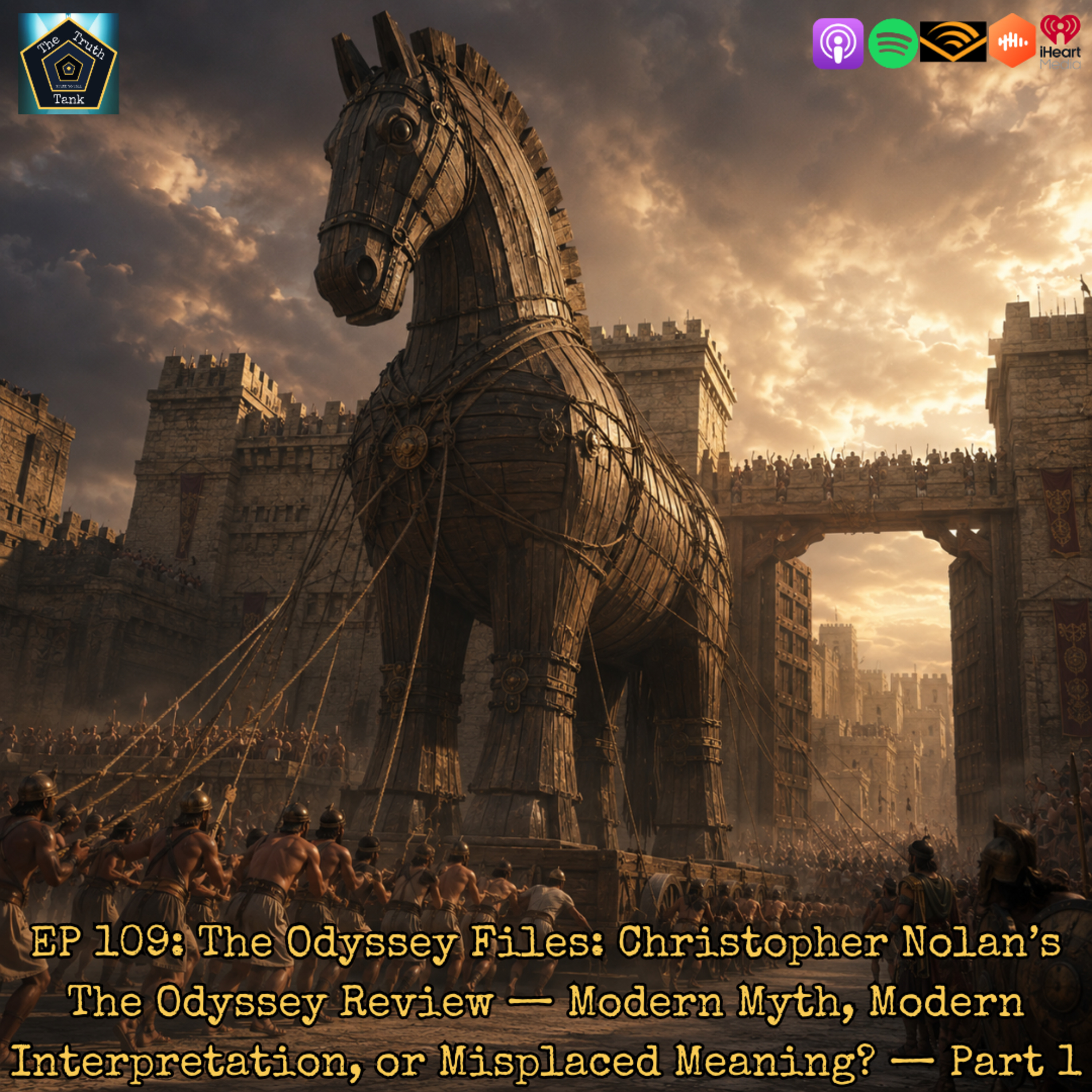
This is episode 109 of The Truth Tank Christopher Nolan’s The Odyssey is one of the most ambitious cinematic adaptations of an ancient story ever attempted. But how much of Homer’s Odyssey actually survives Nolan’s interpretation? In Part 1 of The Odyssey Files, I put Nolan’s film under the microscope and repeatedly return to Homer’s original poem as the benchmark. Rather than judging the film purely as a piece of modern cinema, I’m asking a bigger question: is Nolan’s interpretation faithful to the myth, the world, and the ideas that made Homer’s Odyssey endure for almost three thousand years? Having visited the ruins traditionally associated with ancient Troy and spent time studying the world in which the story is set, I look closely at Nolan’s historical and cultural choices — from the Trojan Horse and Bronze Age armour to the age of Telemachus, Agamemnon’s appearance, the accents, and the film’s unusual collision of past and present. I also examine Nolan’s decision to modernise the mythology. The Odyssey is not simply fantasy; it is mythology, built around ancient Greek concepts of mythos and logos, fate, the gods, hubris, identity, heroism and the consequences of human choices. Has Nolan found a way to translate those ideas for a modern audience, or has the modernisation stripped away some of Homer’s original meaning? Then there’s the filmmaking itself. I take a closer look at Nolan’s use of IMAX and 65mm film, questioning whether the enormous formats genuinely serve the story or whether IMAX has become something of a cinematic Trojan Horse — a way of convincing audiences that they need to buy the most expensive ticket possible. From the half-sunken Trojan Horse in the opening scenes and some questionable creative choices, to the film’s casting, jumpy editing and the changing tone once Odysseus and his crew reach the open sea, I work through the major strengths and weaknesses of Nolan’s adaptation. We also get into Agamemnon, the Cyclops, Circe, the suitors, Odysseus himself and the film’s treatment of the gods. Why does Nolan make Odysseus such a different character? Does the emphasis on PTSD fundamentally change the meaning of his journey? Has the Cyclops been reduced to just another monster when Homer’s story is really about hubris and its consequences? Why has Athena’s role been so heavily altered? And what happens to the mythology when the gods themselves are pushed into the background? Perhaps the biggest question of all is this: Is Odysseus still Odysseus in Nolan’s Odyssey? Christopher Nolan has spent much of his career reinventing established mythology and characters through modern lenses, from Batman in The Dark Knight trilogy to his explorations of time, memory, identity and reality. But Homer’s Odyssey is not simply another story to reinterpret. It is one of the foundations of Western storytelling. So has Nolan successfully modernised an ancient myth or has he pushed his creative interpretation too far? This is Part 1 of my...
0:00Telomemuse of the Man of Many ways.
0:04Nearly 3000 years ago, a poet stood before an audience and
0:08began with a single request. These words would survive the
0:12collapse of kingdoms, the rise and fall of empires, the burning
0:15of libraries, and the passing of almost 3 millennia.
0:21They would inspire philosophers, kings, artists, explorers, and
0:24eventually Hollywood. So on this week's episode, one
0:28of the world's most celebrated film makers, Christopher Nolan,
0:31has attempted what many would call impossible, bringing The
0:34Odyssey to the big screen. But adapting Homer isn't like
0:38adapting any ordinary novel. This isn't just another
0:41blockbuster, it's one of the oldest surviving stories ever
0:45told, a cornerstone of Western literature.
0:48Born from a world where God's walked among men.
0:51Honor meant everything, and A Journey Home became one of