
The Trans-Atlanticist · Andrew Sola
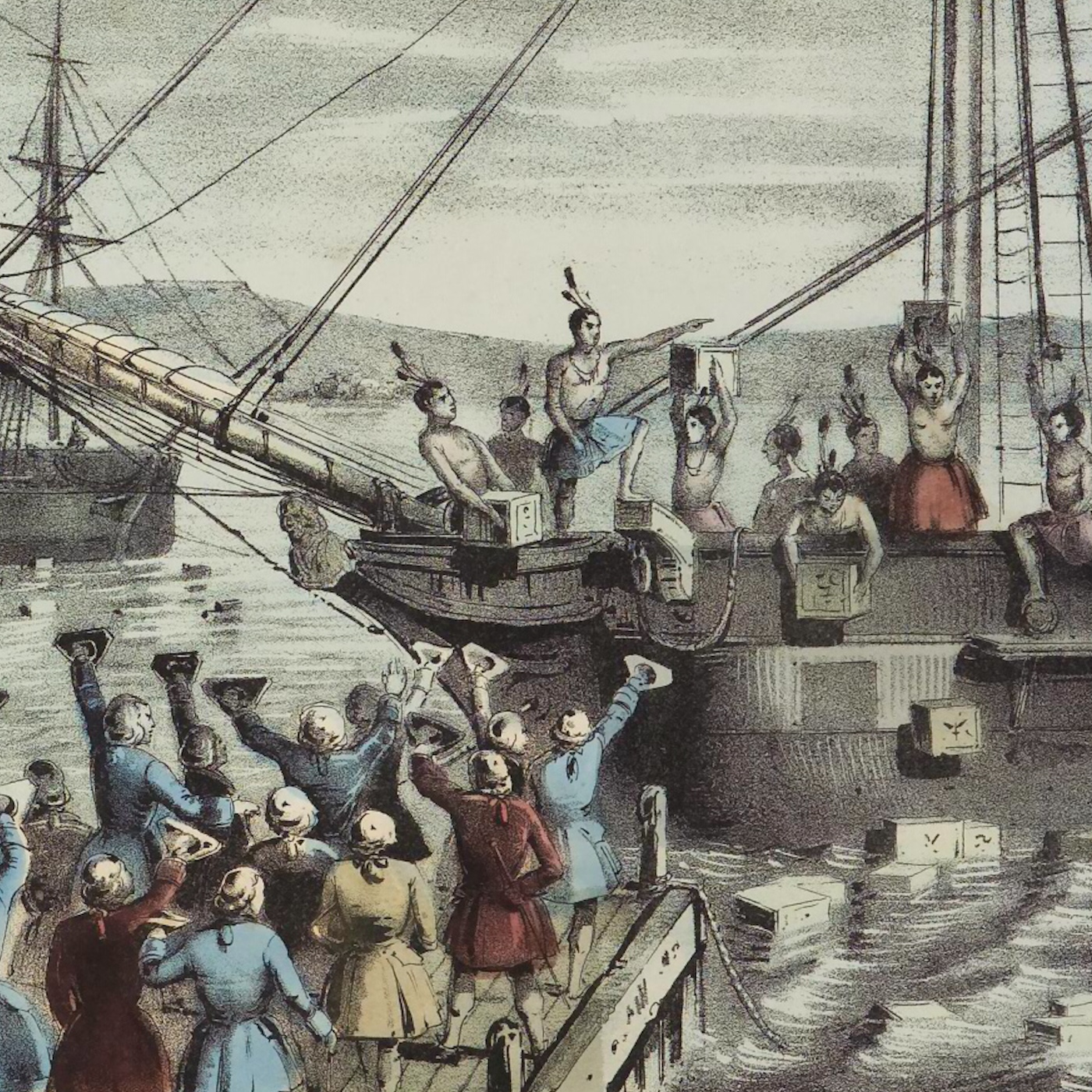
"A Prince, whose character is thus marked by every act which may define a Tyrant, is unfit to be the ruler of a free people." In this episode, we explore the Boston Tea Party, the global tea industry, British-American perceptions of tyrannical governments in Asia, and the Declaration of Independence. Topics include the following: -the connotations of the word "tyranny" in the Colonies -the presumption in the Britain and the Colonies that "freedom" only meant being Protestant and living in a constitutional monarchy -the East India Company, the tea trade, the cotton trade, and the Mughal Empire -Colonial American consumer culture and the origins of ethical consumption movements -the 7 Years' War, the Battle of Plassey (1757), and the conquest of Bengal by the East India Company -the East India Company's role in the famine in Bengal in the late 1760s, which led to the deaths of millions of people there -the Tea Act of 1773, which was an effort by the British government to generate revenue after the decline in income from the East India Company due to the famine -the Boston Tea Party and the British reaction in the form of the Intolerable Acts -reasons for Americans' long-standing distrust of giant, unaccountable corporations like the East India Company [Selling Empire: India in the Making of Britain and America, 1600-1830](https://uncpress.org/9781469636177/selling-empire/) The cover image depicts The Destruction of Tea at Boston Harbor, an 1846 lithograph by Nathaniel Currier.
0:10Speaker 0: A prince whose character is thus marked by every act which may define a tyrant, Is unfit to be the ruler of free
0:21Speaker 1: people.
0:24Speaker 1: Welcome To Life, Liberty and The Pursuit Of Happiness, a podcast commemorating the two-hundred fifty year anniversary of the Declaration of Independence!
0:31Speaker 1: This show was sponsored by American Centralman Hamburg Germany And I'm your host Andrew Sola.
0:37Speaker 1: On the night of December sixteenth, seventeen seventy-three a group of men dressed as Native Americans snuck aboard The Dartmouth.
0:46Speaker 1: A British merchant ship that had just arrived in Boston Harbor carrying and major shipment of tea.
0:54Speaker 1: These natives who were in fact members of the Sons Of Liberty threw three hundred forty two chests of the East India Company's Tea into the freezing waters of Boston Harbor.
1:07Speaker 1: We remember this event as the Boston Tea Party, an event that helped set off The War of Independence against King George.
1:15Speaker 1: A British tyrant who in words was no longer fit to be a ruler of free people.
1:26Speaker 1: So what is connection between American independence and tea?
1:34Speaker 1: What was East India Company and why was it so important in shaping the events that led to The American Revolution?
1:43Speaker 1: And what did the colonists think about the British Empire in India, and the tea trade in general.
1:49Speaker 1: Here with me today is Professor Jonathan Eckett.
1:56Speaker 1: Jonathan is Associate Professor of History at University of California Riverside.
2:01Speaker 1: His research focuses on the British and their empire from the eighteenth century to the present.