
The Trans-Atlanticist · Andrew Sola
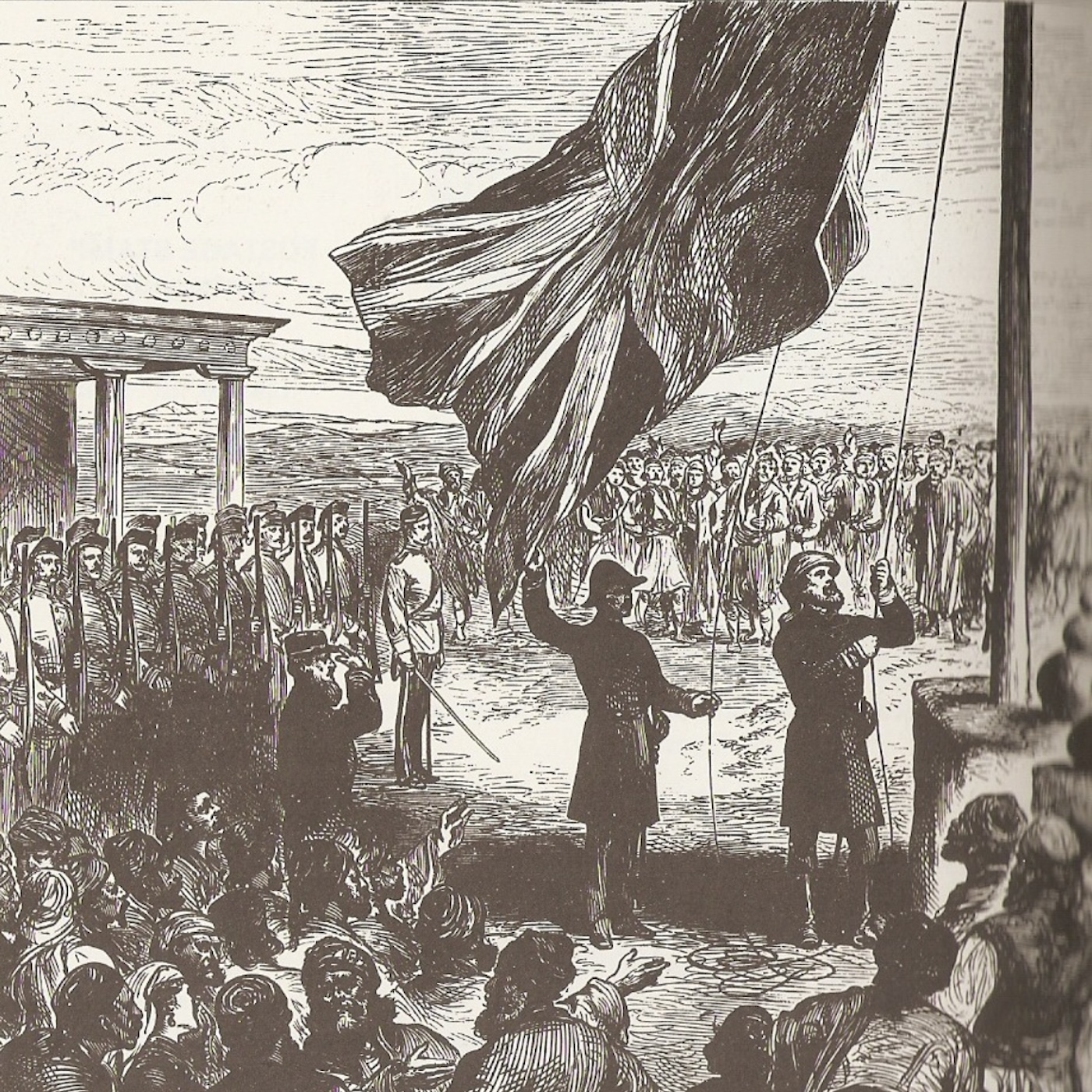
"I would be prepared to accept the status of independence for Cyprus on the condition that this status shall not be changed, either by union with Greece, by partition, or by any other way, unless the United Nations approves such a change." Archbishop Makarios, September 1958 In this episode, we explore connections between the American struggle for independence from Britain in 1776 and the Cypriot struggle for independence from Britain nearly 200 years later. Here is a list of key terms, organizations, and people: ENOSIS: the union of Cyprus with Greece TAKSIM: the partition of Cyprus between Turkish and Greek populations NATIONAL RADICAL UNION OF CYPRUS: precursor to EOKA EOKA: the name of the Greek nationalist organization TMT: the name of the Turkish nationalist organization AKEL: the trade union party of Cyprus, with links to communism Archbishop Makarios: Leader of the enosis movement and first president of Cyprus Jason Loukianou: proponent of a liberal republic of Cyprus Antonios Triantafyllides: lawyer and nationalist politician assassinated in 1934 for agreeing to participate in British Colonial Advisory Council General Georgios Grivas: Greek nationalist and military leader of EOKA Topics include: -a brief history of modern Cyprus from 1776, during Ottoman rule (1570-1878), through British rule (1878-1960) -the changing governance models in Cyprus and the evolving legal status of Cypriots while under British rule -the re-introduction by the British of democratic practices, constitutional rule, and a liberal legal system into Cyprus -the impact of the Great Depression on Cyprus -the impact of WWII, the Greek Civil War, and the Cold War on Cyprus Prof. Varnava's books can be found here: [Assassination in Colonial Cyprus in 1934 and the Origins of EOKA](https://anthempress.com/books/assassination-in-colonial-cyprus-in-1934-and-the-origins-of-eoka-pb) [British Cyprus and the Long Great War, 1914-1925: Empire, Loyalties and Democratic Deficit ](https://www.routledge.com/British-Cyprus-and-the-Long-Great-War-1914-1925-Empire-Loyalties-and/Varnava/p/book/9781138698321?fbclid=IwAR3EVpbAACDza6h6eIHrw1H5ghmBXeMRmEKGjtwGIaIgpG1wGVxBH-5Y36E) [Serving the Empire in the Great War: The Cypriot Mule Corps, Imperial Loyalty and Silenced Memory](https://manchesteruniversitypress.co.uk/9781526103673/) [ British Imperialism in Cyprus, 1878-1915: The Inconsequential Possession](https://manchesteruniversitypress.co.uk/9780719086403/) The cover image depicts the British military hoisting the Union Jack in Nicosia, Cyprus, on 12 July 1878.
0:09Speaker 1: In September of nineteen fifty eight Archbishop Macarios made a statement in which he said, I would be prepared to accept the status of independence for Cyprus on condition that this status shall not be changed either by union with Greece, by partition or any other way unless United Nations approves such
0:31Speaker 0: change.
0:33Speaker 0: Welcome to Life, Liberty and the Pursuit of Happiness a podcast commemorating The Two Hundred Fifty Year Anniversary Of The American Declaration of Independence.
0:42Speaker 0: This show is sponsored by The American Centrum in Hamburg Germany And I'm your host Andrew Sola.
0:48Speaker 0: Throughout this series we've explored A wide variety of perspectives about the declaration of independence.
0:54Speaker 0: We have looked at female perspectives Black Perspectives Native American Perspective And we've also looked at the influence of American declaration on different countries from Ireland to Mexico and France.
1:08Speaker 0: By using this comparative approach, We have learned that The Declaration was influential in some ways That we haven't realized.
1:15Speaker 0: At same time it wasn't as influential As we often assume.
1:22Speaker 0: Nevertheless, the comparative approach always offers up some fresh insights.
1:27Speaker 0: And today we're going to do more comparative history by focusing on the island of Cyprus and its struggle for independence from the British Empire which indeed finally occurred in nineteen sixty roughly two hundred years after The American Declaration.
1:45Speaker 0: The obvious similarity between American and Cypriot independence is that both sought some form of independence from British rule.
1:53Speaker 0: Also, within both societies there was a wide variety of opinions about what their relationship with Britain should be like.
2:02Speaker 0: In the American colonies There were loyalists who wanted to remain British subjects.
2:07Speaker 0: There were moderates who wanted an Irish model which meant a restoration of their rights within a British imperial system.
2:15Speaker 0: And, of course there were also extremists—the Sons Of Liberty who advocated absolute independence from Britain and who committed violence not only against their fellow Americans but Britons too in order to achieve those