
The Think Wildlife Podcast · The Think Wildlife Podcast
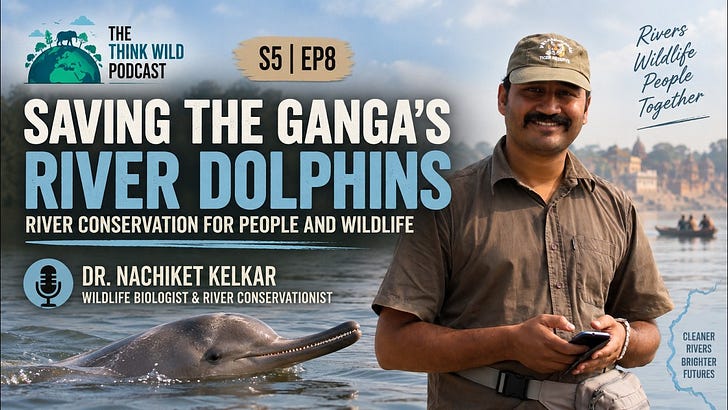
South Asia’s rivers are among the most biodiverse freshwater ecosystems on Earth, yet they are also among the most threatened. In this episode of the Think Wildlife Podcast, host Anish Banerjee is joined by Dr. Nachiket Kelkar, freshwater ecologist and researcher at the Wildlife Conservation Trust (WCT), to explore the future of river conservation across the Indian subcontinent. The conversation examines why conserving the Ganga and other major river systems requires protecting entire river ecosystems, balancing human livelihoods with biodiversity, and rethinking how we manage freshwater resources. Dr. Kelkar begins by sharing how his fascination with whales and dolphins eventually led him to study one of the world’s most remarkable freshwater mammals—the Gangetic river dolphin. Often called the “blind tiger of the Ganga,” this functionally blind cetacean relies on echolocation to navigate the often muddy waters of the Ganga-Brahmaputra-Meghna-Karnaphuli-Sangu river basins, which span India, Bangladesh, and Nepal. He explains the dolphin’s unique adaptations, conservation status, and why it has become an iconic symbol of Ganga conservation and river biodiversity conservation. The discussion explores whether the Gangetic river dolphin truly functions as an umbrella species for protecting Gangetic river biodiversity. While flagship species can help generate public awareness and political support, Dr. Kelkar explains why conserving freshwater ecosystems ultimately requires protecting fish, turtles, crocodilians, aquatic birds, riparian habitats, and the ecological processes that sustain entire river ecosystems, rather than focusing on a single charismatic species. Studying dolphins in large, dynamic rivers presents unique scientific challenges. Dr. Kelkar discusses innovative survey techniques including double-observer surveys, acoustic monitoring, and population estimation methods that allow researchers to better understand dolphin abundance, behaviour, and habitat use. These scientific tools are essential for monitoring long-term population trends and guiding effective river wildlife conservation. The conversation then turns to the growing threats facing South Asia’s freshwater ecosystems. Dr. Kelkar explains how dams, barrages, river fragmentation, canals, overfishing, bycatch, sand mining, pollution, reduced environmental flows, inland waterways, and proposed river interlinking projects are transforming the ecological character of rivers across the Gangetic plains. These pressures not only threaten the Gangetic river dolphin, but also jeopardise fisheries, ecosystem services, and countless other species that depend upon healthy freshwater habitats. The episode highlights why protecting river biodiversity must become a central component of broader wildlife conservation and biodiversity conservation strategies. Pollution is another major focus of the discussion. Rather than viewing pollution solely as an engineering challenge, Dr. Kelkar argues...
0:01SPEAKER_01Rivers are often called the lifeline of civilization,
0:05SPEAKER_01yet across South Asia,
0:06SPEAKER_01they are amongst the most threatened ecosystems,
0:09SPEAKER_01fragmented by dams,
0:10SPEAKER_01polluted by industries,
0:12SPEAKER_01overfished,
0:13SPEAKER_01and increasingly shaped by competing demands of water,
0:17SPEAKER_01energy, agriculture, and development.
0:21SPEAKER_01Protecting freshwater biodiversity today means looking far beyond individual species
0:27SPEAKER_01and understanding entire river ecosystems.
0:32SPEAKER_01Today, I am joined by Dr.
0:34SPEAKER_01Nachikit Kelgar who heads the River and Ecosystems and Livelihood Program at
0:38SPEAKER_01the Wildlife Conservation Trust.
0:42SPEAKER_01For nearly two decades,
0:43SPEAKER_01he has worked on the conservation of Ganges,