
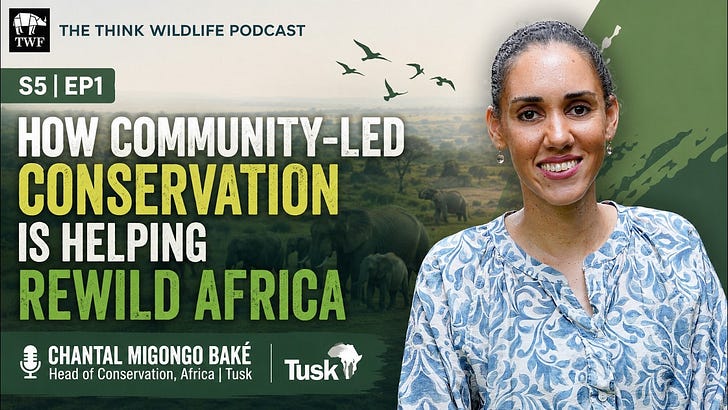
The Think Wildlife Podcast · The Think Wildlife Podcast
Season 5 of the Think Wildlife Podcast returns in a new video format on YouTube and Substack, while continuing to be available on all major podcast platforms. In this episode, host Anish Banerjee is joined by Chantal Migongo Baké, Chief Conservation Officer at Tusk, one of Africa’s leading conservation organisations, for an in-depth discussion on the future of community-led conservation across the continent. Drawing on more than a decade of experience working at the intersection of conservation, communities and sustainable development, Chantal shares her journey into conservation, from growing up in Africa to pursuing environmental social science and ultimately becoming one of the continent’s leading conservation voices. She reflects on the challenges of building a career in a traditionally male-dominated sector, balancing conservation with increasing development pressures, and why spending time in the field and building trust with local communities remain essential to effective conservation. The conversation explores Chantal’s vision for Tusk’s conservation portfolio as Chief Conservation Officer, including strengthening partnerships, reviewing long-term investments, reducing fragmented conservation efforts, and expanding support into Central and West Africa. She explains why successful conservation requires collaboration across organisations and disciplines rather than isolated projects. A major focus of the episode is community-led conservation. Chantal discusses what makes conservation initiatives successful, highlighting the importance of secure land tenure, community governance, equitable resource rights and sustainable livelihood opportunities. Through examples including Kenya’s Northern Rangelands Trust, Namibia’s conservancies and Tanzania’s Wildlife Management Areas, she explains how empowering local communities can deliver lasting conservation outcomes while improving livelihoods. The discussion also examines the growing recognition of Other Effective Area-Based Conservation Measures (OECMs) and their role in achieving global 30x30 biodiversity targets, as well as the importance of integrating protected areas with community-managed landscapes to maintain ecological connectivity. Chantal also makes a compelling case for preserving traditional ecological knowledge alongside modern conservation science. She discusses why Indigenous knowledge systems are indispensable for understanding ecosystems, why they are increasingly at risk of being lost, and how combining scientific research with local expertise can produce stronger conservation outcomes. The latter half of the episode focuses on one of conservation’s greatest challenges: enabling people and wildlife to coexist. Chantal shares examples of innovative human-wildlife conflict mitigation strategies being implemented across Africa, including early-warning systems, community ranger networks, mobile electric fencing, wildlife monitoring technologies and collaborative learning between...
0:01SPEAKER_00Welcome to Season 5 of The Think Wildlife Podcast.
0:06SPEAKER_00After a short break,
0:07SPEAKER_00the podcast returns with a new video format which can be viewed through YouTube
0:11SPEAKER_00and Substack.
0:13SPEAKER_00The audio episodes can still be listened to on all
0:16SPEAKER_00the normal podcast apps including Spotify and iTunes.
0:21SPEAKER_00I hope you enjoy listening to the new season and don't forget to subscribe to
0:25SPEAKER_00the podcast on whichever platform you listen on to.
0:29SPEAKER_00Your engagement will help the podcast and conservation science reach new audiences.
0:36SPEAKER_00Today, I am joined by Chantal Mugongo-Pake,
0:40SPEAKER_00Chief Conservation Officer at TASC,
0:43SPEAKER_00one of Africa's leading conservation organizations.
0:48SPEAKER_00With a background in environmental social science and years of experience working at
0:52SPEAKER_00the intersection of conservation,
0:54SPEAKER_00communities,