
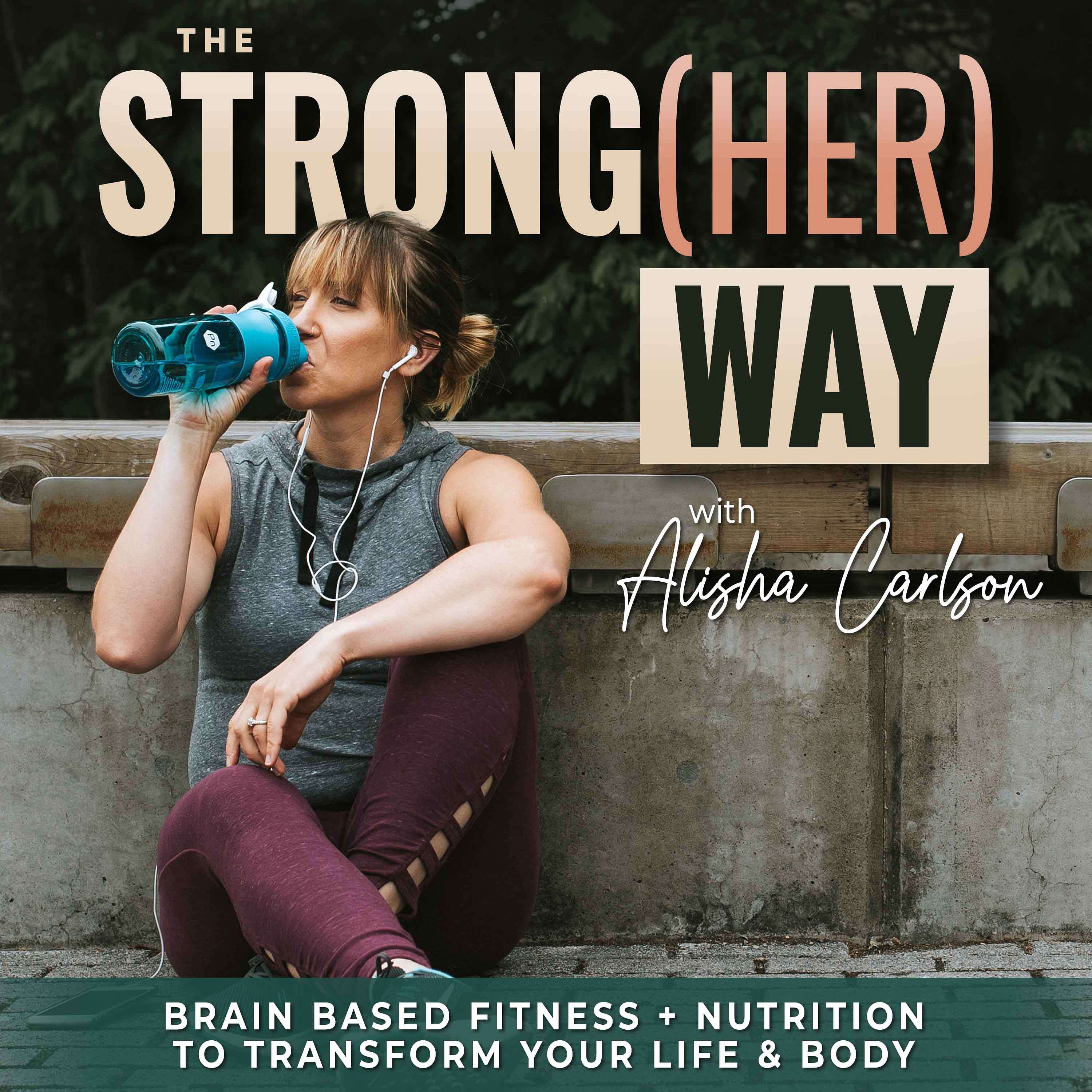
The Strong[HER] Way | Healthy nutrition and habits for moms, routines, strength training for women · Alisha Carlson, Fitness and Nutrition Coach for Moms
The 21-Day Myth: Why Habit Timelines Are a Lie If you've ever white-knuckled your way to a goal, an extreme diet, an all-in reset, only to watch the results slowly slip away, this episode is for you. Recorded live from the carpool line (messy audio, real life), Alicia breaks down the two things that sabotage a fitness or health goal faster than anything else: getting too attached to your timeline, and trying to shortcut the process instead of going through it. You'll learn why the process itself, not just the outcome, is what makes a result stick. Resources: - Free Fit + Fueled community: thestrongherway.com/work-with-us - This episode's listener guide (journal prompts + bonus research): available in the resource tab
Alisha Carlson: Hey hey, welcome back to the Stronger Way. It is your host, Alicia Carlson, and I am taking you with me in the car as we make our rounds for pickup today. life has been a little bit out of the ordinary for the past few days and we're just rolling with it because that is what we do at the Stronger Way. and it's real life, right? Sometimes it's messy, sometimes it's imperfect. I mean okay, if we're being honest, that probably happens so much more than we think it does. But if the audio is not super high quality, just know it is for good reason. as we're doing this in the car today. so anyway, I hope you all have had a great week. I hope that your day up to this point is going well. And I wanted to just share a topic with you that came up recently in our weekly workshops that we do inside of the stronger way fit-in-fueled community. This has really been a message that has been coming up for me recently as I've listened to different sermons and different podcasts or seen different people's social media posts and it's really resonated with me with business, but it's also so valuable and so timely really in any area that you would set a goal. but we're gonna talk about it specifically as it relates to fitness goals that you might have for yourself. And the two kind of key topics that came up was one the timeline aspect of a goal and how long it takes us to achieve a goal. But then this idea of trying to take a shortcut, like trying to speed the process up. or maybe avoid entire parts of the process altogether and how both of those things end up sabotaging us more than they end up actually helping us. And if you have ever set a goal for let's say like fat loss or weight loss, because let's be real, those are unf You know, fortunately, unfortunately, however you want to look at it, those are a lot of the more common goals when we think about setting a fitness goal or a health goal. And there's nothing wrong with that. however, I think the way that we approach that, the way that we've been taught to approach that is or can be very problematic. And one of the things I mean by that is that we have been taught that if we just follow this magical calorie formula, we should always be able to predict exactly how much weight we can expect to lose on a weekly basis. And I don't know about some of you guys. For me this I mean it does seem like it did work at one point in my life, even if it was very short lived. but it's doesn't really always fit so nicely in a box, especially I think as we hit a certain age, different things start happening hormonally in our body. maybe we're just in a season of life where we don't have as much time or energy or bandwidth to focus on tracking our calories or our macros. And you know, there's different schools of thought about, you know calorie counting anyway and I tend to be in the camp that doesn't really find it all that useful even if you have a physique related goal like losing weight or losing fat and that's not the same as me saying that a calorie deficit or a calorie surplus doesn't matter when it comes to overall like changes in body. But there's a lot of I think unintentional side effects or consequences when we are only focusing on that and we're so attached to the timeline. And I know that that is so contrary to everything that we've been taught about setting goals, especially when you look at smart goals, that they have to, you know, the T is like it has to be time bound. And while I do agree like there is some value. in having a timeline on a goal potentially, it's less about like that's when we have to reach the goal by and more it it becomes more valuable when we are setting a timeline because that's going to be potentially the fire that needs to be lit under our tushes to actually get into action and do things. For some people when there is no deadline it's Really easy to just kind of dawdle, I guess, when it comes to your goal. So you're kind of part part of the way in, part of the way out. I think we're setting the timeline of a goal is not useful, especially if it's like a weight loss goal, let's say, is that you can become really defeated and really discouraged when you are not continually seeing progress trending in the way or in the direction that you. And then inadvertently, because you're feeling discouraged, you end up doing behaviors or taking action that is actually the opposite of what you need to be doing in order to reach the goal. So one, I guess it's just recognizing that we cannot always control the timeline as much as we think we can. We think we should be able to based on what we've been taught or been sold. By the weight loss industry, by the diet industry. The second thing that I want to address is this idea of taking a shortcut and not necessarily like taking a faster route or taking a more efficient route, but rather just trying to completely bypass having to go through the process and become the woman who has the goal that you are working on. They're is a reason that we have to endure the process until we reach the goal and that's because there's something that changes inside of us as we continue to work consistently day in and day out on our specific goals that we don't get when we bypass the process altogether. And if you've ever like gone on a diet and you've done like all the extreme things, you've lost the weight, but then you find yourself at your goal, rebounding and engaging in all of your old activities and behaviors and gaining the weight back and likely then some, that's because you were trying to bypass the process. There was no shift in the internal dialogue around food. Or around exercise. There was no change in your habits. There was no change in your self-concept. You purely just like probably with a lot of effort did what had to be done in order to reach the goal. But then as soon as you got to the goal, there was no long-term lasting change. I like to kind of equate this to the idea, or it's like a parable of. A person who builds their house on sand when the storms come and the winds and the rains come, there is no solid foundation for that house and it's gonna crumble. That's exactly what happens when we pursue our goals without going through the process, without working on the consistent habits, the you know, just getting your reps in day in and day out, even when they're not done perfectly or Working on your mindset, working on your stories around food, around exercise, around the scale, around your body, your time, like all of the reasons that you don't have your goals yet. What are the stories about that? Who would you need to become? Like what are the excuses or the parts of your story that you need to let go of? Those are all of the things that then become you building Your house on the solid rock, right? So it's like on the one hand, you can build it on the sand, which is like the quick fixes, the white knuckle it until you get to your results. And then there is the version of you that built your house on the rock, which is a solid foundation, and that is the identity piece, that's the consistency piece, that's the patience, right? That's not being attached to the outcome, not having urgency or needing to be in a hurry to get to your goal, but really just relaxing into the idea that y you're gonna have to do the things that get you to your goal forever. Like there is no finish line, right? So by the time you reach a certain goal, you probably have another goal. That's why I like to look at it as You know, instead of your goal being a destination, it is a mile marker on this longer term journey. And I'll tell you that the clients that tend to have the best results make that shift into this is this is a lifestyle, like this is something I have to do forever. And sometimes that can be daunting. And in that case, it's like, okay, then you just focus on doing it for the next meal. For the you know, just for today and then tomorrow, we start all over with that recommitment. But when we try to speed the timeline up or when we try to think that we have or should have full control over the timeline, that ends up backfiring and stressing us out and actually causing us to sabotage and go the other direction. when we try to bypass the process and speed it up and cut certain parts out of it, and we think it's just about the willpower, it's just about white knuckling our way to the goal, not only are you not gonna have fun in your everyday life, you're almost it's almost like you're holding your breath to enjoy your life until you reach the goal. And the only reason I know that is because that is how I used to live my life. Is okay, let me just white knuckle it, let me just work really hard, put in a lot of effort to get to the goal. And once I reach the goal, then I'm gonna be happy. Then, you know, my marriage is gonna be better, then I'm gonna be a better mom. Then you know, all of these things that I thought were going to happen once I reached the goal. Well, spoiler alert, I reached the goal and much of my life still looked the same, except now I'm Also anxious and worried about how do I maintain these results? How do I keep this goal? Because there wasn't that internal shift that happened in me. There wasn't the mindset shift or the story shift. There wasn't a shift in my self-concept and the way that I thought about myself. So it was a lot of energy to reach the goal. It was even more energy to maintain the goal. And As much as I thought my life would get better once I had the the goal or the results that I was working on, in some ways it actually made it worse. And I know that sounds crazy, especially if you're listening to this and you're thinking, you know, yeah, but I have X number of pounds to lose, or you know, but I I wanna look this way or I wanna be in this size or whatever that is for you. Believe me, I get it. I went from couch potato to figure competitor, so I have been on both sides of the spectrum. And what I can tell you is the thing that is going to ultimately allow you to live the biggest life that you can and to really enjoy your life, not just when you get to the goal, but enjoy your life while you're working on it, is by releasing the timeline. Recognizing that that is not in your control. Your job is to focus on the daily input. So what can you control? That's you in your consistency and just getting those daily reps in of the walks, of the workouts, of your sleep, of your water, of your protein, of your fiber, of your rest, right? Like all of those things. It's you just consistently getting those reps in and releasing the timeline. And then it's you just kind of leaning into the process of like how can I enjoy this? And for a lot of us, like turning it into a game is something that can be helpful. So one of the things that I have had a few of my clients implement is we've created these like personal bingo cards where they put their habits that they're trying to implement or they put these things that they're working on on their bingo card. And then every day, you know, they're trying to get a bingo. And maybe, you know, over throughout the week, their goal is to get a full blackout on their card. But just finding ways to keep yourself engaged in the process, having fun with it is going to be huge. But here is where we can get stuck in that is that a lot of the reason that there is so much urgency towards the goal is because we are chasing the goal. Because we need to accomplish and reach the goal in order for us to feel good about ourselves. In order for us to feel good or to feel satisfied in our life. Right? It's been said that we pursue goals because we're ultimately trying to fulfill one of three needs. We either need to feel loved, like we're loved, we're lovable, we need to feel like we're worthy, usually, of being loved. And that we're valuable, that we matter, that our lives matter, that you know, we're important. And so as long as we are chasing after a goal, whether it's a fitness goal or not, from a lack in one of those three areas, we are never going to feel like it's good enough. We're never going to feel like we have reached it or made it, versus when you can just kind of come to peace with because you're a human being and You know, in my faith, because you were made in the image of God, you are loved, right? You are worthy of being loved. You are valuable as a human being. There's nothing that you need to do to earn any of those things. You're going to constantly be attached to the outcome and worried about that. And so You know, that is like a deeper part of the process is just making peace with the fact that you don't need to chase or pursue any of those things, but rather you get to go after those goals already from that place of being loved, of being valuable, of being worthy. And I promise you that will be a total game changer. It was for me, and I have seen it time and time again with my clients. So, You know, that is really kind of what I have for you today. I know this was a little bit of an unorthodox way to do the podcast, and I'm sure there are so many other things that I would have loved to have said to you that I didn't get said. So what I'm going to do is create a client guide or a listener guide, if you will. I will put that inside of our free community. And so if you want to grab that guide that will really just have a lot of the notes from today on it, some journal prompts as well, I'm gonna invite you to join our free community. We'll have the link to that in our show notes. but if you go to thestronherway.com slash work dash with dash us. You will also be able to join the free group there. And in the resource tab, you'll be able to find the guide for this episode as well as any future episodes that we release that we put a guide with as well. So thanks for hanging out with me today and this week. Like I said, I know it was a little bit unorthodox and kind of crazy, but It was a good message, a good workshop that we had inside Fit and Fueled, and I really wanted to share it with you all because if I would have like heeded this advice or had this advice earlier on in my fitness journey, I know that I would have saved myself so many years, so many hours of anxiety and fear and Agony might be like a bit of a strong word there, but I just would have saved myself a ton of time and energy. And that is my hope and my goal with this podcast and with everything that we do is to help you guys reach your goals faster and easier, and just sparing you from some of the the pain and the heartache that I had endured over the last 20 years. So Thanks for kicking it with me today. I hope you guys have a great rest of your week. And again, if you want to grab that guide, just click the link in the show notes, join our free group, get the guide, and we will see you on the inside. Until next week. Bye.