
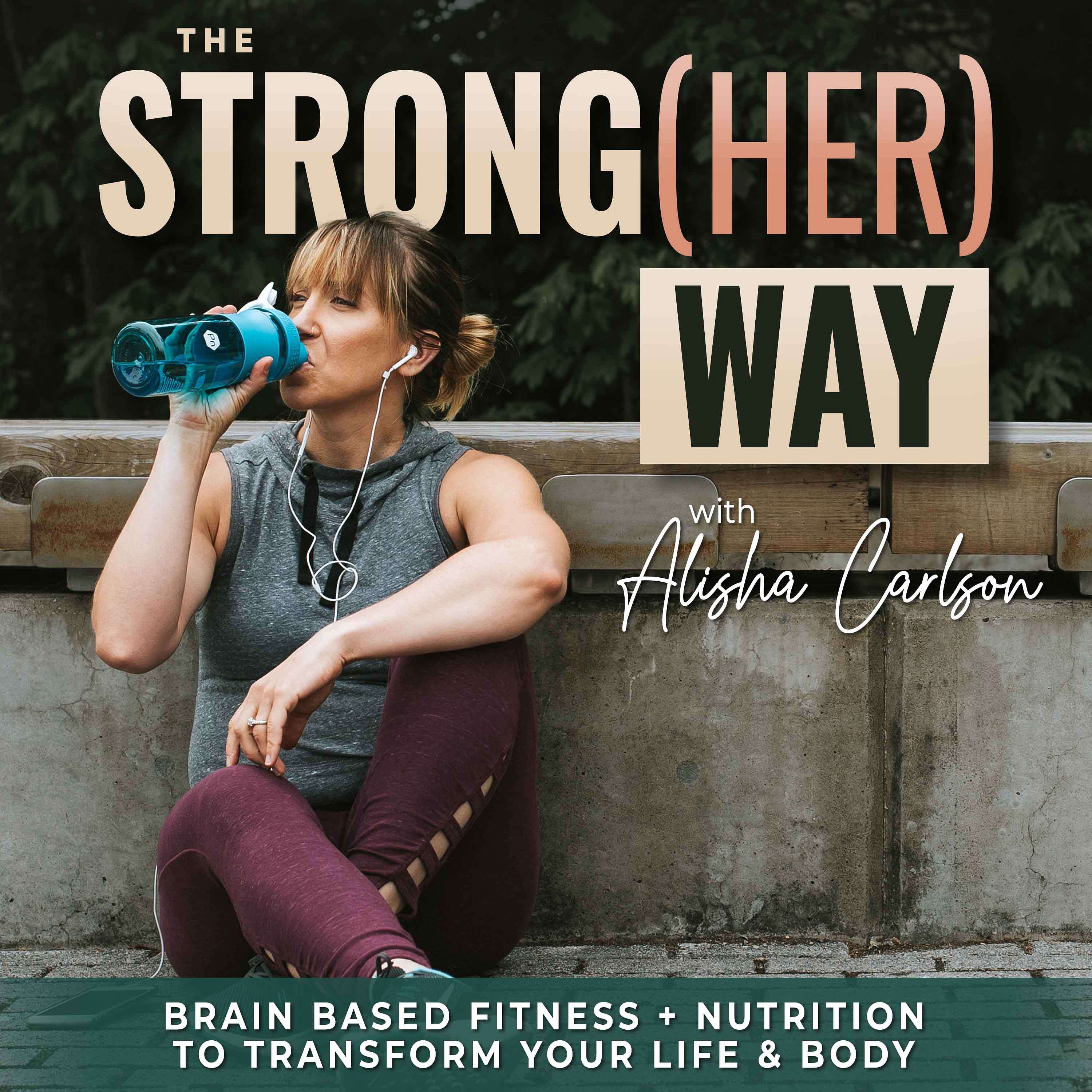
The Strong[HER] Way | Healthy nutrition and habits for moms, routines, strength training for women · Alisha Carlson, Fitness and Nutrition Coach for Moms
Feeling stuck? If you're one of the moms over 35 who is eating less, training more, and still not getting leaner, this episode explains why under-eating, not a lack of discipline, may be the real problem. In this solo episode, Alisha Carlson breaks down what the research says about metabolic adaptation, low energy availability, and body recomposition (building muscle and losing fat at the same time). Then she walks you through a simple three-step plan: check whether you're under-fueled, get enough protein at every meal, and let strength training do the building. She also gives an honest look at reverse dieting and where the evidence is still thin. If you're a busy mom, a mompreneur, or a woman in perimenopause who is tired of starting over every Monday, this one is for you. A note on the research: much of it comes from adults over 50 and from young, lean women, so Alisha flags where it fits you and where it doesn't. WHAT YOU'LL LEARN - Why eating too little for too long can make your body conserve, and how big that effect really is - What body recomposition is, and who it works best for (beginners, people returning to lifting, and people with more body fat) - How to tell if you might be under-fueled, including the signs worth talking to your doctor about - How much protein to aim for at each meal for muscle, and why spreading it out matters - Why more cardio can't fix an under-fueling problem, and why lifting should drive the change - An honest look at reverse dieting: what one small study found and what it didn't - The identity shift behind the "eat less, move more" trap, and how to stop blaming yourself THIS EPISODE IS FOR YOU IF... - You're a mom over 35 who is eating less and exercising more, and your body isn't responding the way you expected - You're stuck in the restrict, crash, restart cycle and want a sustainable, non-diet way out - You lift (or want to start) and want to know how nutrition supports building muscle for moms - You're in perimenopause and want to understand what the research does and doesn't tell us yet - You're ready to stop assuming that your body, or your discipline, is the problem If today's episode hit home and you're tired of assuming your body or your willpower is the problem, there's a different way to do this. The Strong(HER) Way isn't another restriction-first fitness program. It's a transformation from the inside out, built for women who are done dieting and ready for a sustainable, non-diet approach to food, training, and their bodies. Ready to stop guessing? Start small with the $27 Fit and Fueled Foundation at thestrongherway.com/work-with-us, or book a free 1:1 consult here. You can also connect on Instagram @alishacarlson_.
Alisha Carlson: Hey, hey, welcome back to the stronger way. It's Alicia, and it is so good to be here with you today. If you would say you're a high achiever. You've got a history of some all or nothing around food or exercise, a little bit of perfectionism in your history as well. You are in the right place and you are in good company. Today we're going to be chatting about something that definitely impacted me early on in my fitness journey. And then I wanted to share just quickly what inspired me to talk about this from this perspective. Several weeks ago, I decided after having a chat with my doctor about some lab work I had over the summer, found out my cholesterol is elevated, partially due to the higher genetic cholesterol. But really, since I can't do anything about that, what can I do to help control the other cholesterol? One of the things was to just eat more carbs. Now, my history around food has definitely been disordered. There was a lot of chronic dieting in my earlier years. And probably one of the residual things that sort of stuck around was this idea of like a lower carb lifestyle. Now, early on in my journey, that really did work to lose weight. However, now in my early 40s, I'm starting to recognize that that probably wasn't really the best approach, especially when you're still wanting to train with some intensity, because now the focus, of course, is on preserving muscle, preserving bone, and hopefully even trying to build that. So, all that to say, that is what inspired the topic for this week's workshop inside fit and fueled. And I wanted to bring you a spin of it on the podcast as well. So why you're not getting leaner, even if you're doing all of the quote unquote right things, you're, you know, you've done the restriction, you're eating less, you've added in more cardio or more exercise to burn more calories, and you're not really seeing the results that you want. Spoiler alert, it is likely not a discipline problem, especially if you identify as that high achiever, right? You don't have any problem showing up and doing the work. So what is happening, right? You've cut the calories, you're burning a ton of calories in your workouts, you've restricted, you're cutting out all of your favorite things, you're working out 45 to 60 minutes most days of the week. The scale is barely moving. Instead, what you're feeling is tired, you're cold, you're hungry, maybe you're a little bit cranky. But the only advice that you seem to be getting or that your brain is registering is that you need to try harder. You do, you need to be more consistent. Maybe you're not cutting enough calories. Here's what I want you to hear from me is that you're not lazy, you're not undisciplined, and your body is not broken. A A lot of times what we find is that the answer is a little bit more complex than just trying harder, just doing more, especially if you identify as that high achiever. You have no problem with the doing. Sometimes we actually need to maybe back off and do a little bit less and then focus on those bigger rocks. So what is actually going on? If you eat too little for too long, your body is going to do what it was made to do, which is to kind of conserve and go into protect mode, which means it's going to burn a little bit less. Now it's not going to be like completely, you know, where your metabolism is totally downregulated, but you are going to be burning a little bit less. Your hormones turn things down as well. So the fuel gauge. Starts to read as low, your brain turns the idol down all to save gas. And then your hunger cues get louder. So it's like you're feeling more hunger throughout the day. You're not feeling quite as satiated with the meals that you are eating. This is biology. It's not willpower. It's not a flaw on your behalf. So the problem here is that. Inside, you feel like you're the one that's broken, that there's just something wrong with you. Like, why can't you get it figured out? But what I want to encourage you with is that it's not that you're not trying hard enough, but maybe we're trying hard at the wrong things. And maybe there's just some information that you haven't had up to this point. So if you can resonate or connect to any of this, then I definitely want to invite you to hop into our free community because that is going to be a place where you can get additional resources from the podcast. You can connect with other listeners, you can drop your questions in there. And we've even started adding in some companion guides, some listener guides from the podcast if you want to take what you're hearing and apply it a little bit further. One of the bigger problems here is that as women, we have been sort of conditioned with this idea that less is more. Like if we weighed less, if we are so so disciplined that we can follow this super restrictive diet, that somehow there's more virtue in that. The thing that most people don't know, most women especially don't know, is that your body may actually be requiring more fuel than what you're giving it, not less, in order for you to actually see the results that you want. Because remember, your body's number one priority is survival. It's not necessarily as concerned with how you look in a swimsuit, how you're gonna look on vacation. How you're going to look at your cousin's wedding coming up, it's thinking about do we have enough coming in to meet just our bodily demands? It's not going to prioritize building muscle or burning fat. In fact, a lot of times what we're doing to lose the weight, to be to get more of that defined look is actually working against us and is putting our bodies into more of like, Conservation mode. So that's again is where it's slowing things down a little bit. Now, I have been exactly where you were or where you might be now. I mean, that was my journey for so many years. And it's just is this exhausting thing. So, you know, I can distinctly just remember my whole entire life being ruled by. Trying to control the exact number of calories coming in and the calories going out. And the days or the weeks that I didn't see the scale moving exactly the way that I thought that it should, I felt like I was such a failure. The problem is that calorie math is sort of imperfect anyway. There's always going to be some margin of error sort of built into that. And also our bodies are not. Like this linear machine, meaning that we can't always predict fully the outcome that we're going to get. I wish that somebody would have told me that sooner because I probably would have had a lot more grace, a lot more patience with myself, and I probably would have been in a better position, sort of going into perimenopause. So, the good news is that you can build muscle, you can lose fat, you can even do that at the same time. And that's body recomposition. If you've never heard that before, it's real. And here are three simple ways that we can actually make this work in your favor. So, one, you want to focus on eating enough fuel to not only support your training and the work that you're doing in the gym lifting the weights. But you also need enough fuel for recovery. So a lot of times we think that the magic is happening in the workouts. And that's absolutely a necessary stimulus that we need. But just as equally, we need to allow our bodies to fully recover if we are wanting to get those training adaptations. The second thing you want to do is you want to make sure that you are following a program. For your lifting that is going to progressively get harder and continue to challenge your body. This is really sending the signal that it is time to build. It's time to build your muscle. It's time to build your bone, to build your light tendons and your ligaments. And that has to be enough of a load. So if you're constantly doing the same kind of workouts day in and day out, that's not necessarily going to be the stimulus that your body needs. Two things that we kind of talk about inside of my classes and the training that I do in person and with my clients is one, you want to make sure that the weight that you are lifting, you could maybe only do one to three additional reps outside of that prescribed rep range. So if your goal or your target is 10 reps, you could maybe do 11 to 13 with good form. Now, the second layer to that is that it should feel like work from the moment you pick the weight up. Now, you shouldn't be struggling to get good form on the first or second or third rep, but it should immediately feel like, man, this is hard and this is a lot of work. So that you're adequately loading the muscle throughout the entire set. If it's starting to feel hard, only by the time that you get to seven, eight, nine, 10 reps. Then those first few reps were were kind of just like a little bit of a warm-up, right? So can we do one to three reps after the prescribed the prescribed set number or rep number rather? And is it challenging right from the get-go? Now, of course, form first, we don't ever want to sacrifice sacrifice that. And then for sure, the third thing is: are we getting enough protein? So this is just that raw protein. material that your body needs, those building blocks that your body needs. Now, the thing here is that this is, of course, going to work a little bit better if you are newer to lifting, maybe if you're just coming back after a long bit away, or if you are somebody who is carrying a little bit more body fat. It is going to be a slower process if you are somebody who is maybe a little bit more advanced in your training years, or if you already tend to be a little bit leaner. So again, just kind of going back to this idea that your body is always thinking about homeostasis, it's thinking about your survival, it's thinking about preservation. It's not necessarily thinking about how your arms look when you're in a tank top. So three steps that you can take starting today. Number one is just kind of checking in and doing what I would call an underfueling gut check. So just really having an honest conversation with yourself. Where do you think you're at? Do you do you think that you're underfueling for the amount of work that you are doing in the gym? Do you think that you know, maybe you're getting the The right amount of food, but maybe it's the wrong combination of food for you? Do you feel like you just are not sure what to eat or how much to eat? Or maybe you find yourself in a place where you think that you are doing pretty good on all of this. where are you? Are you underfueling? Are you hitting your protein number? So I like to do the sort of that quick and dirty one gram of protein per pound of your target body weight. Are you hitting that consistently every single day? This is not one of those things that we can take an average of over the course of a week, but we really need to put some focused energy and attention there every single day. And then really letting strength training drive the changes that you want to see. So this goes back to that progressive overload. making sure that we are appropriately loading the body and challenging it. And if you're not sure like where to start with that or how to get started, that would be like where you look at hiring a trainer or working with a coach for a little while. you know, if that's something that you're interested in chatting about, definitely check out the links that we'll have in the show notes and kind of figure out what that next best step is for you. So, step one, checking if you're under fueling. How do we know if that's what's actually happening? Here are some symptoms that could kind of point to that. If you are missing a period or if there's an irregular period, you know, when you're not in perimenopause, I know things like PCOS can also impact that as well. but if you are not in perimenopause or you know, nearing menopause, If you don't have PCOS, but you're noticing that your period is either missing or is a little bit irregular, that could be a symptom that we're underfueling. Do you feel cold all the time? Is your sleep disrupted? Are you noticing your hair maybe coming out in chunks or more than normal in the shower when you're brushing it? Do you feel wired but exhausted? and then are you just feeling maybe kind of generally stuck or stalled with what's happening physically? So maybe you're putting in the work in the gym, you're making some changes to what you're eating, but you're not really seeing or noticing those changes. definitely, you know, if you're having these missed periods or constant exhaustion, this is also going to be a place where you might want to check in a little bit more with your healthcare provider. To see if there's something else underlying going on as well. Getting enough protein. So a great way to kind of take that one gram per pound of your target body weight is to break that down by meal. So this is a little bit easier to kind of wrap your head around than thinking, my gosh, my goal is 150 grams of protein. How am I going to get that in? And just trying to get it in, you know, kind of willy-nilly throughout the day. I would take whatever your target is and then just divide that up into three meals, right? So it's like if it's 150 grams by three meals, you want to get at least 50 grams of protein in at each meal. Now, if that seems like way too much, or if you're finding that you're getting fuller or full, fuller faster, right? So essentially you're just not able to eat that 50 grams of protein in one setting. You may want to look at adding an additional meal in just to make that a little bit more manageable. But take that bigger number and then chunk it down to where you have kind of a cleaner, an easier, a smaller target to hit at each and every meal. Now, one thing also to kind of point out here is that as we get older, our body is not going to absorb protein quite as easy. So your needs might actually be a little bit more. that's where, you know, just that one gram per pound of target body weight is a great place to start. But as always, we're also individuals. So you might need to kind of tweak it and test it and just see what ultimately ends up working for your body and the results that you want. Step three. So letting your lifting your time in the gym really do the work. So lifting again is the signal. Protein is going to be that raw building block material that your body needs. One of the biggest things that I see a lot is that we think in order to get that more defined look that we're after, is that it's just about losing weight. The reality is that it's not always about losing weight. Instead, I want you to think about reframing that and focusing more on building muscle. So getting stronger, building more muscle. That is not going to come from doing cardio. That's not going to necessarily be about the calorie burn. Yes, if your goal is weight loss and you don't care what weight you're losing, then just doing the eat less, move more can work for a short period of time. But in my experience, in most women, that tends to backfire for a number of reasons. Some of it's the physical aspects we've been talking about today. A lot of it can be like emotional and psychological as well. So stop trying to You know, just burn more calories and eat less. Instead, shift your mindset, shift your goal and your focus into building muscle and building bone. And a lot of times the things that tend to be pro-muscle also are pro-fat loss. So you're gonna get kind of the best of all worlds there. So there's two paths really from here, right? We can either keep doing it the same way that we've been doing and then hope that one day magically we're gonna start to experience some unicorn results. So more restriction, we're burning more muscle. you know, just not really enjoying our life or the process very much. And then the weight gain comes back, right? There's more restriction, more weight gain. And we just kind of keep riding that diet roller coaster that we're all so familiar with. Or we can shift into that mindset of fueling and lifting and building and experience steadier energy, a body that's actually ri responding to the training that you're doing. Yes, it's going to feel likely a lot slower than you want it to, but it's going to be real change, long-term lasting change and not white white knuckling it until our willpower breaks and we just feel like we're starting all over again on the next Monday. So if you are listening to this and you're like, okay, this is great. I've been listening for a while. I'm ready to take the next step. There are a couple of ways that we can do that. We've got the Fit and Field Foundation, which is a $27 micro course. It's such an easy way to get started, to start taking what you're hearing, not only in this episode, but in other episodes, and actually start applying it to your life. Or if you feel like you are ready to take the next step and get a little bit more support, you can do that as well. We're going to link to all of the different ways that we can work together in the show notes, or you can head to the strongerway.com backslash work dash with dash us to learn a little bit more about what we've got going on. So what I hope that you are getting from this is that it likely never was you or your body that was actually the problem. If you've been approaching it the way that we've all been taught to, which is just eat less, move more, it's all about the calories in, calories out. There is a good chance that you may have been underfueling your body for years and not even know it, not even know that that's part of the reason it feels like such a struggle to make any real lasting progress. You likely don't need more discipline. You needed maybe some different information, and now you have it. And now the next step is to figure out how you want to start applying this. So we're eating our protein, we're lifting something heavy. It can be really super simple and super doable. It doesn't have to be this long. And crazy process. In fact, some of the hardest ways that I ever lost weight was by just trying to eat less and exercise more and trying to control every single bite that went into my mouth. I think, especially as kind of a high achiever, somebody that, you know, has no problem going and getting after it, the harder part was wrapping my head around it mentally of taking this different approach of trusting the process enough, trusting The research that we do have on, you know, our bodies and what they need to actually be able to eat enough to fuel my body. But like I shared at the top of the episode, over these past several weeks of focusing more on sleep, on actually eating more and being really intentional and focused on the protein, those few changes have really been. Kind of a big game changer for me. And so the hope and the encouragement here is that you don't have to do all of the things at once. Maybe you're listening to this and you can easily identify an area, right? It's like maybe you feel like you're pretty locked in on your protein and your fiber, but you're not getting enough carbs. That's what one of my clients had the same kind of realization is that she was pretty locked in on her fiber and her protein. But because of some old diet mentality around food, she was not getting in enough grains, not getting in enough carbohydrates. And so we've started to add some of those in. And she's also seeing the scale drop. So again, you know, there's not always like this perfect science. Some of it is a little bit about trial and error. But I think the biggest thing is us sort of getting out of our own way and Being willing to take the risk to try something that feels a little bit harder, a little bit less comfortable because it goes in the face of everything that we had been taught for so long. So hopefully this episode has encouraged you, it's blessed you, it's given you some new perspective when you're thinking about your relationship to food and to exercise. And of course, if you are looking for ways that you can take what you're learning here a little bit deeper, we will have. all of the different ways that you can connect with us or the next step that you want to take depending on wherever you're at in our show notes. Again, you can also go to thestronherway.com, click on the work with us page, and that will link you to the community if that's the next right step. If you want to grab the micro course, you can do that there. If you want to take it a little bit deeper and maybe work with a coach one-on-one, you can also access that there and book your consultation. Thank you again for spending your time and hanging out with us. I know your time is precious. I know you've got a lot of different things that you could be doing or listening to. And so we are so blessed and so honored that you're here with us. And until next week, have a great rest of your day. We'll talk to you then. Bye.