
The Starting Block · The Block
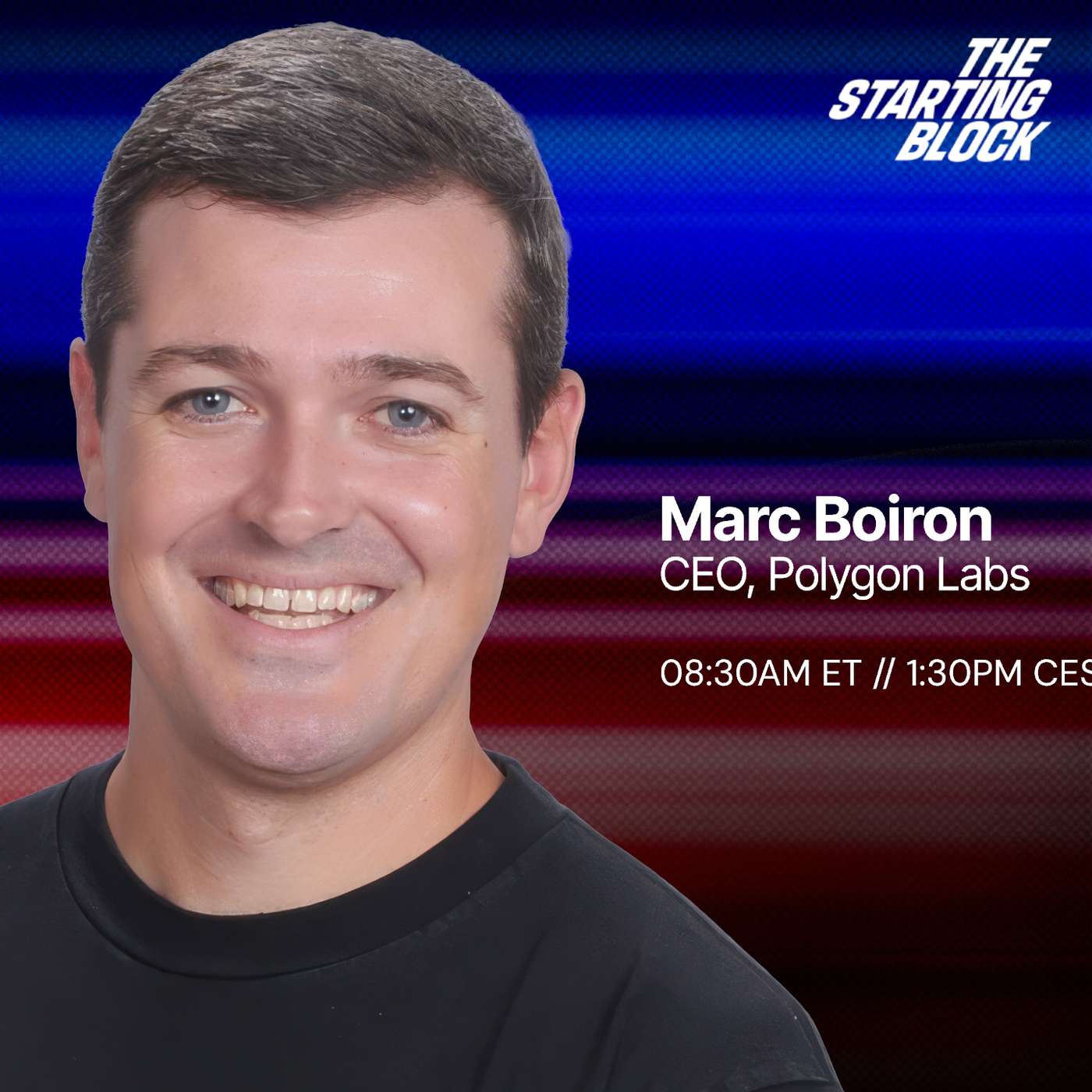
The Starting Block, hosted by The Block's Gareth Jenkinson, was broadcasted live with Polygon CEO Marc Boiron. Polygon CEO Marc Boiron joins Gareth Jenkinson on The Starting Block to discuss the launch of the Open Money Stack on Solana, Polygon's strategic pivot to payments infrastructure, and why he sees Polygon competing with payments players rather than other blockchains. Boiron opened by explaining what the Open Money Stack is: a single API that lets businesses on-ramp money onto a chain, move it across chains, hold it in a wallet, and execute any stablecoin operation through one integration, rather than stitching together separate providers for wallets, RPCs, indexers, on-ramps, off-ramps, and interop. He said the addition of Solana was driven by customer demand, noting that Solana has pushed hard in the payments space and that customers were asking for it. He argued that stablecoin adoption has been slower than it should be since the GENIUS Act passed roughly a year ago — where he would expect 1,000 percent growth in stablecoin payments — and that complexity is the main bottleneck his product is designed to remove. He also cited Polygon's dedicated pay channels, which he said have been tested at 41 million transactions per second, a figure he said no other chain can match and one that will become necessary as AI agents transact at scale. On Polygon's broader evolution, Boiron said chains have become commodity infrastructure — fast, cheap, and largely indistinguishable — and that winning requires vertical focus rather than being a general-purpose chain. He described Polygon's chosen vertical as payments, positioning Solana as strong on trading and Ethereum as the home for deep liquidity on large trades, while Polygon goes after global money movement. He cited Polymarket and Courtyard as flagship examples of what Polygon's infrastructure made possible, saying Polygon was the first chain that could support the transaction volumes Polymarket needed, and that Polygon has 10x'd its scale over the past 12 months to keep pace with Polymarket's growth. He also described the consolidation effort at Polygon over recent years: spinning off non-strategic products, shutting down initiatives that did not work such as the Polygon zkEVM, and watching projects like the privacy-focused chain Myden emerge from that work. Boiron drew an analogy between Polygon and Visa, noting that Visa earns $17 billion a year just from flat data-processing fees on transactions — not volume-based bips — and argued that global money movement as a category is far larger than card-network payments alone. He said he came into crypto excited by sovereign money and fully autonomous systems, acknowledged that vision has had to adjust to reality, but maintained that a more resilient, transparent, and accessible global ledger still materially improves people's lives. He closed by defending his increasingly candid posts on X, saying founders who want to run companies need an...
0:06Welcome back to The Starting Block.
0:08Happy Thursday to wherever you're
0:09joining us from today and welcome to
0:11the show. If this is your first time
0:12here, my name is Gareth Jenkinson.
0:14I'm the host of The Starting block,
0:15head of multimedia at The Block.
0:17We've been going for a few months
0:19now and if you haven't been with us
0:20at all for the journey, I'd
0:22like to ask you to go and check out
0:23The Block's YouTube channel.
0:25If you click on the live tab there,
0:27you can scroll down and catch up on
0:29all of the episodes that we've been