
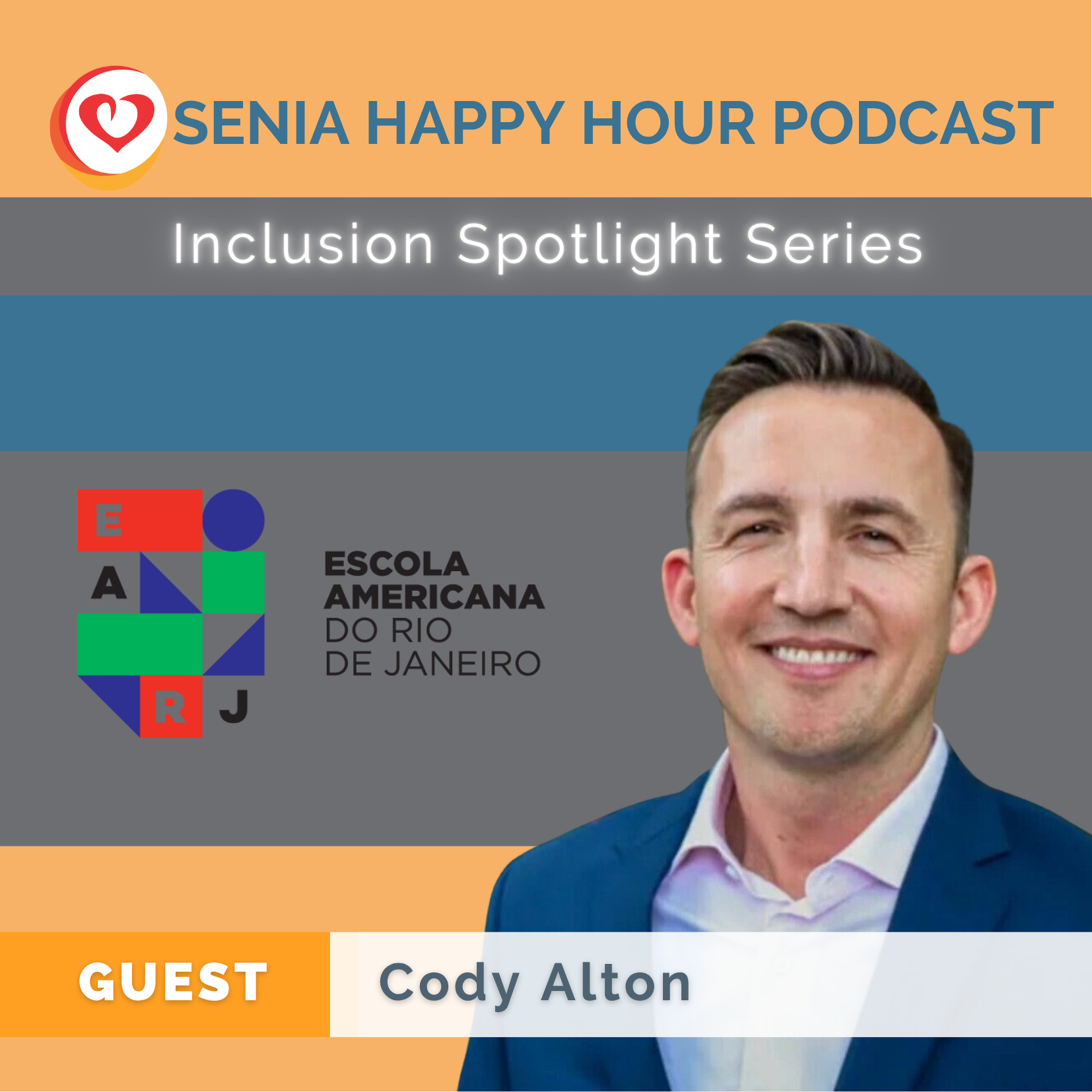
The SENIA Happy Hour Podcast · Lori Boll
The conversation with Cody Alton from EARJ covers topics such as the school's unique structure, navigating a new role, legal landscape and inclusion challenges, responsible inclusion and capacity stretch, developing support for gifted learners, next steps and leadership transition, and the school's connection with SENIA. The discussion highlights the intentional and thoughtful approach of EARJ towards every student's learning process, as well as the school's commitment to inclusion and community building. Takeaways Unique structure of EARJ with two campuses and diverse pathways Challenges and opportunities in responsible inclusion and capacity stretch Chapters 00:00 Introduction to EARJ 01:14 EARJ's Unique Structure 03:10 Navigating a New Role 10:06 Legal Landscape and Inclusion Challenges 16:12 Responsible Inclusion and Capacity Stretch 26:12 Developing Support for Gifted Learners 34:19 Next Steps and Leadership Transition 36:52 Connection with SENIA
Lori Boll / Executive Director: Hello everyone. Today I'm joined by Cody Alton from Escola Americana do Rio de Janeiro, or EARJ. With two N to twelve campuses, four leadership teams, and Brazilian American and IB diploma pathways, EARJ offers a uniquely complex setting for building inclusive education. We will discuss Brazil's legal landscape, the distinction between therapeutic and educational support, responsible inclusion when capacity is stretched, and EARJ's growing work with gifted and high ability learners. So, Cody, welcome to the podcast. Cody Alton: Thank you, Lori. It's really a pleasure to be here with you today. I appreciate the invitation. Lori Boll / Executive Director: Yeah. Well, thanks for coming. So to set the context, how would you describe EARJ's unique structure with two and twelve campuses, four leadership teams, and Brazilian American and I B D P pathways operating side by side? That's a mouthful. Cody Alton: Yeah, you just did a great job of kind of kind of giving that Lori Boll / Executive Director: Ha Cody Alton: c context. But but yeah, we're the we're the American school in Rio de Janeiro in Brazil. if you come to Rio and you want to visit, Rio is pronounced Rio. So Escola Americana do Rio de Janeiro. and we're the home of the Panthers. So we are an inclusive not for profit school. as you mentioned, IB World School, also with Brazilian curriculum. We are part of the AMISA network, which is the American international schools across America. and we have about 1,300 students from just under 50 nationalities. so it's a Lori Boll / Executive Director: Wow. Cody Alton: it's a school with a long history. We're turning 90 years old in March. And just a couple years ago, we had a fourth generation Panther graduate from our school. So a lot of history. And yeah, I I've been in other two campus schools, but we have we have two campuses running really in parallel. So as you shared, we have from nursery to grade twelve on both of those campuses, which exist about twelve miles or twenty some kilometers apart. and then and I work across both of Lori Boll / Executive Director: That sounds challenging. Cody Alton: Yeah, it's it's the the good challenge. You learn a lot and I mean one of the things that that we look at across that complexity is is where how you're trying to build a program with alignment, right? Lori Boll / Executive Director: Mm. Cody Alton: and so that that can add one of those those complexities, but you also have a lot of room for iteration, because you have a lot of you have different leaders, you have different teams. So there's Lori Boll / Executive Director: Yeah. Cody Alton: always there's always the opportunities that come. Lori Boll / Executive Director: Well, you have two campuses, almost ninety years of history. So what did that mean for you when you stepped into the brand new role? and how did you navigate it? Cody Alton: Yeah, so it was new. We had we had like department kind of existing inside of those divisions, but we didn't have like a unified context, a unified department. And I think no matter what, when you're coming into a new context, you have to learn that context. so there's a culture of Brazil. Brazil is huge. There's Rio that's unique inside of that. And then there's also your school community. And so a lot of that is just learning. As a leader, you're also trying to build trust. And you're trying to build that trust very quickly as you're learning. And I think the difficult thing about that is trust is built differently across cultures. So in Brazil, trust is highly relational. And not just not just being friendly and kind, but really, really getting to know people. Lori Boll / Executive Director: Mm. Cody Alton: And there are some of those pieces that you have to learn about what those expectations are to build that trust. And you know, if I came in and tried to build trust through demonstrating experience and expertise, you know, that's that's gonna be failure. Lori Boll / Executive Director: Mm-hmm. Cody Alton: so it was it was a lot of questions. It was a lot of questions to to different stakeholder groups, you know, trying to really listen openly about experiences, challenges, hopes. one of the most informative conversations I had was meeting with our employees, non-teaching faculty, non-teaching staff, with children in the school. And so I was meeting with parents who who are employees of the school that work in maybe facilities, maintenance, transport, and talking to them about their experience. It was so insightful. It was so insightful what they what they could tell me about what the culture was, what was happening in the school. so I think that was a big part of it. I also had good coaching, which helps. I had ahead of school, Dr. Nigel Winnard, who was a part of bringing this position to the school and he really helped onboard me to that culture. I had some close teachers and some within the student support services that have not only been working at the school for a long time, but they're former students as well. So it's like Amazing institutional knowledge. and those those perspectives can be really invaluable. so I had an experience, I think a few weeks into the school where there was something really urgent. I needed to get feedback, I needed to get context from the team. And I thought, okay, 10 minutes, our lunches are an hour in Brazil. And I was like, that's so much time. let's use 10 minutes, let's come together. And everyone came into a classroom. They were great. They gave me like the feedback I needed, the context, and the meeting ended, we went on our way, and I was feeling really good. I checked in with the the teacher whose room we were borrowing, who's a part of our team. I said, Hey, how's it going? And very kindly she said, like, lunches are sacred. Don't do that. You know. Lori Boll / Executive Director: Lesson learned. Cody Alton: You know, I could have come out of that going, this is great. I just found a way to talk to this team whenever I need to. And what Lori Boll / Executive Director: Right. Cody Alton: I heard was, Cody, that's not how you're gonna Lori Boll / Executive Director: Yeah. Cody Alton: build this team. So it was the last lunch meeting I ever had. and we found different ways of working, but that was part of it. there's a practical Lori Boll / Executive Director: Great. Cody Alton: side too, Lori, I guess, which I'll share, which is, you know, as I as I talked about, we're trying to unify a department and We're shifting supervision and leadership and it's it's kind of muddy, right? And you're you're navigating, Lori Boll / Executive Director: Sure. Cody Alton: you know, those agreements and how that looks and who has who has those the autonomy to do things, who has the accountability and the responsibility. So those are really tricky and from a very practical standpoint, we we just started looking inward. So was let's build our foundations. Let's build student support services foundations. Who are our students? Who are our teachers? What are our environments looking like? and really a big part of it was just focusing on like what was what was working? Where are we having positive impact? And can we build that into a little bit more of our policy and processes? Because it's two schools, four divisions. we we've been building it through a layered approach. So we have what we might call like our fidelity of services. That's our like department policy. And so those are the things that we need to be very aligned across those four divisions because we want a family, we want a a child to experience the same like fidelity of service no matter where they come into our school. Lori Boll / Executive Director: Mm. Cody Alton: the second layer is we also have processes that happen across divisions that might look very differently. so we want We want those division processes to have some flexibility. And so we focus on the consistency in those teams. So if it's a lower school EAL team, and let's say we're doing the beginning of the year letters, those might look differently across those four divisions, but we want that EAL team to have consistency. And so we have that team level consistency. And then I'd say finally we have. kind of our individual instruction layer and that's where we have as much flexibility as we can, holding to best practice, where we have, you know, our student needs. What what are they now and how can we use the student strengths and our team strengths and what's available to us. So we we have kind of those three levels of trying to build across those complex Lori Boll / Executive Director: Yeah. Cody Alton: campuses and divisions. Yeah. Lori Boll / Executive Director: Well, how many how many people do you think you have on your sport team across both campuses? Cody Alton: So we have learning support teachers, we have our EAL teachers, English as an academic language, we have an educational psychologist that works across campus, and we have inclusion assistants that support sometimes three students, sometimes one student, kind of as a paraprofessional role. And as a whole, across the whole school, we have 29. 29 people. Lori Boll / Executive Director: Wow, that's huge. Cody Alton: Yeah, so we've been growing. Lori Boll / Executive Director: Yeah. Well, for listeners outside of Brazil, can you paint a picture of the legal landscape around inclusion? Cody Alton: Yeah, we I think coming from special education, we have a relationship with law, right? We have relationship with with what that means. And you know, we work really hard to align our best practices to also the federal, state and city laws. Brazil is fairly litigious. So it's important to know and align as much as possible. And I I've had meetings where the law is present on that table. You know, and so it's in it's important to have a good understanding and it can move quickly. So I have some wonderful colleagues that also support that. and that's been invaluable. But you know, these laws, they can really create strong levers for schools, right? To to to increase inclusion. And those like IDAA is is is a lever for trying to increase accessibility. So so those can be great. they can also the same time create challenges for you know an independent family choice school so you know to talk about a couple pieces of that one we can't charge for any services related to learning support so Lori Boll / Executive Director: Mm. Cody Alton: philosophically I'm highly aligned to this it does mean though that that cost is shared across general tuition so we have Lori Boll / Executive Director: Right. Cody Alton: a we have a supportive community we have a supportive board and we're really like working to remain fiscally sustainable as we grow. One of our one of our biggest challenges I'd say that we s that we're working around and we've been trying to to find different workarounds, and I don't think we've really solved it yet, is there's a a distinction between the school environment and the therapeutic environment in Brazil. And so there's a there's a restriction between having therapy in the school environment. So like speech therapy. Like I understand this piece around like why this makes sense in Brazil and and how they're trying to make sure that these are these are different complementary approaches, right? And not supplementary. We don't want to have speech instead of going to your like unit of inquiry. Lori Boll / Executive Director: Right. Cody Alton: at the same time, like, you know, understandably that can be a real challenge for families coming from around the world. And these resources are tough to to get into their schedule and maybe tough to meet language needs if it's if it's more specific to language needs like speech might be very language specific. Lori Boll / Executive Director: Mm. Cody Alton: and this can be really frustrating to them. so for for those families, yeah, we've tried workarounds and sometimes we found something that works within the law and and practice and sometimes we really haven't, and it it it it falls on families to have to find that online source. fit into that schedule after school, which can be tight. Lori Boll / Executive Director: Yeah. So so you're saying that any therapy needs to be done outside of school hour hours. Cody Alton: Yeah, so like there are Lori Boll / Executive Director: Wow. Okay. Cody Alton: there are some pieces that are in the law that that talk about those specific setting settings and then there are some pieces Lori Boll / Executive Director: Mm. Cody Alton: like inside of I forget the the Brazilian term for it now, but it's it's like the the group that that does the certification for like speech pathologists and things like that, right? So it's Lori Boll / Executive Director: Right. Cody Alton: it it's intricate in that way. and there's nuance to it where You can hire speech pathologist that does core work with all kids in early childhood. Great. That's not a therapeutic approach. But if they're going to be doing individual small group therapy sessions, it it becomes that. Lori Boll / Executive Director: Okay. Cody Alton: and there's a lot of services here and they're and they're quite good. but schedules are tight and families are really open to service, to therapeutic services. Lori Boll / Executive Director: Yeah. Cody Alton: And so that's great, but it also means like there are we don't have therapists who are like, I could really partner with you and come to your campus and and support people after hours. Like therapists are like, I'm booked. I don't wanna come. I don't wanna come to you and spend Lori Boll / Executive Director: Yeah. Cody Alton: two hours driving. Like I you know, so yeah. Lori Boll / Executive Director: Sure. Yeah. Yeah. And then there's the toll it takes on the child as well. You know, they've already had an exhausting day at school and then to tap on an hour of therapy after that could be could be challenging. Cody Alton: Yeah, and and this is part of it too, because a lot of students will go to school, but a Brazilian public school and their day is much shorter. so it Lori Boll / Executive Director: Mm. Cody Alton: offers a little bit more stretch. So that's again where we're trying to navigate between what does that mean for us as a as an independent choice school inside of that law that that requires us to Lori Boll / Executive Director: Right. Cody Alton: follow those same laws, yeah. Lori Boll / Executive Director: Right. Well, thanks for sharing about that. I think as in international schools generally it you know, we aren't so much tied to laws in the countries where we're at. So I think you are definitely in a unique situation there. So it's good to hear about. I'm curious about responsible inclusion. You your school mentions that. What does it look like at EARJ when the demand for support can exceed or stretch the school's current capacity? Cody Alton: Yeah, I think we've been or we've received probably one of the best indicators I think a program can have for a school that we're on the right path because we we've seen a shift in our admissions. Lori Boll / Executive Director: Mm. Cody Alton: so we are we're consistently receiving referrals from families that have heard about ERJ, about the inclusive programming, from current past parents, as well as professionals in the community. Some we've never met, but have supported families. and have seen the outcomes and say, hey, you should look at ERJ for your child. It feels like a great honor to have that, but we are we are a choice school. So people can come around Rio and come to our school. And so we do again have to be really intentional about how we're we're growing to ensure that we can like sustain that work and with the law about requiring Part of that inclusion law too is requiring that all schools are becoming inclusive. And they've they've aligned that law to to make a connection to how schools should support what looks like what exists inside the community, right? So like I think the WHO like global disability prevalence is like 16%. IDA supports about 15% in the US in public schools. So we we have the Rio Census data that's tied to the law. And so we have that as far as contextualizing what the law expects from like a percentage in our student population. I also really believe that we should and can support higher capacity than the public school down the street. We're much better resourced. And so this is a part of the work that that we do to understand what that looks like across who we are, how we're wanting to support, what are what does our staffing look like, what does that schedule, all that. but that sustainability piece for me is a lot about adaptation. So, you know, we have maybe percentages inside of grade levels or divisions go up and down, our capacity needs to shift a little bit with that. And so we work really hard to have some flexibility in that piece to adapt. So if we have a sudden increase or a sudden decrease, we're not trying to make massive changes to staffing. we're not look re-looking at budgets that were approved nine months ago. We are, we are, how does that look for our success? How does that look for the the ways we're going to work this year and how do we communicate that. So I think that adaptability helps us be sustainable and have this more slow growth period. Lori Boll / Executive Director: Hmm. Cody Alton: Additionally, student support is supported by the general tuition. So if the Lori Boll / Executive Director: Right. Cody Alton: school population goes down, we have less money. We're a not profit, but we have less money as a school at the same time, we could see our student support population increasing. So it's tricky because we have less money as a school, but we have needs that are increasing and might need some financial support. So this is that piece that we're we're constantly Lori Boll / Executive Director: Right. Cody Alton: navigating and how we can be adaptable and how we're trying to to look at trends and and think, you know, a few a few years in advance as much as we can. Yeah. Lori Boll / Executive Director: Hmm. So interesting. Cody Alton: It's fun work, right? It's difficult. But it's good. Lori Boll / Executive Director: Well Yeah, yeah, yeah. Every day's a puzzle. So Cody Alton: Yeah, yeah. Lori Boll / Executive Director: Well now that you've built the foundations, what what comes next? Cody Alton: Yeah, so those those foundations were understanding and developing our capacity, started with student support, we grew as a department, we hired an exceptional educational psychologist, Priscilla Montero. we've been developing our practices together. The next shift becomes okay, how are we developing school capacity? And My thinking around learning is really heavily influenced by the instructional core model, Dr. Richard Elmore, I think, which is the relationship between the student, the teacher, and the curriculum. It's often seen as like this triangle. And the learning is dependent on how these three elements interact. And what the student learns comes from the task, the instructional task, and that sits kind of at the middle. And what's beautiful about that is it can be observed. So what is that student doing? And so when we're looking into that core learning environment, these are the three elements that exist. So we're we're attempting to support the instructional core increasing to increase student learning. So for us, the challenge is how do we upscale those three pieces and the relationship between those three pieces as a complementary service? Vision or student support services, right? so how do we do that? what we're trying to do that through is through kind of three lenses, and these are student lenses. So student strengths, student challenges, and barriers to access. So those aren't new, probably to anyone listening, but the way we're trying to frame them is really specific. So The student strengths, we lead with student strengths within those instructional tasks. And to do that, they can't be those strengths like they're really kind. And that's very true. That student might be very kind, but how is that going to fit inside of that instructional task? How is that going to change the relationship between that student and the content? So we need to look at those relative strengths and really think about how that shows up in the learning environment. Student challenges, especially in our setting now, but how we're approaching at the moment, is trying to focus these on skills, things that can be upskilled, things that we can have intervention towards, things that we could do inside the core learning environment, things that could happen in an alternative environment, they could be in school, they could be in a therapeutic environment. but these are things that we can address and that we can upskill. It's not Dyslexia, right? That's not the student challenge. The student challenge for this student right now might be part of their phonics. Okay, great. We can look at decoding. That's something we can upskill. The barriers to access, these are things we have control over. So it can be in the physical environment, it could be the design of a task, an instructional strategy, things that we have control over that are creating a So for example, a student with ADHD. ADHD is not the barrier. The barrier is that they often experience verbal instruction with multiple steps one time. We have Lori Boll / Executive Director: Mm-hmm. Cody Alton: control over that. And that's the barrier for them getting started and maintaining that task. So we're looking at these three in a way says, look, if we can better understand our students and how that fits inside the learning environment, we can really increase the relationships inside that instructional core. So we can design better tasks, provide more useful feedback. and I'm I'm really excited to see how this looks over time because we're really getting started with this. so we'll see. Yeah. Lori Boll / Executive Director: Yeah, I appreciate how thoughtful it is. I'm curious, is this school wide? Is this currently just with your learning sport department? How are you working with the staff? Cody Alton: So it is, yeah. We've been shifting our student support planning currently, so our individual learning plans to represent this better. We're gonna be working at how this gets collected through like referral type processes. And we're unpacking it as a team, but we're also starting to unpack it inside of our divisions. So Tomorrow I have a meeting where I'm doing this work with learning leaders in one of the divisions. The next week I'll be presenting this across two more divisions. And so we are we're at the start, right? We want to model this Lori Boll / Executive Director: Right. Cody Alton: language, we want to use this to have these conversations and start building the practice of of how we're talking about these lenses and then how that fits inside of our classroom. Lori Boll / Executive Director: That's really cool. And I want to hear an update. So make sure you let us know how it goes. So you are currently developing support for gifted high ability learners. I'm curious how that works fits within the school's broader understanding of inclusion. Cody Alton: Yeah, I when I arrived, this was on the fringe of kind of the conversations that were happening. And I think we've been slowly chipping away at this. We were really hesitant to say that we had a gifted program because we didn't we didn't want to oversell right what we can provide to families and there weren't a lot of models that we were seeing that we could compare ourselves to, especially regionally. And so we just we've been kind of building as we go under this idea of gifted planning. We developed identification and eligibility processes and with our educational psychologists really helping that referral process go quite quickly. we've been building student plans, we've been focusing on how curriculum compacting, enrichment, and extension can support these students, but that was always individual work, right? So we have Identified a high ability gifted student, they're working in this environment. Let's go work with that teacher and see if we can build some of this practice. We've had students get course level acceleration in our upper school. We've had some piloting around small group approaches. So developing kind of a small group approach to building skills. So skills like communication and collaboration, which sometimes can be that jagged profile of where we have a skill challenge. But they're like ready to go on higher content. So I would say this is like where it was going. In April of this last year, we were at a regional conference and I was in a workshop with I think like five or six people from our team. One of them was doing this this small group pilot. And the workshop leader asked, like, who in the room has a gifted program? And I put my hand up, I looked around, I was the only one in the room. Like, nobody even from our team was raising their hand. And I was like, what? I was like, man, I was like, I can't believe they didn't put their hands up. Like they're doing so much good work here. And I went to that teacher in particular who was running this pilot and I said, Wow, why didn't why didn't you put your hand up? And she's like, Cody, you've been telling us for years we don't have a gifted program, you know. So, you know, I was like, okay, yeah, you're right. You're right. So the question became like, what is a program? What makes a program? And what's the Lori Boll / Executive Director: Mm. Cody Alton: work we're doing? And so we made the call. We have a program. just like when we talked about the the work with those three lenses, we realized that we weren't facilitating the understanding of student profiles very well. And we had fit that student into a learning support model, at least about how we were documenting things like that. And it it wasn't working as well as we wanted it to. So we had another pilot last year. We tried to do a lot of piloting and iterations across all these divisions and then see what works and try to expand. We piloted a structure that works within admissions because we wanted to make sure that our kids didn't need to be here for months. Before we were able to think about what their what their time is going to look like at school. and we built what we call the gifted learner profile. It's heavily parent and student voice, doesn't take much time to develop, but it actually builds a really strong profile. And that first student that we piled this with has been here for a while now, and it's still a really accurate profile. There are pieces which we've added to it as we've gotten to know the student, but those parents and that student really know what learning feels like. And so we've I've I've heard these conversations happening even in kindergarten with the student. And the way they respond is so different than that 16-year-old, but we're still like super impressed with what we're getting, what we're understanding from them. Because they're the one experiencing Lori Boll / Executive Director: Yeah. Cody Alton: it. And so we've been really excited about that because it's it's not intensive, but it really allows us to have those better conversations about okay, so what does that look like then? how do we use that profile now? And we've been expanding it and we're still building those for all the students that we have in the program. And then how does that help us understand compacting enrichment and extension? And how those are different, how we can use them differently. and support that relationship and the instructional core model. So it's exciting. You know, it's a journey, right? We always want to do more and be better. but Lori Boll / Executive Director: Sure. Cody Alton: our focus right now is that profile. How can we really generate that profile to help us make those decisions, help teachers make those decisions when they can, help us plan for them. and have some of those tricky conversations about acceleration, right? So the Lori Boll / Executive Director: Yeah. Cody Alton: The student and sometimes the parent and sometimes the faculty who are like, let's get this kid flying through math. And math feels very knowledge-based for the early part of school, but then you hit like tenth grade, 11th grade, 12th grade, and math is so deep. And there's so much room for enrichment. and so we're trying to bring those conversations down and help us understand the difference between those subjects and how we can identify what a student needs to really thrive by the time they get into like the diploma program. And they can have a they can have a paper, paper one on knowledge and get a seven, but a paper three on proof and they get like a three. And we're going, wait, Lori Boll / Executive Director: Hm. Cody Alton: we haven't prepared the student for that. So this is kind of the work backwards that we're doing right now for these kids. Lori Boll / Executive Director: You know, you mentioned it's a journey, you mentioned it's challenging. I what I'm hearing from you is your school is very intentional and thoughtful about every single student's process or learning. And and that's to be commended for sure. So Keep going on that journey. Cody Alton: Yeah, thanks. We have this it's a motto. It's a motto. So it's it's you know, you could see it tied across our mission, vision, values, but we have a motto which is find your path. And I I really do think we try to live that. And when, you know, sometimes when I got those conversations with someone going to me, which is like, What are we doing for this student who's gifted, you know, inclusion. is finding your path. We're like, you're right, let's let's build those let's build those pathways. and Lori Boll / Executive Director: Yeah. Cody Alton: we're doing that same work around modified curriculum as well. And really trying to right now it is fully integrated modified curriculum. it's a lot of work. Those teams are really trying to to make it as intentional as possible. So we have really dedicated faculty across Lori Boll / Executive Director: Yeah, Cody Alton: all departments Lori Boll / Executive Director: I can tell. Cody Alton: and it's it's really it's really what helps it's not what helps, it's what makes that possible. Right. Lori Boll / Executive Director: Yeah. Well I'm worried to ask this question because your school is already doing so much with intentionality, but what are you excited about for what comes next? Cody Alton: I think I think this work with with getting into that core environment is really big for us. There's a lot of work across the school looking looking at what's happening in that like tier one core core place. Sometimes you you know, I go into classrooms and I and I look through that that model of the in instructional core with those relationships and you look at tasks and I'm I'm all for, you know, the frameworks of like UDL. There are so many things inside of our core structure that that UDL can support, but there are some really basic things within that relationship of those three pieces that can really create some major access for kids. So I think this is where We're really excited to see how how this work goes with these profiles. you know, what comes next? Like this is this is my last year here. and so we have a a leadership transition. And I think You know, there's there's always some risk inside of leadership transitions, but there's also really great opportunities. So Lori Boll / Executive Director: Sure. Cody Alton: I was the first in this role, right? And I think many of us inside of the transient nature of international schools has heard things like, that's just that's just Cody's thing, like, you know, let's see how long he lasts and we can get back to the status quo, right? I'm hoping this is my eighth year, I'm hoping that's kinda not there anymore, but maybe I've outlasted them. But Lori Boll / Executive Director: Ha Cody Alton: I think I think a strong transition, right? You get an opportunity to really institutionalize and crystallize that that Lori Boll / Executive Director: Sure. Cody Alton: that inclusion commitment. and it offers opportunity for whenever we have people coming into our community, new, fresh thinking, experiences, perspectives, Lori Boll / Executive Director: Mm-hmm. Cody Alton: maybe addressing some of those lingering problems of practice. where's you know Is that solution for speech therapy coming? You know, I think those are exciting. but personally I'm just really excited for what what comes for this ERJ community because they're really committed and I think it is a real community. I think that Brazil relationship piece is so important and it and it it builds a community. So yeah, I'm just really excited. I'm excited Lori Boll / Executive Director: Yeah. Thanks. Cody Alton: for how it keeps going. Lori Boll / Executive Director: Well, and good luck to you on your next adventure, whatever that may be. Yeah. Cody Alton: Yeah, thank you. Whatever that may be. Lori Boll / Executive Director: Well, I asked this for all our inclusive spotlight schools. I'm curious in what way has your school's connection with Senia influenced, supported, or strengthened your school's approach to inclusion. Cody Alton: Yeah, SENIA SENIA is growing in the Americas, right? And there is a there's a real need, right? There's a real need for for that network and some of those pieces. The the resources we've we've definitely grabbed resources even just off the website. Senia Academy, we've had we've had teachers go through the level one educator certificate, which has been really helpful and we're looking at what the level two looks like. I joined a mentor meeting around a problem of practice that was super insightful for me. So I I appreciated that ability. Like the SENIA team, I I I went and requested the mentorship meeting and talked about what I was looking for and and that team really paired me with somebody who could really help me suit through some of that thinking, which was great. and we're gonna be joining SENI unplugged in November. So this is for a for a region, right? It's it's Tough for us to to head to Jakarta in February, is it? it's Lori Boll / Executive Director: Yeah. Yes. Cody Alton: tough for us to head to Jakarta, but but we can get access to those those unplugged events. And so I think that's a big piece for us as well in getting exposure to some of those voices that might not be coming through the region. So I think this has all been really good. And our next step is trying to get more connected to the the network, my network. Lori Boll / Executive Director: That's great. And correct me if I'm wrong going back to the virtual conference, the unplugged, are you doing you're doing the community rate? Is that correct? So Cody Alton: Yeah, so we're gonna yep, we just like made sure we got it confirmed across all that divisional campus structure. Lori Boll / Executive Director: Yeah. Cody Alton: Yeah, yeah. And some of that can be really intentional and some of that can be for that teacher who's going, I've been dying for some training around this and we're like, Look, there's three Lori Boll / Executive Director: Right. Cody Alton: great sessions for you. so a lot of choice too. Yeah. Lori Boll / Executive Director: Super. Yeah, that's exciting. So you can with that, you can bring as many people as you want. So Cody Alton: Yeah, we're super excited. Lori Boll / Executive Director: yeah, love it. Well, Cody, thank you for your time today. Thanks for sharing about EARJ and all the incredible work that you all are doing there. Make sure you, you know, congratulate your your your faculty for and staff for for everything. So thanks. Cody Alton: Yeah, they were amazing. I have to thank them now. Thank you so much for all that you do. Lori Boll / Executive Director: Ha Cody Alton: For sure. And thank you, Lori, and thank you for the Senate team. Really appreciate what you guys are doing.