
The Semi-Seminarian · Pastor Jim Wilhelm
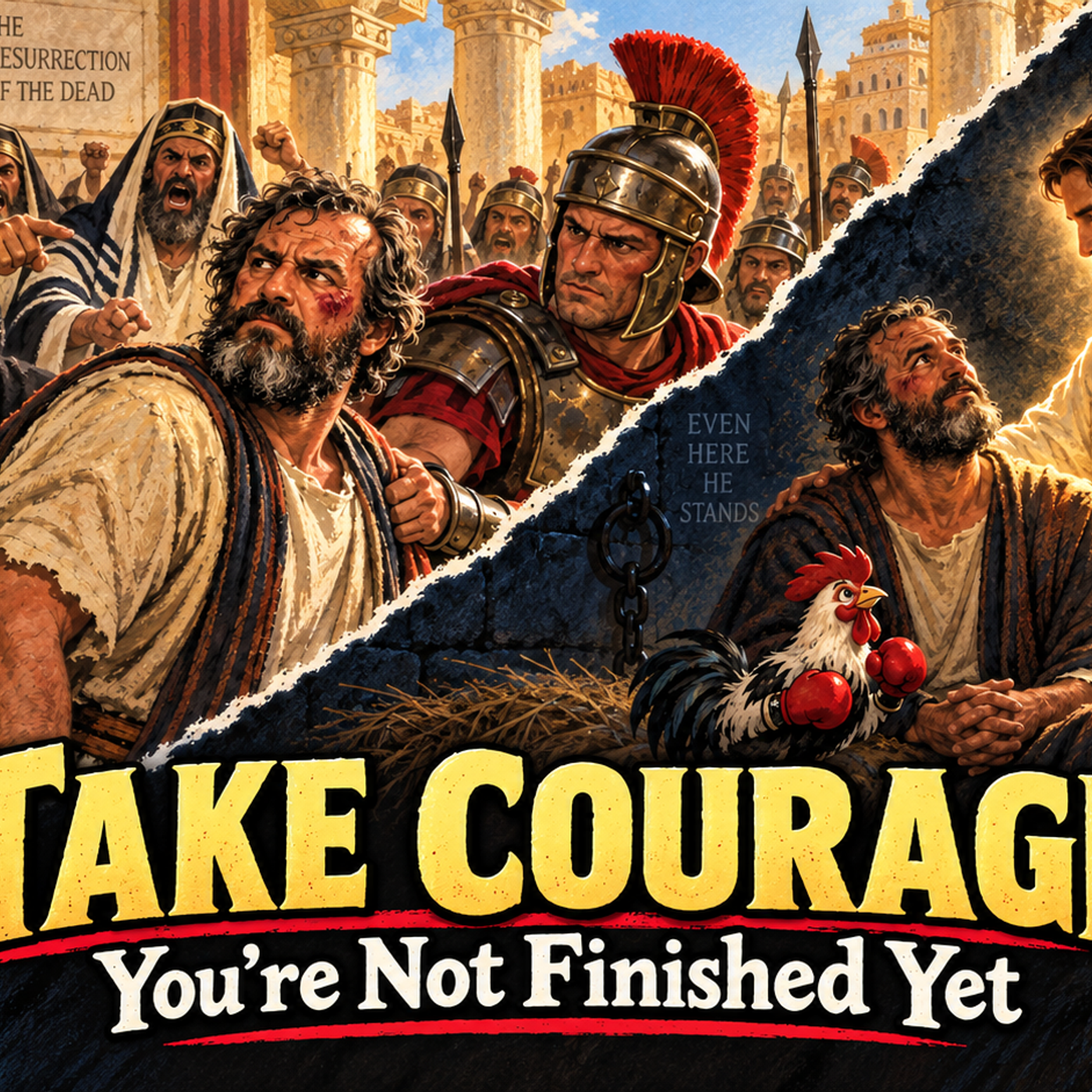
Paul spends the day preaching resurrection. That night, the risen Jesus stands beside him and says: “Take courage.” In this Acts 23:1–11 Bible study, Paul stands before the Sanhedrin, gets struck in the mouth at the command of the high priest Ananias, watches the council erupt over the resurrection of the dead, and is dragged away by Roman soldiers. Then night falls. And Jesus comes near. Acts 23 turns one chaotic courtroom scene into something much bigger: a story about resurrection hope, Christian courage, faithfulness, failure, religious power, Paul the Apostle, the Pharisees and Sadducees, and the presence of Christ when the road ahead makes absolutely no sense. Paul spent the day telling them there is a resurrection. That night the Resurrected One stood beside him. And Jesus does something remarkable: He interprets Paul’s apparent failure differently. The crowd rioted. The council rioted. Paul ended up back in the Roman barracks. From the outside, Jerusalem looks like a catastrophe. Jesus says: “You have testified about me in Jerusalem.” Faithfulness is not always identical to immediate effectiveness. Then comes tomorrow: “You must testify also in Rome.” Paul cannot see Rome. He does not know the route. He does not know about the conspiracy, the soldiers, the hearings, the ship, the storm, the shipwreck, or the island still ahead of him. He gets the destination without the itinerary. And maybe that is part of faith. Not knowing every turn. Not pretending everything is easy. But hearing the risen Christ say: I’m still here. You are not finished. Take courage. CHAPTERS 0:00 Paul Stands Before Power 0:27 From the Roman Stairs to the Council Chamber 2:51 The Reading of God’s Word — Acts 23:1–11 5:39 Paul Before the Sanhedrin 8:07 They Strike the Mouth of the Witness 10:04 Paul, Ananias & Accountability 11:30 The Hope and Resurrection of the Dead 14:15 “What If God Actually Spoke?” 15:41 The Hearing Falls Apart 16:40 Verse 11 Turns to Night 17:55 The Lord Stood Beside Paul 19:30 Faithfulness vs. Visible Results 20:38 Paul Isn’t Trapped — He’s En Route 21:12 Destination Without the Itinerary 22:56 “The Doctrine Walked Into the Room” 24:18 You Are Not Finished Yet Welcome to The Semi-Seminarian — Theology Thru The Static, beaming from the borderlands ’tween the Wild and the Word. If this episode helped you hear the text differently, throw the like in the offering plate, tithe your subscribe, and send it to somebody who needs to hear: You’re not finished yet. Until next time, friend — be blessed. #Acts23 #BibleStudy #PaulTheApostle
jim: Tonight Paul stands before power, gets hit in the mouth, and discovers resurrection hope for the final word. You're listening to the semi seminarian, and I will see you on the other side. Last time I left Paul standing on the Roman stairs. He had been given permission to speak, and he told them everything Jew, Pharisee, Gamaleel, persecutor, Damascus Road, Jesus calling his name, baptism, commission. And you know what? They listened to it all. And then Paul said one word Gentiles. And the whole street came apart. I called that episode up to this word because that's what Luke is telling us. There was a boundary, there was a line where their theology of God became smaller than what God was actually doing. And the crowd erupts. Peter nearly gets flogged until he plays the Roman citizen card. And now the commander has another problem. He still needs to know why this man is a match in a powder keg, but he cannot beat the answer out of a citizen. Acts chapter twenty two verse thirty. He orders the council to assemble. He brings Paul down. Yesterday it was in the street. Today it is in the council chamber. Same Paul, same gospel. Different rooms. Paul keeps getting moved from room to room, but the gospel keeps getting a hearing. Paul looks like the prisoner. Luke keeps quietly suggesting that the word is the thing traveling freely. And you've sat in a room where people used to know you. Maybe it was around a family table, maybe it was a church, maybe it was a workplace where You had given twenty years and the faces were the same, but something behind their eyes was different now. They remember who you were, and they're not sure who you've become. And now you can feel that gap like a draught under a door. Paul walks into this council chamber and some of these men might have known him. Some may remember Saul the Pharisee, some maybe. May remember when this man was on their side of the argument, carrying the right papers, headed in the right direction. Now he is standing before them under Roman guard, and whatever they remember about Paul, it's not this. Friend, attune your ears to the reading of Holy Scripture. Tonight our passage will come to us from the Acts of the Apostles. one through eleven. Paul, looking steadfastly at the council, said, Brothers, I have lived before God in all good conscience until today. The high priest Ananias commanded those who stood by him to strike him on the mouth. Then Paul said to them, God will strike you, you whitewashed wall. Do you sit and to judge me according to the law and command people? Me to be struck contrary to the law? Those who stood by said, Do you malign God's high priest? Paul said, I didn't know, brothers, that he was the high priest, for it is written, You shall not speak evil of a ruler of your people. But when Paul perceived that the one part were Sadducees and the other Pharisees, He cried out to the council, Men and brothers, I am a Pharisee, a son of Pharisees, concerning the hope and resurrection of the dead, I'm being judged. And when he said this, an argument arose between the Pharisees and the Sadducees, and the crowd was divided. For the Sadducees said, That there was no resurrection, nor angel nor spirit, but the Pharisees confess all of these. A great clamor arose, and some of the scribes of the Pharisees' part stood up and contended, saying, We find no evil in this man, but if a spirit or an angel has spoken to him, let's not fight against God. When a great argument arose, the commanding officer Fearing that Paul would be torn into pieces by them, commanded the soldiers to go down and take him by force from among them and bring him into the barracks. The following night the Lord stood by him and said, Cheer up, Paul, for as you have testified about me in Jerusalem, so you must testify about me at Rome. And thus will end the reading of Holy Scripture. Paul had spent the day telling them there is a resurrection, and that night the resurrected one stood beside him. Paul looked straight at the council, and that matters. He doesn't mumble, he doesn't look at the floor, he looks them in the eye and says one word before anything else. Brothers, not enemies, not hypocrites, not you people used to be on my side, brothers. These are his people. He knows it, and he's not pretending otherwise. And then he tells them he has lived before God with good conscience up to this day, and let's slow that way down. Paul knows better than anybody that sincerity is not since. not the same thing as being right. This is a man who persecuted the church, believing he was serving God. His conscience was clear the whole way to Damascus. So, Paul cannot mean everything I ever did was correct because I feel good about it. That's not what he's saying, and that would erase his testimony. What I hear is something more like. I have tried to live my life accountable to God. Even when I was wrong, I was not playing games. And once God corrected me, I changed directions. A conscience can have conversion too. Paul's conscience once signed the paperwork, then Jesus got a hold of Paul and his compass started pointing somewhere else. So when Paul says he has lived before God with a good conscience, the claim here is not perfection, the claim is integrity. I am not standing here today as somebody who abandoned Israel's God. I am standing here because I followed where I became convinced Israel's God was actually going. And he barely Finishes that sentence and the high priest Ananias orders somebody standing nearby to strike Paul on the mouth. And we're not gonna clean that up. This is not something really open for discussion at a Sunday school coffee clash. Somebody hits him. And there's something something perfectly symbolic about the location. They struck the mouth of the witness. Paul's crime throughout Acts has increasingly become that he will not stop talking about what God has done. You can imprison the witness, you can threaten the witness, you can beat the witness. Now somebody literally strikes the part of Paul doing the witnessing. And Paul fires back. God will strike you, you whitewashed wall. And this is not some soft focused stained glass Paul posing for a Sunday school mural. Paul gets hit in the mouth and responds like a man who had just been hit in the mouth. Sometimes Christians read the apostles as though conversion removed their nervous systems. It did not. But what Paul says is also legally precise. You are sitting there to judge me according to the law. While violating the law in the act of judging me. The robe may say justice, the chair may say authority, the office may say holiness, but what did you just but what you just did exposed the wall underneath the paint. And then somebody says you malign God's high priest, and Paul pulls back. He says he didn't know. Maybe he genuinely didn't recognize Ananias. Maybe it's sarcasm. Luke doesn't nail the door shut, and neither will I. It's speculation. But once Paul is told who Ananias is, he appeals to Scripture. You shall not speak evil of a ruler of your people. Now, that doesn't mean, and you shouldn't take it, that Paul thought Ananias was right. Paul's legal objection still stands, but Paul refuses to say the other man's failure releases me from my own obligations. And that is a sentence. Some of us need to sit. Somebody else's hypocrisy does not automatically sanctify mine. Somebody else's bad behavior does not make whatever I do in response righteous. Paul can say what you did was wrong, and I am accountable for what I do at the exact same time. Those two things can live in the same room. And then Paul reads the Some of these men are Sadducees, some are Pharisees, and Paul knows exactly what that means. They may all be sitting together against Paul, but they do not all believe the same things, especially about resurrection. So Paul says it. I am a Pharisee, a son of Pharisees, concerning the hope and resurrection of the dead, of which I am being judged, and the room explodes. Now sometimes Paul gets presented here like he pulls off a cheap courtroom trick. Like he couldn't win the case on its merits, so he lobbed a grenade into the room. And yes, Paul unquestionably understands the room. He knows exactly what the word resurrection is gonna do to the council. But resurrection's not a fake issue, it is the issue. The whole reason Paul is standing there. is ultimately because he says a dead man is alive. Take resurrection out of Paul's preaching and most of the trouble disappears. Christianity without resurrection would have been far less offensive because Christianity without resurrection would also have been far less Christian. Paul's not inventing a distraction. He's naming the fault line under everything else. And listen to his phrasing, the hope and resurrection of the dead. Hope. That word is bigger than any argument about what happens to corpses. This is Israel's ancient hope that God has not surrendered creation to death. God will vindicate, God will restore, God will raise, God will finish what God started, and Paul believes the resurrection of Jesus is the beginning of that promised future arriving ahead of schedule. Paul says he's being judged for hope, and that'll preach on a Wednesday night. The coalition against Paul fractures. The Pharisees and the Sadducees are. Start arguing with each other instead of with Paul, and suddenly Paul is no longer the controversy. Resurrection is the controversy. The people who could not agree about the nature of God, Scripture, Angels, or eternity had temporarily agreed on one thing. We don't like that guy. But hatred and jealousy is a lousy glue. Then some of the scribes from the Pharisees party stand up and say something honestly remarkable. We find no evil in this man. But if a spirit or an angel has spoken to him, let's not fight against God. Now, did they suddenly believe Paul's whole Damascus road testimony? Probably not. But they'd walk themselves into a corner where they must at least At least concede the category. What if God actually spoke? What if something actually happened on that road? What if the category they dismissed is, well, what if it's the very category that God decided to use? And so often, my friend. True, honest, authentic faith often simply begins with what if? Not almost ever, never certainty. Not a theological exam, not intellectual conquest, just enough openness to say what if God is doing something here that I haven't accounted for? I have seen God do a lot with a wad him. And the argument turns violent. The commanding officer sends soldiers to pull Paul out by force and brings him back to the barracks. Again. This story keeps producing almost a comic pattern. Everybody supposedly wants justice. Nobody can even hold a proper hearing. Ananias, the son of Nebedaus, served as high priest roughly from forty seven to fifty-nine A.D. The historical Sources paint him as a hard political operator. Josephus records that he met a violent end during the revolt of 66 AD. And I don't need to imagine some gentle old churchman who momentarily lost his temper. This is a world where religious and political power are stitched together, and Paul is standing on the scene. But all of that, the slap. The whitewashed wall, the eruption, the soldiers pulling Paul out again, all of that is in the daytime. Verse eleven is nighttime. Paul is back in the barracks. Think just for one second, think about what his last forty eight hours must have looked like. He comes to Jerusalem, gets seized, nearly beaten to death. Roman soldiers drag him out. He tries to explain himself. The crowd erupts again. He nearly gets flogged. He then gets hauled before the council. He gets hit in the mouth. The council erupts. He nearly gets torn apart and now is in the dark. Paul sitting in a Roman barracks and the day is finally over. I don't need to invent psychologically a nervous breakdown. Luke doesn't tell me how Paul felt. But I am allowed to notice that this has been one brutal stretch, and that faithfulness has not made things any easier. And then the Lord stood beside. Not sent him a letter, not shouted down from angel, not explained the whole five year plan to him. Jesus stood beside him. The word our translation renders as cheer up Tharsay. That word deserves more than just what cheer up can carry. It's the same word Jesus uses when the woman who has been bleeding for twelve years touches his cloak and he turns around and says to her, Take heart, daughter. It's the same word. Jesus speaks to terrified disciples in a boat on a black sea. Take courage, it is I. It's the same word Jesus uses in the upper room on the last night of his life when he says, In this world you'll have trouble, but take courage, for I have overcome the world. This is no small talk. This isn't Jesus patting Paul on the back, saying, Hang in there, buddy. This is a resurrection word. Every time Jesus uses it in the Gospels, somebody is afraid, somebody is suffering, somebody's world is coming apart, and Jesus steps into the middle of the entire tornado and says the same thing. Tharsay, take courage. And then Jesus does something even more beautiful. He interprets Paul's past for him. You have testibo you have testified about me at Jerusalem. That sentence matters. From the outside, Jerusalem should look like failure. Nobody repented in the streets, the crowd rioted, the council rioted. Paul ends up in the Roman barracks. If I had to evaluate ministry entirely by immediate visible results. Pile Paul's Jerusalem campaign is a catastrophe. Jesus evaluates it differently. You testified about me, and that is what happened. Faithfulness is not identical to immediate effectiveness. Paul's job was witness. Paul witnessed. Jesus calls it what it is. That's a word, perhaps for some tired preacher, somewhere out there needing to hear it. And then Jesus gives in tomorrow. You must testify also in Rome. Suddenly, Paul's not trapped, he's en route. Barracks is not the end of the road, it's a waypoint. Paul cannot see Rome from where he's sitting, and he doesn't yet know the chain of events that will carry him there. A conspiracy, a nephew, a centurion, two hundred soldiers, seventy horsemen, two hundred spearmen, a governor, more hearings, a ship, a storm, a sh a shipwreck, an island, and then eventually Rome. He gets one sentence there. God gives Paul the destination without giving him that whole itinerary. And I have a good reason to suspect why. But I want you to see the thread running from last Sunday into tonight. In Acts 22, the crowd broke at the word Gentiles. Tonight the council breaks at the word resurrection. Those are not two random controversies. Those are two different dimensions of the same gospel. Gentiles asks the question. How far does God's mercy reach? Resurrection asks the question How far does God's power reach? And Paul's gospel answers both farther than you could ever imagine. The mercy reaches the outsider. The life reaches the grave, and every time somebody tries to build a wall around what God can do, Axe kicks another hole in it. But I don't want to leave you tonight asking whether you're courageous enough. That becomes moralism way too fast. Paul doesn't manufacture courage. Jesus comes near and tells Paul to take it. Christian courage is not the announcement that I can handle everything. Christian courage is the discovery that I am not alone in whatever comes. Paul's confidence is not that Paul is indestructible. Paul will die. Paul's confidence is that the risen Jesus has already defeated the thing Paul will eventually face. And that, my friends, is resurrection logic. Which brings the whole passage back around again. Paul is on trial because of the hope of resurrection, and that The resurrected Jesus stands beside him. The doctrine walked into the room. Paul can't control the crowd. He can't control the commander. He can't control Ananias. He cannot control the council, the Pharisees, the Sadducees, or the soldiers. By the end of this chapter, he will not even control his own transportation, but he can still witness, and Jesus still says, Take courage. We want turn by turn directions. God gives a promise. We want the route. God gives us the destination. We want to know. Jesus says, take courage. We want to know how. And Jesus says, take courage. And then Paul wakes up to discover that forty men have already sworn an oath to kill him. But we'll get there on Sunday. Paul spent the day telling them there is a resurrection. Then night fell, then shouting, stop. The council went home, the soldiers settled into the barracks, and Jesus came. No crowd, no counsel, no defense, no argument, just Jesus standing beside a man who'd been faithful and beaten and faithful again. and the word he speaks is the same word he's always spoken to people who Whose worlds are coming apart. Take courage. You testified here, you will testify there. Jerusalem is not where your story ends. And sometimes God gives me just enough light to see the destination without enough light to understand the road. And maybe faith is not knowing every turn. Maybe faith is hearing Jesus say, I'm still here. You are not finished, so take courage. Then getting up tomorrow and walking into whatever tomorrow holds. Amen. Amen. when the room turns violet and tomorrow looks uncertain, take courage. The risen Christ still stands beside his battered witnesses. Hey friend, until next time, be blessed.