
The Semi-Seminarian · Pastor Jim Wilhelm
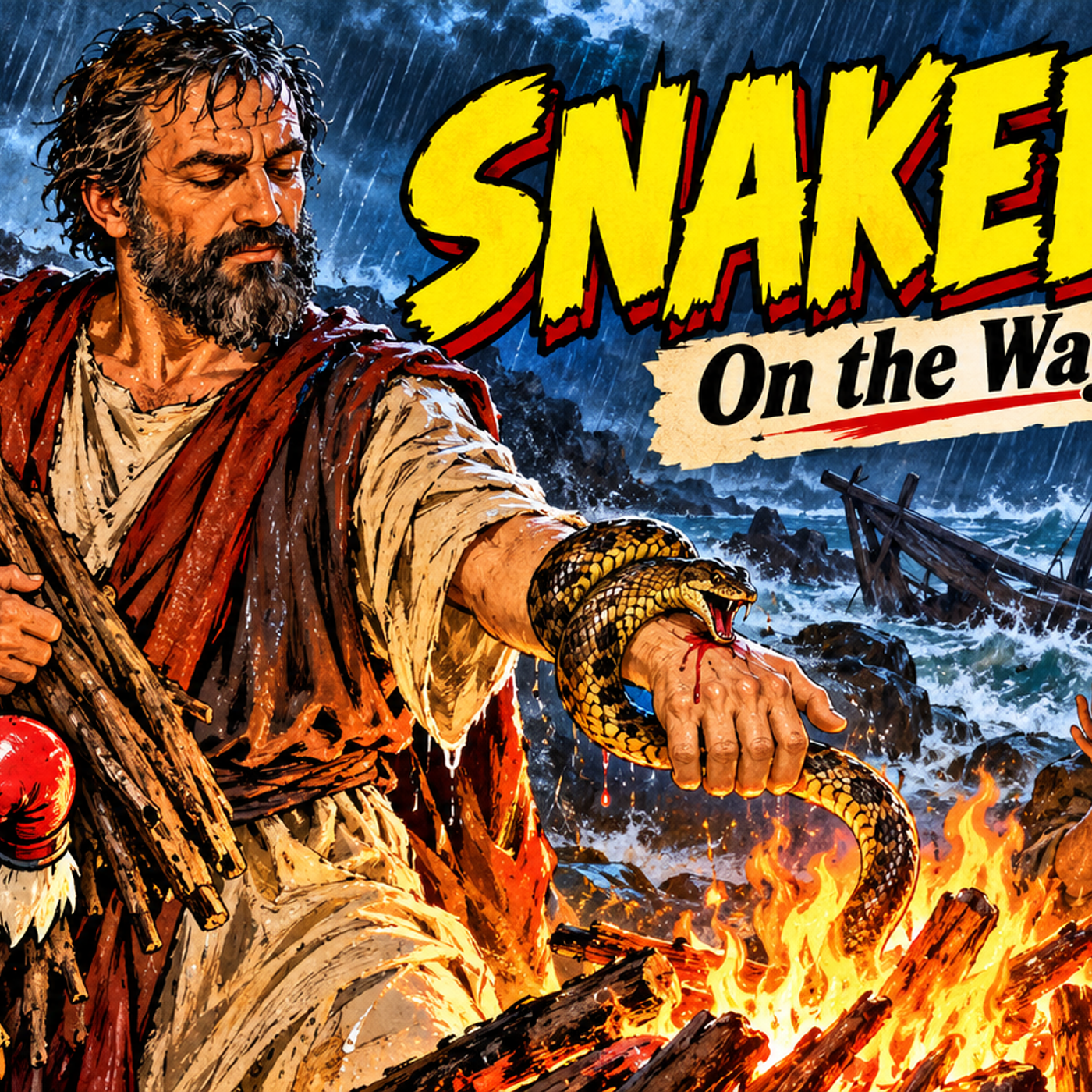
Paul survived 14 nights in a storm and a shipwreck off Malta. Then, while he was gathering firewood for everybody else, a viper came out of the kindling and bit him. The islanders had him figured out in about four seconds: he must be a murderer, and Justice finally caught up with him. When he didn't die, they changed their minds. He must be a god. Paul never changed by one hair. If you've ever thought "the worst is behind me" right before something came out of the kindling, this one's for you. If you've ever had somebody's "everything happens for a reason" run on you, by strangers, by family, by people holding Bibles, or by yourself at three in the morning, this one's for you too. Jesus gave Paul the destination, not the itinerary. He never promised that nothing would bite him. He promised that nothing gets to finish the sentence but Jesus. And forty miles outside Rome, the church walked out to meet a prisoner on the road, and Paul took courage. "So we came to Rome." 📖 Acts 28:1–16 (World English Bible) Preached live at First Christian Church (Disciples of Christ), Cushing, Oklahoma CHAPTERS 00:00 Snakebit on the Way to Rome 00:32 The Shipwreck Didn’t Cancel the Promise 02:15 Uncommon Kindness on Malta 05:53 Acts 28:1–6 — Scripture Reading 06:59 Fourteen Nights of Storm… Then the Snake 09:38 “I’ve Had My Storm” 10:23 The Crowd Decides Who Paul Is 11:31 The Snake Goes Into the Fire 12:26 Murderer. God. Same Paul. 13:31 When People Holding Bibles Do the Math 14:09 Jesus Gave Him the Destination 15:40 Don’t Build a Snake-Proof Gospel 16:48 The Same Hand That Got Bitten 17:19 Grace Has Fingerprints 18:11 The Journey Starts Again 19:15 Courage Comes With Faces 21:33 So We Came to Rome Part of our verse-by-verse walk through the Book of Acts. Previously: "What Has to Go Overboard?" (Acts 27, the shipwreck) Next: the last chapter of Acts, and the last word Luke ever wrote. 🎙️ The Semi-Seminarian: The Podcast Your Pastor Probably Listens To A digital church bell for anybody listening alone in the dark. We'll never ask you for money. Just tithe your subscribe. 🔔 #Acts28 #ApostlePaul #Sermon
Jim Wilhelm: The storm didn't kill Paul, and the snake won't either. Jesus said Rome, and disaster does not get the final word. You're listening to the semi seminarian, and I will see you on the other side. if you were Here Wednesday night, you might still be a little bit wet. We left 276 people in a surf off of an island, nobody could name. And they, if you remember, 14 nights, they were in a nor'easter, the Euroclydon No sun, no stars, the cargo went over the side. Ship's tackle went over the side, thrown by the same hands, depended upon it. And if you recall the wheat. And at daybreak, the ship itself came apart on a sandbar. Everybody went into the water. Some swam, the rest rode in on planks or whatever was left of the thing they'd been carrying. And every one of them made it. Sailors, soldiers, prisoners, a centurion named Julius, a doctor named Luke, and a tent maker under guard, who had told them all along that they were gonna. He knew because of a sentence. Back in Jerusalem, in a barracks in the middle of the night, the risen Jesus Christ stood beside him and said, Cheer up, Paul, for as you have testified about me in Jerusalem, so you must testify also in Rome. That was five chapters and better than two years ago. Felix The governor set on him for those two years. He was hoping for a bribe. Festus inherited him. A king named Agrippa came along, heard him out, and changed the subject. Paul appealed to Caesar, and the empire that meant to try him bought him his ticket. And now it's November, more or less, and the sailing season is over. The island is Malta. It's about sixty miles south of Sicily, with centuries of Phoenician and Punic history behind it. Whatever language was moving around that beach, it wasn't just Luke's Greek. And his word for these people is the one that the Greeks used for anybody whose talk sounded to them like bar bar. Barbarians. And the barbarians built a fire. It's raining. It's cold. Nobody on that beach owes a thing to these 276 half-drowned strangers, a good number of them wearing Roman iron. And Luke says they showed uncommon kindness. They lit a fire. They made room for everybody. And that's where we are this morning on a beach in the rain. Steam coming off of our clothes at a fire somebody else built. And you cannot feel your feet. You can feel everything else, salt in every cut. Fourteen days of rope burned across your palms, a shiver that started in the water and has not bothered yet to ask permission to leave. But there's sand under you and it's not moving anymore. You had forgotten. That solid ground did that. Up the beach somebody has a fire going. You smell it before you see it, wet wood and smoke lying low under the rain. Strangers are waving you towards it. You don't have their words and they do not have yours. And it turns out an open hand means the same thing in any language. So you go and you stand in the circle. You watch the faces come up out of the dark. One after another, and you count them the way you count children at a lake. And they're all here, every one of them two hundred seventy six. The fire then sags, wet wood eats fast and gives little. Nobody asks you because you're a prisoner. Nobody expects a thing from you, but you have hands, and the fire is low. There's a brush pile just past the edge of the Of the light. So you walk out of the warm and back into the rain, and you bend down and you gather dead branches, driftwood, tangle of something dry underneath that the rain hadn't reached yet. You fill your arms the way you filled them your whole life with whatever the people around you needed next. And walking back toward the light with your arms full, you think. Maybe for the first time in the last fourteen days, the The worst is behind me. Friends, attune your ears to the reading of Holy Scripture. Our passage this morning comes to us from the Acts of the Apostles. Chapter twenty eight, I'll begin reading with verse one. When we had escaped, then they learned that the island was called Malta. The natives showed us uncommon kindness, for they kindled the fire and received us all, because of the present rain and because of the cold. But when Paul had gathered a bundle of sticks and laid them on the fire, A viper came out because of the heat and fastened on his hand. When the natives saw the creature hanging from his hand, they said to one another, No doubt this man is a murderer, whom, though he is escaped from the sea, justice has not allowed to live. However, he shook off the creature into the fire and wasn't harmed. They expected that he would have swollen or fallen dead suddenly, but when they watched for a long time and saw nothing bad happen to him, they changed their minds. Said that he was a god. And thus ends the reading of the word this morning. Fourteen nights of storm, and it was the firewood that got him. We have a word for that here in Oklahoma. Snake bit. And when we use it, we hardly ever mean snake. We mean the fella whose truck threw a rod a week after the hail took his wheat. We mean the ball club that finds brand new ways to lose football games every single fall. We say it with a shake of the head that old boy just snake bit. Paul is the only man I know of who managed it both ways in one afternoon. And look what he was doing when it happened. He was not preaching, he was not standing on anything. There were 276 cold people around a fire that's going out. And the apostle to the Gentiles is picking up sticks. He didn't walk up to the beach asking, Don't you not know who I am? Somebody needed wood, he got wood. That is apostolic life without the apostolic furniture. And anybody who's ever lived in this county, who's ever cleaned out a fence row, knows what comes next. A cold snake doesn't look like a snake. A cold snake looks like a stick. It lies stiff in the pile. It rides along in the armload, and it doesn't wake up until it gets warm. Luke says the viper came out because of the heat. Paul carried the thing to the fire himself in the same arms he was using to help. He was doing exactly what love required, and he got bit doing it. And I think every single one of us knows what that's like. You go through the surgery and then the bill came. You buried your mother? Then the family started fighting over the house. You finally got the long thing behind you, the 14 night thing. And you were standing at the fire with the steam coming off of you, and you thought. Worst is behind me. And then something came out of the kindling. And we carry a quiet arithmetic about this. If God got me through that, then certainly the next stretch must be easier. I've had my storm. I have paid in, I've owed some smooth water. Luke's first words on Malta were when we had escaped, safe, brought through. And he lets you hold that safety for about two sentences. Safe and snake bit turn out to be in the same afternoon. And the people around the fire see it before Paul does. Snake is hanging from a man's hand, and they don't scream, they don't run for help. They turn to each other and explain it. No doubt this man is a murderer. Whom though he has escaped from the sea, yet justice has not allowed to live. Justice there has a capital J, because to them she's a person. Dikē, that's the word in Greek, daughter of Zeus. She kept the books, she does not lose paperwork. The sea was supposed to collect on this man, and the sea missed. So she sent a snake to finish the job. And these aren't cruel people. They built the fire. They are just certain. They have a system that explains everything that happens to everybody. And it took them about four seconds to run Paul through it. Then comes the part Luke could have skipped, and he did not. They watched for a long time, a long time, a whole beach staring at a man's hand. Waiting for that arm to swell, waiting for him to pitch over into the sand. Nobody is talking now. And Paul, as far as Luke tells it, never says a word. Snake is in the fire, the man is still standing, and I suspect he went back for more wood. And when the dying does not come, the same people with the same certainty turn the whole thing over. He must be a god. Murderer, God. And Paul has it changed by one hair. And this isn't his first time we've seen this. At Lystra they called him a god, and then they left him for dead under a pile of rocks. In Jerusalem, there were four different Pauls going around before he ever even got to open up his mouth. Now Malta has two more. All the way down this book, people keep reading Paul off of whatever happened to him last. And I'd love to leave that on the beach with the barbarians. But I've stood around that fire. And so have you. You've done the math on somebody else's snake. The diagnosis, the divorce, that boy who went wrong. Well, you have to wonder what's going on in that house. We just don't know. Better pray for them. Now we would never say justice with a capital J. We say everything happens for a reason. And then we go looking for the reason, the person it happened to. Some of you have had that math run on you by people holding their Bibles. And some of you have run it on yourself at three in the morning. What did I do? What is this for? Who's collecting on me? The snake only wanted his hand. The crowd wanted to tell him who he was. And Paul doesn't argue with either verdict. He doesn't have to. He walked on to that beach, already cold carrying a sentence older than both of those. Cheer up, Paul, for as you have testified about me in Jerusalem, so you must. Testify about me at Rome. Everything we have seen happen since that night has been inside that sentence. That remember, there were 40 some men who had sworn they weren't going to eat again until Paul was dead. Two years in Governor Felix's custody, the appeal, the grain ship, the storm, every single Bit of it had to fit between Jerusalem and Rome. And none of it got a vote on how the sentence ended. Jesus gave the destination. He never gave Paul the itinerary. He never said the ship would hold. He never said the fire would be safe. He just said Rome. Storm didn't get to tell Paul who he was. The snake doesn't get to. The islanders don't get to either time. And when he gets there, Rome will not get to. That was settled in a barracks in the dark in Jerusalem by the only one withstanding to actually say it. So when the islanders Watch that hand for a long time and nothing happens. The reason is not that Paul is a god, and it's not that Paul is bulletproof. The reason is on the far end of the sentence. A man named a man Jesus had promised to Rome can't die on a beach in Malta. And let us not build a snake proof gospel out of this beach. The hand that shook off that viper belongs to a body still marked by those rocks from Lystra. And the Rome he was promised is the Rome where, as the church historians have always told it, he will in fact die. Promise was never that nothing would happen to him. The promise was that nothing gets to finish the sentence Jesus started. And they winter. On Malta for three months. Luke gives the whole season in four verses. The leading man on the island, his name was Publius, He takes them in. His father is down with fever and dysentery. Paul goes into him, he prays, he lands hand lays hands on him, and the old man gets well. The same hand, the whole beach, had sat there staring at. That's a sign. Not a formula, and nobody gets to use it to shame a body, right? Nobody that has been preyed upon and is still sick. Then the season turns and it's time to sail. And Luke says the islanders put on board all of the things that they needed. Everything Acts 27 threw aside, strangers carry back up the gangplank. The people who started the winter calling him a murderer ends up loading his boat. That is how God keeps sentence. Hardly ever with a clear road, with a nephew in a hallway, a centurion who took a liking to him, a plank, a fire in the rain, an island farmer with a sack of grain on his shoulder. Grace has its fingerprints all over it. And most of them belonged to people who had no idea what they were actually carrying. So they sail north on a ship out of Alexandria with the twin brothers carved on the bow, Castor and Pollux, somebody else's gods for good luck now, Syracuse, Rhegium, Puteoli, where they find believers and they stay a week. There is no more boat. There's Only road now, better than a hundred miles of it to go, and a prisoner walks it. And I don't think Paul was feeling brave on the road at this point. He had been brave for everybody else for a long time. He's the one that stood up in the storm and told 276 frightened people to eat something because they were going to need it. And every step north now is a step closer to a Roman Caesar named Nero. From there the brothers, when they heard of us, came to meet us as far as the market of Appius and the three taverns. And when Paul saw them, he thanked God and he took courage. The three taverns is about thirty miles south of Rome. The market of Appius about forty. Somebody in Rome had heard that the prisoner was coming up a road, a man of Of which a good many of them knew only from a letter, and we're going to talk about that letter later. He had written it to them some three years back, and in it he had told them he had planned to come many times, but was hindered so far. Now, here he comes in chains. And they walked 40 miles to stand beside that road, so he wouldn't walk it alone. Take courage. One translation has Jesus saying, Cheer up, Paul, in that verse. And that word is heavier than that. It is take courage. Five chapters later, Luke reaches from back into that same family of words. In Jerusalem, Jesus says, Paul, take courage. And on the Appian Way, Luke tells us Paul took courage. In Jerusalem, courage came from the risen Christ. Standing beside him in the dark. On the Appian Way, it comes with faces on it. Church has stood beside a road here for over 123 years. Somebody you know is on that road this morning. They made it through the storm and then they got bitten at the fire, and half the town has a theory about why. They don't need your theory. They need you 30 miles out when they can see you coming from a long way off. And if you're the one walking, if you've been the strong one for so long that nobody thinks to ask, look up, look around you. Somebody has come. Luke puts this arrival. In one small sentence. So we came to Rome. So the word means like this, in this manner. Felix Festus Agrippa, a grain ship that should have stayed in a harbor, fourteen nights in a storm, cargo into the sea, a sandbar, a plank, a beach, a fire, a snake, a sick old man, a boat loaded by strangers, Syracuse, Rhegium, Puteoli, Aroad, the three taverns. In that manner. Not the way it'd have drawn it up, not as a free man, but he's standing exactly where Jesus said he would stand. Storm didn't cancel it out, the wreck didn't cancel it out. Snake didn't cancel it. And everybody's theory about him and who he was and what should happen to him didn't cancel it. So we came to Rome. So go from this place, way Paul left that beach, not untouched. Nobody promised you that. May the one who stood beside Paul in the dark stand beside you in yours. And when the fire is low, may you be found picking up sticks. And when something comes out of the kindling, May you remember whose sentence you're living inside. When everybody has a theory about you, may you answer to the one voice that named you first. And when your own courage runs thin, may God send it to you with faces on it, standing beside the road, cheering you on. Take courage. Sentence is not finished yet, and it's not yours to finish. Now Paul still has something to say, and we'll hear that on Wednesday. Amen. Amen. The storm has passed, the snake fell, and Rome still waited because nothing gets to finish the sentence Jesus has already spoken. Hey, I'll see you next time, friend. Until then, be blessed.