
The Scuba Gear Lab · The Scuba Gear Lab
How to Choose Your First Scuba Gear Set I remember standing in a dive shop in San Pedro three years ago, completely overwhelmed by the wall of equipment in front of me. Regulators, BCDs, gauges—everything looked important, and I had no idea where to start. If you're wondering how to choose first scuba gear, you're not alone in feeling lost. I made plenty of mistakes building my kit, and I'm still learning with every dive. This guide will walk you through choosing your first complete scuba setup without the overwhelm. We'll cover which pieces to buy first, what actually matters for your specific diving style, and how to avoid the expensive mistakes I made. Whether you're diving warm Caribbean waters or planning cooler adventures, you'll learn how to build a reliable kit that grows with your skills. Plan on spending about 30 minutes reading through this—I wish someone had laid it all out this clearly for me when I started. What You'll Need Before you start shopping, gather these resources: - Your certification card (to verify you're qualified to purchase scuba gear) - Budget estimate (realistic range you can spend over 6-12 months) - Diving plans (destinations, water temps, freq…
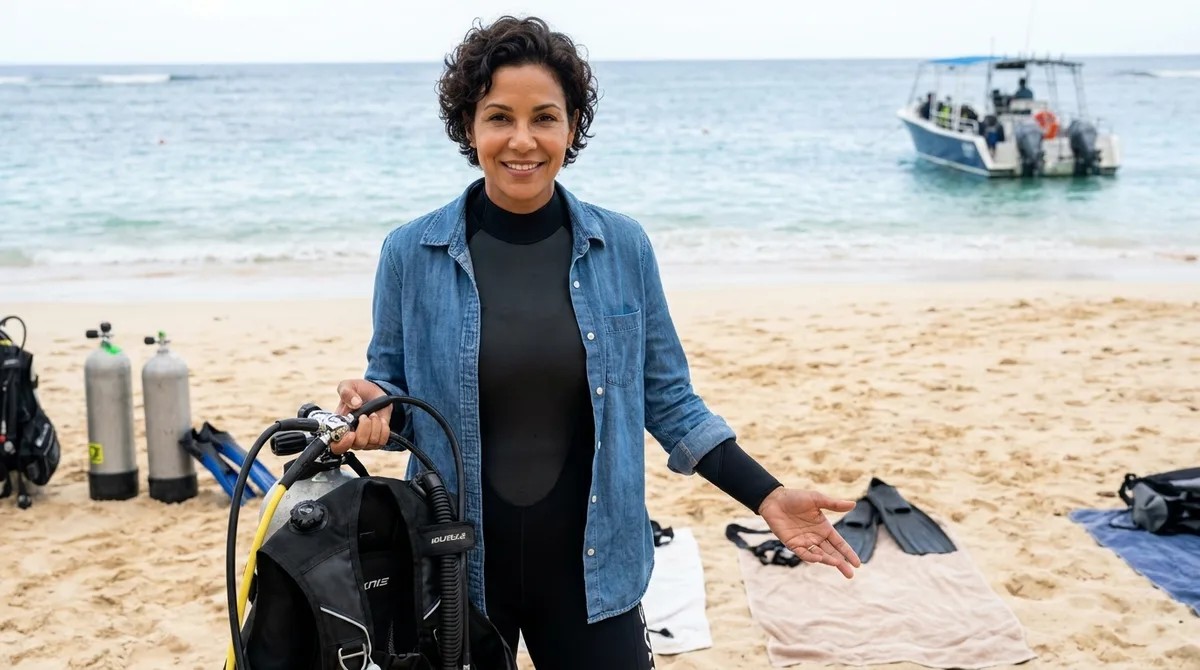
Three years ago, I walked into a dive shop in San Pedro, Belize, and just froze. There was this entire wall of equipment — regulators hanging like chandeliers, BCDs in every color, gauges I couldn't even name — and I had absolutely no clue where to begin. Everything looked critical. Everything looked expensive. And I was completely lost. I'm Camila Reyes, and I've been diving recreationally ever since that overwhelming day, learning through plenty of mistakes exactly how to build a scuba kit that actually works. You're listening to The Scuba Gear Lab Podcast. Quick note before we get started: all the research, advice, and writing you'll hear today comes from real divers who actually use this gear, but the voice bringing it to you is AI-generated. Just wanted to be upfront about that. Now, if you've been tuning in regularly, thank you. Seriously. It's great knowing there are people out there who care about this stuff as much as I do. And if you're new to the podcast, I'm glad you found us. We release new episodes every Monday, Wednesday, and Friday, covering gear reviews, buying advice, and the kind of practical diving tips that actually matter when you're underwater. Today we're tackling something that trips up almost every new diver: how to build your first complete scuba kit without the overwhelm. Let's get into it. This guide walks you through choosing your first complete scuba setup without all that overwhelm. We'll cover which pieces to buy first, what actually matters for your specific diving style, and how to avoid the expensive mistakes I made along the way. Whether you're diving warm Caribbean waters or planning cooler adventures, you'll learn how to build a reliable kit that grows with your skills. Give yourself about thirty minutes with this one. I really wish someone had laid it all out this clearly for me when I started. Before you start shopping, gather a few resources. You'll need your certification card to verify you're qualified to purchase scuba gear. Have a realistic budget estimate in mind, something you can spend over six to twelve months. Think through your diving plans — destinations, water temperatures, how often you'll actually get in the water. Get your body measurements handy: height, weight, chest, wetsuit size if you know it. Find a local dive shop contact for fitting and professional advice. Keep your logbook accessible so you can review your diving patterns and preferences. And plan several weeks between your initial research and actually making purchases. This isn't gear you want to rush. Now, let's talk about where to start. The first pieces I bought were my mask and fins, and honestly, this is where everyone should start. These are the most personal items in your kit. Rental masks leak. Rental fins give you blisters. Nothing kills a dive faster than fighting uncomfortable gear. Your mask needs to fit your face perfectly. I learned this the hard way after buying a beautiful mask online that flooded constantly. Do the suction test in person. Hold the mask to your face without the strap, breathe in through your nose, and it should stay put when you let go. If it falls off, keep trying different models. Everyone's face shape is different, and there's no shortcut here. For fins, think about where you'll actually dive. I started with split fins because they looked cool, but they're terrible in currents. Blade-style fins give you more power when you need to swim against water movement, which happens a lot around the cayes here in Belize. Get open-heel fins with adjustable straps if you'll dive in anything cooler than bathwater. You'll need boots underneath, and your foot size changes slightly in different thicknesses of neoprene. The snorkel is honestly the least critical piece, but grab a simple J-style model. Skip the fancy dry-top designs that add bulk. You won't use it much during actual dives, but you'll appreciate having it for surface swims getting to and from dive sites. Moving on to your regulator system. After my twentieth dive, I bought my regulator, and it completely changed my diving experience. This is the piece of equipment that literally gives you every breath underwater, and rental regs vary wildly in breathing comfort and maintenance quality. A complete regulator system includes the first stage, which connects to your tank. The primary second stage, what you breathe from. An alternate air source, your backup regulator. And pressure gauges. You don't need the most expensive model, but don't cheap out here either. I found that mid-range regulators in the four hundred to six hundred dollar range offer great breathing performance for recreational diving. Cold water makes a huge difference in regulator choice. If you're diving water below fifty degrees Fahrenheit regularly, you need a regulator specifically designed for cold water with environmental sealing. I dive tropical water year round, so I went with a standard balanced diaphragm model that breathes easily at recreational depths. One thing that confused me at first: yoke versus DIN connections. Most rental tanks in the Caribbean use yoke, the clamp-style connection, so that's what I bought. If you plan to dive in Europe or do technical diving later, DIN is the standard there. Some regulators let you swap between both, which is handy if you travel internationally. Get your regulator serviced annually or every hundred dives, whichever comes first. This isn't optional. It's a life-support system. Budget around a hundred to a hundred fifty dollars per year for professional servicing. Next up, choosing the right buoyancy compensator, or BCD. This decision took me forever because there are so many styles, and everyone has strong opinions. A BCD is basically an inflatable vest that lets you control whether you float, sink, or hover neutrally at any depth. It also holds your tank on your back and provides attachment points for all your other gear. Back-inflate versus jacket-style is the big debate. Jacket BCDs wrap around you and feel more secure at the surface, which I appreciated as a newer diver. Back-inflate BCDs, and their cousins, backplate-and-wing systems, keep you more horizontal in the water, which is better for your position and air consumption once you've developed decent buoyancy control. I started with a jacket style and switched to back-inflate around dive fifty. I wish I'd just started with back-inflate, but the jacket did help me feel more stable early on. Think about how you'll travel with your gear. My first BCD was heavy and bulky, which made it a nightmare to pack for dive trips. If you're planning to fly to dive destinations regularly, weight matters. Some travel-specific BCDs pack down surprisingly small and weigh thirty to forty percent less than standard models. Make sure whatever you choose has enough lift capacity for your body weight plus exposure suit plus any extra gear. As a general rule, you want lift capacity, measured in pounds, that's at least equal to your body weight. I'm about a hundred thirty pounds, so my thirty-pound lift BCD works fine for recreational diving in warm water. If you're larger or diving in thick drysuits, you'll need more lift. Let's talk about dive computers. I dove with rental computers and depth gauges for my first twenty-five dives, but buying my own computer was probably the smartest safety investment I made. A dive computer tracks your depth, time, nitrogen absorption, and no-decompression limits in real time. They're not technically required — you can dive with tables — but they're so much safer and give you more bottom time by calculating your actual dive profile instead of square profiles. Start with a wrist-mounted, air-integrated computer if your budget allows. Air integration means it wirelessly connects to a transmitter on your first stage and shows your tank pressure right on your wrist. No more craning your neck to check a gauge clipped to your chest. I didn't think this mattered until I tried it, and now I can't imagine going back. Look for a computer with a clear display you can read easily underwater. I dive in bright, shallow water a lot for photography, and some screens completely wash out in sunlight. Test this in the shop if possible by shining a bright light at the display. Nitrox capability is standard on most computers now, and even if you're not nitrox-certified yet, you probably will be eventually. Don't buy a computer that only handles regular air. You'll just need to upgrade later. Battery life varies wildly. Some computers use user-replaceable batteries, usually CR2032s, that last a year or two. Others have rechargeable batteries that need charging every twenty to thirty dives. I prefer replaceable batteries because I don't want to worry about charging yet another device, and I can swap a fresh battery before a dive trip. Now we need to talk about exposure protection. Water temperature dictates everything here, and this is where you really need to be honest about where you'll actually dive. I'm spoiled with seventy-eight to eighty-two degree water year round, so I own a three millimeter full wetsuit and a five millimeter for deeper dives or windier days. If you're diving anywhere with water below seventy-five degrees, pay close attention to this part. Wetsuit thickness matters more than brand names. A three millimeter suit works for water above seventy-five degrees. Five millimeter for sixty-five to seventy-five degrees. Seven millimeter for fifty-five to sixty-five degrees. Below that you're looking at drysuits. These are rough guidelines. I get cold easily, so I wear my five millimeter when other divers are comfortable in three. Know your own cold tolerance. Wetsuit fit is annoyingly specific to each manufacturer's cut. What fits perfectly in one brand might gap at your neck or squeeze your shoulders in another. If possible, try before you buy. Wetsuits should feel snug on land, almost uncomfortably tight, because they loosen up underwater. If it's comfortable standing in the shop, it's too big for diving. Two-piece suits, farmer john bottom plus jacket top, give you more flexibility to mix thicknesses, but I find them bulkier and more annoying to put on. One-piece suits are simpler, though you can't adjust the insulation level. Some divers layer a hooded vest under their wetsuit for extra warmth. This works well for occasional cold dives without buying a whole new suit. For tropical diving, some people skip the wetsuit entirely and dive in a rashguard or swimsuit. I don't recommend this. Even in warm water, a thin wetsuit protects you from stinging creatures, coral scrapes, and sun exposure during surface intervals. Plus, even eighty degree water pulls heat from your body over a sixty-minute dive. Let's move on to essential accessories and safety gear. The small stuff adds up fast, but these pieces aren't optional. They're safety requirements or practical necessities you'll use every single dive. Surface marker buoy, or SMB, and reel. If you're doing boat dives or any diving where you surface away from shore, you need a way to mark your position. I carry a four-foot bright orange SMB with about a hundred feet of line. Deploy it during your safety stop so boats can see where you'll surface. I didn't think this was a big deal until a dive guide read me the riot act after I surfaced without marking my position near a boat channel. He was right. It's a safety issue. Dive knife or cutting tool. Not for fighting sharks — please don't do that — but for cutting fishing line or nets if you get tangled. I carry a small line cutter strapped to my BCD shoulder strap. It's compact, easy to reach with either hand, and I've had to use it twice to free myself from monofilament. Underwater light. Even in daytime shallow water, a light helps you see the real colors of fish and coral. Everything looks blue-green without light below about thirty feet. For night diving, a primary light is obviously required, plus a backup. I started with a cheap light that flooded after ten dives, so spend a bit more for something actually waterproof. Look for depth ratings of at least a hundred thirty feet even if you're only diving to sixty feet. The pressure testing on cheap lights is optimistic. Compass. Your dive computer might have a digital compass, but I prefer a physical wrist compass as a backup. Navigation underwater is surprisingly difficult, and surfacing only to realize you're two hundred yards from the boat gets old fast. Logbook and certification card. Always bring proof of certification. Some dive operations are strict about this. I keep my C-card in my wallet and travel with my logbook, though I also maintain a digital log as backup. Gear bag. You need something to haul all this equipment around. Mesh panels for drainage, padded compartments for delicate items like your computer, and enough capacity for a full kit without being so huge you can't lift it. Here's the part nobody talks about enough. You don't need to buy everything at once. I tried to do that and ended up making poor choices because I was focused on spending less rather than buying right. My recommended purchase order, based on what I wish I'd done. Month one: mask, snorkel, fins, boots. Around three hundred to four hundred dollars total. These are the most personal fit items. Month three: dive computer. Around three hundred to six hundred dollars. Safety equipment you'll use every dive. Month six: regulator system. Around four hundred to seven hundred dollars. Life support that justifies saving up for quality. Month eight: BCD. Around four hundred to seven hundred dollars. Big purchase, take time to research fit and style. Month ten: wetsuit. Around two hundred to five hundred dollars. Once you know your actual diving patterns and temperatures. Month twelve: accessories. Around two hundred to three hundred dollars. After you've identified your specific needs. This spreads the cost over a year and lets you make informed decisions based on actual diving experience. Your total investment will be somewhere around two thousand to thirty-five hundred dollars for a complete personal kit, but the range is huge depending on brands and features. Buy what actually fits your diving. I almost bought a drysuit because technical divers on forums said wetsuits were inferior, but I dive tropical water and travel internationally. A drysuit would sit in my closet unused. Don't let gear snobs talk you into equipment you don't need. Consider buying certified pre-owned gear for some items. Masks, fins, and computers I'd buy new because they're either fit-specific or rely on watertight integrity. But BCDs and wetsuits can be great used purchases if they're in good condition. Just have any used regulator professionally serviced before you dive it. You don't know its history. Let's talk about getting properly fitted and trained on your gear. Buying gear is only half the process. You need to actually learn how it works before you splash with it. This seems obvious, but I made the mistake of showing up to a dive with a brand-new BCD I'd never inflated or adjusted. The dive was a disaster of tangled hoses and fumbling with unfamiliar buckles. Do a confined water session with new gear before a real dive. Most dive shops offer pool time or calm shallow water checkout dives. Spend an hour in ten feet of water getting comfortable with every piece. Practice clearing your mask, switching to your alternate regulator, adjusting your BCD buoyancy, deploying your SMB. Figure out where to clip accessories so you can reach them without looking. Learn the maintenance requirements for each piece. Your regulator needs annual service. Your computer battery eventually dies. BCDs need rinsing after every dive and pressure testing annually. Wetsuits need proper storage away from sunlight. I also recommend building your kit gradually in terms of what you actually carry on dives. Don't show up to dive thirty-one with every new piece of gear simultaneously. That's too many new variables. Add one or two new items per dive so you can learn each piece without being overwhelmed. Talk to your dive guides and instructors about your gear. Show them your setup and ask for feedback. I got great advice about repositioning my octopus holder and routing my computer hose from a divemaster who noticed I was struggling with my configuration. Experienced divers can spot inefficient setups in seconds. Now for some pro tips and common mistakes. The biggest mistake I see new divers make, and I made it too, is buying whatever their first instructor used without considering their own diving plans. Your instructor might be a cold-water technical diver who needs dramatically different gear than someone doing recreational reef dives in warm water. Match your gear to your actual diving, not someone else's. Avoid buying a complete package deal without trying the individual pieces. Shops love to sell starter packages, and they're convenient, but you're often getting whatever they're trying to move, not what fits you best. The exception is if the shop lets you try each component and genuinely customizes the package. That can be a decent deal. Rental fees stop mattering after about thirty to forty dives. Do the math for your situation. If you're diving twenty plus times a year, owning gear pays for itself fast. If you dive twice a year on vacation, just rent. I wasted money buying a GoPro and housing before I bought my dive computer. Yes, I got cool videos, but I would have been safer and more comfortable investing that four hundred dollars in a good computer first. Prioritize safety and comfort gear over fun extras until you have the basics dialed in. Don't trust online sizing for exposure suits or anything that needs to fit precisely. I bought fins and a wetsuit online based on size charts, and both fit poorly. The fins gave me blisters for three months until I finally replaced them, and the wetsuit flooded because it gaped at my neck. Save yourself the hassle and buy these items in person after trying them on. Keep all your receipts and warranty information organized. I lost the receipt for my regulator and couldn't get warranty service when a hose started leaking. Gear is expensive enough. Protect yourself by keeping documentation in a folder, physical or digital. Let's go through some frequently asked questions. How much should I budget for my first complete scuba gear set? You should plan to spend between two thousand and thirty-five hundred dollars for a complete recreational scuba setup including mask, fins, regulator system, BCD, dive computer, wetsuit, and basic accessories. This budget gets you reliable mid-range gear that will last for years with proper maintenance. You can reduce costs by purchasing over twelve months rather than all at once, or by buying certain items like BCDs used from reputable sources. Should I buy scuba gear before getting certified or wait until after? Wait until after your certification course to buy most gear except possibly a mask. During training you'll learn what features matter to you, what fits comfortably, and what type of diving you're actually interested in pursuing. Many divers discover their planned diving style changes completely after getting certified, and gear purchased beforehand often doesn't match their actual needs. Is it better to buy gear online or from a local dive shop? Buy fit-critical items like masks, wetsuits, BCDs, and fins from a local dive shop where you can try before purchasing. Online prices might be lower, but a poorly fitting mask or BCD ruins dives and often costs more to replace than you saved. Life-support equipment like regulators can be purchased online if you know exactly what you want, but you'll still need to pay a shop for annual servicing regardless of where you bought it. How long does scuba gear typically last before needing replacement? A well-maintained regulator can last fifteen to twenty years with annual servicing, while BCDs typically last ten to fifteen years before bladder materials degrade. Wetsuits lose insulation properties after five to eight years depending on dive frequency and care. Masks and fins can last indefinitely if not damaged, though straps may need replacement. Dive computers last five to ten years before battery systems fail or technology becomes outdated. Proper rinsing, storage, and professional maintenance dramatically extends the life of all scuba equipment. So to wrap things up. Learning how to choose first scuba gear doesn't have to be overwhelming if you break it down into manageable steps. Start with the personal fit items, mask, fins, and snorkel, then work your way up to life-support equipment like regulators and dive computers as your budget allows. Match each purchase to your actual diving plans rather than what looks cool or what other divers recommend for completely different conditions. I'm still building my perfect kit three years in, and that's completely normal. Your gear needs will evolve as you gain experience and discover what type of diving you love most. The basics I've outlined here will get you safely in the water with reliable equipment that grows with your skills. Take your time, try before you buy, and don't let anyone pressure you into gear you're not ready for. The best setup is the one that fits your body, matches your diving style, and gives you confidence underwater. Everything else is just details. That's it for this episode of The Scuba Gear Lab Podcast. Thanks for spending part of your day with me. We've got new episodes dropping every Monday, Wednesday, and Friday, so there's always something fresh coming up. If you found this helpful, I'd be really grateful if you could leave a five-star rating and write a quick review. It actually makes a difference. It's how other divers find the show when they're searching for honest gear advice. And go ahead and hit subscribe or follow so you get notified the second a new episode goes live. I'll catch you next time.