
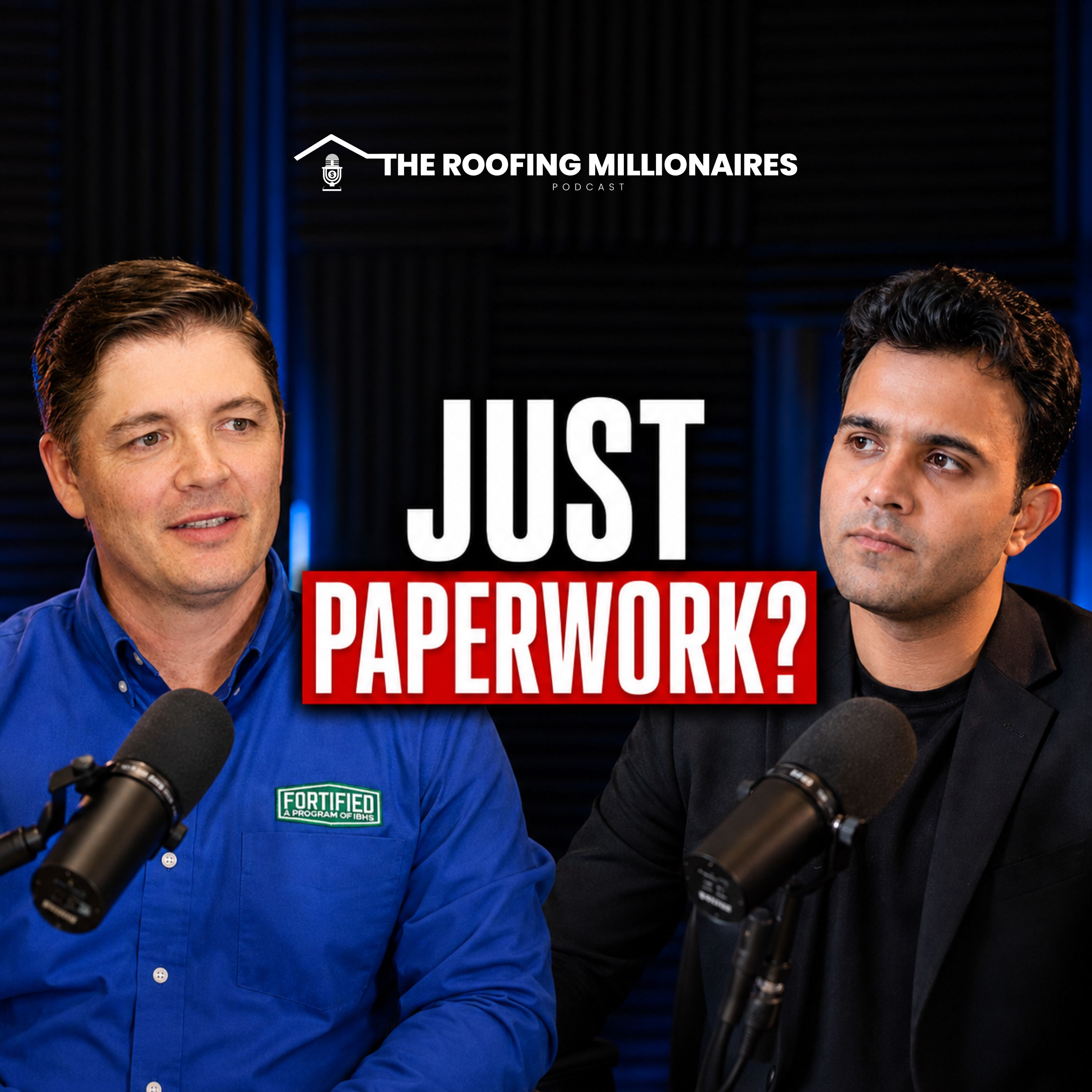
The Roofing Millionaires · Muhammad Faiz
Is FORTIFIED roofing being oversold, or does the roofing industry’s resistance have more to do with cost, change, and accountability? After our first conversation generated both support and pushback from roofing contractors, Muhammad Faiz sits down again with Fred Malik from @IBHS_org FORTIFIED. This time, Muhammad brings Fred the objections and difficult questions roofers have raised about the program. They discuss whether FORTIFIED is simply another certification layer, whether strong building codes should already be enough, and why homeowners should pay more for third-party verification when their contractor claims to be following every required standard. Fred also addresses questions about the long-term performance of sealed roof decks, tapes, membranes, and adhesives under heat and moisture. He explains the different sealed-roof-deck methods permitted under FORTIFIED and what contractors must do when a FORTIFIED roof reaches its next replacement cycle. Finally, Muhammad asks Fred for a practical example of a homeowner who should not invest in FORTIFIED and whether contractor resistance may ultimately be resistance to greater accountability. This is not a FORTIFIED sales presentation or a roofing-contractor takedown. It is a direct conversation about roof performance, building codes, third-party verification, insurance incentives, installation quality, and what homeowners are actually paying for. In this episode: * Is FORTIFIED roofing being oversold? * Why some contractors see it as unnecessary certification * Whether homeowners will pay more for roof resilience * Why FORTIFIED matters outside coastal hurricane markets * How wind, hail, and wind-driven rain affect roof systems * Whether sealed-roof-deck tapes and adhesives last * What the available long-term field evidence shows * Code-compliant roofing versus third-party verification * Whether homeowners are paying for better roofs or better paperwork * Insurance incentives and FORTIFIED grant programs * Who homeowners should trust when contractors disagree * FORTIFIED’s positioning problem within the roofing industry * What happens during the next roof-replacement cycle * Whether FORTIFIED benefits IBHS more than homeowners * The most common objections Fred hears from contractors * Who should—and should not—invest in a FORTIFIED roof * Accountability and the future of roofing standards Chapters: 00:00 Highlights 02:03 Introduction 02:51 FORTIFIED reaches 100,000 designated homes 05:32 Is FORTIFIED being oversold? 08:46 Sealed roof decks and hurricane zones 19:55 Strong building codes versus FORTIFIED 29:01 Who should the homeowner trust? 36:27 What happens during the next roof replacement? 41:59 Who benefits most from FORTIFIED? 50:37 Who should not invest in FORTIFIED? Learn more about FORTIFIED and IBHS: https://fortifiedhome.org/ https://ibhs.org/ Connect with Muhammad Faiz: https://www.facebook.com/muhammadfaiz99/ [email protected] #FORTIFIED #RoofingPodcast...
0:00And here's a solution for that. So I think that
0:02roofers have the opportunity, if they look at
0:05this objectively, they can say, okay, this is
0:08grounded and reasonable, practical. Do you think
0:10that Fortified is struggling with its positioning
0:14in the roofing industry? An alternative are acrylic
0:17tapes. They meet AMA 711 Level 3, and the Level
0:213 is really critically important. This is why
0:23the details matter. This is why we go through
0:25such intense effort to really find the... best
0:28solution. I'm reading from the comments that
0:30I received from roofers and one of them is that
0:33what long -term field evidence shows these tapes
0:37membranes and adhesives still perform after years
0:40of heat and exposure like what is the industry