
The Recovered Life Show | Mental Health and Addiction Recovery Podcast · Damon Frank
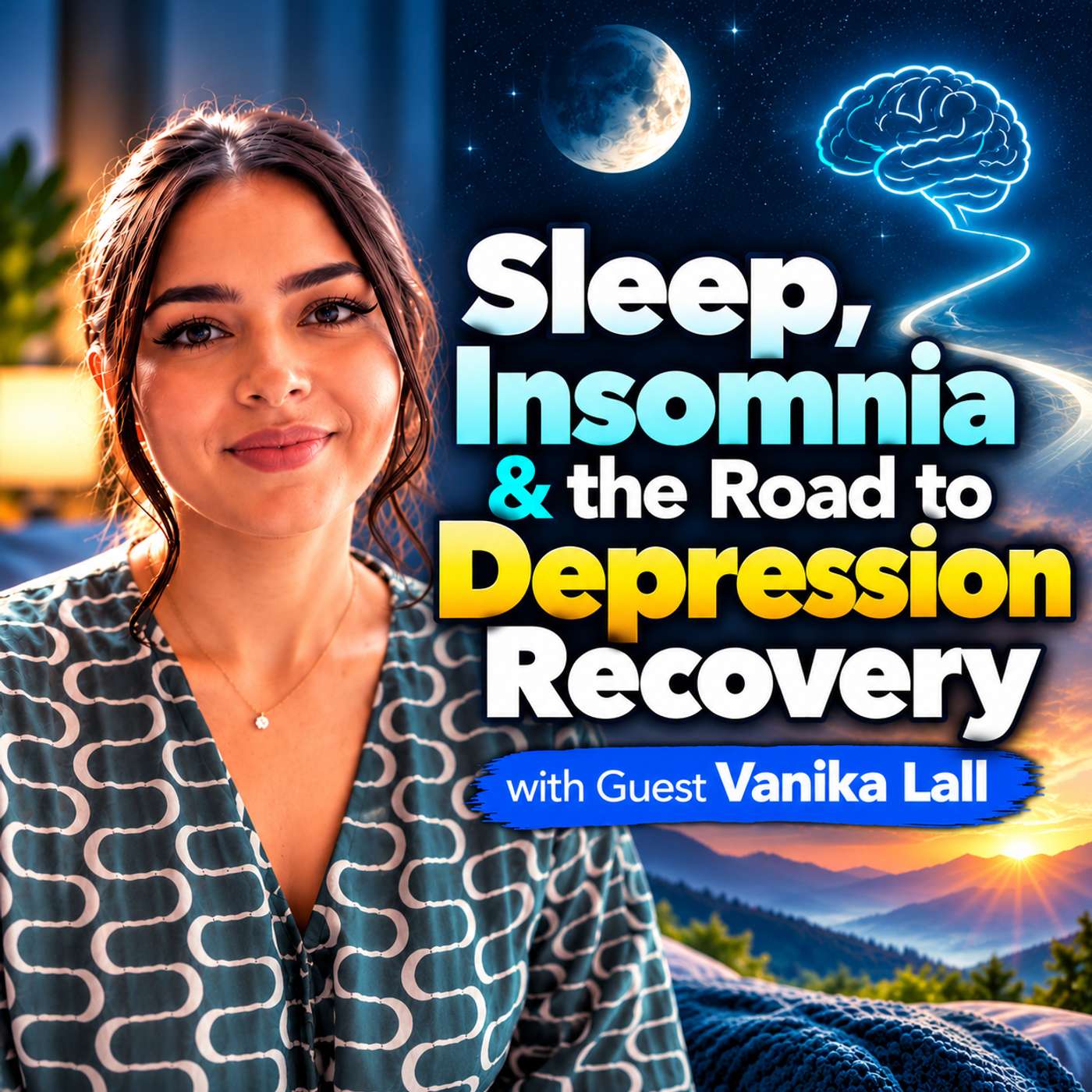
Up to 9 in 10 people with depression also struggle with disturbed sleep — and new research says that leftover insomnia may be exactly why depression keeps coming back. Sleep researcher Vanika Lall of the University of Western Australia joins Damon to break down her Sleep Well for Mood study: when people with depression treated their insomnia with CBT-I — cognitive behavioral therapy for insomnia — their depression improved too, and their recovery lasted longer. Vanika explains why insomnia often survives depression treatment, why it is the quality of your sleep (not just the hours) that moves your mood, and the three core tools of CBT-I: quieting the racing mind, stimulus control, and sleep restriction. Plus: what this means for people in addiction recovery, where being tired is one of the classic HALT relapse triggers — and why Vanika says even 20 or 30 years of chronic insomnia is treatable. Join the Recovered Life Community here. Find out how to work with Damon here.
What we find is that insomnia symptoms can still remain and when they do remain, the chance of relapse is much, much higher. And it's fascinating. So what you're saying is, and this is across the board, so if somebody's maybe on an antidepressant, if somebody's not on an antidepressant, okay, you're, okay, so say this again, because I wanna make sure that people understand this. You're much more likely to recover from depression if you can fix the sleep issue. Yes, so when insomnia and sleep issues are treated alongside depression, your recovery would last much longer. The weight of the world in my hands. You're listening to The Recovered Life Show, the show that helps people in recovery live their best recovered lives. It's Damon Frank and welcome back to The Recovered Life Show. Today I'm joined by Vanika Law, a PhD researcher in the School of Psychological Science at the University of Western Australia in Perth, whose new research shows that treating insomnia may be the key to lasting recovery from depression. Welcome to the show. Thank you, Damon. It's a pleasure to be here. I am so thrilled that you're here coming in all the way from Australia. I love that, I love that. I love talking with people all around the world. And you know what it seems like, Vanika, it's that no matter where you're at in the world, addiction, mental health, this topic of depression, everybody's talking about it. And that's why I saw your research that you're doing. It is so fascinating. I wanna dive right into this because anybody who suffers from depression, I would say even seasonal depression, if you've ever had this experience of depression, this is gonna be very interesting and very helpful for you. I'm just gonna set it up here for you to take over on this. But it seems like from what I read, nine in 10 people that suffer from a form of depression also have disturbed sleep. What did you find here? Yeah, so there've been quite a few studies done with large sample size. So this is sample size of 1,000, 2,000, 4,000 people. And what the findings find is of the findings show us is that approximately or up to 90% of people with depression will also have trouble sleeping. So that's where the number nine in 10 people with depression comes. That is, now that is a lot of people. It is a lot of people. This is not a coincidence. So if you're having depression, the odds are you're gonna have sleep disturbances. When you say sleep disturbances, what do you mean by that specifically? Because I think everybody, especially if they found out that, oh my God, I'm suffering from depression and they're being treated for depression or maybe gonna lose some sleep over it because maybe they're not feeling the best, especially people in addiction recovery. Maybe they're not feeling the best in early recovery. What do you mean by lack of sleep? So sleep disturbance can be trouble going to sleep. So trouble falling asleep. It could also mean trouble staying asleep. So this is when you keep waking up in the middle of the night quite frequently or for long periods of time. And it could also mean early morning awakenings where you're waking up quite early in the morning, way before you have to, and you're unable to go to bed after. Now, depression, a symptom of depression is insomnia. But what we found is that insomnia very quickly can snowball and become its own independent issue. And so that's why it's important to be looking at your sleep and taking care of your sleep as well. Now, did you find this in all types of forms of depression, severe depression, people maybe who are seasonally depressed? Is this every type of depression that sleep sends to be an issue? Yeah, so a lot of different kinds of depression, I think sleep still tends to be a problem for most, across most of the depression disorders, yeah. You know, it's funny because people, when you talk about depression, people say, let's treat the depression. Yes. Let's treat it with either drugs, something in your lifestyle. Rarely do I hear people actually talk about, let's just go with the basics. Are you sleeping through the night? Yeah. What's with this? Because I think when I look at people who have depression, they tend to go to these more drastic measures instead of dealing with the bit. Why is sleep so important with depression? I think that's the big question. Why is it so important and why should people focus on that maybe first? Yeah, so look, it is important to treat depression, the low mood or the other symptoms that come with depression. But the thing is that insomnia and sleep problems tend to be a risk factor for depression as well. So what that means is that if you have symptoms of insomnia or if you're diagnosed with insomnia, you're at a higher risk for developing depression. It's harder to treat depression if you have insomnia. It's also your depression severity is much higher when you have insomnia. And when you are successfully treated for depression, so let's say you're on antidepressants or you're using psychological intervention for depression and you're successfully treated, what we find is that insomnia symptoms can still remain and when they do remain, the chance of relapse is much, much higher. And it's fascinating. So what you're saying is, and this is across the board. So if somebody's maybe on antidepressant, if somebody's not on an antidepressant, okay, you're, okay, so say this again, because I wanna make sure that people understand this. You're much more likely to recover from depression if you can fix the sleep issue. Yes, so when insomnia and sleep issues are treated alongside depression, your recovery would last much longer. You would just have better outcomes. You do better. Wow, wow, that's interesting. Now I wanna talk a little bit about the modalities here that you're dealing with, the different techniques you're dealing with. I noticed that there was cognitive behavioral therapy. Yes. That you mentioned in this report and we've done some shows on CBT in the past. Can you explain to people kind of what that is and how did you apply and why did you apply CBT to this? Yeah, so what we used was cognitive behavior therapy for insomnia. Now this is a gold standard treatment for insomnia recommended by medical and sleep associations in the US, the UK, Canada, Australia. And what you do here is, so there are quite a few different components that make up CBTI, but really there are three main components. One is cognitive therapy. So this is where you're providing strategies to individuals to manage worries, anxiety, busy mind, especially when they're in bed, which interferes with sleep. We're also helping identify and correct unhelpful beliefs that can maintain insomnia problems and worsen them. The second component is called stimulus control. Now what we see a lot of the times is that people will come in and go, geez, we're tired all day and we're sleepy to the point where we're falling asleep on the couch, but as soon as our head hits the pillow, we're wide awake and cannot go to bed. And that usually happens when your bedroom and your bed has been paired with wakefulness and the anxiety and worries that comes with not being able to sleep. So that's where stimulus control comes in handy where we try to pair and link sleep back with bedroom and your bed. And so this is with strategies like only using the bed for sleep and intimate activities and keeping everything else, eating, working, answering emails for work out of the bedroom, but also waking if you can't fall asleep, getting up and leaving the bedroom, engaging in some sort of calming activity and coming back to bed when you feel sleepy again. So that's the second component. And the third one is called sleep restriction. So this is where you and your clinician will work together to initially reduce the time that you're spending in bed. And it's quite a powerful tool which helps consolidate your sleep and helps you sleep quicker. So for example, if you're only sleeping about six hours, you and your clinician may decide that you'll actually only spend six and a half hours in bed so that if you have to wake up at 6.30, you only go to bed at 12 at midnight, right? And get up at 6.30. And what this does is it improves your sleep pressure. It increases your sleep drive which helps you fall asleep quicker and it stops your sleep from breaking in the middle of the night. So you sleep continuously. So these are the three components or the main components of CBTI that we use, changing behaviors and cognition that maintain sleep. And then there are the smaller components that can also help like relaxation training and adding sleep hygiene just to tell people what, how you can create habits and create a bedroom environment that will support a good night's sleep. You know, what I find very interesting with this is that I think there's a lot of myth when it comes to mental health and depression. And I think one of it is, is that people sleep all the time. See, I think people think that when you're depressed, your whole body slows down, you lack interest which is not untrue, right? Like it's untrue. You do have these, you have less interest in something and you have less joy, less engagement. But I think a lot of people think that they sleep more when they're depressed. And maybe they do, but they just don't sleep well. Yeah. And look, it is, yes, sleep. When we say sleep disturbance, there are indeed people that would actually sleep more. And that's called hypersomnia. But what we find is that more people have difficulty falling asleep and more people struggle with insomnia than others. But either way, they're both equally important issues that we need to deal with when people have depression to help them get better and stay better for longer. Love that. And you know, I think this is, it's almost like a chicken and egg thing. What comes first, Vanika? Do depressed people not sleep? Develop sleep things? Or is it first something with their sleep that causes depression? Did, what's going on there with that? Yeah. And that's a good question. And it can be both. So what we find is for some people, even though sometimes depression is looked at as the main problem, for some people, insomnia actually came first. And like I mentioned before, that then increases your chance of developing depression. So then you've also developed depression. And other times depression came, insomnia was part or a symptom of depression. But as your insomnia and sleep issues kept growing, it then became its own problem that needs its own treatment. So it can't be, or it can't always be treated with depression treatment. In fact, insomnia is one of the most common residual symptoms after depression treatment. And what that means is that depression would improve, but sleep problems tend to remain in a lot of people even after the successful treatment. Wow, okay. So this is something you really have to pay attention to. So I get, you know, one of the things that what I found very interesting with this is that I firmly believe, you know, and I'm just gonna say to me personally, I'm somebody who, if I'm emotionally taxed or my nervous system is taxed, I'm one of these people that just fall asleep. Okay, yeah. I'm one of those people that just, cause I'm a little late, people that know me on here are laughing because they're like, you know, gaming your little ADHD, you're all over the place, you know, very high energy. And then when I'm off, I'm off, okay? And like that's it, it shuts down. But I do notice that sometimes seasonally or when I do feel depressed or if I have bouts of depression, I do not sleep as well. I will randomly wake up at 3 a.m. I will sleep during the day. My sleep hygiene will be terrible. I'll go to bed later. So what I find interesting in this is I personally believe this is probably the biggest key to really mental health. You know, that I see is people getting a good night's sleep. Yeah. We have all these devices, we have everything. So tell me about the people real quick that you did this study with. You know, I wanna say, when you guys got together, what was the big aha moment of something that you said, you know, we kind of thought one thing, but when we looked at this, it was like, wow. Yeah. We were surprised by this. Yeah. So this study, and I'd like to acknowledge my co-authors here, Associate Professor Melissa Rhee and Professor Romer Box. So what we did in this study was there's actually quite a lot of evidence that sleep CBTI, this insomnia therapy, when it's given to people with depression and insomnia, their depression and insomnia improves together. So we don't only see improvement in insomnia, we see improvements in their depression as well. And what we wanted to see was that, well, what's happening? Why is it that as your insomnia improves, your depression is improving as well, right? And it seems when I would tell my participants that that's what the study was doing, they'd be like, well, you could have asked me that. Clearly when we sleep better, we just feel better. So it seems very obvious that if your sleep improves, your mood's improving as well. But we wanted to just have an in-depth look into what it is that happens. And so we looked at a few different things. One was repetitive negative thinking. So this is the amount of negative thinking that comes to you repetitively that you can't control. What happens to that? And the other was behavioral activation. So this is amount of meaningful activities that you're engaging in. And what we found was when with people who present or experience both insomnia and depression, two things that seem to be quite common is that they engage more in negative thinking and they also just spend less time socializing, going outside, engaging with physical activities. And what we found was that when you give people CBTI, they start having less negative thoughts. They're worrying less about sleep, which we also know can fuel depression. And they also started going out and actually engaging in meaningful activities. So socializing with their friends and families and having more levels of physical activities, doing house chores, which can also help you just feel better and that you've achieved something. But one thing that really stood out was that their insomnia symptoms improved, which was associated or linked to better depression outcomes. But their sleep, so we use a sleep diary, which they fill out every morning and they tell you, well, okay, we think we slept about six hours and seven hours and whatnot. And whilst their total sleep time did improve, it didn't show any association with improvements in depression, at least in our study. So what was surprising there was that actually, when people are looking at, when we're looking at the insomnia symptoms, we're looking at, well, how they perceive their sleep. So how bad are my sleep problems and how much it's impacting my life? When that improves, your depression improved, right? But the total amount of sleep that they said, okay, well, I'm sleeping six hours now and then now I'm sleeping seven, that was not related to improvements in depression. And so that says something, right? It says, well, not every type of sleep and how we measure sleep may actually matter. It may not necessarily be hours of sleep, but how you perceive your sleeping, how well you think you're sleeping and how that's impacting your daily life and your daytime functioning that impacts depression. And to me, that's very interesting. That is, yeah. It's quality, right? It is the quality of your sleep that you're getting. You know, this is so, Vanika, this is so surrealistic for me because, you know, I come into this with my own journey of addiction recovery and I'm doing this decades and working with people and in the public life community, it has a lot of people in addiction recovery and a lot of people that have a lot of time as well as new people that are coming in. And one of the things that they said, I've heard this literally for 33 years, it's acronym that they would say, Hungry, Angry, Lonely, Tired, Halt. That this was one of the biggest triggers that you could do. And I just did an episode, we just did an episode all about what's actually happening when we eat, right? The idea of panic and what happens in our blood. So we've been doing all those episodes. And the science is starting to prove the old cultural things that people used to say. Groups like if you are tired, it's very dangerous for you in early recovery. So sleeping is as important as going to meetings, not drinking and using all of these other things, right? And now what we're finding is this, there's also a science behind this. If you're tired, you're not making great decisions and you're more depressed. Yes, that's right. And I think people tend to forget that sleep is as necessary as food, air, water is for us, right? It's a very important biological process for us. So we should be treating insomnia symptoms and sleep problems and taking care of our sleep for sure. I want to dive into sleep hygiene here because I think I think the science is interesting, but how you apply this, I think in your life is even more interesting. Yeah. I think I'm just going to tell you, I know you're in Australia. I bet it's the same there as it is here. I found myself sleeping with my tablet, my laptop on the floor next to me and my cell phone. And I realized the other night, I was like, this is not good. Like this is not, this is just not good. Why are they in the room? Why was I just in the bed watching Netflix for an hour and a half? Like before I go to sleep, I should have watched Netflix in the living room, gone in and then turned everything off and gone to bed. But this is like, we're always on, we're always on vanilla. And this cannot be good for us. Yeah. And look, it's interesting because when it comes to sleep and sleep hygiene, it's not one size fits all. So it can really depend from person to person. For example, I've worked with participants that can't have their phone in the room with them because they'll see the phone turn on because someone's messaged them and they freaked out and they want to look at the phone and that really causes this hyper arousal where they're all activated again and they want to do things with their phone that would cause them to be more awake. And for people like that, it is important to keep your screens away, to stop maybe doing things that get you all active and wired up maybe an hour or two before bed. But then there are other people like me who can actually have their screens with them in bedroom and they're completely fine. If anything, I actually use my device to go to bed because I like to have some sort of noise or a show that I already have watched multiple times going in the background, which stops me from thinking about anything else and helps me fall asleep really quickly. Well, I would like to thank you personally for co-writing my dysfunction because I think I am similar, right? Like I'm somebody my mind is constantly going. So for me, slowing it down with a show or music or listening to a podcast or something, get me into that one channel. You know, if you're finding something, I had a neuroscientist on the other day from the University of Texas in Austin. And he's doing a study about neurons in the brain about how impulse control and about this whole idea of willpower, how there's this spillover into the frontal part of the brain and about how there's really a lack of willpower with people because they can't access the willpower, you know? And I'm finding with this whole thing with decision-making, I don't sleep well. I don't make as great decisions. And the less decisions, good decisions I make, the more depressed I am about it, obviously, right? So how do you turn this around? Because I want to say here like, if there's somebody's listening to this and they're like, man, I have never been a good sleeper and maybe they were great all the way through their 20s and 30s and could handle it. But now they get 30s, 40s and 50s are like, their body can't handle it, their nervous system can't handle it anymore. Yeah. Is there hope? Is there hope if they found themselves depressed? Is there hope here? Absolutely, there is hope. And that's why me and, you know, my co-authors are very passionate about advocating for sleep treatment because we know that it helps. And we just want to get the word out there that, hey, even if you have chronic insomnia, you know, you have people who've been struggling with insomnia for 30, 20 years, the treatment can help, right? And so we want general practitioners, the physicians, the clinicians to be aware that when people come to you and they're saying, hey, I've been struggling with insomnia for, you know, 10, 20, 30 years to help them get a clinician or, you know, someone who can deliver CBTI to them and help them with this problem. Is that a therapist typically? Is that somebody who's just trained in CBTI? Yeah, so you'd have, you can have a therapist. So a clinical psychologist is a psychologist that's trained in CBTI, but there are also programs that are now starting to train nurses in delivering CBTI. We also have online CBTI programs that are more and more available for people to be able to access and see how they go with it. I love this, you know, because I'm just thinking right now, somebody is at 2 a.m. watching this on YouTube right now saying, you know what, maybe this is the key for me to get out of depression. I mean, I think so many, there's so much emphasis put on drugs and thank God we have drugs, right? Like thank God we have these other things that we can use, but it seems to me that this is a huge piece of the puzzle. Where do you think this is gonna go? Where do you think your study and other studies like it, how do you think that this is gonna be applied in mental health recovery moving forward? Well, hopefully what we would like to see is more and more recognition of sleep within mental health and how important it is to see where the people that are coming to you, talking about their mental health issues, whether they're also having sleep problems and treating it alongside depression, bipolar, anxiety, whatever else that they have, incorporating treatments and strategies to help them improve their sleep as well. That's what we would like to see for sure. This is absolutely an amazing study. Thank you so much for coming on The Workovered Life Show. We're definitely gonna have you back. This was very interesting. I think the big takeaway here for me is a sleep hygiene is a thing everybody needs to pay attention to. Yeah, and look, sleep hygiene is important, but if you are struggling with sleep, it's seeking out CBTI, which is different and it's standardized treatment that can help, right? Sleep hygiene is definitely part of CBTI, but as a standalone, it's not an adequate treatment. So it's seeking treatments like CBTI that can hopefully help a lot for people struggling with their sleep. Love it. Thank you so much for coming on the show. Thank you, David. It was a pleasure.
More The Recovered Life Show | Mental Health and Addiction Recovery Podcast episodes →