
The Poverty Trap · Joan DeMartin
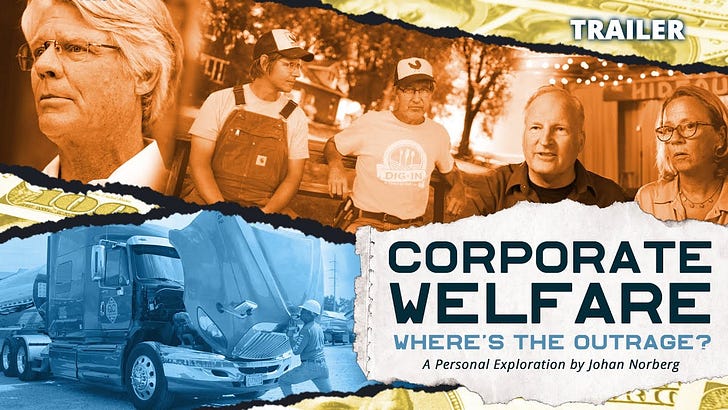
Welcome to The Poverty Trap, a Newsletter and Podcast About the Politics And Policy Choices That Create a Cycle of Economic, Racial and Environmental Inequality...and What We Can Do To Change It. Thinking about subscribing? Here’s what one paid subscriber recently had to say about The Poverty Trap: “You do great work, Joan. I don’t always get to read your newsletter, but when I do, I leave more informed and more compassionate…” Amy B. I’m including the “trailer” for the 2021 PBS documentary, “Corporate Welfare, Where’s The Outrage” again, along with the direct link to the hour long, PBS documentary here: https://www.pbs.org/video/corporate-welfare-ptwdrw/, because it is essential viewing if you want to sort out the ‘double talk” leading up to the mid-term elections and make better choices as you go to the polls this November. It’s even more important to understand why our system continues to favor subsidies to businesses (aka Corporate welfare) over help to individuals and communities, and how the numbers actually break-down, so you have a better idea of where your tax dollars are going and who benefits from this windfall. I don’t believe it’s as simple as corporations benefit and individuals and communities suffer. Although this is true, it’s more complicated and maybe more insidious than that statement implies. Take this data from a Good Jobs First article published a little over a month ago: The [list below shows] September 2025 data from 11 states, [Government Accounting Office ] GAO identified 46 companies that ranked among the top 25 employers of Medicaid or SNAP recipients in at least two states. Seventeen were among the 50 largest Fortune 500 employers. The state data are not nationally representative, but the pattern is unmistakable: large, profitable corporations are among the leading employers of workers who need public assistance. Good Jobs First’s Subsidy Tracker adds another dimension. Eight prominent companies appearing in GAO’s employer tables have received at least $16.5 billion in disclosed state and local subsidies. This data are from both the GAO and the Good Jobs First data research team. Here’s how it breaks down according to the Good Jobs First article: Corporation Disclosed Subsidies: Examples From GAO Employer Lists: Amazon $15.16 Billion—Major Employer Of Medicaid And SNAP Recipients In Multiple States FedEx $660.5 Million—Among Tennessee’s Top Employers Of SNAP Recipients (The Company Has A Huge Hub In Memphis) Walmart $287.2 Million—Top Employer Of Medicaid Recipients In Georgia And Oklahoma Target $189.8 Million—Appears Among Large Employers Of Benefit Recipients Kroger $87.4 Million—Appears Among Major Grocery-Sector Employers Dollar General $59.7 Million—Among Tennessee’s Top Employers Of SNAP Recipients Dollar Tree $55.8 Million—Appears In State Employer Rankings McDonald’s $11.8 Million—Among Tennessee’s Top Employers Of SNAP Recipients Total $16.51 Billion Source: Good Jobs First Subsidy Tracker and...
0:00SPEAKER_00Hello, subscribers.
0:02SPEAKER_00This is Joan DeMartin,
0:04SPEAKER_00and welcome to The Poverty Trap,
0:07SPEAKER_00a newsletter and podcast about the politics and policy choices that create a cycle
0:14SPEAKER_00of economic, racial, and environmental inequality and what we can do to change it.
0:22SPEAKER_00The title of today's post is Corporate Welfare Explained for Everyday Folks.
0:30SPEAKER_00Like you and me.
0:33SPEAKER_00And as an aside,
0:36SPEAKER_00just in case you're thinking about subscribing,
0:39SPEAKER_00which I hope you will,
0:42SPEAKER_00here's what one paid subscriber recently had to say about The Poverty Trap.
0:47SPEAKER_00Quote, you do great work, Joan.
0:49SPEAKER_00I don't always get to read your newsletter,
0:52SPEAKER_00but when I do, I leave more informed and more compassionate.
0:57SPEAKER_00End quote.