
The PE Umbrella · Ryan Ellis
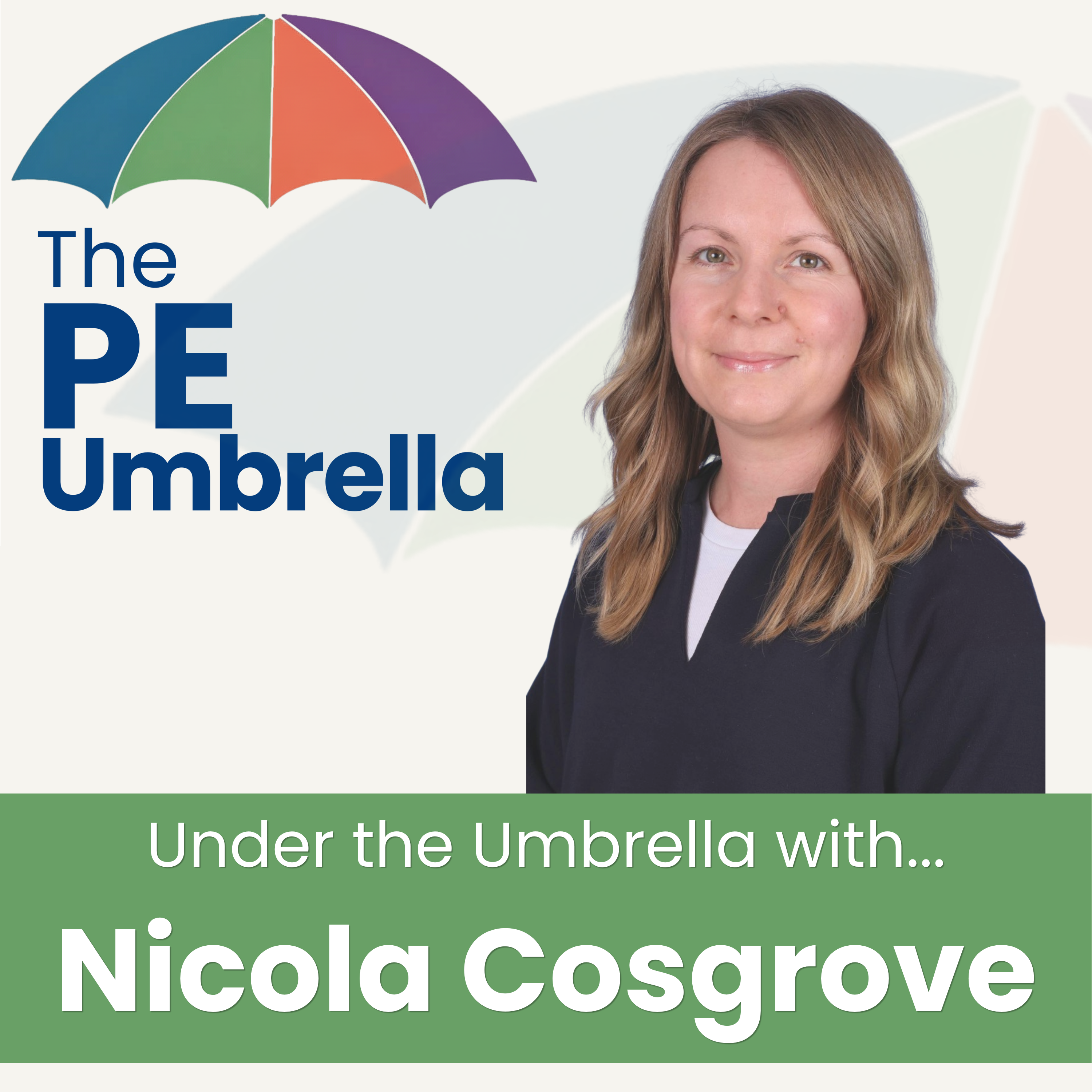
In this episode of The PE Umbrella podcast I am joined by Nicola Cosgrove for a fascinating conversation about student ownership and what can happen when we give children more of a say in their PE experiences. Although Nicola teaches secondary PE, there are plenty of ideas here that can translate directly into primary settings. We explore what genuine ownership actually looks like, moving beyond simply letting pupils lead activities and towards giving them meaningful opportunities to make decisions, take initiative and shape their own learning. We discuss the role of choice, trust and flexibility, and how giving pupils greater ownership can influence motivation, engagement, confidence and the way they think about themselves as learners. Nicola also shares some wonderfully practical approaches, including how simple routines can become stepping stones towards greater independence, and how technology can help children and teachers reflect on learning. It's a conversation that challenges us to consider whether we're giving children enough opportunity to have a voice in PE and what might happen if we trusted them with a little more. So what are you waiting for? Come and join us under The PE Umbrella
Ryan: Before we jump into today's conversation, a quick reminder that great PE is about so much more than movement alone. Here at the PE Umbrella, we're passionate about helping children move, think, connect, and grow in confidence through meaningful physical education experiences. If these conversations are helping you reflect on your own practice, I'd be hugely grateful if you could follow the podcast and leave a rating or review. It really does make a difference and helps others discover the show. Thank you for your continued support. Now, welcome back to the PE Umbrella Podcast, episode two hundred and sixty-six. Hello there, everybody, and welcome to the PE Umbrella Podcast, the place that we discuss and share practical ideas to help you deliver better primary PE. With me under the umbrella this week is secondary PE teacher, Nicola Cosgrove. Thank you so much for joining me today, Nicola. How are you doing? Nicola: I'm doing good, thank you. Yeah, thanks. Ryan: Good. Well, it's a d delight and a pleasure to welcome you under the umbrella, especially with your secondary perspective. And I've got a really interesting conversation hopefully lined up for us. But before we get into that, could you perhaps give the listeners of the P Umbrella podcast today a elevator pitch whistle stop tour of your background in education, leading to what it is you're Nicola: Yeah. Ryan: doing now? Nicola: Yeah, absolutely. So yeah, I'm Nicola. People usually call me Nick. And I started my teaching career in the UK. So I was there for about five years, did my yeah, was at university, University of Greenwich, did all everything there. And then yeah, five years of teaching at two different schools, one kind of inner London and then outside of London. And yeah, after that met my now husband at the The one of the schools there, and we decided that international teaching is the way to go. And so we moved to Switzerland 10 years ago, actually, 10 years ago this summer. And yeah, we've been in Switzerland ever since. I've just been teaching PE and I've been involved in I kind of as my role has progressed, I would say, I've been involved in yeah, being more sort of head of PE, but then also thinking about research and professional development in in our school that we're at at the moment. So like being part of a professional learning. group or center, looking at yeah, how can we elevate in-house PD and bring that really to the forefront. And then yeah, just my career has kind of taken me in different directions, but I would say going to do like accreditations for schools, going visits on schools around the world has been great. And now kind of moving into teaching still, but doing my own kind of consulting as well. That's something I'm exploring. So yeah. Ryan: Amazing. And and that's the wealth of experience I'm really excited to draw upon. And of course, as I've already mentioned, and you have, you're joining us from a, I guess, a secondary PE background, but I actually think that gives us a really interesting perspective in this podcast and conversation. You know, often primary teachers, certainly over here, are preparing children for hopefully lifelong engagement with movement, but also for their next stage of education, which is indeed hitting secondary school. So so Nicola, when year seven pupils arrive in your lessons at secondary school, what is it that you wish more of them could already do? And is it physical competence based or is it something else? Nicola: It it varies really. Depends who you get, I think. I think yes, the physical competence is is important, but it's not the be-all and end all. Like if I see a student come in and they can't, you know, do basic verin and catching, that that's okay. Like I'm not gonna be like, like this is this is terrible. But I would say I think what I would love them to come in with is kind of a open mind to what PE is. Because a lot of the time I will get students to come in year seven, eight, nine, even ten, and they think that P is just that physical element, right? They just think, okay, it's all about just what we can do. And, you know, when I ask them about their experiences and say, like, what did you do in your last school? Like, what was P like for you? They'll say, well, the teacher just, you know, said we could play football, we just played basketball, or like very kind of like traditional sports. So That kind of makes me think like, okay, interesting. But then there'll be other students that will say, yeah, we did, you know, frisbee and like golf and like, you know, trying all these like random alternative games that I've never even heard of. And I'm like, that's really cool. So I think just coming in with a more sort of open mind to, yeah, what P is and what P can be as well, because it it we have that kind of like very stereotypical view of P is like you come in and it's you know, you choose the teams and off you go and and you play. And it's like, no, that is not everything about P so yeah, I think just coming in and really being open to what P could be, yeah. Ryan: I think that that what you mentioned about sport and games is a misconception that runs deep for sure. I would absolutely say that. And I like the fact that you said quite early on there, it doesn't actually matter if they're struggling with some of the physical competences at all, because you you can still teach them. And it this takes me back to an an interview that I did probably the best part of seven or eight years ago now with a friend of mine called Stuart Owen, a secondary teacher. And he said pretty much something along the same lines that it didn't matter at all. If students came to him and they were still finding difficulty in some physical type skills and activities, providing that they had the right attitude. And if they enjoyed it, the enjoyment piece. And if that was there, sooner or later you can teach anybody anybody anything over a given period of time. So that that attitude piece has to be right. You you Nicola: Well. Ryan: arrived at the the conclusion of them hopefully having more of an open mind to what PE is and could be and what you're going to offer them from your menu of PE. So let's say you've got some students who have come to you or came to you and they clearly didn't have an open mind, what would your f first step or steps be to helping open their mind, providing they've not come with an open mind already? Nicola: Do I do struggle with this sometimes and I do it's taken me a long time to really figure out and I don't think I've got it the right solution yet, but just to figure out how do I how do I do that? And I think the last year or so I've really thought about what does the first sort of five, six weeks look like in PE, like a more of introductory introductory unit. So like having kids come in and we just do lots of different things, lots of games, lots of team building, like try and open their eyes to what P can be like throughout the rest of the year. So for me, like the first, very first lesson I did last, like this last school year, they came in and they had like four activities and they just came in and they just got going. And they all kind of like looked at me and said, like, well, wait, what, we're not gonna do like rules and expectations and all these things. And I like, nope. I was like, just go in and just have at it. Like, and When I got feedback at the end of this year from them, they did say to me, like, we really, really enjoyed that that first unit because it was just play, play, play, lots of different things and things that there's something they'd never heard of. So it was like, okay, like really opening them up to not just the traditional sports, right? So I'd say that's one Ryan: Mm. Nicola: definitely one thing. the second thing that I do is I do ask them quite in detail about like I said before, like what their experience has been, what they think PE is about, what they also think the role of their their role is and what the teacher's role is in PE classes, how much work they feel like they have to be doing, how much work the teacher has to be doing. So I've really kind of crafted I'd say yeah, a survey, like and I use it a Google survey and like send it out to them and I really kind of hone down on what they are thinking. at this point going into it so that then I can go, okay, well, these kids really understand what P could be and what it is. And these kids maybe need a little bit of help here. And then then I can go, right, okay, now as I'm going through my lessons, I can really hone in on not just the physical, but like the holistic part as well. Not it's not just everything about the physical all the time. It is about like the social connection, the personal growth, like the knowledge that you gain. There's just so many elements to it. And so that's another thing. And then one other thing I do try and do. And I don't think I've got this right yet, is we have four standards. So we have knowledge, physical competence, personal growth and social interaction. And then those four, I have them up on our big board, like in our gym, and they stay there and they live there the whole year. And I just when we do something, I say, Well, where do you think that connects to? Like we j say let's say we Ryan: Mm-hmm. Nicola: just did Babington and in that we had to play doubles. Okay, in doubles, what where does that connect? And then they might go, okay, it connects here and then but it might connect here as well. So then just having those conversations about where it can connect so that they can just see that it's not all about that physical skill all the time. There is that social interaction, there's that communication, there's that like, you know, open mind, growth mindset, like whatever it is at the time. Just to yeah, just to open them up to make them aware. Ryan: I th there's so there's so much to unpack there and a few things that I I will try and go down, providing that my memory serves me well and I remember to. I want to take you back to when you mentioned the start of your year there and how you maybe started it maybe different to how you may do if they came already potentially open minded and you mentioned you had like four activities. Could you just put a bit of flesh on the bones for any of the listeners and just even if you just tell w what's one of the activities, for example, that you had the students doing? Nicola: Yeah, so I had, gosh, I need to think about this now. I had I think I had like hockey but with like pool noodles, so they had to play hockey with pool noodles. I think I had frisbee but with like hockey goals, so they had to throw it into the goal. I had two netball posts, so it was essentially netball, but I think I had a few different like conditions on there, so like you can dribble the ball. you can you can move with like more than two steps and things like that just a few things to make it a little bit easier than what maybe netball is and then I forget what the other one was but yeah just just activities that kind of open their eyes to something different maybe combining sports as well like if for example handball and football is a great one because you can say well you can kick it up to each other catch it you can then if it falls on the floor, then you can kick it, like it becomes football. So just things like that w were really kind of easy, easy in a way, well, easy for secondary school kids, maybe not for pr so much Ryan: Mm. Yeah. Nicola: for primary, but just something that they could come in and just go, okay, this is different. And then then I would say to them, Okay, well, you had these four here, which ones did you like? And then that that kind of like sparks conversation and sparks what I do next. But yeah, that Ryan: It and Nicola: was just one particular lesson, yeah. Ryan: And you find that even even if they came and their physical competences weren't perhaps where you'd hoped they would be, it's still accessible for them, or maybe there were Nicola: Hmm. Ryan: ways in which you were able to then cater and adapt accordingly so they could still access and find perhaps moments of s of success within that. You know, one Nicola: Yeah. Ryan: of the other things you mentioned there were those four aspects that you cover. Was it knowledge? What were the other three again? Sorry, Nick. Is it Nicola: Yeah, knowledge, physical competence, personal growth and then social interaction. Yeah. Ryan: Yeah. And and having those sort of visible, it just jogged my memory of a lot of the time I spent in the classroom when I were working in with certain schools using the P umbrella concepts, if you will, and we'd talk about the the four different umbrellas, the blue, the green, the red, the purple umbrella. And they they'd be visible so the pupils would know what they are and what they mean. So I wanted them to understand they could learn across these different domains. But then we often would have those conversations at the end of any given lesson and ask them about what which Which umbrella do you think you strengthened today? Can you give me an example? Have you have you developed your Nicola: Yeah. Ryan: social umbrella? When did that happen? What did that look like? And I started to get these little packs together for them in the classroom where they would actually then make notes and anatom and write down for each of the umbrellas. So over a period of time, they had this little bank of evidence which showcased how they've strengthened any of those given umbrellas across any breadth of PE work that we've done. And it was very useful Nicola: Yeah. Yeah. Ryan: in getting them to open their eyes and see, actually, success can be more. Than just me being able to jump Nicola: Yeah. Ryan: far and throw far or in PE. There can be success in how I can adapt, in how I can overcome, in how I can solve a problem, in how I can be a good listener, in how I can be resilient or brave. All of these things contribute to their their wider development. Something Nicola: Hmm. Yeah, definitely. Ryan: that I've I've heard you touch upon there in terms of was something which to me sounded a little bit like potential student ownership in some of your work and and what they Nicola: Mm. Ryan: potentially do. Now student ownership sounds to me like one of those phrases which we hear a lot of in education potentially. I would like to know, Nicola, how how do you define it? And what does it actually look like in a P E lesson? Nicola: I would say own student ownership is on many different levels. It's not, it's not, you know, students are leading the lesson and that's it. Because I think that's what people tend to perceive it as. It's like, well, the teacher is very hands-off and the students are leading everything. I think it can be as simple as coming in and having someone that is in charge of the equipment, right? That could be the very, very simple low. sort of basic level, but then you could you can go up to the point where students are coming in and and running the lesson themselves. Like it's there's two kind of big extremes there. But I would say it's just for me it's coming in and not relying on the teacher all the time and rely knowing when to rely on the teacher and when to take, you know, initiative. So I think that was how I I would define it because I feel like Yeah, there are times when students need me. They they come to me and say, Miss, we need you to make the decision today because we just cannot do it. And I'm like, okay, great. And that that to me is ownership because they're actually saying, Yeah, we actually can't figure this out right now and we need some help. and so when I when that happens in my class, I'm like, Yes, I'm I know I'm doing something right here because they know like when to kind of step like s come to me and say, Yeah, Nicola not Nicola, yeah, miss, like come to you know, help us out. But Yes, like some examples I would say, I mean, I gave you two extremes there, but one of them, which I think is such a great tool and it's so simple to do, but it's so kind of people go, yeah, well I've done that. And I'm like, Yeah, but like if you do it in a certain way, like you could actually spark a lot of ownership here, is the entry routines, like coming in and knowing what is expected of them as soon as they walk in the door, especially in secondary. Secondary care We can be really, really difficult in terms of you've got changing, you've got all the, you know, valuables, you've got I've got a medical note, like you've got all these things happening, and you're kind of frazzled before you've even begun. So Ryan: Mm. Nicola: having some sort of activity that they know they come in, they can see it, it's ready to go, or they might have to set it up, maybe if they're if they're at a more higher level of ownership. They're coming in, something is here ready for them to do, and they can start working right away. And there's no, well, there's less shepherding from the teacher, let's say. Like the teacher's not, you know, driving everything even in those first few minutes. It's come Ryan: Mm. Nicola: in and here's what to do. It might change, it might evolve over time, but at least, you know, the ownership is off the teacher a little bit. So they can deal with the things that start at the beginning of the lesson. They can stand brown and go. Okay, who maybe needs some help here? Who doesn't? Like, who can I let go? Who can I need to like be more on top of? So yeah, I think these entry routines have just really for me sparked so much more ownership because then kids start coming in and setting up things. They start changing the activity when I'm not looking, which sometimes is good. other times you're like, no, that's not quite what we were doing, but okay. but yeah, like they can they come in and they start giving me ideas like, miss, can we actually do this next time? miss, that really worked, that didn't. Let's do that. And I'm like, okay. So then I can kind of build upon that. And then they started coming in and just like telling me they wanted to lead warmups and things. And I was like, okay, like this is great. Like it just unlocked a lot of ownership. And it just was so like it's so great to see when that starts happening in classes. I'm like, okay, yes, this is great. Ryan: Mm. Nicola: Because they just yeah, I could talk about it for days about what that feeling is like, but yeah. Ryan: I w what the so I'm I've got I'm really interested in some of the intricacies of this, but really get getting down to the nuts and bolts of it, some of the things you've explained there sound fantastic in in principle, but what are some of the the foundations that you had to set or lay in place in order to get to the position that you're in now? So there's not a teacher who's thinking now listening or I've got P Nicola: Hm. Ryan: tomorrow, I might just go in and let them start and do what they want. You know, what what's the foundations that you securely had to have in place before you could metaphorically start loosening the grip and and providing Nicola: Hmm. Ryan: more ownership for some of your students? Nicola: think honestly it's it's taking a look at yourself as the teacher like how do you perceive what do you perceive ownership to be and are you willing to take some risks I think and in you are you willing to have a little bit of maybe messiness or chaos in your Ryan: Mm-hmm. Nicola: in your lesson and if you're not that doesn't mean to say that you can't try but it it does create a barrier. and it's I talk about a lot this with some teachers that I work with and it's this kind of inherited belief that if we have control that means we have respect or we have and we have less chaos and we have, you know, it kind of if Ryan: Mm. Nicola: you keep asking why about why do we do these things, it actually leads to well well, but this is kind of just how it's always happened. And it's like, but why why can't there be some sort of chaos? Why can't there be like Little bit of messiness. Like it can happen and it you can rescue it, but you have to know when is the right time. And I think for me, it took a long time to do that. And I was to test test a lot of things out. But I would say, even just filming yourself as a teacher, film a lesson and go, right, okay, where am I stepping in too much here? Like, for example, I I show a a clip to some of my like clients and I say, this is me teaching. This is me doing, I was doing a trampoline lesson and I was giving feedback to a student on the trampoline. And actually there was a student right next to them, like spotting, that was started to give feedback and I interrupted them. And like I would I never would have noticed this unless I'd watched it back. And I was like, I really interrupted that student. And that student was actually one that didn't want to engage, didn't want to participate, was actually doing something to be part of the lesson and I interrupted. And I did actually stop myself a little bit and let that student speak, but I was like, wow, okay, I do this a lot. And so then when I'm going through the lesson, I'm like, okay, I need to like shut my mouth and like let Ryan: Yeah, yeah. Nicola: students take a little bit of control here, even just in the conversations. It doesn't have to be control of the lesson. It can just be, okay, let them talk a little bit more, talk for a little bit longer, or even just wait time. So I think, yeah, it's definitely looking at where are those opportunities for ownership. Where could you step back a little bit? Ryan: Mm. Nicola: Where could you take a tiny little risk? It doesn't have to be a big one, but where could you just say, I'm just gonna let them go for a little bit longer, like Ryan: Yeah. Nicola: two, three minutes more? so I think it's really spotting that first and thinking about where maybe you feel uneasy and letting it, yeah, push a bit. Ryan: And I think it's up to us as as teachers to to create an environment in which children, pupils or students we have feel feel safe, feel safe to try, feel safe to fail, feel safe in that environment and then get providing ownership. And I always look at it from the concept of us not being as a teacher the sage on the stage, but we're the guide on the side, with that facilitator Nicola: Yeah, totally. Ryan: who's able to then jump in if needs be. But if not, we can take those those steps back, Nicola: Mm-hmm. Ryan: rather than being at the forefront all the time. And when you were mentioning feedback there, what what popped into my head, I think it's so true. And anyone listening, if you've never had any of your own lessons videoed, whether you're in the classroom in primary or in a PE setting, I would absolutely advocate for doing it 'cause you you're so incredibly correct when you you spot things you don't notice. And that's one of the reasons that I first used, for example, a tool in PE for for students to self assess and peer assess was that, you BAM video delay. It still exists. I used BAM video delay on the iPads. For whether it was a dance routine or a gymnastics sequence, or if it was a specific skill in a club like a front foot drive in cricket, ban video delay is essentially a video looping app where you don't have to click record and play and stop and all of that. It just plays on a loop and you can set the delay to any number of seconds you want. So if I set it to 45 seconds, I can then have pupils, and I do this at university now, have students will do a gymnastics sequence, which is 20 seconds in length. They will walk over to the iPad, and by the time they get there and look, it'll be them playing back what they've just done. Nicola: Mm. Ryan: Some people find it quite uncomfortable, but they notice so much more watching themselves back than any information I could verbally give sometimes. I could say this was great. How don't you why don't you consider doing that instead? But the amount they can notice and see. And if I couple that with maybe written prompts or success criteria of what I expect from that outcome as well, they can almost assess it against that and visually watch it. Then they can Nicola: Mm. Ryan: immediately go back and repeat. And there's no need for starts and stops. They can just work in a loop. And that feedback is so rich. But then same Nicola: Yeah. Ryan: for us as teachers. If we can be videoed and filmed teaching, we'll pick up on nuanced little things we probably have no idea we're doing that Nicola: Mm. Yeah. Ryan: somebody observing us might miss. And then we can sort of improve our craft, can't we? There. Nicola: Yeah, and it's it can be cringy too. Like I really didn't want to film myself. I was like, no. And when I watched it back, yeah, I hate the sound of my own voice, but Ryan: Yeah. Nicola: I was like, okay, I I need to look at this, I need to see, even if it's just the first ten minutes, like it doesn't have to be a whole lesson. But yeah, it can be hard to watch at times. And even now I still cringe at myself. I'm like, ugh. But it's made me better teacher and and my students have been better because of it. So if if that's gonna make my Ryan: Yeah. Nicola: students better and more kind of like feeling like they can own more of their learning then I'm gonna do it. Yeah. Ryan: course. And and actually w through your journey teaching then, Nicola, and the more this has become a a larger part of who you are and what you do as a practitioner, what changes then when children, when students genuinely feel ownership over their learning? What changes? What's the outcomes that are different Nicola: I think y there's many. but I would say some of the big things that I've noticed when I feel like, yeah, this is this is happening now is when they actually stop me kind of mid-sentence and say, No, like no, we're not doing what you're what you're telling us to do. I had a a particular lesson where we were playing Capture the Flag and I was actually playing on one of the teams because they had an odd number. And so I'm playing and playing. And then we stopped and we we met we kind of regrouped and said, okay, what do we need to change and add? And they they made those changes and we noted them down. And then we play again. And something happened in the game. And they were like, so I went to stop and kind of say, like, okay, let's model like this. There was a conflict here. Let's try and solve it. And they were like, No, but you can't solve this now because you're on that team, so you're biased. And so we need to solve it ourselves. And I was like, Okay, I was like, this this is gold. Like this is where I really can step back. So that would be one thing is like them being able to, yeah, sort of take control in that in those moments and stop me. I would say yeah, it's kind of in the routines, in the the conversations that we have when we talk about what we're gonna do next, like they I hope. they lead the conversation in in a way and they say, like, we really want to do this instead. I'm like, okay. So then we have a, you know, kind of try and meet in the middle a little bit. yeah, I would just say it's kind of always happening in mini kind of Ryan: Mm. Nicola: little episodes here and there. I think one of the ones that I think is kind of that really high end is one of my groups like back in COVID times, they Had like four kids in a lesson. I was like, right, okay. And that was going to be four kids for like a good 10 weeks. And I was like, right, okay, what we're gonna do? And they're like, we want to do our own kind of like personal time. And I was like, well, what does that look like? And so we kind of crafted like it might be yoga for someone, it might be going for a walk, it might be doing a specific workout, it might be doing some climbing, like whatever those things were. And that then evolved into now a program that we have. once a week, every week for each class, which is called personal project time. And kids come in and they go into three different pathways. And in those pathways they have scaffolded tasks that they have to do, but they can kind of set themselves a goal of what they want to achieve by the end. So for example, one of them is fitness goal or fitness pathway. So they come in and they set themselves a fitness goal and they they have conversations with me. And then they can pull from different resources. This is obviously secondary, like this might not happen so much in primary, but they're able to pull from certain resources. They're able to talk to me and ask me if they can bring certain teachers in, like coaches in and things like that. or they just need a little bit more guidance and then they can go off and they fill out a journal that then they do every week and then we reflect on it. So that program is like one of the biggest things that's come out of this whole exploration that I've been on this journey is that kids really can push you. to doing things that you'd never thought were possible. So yeah. Ryan: That that that sounds incredible. And I suppose it it sort of ties into where I wanted to lead and sort of probe around with all this whole notion and concept. But how have you noticed over the most recent years of exploring these ways of working? How how does if at all this kind of approach influence motivation? And have you seen any differences in terms of even things like behaviour? Nicola: Yeah. Yeah. a hundred percent. I have I'll tell you a little story about a group that I had two years ago and they were a group of about eight eighteen students. So it's quite a low number in terms of like maybe what other teachers are used to, but in our school 18 is kind of the max. And I remember thinking, okay, yeah, eighteen I can do that. I used to do thirty-five plus. Like this is, you know, fine. And I quickly realized that I had lots of different types of students in that room. So I had, you know, ones that really wanted just connect and meet with their friends, ones that were come really competitive, ones that really didn't care at all about PE. we had a lot of different needs as well, like learning needs in that group. And I remember just thinking every lesson, I was like, I don't know what I'm doing wrong here. Like I would try so many different things, and I just could not get to a place where I felt like I wasn't playing whack and well all the time. Like you stop this, you do that, now you do this. Like it was constant. And I remember thinking, okay, I'm gonna try it like the sport ed model. So I tried that and they adapted it a bit and they sort of really bought into it. Like and I was like, okay, this is something that could work. But I couldn't do that all year. So I thought, okay, I need to like really get them to think about like how can they do this but in more of a yeah, like ownership way that's going to be sustainable throughout the rest of the year. So I started giving them this personal project time. I didn't think they were capable of it at all. And I was like, no, this group cannot do it. And I gave them that. And once I did that, the first lesson, it was like night and day. I looked around and I took a video on my phone because I was like, I cannot believe that everybody is doing something and I just have to stand here. And I was like, what has happened? And I just said to them like what What what's what's going on here? And they're like, because we have choice. And I was like, Yeah, okay, yeah, I get it. And I was trying to give you choice, but it wasn't really working before. And I don't really know why. So then after that, we really had a lot of open conversations about okay, how can this look for the rest of the year? Because it can't just be choice, choice, choice all the time. Like, how can Ryan: Mm. Nicola: we work together? And yeah, there were still bumps in the road, but it was 10 times better than what it was previously. And I think That is the the the feedback I get over and over again every single year is the fact that they have choice and it makes them feel like they have freedom and then it motivates them to come in and want to do PE. Yeah, not every day, but they'll come in and say, like, I don't feel like that great today. I don't feel that motivated. Okay, but how can we still tap into what you enjoy or what you like or how you like to learn? So at least it's something that you'll you'll enjoy you'll think at the end of the lesson, okay, I got through that and I and I was actually am okay. Ryan: Yeah. Nicola: Like I have one particular student, she would always come in and be like, I have this medical issue. Like I really feel like I can't do PE today. And I was like, okay, that's fine. Like just do what you can do. And when she actually had a little bit of choice and ownership over what she was doing, she would leave the lesson and be like, yeah, I'm totally fine now. I'm like, okay. So sometimes you think, mm okay, how much is Ryan: Yeah. Nicola: that like a real sort of you're feeling not great? Or is that just Ryan: Mm. Nicola: that sort of motivation and that that kind of doing something then kind of picked her up and put her into a better mood. So yeah, I think it's Ryan: Yeah. So you what you've done there is you've created an environment which actually for that individual, by changing the way you approached it, that's it became more appealing and it was easier to now opt in. But before it felt easier to opt out and maybe didn't want to be there. And and you know that that go on, go ahead, Nicola. Nicola: Yeah. Yeah. Yeah. And I think you've got I th I think it's also knowing who your kids are, right? Who what type of kids have you got coming in the room? Because you're not gonna have the same kid every time. And I I talk about this quite a bit in some webinars I've been doing recently is like there are real f like four types of student that I see over and over again. You've got like the competitive, the s the lack of a better word, the sporty ones. you've got sort of the ones that really want to be with their friends and they they might veer off and like start doing you know other conversations and TikTok dances and whatever they want to do in the corner there, but they are your kind of like they want that connection piece. And then you've got, you know, your kids that, you know, take a step back. They're really not sure how to operate in a more maybe competitive or team environment. They kind of shy away from that a bit. And then you've got ones that kind of really seek that purpose. Like, why are we doing This, like, how is this going to relate to my life? And so I think every class I've ever had, I can put them either into one in one complete box or just overlap them and say, Yeah, this student is a bit of this and a bit of that. And how can I then create an environment where they can operate together, but also everything works well for those particular groups? So it's it's hard, it's not easy, but Knowing who they are, I think, is a really good start and not trying to Ryan: Yeah. Nicola: change who they are right away, like just going, Yeah, I'm gonna lean into what the the the kind of profile that you've come in and shown me at this time. So Ryan: Yeah. And there's something in primary we we we've got the benefit of it. If we're a primary class teacher who's teaching PE, we know our children inside and out because we we have them all the time, all day, Nicola: Yeah. Ryan: every day. So we'll know those little nuances. And I'm sure everybody listening can relate to the facts we've all had and probably still do have lessons that feel like whack-a-mole. But we keep constantly de trying different things and that autonomy or choice piece takes me back to way back when when I read Daniel Pink's books. called drive and the that intrinsic motivation piece, his three prongs in that, if you will, are autonomy, mastery and purpose. Autonomy being the first one. So that sense of having a decision over what you do can drive intrinsic motivation. And you know that's the powerful piece. Not not the extrinsic motivation, which can help and primary schools are riddled with that. It's stickers and Nicola: Yeah. Ryan: rewards and dojos, but being intrinsically motivated, that's the the sweet spot. Autonomy being key, masteries, there are a perception that we're improving and getting better at something and purpose you touched upon there a bit. Why? Why am I doing it? What's the point of this? What what is this doing for me? Now, if I if I spin a bit of a a P umbrella lens, the red umbr umbrella onto this, you know, student ownership might sometimes, for some people listening, sound or feel quite individual. But do you think it actually in some ways can strengthen collaboration and relationships within a class and within a group as well? Nicola: Yeah, definitely. I think it can it can bring different personalities together. because like I would just touched upon and said, you know, you've got different types of students and Ryan: Mm. Nicola: maybe that competitive student is not really going to engage with someone who it wants to step back and kind of retreat. So I think doing a lot of work on what strengths do we bring to the table. At the start of the end and throughout is really, really important because if you start to recognise, okay, this person is really good at this and really good at this, and not focusing necessarily on like what they need to develop, but then pulling those people in when needed is is also like something that you know you start on a positive, right? You don't go, well, now we need to develop on this, and this person needs to work on that. Like it's no, everyone can bring something to our class. And I noticed at the very end of this past year, I spent a lot of time doing this work. Like who, who is really good at this? Who's really good at that? Like, what what can we notice about each other? By doing that a lot, students at the end of the year, they were able to play a specific that we're in a unit actually, they're in a flag football unit at the end. And I remember they were playing this game and there were lots of adaptations of the rules just to suit everybody. But I remember thinking, The competitive students were really pushing those ones that really were were treating at the beginning of the year and saying, like, yeah, you can do it. Like you here's the ball for you because you need to do this. And Ryan: Mm. Nicola: they were really catering to each other. And it wasn't in a like sarcastic or derogatory way. It was like they were really like, Yeah, no, we need to do this for you. And so that you can have success and you can feel like Ryan: Mm. Nicola: you are enjoying not just a lesson, but just like yourself, right? And I think that is really, really key is like making sure that yeah, students can understand each other and not feel like there's divides because that can happen a lot in a in Ryan: Hmm. Nicola: a P environment. Ryan: Yeah. What what you've noted there about some students maybe taking on responsibility to encourage and bring others along. I've noted that when I've tried at sport education seasons before, even in primary, especially when it's tied to their team identity and they know that they're building towards this sort of end goal and they're accumulating points. And actually, what I'm looking for is that is those those wider things than just the winning of the games. It's that team spirit, it's that encouragement piece. And Yes, initially they might be thinking, well, I might get some extra bonus points if Mr. Ellis spots me doing said thing. But what I'm really doing within that is it's becoming a bit of a habit for them. So over time, even if and when that isn't the case, they're getting into this habit of being the sort of person, being the sort of peer who is a supportive peer who knows it isn't always about the winning and the competitive spirit. And something that's just sparks off thoughts in my mind as we've been talking through this sort of ownership piece, Nicola. And I've got my primary hat on, of course, for this. Now, for some pupils, taking ownership, I would imagine, in a PE setting sounds or is maybe very exciting. Like, this is this is quite Nicola: Yeah. Ryan: nice and novel. But I'd imagine for other pupils it it might actually feel quite daunting to them being given some form of ownership. So how how do we or how do you and have you built confidence alongside responsibility in a PE setting? Nicola: I think yeah, that's that's an interesting question. I feel like for me, I would say yeah, confidence in that. I think it is yeah, it is hard at the beginning because they don't really know what to do with it. And there will be students that will take the lead and students that won't. And I think i a lot of it is also doing it in smaller groups as well. Like I know you said about like a bigger group, like how do we get groups to work kind of together. But I think it does start kind of in smallish groups as well. So having like lots of different games going on so that they can do it in a less daunting setting. Cause when you've got, you know, 25 plus students and you're trying to say like, okay, now talk about it. They they're probably not going to say anything, right? But if they're doing it in smaller groups with people that maybe they are used to at the beginning, then they can then start to build on that and then you can start to make them bigger and do whole group discussions. But I would say, yeah, definitely in smaller settings, like having conversations just with me too. So for example, if I want feedback on something, or if I want them to kind of drive what's happening next, I will ask them in a small group, I'll then bring them over and say, hey, what do you think about this? try and just do it in many different ways so that I'm not always 'Cause when you're in big group, like when you're doing a whole class discussion, I I know I do this a lot. I tend to pick on the students that like are more vocal. And I don't really and and it's hard, like I I'm trying really hard to do that sometimes. Sometimes I'm really need like think about everyone. But also you get into the zone as well, don't you, as a teacher and you go, okay, yeah, okay, I've got the answer I want. Yeah, off we go. But then yeah, coming back around to those other students that maybe are not as vocal. Has been really, really helpful because then I can say, well, look, other people have said this too. They might not say it out loud in this group discussion, but other people are saying these things too. I did a blind vote actually one time for me. We were voting for something that they wanted to do next. And I gave them a few options and then they all had to write down what they wanted to do, and then I put it in the middle, and then just everyone like showed them there and then. I was like, this is what's what everyone has said. And so they were like, Okay. And they all kind of were off on their own. They didn't have influence over each other. So no one could be like, put this down or do that or do that. So Ryan: Mm, yeah, yeah, yeah. Nicola: things like that, just to kind of get them to understand that I'm not just gonna pick those more vocal students and take their their decisions that Ryan: Yeah. Nicola: they've made. Like it's gotta be from everyone. And I think I would say it's hard to really measure how confident students have been for that, but I would say students are definitely more confident in saying what they think, whether it's in a survey or whether it's talking to me, or it might not be in a whole group, but they're definitely more confident in saying what they really think, which is sometimes great. Ryan: Mm-hmm. Nicola: And other times you're like, okay, interesting. so teaching them how Ryan: Yes. Nicola: to say those things in a in the right way as well has been has been has been interesting. Yeah. Ryan: Excellent. So based on our conversation so far on this epi episode, Nicola, if if a primary teacher was to try one thing next week or do something different, what would you advocate or advise it to be? They're just gonna make one very quick change next week to their PE. Is there something that you would say, try this, do this one thing? Nicola: Think it would be take a second to look around at what's going on and notice where there's opportunity for students to take a little bit of control, whether it's Ryan: Mm. Nicola: in a game that's happening, like that maybe there's a conflict happening and it and you think like maybe this could could continue and be okay, just let it let it run and see what happens. Because you can rescue it, like and if you'll know as a teacher when to rescue things and when not to, but It's thinking about how can I just let them go just a little bit more. That would be for someone who hasn't tried any of it, I would definitely say that's my recommendation. It's just Ryan: That's a great piece of advice. And you know, I try I try and advocate for the use of, you know, something which as a teacher I've used for years and what even when I was coaching way back in the day. it's something like the step principle. I tell the students and pupils about it. I let them know about it and I will allow them to modify some of their activities using their knowledge of the STEP principle themselves with that ownership. It shouldn't be sort of gate kept and guarded for just teachers to use if My year fours know what step is. They can all adjust their space, the task, the equipment, the people involved if it they see fit within that as well. Now, if I flip Nicola: Yeah. Ryan: that on its head a little bit in terms of what a primary teacher could do, I'm really intrigued to see where you go with this one, Nicola. But do you th are there things that secondary PE teachers could actually learn from primary PE, do you think? Nicola: Yeah. I would say I say differentiation because I feel like this is my experience. Maybe it's not the same for everyone, but I would say that sometimes I often think, well, okay, I've given them like maybe two or three options of how to do it. But I think primary teachers do that so well and they have, you know, different equipment. They have like different variations of the game. I feel like secondary can be like Very like I've got two or three options, and that's it. Like, I feel like I would love to, and I'm I'm actually gonna do this in the in November is like more like a physical literacy course, just to kind of really go back to sort of those real fundamental skills as well. Because I think in secondary you can get very sort of funneled into okay, now we're doing six weeks of this, six weeks of that, or you know, we're doing this particular sport, and actually it's not about that, it's about those fundamental skills that can go across many different ones. So that's something I've really experienced that I would love to go and learn from primary teachers because I think they do that so, so well. Ryan: Yeah, well believe you me, the this the blocks that you just mentioned there, that absolutely does occur in places in some primary settings over Nicola: Mm. Ryan: here as well. And that's something I'd love to be able to change. In fact, if I could have a magic wand right now and ch that's one thing I would immediately go to, is seeing pee in these convenient, neat little blocks where we think that learning is linear and it just happens in a straight line. And, you know, I hope I don't see any more of these schemes that appear where it is literally and this is talking for maybe a seven year old in primary school. We're doing football and week one we're doing dribbling, week two we're doing passing, week three we're doing attacking, week four we're defending, and then week five we're having a match. You think do we really Nicola: Yeah. Ryan: think they've learned in one lesson how to dribble? I could do an entire unit where they dribble, never mind a week at a time, and we've got to really take it learning at the pace it goes at. It doesn't work that way in any other subject, but sometimes in PE Nicola: Yeah. Yeah. Ryan: we seem to think it does, and we get too rigidly stuck to the the scheme and and unit of work. And I always say to my students, I say, that's your guide. It is not a script. It's giving you an idea of what to do, but all you can do is teach what's in front of you. And that's the pace we go Nicola: Yeah, absolutely. Ryan: at. And we want to embed those skills more rigorously. So we've got those foundations. And, you know, ultimately out of that will hopefully come enjoyment as well. Now this as we sort of I've got some questions as we start to sort of wind our way towards some finale here, Nick and This this question links back into almost where we started in terms of the the primary secondary link. But if you could send one message back to every primary PE teacher or every primary teacher who delivers PE based on what you see in year seven, what would that message be? Nicola: Think it would be to I could say many things, but I think it would be to just instill that love of movement because and and and and do it in a way that caters to the people in front of you, like you were just saying, right? Like I think if students can come and have a a love of movement and not A negative, not I don't want to say negative, but like an experience that is maybe more traditional. That would be my wish is to have kids that come in and say, like I said at the beginning, kids that come in and go, yeah, I'm really excited about this. And we played this really interesting game that was like this, and and they just it's definitely more sort of I would describe it as like playground in the sense that like they want to come in and they want to just try loads of different things. It's not I want to be funneled into these different sports because then that makes it more serious in a sense. Like kids come in a lot of times and they go, Well, we want to do like busball, we want to play a match. And I was like, Yes, we can do that. But like we doesn't have to be everything. So I would say, yeah, just that love of of movement in general. Ryan: Yeah, and and that and it ties nicely to what you said at the start because that phrase you used at the beginning was open minded. So if they can come to you perhaps being Nicola: Mm. Ryan: open minded and enjoy, then that that's where you that starting point is for you. And it's interesting that you say students, children will say, can we play a match? Can we do this? Can we do that? I spoke on the podcast before about that friction that's I've had during my time in schools where I'm trying to deliver PE in a slightly different way, and if they've been so used to just having a match. Every week, or playing, or we're doing bench ball this week, or the white van man turns up with a bag of footballs, then actually early on there's pushback to that. They might not respond to maybe this holistic, different lens on PE. And then my what I do is I can either choose to persevere through that because I know I'm doing it for the greater good down the line, but sometimes it's easier to go, you know what, yeah, okay. And just cave in. Nicola: Yeah. Yeah. Ryan: But actually Nicola: Yeah. Ryan: we've we make the decisions for you know five, ten, fifteen years down the line as we're changing the narrative about what PE can be. And Nicola: Yeah, exactly. Ryan: I want you to imagine now then a teacher listening leaves they've got a P lesson plan next week, they leave it exactly as it is. And I think about my PE umbrella colours, we've got blue physical, green cognitive, red social, purple is the emotional effective domain. So they've got a PE lesson next week, they're leaving the lesson as it is, but they're going to intentionally add or amplify one of those four colours, which one of those colours would you encourage them to add? Nicola: Say the social or the emotional, definitely. Yeah. Ryan: So red or purple. Why is that? Nicola: Because I feel like, yeah, as I've said before, PE is just very much perceived as this physical entity, and it and it is, and it's it rightly so, but there is so much more to it, and if we can tap into that social and emotional part of it, then that leads to that open mind of like PE isn't just for those, you know, sp sporty or or sport inclined people. Yeah. Ryan: Hmm. Wonderful. I love that. And I've got one more question for you today, Nicola. And the finisher that all the guests hopefully enjoy answering. But I'd like to know what is something that you have learned either about yourself or the PE space in the last 12 months that you didn't know or believe before that? Nicola: that is a really good question. Something I've learned okay about myself or the peas. this is this is a hard question because there's probably a lot and I'm trying to I'm blanking on what what it would be. I would say I think okay, I've learned this more so like in the last six years, but I'd say in the last 12 months I've definitely learned that I need to trust my students a lot more than I already were was doing. I need to not also keep yes, I I'm I'm the author authority authority figure-ish in the room, but I I don't always need to stick to what I think is good for the kids at the time because I know that there are times when I can do that and I can really kind of work with them, and there are times when they just need to go in their direction. And that might not be easy for some people to do. they might not feel like they have the freedom or the flexibility, but there are some times where you just have to let things go and say, okay, let's let's run with this for a bit and see how it works out. And I feel like, yeah, I've had to really do that a few moments this year and I didn't want to. And then it's backfired on me. So I was like, right, okay, I need to just remember that going into the next school year. Yeah. Ryan: it and there's always room for opportunities for growth and more to come. I think it's a great way to to finish our conversation with that reflective piece there. Now, before we do leave the conversation, Nicola, how can the listeners of the Peter Umbrella podcast, if they already aren't, stay in touch with and follow you and all the things you're up to? Nicola: They can go onto LinkedIn. So LinkedIn if you just type in Nicola Cosgrove and on Instagram as well, Nicola Cosgrove Consulting. That's where you can find me. Yep. Yep. Ryan: Effect. Well, make sure you head on over there to check those places out. And there we have it. Thank you, Nicola, for sharing with us your thoughts, your work today. It is hugely appreciated. And thank you to anybody and everybody who's tuned in and listened to this episode of the podcast. The show simply would not exist without you. If you enjoyed the episode, be sure to like and subscribe to the podcast. Maybe consider even sharing this episode with a friend, a colleague, a peer, a family member, whoever who might work in the education space. But for now though. I want you to all keep on motivating, engaging and inspiring the children that you teach. And I will catch you all again very soon under the PE umbrella. Thanks again, Nicola. Nicola: Thank you.